Please cite this article as: F. Bagheri, M. Kermanshahi, A. S. Safaei, M. M. Paydar, Robust Design of Dynamic Cell Formation Problem Considering the Workers Interest, International Journal of Engineering (IJE), IJE TRANSACTIONS C: Aspects Vol. 32, No. 12, (December 2019) 1790-1797
International Journal of Engineering
J o u r n a l H o m e p a g e : w w w . i j e . i rRobust Design of Dynamic Cell Formation Problem Considering the Workers Interest
F. Bagheri, M. Kermanshahi, A. S. Safaei*, M. M. Paydar
Department of Industrial Engineering, Babol Noshirvani University of Technology, Babol, Iran
P A P E R I N F O
Paper history:
Received 05 August 2019
Received in revised form 21 September 2019 Accepted 08 November 2019
Keywords:
Dynamic Cellular Manufacturing Systems Group Efficiency
Revised Multi-choice Goal Programming Method
Worker Interest
A B S T R A C T
To enhance agility and quick responding to customers' demand, manufacturing processes are rearrenged according to different systems. The efficient execution of a manufacturing system depends on various factors. Among them, cell design and human issue are the pivotal ones. The proposed model designs cellular manufacturing systems using three objective functions from three different perspectives, to reflect a more realistic picture of the cell formation problem. This paper presents a model with the goals of maximizing the total value of grouping efficacy and minimizing the total costs and total non-interest workers in cells in a dynamic environment for several consecutive periods. The main idea of the proposed model is enhancing cell efficiency through an assigning the group of workers who have a mutual interest in working with each other. For solving the current model, the revised multi-choice goal programming method has been employed. Finally, computational results and sensitivity analysis are discussed.
doi: 10.5829/ije.2019.32.12c.12
1. INTRODUCTION1
Manufacturing companies upgrade their process continuously regarding maintaining their share survival in growing global markets. Group technology (GT) by concentrating on cellular manufacturing (CM) is an approach that helps manufacturers to enhance agility and quick responding to customers' demands. Cellular manufacturing (CM) systems give practitioners an exceptional opportunity to take the advantage of the cost-effectiveness of mass production approach and flexibility of job shop manufacturing by classifying similar parts and dissimilar machines into part families and machines cells, respectively.
There are many preponderances concerned with cellular manufacturing systems including diminished material handling, setup time, expedition, in-process inventory, part makespan, promoted human relations, and operator proficiency and also some disservices including boosted capital investment and lower machine usage. Throughout the literature on CM, there are several surveys and review-based articles which have provided a wide perspective about the research achievements and future research directions.
*Corresponding Author Email: [email protected] (A. S. Safaei)
the mentioned condition and in the long run, manufacturers will reach to more profit. As it is shown in Table 1, there is no previous study that incorporates the mutual interest among workers concerned with worker assignment problem.
This paper presents a multi-objective mathematical model for the multi-period cell formation problem in a dynamic environment. The proposed considered multi-period multi-period, system reconfiguration, the availability of workers, worker assignment considering the mutual interest among operators, machine assignment, and machine capacity. The intention of the proposed model are maximizing the total value of grouping efficacy, minimizing the total costs and total noninterest workers in each cell. The cost function includes machine overhead cost, machine processing, hiring, firing, and salary costs. To solve the proposed multi-objective mathematical model, a revised multi-choice goal programming is utilized. The rest of the paper is arranged as follows: Sections 2 and 3 provide problem formulation and methodology, respectively. Problem validation using experimental results presents in section 4. In section 5, the sensitivity analysis is carried out. The conclusion is provided in section 6. The paper ends with some directions for future works.
2. PROBLEM FORMULATION
In this section, The proposed model with the goals of
maximizing the total value of grouping efficacy (TVGE), and minimizing the total costs (TC) and total noninterest (TNI) workers in cells is described. The momentous notion of the proposed model is enhancing cell efficiency through an assigning the group of workers who have a mutual interest in working with each other.
2. 1.Sets
Q Number of part types. W Number of worker types. M Number of machine types. C Number of cells.
H Number of periods.
I Index for part type (i=1, …, Q) W Index for worker type (w=1,…,W) M Index for machine type (m=1,…,M) K Index for cell (c=1,…,C)
T Index for period (h=1,…,H)
2. 2. Input Parameters
𝑟𝑖𝑚𝑤 1 if machine type with worker w; 0 otherwise. m is capable to process part type i
𝑎𝑖𝑚 1 if part type otherwise. i requires machine type m; 0
𝑏𝑤𝑤′ 1 if there is mutual interest between worker w and w' ; 0 otherwise
𝐿𝑀𝑘 Minimum number of machines assigned to cell k
𝐿𝑊𝑘 Minimum number of workers assigned to cell k
TABLE 1. An overview of literature on the worker assignment
Ref. Goals
Considered factors in worker assignment Part
Assignment Machine
Assignment Worker
Assignment Production
Planning Cell
Layout
[3] ■
Technical skill, Worker conative tendencies
[4] ■
■ Technical skill, change in worker skill level/ Training,
General Cognitive Ability level
[5] ■
■ Technical skill,workers' multi-functionality
[6] ■
■ Available number of workers
[7] ■
■ ■
■ Available time and number of workers
[8] ■
■ ■
■ Technical skill, available time and number of workers
[9] ■
■ ■
■ Technical skill, change in worker skill level/ Training, workers' multi-functionality
[10] ■
■ ■
Technical skill
[11] ■
■ ■
■ Technical skill, change in worker skill level/ Training
and forgetting
[12] ■
■ ■
■ ■
Technical skill, change in worker skill level/ Training
[13] ■
■ ■
■ Technical skill, available time and number of workers
[14] ■
■ ■
■ Technical skill, change in worker skill level/ Training,
available time and number of workers
[15] ■
■ ■
■ ■
Technical skill, change in worker skill level/ Training, available time and number of workers
Current work ■
■ ■
■ Technical skill, available time and number of workers,
𝐿𝑃𝑘 Minimum the number of parts assigned to cell k
𝐴𝑀𝑚 The number of available machines of type m
𝐴𝑊𝑤 The number of available workers of type w
𝑅𝑊𝑤𝑡 Available time for worker type w in period t
𝑅𝑀𝑚𝑡 Available time for machine type m in period t
𝑇𝑖𝑖𝑚𝑤 Processing time of part type with worker type w i on machine type m
𝐷𝑖𝑡 Demand of part type i in period t
𝛼𝑚 Maintenance and overhead expenses of machine type m.
𝛽𝑚 Operation expense of machine type m in unit time
𝐻𝐼𝑤𝑡 Hiring expense of worker type w within period t
𝐹𝐼𝑤𝑡 Firing expense of worker type w in period t
𝑆𝑎𝑤𝑡 Salary expense of worker type w in period t.
NP Number of periods
A An arbitrary big positive number
2. 3. Decision Variables
𝒀𝒊𝒌𝒕 1 if part type not. i is operated in cell k in period t, 0 if
𝑍𝑤𝑘𝑡 1 if worker w is allocated to cell not. k in period t, 0 if
𝑋𝑚𝑘 1 if machine m is assigned to cell not. k in period t, 0 if
𝐺𝑖𝑚𝑤𝑘𝑡 1 if part type with worker wi in cell is to be operated on machine type k in period t, 0 if not. m
𝑁𝑊𝑤𝑡 A number of workers of type w assigned period t.
𝐿+𝑤𝑡 A number of workers of type period t. w hired system during
𝐿−𝑤𝑡
A number of workers of type w fired during period t.
2. 4. Mathematical Model
𝑀𝑎𝑥𝑇𝑉𝐺𝐸 = ∑𝑇𝑡=1∑𝑝𝑖=1𝐷𝑖𝑡(𝐷𝑒𝑛𝑜 𝑚𝑖𝑛 𝑎𝑡𝑜𝑟𝑁𝑢𝑚𝑒𝑟𝑎𝑡𝑜𝑟 )
1 1
: Mm Ww imw Numerator
= =r − ∑𝐶𝑘=1∑𝑀𝑚=1∑𝑊𝑤=1[𝑋𝑚𝑘(2 − 𝑌𝑖𝑘𝑡−𝑍𝑤𝑘𝑡)𝐺𝑖𝑚𝑤𝑘𝑡] 𝐷𝑒𝑛𝑜 𝑚𝑖𝑛 𝑎 𝑡𝑜𝑟: ∑𝑀𝑚=1∑𝑊𝑤=1𝑟𝑖𝑚𝑤+
1[ 1 1 . .
C M W
mk ikt wkt k= m= w=X Y Z −
∑𝑀𝑚=1∑𝑊𝑤=1𝑋𝑚𝑘. 𝑌𝑖𝑘𝑡. 𝑍𝑤𝑘𝑡. 𝐺𝑖𝑚𝑤𝑘𝑡]
(1)
𝑀𝑖𝑛𝑇𝐶 = [(∑𝐶𝑘=1∑𝑀𝑚=1𝛼𝑚. 𝑋𝑚𝑘). 𝑁𝑃] +
1 1 1 1 1 . . .
T l C W M
m imw imwkt it t= i= k= w= m=B Ti G D +
∑𝑇𝑡=1∑𝑊𝑤=1𝐻𝐼𝑤𝑡. 𝐿𝑤𝑡+ + ∑𝑇𝑡=1∑𝑊𝑤=1𝐹𝐼𝑤𝑡. 𝐿−𝑤𝑡+
∑𝑇𝑡=1∑𝑊𝑤=1𝑆𝑎𝑤𝑡. 𝑁𝑊𝑤𝑡
(2)
𝑀𝑖𝑛𝑇𝑁𝐼 =
∑𝐾𝑘=1∑𝑇𝑡=1∑𝑊−1𝑤=1∑𝑊𝑤′=𝑤+1𝑧𝑤𝑘𝑡. 𝑧𝑤′𝑘𝑡(1 − 𝑏𝑤𝑤′)
(3)
Subject to:
∑𝑊𝑤=1 ∑𝐼𝑖=1 𝐺𝑖𝑚𝑤𝑘𝑡 . 𝑇𝑖𝑖𝑚𝑤. 𝐷𝑖𝑡≤
𝑋𝑚𝑘 . 𝑅𝑀𝑚𝑡
∀𝑚, 𝑘, 𝑡 (4)
∑𝑀𝑚=1 ∑𝐼𝑖=1𝐺𝑖𝑚𝑤𝑘𝑡. 𝑇𝑖𝑖𝑚𝑤. 𝐷𝑖𝑡≤
𝑁𝑊𝑤𝑡 . 𝑅𝑊𝑤𝑡 ∀𝑤, 𝑘, 𝑡
(5)
𝑁𝑊𝑤𝑡= 𝑁𝑊𝑤 (𝑡−1) + 𝐿 + 𝑤𝑡 −
𝐿 − 𝑤𝑡
∀𝑤, 𝑡 (6)
∑𝐶𝑘=1 𝑋𝑚𝑘≤ 𝐴𝑀𝑚 ∀𝑚 (7)
∑𝐶𝑘=1 𝑍𝑤𝑘𝑡 ≤ 𝐴𝑊𝑤 ∀𝑤, 𝑡 (8)
∑𝑊𝑤=1 𝑍𝑤𝑘𝑡 ≥ 𝐿𝑊𝑘 ∀𝑘, 𝑡 (9)
∑𝑀𝑚=1 𝑋𝑚𝑘 ≥ 𝐿𝑀𝑘 ∀𝑘 (10)
∑𝐼𝑖=1 𝑌𝑖𝑘𝑡≥ 𝐿𝑃𝑘 ∀𝑘, 𝑡 (11)
∑𝐶𝑘=1 𝑍𝑤𝑘𝑡= 𝑁𝑊𝑤𝑡 ∀𝑤, 𝑡 (12)
∑𝐶𝑘=1𝑌𝑖𝑘𝑡= 𝑚𝑖𝑛 (1 , 𝐷𝑖𝑡) ∀𝑖, 𝑡 (13)
𝐺𝑖𝑚𝑤𝑘𝑡 ≤ 𝑟𝑖𝑚𝑤 . 𝑋𝑚𝑘 ∀𝑖, 𝑚, 𝑤, 𝑘, 𝑡 (14)
∑𝐶𝑘=1 ∑𝑊𝑤=1 𝐺𝑖𝑚𝑤𝑘𝑡 =
𝑎𝑖𝑚 . ∑𝐶𝑘=1 𝑌𝑖𝑘𝑡
∀𝑖, 𝑚, 𝑡 (15)
𝑋𝑚𝑘 , 𝑍𝑤𝑘𝑡 , 𝑌𝑖𝑘𝑡 , 𝐺𝑖𝑚𝑤𝑘𝑡 ∈ {0,1} ∀𝑖, 𝑚, 𝑤, 𝑘, 𝑡 (16)
𝐿 + 𝑤𝑡, 𝐿 − 𝑤𝑡, 𝑁𝑊 𝑘𝑡 ≥ 0 ∀𝑤, 𝑘, 𝑡 (17)
The first objective function (TVGE) attempts to maximize the total value of grouping efficacy. TC minimizes several costs. The third objective function minimizes total noninterest (TNI) workers in cells.
In the way of solving multi- objective optimization model, advantages associated with the goal programming (GP) approach [16] have made it as an attractive approach [17] for scholars. Chang et al. [18] imposed some revisions on GP and proposed the revised multi-choice goal programming (RMCGP) approach which is more flexible speedy than the original version of GP.
Here, the revised multi-choice goal programming (RMCGP) model for the proposed problem is formulated. Variables and Parameters:
𝑤𝑖 weight of positive and negative deviation of the th goal
i-𝑓𝑖.𝑚𝑖𝑛 Lower bound of the i-th goal expectation level
𝑓𝑖.𝑚𝑎𝑥 Upper bound of i-th goal expectation level
𝜌𝑖 The weight attached to the sum of the positive and negative deviations from level R
i
𝑓1 TVGE objective function
𝑓2 TC objective function
𝑓3 TNI objective function
𝑒𝑖+,𝑒𝑖− Positive and negative deviations attached to |𝑦 𝑖− 𝑔𝑖 𝑚𝑎𝑥| , the more the better strategy- based
𝑒𝑖+,𝑒𝑖− Positive and negative deviations attached to |𝑦 𝑖− 𝑔𝑖 𝑚𝑖𝑛| , the less the better strategy- based
𝑅𝑖 Expected level for objective function i
Mathematical model:
1 1
1 1 1 1
1.max 1.min 1.max 1.min
2 2
2 2 2 2
2.max 2.min 2.max 2.min
3 3
3 3 3 3
3.max 3.min 3.max 3.min
( ) ( )
( ) ( )
( ) ( )
w
Minz d d e e
f f f f
w
d d e e
f f f f
w
d d e e
f f f f
+ − + −
+ − + −
+ − + −
= + + +
− −
+ − + + − + +
+ + +
− −
(18)
S.t:
Constraints (4)-(17)
𝑓1− 𝑑1++ 𝑑1−= 𝑅1 (19)
𝑅1− 𝑒1++ 𝑒1−= 𝑓1.𝑚𝑎𝑥 (20)
𝑓11.𝑚𝑎𝑥1.𝑚𝑖𝑛 (21)
𝑓2− 𝑑2++ 𝑑2−= 𝑅2 (22)
𝑅2− 𝑒2++ 𝑒2−= 𝑓2.𝑚𝑖𝑛 (23)
𝑓22.𝑚𝑎𝑥2.𝑚𝑖𝑛 (24)
𝑓3− 𝑑3++ 𝑑3−= 𝑅3 (25)
𝑅3− 𝑒3++ 𝑒3−= 𝑓3.𝑚𝑖𝑛 (26)
𝑓33.𝑚𝑎𝑥3.𝑚𝑖𝑛 (27)
𝑓1≤ 𝑓1.𝑚𝑎𝑥 (28)
𝑓1≥ 𝑓1.𝑚𝑖𝑛 (29)
𝑓2≤ 𝑓2.𝑚𝑎𝑥 (30)
𝑓2≥ 𝑓2.𝑚𝑖𝑛 (31)
𝑓3≤ 𝑓3.𝑚𝑎𝑥 (32)
𝑓3≥ 𝑓3.𝑚𝑖𝑛 (33)
𝑑1+, 𝑑1−, 𝑑2+, 𝑑2−, 𝑑3+, 𝑑3−, 𝑒1+, 𝑒1−, 𝑒2+, 𝑒2−, 𝑒3+, 𝑒3−≥ 0 (34)
3. COMPUTATIONAL RESULT
To elucidate the credibility of the proposed model, some instances are solved using RMCGP by LINGO 9.0. The first example consists of two cells, four machines, four parts, and three workers. The data set associated with are given in Tables 1 to 3, respectively.
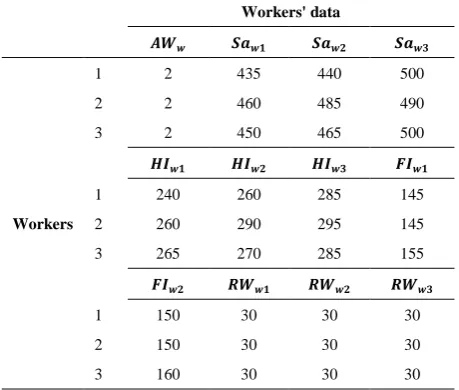
The workers data, processing time of each part, and machine data set are presented in Tables 4 to 6, respectively. The results are pesented in Table 7. This
TABLE 1. Example #1 input data of machine -part matrix
Machine type Demand Quantity
1 2 3 4 𝐷𝑖1 𝐷𝑖2 𝐷𝑖3
Part type
1 1 0 1 0 300 1500 150
2 0 1 0 0 20 0 500
3 1 0 1 0 400 980 0
4 0 0 0 1 700 750 300
TABLE 2. Example #1 input data of machine-worker
Machine type
1 2 3 4
Worker type
1 1 0 1 0
2 0 1 0 0
3 1 0 1 1
TABLE 3. Example #1 input data of worker_worker incidence
matrix
Worker type
1 2 3
Worker type
1 1 0 1
2 0 1 0
Table shows the machine assignment, part assignment and worker assignment to cells during three consecutive periods. Moreover, the obtained results of large instances, example numbers 2 and 3, through proposing model and RMCGP method are summarized in Table 8. For brevity, the related data of examples 2 and 3 are not given.
TABLE 4. Example #1 input data about workers
Workers' data
𝑨𝑾𝒘 𝑺𝒂𝒘𝟏 𝑺𝒂𝒘𝟐 𝑺𝒂𝒘𝟑
Workers
1 2 435 440 500
2 2 460 485 490
3 2 450 465 500
𝑯𝑰𝒘𝟏 𝑯𝑰𝒘𝟐 𝑯𝑰𝒘𝟑 𝑭𝑰𝒘𝟏
1 240 260 285 145
2 260 290 295 145
3 265 270 285 155
𝑭𝑰𝒘𝟐 𝑹𝑾𝒘𝟏 𝑹𝑾𝒘𝟐 𝑹𝑾𝒘𝟑
1 150 30 30 30
2 150 30 30 30
3 160 30 30 30
TABLE5. Example #1, the processing time
Part 1 Part 2
𝑾𝟏 𝑾𝟐 𝑾𝟑 𝑾𝟏 𝑾𝟐 𝑾𝟑
M
a
ch
in
e
M1 0.04 0.02
M2 0.03
M3 0.01 0.02
M4
Part 3 Part 4
𝑾𝟏 𝑾𝟐 𝑾𝟑 𝑾𝟏 𝑾𝟐 𝑾𝟑
M
a
ch
in
e
M1 0.02 0.03
M2
M3 0.03 0.04
M4 0.03 0.04 0.02 0.04
TABLE 6. Example #1, input data about machines
Machine type
Data of machines
𝑨𝑴𝑴 𝜶𝒎 𝑩𝒎 𝑹𝑴𝒎𝟏 𝑹𝑴𝒎𝟐 𝑹𝑴𝒎𝟑
1 2 620 20 30 30 30
2 2 810 30 30 30 30
3 2 730 25 30 30 30
4 2 670 28 30 30 30
TABLE 7. The results of Example #1
P
Part Assignment Machine Assignment
Workers Assignment
Cell 1 Cell 2 Cell 1 Cell 2 Cell 1 Cell 2
1 2 1 & 3 2 3
2 4 1 & 3 2& 4 3 & 1 3 3
3 2 1 & 4 2 3
TABLE 8. The result of example number 1, 2, and 3
E
x
p
.
N
o.
P W M K T
N
o.
o
f
co
n
st
ra
in
t
N
o.
o
f
th
e
d
ec
is
io
n
v
a
ri
a
b
le
CPU
(S) TC TVGE TN
I
1 4 3 4 2 3 469 383 50 16206 3980 0
2 7 5 6 2 2 1050 948 2380 16372 1248 0
3 9 5 6 2 2 1318 1196 28800 17208 1587 0
As can be seen in Table 8, with an increase in the size of the problem, the CPU usage will also increase. It means that the proposed algorithm for solving the large size problem is too time-consuming.
4. SENSITIVITY ANALYSIS
We implemented the sensitivity analysis from three different perspectives on model features: (1) hiring and firing workers, (2) the weight of objective functions in goal programming and (3) workers interest perspective.
4. 1. Hiring and Firing Scenarios The owners of various industries, depending on their policies, proceed to hire and fire the workers. Two opposing policies for hiring and firing the workers in the period can be carried out. In this paper, hiring and firing workers occurs at the initiation of a period. However, the production plan can be initiated with fixed workers in all periods. Here, this case is called the opposite scenario. Table 9 shows the value of three objective functions for both flexible and fixed workers scenarios for example 2. Figures 1 and 2 compare the result of these opposing scenarios.
TABLE 9. The value of objective functions in different scenarios
Instance Size
Objective Function
TC TVGE TNI
flexible workers
Small 16206 3980 0
Medium 16372 1248 0
large 17208 1587 0
fixed workers
Small 16458 4030 0
Medium 16635 1483 0
large 17434 1595 0
Figure 1. TC in different scenarios – Example 2
Figure 2. TVEG in different scenarios – Example 2
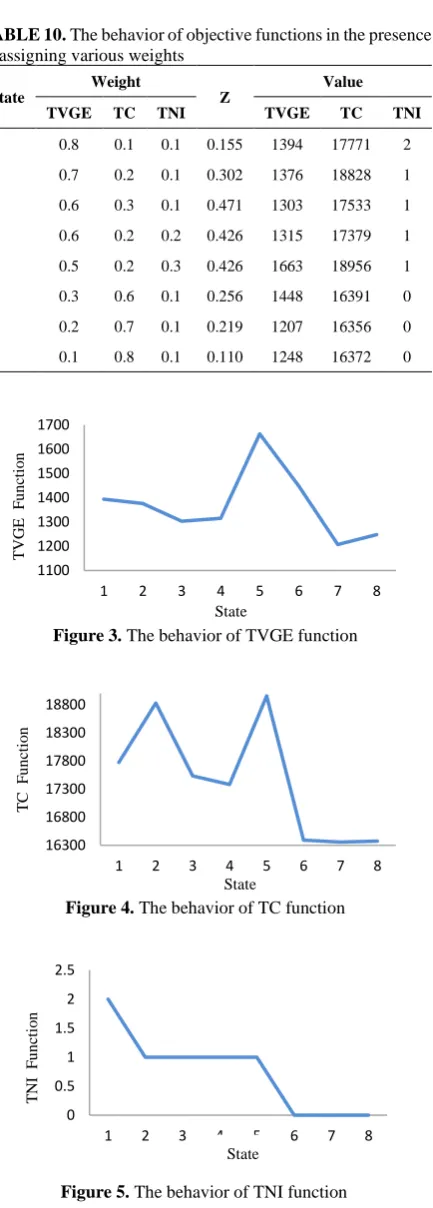
4. 2. Weight of Objective Functions The behavior of objective functions will be examined in this section in the presence of assigning various weights in RMCGP algorithm. In this paper, 8 different weight is assigned to each objective functions. The obtained results have been presented in Table 10 and Figures 3, 4, and 5. Variable Z in Table 10 represents the final value of objective function in RMCGP algorithm.
4. 3. Workers Interet In this section, the behavior of objective functions will be examined in the presence of two opposing situation, when it affects the workers interest and when it assumes that workers are indifferent to each other.
As can be seen in Figure 6 and 7, although the better value for TC and TVGE functions when the interest of the workers is not considered, according to the Liemhetcharat et al.'s research work [19], increasing the synergy among workers has long-term benefits for
system and in this regard, when the system could reach the maximum level of synergy that imposes the workers interest.
TABLE 10. The behavior of objective functions in the presence
of assigning various weights
State Weight Z Value
TVGE TC TNI TVGE TC TNI
1 0.8 0.1 0.1 0.155 1394 17771 2
2 0.7 0.2 0.1 0.302 1376 18828 1
3 0.6 0.3 0.1 0.471 1303 17533 1
4 0.6 0.2 0.2 0.426 1315 17379 1
5 0.5 0.2 0.3 0.426 1663 18956 1
6 0.3 0.6 0.1 0.256 1448 16391 0
7 0.2 0.7 0.1 0.219 1207 16356 0
8 0.1 0.8 0.1 0.110 1248 16372 0
Figure 3. The behavior of TVGE function
Figure 4. The behavior of TC function
Figure 5. The behavior of TNI function
16100 16600 17100
کچوک طسوتم گرزب
W
o
rk
er
s
یلک تلاح جارخاو مادختسا فذحflexible workersfixed workers
1200 2200 3200
کچوک طسوتم گرزب
W
o
rk
er
s
یلک تلاح جارخاو مادختسا فذح
flexible workers fixed workers
Small Medium Large
1100 1200 1300 1400 1500 1600 1700
1 2 3 4 5 6 7 8
T
V
G
E
F
u
n
ct
io
n
State
16300 16800 17300 17800 18300 18800
1 2 3 4 5 6 7 8
T
C
F
u
n
ct
io
n
State
0 0.5 1 1.5 2 2.5
1 2 3 4 5 6 7 8
T
N
I
F
u
n
ct
io
n
تلاح
Small Medium Large
Figure 6. The behavior of TC function
Figure 7. The behavior of TVGE function
5. CONCLUSION
This paper presented a multi-period cell formation problem in a dynamic environment with the goals of maximizing the total value of grouping efficacy and minimizing the total costs and total noninterest workers. The interest-based relationship notion for the worker assignment problem allows workers to establish a friendly atmosphere among themselves. The proposed model designs cellular manufacturing systems using three objective functions from three different perspectives, to reflect a more realistic picture of the cell formation problem.
The sensitivity analysis is executed to figure out the model in the presence of fixed and flexible workers in the system. The model behavior under these two opposing strategies indicates that with the fixed number of workers, the cost of the production system will be significantly increased and also system efficiency will improve. In the second attempt, we tried to evaluate the behavior of objective functions under assigning various weights to them. The question about which objective function should receive more priority is completely depended to company policy and finally, the model behavior was assessed when the workers interest is overlooked.
6.
REFERENCES1. Hut, J. and Molleman, E., “Empowerment and team development”, Team Performance Management: An
International Journal, Vol. 4, No. 2, (1998), 53–66.
2. Bailey, D. E., “Manufacturing improvement team programs in the semiconductor industry”, IEEE Transactions on Semiconductor
Manufacturing, Vol. 10, No. 1, (1997), 1–10.
3. Fitzpatrick, E.L. and Askin, R. G., “Forming effective worker teams with multi-functional skill requirements”, Computers &
Industrial Engineering, Vol. 48, No. 3, (2005), 593–608.
4. Wirojanagud, P., Gel, E.S., Fowler, J.W. and Cardy, R., “Modelling inherent worker differences for workforce planning”,
International Journal of Production Research, Vol. 45, No. 3,
(2007), 525–553.
5. Li, Q., Gong, J., Tang, J. and Song, J., “Simulation of the model of workers’ assignment in cellular manufacturing based on the multifunctional workers”, In 2008 Chinese Control and Decision Conference, IEEE, (2008), 992–996.
6. Süer, G.A., Arikan, F. and Babayigit, C., “Effects of different fuzzy operators on fuzzy bi-objective cell loading problem in labor-intensive manufacturing cells”, Computers & Industrial
Engineering, Vol. 56, No. 2, (2009), 476–488.
7. Mahdavi, I., Aalaei, A., Paydar, M.M. and Solimanpur, M., “Designing a mathematical model for dynamic cellular manufacturing systems considering production planning and worker assignment”, Computers & Mathematics with
Applications, Vol. 60, No. 4, (2010), 1014–1025.
8. Soolaki, M., “A multi-objective integrated cellular manufacturing systems design with production planning, worker assignment and dynamic system reconfiguration”, International Journal of
Industrial and Systems Engineering, Vol. 12, No. 3, (2012),
280–300.
9. Bagheri, M. and Bashiri, M., “A new mathematical model towards the integration of cell formation with operator assignment and inter-cell layout problems in a dynamic environment”,
Applied Mathematical Modelling, Vol. 38, No. 4, (2014), 1237–
1254.
10. Bootaki, B., Mahdavi, I. and Paydar, M. M., “A hybrid GA-AUGMECON method to solve a cubic cell formation problem considering different worker skills”, Computers & Industrial
Engineering, Vol. 75, (2014), 31–40.
11. Liu, C., Wang, J. and Leung, J. Y. T., “Worker assignment and production planning with learning and forgetting in manufacturing cells by hybrid bacteria foraging algorithm”,
Computers & Industrial Engineering, Vol. 96, (2016), 162–179.
12. Sakhaii, M., Tavakkoli-Moghaddam, R., Bagheri, M. and Vatani, B., “A robust optimization approach for an integrated dynamic cellular manufacturing system and production planning with unreliable machines.”, Applied Mathematical Modelling, Vol. 40, No. 1, (2016), 169–191.
13. Mehdizadeh, E., Niaki, S.V.D. and Rahimi, V., “A vibration damping optimization algorithm for solving a new multi-objective dynamic cell formation problem with workers training”,
Computers & Industrial Engineering, Vol. 101, (2016), 35–52.
14. Niakan, F., Baboli, A., Moyaux, T. and Botta-Genoulaz, V., “A bi-objective model in sustainable dynamic cell formation problem with skill-based worker assignment”, Journal of Manufacturing
Systems, Vol. 38, (2016), 46–62.
15. Feng, H., Da, W., Xi, L., Pan, E. and Xia, T., “Solving the integrated cell formation and worker assignment problem using particle swarm optimization and linear programming”,
Computers & Industrial Engineering, Vol. 110, (2017), 126–
137.
16. Arora, J.S., Introduction to optimum design, Elsevier, (2004).
17. Colapinto, C., Jayaraman, R. and Marsiglio, S., “Multi-criteria decision analysis with goal programming in engineering, management and social sciences: a state-of-the art review”,
Annals of Operations Research, Vol. 251, No. 1–2, (2017), 7–
40.
15000 15500 16000 16500 17000 17500
Small Medium Large
T
C
F
u
n
ct
io
n
Interested Indifferent
1200 3200 5200 7200 9200
Small Medium Large
T
V
G
E
F
u
n
ct
io
n
18. Chang, C. T., “Revised multi-choice goal programming”, Applied
Mathematical Modelling, Vol. 32, No. 12, (2008), 2587–2595.
19. Liemhetcharat, S. and Veloso, M., “Weighted synergy graphs for effective team formation with heterogeneous ad hoc agents”,
Artificial Intelligence, Vol. 208, (2014), 41–65.
Robust Design of Dynamic Cell Formation Problem Considering the Workers Interest
F. Bagheri, M. Kermanshahi, A. S. Safaei, M. M. Paydar
Department of Industrial Engineering, Babol Noshirvani University of Technology, Babol, Iran
P A P E R I N F O
Paper history:
Received 05 August 2019
Received in revised form 21 September 2019 Accepted 08 November 2019
Keywords:
Dynamic Cellular Manufacturing Systems Group Efficiency
Revised Multi-choice Goal Programming Method
Worker Interest
هدیکچ
هدایپ یارب یلولس دیلوت قفوم یزاس ،
لماع ود هجوت لباق و مهم روتکاف یناسنا لئاسم و لولس یحارط یم باسح هب یا
.دنیآ
هلاقم نیا رد ، همانرب نتفرگ رظن رد اب یلولس شیارآ هلاسم یارب هفده دنچ یضایر لدم هرود دنچ یزیر
اب ایوپ طیحم رد یا
رثکادح فده هرهب یزاس
لقادح و یهورگ یرو هنیزه یزاس
هقلاع مدع حطس و لک ی لولس نارگراک یدنم
هئارا یراک یاه
هدیا .تسا هدش یداهنشیپ لدم یلصا ی
، هرهب شیازفا لس یرو هقلاع هک ینارگراک یهورگ صیصخت هلیسو هب لو رد لباقتم ی
یداهنشیپ لدم لح یارب .دنراد رگیدکی اب ندرک راک ،
همانرب شور هنیزگ دنچ ینامرآ یزیر هدش هتفرگ راک هب هدش حلاصا یا
.تسا اسح زیلانآ اب هارمه یتابساحم جیاتن س
.تسا هدش هئارا هنومن هلاسم دنچ یور رب تی