www.fm.viamedica.pl
Address for correspondence: Dr. M. Loukas, MD, PhD, Ass. Prof., Department of Anatomical Sciences, St George’s University,
School of Medicine, Grenada, West Indies, tel: 473 444 4175 x2556, fax: 473 444 2887, e-mail: [email protected]; [email protected]
Popliteal artery aneurysms: a review
M. Loukas
1, Z. Klaassen
1, R.S. Tubbs
2, N. Apaydin
31Department of Anatomical Sciences, St. George’s University, Grenada, West Indies 2Department of Cell Biology, University of Alabama at Birmingham, Birmingham AL, USA 3Department of Anatomy, Ankara University School of Medicine, Ankara, Turkey
[Received 22 March 2007; Accepted 5 July 2007]
Popliteal artery aneurysms (PAAs) are the most common form of peripheral arte-rial aneurysms. The popliteal artery is the continuation of the femoral artery and represents the major source of blood to the leg. Thrombus formation as a result of PAA may reduce blood flow, leading to limb-threatening ischemia and po-tential limb amputation. Popliteal artery aneurysms are predominantly seen in males (95–99% of cases), presumably owing to their predisposition for arterio-sclerosis, which is also a major factor for PAA predisposition. Additionally, it is not uncommon to see an abdominal aortic aneurysm associated with a PAA (30–50% of cases) or bilateral presentation of PAA (~50% of cases). A conse-quence of a PAA and thrombus located in the popliteal fossa is an inflammatory reaction, potentially involving adjacent structures in the fossa. This may present clinically as pain in the leg and/or edema. Treatment of PAA involves either a conservative management protocol or a more aggressive intervention such as surgery. Proponents of conservative management will regulate the diameter of the aneurysm by ultrasound, while those in favor of surgical intervention will repair the aneurysm through a number of open surgical methods or by endo-vascular stent grafting. This review summarizes the historical points related to PAA and analyzes the pertinent anatomical implications, clinical findings and treatment methods for PAA.
Key words: popliteal artery, popliteal fossa, aneurysm, lower limb
HISTORY OF POPLITEAL
ARTERY ANEURYSMS
Although popliteal artery aneurysms (PAAs) are a relatively rare condition, they are the most com-mon form of peripheral arterial aneurysms [17, 26, 32, 33]. The most feared complication of PAA is the development of acute ischemia caused by thrombo-sis [12]. This has led to its being dubbed the “silent killer of leg circulation” [18]. Historically, these com-plications have progressed to lower limb morbidity and leg amputation.
One of the earliest studies of PAA was conducted by Gifford et al. [15] in 1953, in which 100 popliteal
aneurysms were analyzed. They reported an overall complication rate of 62%, with a complication rate of only 26% in patients who were asymptomatic at the time of analysis [6, 7]. Additionally, they noted an amputation rate of 20% [15, 18]. In 1970 the results of Gifford et al. [15] were reinforced by the study of Wychulis et al. [38], who found similar rates of complication and limb amputation.
first two years following surgery when the aneurysm had been encountered in an emergency situation, while the rate decreased to 0% during the first four years of follow-up for patients who had been as-ymptomatic and received elective PAA repair [15, 30]. The results reported by Schroder et al. confirmed the 1991 results of Dawson et al. [7, 6], who reported that in a 10-year follow-up 71 limbs were 100% sal-vageable in patients with chronic ischemia, compared to 60% in those with acute ischemia. Furthermore, Shortell et al. [31] reported limb salvage rates of 100% for those with asymptomatic aneurysms and 84% for those with threatening ischemia of the low-er limb ovlow-er a five-year follow-up plow-eriod for 51 cas-es of PAA.
The repair of PAA is recorded as far back as the second century AD when Antyllus described surgical ligation of PAA [10, 32]. A number of open surgical techniques were used until 1991, when Parodi et al. [28, 32] described an endovascular stent grafting technique to repair abdominal aortic aneurysms (AAA). Shortly after the initial attempt for AAA the procedure was emulated for PAA [20, 22, 25, 32] with satisfactory outcomes. There is lingering skep-ticism as to the viability of endovascular stent graft-ing [12]. Gerasimidis et al. [14] described primary patency rates of 64% and 47% at 1 month and 12 months after surgery, which was noted by Galland [12] as unfavorable in comparison with the patency rates of other surgical procedures over a similar period. It stands to reason that there are disagreements re-garding the treatment and management of PAA.
ANATOMY OF POPLITEAL
ARTERY ANEURYSMS
The popliteal artery is the continuation of the femoral artery as it passes through the adductor hi-atus of the adductor magnus muscle. As the artery passes through the popliteal fossa it gives off supe-rior, middle and inferior genicular arteries to both the lateral and medial aspects of the knee [27], play-ing a key role in the genicular anastomosis. Muscu-lar distributions of the popliteal artery include the hamstring, gastrocnemius, soleus, and plantaris muscles [27]. The popliteal artery terminates as the anterior and posterior tibial arteries, providing blood to the leg and foot.
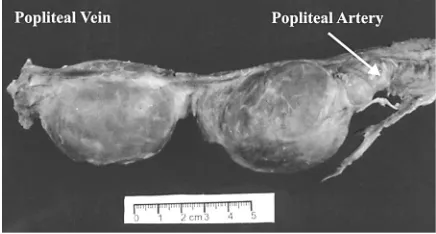
Although PAA is a rare occurrence, an AAA is seen secondarily to a PAA in 30–50% of cases [6, 18, 32, 37], while the converse event of a PAA second-ary to an AAA is only seen in 10–14% of patients [8, 16, 37] (Fig. 1). In addition, PAAs are often seen
bilaterally. Dawson et al. [6] report seeing bilateral PAAs in 50% of their cases, and Wright et al. [37] documented bilateralism in 50–70% of patients. It is apparent that when a PAA is diagnosed, investiga-tion should be done for a PAA in the opposite leg, as well as an AAA at all points along the course of the abdominal aorta.
Because of to the contents and compactness of the popliteal fossa, a PAA in this region has the po-tential to affect a number of structures, implicating the leg. Among the structures of the popliteal fossa, in addition to the popliteal artery, are the following: the small saphenous vein, the popliteal vein, the tib-ial and common fibular nerves, the posterior cuta-neous nerve of the thigh, the plantaris and popli-teus muscles, the popliteal lymph nodes and the lym-phatic vessels [27]. Rupture of a PAA is quite rare, so non-thrombotic complications of the popliteal fos-sa structures are more likely to be related to distor-tion and lengthening of the artery as it dilates, ow-ing to the upper and lower ends of the artery essen-tially being fixed [12]. The presence of a thrombus within an aneurysm in the popliteal fossa often re-sults in chronic inflammatory changes [36], and a number of reports [3, 5, 24, 34, 35] have docu-mented compression of nerves and/or veins behind the knee causing pain and leading to edema. It is possible that the close proximity of the tibial and com-mon fibular nerves may lead to compression and sub-sequent pain in the leg as the aneurysm enlarges.
Additional complications within the popliteal fos-sa are popliteal artery pseudoaneurysms. A popliteal pseudoaneurysm commonly forms as a result of a stab wound or low velocity gun-shot [36], poten-tially leading to similar inflammatory changes and consequences to those seen in PAA. The inflamma-tory reaction probably occurs as a result of blood escaping from the lacerated vessel into the popliteal fossa. In addition, popliteal pseudoaneurysms are
associated with fixed flexion deformities [36], which are likely to cripple any leg movement by the pa-tient. While the location of popliteal pseudoaneu-rysms and PAA may be similar, the etiology of the complications is usually unrelated.
CLINICAL FINDINGS OF POPLITEAL
ARTERY ANEURYSMS
The popliteal artery is of clinical importance, as it is the primary artery supplying the leg [19]. Patients with PAA usually present with ischemia of the lower limb due to thrombus formation or embolization occluding the popliteal artery [18]. In addition, micro-emboli formation may give rise to “blue toe” syndrome as a result of blockage of a peripheral artery [12]. Proper diagnosis of PAA and management of the situation is important, as limb-threatening compli-cations may occur secondary to present ischemia such as nerve and vein compression, circulation ab-normalities and amputation.
PAA may be regarded as a predominantly male condition, as 95–99% of cases reported [1, 5, 32, 34] have been in men with a median age of 60–69 years. This may be due to arteriosclerosis occurring more frequently in males, arteriosclerosis being one of the most common causes of PAA in aging populations [18, 24]. One theory implicating arteriosclerosis as a factor for PAA is turbulent flow distal to arterio-sclerotic lesions resulting in dilation of the vessel once it passes through the adductor hiatus and enters the popliteal fossa [18]. In parallel with this is the theory that hypertension (co-morbid with arteriosclerosis) is associated with rapid growth and dilation of the aneurysm [12]. It is evident that factors associated with cardiovascular morbidity are probably implicat-ed in the development and complications associat-ed with PAA.
Others who develop PAA may be those suffering from infection of the popliteal fossa [18], as well as those developing PAA-like symptoms owing to trau-ma. Syphilis infection may participate in PAA forma-tion [18], as the tertiary stage of syphilis is associat-ed with inflammation of the outer portion of ves-sels, potentially weakening the wall and predispos-ing the patient to aneurysm. A condition that pre-sents with symptoms similar to PAA is complete knee dislocation leading to occlusion of the popliteal ar-tery [11, 37]. This occlusion may lead to ischemia of the lower limb, similar to PAA thrombus formation, occluding the popliteal artery. Traditionally, this dis-location is seen in people involved in motor vehicle accidents [37].
A recent case report presented by Akagi et al. [2] implicated the popliteal artery in Klippel-Trenaunay syndrome, a relatively rare disorder characterized by soft tissue and bone hypertrophy with superficial varicosities [21]. Angiodysplasia in the venous sys-tem may predispose people with this syndrome to venous aneurysms. As reported by Akagi et al. [2], there have been only five previous reports of arterial aneurysms associated with the syndrome, as it pri-marily affects the venous system. In the case report-ed, disrupted elastic fibers near the aneurysm indi-cated a potential abnormality in tissue construction that may have mirrored the characteristic venous ectasia seen in Klippel-Trenaunay syndrome [2].
TREATMENT OF POPLITEAL
ARTERY ANEURYSMS
Throughout the treatment of an aneurysm, the goal is to restore normal blood flow without ruptur-ing the dilation or producruptur-ing a thrombus. When a PAA is treated, the potential for rupturing the an-eurysm is quite low, so the management of these patients revolves around deciding whether to treat them only when they are symptomatic or when they are still asymptomatic. Additionally, the diameter of the aneurysm is usually taken into consideration when developing a management plan.
programs for detection of PAA as even major vascu-lar centers usually only see approximately five pa-tients per year with PAA.
Intervention may also depend on the diameter of the aneurysm. Indications are varied, but Lowell et al. [23] reported that a diameter greater than 2 cm increased the risk of complications if no inter-vention was made. In contrast, Galland [12] noted that in the absence of major distortion of the aneu-rysm, a diameter of < 3 cm could be managed with-out immediate intervention, stating that the rate of thrombosis formation would not increase in this sit-uation. Furthermore, Wright et al. [37] claimed that the popliteal artery is considered aneurysmal only if its diameter exceeds 0.7 cm. They did not mention what diameter the aneurysm should reach before treatment is initiated. Proponents of conservative management carefully monitor aneurysm size and believe routine surveillance of the aneurysm is suffi-cient as long as the aneurysm is less than 2 cm in diameter and no thrombus is present [18]. Surveil-lance is usually carried out by means of ultrasound [19], which provides a sufficient method for moni-toring expansion. There is clearly ambiguity in the literature as to the diameter a PAA must reach be-fore it becomes clinically significant. The decision is likely to incorporate other predisposing factors for complication, including connective tissue disorders such as Ehlers-Danlos and Marfan’s syndromes, preg-nancy, age, and overall general health.
Those in favor of immediate intervention cite the fact that most patients who are asymptomatic un-der conservative management become symptomat-ic and require surgsymptomat-ical intervention within 1 to 3 years [18]. A number of surgical procedures have been used with a common approach along the medial side of the popliteal fossa, thus allowing venous vessel harvesting from the same incision made for the re-pair [18]. Arguably the most common open proce-dure is bypass with the saphenous vein, a recent re-port giving a five-year patency of 69% and a limb salvage rate of 87% [24, 32]. Thrombolysis therapy for the treatment of PAA was analyzed in 2002 by Dorigo et al. [9]. These authors concluded that those treated by thrombolysis followed by surgery were post-operatively better conditioned than those treat-ed only with a surgical proctreat-edure. As previously mentioned [14, 20, 22, 25, 28], endovascular stent grafting is a surgical procedure used more frequent-ly for PAA repair, even though developmentalfrequent-ly it is somewhat in its infancy. This procedure has the
advantage of requiring a smaller incision and of being carried out under local anesthesia [32] compared to the larger incision and general anesthesia for open surgical procedures. Although not totally accepted as a viable repair option, this procedure has the po-tential to decrease infection, blood loss, and post-operative recovery time for PAA repair in the future.
CONCLUSIONS
Popliteal artery aneurysms may be a rare occur-rence, but potential thrombus formation leading to decreased blood supply to the leg has significant clin-ical manifestations. A number of management pro-cedures are commonly used and debate continues as to the most effective and efficient procedure. With arteriosclerosis as a predisposing factor for PAA, this condition may be increasing as the population ad-vances in age and develops diabetes, hypertension and other pathological cardiovascular complications.
REFERENCES
1. Ailawadi G, Eliason JL, Upchurch GR (2003) Current concepts in the pathogenesis of abdominal aortic an-eurysm. J Vasc Surg, 38: 584–588.
2. Akagi D, Ishii S, Kitagawa T, Nagawa H, Miyata T (2006) Popliteal arterial aneurysm associated with Klippel--Trenaunay syndrome: case report and literature re-view. J Vasc Surg, 43: 1287–1289.
3. Aulivola B, Hamdan AD, Hile CN, Sheahan MG, Skillman JJ, Campbell DR, Scovell SD, LoGerfo FW, Pomposelli FB Jr (2004) Popliteal artery aneurysms: a comparison of outcomes in elective versus emergent repair. J Vasc Surg, 39: 1171–1177.
4. Ascher E, Markevich N, Schutzer RW, Kallakuri S, Jacob T, Hingorani AP (2003) Small popliteal artery an-eurysms: are they clinically significant? J Vasc Surg, 37: 755–760.
5. Carpenter JP, Barker CF, Roberts B, Berkowitz HD, Lusk EJ, Perloff LJ (1994) Popliteal artery aneurysms: current management and outcome. J Vasc Surg, 19: 65–72. 6. Dawson I, Sie RB, van Bockel JH (1997) Atherosclerotic
popliteal aneurysm. Br J Surg, 84: 293–299.
7. Dawson I, van Bockel JH, Brand R, Terpstra JL (1991) Popliteal artery aneurysms: long-term follow-up of aneurysmal disease and results of surgical treatment. J Vasc Surg, 13: 398–407.
8. Diwan A, Sarkar R, Stanley JC, Zelenock GB, Wakefield TW (2000) Incidence of femoral and popliteal artery an-eurysms in patients with abdominal aortic anan-eurysms. J Vasc Surg, 31: 863–869.
9. Dorigo W, Pulli R, Turini F, Pratesi G, Credi G, Innocenti AA, Prateci C (2002) Acute leg ischemia from thrombosed popliteal artery aneurysms: role of preoperative throm-bolysis. Eur J Vasc Endovasc Surg, 23: 251–254. 10. Friedman SG, Friedman MS. (1989) Matas. Antyllus and
endoaneurysmorrhaphy. Surg, 105: 761–763. 11. Frykberg ER (2002) Popliteal vascular injuries. Surg Clin
12. Galland RB (2005) Popliteal aneurysms: controversies in their management. Amer J Surg, 190: 314–318. 13. Galland RB, Magee TR (2002) Management of popliteal
aneurysm. Br J Surg, 89: 1382–1385.
14. Gerasimidis T, Sfyroeras G, Papazoglou K, Trellopoulos G, Ntinas A, Karamanos D (2003) Endovascular treatment of popliteal artery aneurysms. Eur J Vasc Endovasc Surg, 26: 506–511.
15. Gifford RW, Hines EA, Janes JM (1953) An analysis and follow-up study of one hundred popliteal aneurysms. Surg, 33: 284–293.
16. Graham LM. Femoral and popliteal aneurysms (2000) In: Rutherford RB (ed) Vascular surgery. Saunders, Philadelphia, pp. 1345–1368.
17. Halliday AW, Wolfe JH, Taylor PR (1991) The manage-ment of popliteal aneurysm: the importance of early surgical repair. Ann R Coll Surg Engl, 73: 253–257. 18. Hamish M, Lockwood A, Cosgrove C, Walker AJ, Wilkins D,
Ashley S (2006) Management of popliteal artery an-eurysms. ANZ J Surg, 76: 912–915.
19. Hirsch AT, Haskal ZJ, Hertzer NR, Bakal CW, Creager MA, Halperin JL (2006) ACC/AHA 2005 Practice guidelines for the management of patients with peripheral arte-rial disease. Circulation, 113: 463–654.
20. Joyce WP, McGrath F, Leahy AL, Bouchier-Hayes D (1995) A safe combined surgical/radiological approach to endoluminal graft stenting of a popliteal aneurysm. Eur J Vasc Endovasc Surg, 10: 489–491.
21. Klippel M, Trenaunay P (1900) Due naevus variqueux osteohypertrophique. Arch Gen Med, 185: 641–672. 22. Krajcer Z, Diethrich EB (1997) Successful endoluminal
repair of arterial aneurysms by Wallstent prosthesis and PTFE graft: preliminary results with a new tech-nique. J Endovasc Surg, 4: 80–87.
23. Lowell RC, Gloviczki P, Hallet JW Jr, Naessens JM, Maus TP, Cherry KJ Jr, Bower TC, Pairolero PC (1994) Popliteal artery aneurysms: the risk of non-operative manage-ment. Ann Vasc Surg, 8: 14–23.
24. Manhood A, Salaman R, Sintler M, Smith SR, Simms MH, Vohra RK (2003) Surgery of popliteal artery aneurysms: a 12-year experience. J Vasc Surg, 37: 586–593. 25. Marin ML, Veith FJ, Panetta TF, Cynamon J, Bakal CW,
Suggs WD, Wengerter KR, Barone HD, Schonholz C,
Parodi JC (1994) Transfemoral endoluminal stented graft repair of popliteal aneurysms. J Vasc Surg, 19: 754–757.
26. McGowan GW, Saif MF, O’Neil G. (1985) Ultrasound examination in the diagnosis of popliteal artery aneu-rysms. Br J Surg, 72: 528–529.
27. Moore KL, Agur AMR (2002) Chapter 3: Abdomen. Essential Clinical Anatomy. 2nd ed. Lippincott Williams & Williams, Baltimore, pp. 356–357.
28. Parodi JC, Palmaz JC, Barone HD (1991) Transfemoral intraluminal graft implantation for abdominal aortic aneurysms. Ann Vasc Surg, 5: 491–499.
29. Sarcina A, Bellosta R, Luzzani L, Agrifoglis G (1997) Surgical treatment of popliteal aneurysm. A 20 year experience. J Cardiovasc Surg, 38: 347–354.
30. Schroder A, Gohlke J, Gross-Fengels W, Horstmann R (1996) Popliteal aneurysms — surgical management versus conservative procedure. Lang Arch Chir Suppl Kongress, 113: 857–863.
31. Shortell CK, DeWeese JA, Ouriel K, Green RM (1991) Popliteal artery aneurysms: a 25-year experience. J Vasc Surg, 14: 771–776.
32. Siauw R, Koh EH, Walker SR (2006) Endovascular repair of popliteal artery aneurysms: techniques, current evi-dence and recent experience. ANZ J Surg, 76: 505–511. 33. Szilagyi DE, Schwartz RL, Reddy HD (1981) Popliteal arterial aneurysms: their natural history and manage-ment. Arch Surg, 116: 724–728.
34. Varga ZA, Locke-Edmunds JC, Baird RN (1994) Joint Vascular Research Group. A multicenter study of popliteal aneurysms. J Vasc Surg, 20: 171–177. 35. Vermilion BD, Kimmins SA, Pace WG, Evans WE (1981)
A review of 147 popliteal artery aneruysms with long--term follow-up. Surg, 90: 1009–1014.
36. Woolgar JD, Reddy DS, Robbs JV (2002) Delayed pre-sentation of traumatic popliteal artery pseudoaneu-rysms: a review of seven cases. Eur J Vasc Endovasc Surg, 23: 255–259.
37. Wright LB, Matchett WJ, Cruz CP, James CA, Culp WC, Eidt JF, McCowan TC (2004) Popliteal artery disease: diagnosis and treatment. Rad Graph, 24: 467–479. 38. Wychulis AR, Spittell JA, Wallace RB (1970) Popliteal