Management and Research
Available online at: www.ijstmr.comIJSTMR © 2016 | All Rights Reserved 29
Survey on Different Techniques of
Content-Based Image Retrieval
Aarti S. Datir1
Department of Computer Engineering Gokhale Education Society’s, R. H. Sapat College of
Engineering, Management Studies and Research, Nashik, (M.S.), INDIA
Dipak V. Patil2
Department of Computer Engineering Gokhale Education Society’s, R. H. Sapat College of
Engineering, Management Studies and Research, Nashik, (M.S.), INDIA
Abstract: Image retrieval system is a computer system for browsing, searching and retrieve images from a huge data set of digital images. Content-based image retrieval (CBIR) is the function of computer vision to the image retrieval problem, that is, the problem of searching for digital images in large datasets. CBIR retrieves similar images from huge image dataset based on image features. Content-based means that the searching will evaluate the actual contents of the image. The content of image might refer colors, shapes, textures, or any other information that can be derived from the image itself. CBIR techniques provide a method to find images in large databases by using unique descriptors from a trained image. Data clustering is an unsubstantiated method for extraction hidden pattern from huge data sets. In this paper the clustering techniques are discussed and analyzed. A lots of research works had been completed to design efficient image retrieval techniques from the image. This paper will present a survey and discuss the existing literature of different types of image retrieval (CBIR) systems.
Keywords: Content based image retrieval, Feature extraction, Image retrieval, Image similarity, Clustering Techniques.
I. INTRODUCTION
There are many resources are available on the internet through which people can create, process and store images. This has created the requirement to manage and search these images. Therefore, finding competent image retrieval mechanisms from large assets has become a wide area of interest to researchers. Image retrieval is a technique for searching and retrieving images from a huge dataset of digital images. The aim of CBIR is to avoid the use of textual descriptions. So in Content Based Image Retrieval retrieving of image based on similarities in their contents like textures ,colors, shapes etc. which are the lower level features of image. Content-based image retrieval is a system where relevant images from large scale image databases are searched according to users interests. The algorithms, tools and techniques that are used in CBIR, invent from many fields such as pattern recognition, computer vision, statistics, signal processing,. It is a field of research that is attracting professionals from different fields like architecture, fashion and publishing, crime prevention, medicine. In Content based image retrieval the search will identify the actual contents of the image rather than the metadata such as tags, keywords, and/or descriptions associated with the image [1][3].
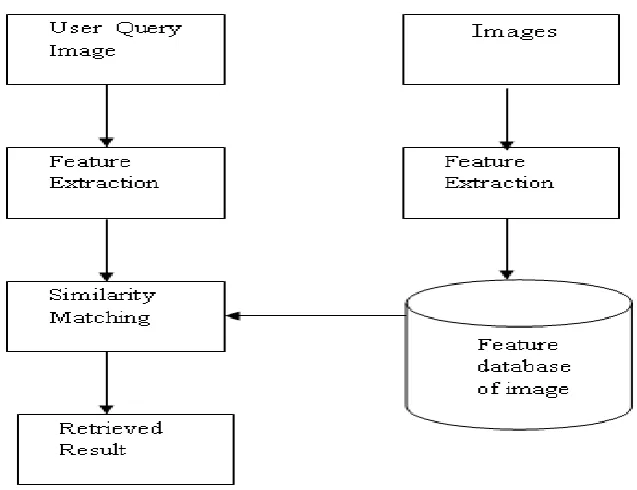
In Content-Based Image Retrieval system retrieval of image is based on similarities in their contents, i.e., colors, textures, shapes etc. Which are the application independent features. The main focus of CBIR is low level feature extraction. Feature extraction done from whole image or particular region form an image. This approach is based on similarity between user query image and trained images which are already stored in a database. In CBIR each image is stored in a large database, Features are extracted from each image and that features are compared with features of query image. The main goal of CBIR is to develop a techniques that will increase the retrieval accuracy and decrease the retrieval time [1][2].
CBIR consist of following modules [2]:
1) Feature Extraction: Features are extracted from the images. Mapping of image pixels into the Feature space is known as feature extraction.
2) Feature extraction of query image: Extract the features of user query image. Query image can be the element of image database or cannot be element of image database.
3) Similarity Measure: mapping of features of query image and image from image database based on similarity measure. Basically here two images are compared and check whether they are matching or not similarity between two images are shows that how closely the extracted features of images are. There are various similarity measurement techniques such as Mean Square Error, Sum of Absolute Differences, Euclidean Distance are common for CBIR applications.
IJSTMR © 2016 | All Rights Reserved 30 Fig. 1 Basic block diagram of CBIR
II. APPLICATIONS
1) Medicine Diagnosis: Tumors detection, Improve MRI and CT scan Understand ability. 2) Simple users searching a particular image on the web
3) Geographical information and remote sensing systems 4) Fashion & Publishing
5) Retail Catalogues
6) Architectural & Engineering Design
7) Various types of professionals like police force for picture recognition in crime prevention. 8) Home Entertainment
9) Cartography: map making from photographs, synthesis of weather maps
III. CBIR RETRIEVAL TECHNIQUES
Visual contents can be categorized in two types: visual contents based and text based. Textual (text based) features are keywords, documents, html tags etc. Visual based image features are color, shape, texture etc. There are two types of visual features: General features and Domain specific features. General features are color, texture, shape and Domain specific features are related to pattern recognition, these features are application dependent, for e.g. finger prints and human faces. Content-based image retrieval uses the visual features of an image such as color, shape, texture, and spatial layout to represents and indexed the image. The low level visual features are-:
1) Retrieval Based on color: Retrieval is based on color similarity. It is done by computing a color histogram for each image that identifies the part of pixels within an image which holding specific values[1][3]. The aim of finding color feature is to retrieve all the images whose color configurations are related to the color configuration of the query image. The color content is widely used important feature for image representation. Color histogram, color space, color correlation, relationship measurement and color quantization are the key components of color feature extraction. Color features are not conditional for size of image and shape. The color models can be categorized into RGB and LUV, HSV, YCBCR etc.
2) Retrieval Based on shape: Shape does not refer to the shape of an image but it is a shape of a particular region. Shape information are extracted using edge detection or segmentation [2] [4]. Shape is one of the important feature of an image. It contains the most attractive visual information for human insight. Shape features is divided into two types region based and contour based. Contour based shape features uses only boundary of the shape whereas region-based shape features uses entire shape region[10]. Shape features are known as geometric features, shape feature are commonly used global features such as circularity, aspect ratio, local features, moment invariants[12].
IJSTMR © 2016 | All Rights Reserved 31 used to get the multi-resolution attributes of an image. It refers to native surface properties of an object and their relationship to the neighboring environment. Texture feature arises where coarseness and regularity is presents. Texture feature describes spectral features which are taken using statistical features ,wavelet transform, tamura texture features etc. Tamura describes the texture representation from a different viewpoint[11].
IV. DESCRIPTORS
1) Local Descriptor: A descriptor encodes an image in a way that allows it to be compared and matched to other images. A local descriptor describes a patch within an image. Local features are small square, sub-images extracted from the original image [5][8][9].
2) Global Descriptor: A global descriptor describes the complete image or whole image. MPEG-7 Family of global descriptors consist of color layout descriptor, scalable color descriptor, Edge Histogram Descriptor[8][9].
V. RETRIEVAL BASED ON CLUSTERING TECHNIQUES
1) K-means: K-Means is a least-square partitioning method that divides a set of objects into K groups. The algorithm iterates over two steps:
1. Calculate the mean of each cluster.
2. Calculate the distance of each point from each cluster by calculating its distance from the consequent cluster mean. Allocate each point to the cluster it is nearest to.
3. Repeat the above two steps till the sum of squared within group errors cannot be lowered any more [6].
2) Hierarchical Clustering: Hierarchical clustering (HC) algorithms organize data into a hierarchical manner according to the proximity matrix. The results of Hierarchical Clustering are usually given by a binary tree or dendrogram. This design provides descriptions, information and visualization for the potential data clustering structures, especially when real hierarchical relations exist in the data, like the data from evolutionary research on different species of organisms. Hierarchical Clustering algorithms are mainly categorized as agglomerative methods and divisive methods. Agglomerative clustering starts with clusters and each of them consist of exactly one object. Divisive clustering is totally in an opposite way. At starting, the entire data set belongs to a cluster and a procedure sequentially divides it until all clusters are singleton clusters [6].
3) Retrieval Dictionary Based Clustering: In this a rough classification retrieval system is created. This is created by calculating the distance between two learned patterns and these learned patterns are divided into different clusters followed by a retrieval stage [6].
VI. SIMILARITY MEASURES
1) Sum of absolute difference (SAD): The sum of absolute difference (SAD) is a distance metric used for calculating the distance between two images to get the similarity. In this sum of the differences of the absolute values of the two feature vectors are calculated [7]. The similarity is determined on the calculated value of distance. It is calculated as,
Where, n is the number of features, i = 1, 2…, n. Both images are the same for Δd = 0 and the small value of Δd shows the relevant image to the query image.
2) Euclidean distance: This distance metric is most commonly used for similarity measurement in image retrieval because of its effectiveness and efficiency[7].It measures the distance between two vectors of images by calculating the square root of the sum of the squared absolute differences and it can be calculated as:
3) Maximum value distance: This metric is used to obtain the largest value of the absolute differences of paired features of feature vectors and it is calculated as:
IJSTMR © 2016 | All Rights Reserved 32 VII. PERFORMANCE MEASURES FOR IMAGE RETRIEVAL
1) Precision: Precision is the ratio of the number of relevant images retrieved to the total number of irrelevant and relevant images retrieved[8].
Relevant images are the positives
Retrieved images are the classified as positives
Relevant and retrieved are the true positives.
2) Recall: Recall is the ratio of the number of relevant records retrieved to the total number of relevant records in the database. Recall is also known as sensitivity or true positive rate. It’s the ratio of correctly predicted positive events[8].
Recall is calculated as ,
VIII. REVIEW BASED ON VARIOUS EXISTING TECHNIQUES
Based on the reviews of the various existing content based image retrieval(CBIR) techniques it can be divided into following different types:
1. Retrieval based on color 2. Retrieval based on texture 3. Retrieval based on shape
4. Retrieval based on mixed contents.
1) Retrieval based on color
Shrivastav, Tygi et. al. [18] presents a new image retrieval technique which retrieves similar images in three stages. A fixed number of images firstly retrieved based on their color feature similarity. The significance of the retrieved images is further improved by matching their shape and texture features. This eliminates the need of fusion and normalization techniques, which are commonly used to calculate similarity matching. This reduces the computation time and increases the overall accuracy of the system.
Kousalya, Thanamani, et al.[20] introduced color features concepts for retrieving similar images. CBIR aim at measuring color for specific images that are similar to a given query color. This approach include color features are generally represented as a histograms of intensity of the pixel colors. The Objective is to extracting color from specific images and retrieving the similar pixels using Euclidean distance measures.
Kinnareea, Pattanasethanonb, Boonthoa Thanaputtiwirota, et. al.[25] proposed an image retrieval method which is based on the concept of maximum RGB color correlation index between images. The proposed method retrieves the images on the basis of maximum color correlation so that the images with more similarities and, hence, exhibiting maximum correlation with each image is the index for retrieved accordingly. The RGB correlation index method has a maximum precision and recall rate. The propose image retrieval system has a high detection rate with RGB correlation index.
2) Retrieval based on shape
IJSTMR © 2016 | All Rights Reserved 33 to compare automated segmentation and manual segmentation with without segmentation. It uses two feature extraction techniques color & shape for indexing and recognition [21].
Acharya, Devi [24] proposed a new technique of incorporating visual attention model to segment and extract the Region of Interest(ROI) from an image and then use the result for image retrieval purposes. The main advantage of this concept lies in the improvement of the performance of the retrieval scheme in terms of Precision and Recall.
3) Retrieval based on Texture
K.P, Mary, Vasuki, et al.[19] introduced the semantic based image retrieval system which is based on the texture feature. generalized linear model constraints(GLMC) method is used for texture feature extraction which gives semantic analysis of images .The paper works for reducing the semantic gap between the low level feature and high level feature. The extracted features are assigned into semantics.
4) Retrieval based on shape Mixed (combination of color, texture, shape) Content
WangXing-yuan , ChenZhi-feng, YunJiao-jiao[23] presents a effective color image retrieval method based on texture, which uses the color co-occurrence matrix to extract the texture feature and measure the similarity of two color images. But proposed method is superior to the gray-level co-occurrence matrix method and color histogram method.
Kannan, Mohan, Anbazhagan, et al. proposed a combined approach of image mining and content based image retrieval and a new clustering technique to increase the speed of the image retrieval system. The objective of this approach is to reduce loss of information in images and extracting meaningful features [26].
Maheshwari, Silakari, Motwani [27] focuses on image clustering based on color and texture features. For extracting the information from the image dataset used Color moment and Gabor filter. For image data clustering used K-means and hierarchical data mining clustering algorithm of the image dataset. This approach provides a group of image data set into various clusters.
Datta, Joshi Li, Z. Wang introduced the theoretical study and analysis related to image retrieval and automatic image annotation and also discuss significant challenges involved in the Image retrieval system. The article shows the concepts adaptation of existing image retrieval techniques to build new systems that can be useful in the real world. It also gives the future research aspects for image retrieval [28].
CONCLUSION
This paper has surveyed the concepts of content-based image retrieval systems. Using descriptors and local features including color, texture and shape as feature vector of the regions to match images can give better results. Combining advantages of clustering strategy can provide both efficiency and quality. Similarity measures such as Euclidean distance, maximum value distance and sum of absolute difference (SAD) metrics give good performance in terms of precision.
REFERENCE
[1] Vivek Jain, Neha Sahu,” A Survey: On Content Based Image Retrieval”, International Journal of Engineering Research and Applications, Vol. 3, Issue 4, Jul-Aug 2013, pp.1166-1169
[2] R. Priyatharshini, Surendernath S.P, Dr.S.Chitrakala,” APPLICATIONS OF SPATIAL FEATURES IN CBIR : A SURVEY”, David C. Wyld (Eds)
: ICCSEA, SPPR, CSIA, WimoA – 2013,pp. 303–311, 2013.
[3] Mohammed Alkhawlani, Mohammed Elmogy, Hazem El Bakry, “Text-based, Content-based, and Semantic-based Image Retrievals: A Survey”,
International Journal of Computer and Information Technology (ISSN: 2279 – 0764) Volume 04 – Issue 01, January 2015
[4] Fazal Malik , Baharum Baharudin,” Analysis of distance metrics in content-based image retrieval using statistical quantized histogram texture
features in the DCT domain”, Journal of
King Saud University – Computer and Information Sciences (2013) 25, 207–218
[5] Thomas Deselaers, Daniel Keysers, and Hermann Ney,” Features for Image Retrieval: A Quantitative Comparison”.
[6] Monika Jain, Dr. S.K.Singh,” A Survey On: Content Based Image Retrieval Systems Using Clustering Techniques For Large Data sets”,
International Journal of Managing Information Technology (IJMIT) ,Vol.3, No.4, November 2011
[7] Fazal Malik , Baharum Baharudin,” Analysis of distance metrics in content-based image retrieval using statistical quantized histogram texture
features in the DCT domain”, Journal of
King Saud University – Computer and Information Sciences (2013) 25, 207–218
[8] Yogita Mistry, Dr.D.T. Ingole,” Survey on Content Based Image Retrieval Systems”, International Journal of Innovative Research in Computer
and Communication Engineering, Vol. 1, Issue 8, October 2013
IJSTMR © 2016 | All Rights Reserved 34 [10] Henning Müller, Nicolas Michoux, David Bandon, Antoine Geissbuhler (2004), “A review of content- based image retrieval systems in medical applications–clinical benefits and future directions”, International Journal of Medical Informatics 73, 1-23.
[11] Chiu, C.Y., Yang, S. and Lin, H.C.(2002), “Learning human perceptual concepts in a fuzzy content based image retrieval system”, 5th International Conference on Computational intelligence and Multimedia Applications, pp. 330-335.
[12] Ying Liu, Dengsheng Zhang, Guojun Lu, Wei-Ying Ma.(2007), “A survey of content-based image retrieval with high-level semantics” The Journal of the pattern recognition society. (2007)262 – 282.
[13] Jayant Mishra, Anubhav Sharma and Kapil Chaturvedi(2011), “An Unsupervised Cluster-based Image Retrieval Algorithm using Relevance Feedback” International Journal of Managing Information Technology (IJMIT) Vol.3, No.2, May 2011
[14] Dr. Anna Saro Vijendran and S. Vinod Kumar “A New Content Based Image Retrieval System by HOG of Wavelet Sub Bands” International Journal of Signal Processing, Image Processing and Pattern Recognition Vol. 8, No. 4 (2015), pp. 297-306.
[15] Keyuri M. Zinzuvadia, Prof. Bhavesh A. Tanawala, Prof. KeyurN.Brahmbhatt,” A Survey on Feature Based Image Retrieval Using Classification and Relevance Feedback Techniques”, International Journal of Innovative Research in Computer & Communication Engineering, Vol.3, Issue 1, January 2015, pp: 508-513.
[16] Mohd. Danish, Ritika Rawat , Ratika Sharma “ A Survey: Content Based Image Retrieval Based On Color,Texture,Shape & Neuro Fuzzy” Journal Of Engineering Research And Applications ISSN 2248-9622, Vol. 3, Issue 5,Sep-Oct2013,Pp. 839-844.
[17] P. S. Hiremath , Jagadeesh Pujari, “Content Based Image Retrieval using Colour, Texture and Shapefeatures”, 15th International Conference on Advanced Computing and Communications,2007.
[18] Nishant Shrivastav, Vipin Tygi “An Efficient Techniques For Image Retrival Of Color Images In Large Data Base” Elsevier Computer And Electrical Engineering Nov. 2014.
[19] Jisha K.P,Thusnavis Bella Mary. I,dr. A. Vasuki, “An Image Retrival Techniques Based On Texture Feature Using Semantic Properties” IEEE International Conference On Signal Processing and pattern Recogntion 2013.
[20] S. Kousalya, Dr. Antony Selvadoss Thanamani, “Image Color Extraction And Retrieval Using Classification Techniques” IJCSMC International Journal of computer science and mobile computing Vol. 2,no. 8 August 2013.
[21] AhsanRaza Sheikh, Sarina Mansor, Mohd.H.Lye, Mohd.F. A. Fauzi, “Content Based Image Retrival System For Marine Life Images Using Gradient Vector Flow” IEEE International Conference On Signal And Image Processing Apllication 2013.
[22] Divakar Singh Anju Singh “A New Frame Work For Texure Based Image Content With Comparative Analysis of Clustering Techniques” IEEE International Conference On Computational Intelligence And Communication Network 2012.
[23] WangXing-yuan , ChenZhi-feng, YunJiao-jiao, “An effective method for color image retrieval based on texture”, Computer Standards & Interfaces Volume 34, 2012.method[16].
[24] Satrajit Acharya, M.R.Vimala Devi, “Image Retrieval Based on Visual attention Model” Elsevier Procedia Engineering International Conference on Communication Technology and System Design 2011 30 (2012) 542 – 545.
[25] Parichat Kinnareea, Singthong Pattanasethanonb, Somsak Thanaputtiwirota, Somchat Boonthoa “RGB Color Correlation Index for Image Retrieval” 2nd International Science, Social-Science, Engineering and Energy Conference, Elsevier Procedia Engineering 8 (2011) pp no.36–41.
[26] A.Kannan,Dr.V.Mohan, Dr.N.Anbazhagan “Image Clustering and Retrieval using Image Mining Techniques” 2010.
[27] Manish Maheshwari Dr. Sanjay Silakari Dr. Mahesh Motwani, “Image Clustering using Color and Texture” IEEE First International Conference on Computational Intelligence, Communication Systems and Networks 2009.