Gapping through TAG Derivation Trees
∗Timm Lichte and Laura Kallmeyer
Emmy Noether Research Group, SFB 833, University of T¨ubingen [email protected],[email protected]
Abstract
This work provides a TAG account of gapping in English, based on a novel deletion-like op-eration that is referred to as de-anchoring. De-anchoring applies onto elementary trees, but it is licensed by the derivation tree in two ways. Firstly, de-anchored trees must be linked to the root of the derivation tree by a chain of adjunc-tions, and the sub-graph of de-anchored nodes in a derivation tree must satisfy certain inter-nal constraints. Secondly, de-anchoring must be licensed by the presence of a homomorphic antecedent derivation tree.
1 Introduction
Existing TAG-accounts of gapping propose the con-traction of nodes (Sarkar and Joshi, 1997) or adopt elementary trees with a gap that lack the ver-bal anchor (Babko-Malaya, 2006) or combine the gapped elementary tree with its antecedent site into a tree set within an MCTAG-account (Seddah, 2008). This work breaks new ground in that it uses de-anchoring, a deletion-like operation, for the mod-elling of gapping, which applies to elementary trees while being licensed by the derivation tree of licit TAG-derivations. De-anchoring removes the an-chors of an elementary tree and can be seen to par-allel PF-deletion in generative grammar (Hartmann, 2000; Merchant, 2001).
∗We are grateful to Maribel Romero and Andreas
Koniet-zko; the paper has benefitted a lot from discussions with them. Furthermore, we would like to thank three anonymous review-ers for their valuable comments.
Our work is inspired by recent ideas from (Os-borne, 2008; Kobele, 2009). Working in minimal-ist grammar, (Kobele, 2009) states the following Derivational Identity Hypothesis (DIH): “If a syn-tactic objectSO1is elided under identity withSO2, thenSO1andSO2 have been derived in exactly the same way.” A strict reading of the DIH then leads to the prediction that subtrees of the derivational struc-ture can be a target of a deletion-like operation that yields gapped structures only if an isomorphic an-tecedent subtree of the derivation structure exists.
(Osborne, 2008), on the other side, transfers the notion of major constituent, that is seen as being central to the licensing of gapping (Hankamer, 1973; Neijt, 1979; Chao, 1987), from generative gram-mar to a dependency-based description of gapping. A major constituent is then “a constituent the head [i.e. the governor] of which is, but the root of which is not, a link in the predicate chain”. The predi-cate chain is made of the verbal complex. Gapping then complies to the Restriction on Internal Sharing (RIS): “The gap of conjunct-internal sharing may not cut into a major constituent.”
We combine these approaches by describing gap-ping in TAG as a de-anchoring operation restricted by the derivation tree.
2 The Idea of De-Anchoring
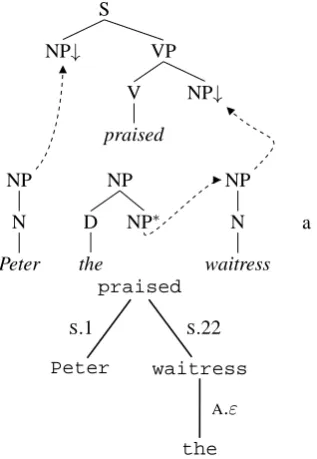
In our TAG derivation trees, the edge label S, fol-lowed by the Gorn address of the substitution node, indicates substitution, whereas A indicates adjunc-tion, again followed by the Gorn address of the ad-junction site.1 As an example, Fig. 1 shows the derivation of (1-a).
S
NP↓ VP
V NP↓
praised
NP
N
Peter
NP
D NP∗
the
NP
N
waitress a
praised
Peter
S.1
waitress
S.22
the
[image:2.595.359.456.134.224.2]A.ε
Figure 1: Derivation and derivation tree for “Peter praised the waitress”.
(1) a. Peter praised the waitress.
b. Adam praised Mary, and Peter praised the waitress.
We write derivation trees as graphshV, E, riwhere V is the set of vertices or nodes, E ⊂ V ×V the set of edges and there is a labeling function l that assigns a labell(v)to each nodev ∈V and a label l(e) to each edge e ∈ E. r ∈ V is the root node, i.e., the node with in-degree 0. E∗ represents the reflexive transitive closure ofE, i.e., the dominance relation in the tree.
We say that an elementary tree γ is de-anchored if the terminals ofγ are deleted (i.e., replaced with a label ε), while the other parts of γ are retained, thus preserving, e.g., case marking and semantics.
1
The Gorn address of the root node isεwhile the Gorn ad-dress of theith daughter of a node with Gorn addresspisp·i.
An example is the gapping correlate of (1-a) in (1-b) and its derivation tree in Fig. 2, in which the root node is de-anchored, indicated by crossing out the node label.
praised
Peter
S.1
waitress
S.22
the
[image:2.595.94.253.185.415.2]A.ε
Figure 2: Derivation tree for “Peter praised the waitress”.
Interesting questions are now, what kind of elemen-tary trees can be de-anchored (“internal conditions on de-anchoring”), and what types of configurations allow for anchoring (“external conditions on de-anchoring”). We will formulate both types of condi-tions depending on the TAG derivation tree.
3 Internal Conditions on De-Anchoring
Based on Fig. 2, a preliminary formulation of the internal condition would be that only root nodes of derivation trees can be de-anchored while complete subtrees of the root node are major constituents. This explains the unavailability of (2).
(2) *Adam praised Mary and Peter praised the wait-ress.
However, there are cases where not only the root is part of the gap. Examples are (3) and (4).
(3) a. John gives Mary a book and Peter gives Mary a disk.
b. John gives Mary a book and John gives Pe-ter a disk.
(4) a. John is fond of Mary and Mary is fond of Sue.
b. John is a reader in linguistics and Mary is a reader in philosophy.
gives
S.1 S.22 S.23
Peter Mary a book gives
S.1 S.22 S.23
[image:3.595.124.243.72.173.2]John Peter a book
Figure 3: Derivation trees for (3).
In (4) , the deleted part includes a copula and a predicate. In XTAG (XTAG Research Group, 2001), copula as in (4) receive a small clause analysis. We adapt this idea, differing from the XTAG-analysis, however, in treating prepositions not as co-anchors of the predicate (see Fig. 4). In this analysis the predicate fond is the root of the derivation tree, and it dominates the copula verb.
NP
N
Mary
S
NP↓ VP
V AP
ǫ A PP↓
fond
VP
V VP*
is
PP
P NP↓ of
NP
N
Sue
fond
Mary
S.1
is
A.2
of
S.222
Sue
S.2
Figure 4: Derivation for “Mary is fond of Sue”.
In order to account for (4) and (3), we revise our internal condition as follows: The gap constitutes a singleA-branch in the derivation tree. AnA-branch is a path of nodes connected by A-edges. Further-more, if a node in the derivation tree is de-anchored,
itsS-daughters can be de-anchored as well.
The gap may also contain a chain of control verbs, as has been noted already in (Ross, 1970), exempli-fied in (5).
(5) I want to try to begin to write a novel, and a. Mary wants to try to begin to write a play. b. Mary wants to try to begin to write a play. c. Mary wants to try to begin to write a play. d. Mary wants to try to begin to write a play.
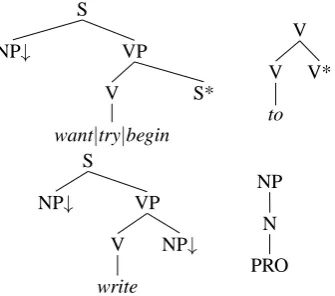
XTAG adopts an analysis of control verbs that ad-joins the control verb at the embedded infinitive and that uses an empty category PRO that substitutes into the subject NP slot. Such infinitives allow only PRO as subjects; this constraint is achieved via cor-responding features on the substitution node. The elementary trees are shown in Fig. 5.
S
NP↓ VP
V S*
want|try|begin
V
V V*
to
S
NP↓ VP
V NP↓ write
NP
N
[image:3.595.341.509.321.469.2]PRO
Figure 5: Elementary trees for control verbs in the spirit of XTAG.
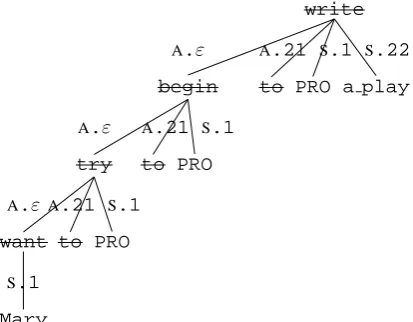
The derivation tree for (5-a) is shown in Fig. 6. Three observations are striking: (i) the remnants Mary and a play are complements of different verbs; (ii) the gaps are variable in size; (iii) the gaps con-stituteA-subtrees rather than justA-branches.
The first observation contradicts the here pro-posed conception of major constituency, since the first remnant Mary is not an immediate daughter of the root. Instead, it is the immediateS-daughter of a node on aA-subtree.
[image:3.595.107.253.326.620.2]write
A.ε A.21 S.1 S.22
begin to PRO a play
A.ε A.21 S.1 try to PRO
A.εA.21 S.1 want to PRO
[image:4.595.63.270.72.233.2]S.1 Mary
Figure 6: Derivation for (5-a).
Finally, we learn from the third observation that we have to either disallow the infinitive marker to to adjoin to the verbal stem and rather give it a lex-ical analysis, or we have to allow the de-anchoring of sister nodes, hence of A-subtrees of the deriva-tion tree. When the mother is not de-anchored, how-ever, it moreover holds that only the node adjoining highest can be de-anchored. This captures the un-availability of a sole de-anchoring of the infinitive marker:
(6) *. . . and I want to try to begin to write a novel.
In order to formulate our internal condition, we need the following notions: Given a derivation treeδ = hV, E, ri, we call the sub-graph γ of de-anchored nodes a gap. Given a nodev ∈V withA-daughters v1, . . . , vk, we callhv, viia maximally high
adjunc-tion if its label isA.p and all edges hv, vji, j 6= i,
1≤j≤k, are labeledA.pqwithq6=ε.
Gaps must satisfy the following Internal
Condi-tion on De-Anchoring:
1. γ must be a tree γ = hVg, Eg, rgi withVg ⊂
V, Eg ⊂E;
2. there must be an A-branch (possibly empty) from the root ofδto the root ofγ such that all edges on this path are maximally high adjunc-tions;
3. for every node vg ∈ Vg, it holds that all A
-daughters ofvginδare also part ofγ. I.e., for
allvg ∈ Vg and allv ∈ V, ifhvg, vi ∈ E and
l(hvg, vi) =A.pfor some Gorn addressp, then
v∈Vg;
4. for every node vg ∈ Vg, it holds that an S
-daughtervsofvginδcan be part ofγ; if so, all
nodes dominated byvs inδ must also be part
ofγ. I.e., for allvg ∈ Vg and allv ∈ V such
thathvg, vi ∈E andl(hvg, vi) = S.pfor some
Gorn address p, ifv ∈Vg, then it holds for all
v′withhv, v′i ∈E∗thatv′ ∈V
g.
It follows that in our model major constituents correspond toS-daughters of nodes of theA-subtree below the root node. It is not permitted to delete only parts of them. This use, however, is not exten-sionally congruent with Osborne’s use of the term, since he also applies it to modifiers.
4 External Conditions on De-Anchoring
Gapping is further constrained by a certain paral-lelism of the ellipsis site and the antecedent site. We assume here that an antecedent derivation tree repre-sents the first conjunct of a coordinative construction whose second conjunct includes the ellipsis. We call this aspect the external conditions on de-anchoring, and we will be mainly dealing with homomorphism properties of the derivation trees of the ellipsis site and the antecedent site. A strict formulation of the external condition would be that de-anchored nodes must have a corresponding node in the antecedent derivation tree, such that both have (i) an identical position in their derivation trees (i.e. an identical path to the respective root nodes) and (ii) an identi-cal node label, given that the node label always iden-tifies an elementary tree unambiguously.
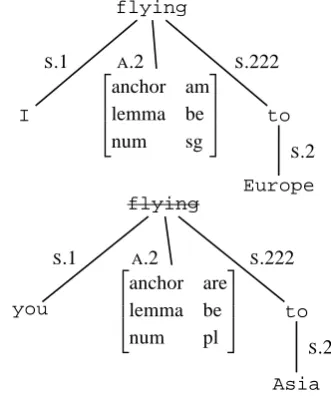
This is however too restrictive: Gapping is known to allow number mismatch between elided material and its antecedent, see (7) and also (5) above.
(7) I am flying to Europe, and you are flying to
Asia. (Osborne, 2008)
while theANCHORand NUMfeatures can be differ-ent.
flying
I
S.1
anchor am lemma be
num sg
A.2
to
S.222
Europe
S.2
flying
you
S.1
anchor are lemma be
num pl
A.2
to
S.222
Asia
[image:5.595.108.274.108.307.2]S.2
Figure 7: Derivation trees of the first and second conjunct of (7) with complex nodes.
Furthermore, dissimilarities of other properties of ellipsis and antecedent could be permissible, though not as easily as number mismatch. For example, the gapped verb could be differing from the antecedent verb wrt. word order, such as in (8), and subcatego-rization properties, as shown in (9).
(8) ?This guy she likes, and Mary likes Peter.
(9) a. ?Peter was looking for the Olympic games and Mary was looking after the children. b. ?Peter ate and Mary ate a whole chicken.
These kinds of mismatch would also be handled in terms of partial identity of complex node labels in the derivation tree.
On the other side, certain properties of the nodes in question must be identical, most prominently their position within the derivation tree: In (10), the an-tecedent verb ordered is embedded in a fronted ad-verbial clause, whereas the elided correspondent is the matrix verb and hence in the root position of the second conjunct.
(10) *Since Peter ordered a beer, the waitress in-stantly reached for the fridge and
Mary ordered a whole chicken.
Likewise, we claim that mismatches of voice and
tense are not acceptable (see (11)).
(11) a. *Peter was informed by the young police officer, and the older one was informing Mary.
b.?*Peter had to clean the floor last week, and Mary has to clean the kitchen this week
The External Condition on De-Anchoring is then as follows: A derivation treeδcontaining a gapγ = hVg, Egiis licensed if the following holds: There are
two subtreeδ1 =hV1, E1, r1i,δ2 =hV2, E2, r2iof δsuch thatδrepresents the conjunction ofδ1andδ2, γ is a subtree of δ2 and there is a homomorphism h:Vg →V1such that:
1. Identity of paths to root nodes: for allv ∈ Vg:
There arev(2)1 , . . . , v(2)k ∈ V2 for somek ≥ 1 with v(2)1 = r2, vk(2) = v and hv
(2)
i , v
(2)
i+1i ∈ E2 and l(hvi(2), v
(2)
i+1i) = li for 1 ≤ i < k
iff there are v1(1), . . . , vk(1) ∈ V1 with v1(1) = r1, v(1)k = h(v) and hvi(1), v(1)i+1i ∈ E1 and l(hvi(1), vi(1)+1i) =lifor1≤i < k.
2. Identity of specific features: for all v ∈ Vg:
Certain feature values are identical for v and h(v) in δ. These include at least LEMMA, TENSEand VOICE.
5 Problems
The internal condition on de-anchoring correctly al-lows for the de-anchoring ofS-nodes, accounting for examples such as (12).
(12) John gave a book to Mary and
a. Peter gave a book to Sue. b. Peter gave a report to Mary.
This, however, is too permissive. It needs to be care-fully constrained, in order to rule out instances of bare argument ellipsis such as in (13), which are traditionally judged ungrammatical (see, e.g., (Jack-endoff, 1971, (27-a)), (Johnson, 2004, p.3)).
(13) *John gave a book to Mary and Peter gave a book to Mary.
the proposals of, e.g., (Neijt, 1979) and (Hartmann, 2000, p.144).
The internal condition, moreover, turns out to be too restrictive when it comes to adverbial remnants. Consider the gapping instance in (14) and its deriva-tion tree in Fig. 8.2
(14) Mary always finishes her homework, but Peter finishes his homework only sometimes.
finish
Peter
S.1
only sometimes
A.2
homework
[image:6.595.311.506.70.161.2]S.22
Figure 8: Derivation tree of (14).
We must observe that the adverb remains overt while its dominating A-node is de-anchored. This con-tradicts the internal condition according to which A-daughters of anchored nodes must be de-anchored as well. A solution could be to enable the optionality of the de-anchoring of adverbs. This would make it necessary to have access to a distinc-tive feature of adverbs and verbs in the process of de-anchoring, e.g., by having access to the feature structure used for implementing the external condi-tion below. The distinccondi-tion could be a distinccondi-tion be-tween modifier auxiliary trees (adverbs, adjectives, etc.) and predicative auxiliary trees (verbs select-ing for a sentential complement). This distinction al-ready has been used in (Schabes and Shieber, 1994). A further example of an adverb that is not de-anchored is (15). The derivation tree is shown in Fig. 9.
(15) Mary is always fond of cheese cake, but Peter is only sometimes fond of cheese cake.
Here, the adverb remains overt while not only its dominating A-node but also its dominated A -node are de-anchored. Hence, the A-branch is de-anchored with a hole. This clearly contra-dicts the internal condition on de-anchoring. Mak-ing use of concepts such as sister adjunction, one
2Note that the alternative gapping instance “Peter always finishes his homework only sometimes” is not ruled out by the syntax.
fond
Peter
S.1
only sometimes
A.2
is
A.ε
of
S.222
cheese cake
[image:6.595.66.284.210.263.2]S.2
Figure 9: Derivation tree of (15).
could rearrange the derivation tree such that is
andonly sometimesare siblings, directly dom-inated byfond. This would reduce the example to an example of the type of (14).
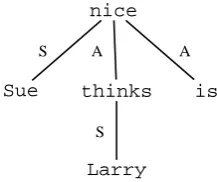
Finally, the internal condition on de-anchoring proves too permissive in cases, where the A-tree does not correspond to a small clause or a control chain, but rather to , e.g., a bridge verb construction. Consider the derivation tree in Fig. 10 resulting from the XTAG analysis for (16):
(16) Larry thinks Sue is nice.
nice
Sue
S
thinks
A
Larry
S
is
A
Figure 10: Derivation trees for “Larry thinks Sue is nice”.
Since both the bridging verb thinks and the embed-ded finite auxiliary verb is directly adjoin to the small clause anchored by nice, the derivation tree contains exactly twoA-branches. Taken the internal condition for granted, the acceptability of the fol-lowing gaps is predicted:
(17) Larry thinks Sue is nice and a. *Sue thinks Larry is funny. b. *Sue thinks Larry is nice.
(17-a) and (17-b) are claimed to be unacceptable (see, e.g., (Sag, 1976, p.198)), (Johnson, 2004, p.18), (Osborne, 2008, (106))).3 The internal
con-3
[image:6.595.353.462.381.472.2]dition might thus be too permissive.
One could argue that the verb thinks in (16) is no bridge verb, but receives an analysis, where the clausal complement is substituted into the elemen-tary tree of thinks. Gapping into the clausal comple-ment would thus be blocked since a de-anchoring of nice would also require a de-anchoring of the entire complement clause. This move, however, would ex-plain only such simple cases. Where the bridge verb analysis with adjunction is inevitable, it would still predict the availability of the following, highly awk-ward gapping instance:
(18) ?*Who does Mary think Bill likes and who does Sue think Joe likes.
Note however that the available literature on gapped bridge verb constructions seems to be very slim. Furthermore, the dependency analysis in (Osborne, 2008) can correctly predict the unacceptability of (17-b) only by the cost of stipulating two separate predicate chains. The syntactic characterization of those predicate chains and their separation is again obscure.
6 Related Work
Previous TAG-accounts of gapping consider only a very limited set of data. Furthermore, complex gaps such as (4) and (5) pose a serious challenge for those accounts that model the ellipsis-antecedent relations syntactically, such as (Sarkar and Joshi, 1997) and (Seddah, 2008). In the simple cases of gapping, (Sarkar and Joshi, 1997) let the preterminal nodes contract such that anchoring (i.e. lexicalization) happens at the same time as substitution and adjunc-tion during the parse. When gaps are complex, how-ever, not yet anchored derived trees have to be con-tracted instead of not yet anchored elementary trees. In other words, contraction would then also operate on non-immediate daughters of the conjunctor in the derivation tree. Unfortunately, Sarkar and Joshi do not elaborate on the details of this powerful exten-sion, in particular on how to constrain it.
(Seddah, 2008) also analyzes simple cases of gap-ping. In his approach, he combines the elemen-tary trees of the antecedent verb and the elided verb
funny”. (c.f. (Sag, 1976, p.198)),(Osborne, 2008, (5))
into a single tree set. The resulting MCTAG is con-strained to be tree-local. To process complex gaps in this vein, however, requires more expressive power: since, e.g., the control verbs and their elided coun-terpart adjoin into different trees from different el-ementary trees belonging to the same tree set, we need at least set-locality. This illustrates the so far unnoticed complication due to complex gaps.
It remains to say that the semantic account in (Babko-Malaya, 2006) is not affected in this respect. Even though we share with (Kobele, 2009) the interest in derivational structures along the Derivational Identity Hypothesis (DIH), his account (within the minimalist grammar framework) differs considerably from ours. The main reason for this contrast is the fundamentally differing nature of the respective derivational structures. In minimal-ist grammar, the non-terminal nodes of the deriva-tion tree indicate combinatorial operaderiva-tions, i.e., merge and move. Most importantly, the predicate-argument relation is opaque, which also follows from the fact that minimalist grammar does not dis-pose of an extended domain of locality. Since the DIH suggests that only common subderivations are subject to deletion, Kobele’s account seems to run into difficulties when applied even to simple cases of gapping. In fact, Kobele does not flesh out a theory of gapping in his paper. He is more concerned with voice mismatches in sluicing constructions, where his account is particularly fruitful.
due to the fact that Osborne aims at rephrasing ma-jor constituency in terms of dependency, and trol chains are considered not to involve major con-stituents. Finally, our account includes an expli-cation of the antecedent-ellipsis relation in terms of a homomorphism on derivation trees, which Os-borne’s proposal lacks completely.
The problems of our account concerning the role of adverbs reflect the ambivalence of adjunction with respect to complementation and modification. This work would, thus, benefit from a convergence with dependency representations in this regard.
7 Implementation Issues
As we have seen when formulating the external con-dition, de-anchoring is licensed only if we can find a homomorphic antecedent node in the derivation tree of the first conjunct. This could be exploited for parsing. The idea is to allow some kind of multi-ple use under de-anchoring for selected elementary trees. Whenever a de-anchored tree is used during parsing, we check the internal and external condi-tions for de-anchoring on the part of the derivation tree that is already available.
8 Conclusion
This paper has provided an account of gapping in English within LTAG. We have exploited the fact that LTAG provides an extended domain of locality and, besides the derived trees, generates also deriva-tion trees that abstract away from details of the con-stituency structure and that are close to dependency trees. We claim that LTAG derivation trees are an appropriate structure for restricting the availability of gapping constructions.
In our approach, gapping is achieved via an op-eration of de-anchoring that deletes lexical anchors from elementary trees. Inspired by recent research on gapping and relations to the derivation structure in the context of minimalist grammar, we have for-mulated a list of licensing conditions on the deriva-tion tree that allow for de-anchoring within gapping constructions. Even though there are cases that re-main problematic, our approach covers a large part of the gapping phenomena discussed in the litera-ture.
References
Olga Babko-Malaya. 2006. Semantic interpretation of unrealized syntactic material in LTAG. In Proceed-ings of the Eighth International Workshop on Tree Ad-joining Grammar and Related Formalisms, pages 91– 96, Sydney, Australia, July. Association for Computa-tional Linguistics.
Wynn Chao. 1987. On ellipsis. Ph.D. thesis, University of Massachusetts, Amherst, Massachusetts.
Jorge Hankamer. 1973. Unacceptable ambiguity. Lin-guistic Inquiry, 4(1):17–68.
Katharina Hartmann. 2000. Right Node Raising and Gapping. John Benjamins, Amsterdam.
Ray S. Jackendoff. 1971. Gapping and related rules. Linguistic Inquiry, 2(1):21–35.
Kyle Johnson. 2004. In search of the English middle field. Unpublished manuscript. University of Mas-sachusetts at Amherst.
Gregory M. Kobele. 2009. Syntactic identity in survive-minimalism. Ellipsis and the derivational identity hy-pothesis. In Towards a Derivational Syntax: Survive-Minimalism. John Benjamins.
Jason Merchant. 2001. The Syntax of Silence. Oxford Univ. Press.
Anna H. Neijt. 1979. Gapping: A Contribution to Sen-tence Grammar. Ph.D. thesis, Utrecht University. Thomas Osborne. 2008. Major constituents and two
de-pendency grammar constraints on sharing in coordina-tion. Linguistics, 46:1109–1165.
John Robert Ross. 1970. Gapping and the order of con-stituents. In Manfred Bierwisch and Karl Erich Hei-dolph, editors, Progress in Linguistics, pages 249–259. Mouton, The Hague.
Ivan A. Sag. 1976. Deletion and logical form. Ph.D. thesis, MIT.
Anoop Sarkar and Aravind Joshi. 1997. Handling coor-dination in a tree adjoining grammar. Longer version of paper in Proceedings of COLING 1996. Draft of August 19, 1997.
Yves Schabes and Stuart M. Shieber. 1994. An Alterna-tive Conception of Tree-Adjoining Derivation. Com-putational Linguistics, 20(1):91–124, March.
Djam´e Seddah. 2008. The use of MCTAG to process el-liptic coordination. In Proceedings of The Ninth Inter-national Workshop on Tree Adjoining Grammars and Related Formalisms (TAG+9).