Proceedings of the 2018 Conference on Empirical Methods in Natural Language Processing, pages 4470–4481 Brussels, Belgium, October 31 - November 4, 2018. c2018 Association for Computational Linguistics
4470
Simple Recurrent Units for Highly Parallelizable Recurrence
Tao Lei1 Yu Zhang2 Sida I. Wang1,3 Hui Dai1 Yoav Artzi1,4
1ASAPP Inc. 2Google Brain 3Princeton University 4Cornell University
1{tao, hd}@asapp.com 2[email protected]
3[email protected] 4[email protected]
Abstract
Common recurrent neural architectures scale poorly due to the intrinsic difficulty in par-allelizing their state computations. In this work, we propose the Simple Recurrent Unit (SRU), a light recurrent unit that balances model capacity and scalability. SRU is de-signed to provide expressive recurrence, en-able highly parallelized implementation, and comes with careful initialization to facili-tate training of deep models. We demon-strate the effectiveness of SRU on multiple NLP tasks. SRU achieves 5–9x speed-up over cuDNN-optimized LSTM on classifica-tion and quesclassifica-tion answering datasets, and de-livers stronger results than LSTM and convo-lutional models. We also obtain an average of 0.7 BLEU improvement over the Transformer model (Vaswani et al.,2017) on translation by incorporating SRU into the architecture.1 1 Introduction
Recurrent neural networks (RNN) are at the core of state-of-the-art approaches for a large num-ber of natural language tasks, including machine translation (Cho et al., 2014; Bahdanau et al.,
2015;Jean et al.,2015;Luong et al., 2015),
lan-guage modeling (Zaremba et al., 2014; Gal and
Ghahramani, 2016; Zoph and Le, 2016),
opin-ion mining (Irsoy and Cardie,2014), and situated language understanding (Mei et al., 2016;Misra
et al., 2017; Suhr et al., 2018; Suhr and Artzi,
2018). Key to many of these advancements are architectures of increased capacity and computa-tion. For instance, the top-performing models for semantic role labeling and translation use eight re-current layers, requiring days to train (He et al.,
2017;Wu et al., 2016b). The scalability of these
models has become an important problem that im-pedes NLP research.
1Our code is available at https://github.com/ taolei87/sru.
The difficulty of scaling recurrent networks arises from the time dependence of state com-putation. In common architectures, such as Long Short-term Memory (LSTM; Hochreiter
and Schmidhuber, 1997) and Gated Recurrent
Units (GRU; Cho et al., 2014), the computation of each step is suspended until the complete ex-ecution of the previous step. This sequential de-pendency makes recurrent networks significantly slower than other operations, and limits their ap-plicability. For example, recent translation mod-els consist of non-recurrent components only, such as attention and convolution, to scale model train-ing (Gehring et al.,2017;Vaswani et al.,2017).
In this work, we introduce the Simple Recurrent Unit (SRU), a unit with light recurrence that offers both high parallelization and sequence modeling capacity. The design of SRU is inspired by pre-vious efforts, such as Quasi-RNN (QRNN;
Brad-bury et al.,2017) and Kernel NN (KNN;Lei et al.,
2017), but enjoys additional benefits:
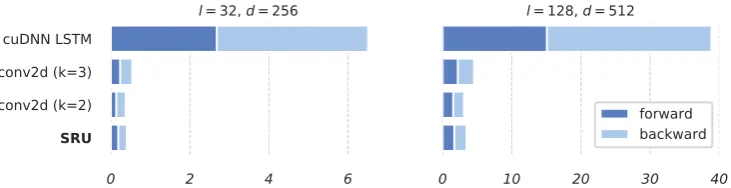
• SRU exhibits the same level of parallelism as convolution and feed-forward nets. This is achieved by balancing sequential dependence and independence: while the state compu-tation of SRU is time-dependent, each state dimension is independent. This simplifica-tion enables CUDA-level optimizasimplifica-tions that parallelize the computation across hidden di-mensions and time steps, effectively using the full capacity of modern GPUs. Figure1 com-pares our architecture’s runtimes to common architectures.
4471
Figure 1: Average processing time in milliseconds of a batch of 32 samples using cuDNN LSTM, word-level convolutionconv2d(with filter width k = 2andk = 3), and the proposed SRU. We vary the number of tokens per sequence (l) and feature dimension (d).
• SRU improves the training of deep recur-rent models by employing highway connec-tions (Srivastava et al.,2015) and a parame-ter initialization scheme tailored for gradient propagation in deep architectures.
We evaluate SRU on a broad set of problems, including text classification, question answering, translation and character-level language model-ing. Our experiments demonstrate that light re-currence is sufficient for various natural language tasks, offering a good trade-off between scala-bility and representational power. On classifica-tion and quesclassifica-tion answering datasets, SRU out-performs common recurrent and non-recurrent ar-chitectures, while achieving 5–9x speed-up com-pared to cuDNN LSTM. Stacking additional lay-ers further improves performance, while incurring relatively small costs owing to the cheap compu-tation of a single layer. We also obtain an average improvement of 0.7 BLEU score on the English to German translation task by incorporating SRU into Transformer (Vaswani et al.,2017).
2 Related Work
Improving on common architectures for sequence processing has recently received significant atten-tion (Greff et al., 2017; Balduzzi and Ghifary,
2016;Miao et al.,2016;Zoph and Le, 2016;Lee
et al.,2017). One area of research involves
incor-porating word-level convolutions (i.e. n-gram fil-ters) into recurrent computation (Lei et al.,2015;
Bradbury et al., 2017;Lei et al., 2017). For
ex-ample, Quasi-RNN (Bradbury et al., 2017) pro-poses to alternate convolutions and a minimal-ist recurrent pooling function and achieves sig-nificant speed-up over LSTM. While Bradbury
et al. (2017) focus on the speed advantages of
the network, Lei et al. (2017) study the
theoret-ical characteristics of such computation and pos-sible extensions. Their results suggest that sim-plified recurrence retains strong modeling capac-ity through layer stacking. This finding motivates the design of SRU for both high parallelization and representational power. SRU also relates to IRNN (Le et al.,2015), which uses an identity di-agonal matrix to initialize hidden-to-hidden con-nections. SRU uses point-wise multiplication for hidden connections, which is equivalent to using a diagonal weight matrix. This can be seen as a constrained version of diagonal initialization.
Various strategies have been proposed to scale network training (Goyal et al., 2017) and to speed up recurrent networks (Diamos et al.,2016;
Shazeer et al., 2017; Kuchaiev and Ginsburg,
2017). For instance, Diamos et al.(2016) utilize hardware infrastructures by stashing RNN param-eters on cache (or fast memory). Shazeer et al.
(2017) and Kuchaiev and Ginsburg (2017) im-prove the computation via conditional computing and matrix factorization respectively. Our imple-mentation for SRU is inspired by the cuDNN-optimized LSTM (Appleyard et al.,2016), but en-ables more parallelism – while cuDNN LSTM re-quires six optimization steps, SRU achieves more significant speed-up via two optimizations.
The design of recurrent networks, such as SRU and related architectures, raises questions about representational power and interpretability (Chen
et al.,2018;Peng et al.,2018).Balduzzi and
Ghi-fary (2016) applies type-preserving transforma-tions to discuss the capacity of various simplified RNN architectures. Recent work (Anselmi et al.,
2015;Daniely et al.,2016;Zhang et al.,2016;Lei
et al.,2017) relates the capacity of neural networks
4472
3 Simple Recurrent Unit
We present and explain the design of Simple Re-current Unit (SRU) in this section. A single layer of SRU involves the following computation:
ft = (Wfxt+vf ct 1+bf) (1) ct = ft ct 1+ (1 ft) (Wxt) (2)
rt = (Wrxt+vr ct 1+br) (3) ht = rt ct+ (1 rt) xt (4)
where W, Wf and Wr are parameter matrices and vf, vr, bf andbv are parameter vectors to be learnt during training. The complete architec-ture decomposes to two sub-components: alight recurrence(Equation 1 and 2) and ahighway net-work(Equation 3 and 4).
The light recurrence component successively reads the input vectors xt and computes the se-quence of statesctcapturing sequential informa-tion. The computation resembles other recurrent networks such as LSTM, GRU and RAN (Lee
et al.,2017). Specifically, a forget gateftcontrols
the information flow (Equation 1) and the state vector ct is determined by adaptively averaging the previous statect 1and the current observation
Wxtaccording toft(Equation 2).
One key design decision that differs from previ-ous gated recurrent architectures is the wayct 1
is used in the sigmoid gate. Typically, ct 1 is
multiplied with a parameter matrix to computeft, e.g.,ft = (Wfxt+Vfct 1 +bf). However, the inclusion ofVfct 1 makes it difficult to
par-allelize the state computation: each dimension of ct and ft depends on all entries ofct 1, and the
computation has to wait until ct 1 is fully
com-puted. To facilitate parallelization, our light recur-rence component uses a point-wise multiplication vf ct 1 instead. With this simplification, each
dimension of the state vectors becomes indepen-dent and hence parallelizable.
The highway network component (Srivastava
et al., 2015) facilitates gradient-based training of
deep networks. It uses the reset gatert(Equation 3) to adaptively combine the inputxtand the state ct produced from the light recurrence (Equation 4), where(1 rt) xtis a skip connection that allows the gradient to directly propagate to the pre-vious layer. Such connections have been shown to improve scalability (Wu et al.,2016a;Kim et al.,
2016;He et al.,2016;Zilly et al.,2017).
The combination of the two components makes the overall architecture simple yet expressive, and easy to scale due to enhanced parallelization and gradient propagation.
3.1 Parallelized Implementation
Despite the parallelization friendly design of SRU, a naive implementation which computes equations (1)–(4) for each step t sequentially would not achieve SRU’s full potential. We employ two op-timizations to enhance parallelism. The optimiza-tions are performed in the context of GPU / CUDA programming, but the general idea can be applied to other parallel programming models.
We re-organize the computation of equations (1)–(4) into two major steps. First, given the input sequence{x1· · ·xL}, we batch the matrix multi-plications across all time steps. This significantly improves the computation intensity (e.g. GPU uti-lization). The batched multiplication is:
U> =
0 @
W Wf Wr
1
A[x1,x2,· · · ,xL] ,
where L is the sequence length, U 2 RL⇥3d is the computed matrix anddis the hidden state size. When the input is a mini-batch ofBsequences,U would be a tensor of size(L, B,3d).
The second step computes the remaining point-wise operations. Specifically, we compile all point-wise operations into a single fused CUDA kernel and parallelize the computation across each dimension of the hidden state. Algorithm1shows the pseudo code of the forward function. The com-plexity of this step isO(L·B·d)per layer, where
Lis the sequence length andBis the batch size. In contrast, the complexity of LSTM isO(L·B·d2)
because of the hidden-to-hidden multiplications (e.g. Vht 1), and each dimension can not be
in-dependently parallelized. The fused kernel also reduces overhead. Without it, operations such as sigmoid activation would each invoke a separate function call, adding kernel launching latency and more data moving costs.
The implementation of a bidirectional SRU is similar: the matrix multiplications of both direc-tions are batched, and the fused kernel handles and parallelizes both directions at the same time.
3.2 Initialization
4473
Algorithm 1Mini-batch version of the forward pass defined in Equations (1)–(4).
Indices: Sequence lengthL, mini-batch sizeB, hidden state dimensiond.
Input: Input sequences batchx[l, i, j]; grouped matrix multiplicationU[l, i, j0];
initial statec0[i, j]; parametersvf[j],vr[j],bf[j]andbr[j].
Output: Outputh[·,·,·]and internalc[·,·,·]states.
Initializeh[·,·,·]andc[·,·,·]as twoL⇥B⇥dtensors.
fori= 1,· · · , B;j = 1,· · · , ddo // Parallelize each exampleiand dimensionj c=c0[i, j]
forl= 1,· · · , Ldo
f = (U[l, i, j+d] +vf[j]⇥c+bf[j] )
c=f⇥c+ (1 f)⇥U[l, i, j]
r= (U[l, i, j+d⇥2] +vr[j]⇥c+br[j] )
h=r⇥c+ (1 r)⇥x[l, i, j] c[l, i, j] =c
h[l, i, j] =h
returnh[·,·,·]andc[·,·,·]
impact on the final performance. We now describe an initialization strategy tailored for SRU.
We start by adopting common initializations de-rived for feed-forward networks (Glorot and
Ben-gio,2010;He et al.,2015). The weights of
param-eter matrices are drawn with zero mean and 1/d variance, for instance, via the uniform distribution [ p3/d,+p3/d]. This ensures the output vari-ance remains approximately the same as the input variance after the matrix multiplication.
However, the light recurrence and highway computation would still reduce the variance of hidden representations by a factor of1/3to1/2:
1
3
Var[ht] Var[xt]
1 2 ,
and the factor converges to 1/2 in deeper layers (see AppendixA). This implies the outputhtand the gradient would vanish in deep models. To off-set the problem, we introduce ascaling correction
constant↵in the highway connection
ht = rt ct + (1 rt) xt·↵ ,
where↵is set top3 such that Var[ht] ⇡Var[xt] at initialization. When the highway network is ini-tialized with a non-zero bias br = b, the scaling constant↵can be accordingly set as:
↵ = p1 + exp(b)⇥2 .
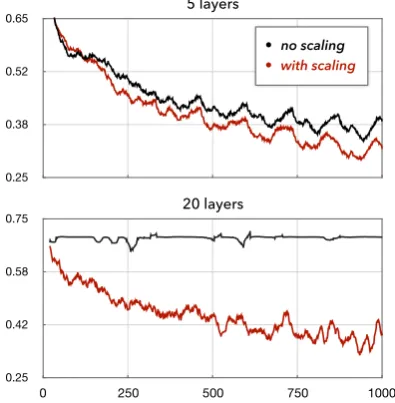
Figure2compares the training progress with and without the scaling correction. See Appendix A
for the derivation and more discussion.
0.25 0.38 0.52 0.65
5 layer
step no scaling with scaling
1 0.69587987661361 69 0.69471210241317 75 2 0.69360971450805 66 0.70679479837417 6 4 0.69167828559875 49 0.68963408470153 81 5 0.69149464368820 19 0.68712782859802 25 6 0.69109219312667
85 0.6831133365631104
7 0.69028604030609 13
0.68658131361007 69
8 0.68636518716812
13 0.6747273802757263
9 0.69153815507888 79
0.68284726142883 3
10 0.68511354923248
29 0.6826606392860413
11 0.67692613601684 57
0.66606879234313 96
12 0.68502306938171
39 0.6728894710540771
13 0.68517547845840 45
0.67398208379745 48
14 0.66570037603378
3 0.6354039311408997
15 0.65827196836471 56
0.63521456718444 82
16 0.66550070047378
54 0.6511343717575073
17 0.66228967905044 56
0.65273129940032 96
18 0.59680402278900
15 0.5772292613983154
19 0.66552460193634
03 0.6686962246894836
20 0.58357143402099 61
0.57429039478302
21 0.66341418027877
81 0.6961659789085388
22 0.59275627136230 47
0.61363184452056 88
23 0.57578068971633
91 0.574468195438385
24 0.56586354970932 01
0.61302137374877 93
25 0.58144080638885
5 0.6160621643066406
26 0.62346082925796 51
0.61466139554977 42
27 0.71355241537094
12 0.6505687236785889
28 0.58123964071273 8
0.62549662590026 86
30 0.68998241424560
55 0.6361363530158997
31 0.62475991249084 47
0.65779834985733 03
32 0.61295872926712
04 0.6187800765037537
33 0.55482220649719 24 0.62934297323226 93 34 0.57439488172531 13 0.57176047563552 86 35 0.56072294712066
65 0.579410195350647
36 0.51351976394653 32
0.52448111772537 23
37 0.61627656221389
77 0.6503244638442993
38 0.70487678050994 87
0.68365365266799 93
39 0.52156120538711
55 0.559955358505249
40 0.61801612377166 75
0.59346944093704 22
41 0.66186791658401
49 0.7113165855407715
43 0.55648767948150 63
0.60116279125213 62
44 0.56969976425170
9 0.6278694272041321
45 0.51646989583969 12
0.57864898443222 05
46 0.62215346097946
17 0.6011412739753723
0.25 0.42 0.58 0.75
0 250 500 750 1000
• no scaling • with scaling
5 layers
[image:4.595.315.513.305.507.2]20 layers
Figure 2: Training curves of SRU on classification. The x-axis is the number of training steps and the y-axis is the training loss. Scaling correction im-proves the training progress, especially for deeper models with many stacked layers.
4 Experiments
We evaluate SRU on several natural language pro-cessing tasks and perform additional analyses of the model. The set of tasks includes text classifica-tion, question answering, machine translaclassifica-tion, and character-level language modeling. Training time on these benchmarks ranges from minutes (classi-fication) to days (translation), providing a variety of computation challenges.
4474
Model Size CR SUBJ MR TREC MPQA SST Time
Best reported results:
Wang and Manning(2013) 82.1 93.6 79.1 - 86.3 -
-Kalchbrenner et al.(2014) - - - 93.0 - 86.8
-Kim(2014) 85.0 93.4 81.5 93.6 89.6 88.1
-Zhang and Wallace(2017) 84.7 93.7 81.7 91.6 89.6 85.5
-Zhao et al.(2015) 86.3 95.5 83.1 92.4 93.3 -
-Our setup (default Adam, fixed word embeddings):
CNN 360k 83.1±1.6 92.7±0.9 78.9±1.3 93.2±0.8 89.2±0.8 85.1±0.6 417 LSTM 352k 82.7±1.9 92.6±0.8 79.8±1.3 93.4±0.9 89.4±0.7 88.1±0.8 2409 QRNN (k=1) 165k 83.5±1.9 93.4±0.6 82.0±1.0 92.5±0.5 90.2±0.7 88.2±0.4 345 QRNN (k=1) + highway 204k 84.0±1.9 93.4±0.8 82.1±1.2 93.2±0.6 89.6±1.2 88.9±0.2 371
SRU(2 layers) 204k 84.9±1.6 93.5±0.6 82.3±1.2 94.0±0.5 90.1±0.7 89.2±0.3 320 SRU(4 layers) 303k 85.9±1.5 93.8±0.6 82.9±1.0 94.8±0.5 90.1±0.6 89.6±0.5 510
[image:5.595.78.525.63.272.2]SRU(8 layers) 502k 86.4±1.7 93.7±0.6 83.1±1.0 94.7±0.5 90.2±0.8 88.9±0.6 879
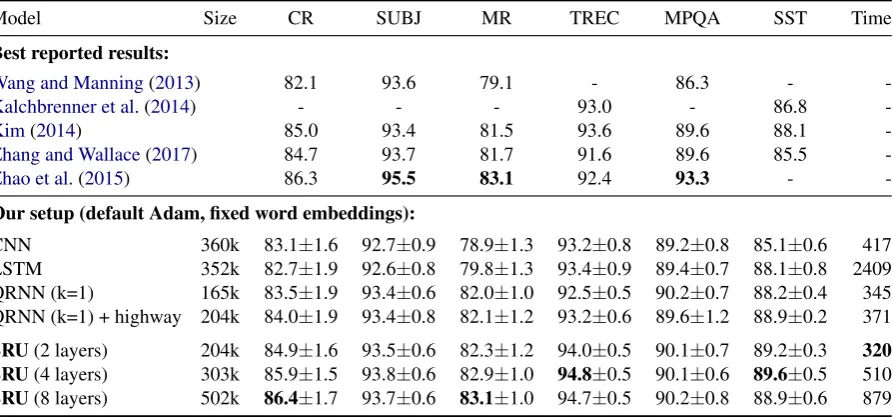
Table 1: Test accuracies on classification benchmarks (Section4.1). The first block presents best reported results of various methods. The second block compares SRU and other baselines given the same setup. For the SST dataset, we report average results of 5 runs. For other datasets, we perform 3 independent trials of 10-fold cross validation (3⇥10 runs). The last column compares the wall clock time (in seconds)
to finish 100 epochs on the SST dataset.
other architectures. We stack multiple layers of SRU to directly substitute other recurrent, convo-lutional or feed-forward modules. We minimize hyper-parameter tuning and architecture engineer-ing for a fair comparison. Such efforts have a non-trivial impact on the results, which are beyond the scope of our experiments. Unless noted otherwise, the hyperparameters are set identical to prior work.
4.1 Text Classification
Dataset We use six sentence classification
benchmarks: movie review sentiment (MR;Pang
and Lee, 2005), sentence subjectivity (SUBJ;
Pang and Lee, 2004), customer reviews
polar-ity (CR;Hu and Liu,2004), question type (TREC;
Li and Roth, 2002), opinion polarity (MPQA;
Wiebe et al., 2005), and the Stanford sentiment
treebank (SST;Socher et al.,2013).2
Following Kim (2014), we use word2vec em-beddings trained on100billion Google News to-kens. For simplicity, all word vectors are normal-ized to unit vectors and are fixed during training.
Setup We stack multiple SRU layers and use
the last output state to predict the class label for a given sentence. We train for 100 epochs and use the validation (i.e., development) set to se-lect the best training epoch. We perform 10-fold
2We use the binary version of SST dataset.
cross validation for datasets that do not have a standard train-evaluation split. The result on SST is averaged over five independent trials. We use Adam (Kingma and Ba, 2014) with the default learning rate 0.001, a weight decay 0 and a hid-den dimension of 128.
We compare SRU with a wide range of meth-ods on these datasets, including various convo-lutional models (Kalchbrenner et al.,2014;Kim,
2014;Zhang and Wallace,2017) and a hierarchical
sentence model (Zhao et al.,2015) reported as the state of the art on these datasets (Conneau et al.,
2017). Their setups are not exactly the same as ours, and may involve more tuning on word em-beddings and other regularizations. We use the setup of Kim (2014) but do not fine-tune word embeddings and the learning method for simplic-ity. In addition, we directly compare against three baselines trained using our code base: a re-implementation of the CNN model ofKim(2014), a two-layer LSTM model and Quasi-RNN (
Brad-bury et al., 2017). We use the official
implemen-tation of Quasi-RNN and also implement a ver-sion with highway connection for a fair compar-ison. These baselines are trained using the same hyper-parameter configuration as SRU.
Results Table1compares the test results on the
re-4475
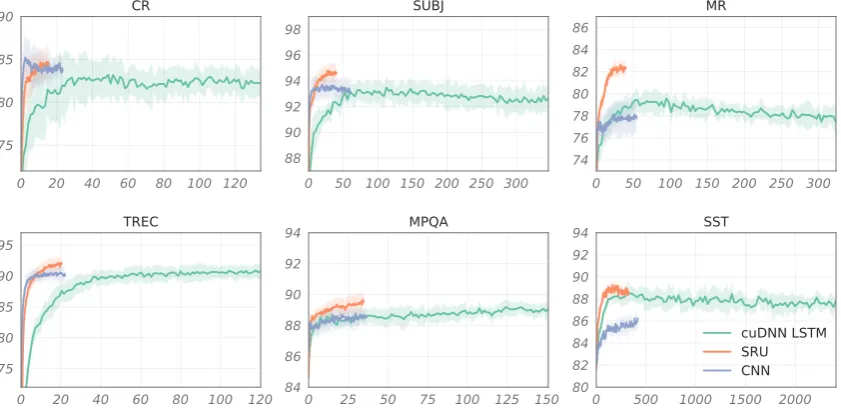
Figure 3: Mean validation accuracies (y-axis) and standard deviations of the CNN, 2-layer LSTM and 2-layer SRU models. We plot the curves of the first 100 epochs. X-axis is the training time used (in seconds). Timings are performed on NVIDIA GeForce GTX 1070 GPU, Intel Core i7-7700K Processor and cuDNN 7003.
ported in previous methods when multiple model variants were explored in their experiments. De-spite our simple setup, SRU outperforms most pre-vious methods and achieves comparable results compared to the state-of-the-art but more sophisti-cated model ofZhao et al.(2015). Figure3shows validation performance relative to training time for SRU, cuDNN LSTM and the CNN model. Our SRU implementation runs 5–9 times faster than cuDNN LSTM, and 6–40% faster than the CNN model ofKim(2014). On the movie review (MR) dataset for instance, SRU completes 100 training epochs within 40 seconds, while LSTM takes over 320 seconds.
4.2 Question Answering
Dataset We use the Stanford Question
Answer-ing Dataset (SQuAD; Rajpurkar et al., 2016). SQuAD is a large machine comprehension dataset that includes over 100K question-answer pairs ex-tracted from Wikipedia articles. We use the stan-dard train and development sets.
Setup We use the Document Reader model of
Chen et al. (2017) as our base architecture for
this task. The model is a combination of word-level bidirectional RNNs and attentions, providing a good testbed to compare our bidirectional SRU
implementation with other RNN components.3
We use the open source implementation of Doc-ument Reader in our experiments.4We train
mod-els for up to 100 epochs, with a batch size of 32 and a hidden dimension of 128. Following the author suggestions, we use the Adamax op-timizer (Kingma and Ba, 2014) and variational dropout (Gal and Ghahramani,2016) during train-ing. We compare with two alternative recurrent components: the bidirectional LSTM adopted in the original implementation ofChen et al.(2017) and Quasi-RNN with highway connections for im-proved performance.
Results Table 2 summarizes the results on
SQuAD. SRU achieves 71.4% exact match and 80.2% F1 score, outperforming the bidirectional LSTM model by 1.9% (EM) and 1.4% (F1) re-spectively. SRU also exhibits over 5x speed-up over LSTM and 53–63% reduction in total train-ing time. In comparison with QRNN, SRU ob-tains 0.8% improvement on exact match and 0.6% on F1 score, and runs 60% faster. This speed im-provement highlights the impact of the fused
ker-3The current state-of-the-art models (Seo et al., 2016;
Wang et al.,2017) make use of additional components such as character-level embeddings, which are not directly com-parable to the setup ofChen et al.(2017). However, these models can potentially benefit from SRU since RNNs are in-corporated in the model architecture.
4476
Model # layers Size Dev Dev Time per epoch
EM F1 RNN Total
LSTM 3 4.1m 69.5 78.8 316s 431s
(Chen et al.,2017)
QRNN (k=1) + highway 46 2.4m3.2m 70.170.6±0.1 79.4±0.1 113s 214s ±0.1 79.6±0.2 161s 262s
SRU 3 2.0m 70.2±0.3 79.3±0.1 58s 159s
SRU 4 2.4m 70.7±0.1 79.7±0.1 72s 173s
SRU 6 3.2m 71.4±0.1 80.2±0.1 100s 201s
Table 2: Exact match (EM) and F1 scores of various models on SQuAD (Section4.2). We also report the total processing time per epoch and the time spent in RNN computations. SRU outperforms other models, and is more than five times faster than cuDNN LSTM.
nel (Algorithm 1). While the QRNN baseline in-volves a similar amount of computation, assem-bling all element-wise operations of both direc-tions in SRU achieves better GPU utilization.
4.3 Machine Translation
Dataset We train translation models on the
WMT English!German dataset, a standard
benchmark for translation systems (Peitz et al.,
2014; Li et al., 2014; Jean et al., 2015). The
dataset consists of 4.5 million sentence pairs. We obtain the pre-tokenized dataset from the Open-NMT project (Klein et al., 2017). The sentences were tokenized using the word-piece model (Wu
et al.,2016b), which generates a shared
vocabu-lary of about 32,000 tokens. Newstest-2014 and newstest-2017 are provided and used as the vali-dation and test sets.5
Setup We use the state-of-the-art Transformer
model ofVaswani et al.(2017) as our base archi-tecture. In the base model, a single Transformer consists of a multi-head attention layer and a bot-tleneck forward layer. We substitute the feed-forward network using our SRU implementation:
base: W·ReLU_layer(x) +b ours: W·SRU_layer(x) +b .
The intuition is that SRU can better capture se-quential information as a recurrent network, and potentially achieve better performance while re-quiring fewer layers.
We keep the model configuration the same as
Vaswani et al. (2017): the model dimension is
5https://github.com/OpenNMT/ OpenNMT-tf/tree/master/scripts/wmt
dmodel = 512, the feed-forward and SRU layer has
inner dimensionalitydff=dsru = 2048, and
posi-tional encoding (Gehring et al.,2017) is applied on the input word embeddings. The base model with-out SRU has 6 layers, while we set the number of layers to 4 and 5 when SRU is added. Following the original setup, we use a dropout probability 0.1 for all components, except the SRU in the 5-layer model, for which we use a dropout of 0.2 as we observe stronger over-fitting in training.
We use a single NVIDIA Tesla V100 GPU for each model. The published results were obtained using 8 GPUs in parallel, which provide a large ef-fective batch size during training. To approximate the setup, we update the model parameters ev-ery 5⇥5120 tokens and use 16,000 warm-up steps following OpenNMT suggestions. We train each model for 40 epochs (250,000 steps), and perform 3 independent trials for each model configuration. A single run takes about 3.5 days with a Tesla V100 GPU.
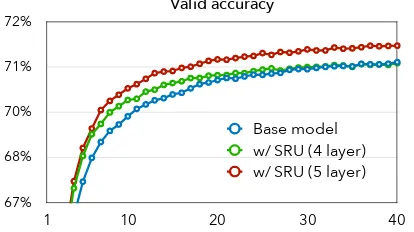
Results Table 3 shows the translation results.
sim-4477
Model # layers Size ValidBLEU score Test (toks/sec) per epochSpeed Hours
Transformer (base) 6 76m 26.6±0.2 (26.9) 27.6±0.2 (27.9) 20k 2.0 Transformer (+SRU) 4 79m 26.7±0.1 (26.8) 27.8±0.1 (28.3) 22k 1.8
[image:8.595.75.282.245.361.2]Transformer (+SRU) 5 90m 27.1±0.0 (27.2) 28.3±0.1 (28.4) 19k 2.1
Table 3: English!German translation results (Section 4.3). We perform 3 independent runs for each
configuration. We select the best epoch based on the valid BLEU score for each run, and report the average results and the standard deviation over 3 runs. In addition, we experiment with averaging model checkpoints and use the averaged version for evaluation, following (Vaswani et al.,2017). We show the best BLEU results achieved in brackets.
3.8 3.9 4.1 4.2 4.3
4.0 4.3 4.5 4.8 5.0
Table 1
Base model (6) w/ SRU (5, 0.2) w/ SRU (4, 0.1) w/ SRU (5, 0.1, 1536) 8.8449 6.9806 6.8904 5.7221 6.0114 5.1309 5.5672 4.8197 5.3095 4.6361 5.1364 4.5104 5.0100 4.4275 4.9129 4.3571 4.8346 4.2995 4.7704 4.2550 4.7163 4.2146 4.6698 4.1893 4.6295 4.1635 4.5939 4.1360 4.5623 4.1260 4.5339 4.1007 4.5084 4.0810 4.4852 4.0714 4.4638 4.0579 4.4443 4.0455 4.4261 4.0365 4.4094 4.0272 4.3939 4.0191 4.3791 4.0091 4.3656 4.0035 4.3527 3.9950 4.3406 3.9850 4.3293 3.9784 4.3188 3.9771 4.3085 3.9825 4.2989 3.9752 4.2896 3.9656 4.2809 3.9641 4.2726 3.9540 4.2645 3.9517 4.2568 3.9482 4.2495 3.9456 4.2423 3.9421 4.2357 3.9353 8.0749 6.4272 6.4581 5.4060 5.6984 4.8829 5.2985 4.6175 5.0637 4.4721 4.9053 4.3722 4.7891 4.2944 4.6997 4.2504 4.6281 4.2073 4.5686 4.1802 4.5186 4.1461 4.4760 4.1203 4.4386 4.0945 4.4060 4.0821 4.3768 4.0678 4.3508 4.0517 4.3272 4.0476 4.3056 4.0331 4.2861 4.0280 4.2681 4.0205 4.2512 4.0098 4.2359 4.0094 4.2216 4.0000 4.2080 3.9928 4.1957 3.9873 4.1839 3.9876 67% 68% 70% 71% 72%
1 10 20 30 40
Base model (6) w/ SRU (4, 0.1) w/ SRU (5, 0.2)
Train PPL
Valid
Train-valid perplexity Valid accuracy
Epoch 67% 68% 70% 71% 72%
1 10 20 30 40
Base model w/ SRU (4 layer) w/ SRU (5 layer) Valid accuracy Epoch 3.8 3.9 4.1 4.2 4.3
4.0 4.3 4.5 4.8 5.0
Base model w/ SRU (5 layer) w/ SRU (4 layer) Train-valid perplexity
Valid
Train PPL
1
Figure 4: Mean validation accuracy (y-axis) of dif-ferent translation models after each training epoch (x-axis).
ilar accuracy. Finally, adding SRU does not affect the parallelization or speed of Transformer – the 4-layer model exhibits 10% speed improvement, while the 5-layer model is only 5% slower com-pared to the base model. We present more results and discussion in AppendixB.3.
4.4 Character-level Language Modeling
Dataset We use Enwik8, a large dataset for
character-level language modeling. Following standard practice, we use the first 90M characters for training and the remaining 10M split evenly for validation and test.
Setup Similar to previous work, we use a batch
size of 128 and an unroll size of 100 for trun-cated backpropagation during training. We also experiment with an unroll size of 256 and a batch size of 64 such that each training instance has longer context. We use a non-zero highway bias br = 3 that is shown useful for training lan-guage model (Zilly et al., 2017). Previous meth-ods employ different optimizers and learning rate schedulers for training. For simplicity and consis-tency, we use the Adam optimizer and the same
learning rate scheduling (i.e., Noam scheduling) as the translation experiments. We train a maxi-mum of 100 epochs (about 700,000 steps).
We compare various recurrent models and use a parameter budget similar to previous methods. In addition, we experiment with the factorization trick (Kuchaiev and Ginsburg,2017) to reduce the total number of parameters without decreasing the performance. See details in AppendixB.
Results Table 4 presents the results of SRU
and other recurrent models. The 8-layer SRU model achieves validation and test bits per char-acter (BPC) of 1.21, outperforming previous best reported results of LSTM, QRNN and recurrent highway networks (RHN). Increasing the layer of SRU to 12 and using a longer context of 256 char-acters in training further improves the BPC to 1.19
4.5 Ablation Analysis
We perform ablation analyses on SRU by succes-sively disabling different components:
(1) Remove the point-wise multiplication term v ct 1 in the forget and reset gates. The
resulting variant involves less recurrence and has less representational capacity.
(2) Disable the scaling correction by setting the constant↵= 1.
(3) Remove the skip connections.
We train model variants on the classification and question answering datasets. Table5and Figure5
4478
Model Size # layers Unroll size Valid Test Time
MI-LSTM (Wu et al.,2016c) 17m 1 100 - 1.44
-HM-LSTM (Chung et al.,2016) 35m 3 100 - 1.32
-LSTM (Melis et al.,2017) 46m 4 50 1.28 1.30
-RHN (Zilly et al.,2017) 46m 10 50 - 1.27
-FS-LSTM (Mujika et al.,2017) 47m 4 100 - 1.25
-QRNN (Merity et al.,2018) 26m 4 200 - 1.33
-LSTM (Merity et al.,2018) 47m 3 200 - 1.23
-SRU 37m 6 100 1.29 1.30 28min
SRU 37m 10 100 1.26 1.27 29min
SRU (with projection) 37m 6 100 1.25 1.26 29min
SRU (with projection) 47m 8 100 1.21 1.21 39min
SRU (with projection) 49m 12 256 1.19 1.19 41min
Table 4: Validation and test BPCs of different recurrent models on Enwik8 dataset. The last column presents the training time per epoch. For SRU with projection, we set the projection dimension to 512.
Model 4 layers 6 layers
SRU (full) 70.7 71.4
removev ct 1 70.6 71.1
[image:9.595.76.288.438.569.2]remove↵-scaling 70.3 71.0 remove highway 69.4 69.1
Table 5: Ablation analysis on SQuAD. Compo-nents are successively removed and the EM scores are averaged over 4 runs.
Table 1
CR CR SUBJ SUBJ MR MR Trec Trec MPQA MPQA
Full (v2) 85.284 84.874 95.389 93.533 83.257 82.301 92.823 94.033 90.14659 90.05592667 - scaling , - c[t-1] 86.78 84.106 94.763 93.473 82.240 82.061 92.284 93.807 91.501 89.732
- highway 85.863 84.115 94.756 93.497 82.771 82.314 91.165 93.093 91.354 90.087
- c[t-1] 0.849 0.836 0.953 0.935 0.831 0.818 0.922 0.939
84.9 83.6 95.3 93.5 83.1 81.8 92.2 93.9
CR CR SUBJ SUBJ MR MR Trec Trec
Full (v2) 85.3 84.9 95.4 93.5 83.3 82.3 92.8 94.0 - c[t-1] 84.9 83.6 95.3 93.5 83.1 81.8 92.2 93.9 - scaling 86.8 84.1 94.8 93.5 82.2 82.1 92.3 93.8 - highway 85.9 84.1 94.8 93.5 82.8 82.3 91.2 93.1
CR SUBJ MR Trec
Full (v2) 85.3 95.4 83.3 92.8
- c[t-1] 84.9 95.3 83.1 92.2 - scaling 86.8 94.8 82.2 92.3 - highway 85.9 94.8 82.8 91.2
CR CR SUBJ SUBJ MR MR Trec Trec CR CR SUBJ SUBJ MR MR Trec Trec CR CR SUBJ SUBJ MR MR Trec Trec
CR SUBJ MR Trec
91.2
82.8 94.8
85.9
92.2
83.1 95.3
84.9
92.8
83.3 95.4
85.3
1
Figure 5: Ablation analysis on the classification datasets. Average validation results are presented. We compare the full SRU implementation (left blue), the variant withoutv ct 1 multiplication
(middle green) and the variant without highway connection (right yellow).
5 Discussion
This work presents Simple Recurrent Unit (SRU), a scalable recurrent architecture that operates as fast as feed-forward and convolutional units. We confirm the effectiveness of SRU on multiple nat-ural language tasks ranging from classification to
translation. We open source our implementation to facilitate future NLP and deep learning research.
Trading capacity with layers SRU achieves
high parallelization by simplifying the hidden-to-hidden dependency. This simplification is likely to reduce the representational power of a single layer and hence should be balanced to avoid perfor-mance loss. However, unlike previous work that suggests additional computation (e.g., n-gram fil-ters) within the layer (Balduzzi and Ghifary,2016;
Bradbury et al., 2017), we argue that increasing
the depth of the model suffices to retain modeling capacity. Our empirical results on various tasks confirm this hypothesis.
Acknowledgement
We thank Alexander Rush and Yoon Kim for help with machine translation experiments, and Danqi Chen for help with SQuAD experiments. We thank Adam Yala, Howard Chen, Jeremy Wohlwend, Lili Yu, Kyle Swanson and Kevin Yang for providing useful feedback on the paper and the SRU implementation. A special thanks to Hugh Perkins for his support on the experimental environment setup and Runqi Yang for answering questions about his code.
References
4479
Jeremy Appleyard, Tomás Kociský, and Phil Blunsom. 2016. Optimizing performance of recurrent neural networks on gpus. CoRR, abs/1604.01946.
Dzmitry Bahdanau, Kyunghyun Cho, and Yoshua Ben-gio. 2015. Neural machine translation by jointly learning to align and translate. In Proceedings of the International Conference on Learning Represen-tations.
David Balduzzi and Muhammad Ghifary. 2016. Strongly-typed recurrent neural networks. In Inter-national Conference on Machine Learning.
James Bradbury, Stephen Merity, Caiming Xiong, and Richard Socher. 2017. Quasi-recurrent neural net-works. InProceedings of the International Confer-ence on Learning Representations.
Danqi Chen, Adam Fisch, Jason Weston, and Antoine Bordes. 2017. Reading wikipedia to answer open-domain questions. In Proceedings of the Annual Meeting of the Association for Computational Lin-guistics.
Yining Chen, Sorcha Gilroy, Kevin Knight, and Jonathan May. 2018. Recurrent neural networks as weighted language recognizers. InProceedings of the Conference of the North American Chapter of the Association for Computational Linguistics: Hu-man Language Technologies.
Kyunghyun Cho, Bart van Merrienboer, à ˘Gaglar GülÃ˘gehre, Dzmitry Bahdanau, Fethi Bougares, Holger Schwenk, and Yoshua Bengio. 2014. Learn-ing phrase representations usLearn-ing rnn encoder– decoder for statistical machine translation. In Pro-ceedings of the Conference on Empirical Methods in Natural Language Processing.
Junyoung Chung, Sungjin Ahn, and Yoshua Bengio. 2016. Hierarchical multiscale recurrent neural net-works. CoRR, abs/1609.01704.
Alexis Conneau, Douwe Kiela, Holger Schwenk, Loïc Barrault, and Antoine Bordes. 2017. Supervised learning of universal sentence representations from natural language inference data. InProceedings of the Conference on Empirical Methods in Natural Language Processing.
Amit Daniely, Roy Frostig, and Yoram Singer. 2016. Toward deeper understanding of neural networks: The power of initialization and a dual view on ex-pressivity. InAdvances In Neural Information Pro-cessing Systems.
Greg Diamos, Shubho Sengupta, Bryan Catanzaro, Mike Chrzanowski, Adam Coates, Erich Elsen, Jesse Engel, Awni Hannun, and Sanjeev Satheesh. 2016. Persistent rnns: Stashing recurrent weights on-chip. In International Conference on Machine Learning.
Yarin Gal and Zoubin Ghahramani. 2016. A theoret-ically grounded application of dropout in recurrent neural networks. InAdvances in Neural Information Processing Systems.
Jonas Gehring, Michael Auli, David Grangier, Denis Yarats, and Yann Dauphin. 2017. Convolutional se-quence to sese-quence learning. InInternational Con-ference on Machine Learning.
Xavier Glorot and Yoshua Bengio. 2010. Understand-ing the difficulty of trainUnderstand-ing deep feedforward neural networks. InProceedings of the international con-ference on artificial intelligence and statistics.
Priya Goyal, Piotr Dollár, Ross B. Girshick, Pieter No-ordhuis, Lukasz Wesolowski, Aapo Kyrola, Andrew Tulloch, Yangqing Jia, and Kaiming He. 2017. Ac-curate, large minibatch SGD: Training imagenet in 1 hour.CoRR, abs/1706.02677.
Klaus Greff, Rupesh Kumar Srivastava, Jan Koutnx00EDk, Bas R. Steunebrink, and Jx00FCrgen Schmidhuber. 2017. Lstm: A search space odyssey. IEEE Transactions on Neural Networks and Learning Systems, 28.
Kaiming He, Xiangyu Zhang, Shaoqing Ren, and Jian Sun. 2015. Delving deep into rectifiers: Surpass-ing human-level performance on imagenet classifi-cation. In Proceedings of the IEEE international conference on computer vision.
Kaiming He, Xiangyu Zhang, Shaoqing Ren, and Jian Sun. 2016. Deep residual learning for image recog-nition. In Proceedings of the IEEE conference on computer vision and pattern recognition.
Luheng He, Kenton Lee, Mike Lewis, and Luke Zettle-moyer. 2017. Deep semantic role labeling: What works and what’s next. InProceedings of the An-nual Meeting of the Association for Computational Linguistics.
Sepp Hochreiter and Jürgen Schmidhuber. 1997. Long short-term memory.Neural computation, 9.
Minqing Hu and Bing Liu. 2004. Mining and summa-rizing customer reviews. InProceedings of the tenth ACM SIGKDD international conference on Knowl-edge discovery and data mining.
Ozan Irsoy and Claire Cardie. 2014. Opinion mining with deep recurrent neural networks. InProceedings of the Conference on Empirical Methods in Natural Language Processing.
Sébastien Jean, Kyunghyun Cho, Roland Memisevic, and Yoshua Bengio. 2015. On using very large tar-get vocabulary for neural machine translation. In
4480
Nal Kalchbrenner, Edward Grefenstette, and Phil Blun-som. 2014. A convolutional neural network for modelling sentences. InProceedings of the Annual Meeting of the Association for Computational Lin-guistics.
Yoon Kim. 2014. Convolutional neural networks for sentence classification. In Proceedings of the Em-pirical Methods in Natural Language Processing.
Yoon Kim, Yacine Jernite, David A Sontag, and Alexander M. Rush. 2016. Character-aware neural language models. InProceedings of the AAAI Con-ference on Artificial Intelligence.
Diederik Kingma and Jimmy Ba. 2014. Adam: A method for stochastic optimization. InProceedings of the International Conference on Learning Repre-sentations.
Guillaume Klein, Yoon Kim, Yuntian Deng, Jean Senellart, and Alexander Rush. 2017. Opennmt: Open-source toolkit for neural machine translation. In Proceedings of ACL 2017, System Demonstra-tions.
Oleksii Kuchaiev and Boris Ginsburg. 2017. Fac-torization tricks for lstm networks. CoRR, abs/1703.10722.
Quoc V. Le, Navdeep Jaitly, and Geoffrey E. Hinton. 2015. A simple way to initialize recurrent networks of rectified linear units. CoRR, abs/1504.00941.
Kenton Lee, Omer Levy, and Luke S. Zettlemoyer. 2017. Recurrent additive networks. CoRR, abs/1705.07393.
Tao Lei, Regina Barzilay, and Tommi Jaakkola. 2015. Molding cnns for text: non-linear, non-consecutive convolutions. InProceedings of the Conference on Empirical Methods in Natural Language Process-ing. Association for Computational Linguistics.
Tao Lei, Wengong Jin, Regina Barzilay, and Tommi Jaakkola. 2017. Deriving neural architectures from sequence and graph kernels. International Confer-ence on Machine Learning.
Liangyou Li, Xiaofeng Wu, Santiago Cortes Vaillo, Jun Xie, Andy Way, and Qun Liu. 2014. The DCU-ICTCAS MT system at WMT 2014 on german-english translation task. InProceedings of the Ninth Workshop on Statistical Machine Translation.
Xin Li and Dan Roth. 2002. Learning question classi-fiers. InProceedings of the international conference on Computational linguistics-Volume 1. Association for Computational Linguistics.
Minh-Thang Luong, Hieu Pham, and Christopher D. Manning. 2015. Effective approaches to attention-based neural machine translation. In Empirical Methods in Natural Language Processing. Associ-ation for ComputAssoci-ational Linguistics.
Hongyuan Mei, Mohit Bansal, and R. Matthew Walter. 2016. What to talk about and how? selective gener-ation using lstms with coarse-to-fine alignment. In
Proceedings of the Conference of the North Amer-ican Chapter of the Association for Computational Linguistics: Human Language Technologies.
Gábor Melis, Chris Dyer, and Phil Blunsom. 2017. On the state of the art of evaluation in neural language models. CoRR, abs/1707.05589.
Stephen Merity, Nitish Shirish Keskar, and Richard Socher. 2018. An analysis of neural language mod-eling at multiple scales. CoRR, abs/1803.08240.
Yajie Miao, Jinyu Li, Yongqiang Wang, Shi-Xiong Zhang, and Yifan Gong. 2016. Simplifying long short-term memory acoustic models for fast training and decoding. InIEEE International Conference on Acoustics, Speech and Signal Processing.
Dipendra Misra, John Langford, and Yoav Artzi. 2017. Mapping instructions and visual observations to ac-tions with reinforcement learning. InProceedings of the Conference on Empirical Methods in Natural Language Processing.
Asier Mujika, Florian Meier, and Angelika Steger. 2017. Fast-slow recurrent neural networks. In Ad-vances in Neural Information Processing Systems.
Bo Pang and Lillian Lee. 2004. A sentimental edu-cation: Sentiment analysis using subjectivity sum-marization based on minimum cuts. InProceedings of the annual meeting on Association for Computa-tional Linguistics.
Bo Pang and Lillian Lee. 2005. Seeing stars: Ex-ploiting class relationships for sentiment categoriza-tion with respect to rating scales. InProceedings of the annual meeting on association for computational linguistics.
Stephan Peitz, Joern Wuebker, Markus Freitag, and Hermann Ney. 2014. The RWTH aachen german-english machine translation system for wmt 2014. InProceedings of the Ninth Workshop on Statistical Machine Translation.
Hao Peng, Roy Schwartz, Sam Thomson, and Noah A. Smith. 2018. Rational recurrences. In Empirical Methods in Natural Language Processing.
P. Rajpurkar, J. Zhang, K. Lopyrev, and P. Liang. 2016. Squad: 100,000+ questions for machine comprehen-sion of text. InEmpirical Methods in Natural Lan-guage Processing.
Min Joon Seo, Aniruddha Kembhavi, Ali Farhadi, and Hannaneh Hajishirzi. 2016. Bidirectional at-tention flow for machine comprehension. CoRR, abs/1611.01603.
4481
The sparsely-gated mixture-of-experts layer. arXiv preprint arXiv:1701.06538.
Richard Socher, Alex Perelygin, Jean Wu, Jason Chuang, Christopher D. Manning, Andrew Y. Ng, and Christopher Potts. 2013. Recursive deep mod-els for semantic compositionality over a sentiment treebank. InProceedings of the Conference on Em-pirical Methods in Natural Language Processing. Rupesh K Srivastava, Klaus Greff, and Jürgen
Schmid-huber. 2015. Training very deep networks. In Ad-vances in neural information processing systems. Alane Suhr and Yoav Artzi. 2018. Situated mapping
of sequential instructions to actions with single-step reward observation. In Proceedings of the Annual Meeting of the Association for Computational Lin-guistics.
Alane Suhr, Srinivasan Iyer, and Yoav Artzi. 2018. Learning to map context-dependent sentences to ex-ecutable formal queries. InProceedings of the Con-ference of the North American Chapter of the Asso-ciation for Computational Linguistics: Human Lan-guage Technologies.
Ashish Vaswani, Noam Shazeer, Niki Parmar, Jakob Uszkoreit, Llion Jones, Aidan N. Gomez, Lukasz Kaiser, and Illia Polosukhin. 2017. Attention is all you need. InAdvances in Neural Information Pro-cessing Systems.
Sida Wang and Christopher Manning. 2013. Fast dropout training. In International Conference on Machine Learning.
Wenhui Wang, Nan Yang, Furu Wei, Baobao Chang, and Ming Zhou. 2017. Gated self-matching net-works for reading comprehension and question an-swering. InProceedings of the Annual Meeting of the Association for Computational Linguistics.
Janyce Wiebe, Theresa Wilson, and Claire Cardie. 2005. Annotating expressions of opinions and emo-tions in language. Language resources and evalua-tion.
Huijia Wu, Jiajun Zhang, and Chengqing Zong. 2016a. An empirical exploration of skip connections for se-quential tagging. In Proceedings of the Interna-tional Conference on ComputaInterna-tional Linguisticss.
Yonghui Wu, Mike Schuster, Zhifeng Chen, Quoc V. Le, Mohammad Norouzi, Wolfgang Macherey, Maxim Krikun, Yuan Cao, Qin Gao, Klaus Macherey, Jeff Klingner, Apurva Shah, Melvin Johnson, Xiaobing Liu, Å ˛Aukasz Kaiser, Stephan Gouws, Yoshikiyo Kato, Taku Kudo, Hideto Kazawa, Keith Stevens, George Kurian, Nishant Patil, Wei Wang, Cliff Young, Jason Smith, Ja-son Riesa, Alex Rudnick, Oriol Vinyals, Greg Cor-rado, Macduff Hughes, and Jeffrey Dean. 2016b. Google’s neural machine translation system: Bridg-ing the gap between human and machine translation.
CoRR, abs/1609.08144.
Yuhuai Wu, Saizheng Zhang, Ying Zhang, Yoshua Bengio, and Ruslan R Salakhutdinov. 2016c. On multiplicative integration with recurrent neural net-works. InAdvances in Neural Information Process-ing Systems.
Wojciech Zaremba, Ilya Sutskever, and Oriol Vinyals. 2014. Recurrent neural network regularization.
CoRR, abs/1409.2329.
Yingjie Zhang and Byron C. Wallace. 2017. A sensi-tivity analysis of (and practitioners’ guide to) convo-lutional neural networks for sentence classification. InProceedings of the International Joint Conference on Natural Language Processing.
Yuchen Zhang, Jason D. Lee, and Michael I. Jordan. 2016. `1-regularized neural networks are
improp-erly learnable in polynomial time. InInternational Conference on Machine Learning.
Han Zhao, Zhengdong Lu, and Pascal Poupart. 2015. Self-adaptive hierarchical sentence model. In Pro-ceedings of the International Joint Conference on Artificial Intelligence.
Julian Georg Zilly, Rupesh Kumar Srivastava, Jan Koutník, and Jürgen Schmidhuber. 2017. Recurrent highway networks. InInternational Conference on Machine Learning.