104
CUNI-Malta system at SIGMORPHON 2019 Shared Task on
Morphological Analysis and Lemmatization in context: Operation-based
word formation
Ronald Cardenas♣♠ Claudia Borg♠ Daniel Zeman♣
♣Institute of Formal and Applied Linguistics, Charles University in Prague
♠Department of Artificial Intelligence, Faculty of ICT, University of Malta
[email protected] [email protected] [email protected]
Abstract
This paper presents the submission by the Charles University-University of Malta team to the SIGMORPHON 2019 Shared Task on Morphological Analysis and Lemmatization in context. We present a lemmatization model based on previous work on neural transduc-ers (Makarov and Clematide,2018b;Aharoni
and Goldberg, 2016). The key difference is
that our model transforms the whole word form in every step, instead of consuming it character by character. We propose a merg-ing strategy inspired by Byte-Pair-Encodmerg-ing that reduces the space of valid operations by merging frequent adjacent operations. The resulting operations not only encode the ac-tions to be performed but the relative position in the word token and how characters need to be transformed. Our morphological tag-ger is a vanilla biLSTM tagtag-ger that operates over operation representations, encoding op-erations and words in a hierarchical manner. Even though relative performance according to metrics is below the baseline, experiments show that our models capture important asso-ciations between interpretable operation labels and fine-grained morpho-syntax labels.
1 Introduction
Tasks related to morphological analysis have been traditionally formulated as string transduction problems tackled by weighted finite state
trans-ducers (Mohri, 2004; Eisner, 2002). More
re-cently, however, the problem has been tackled with neural architectures featuring
sequence-to-sequence architectures (Kann and Sch¨utze,2016)
and neural transducers (Aharoni and Goldberg,
2016;Makarov and Clematide,2018b,a).
In this paper we describe our submission for the SIGMORPHON 2019 Shared Task related to morphological analysis and lemmatization in
context (McCarthy et al., 2019). We focus on
an operation-based word formation process using a neural transducer which consumes more than
one character at a time. Our main motivation
for this approach stems from neural transducers that normally consume one character at a time using context-enriched representation of
charac-ters.1 In language modelling, character-based
RNNs have a difficulty capturing long dependen-cies between characters, especially dependendependen-cies in words which are separated by several tokens. This can be a crucial piece of information for mor-phological analysis in context. This type of ap-proach has already been extend effectively to Neu-ral Machine Translation by (Sennrich et al.,2016), who employ simple character n-gram models and
a segmentation based on the byte pair encoding
(BPE) compression algorithm.
2 Related Work
In the last few years, efforts on the analysis of endangered low-resourced languages and the
de-velopment of basic language tools for them (Rios,
2016;Pereira-Noriega et al., 2017;Cardenas and Zeman, 2018) have once more brought atten-tion into the latent necessity for research of less language-dependent models that are not unreason-ably data hungry.
On the other hand, more recent efforts have proposed combined strategies to bring together the transducer paradigm and neural architectures (Rastogi et al.,2016;Aharoni and Goldberg,2016;
Lin et al., 2019). For example, the neural
trans-ducer proposed by (Aharoni and Goldberg,2016)
presents a sequence to sequence architecture that decodes one character at a time while attending at the input character under a hard-monotonic con-strain. However, their method relies on
out-of-1We release our code at https://github.com/
the-pipeline alignment of the input and output
string at the character level. Subsequent work
by Makarov and Clematide (2018b) proposed a transition-based architecture instead, although still operating under the same conditions, i.e. consum-ing one character at a time and relyconsum-ing on
pre-alignment. More recently, however,Makarov and
Clematide (2018a) proposed to learn alignment lattices along the transduction mechanism under an imitation learning framework, hence eliminat-ing the need for seliminat-ingle, noisy alignments.
In this work, we propose a neural architecture that encodes more expressive, interpretable trans-ducer operations. We relax the condition of con-suming one character at a time, and derive oper-ations meant to be applied at the word level in-stead. These operations are obtained by merging initial character-level operations using the BPE al-gorithm (Gage,1994).
3 Task Description
The SIGMORPHON 2019 Shared Task (
Mc-Carthy et al., 2019) features three main tasks: (i) cross-lingual transfer for inflection generation, (ii) morphological analysis and lemmatization in con-text, and (iii) an open challenge over past editions of the shared tasks.
We participated in Task II for which a com-plete sentence of word forms is presented and lem-mas and feature bundles (morpho-syntantic de-scription labels) are to be predicted for each to-ken. This task features an outstanding diverse pool of 66 languages from a total of 107 treebanks. Data (forms, lemmas, and feature bundles) are obtained from UniversalDependencies v.2.3
tree-banks (Nivre et al., 2018). However, the feature
bundles are translated into the UniMorph tagset (Kirov et al., 2018) using the mapping strategy
proposed byMcCarthy et al.(2018).
4 Problem Formulation
Let w ∈ V and z ∈ VL be a word type and
its corresponding lemma; and let A be a set of
string transformation actions. We define the
func-tionT :V × Am 7→ VLthat receives as input a
word formwand a sequence of string
transforma-tionsa = ha0, ., ai, .., ami. T iteratively applies
the transformations one at a time and returns the resulting string. The objective is to obtain a
se-quence of actionsasuch that a formwgets
trans-formed into its lemmaz, i.e.T(w, a) =z.
4.1 String transformations at the word level
We encode every string transformation
-henceforth, action- ai ∈ A as follows:
hoperation-position-segmenti. The ad-ditional information encoded such as position and segment (characters) involved, allows actions to operate at the word level and act upon a segment of characters instead of a single character. This
is a key difference betweenAand the action sets
of most previously proposed neural transducers (Aharoni and Goldberg, 2017; Makarov and Clematide, 2018b,c) which only encode the operation to perform and consume one character at a time.
4.2 Obtaining gold action sequences
We discuss now how to deterministically
popu-lateA. We start off with operations that act upon
one character at a time. We derive these oper-ations with the Damerou-Levenshtein (DL)
dis-tance algorithm which adds thetransposition
op-eration in addition to the traditional set of the edit
distance algorithm. However, the set A of the
formhoperation-position-segmenti di-rectly derived by this algorithm is too large and sparse to be learned effectively, especially because
of thepositioncomponent.
Hence, we simplify A by merging the kmost
frequent operations performed at adjacent
posi-tions by using Byte-Pair-Encoding (BPE) (Gage,
1994). Furthermore, we replace the position
component of actions performed at the beginning of a token with the label A, indicating that it is a
prefixing action. Analogously, we use the labelA
to indicate it is a suffixing action. Table1presents a description of the licensed values of each com-ponent, including the operation set considered.
Finally, actions are sorted so that prefix actions are performed first, followed by inner-word ac-tions (posiac-tions i), and lastly, suffix actions. In addition, prefix and suffix actions are sorted so that
T would process the word form from the outside
in. Consider the example presented in Table2, a
sequence of suffix actions. The formvisto
(Span-ish for ‘seen’, past participle) is transformed into the lemmaver(‘to see’), with all actions operating at the right border of the current token.
5 System Description
lemma-Component Label Description operation INS insert
DEL delete
SUBS substitute
TRSP transpose
STOP stop
position A at the beginning (prefix)
A at the end (suffix)
i at positioni
[image:3.595.72.305.61.202.2]segment c c∈Σ∗\{∅}
Table 1: Description of components encoded in action labels. Σ: set of characters observed in the training data.
Token Action
visto DEL-A -o vist DEL-A -t vis SUBS-A -er
ver STOP
[image:3.595.344.482.64.128.2]visto DEL-A -o DEL-A -t SUBS-A -er STOP
Table 2: Example of step-by-step transformation from
form visto (Spanish for ‘seen’, past participle) to
lemma ver(‘to see’). Bottom row presents the final token representation as the initial form followed by the action sequence.
tization in context. We tackle the tasks of lemma-tization and analysis with two separate, pipelined models, as follows.
5.1 Lemmatization Model
We posit the task of lemmatization as a language
modelling problem over action sequences. Let
w=hw0, ..., wi, ..., wnibe a sequence of word to-kens,z = hz0, ..., zi, ..., zni the lemma sequence
associated with w, and ai = hai
0, ..., aij, ...aimi
the action sequence such that T(wi, ai) = zi.
We encode ai using an RNN with an LSTM cell
(Hochreiter and Schmidhuber, 1997), as follows hij =LST M(eij, hij−1)
whereeij is the embedding of actionaij. Then, the probability of actionaij is defined as
P(aij|ai1:j−1, θ) =sof tmax(g(W∗hj+b)) (1)
where g(x) is the ReLU activation function, and
W andbare network parameters. As a way to
in-troduce the original word form into the encoded
sequence, we prependwi toai. Hence, the
prob-ability of the first action is determined by h0 =
LST M(ei
0, him−1) where him−1 is the last state of
the encoded action sequence of the previous word wi−1, andei0is the embedding of wordwi.
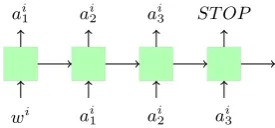
wi ai1 ai2 ai3
ai1 ai2 ai3 ST OP
Figure 1: Architecture of the lemmatization model posited as a language model over action sequences.
The network is then optimized by minimiz-ing the negative log-likelihood of the action se-quences, as follows,
L(W, θ) =− X w∈W
n
X
i=0
P(wi|θ)·
m
X
j=1
P(aij|ai1:j−1, θ)
whereW is the set of all sentences in the
train-ing set andθrepresents the parameters of the
net-work. Figure 1 presents a representation of the
lemmatizer model architecture. Note that aim is
the special action labelST OP. During decoding,
we construct the lemmazi by runningT over the
predicted action sequence ofwi.
5.2 Morphological Tagging Model
LetFi={f0i, ..., fki, fKi }be the morpho-syntactic description (MSD) label associated with word formwi, defined as the concatenation of all
indi-vidual featuresfk such as N orP l, and Fi. We
tackle the task of morphological tagging as a se-quence labeling problem over aggregated repre-sentations of word forms.
We starts off by encoding the action sequence
using a bidirectional LSTM (Graves et al.,2013)
in order to obtain a word level representationxi = [fm;b0], wherefmis the the last forward state and
b0 is the first backward state. We use action
em-beddings trained by the lemmatizer and we freeze them during training.
Then, the sequence x0, .., xn, ui =
biLST M(xi, ui−1) is encoded by a word-level biLSTM
ui = biLST M(xi, ui−1) Then, the probablity of feature labelFiis given by
P(Fi|x1:i−1, θ) =sof tmax(g(W∗ui+b)) (2)
whereg(x)is a ReLU activation function, andW
andbare network parameters. The network is
[image:3.595.75.286.257.318.2]6 Experimental Setup
We follow a two step approach to morphological analysis by first obtaining the action sequence us-ing the lemmatizer model, and then obtainus-ing the feature label sequence over these action represen-tations. All models were implemented and trained
using PyTorch 1.0.0.2
6.1 Action sequence preprocessing
We lowercase forms and lemmas before running the DL-distance algorithm. Following the BPE
training procedure described by Sennrich et al.
(2016), we obtain the list of merged operations
from the action sequences derived from the
train-ing data. We limit the number of merges to
50. Then, these merges are applied to action se-quences on the development and test data.
6.2 Training and optimization of details
Both the lemmatizer and analyzer models were
trained using Adam (Kingma and Ba,2017),
regu-larized using dropout (Srivastava et al.,2014), and employing an early stopping strategy. We tune the hyper-parameters of both models over the
devel-opment set of Spanish (es ancora)3 and then we
use the optimal configuration to train on all
tree-banks except kpv ikdp, kpv lattice, and sa ufal.
Preliminary experiments showed that these tree-banks needed a smaller analyzer model to perform
well. In this case, we choosekpv ikdpas our
ref-erence to obtain an optimal hyper-parameter con-figuration.
In each case, hyper-parameters were optimized over 30 iterations of random search guided by a
Tree-structured Parzen Estimator (TPE).4Table3
presents the hyper-parameters for the lemmatizer, analyzer, and the small version of the analyzer.
For decoding of lemmas, we follow a greedy approach to action sequence decoding. We also experimented with beam search but the improve-ments were not significant. Furthermore, we im-plement heuristics to prune a predicted sequence of actions. In addition to the heuristic of halt-ing decodhalt-ing if a PAD or STOP action is found, we halt if the action is not valid given the current
string. For example, the actionDEL- 5 -o
can-not be applied to stringwhofor the simple reason
2
https://pytorch.org/ 3
We wanted to use a language that is morphologically more complex than English as our reference.
4We use HyperOpt library (http://hyperopt.
github.io/hyperopt/)
Hyper-parameter Lem Anlz
Anlz-small
Batch size 128 24 40
Learning rate 6.90E-05 1.00E-04 0.01
Dropout 0.19 0.05 0.07
Epochs / patience 20 / 5 100 / 30 100 / 30
Action embedding 140 140 140
Action-LSTM cell 100 100 10
Word-LSTM cell - 100 40
FF layer size 100 100 100
[image:4.595.311.524.62.174.2]Clipping threshold - - 0.38
Table 3: Hyper-parameters of all models proposed. Lem = Lemmatizer; Anlz = Analyzer
that the string is not long enough and, hence, the action is not valid.
6.3 Baseline model
We consider the baseline neural model provided by the organizers of the shared task. The architec-ture, proposed byMalaviya et al.(2019), performs lemmatization and morphological tagging jointly. The morphological tagging module of the model
employs an LSTM-based tagger (Heigold et al.,
2017), whilst the lemmatizer module employs a
sequence-to-sequence architecture with hard at-tention mechanism (Xu et al.,2015).
6.4 Co-occurrence of actions and morphological features
We further investigate the co-occurrence of ac-tion labels with individual morphological features.
Given the word formwi and its associated
mor-phological tag Fi = {f0i, ..., fki, fKi } and action sequence ai = ha0, ..., aj, ..., am, let us define
the joint probability distribution between individ-ual features and action labels, as
p(fki, aij) =P(fki|x1:i)·P(aij|ai1:j−1) (3)
We considerP(Fi|x1:i) = P(fki|x1:i),∀fki ∈Fi.
Note that P(Fi|x1:i) and P(aij|ai1:j−1) are the
probabilities obtained by the lemmatizer and tag-ger in equations1and2, respectively.
7 Results and Discussion
7.1 Lemmatization and Morphological Tagging
Table4presents results on all metrics for the top
In lemmatization, our model underperforms the baseline for most treebanks, incurring in an error increase ranging from 0.27% to 35.14% in lemma accuracy. However, we improve over the
base-line on the following languages: Tagalog(tl trg),
Chinese(zh gsd, zh cfl),Cantonese (yue hk),and
Amharic(am att).
We hypothesize that the relative poor perfor-mance in lemmatization stems from the input rep-resentation, i,e. the action sequences.
Combina-tions ofpositioninformation inside the token
( i ) andsegmentcharacters produces an action
setAthat is too fine-grained and sparse, even after the BPE merging of adjacent actions.
In morphological tagging, we observe an error increase ranging from 0.31% to 7.34% in MSD-F1
score. The exception were Russian (ru gsd) and
Finnish (fi tdt) for which we obtain an error
de-crease of 34.88% and 46.71% in MSD-accuracy,5
respectively.
7.2 Actions and Morphological Features
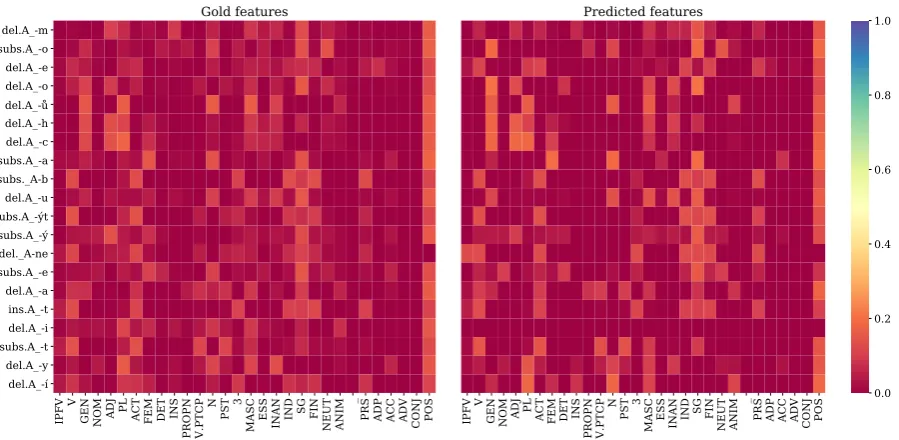
Figure2shows the distribution of individual
mor-phological features over action labels, as defined
in Eq.3for Czech (cs pdt). Every row represents
how likely a fine-grained feature label is to co-occur with an action performed during lemmatiza-tion of a token. On the left, we have co-occurrence distributions of gold actions and gold feature la-bels. On the right, we have co-occurrence distri-butions of predicted actions and predicted feature labels. For ease of visualization, we only plot the 20 most frequent action labels and the 30 most fre-quent features in the development set. We can ob-serve the lemmatizer and tagger succeed in fitting the gold distribution. This is to be expected since the distribution in Eq.3depends onP(Fi|x1:i)and
P(aj|a1:j), which are directly optimized by our
models. We obtain similar plots for Spanish, En-glish, Turkish, German, and Arab.
This analysis also sheds light on which ac-tions and morphological features the model learns
to associate. For example, action del-A -y
is strongly associated with features PL, N, and
MASC, in accordance with the suffix y being a
plural marker. Another notable example is that
of the prefix ne which negates a verb. We
ob-serve that action del- A-ne is strongly
associ-ated with feature V. We also observe ubiquitous
5We noticed that the official MSD-F1 score of the baseline
for these treebanks is reported as0.
features such as POS (positive polarity), which shows an annotation preference unless the bound
morpheme of negation is observed (ne).
8 Limitations
8.1 Fixed gold action sequences
Obtaining gold action sequences as a previous, in-dependent step presents a drawback, as pointed
out byMakarov and Clematide(2018a). The
op-timal action sequence obtained for certain word-lemma pair might not be unique. Hence, if the lemmatizer predicts an alternative valid action se-quence, the loss function would still penalize it during training. Given that we consider only one optimal sequence per word-lemma pair, our model cannot take advantage of all the possible valid al-ternative gold sequences.
8.2 Monotonic correspondence assumption
Previous work on neural transducers for
morphol-ogy tasks (Aharoni and Goldberg,2017;Makarov
and Clematide, 2018b,a) rely on the fact that an almost monotonic alignment of input and output characters exists. This assumption also includes that both words and lemmas are presented in the same writing system (same-script condition), if no off-the-shelf character mapper is used. Our ac-tion sequencer relies on the same-script condiac-tion in order to not produce too long sequences and in turn, our lemmatizer relies on it to learn meaning-ful sequences.
However, upon inspection, we identify a cou-ple of treebanks that violate this condition. In the
first one, Arabic-PUD (ar pud), lemmas are
ro-manized, i.e. presented in Latin rather than Arabic script. For the second one, Akkadian-PISANDUB
(akk pisandub), different writing systems (ideo-graphic vs. syllabic) are encoded in the forms but are not preserved in the lemmas. This encoding in-cludes extra symbols such as hyphens and square brackets as well as capitalization of continuous segments. This kind of mismatch between word forms and lemmas forces our lemmatizer to learn action sequences that transform one character at a time, leading to poor performance given our archi-tecture (16.75% and 14.36% on lemmata accuracy forar pudandakk pisandub,respectively).
8.3 Lemmatizer biased to copy word forms
Treebank Dev Test
LAcc Lev-Dist MAcc M-F1 LAcc Lev-Dist MAcc M-F1
UD Catalan-AnCora 83.25(0.46) 0.27(0.01) 80.56(0.44) 85.59(0.35) 83.47 0.26 81.94 86.79 UD Spanish-GSD 93.78(0.34) 0.11(0.01) 77.58(0.31) 84.64(0.18) 93.83 0.10 78.44 85.06 UD Spanish-AnCora 85.68(0.28) 0.23(0.01) 78.42(0.24) 84.07(0.16) 84.68 0.24 79.66 84.72 UD French-GSD 86.49(0.45) 0.23(0.01) 79.95(0.16) 85.44(0.17) 86.85 0.21 78.59 84.51 UD Hindi-HDTB 92.73(0.26) 0.15(0.01) 69.02(0.42) 84.35(0.20) 92.92 0.15 69.43 84.38 UD Latin-Perseus 57.14(0.65) 1.12(0.01) 31.97(0.86) 33.77(1.46) 56.02 1.14 30.96 32.14 UD Lithuanian-HSE 49.47(0.58) 1.13(0.03) 22.53(6.82) 24.87(4.19) 35.82 1.24 21.39 28.57 UD Cantonese-HK 98.68(0.19) 0.02(0.00) 23.23(0.18) 25.11(0.17) 98.57 0.01 23.57 25.76 UD Chinese-CFL 100.00(0.00) 0.00(0.00) 24.21(0.06) 25.73(0.05) 99.53 0 23.29 24.71 UD Yoruba-YTB 96.80(0.00) 0.03(0.00) 24.40(0.31) 22.06(0.96) 96.12 0.04 20.54 17.5
Mean 74.39 0.62 44.07 53.79 74.94 0.62 50.37 58.81
[image:6.595.73.533.118.261.2]Median 78.46 0.43 45.96 55.13 78.42 0.44 52.77 62.26
Table 4: Results on Task2 for the best and worst 5 treebanks. Scores over the development set are presented as mean (std) values over 10 runs. Scores over test set are taken from the official results. LAcc = lemmatization accuracy; Lev-Dist = Levenshtein distance of lemmas; MAcc = accuracy of morphosyntactic descriptions (features); M-F1 =F1score of morphosyntactic descriptions.
IPFV V GEN NOM ADJ PL ACT FEM DET INS PROPN V.PTCP
N
PST 3
MASC ESS INAN IND SG FIN NEUT ANIM
_
PRS ADP ACC ADV CONJ POS del.A_-m
subs.A_-o del.A_-e del.A_-o del.A_-del.A_-h del.A_-c subs.A_-a subs._A-b del.A_-u subs.A_-ýt subs.A_-ý del._A-ne subs.A_-e del.A_-a ins.A_-t del.A_-i subs.A_-t del.A_-y del.A_-í
Gold features
IPFV V GEN NOM ADJ PL ACT FEM DET INS PROPN V.PTCP
N
PST 3
MASC ESS INAN IND SG FIN NEUT ANIM
_
PRS ADP ACC ADV CONJ POS
Predicted features
0.0 0.2 0.4 0.6 0.8 1.0
[image:6.595.77.527.439.659.2]copying the whole input to the output, as pointed
out byMakarov and Clematide(2018b). Our
pro-posed lemmatizer exhibits the same kind of bias, obtaining up to 99.53% of lemmata accuracy for Chinese-CFL and Levenshtein distance of 0.0 in test set and 100% and 0.0 in the development set. Other languages benefit from this bias also, as can
be observed in Figure3. We note that, on average,
the lemmatizer predicts no more than 3 actions be-fore halting.
0.0 0.5 1.0 1.5 2.0 2.5 Average number of predicted actions 20
30 40 50 60 70 80 90 100
[image:7.595.80.285.218.368.2]Lemmata Accuracy
Figure 3: Average number of predicted actions over de-velopment set, not including the STOP operation, one data point per treebank.
9 Conclusions
We presented our submission to the SIGMOR-PHON 2019 Shared Task on Morphological Anal-ysis and Lemmatization in context. We presented a lemmatization strategy based on word formation operations derived from extended edit-distance operations that operate at the word level instead of at the character leve. These operations are merged using a BPE-inspired algorithm in order to encode segment (prefix, suffix) information in addition to the action to perform. Most notably, the proposed models are capable of associate the derived inter-pretable operations with morpho-syntactic feature labels. We find that the proposed architectures un-derperform the shared task baseline for most tree-banks, showing plenty of room for improvement in this regard.
References
Roee Aharoni and Yoav Goldberg. 2016. Morphologi-cal inflection generation with hard monotonic atten-tion. arXiv preprint arXiv:1611.01487.
Roee Aharoni and Yoav Goldberg. 2017. Morphologi-cal inflection generation with hard monotonic
atten-tion. InProceedings of the 55th Annual Meeting of
the Association for Computational Linguistics (Vol-ume 1: Long Papers), pages 2004–2015, Vancouver, Canada. Association for Computational Linguistics.
Ronald Cardenas and Daniel Zeman. 2018. A mor-phological analyzer for shipibo-konibo. SIGMOR-PHON 2018, page 131.
Jason Eisner. 2002. Parameter estimation for proba-bilistic finite-state transducers. In Proceedings of the 40th Annual Meeting of the Association for Com-putational Linguistics.
Philip Gage. 1994. A new algorithm for data compres-sion.The C Users Journal, 12(2):23–38.
Alex Graves, Abdel-rahman Mohamed, and Geoffrey Hinton. 2013. Speech recognition with deep recur-rent neural networks. In 2013 IEEE international conference on acoustics, speech and signal process-ing, pages 6645–6649. IEEE.
Georg Heigold, Guenter Neumann, and Josef van Gen-abith. 2017. An extensive empirical evaluation of character-based morphological tagging for 14 lan-guages. In Proceedings of the 15th Conference of the European Chapter of the Association for Compu-tational Linguistics: Volume 1, Long Papers, pages 505–513.
Sepp Hochreiter and J¨urgen Schmidhuber. 1997. Long short-term memory. Neural computation, 9(8):1735–1780.
Katharina Kann and Hinrich Sch¨utze. 2016. Single-model encoder-decoder with explicit morphologi-cal representation for reinflection. arXiv preprint arXiv:1606.00589.
Diederik P Kingma and Jimmy Ba. 2017. Adam: A method for stochastic optimization. arXiv preprint arXiv:1412.6980.
Christo Kirov, Ryan Cotterell, John Sylak-Glassman, G´eraldine Walther, Ekaterina Vylomova, Patrick Xia, Manaal Faruqui, Sebastian J. Mielke, Arya Mc-Carthy, Sandra K¨ubler, David Yarowsky, Jason Eis-ner, and Mans Hulden. 2018. UniMorph 2.0:
Uni-versal Morphology. In Proceedings of the 11th
Language Resources and Evaluation Conference, Miyazaki, Japan. European Language Resource As-sociation.
Chu-Cheng Lin, Hao Zhu, Matthew R. Gormley, and Jason Eisner. 2019. Neural finite-state transducers:
Beyond rational relations. In Proceedings of the
Peter Makarov and Simon Clematide. 2018a. Imita-tion learning for neural morphological string trans-duction. InProceedings of the 2018 Conference on Empirical Methods in Natural Language Process-ing, pages 2877–2882.
Peter Makarov and Simon Clematide. 2018b. Neu-ral transition-based string transduction for limited-resource setting in morphology. In Proceedings of the 27th International Conference on Computational Linguistics, pages 83–93.
Peter Makarov and Simon Clematide. 2018c. Uzh at conll-sigmorphon 2018 shared task on univer-sal morphological reinflection. Proceedings of the CoNLL SIGMORPHON 2018 Shared Task: Univer-sal Morphological Reinflection, pages 69–75.
Chaitanya Malaviya, Shijie Wu, and Ryan Cotterell. 2019. A simple joint model for improved contextual neural lemmatization. In Proceedings of the 2019 Annual Conference of the North American Chap-ter of the Association for Computational Linguistics (NAACL).
Arya D. McCarthy, Miikka Silfverberg, Ryan Cotterell, Mans Hulden, and David Yarowsky. 2018. Mar-rying Universal Dependencies and Universal
Mor-phology. In Proceedings of the Second Workshop
on Universal Dependencies (UDW 2018), pages 91– 101, Brussels, Belgium. Association for Computa-tional Linguistics.
Arya D. McCarthy, Ekaterina Vylomova, Shijie Wu, Chaitanya Malaviya, Lawrence Wolf-Sonkin, Gar-rett Nicolai, Christo Kirov, Miikka Silfverberg, Se-bastian Mielke, Jeffrey Heinz, Ryan Cotterell, and Mans Hulden. 2019. The SIGMORPHON 2019 shared task: Crosslinguality and context in
morphol-ogy. In Proceedings of the 16th SIGMORPHON
Workshop on Computational Research in Phonetics, Phonology, and Morphology, Florence, Italy. Asso-ciation for Computational Linguistics.
Mehryar Mohri. 2004. Weighted finite-state transducer algorithms. an overview. InFormal Languages and Applications, pages 551–563. Springer.
Joakim Nivre, Mitchell Abrams, ˇZeljko Agi´c, Lars Ahrenberg, Lene Antonsen, Katya Aplonova, Maria Jesus Aranzabe, Gashaw Arutie, Masayuki Asahara, Luma Ateyah, Mohammed Attia, Aitz-iber Atutxa, Liesbeth Augustinus, Elena Bad-maeva, Miguel Ballesteros, Esha Banerjee, Sebas-tian Bank, Verginica Barbu Mititelu, Victoria Bas-mov, John Bauer, Sandra Bellato, Kepa Bengoetxea, Yevgeni Berzak, Irshad Ahmad Bhat, Riyaz Ah-mad Bhat, Erica Biagetti, Eckhard Bick, Rogier Blokland, Victoria Bobicev, Carl B¨orstell, Cristina Bosco, Gosse Bouma, Sam Bowman, Adriane Boyd, Aljoscha Burchardt, Marie Candito, Bernard Caron, Gauthier Caron, G¨uls¸en Cebiro˘glu Eryi˘git, Flavio Massimiliano Cecchini, Giuseppe G. A. Celano, Slavom´ır ˇC´epl¨o, Savas Cetin, Fabricio Chalub, Jinho Choi, Yongseok Cho, Jayeol Chun,
Benoˆıt Sagot, Shadi Saleh, Tanja Samardˇzi´c, Stephanie Samson, Manuela Sanguinetti, Baiba Saul¯ıte, Yanin Sawanakunanon, Nathan Schnei-der, Sebastian Schuster, Djam´e Seddah, Wolfgang Seeker, Mojgan Seraji, Mo Shen, Atsuko Shi-mada, Muh Shohibussirri, Dmitry Sichinava, Na-talia Silveira, Maria Simi, Radu Simionescu, Katalin Simk´o, M´aria ˇSimkov´a, Kiril Simov, Aaron Smith, Isabela Soares-Bastos, Carolyn Spadine, Antonio Stella, Milan Straka, Jana Strnadov´a, Alane Suhr, Umut Sulubacak, Zsolt Sz´ant´o, Dima Taji, Yuta Takahashi, Takaaki Tanaka, Isabelle Tellier, Trond Trosterud, Anna Trukhina, Reut Tsarfaty, Francis Tyers, Sumire Uematsu, Zdeˇnka Ureˇsov´a, Larraitz Uria, Hans Uszkoreit, Sowmya Vajjala, Daniel van Niekerk, Gertjan van Noord, Viktor Varga, Eric Villemonte de la Clergerie, Veronika Vincze, Lars Wallin, Jing Xian Wang, Jonathan North Washing-ton, Seyi Williams, Mats Wir´en, Tsegay Wolde-mariam, Tak-sum Wong, Chunxiao Yan, Marat M. Yavrumyan, Zhuoran Yu, Zdenˇek ˇZabokrtsk´y, Amir Zeldes, Daniel Zeman, Manying Zhang, and Hanzhi Zhu. 2018. Universal dependencies 2.3. LIN-DAT/CLARIN digital library at the Institute of For-mal and Applied Linguistics ( ´UFAL), Faculty of Mathematics and Physics, Charles University.
Jos´e Pereira-Noriega, Rodolfo Mercado-Gonzales, Andr´es Melgar, Marco Sobrevilla-Cabezudo, and Arturo Oncevay-Marcos. 2017. Ship-lemmatagger: Building an nlp toolkit for a peruvian native lan-guage. InInternational Conference on Text, Speech, and Dialogue, pages 473–481. Springer.
Pushpendre Rastogi, Ryan Cotterell, and Jason Eisner. 2016. Weighting finite-state transductions with neu-ral context. InProceedings of the 2016 Conference of the North American Chapter of the Association for Computational Linguistics: Human Language Technologies, pages 623–633.
Annette Rios. 2016. A basic language technology toolkit for quechua. Procesamiento del Lenguaje Natural, (56):91–94.
Rico Sennrich, Barry Haddow, and Alexandra Birch. 2016. Neural machine translation of rare words
with subword units. InProceedings of the 54th
An-nual Meeting of the Association for Computational Linguistics (Volume 1: Long Papers), pages 1715– 1725, Berlin, Germany. Association for Computa-tional Linguistics.
Nitish Srivastava, Geoffrey Hinton, Alex Krizhevsky, Ilya Sutskever, and Ruslan Salakhutdinov. 2014. Dropout: a simple way to prevent neural networks from overfitting. The Journal of Machine Learning Research, 15(1):1929–1958.
Kelvin Xu, Jimmy Lei Ba, Ryan Kiros, Kyunghyun Cho, Aaron Courville, Ruslan Salakhutdinov, Richard S. Zemel, and Yoshua Bengio. 2015. Show, attend and tell: Neural image caption generation
with visual attention. InProceedings of the 32Nd
In-ternational Conference on InIn-ternational Conference
on Machine Learning - Volume 37, ICML’15, pages 2048–2057. JMLR.org.
Acknowledgments