Munich Personal RePEc Archive
Evaluating policy instruments for the
conservation of biodiversity in a changing
climate
Gerling, Charlotte and Wätzold, Frank
Chair of Environmental Economics, Brandenburg University of
Technology Cottbus-Senftenberg
12 August 2019
1
Evaluating policy instruments for the conservation of biodiversity in a changing
climate
Charlotte Gerling
1[email protected]
+49 (0) 355 69 2094
Frank Wätzold
1[email protected]
1 Chair of Environmental Economics, Brandenburg University of Technology Cottbus-Senftenberg,
Erich-Weinert-Straße 1, Building 1, 03046 Cottbus
Abstract
Climate change is a key threat for biodiversity. In order to mitigate this threat, ecologists suggest two
conservation strategies: (1) enabling a species’ migration towards areas that will become suitable for
the species as climatic conditions change and (2) creating climate refugia in which the species may
persist even if the surrounding landscape is no longer climatically ideal. The policy instruments that
could be used to implement these conservation strategies have so far not been evaluated
comprehensively from an economic perspective. We develop a conceptual evaluation framework with
the criteria ecological effectiveness, cost-effectiveness and dynamic incentives, which are criteria
commonly applied in the economic analysis of environmental policy instruments. For each criterion,
we develop of a set of specific evaluation criteria to assess policy instruments for species conservation
under climate change. We apply the framework by conducting a conceptual analysis of three types of
policy instruments – land purchases, offsets and conservation payments. A key finding of our analysis
is that the degree to which a policy instrument is appropriate for species conservation depends
strongly on the conservation strategy chosen.
Keywords: ecological effectiveness, cost-effectiveness, dynamic incentives, enabling migration,
2 1. Introduction
Climate change is considered one of the main global threats for biodiversity (Sala et al. 2000, Heller &
Zavaleta 2009, Omann et al. 2009). Ecologists warn that current conservation strategies need to take
into account climate change impacts in order to conserve species effectively (Heller & Zavaleta 2009,
Oliver et al. 2016). In principle, they suggest two main strategies to conserve species under climate
change (Vos et al. 2008, Jones et al. 2016).
The first strategy is to enable a species’ migration towards new climate space. “New climate space”
are areas that will become suitable for a species as climatic conditions change (Pearson et al. 2002,
Urban et al. 2016). This “enabling migration” strategy (Vos et al. 2008) is necessary as many species
will not be able to migrate without specific conservation measures in the current fragmented
landscape (Opdam & Wascher 2004, Mooney et al. 2009). Thus, the habitat connectivity towards “new
climate space” will have to be improved by creating migration pathways such as large-scale and
regional corridors (Mackey et al. 2011, Aguiar et al. 2016) or stepping stones (Mackey et al. 2011, Saura
et al. 2013) and habitat sites in the new climate space (Oliver et al. 2016).
The second strategy is “creating climate refugia” (Vos et al. 2008, Singer et al. 2016). This strategy
focuses on enhancing selected “habitat islands” that already exist (Mackey et al. 2011, Oliver et al.
2016). It includes the improvement of habitat quality and the creation of larger and better connected
climate refugia (Vos et al. 2008).
Two important aspects are not considered in the ecologists’ analyses. Firstly, the strategies are
typically analyzed from a conservation planning perspective, i.e. it is explicitly or implicitly assumed
that a planning agency is able to implement conservation measures where and when it desires.
However, often several different types of policy instruments are available for biodiversity conservation
including incentive-based mechanisms. Secondly, the strategies only focus on ecological effectiveness.
3
including cost-effectiveness (Wätzold & Schwerdtner 2005, Laycock et al. 2009, Hily et al. 2015) and
dynamic incentives (Endres 2011, Krämer & Wätzold 2018).
Only few economic analyses of biodiversity conservation under climate change exist. Some authors
focus on a cost-effectiveness analysis of specific measures that may be implemented to protect species
in a case study region without considering the policy instrument context (Wintle et al. 2011;
Mantyka-Pringle et al. 2016). Others investigate the design of single policy instruments (Ay et al. 2014; Rissman
et al. 2015; Tainio et al. 2016; Hily et al. 2017). Finally, some authors analyze aspects of conservation
planning (Strange et al. 2011; Lewis & Polasky 2018) or apply portfolio theory to target cost-effective
conservation activities given climate-change uncertainties (Ando & Hannah 2011; Ando & Mallory
2012; Mallory & Ando 2014; Shah et al. 2016). However, so far there is no comprehensive study that
evaluates different policy instrument options under climate change.
This paper contributes to filling this research gap by developing a framework to evaluate possible
policy instruments for protecting species under climate change at a conceptual level. We modify the
standard economic evaluation criteria ecological effectiveness, cost-effectiveness and dynamic
incentives (Endres 2011; Krämer & Wätzold 2018) to take into account climate change. Our
conservation background are cultural landscapes, for example Western and Central Europe, where
species exist due to a specific, often traditional, land use. This implies that conservation action has to
ensure not only the availability of a specific site for a species but also that a specific land use
(henceforth referred to as conservation measure) is carried out on this site. We demonstrate the
application of the framework for three types of key conservation policy instruments:
(1) Land purchase by conservation agencies to implement species conservation measures on this land,
(2) Offsets as they exist in some Federal German states (OECD 2016) as individually-negotiated,
voluntary contracts where landowners commit themselves to carry out conservation measures for
4
(3) Conservation payments where landowners receive standard payments for pre-defined conservation
measures or conservation output for a short period.
This paper provides novel insights by suggesting an economic framework for evaluating species
conservation policy instruments under climate change. Further, to our knowledge we are the first to
conduct a conceptual analysis of several conservation policy instrument under climate change, which
enables us to derive advantages and disadvantages of different policy instruments. Conceptual
analyses have been used in the past to provide first analyses of an emerging research topic, to
stimulate further discussion and to develop criteria for further analyses (compare Fox & Nino-Murcia
(2005), Wissel & Wätzold (2010) and Engel et al. (2015)).
2. Methods
2.1 Framework of analysis
We create a common setting for the evaluation (cp. Endres 2011). We focus on the impacts of policy
instruments on one species and ignore the impacts on other species. We consider a region with
economic land use where costly conservation measures can turn a site into a suitable habitat for this
species. The region experiences climate change and we assume that the climatically ideal zone for the
species moves from the southern part of the region to its northern part mimicking the poleward shift
of habitats in the Northern Hemisphere. However, even in the climatically less suitable parts of the
region, sites with locally favorable conditions may still be suitable as climate refugia.
The evaluation framework consists of the criteria ecological effectiveness, cost-effectiveness and
dynamic incentives, which are common in the economic analysis of environmental and conservation
policy instruments (Endres 2011, Krämer & Wätzold 2018). We modify the criteria for the evaluation
of conservation policy instruments under climate change as follows.
(1) Ecological effectiveness describes the ability of a conservation instrument to maintain a
species population in a region under climate change (Wätzold 2014) by creating climate
5
(2) Cost-effectiveness describes the ability of a conservation instrument to maintain a species
population in a region under climate change at least costs, or the ability of a conservation
instrument to maximize a species’ survival probability in this region for given costs (Wätzold
2014). Choosing the sites with the highest benefit-cost ratios (with benefit being measured in
terms of ecological effectiveness) is a possible approach to achieve cost-effectiveness as
defined above (Kelly et al. 2017). We only consider “production costs” for biodiversity
conservation measures, such as opportunity costs of landowners who take part in payment
schemes or costs of buying a site and managing it (Wätzold & Schwerdtner 2005). We ignore
transaction costs as the analysis quickly becomes speculative at the conceptual level we have
chosen.
(3) Dynamic incentives refers to the ability of a policy instrument to induce the development and
deployment of improved species conservation measures with a focus on the adaptation to
climate change. Improved species conservation means either a higher ecological output is
achieved with the same costs, or the same ecological output at lower costs (Krämer & Wätzold
2018).
In order to evaluate a policy instrument according to the general criteria ecological effectiveness,
cost-effectiveness and dynamic incentives, we have developed specific criteria for the two strategies
enabling migration and creatingclimate refugia. Depending on the criteria, they may be more or less
relevant for each strategy.
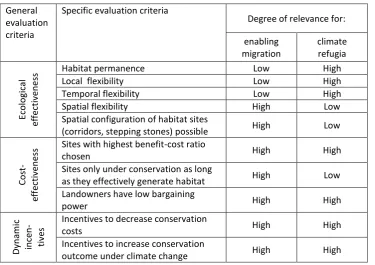
A policy instrument’s degree of permanence, i.e. the long-term maintenance of habitat at a specific
site, may have an important influence on its ecological effectiveness, as habitat turnover negatively
affects the conservation of species that require habitat continuity (Ando & Chen 2011, Johst et al. 2011,
Krause & Culmsee 2013). Avoiding habitat turnover is particularly important for long-term climate
6
Moreover, effectiveness may be positively affected by flexible instruments that allow for adaptations
of conservation measures and sites. Considering flexibility, we distinguish three dimensions. (1) Local
flexibility refers to the ability of a policy instrument to adapt measures to the specific local conditions
of a site. This is relevant for creating climate refugia as they require improved habitat conditions. (2)
Temporal flexibility means the possibility to adapt the implemented measures over time in line with
climate change. Again, this is particularly important for climate refugia in order to maintain a
sufficiently high habitat quality under changing climatic conditions. (3) Spatial flexibility implies the
ability to change the location of conserved sites over time. This is important to enable migration
towards the new climate space and provide conserved sites in this area.
Finally, considering enabling migration, it is important that the policy instrument is able to create
certain spatial configurations of conserved sites such as corridors or stepping stones in order to enable
the species to move.
To reach high levels of cost-effectiveness, sites with the highest benefit-cost ratios should be chosen
for both strategies. It decreases cost-effectiveness if sites that were formerly relevant for conservation,
for example as part of a migration pathway, but are after some time no longer in the climatically
suitable zone, and therefore generate no more conservation benefits, are still under (costly)
conservation. If a specific site is particularly valuable for conservation, depending on the policy
instrument, landowners may have a high bargaining power and demand additional rents in order to
agree to conservation on their land. This generates higher costs and thus decreases a policy
instrument’s cost-effectiveness (Ferraro 2008; Schöttker & Santos 2019). This aspect is relevant for
both strategies as specific sites may be important as climate refugia as well as stepping stones or parts
of a corridor.
Considering dynamic incentives, it is relevant for both strategies that there should be incentives to
decrease the costs of conservation measures and increase their outcome including incentives to adapt
7
[image:8.595.71.447.141.406.2]Table 1 summarizes these specific evaluation criteria and their relevance for the two strategies.
Table 1: Specific evaluation criteria for enabling migration and creatingclimate refugia.
General evaluation criteria
Specific evaluation criteria
Degree of relevance for:
enabling migration climate refugia E col o gi cal e ff e cti ve n e
ss Habitat permanence Local flexibility Low Low High High
Temporal flexibility Low High
Spatial flexibility High Low
Spatial configuration of habitat sites
(corridors, stepping stones) possible High Low
Cos t-e ff e cti ve n e
ss Sites with highest benefit-cost ratio chosen High High
Sites only under conservation as long
as they effectively generate habitat High Low
Landowners have low bargaining
power High High
Dy n ami c in ce n -ti ve
s Incentives to decrease conservation costs High High
Incentives to increase conservation
outcome under climate change High High
2.2 Instrument description
We apply the framework to evaluate stylized versions of three conservation policy instruments. In the
real world, many different versions of the instruments exist. However, for a conceptual analysis a focus
on key characteristics relevant for climate change is necessary.
Land purchase: We assume a conservation agency buys a site to protect a specific species. On its land,
it can implement appropriate conservation measures taking into account species characteristics. Over
time, the agency is able to adapt the measures to changing climatic conditions. It may in principle be
possible for conservation agencies to sell land. However, transaction costs of buying and selling land
are substantial and often the statutes of agencies or local legislation prevent them from selling sites
under conservation (Schöttker & Wätzold 2018). Thus, we assume a conservation agency is unable to
8
Offsets: Having the German impact mitigation regulation as an example in mind (OECD 2016), we
consider offsets to consist of site-specific contracts with the purpose of ensuring conservation
outcomes over a period of 30 years to compensate for impacts of development projects (MLUL
Brandenburg 2017). The contracts are a voluntary, individually negotiated agreement in which
landowners agree to restrictions in land use in exchange for payments. However, the measures cannot
easily be adapted to changing climatic conditions as they are typically specified for the whole contract
period (OECD 2016).
Conservation payments: They are short-term (usually 5 years, cp. Drechsler et al. 2017), voluntary
contracts according to which landowners are paid for implementing conservation measures or
achieving conservation outputs. Typically, contracts with the same measures and payments are offered
to all landowners in a region (Ovenden et al. 1998). We assume that farmers are profit-maximising and
therefore only take part in a payment scheme if at least their costs are covered. We further assume
that any changes in measures (e.g. to adapt to changing climatic conditions) take some time to be
implemented due to the political processes involved and bureaucratic inertia (Theesfeld 2010).
We distinguish between two categories of conservation payments. Measure-based conservation
payments, in which farmers are paid for implementing certain conservation measures, and
results-based conservation payments (Burton & Schwarz 2013, Russi et al. 2016, Drechsler 2017), in which
farmers are free to choose appropriate conservation measures, but are (only) paid if a species to be
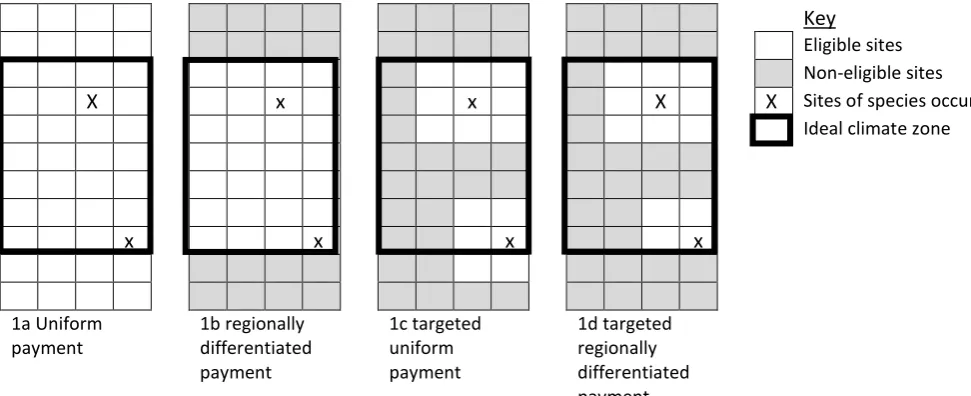
conserved actually occurs on their land. Moreover, we follow Hily et al. (2017) in distinguishing four
types of measure-based conservation payments (Figure 1). They differ in the eligibility criteria for
taking part in the conservation payments. (1) In the uniform conservation payments, any site in a
landscape is eligible. The other conservation payments have limited eligibility: (2) In the regionally
differentiated payment, at any point in time only those sites within the ideal climate zone are eligible.
(3) In the targeted uniform payment, only those sites surrounding current sites of species occurrence
9
conservation payments, only those sites surrounding current sites of species occurrence that lie within
the ideal climate zone are eligible.
Key
Eligible sites Non-eligible sites
X x x X X Sites of species occurrence
Ideal climate zone
x x x x
1a Uniform payment
1b regionally differentiated payment
1c targeted uniform payment
[image:10.595.71.557.131.329.2]1d targeted regionally differentiated payment Figure 1: four types of conservation payments. Source: adapted from Hily et al. (2017).
3 Results
3.1 Land purchase
Effectiveness
Considering the strategy enabling migration, land purchases enable the conservation agency to take
into account the necessary spatial configuration of sites to create corridors or stepping stones.
However, over time, sites in the southern part of the region will have to be substituted by potential
habitat sites in the northern part due to changing climatic suitability. This reduces the effectiveness of
land purchases as acquired sites in the southern part are no longer within the ideal climate zone.
Regarding the creation of climate refugia, land purchases are effective as they ensure the necessary
permanence of sites and allow the adaptation of the implemented conservation measures to local
conditions and to climate change.
Cost-effectiveness
The factors that influence the effectiveness of land purchase also influence their cost-effectiveness.
10
the highest benefit-cost ratios for corridors or stepping stones. However, landowners who sell their
land may ask for price premiums if they know about the importance of their site in the spatial
configuration of the agency’s habitat sites. Moreover, as sites in the southern part of the region are
ineffective at protecting species at some point, the resources spent for the purchase of the site have
no impact on the conservation of the considered species from this point onwards.
Regarding the strategy climate refugia, conservation agencies with limited budgets are able to
purchase the sites with the highest benefit-cost-ratios and to select conservation measures that are
most effective for the available budgets. As the conservation agency is not bound to purchasing a site
within a specific spatial configuration, it is likely that there is sufficient land supply. In this case, the
bargaining power of landowners is low. Both factors imply a high level of cost-effectiveness.
Dynamic incentives
The conservation agency has an interest to conserve species but also has to bear the cost of
conservation measures on acquired land. This creates strong dynamic incentives to develop and apply
more effective conservation measures, also considering the impact of climate change on those
measures, and to identify cost saving opportunities.
3.2 Offsets
Effectiveness
Regarding the strategy enabling migration, the effective spatial configuration of sites for corridors or
stepping stones can be taken into account when negotiating contracts with landowners. In contrast to
land purchases, habitat sites which move outside the ideal climate zone may be replaced by sites in
“new climate space” after the contract ends.
For climate refugia, measures may be developed site-specifically. They may also be adapted to a
11
changing climate conditions are possible as the measures are typically set for the whole period.
Landowners may also decide not to renew a contract, which implies a loss of the climate refugia.
Cost-effectiveness
As contracts are done on an individual basis, offsets provide the possibility to spatially target the sites
with the highest benefit-cost ratio in terms of enabling migration. However, this gives bargaining
power to individual landowners along this migration route, thus reducing cost-effectiveness. To create
climate refugia, offsets are likely to be less cost-effective than land purchases, as the medium-term
offset contract will have to be renewed to provide long-term refugia. This gives a high bargaining
power to landowners, as their sites may have become essential “habitat islands”. Additionally,
landowners generally prefer short-term contracts and may demand premiums on the payments when
agreeing to medium-term offset contracts (Lennox & Armsworth 2011, Drechsler et al. 2017).
Dynamic incentives
During the contract period, dynamic incentives exist only to decrease the costs of the measures but
not to increase the conservation outcome or to respond to changing climatic conditions.
3.3 Conservation payments
Effectiveness
Conservation payments are not well suited to generate a certain spatial configuration of habitat sites.
As any landowner may participate in a scheme, the participating sites generate corridors and stepping
stones only by chance. While payment schemes with limited eligibility lead to more connected sites,
the suitable spatial configuration for migration (i.e. stepping stones or corridors) is still generated only
by chance (Figure 1). Considering the movement of sites with the ideal climate zone, only conservation
payments with restricted eligibility consider the impact of climate change, as sites that lie outside of
the ideal climate zone are automatically excluded from the scheme. However, even this restriction
12
Considering climate refugia, the effectiveness of conservation payments may suffer from habitat
turnover as landowners who participate in a payment scheme in one period may stop doing so in the
next period, while new landowners join the scheme (see Schöttker et al. (2016) and Bartkowski &
Bartke (2018) for factors influencing landowners’ decision making). Additionally, measure-based
schemes are not adapted to the conditions on-site, as all landowners are offered the same measures.
Results-based schemes however do provide incentives to adapt measures to local conditions in order
to create climate refugia.
Measure-based schemes are not very adaptive to climate change, as any adaptation of measures needs
to go through (partly lengthy) administrative and political processes. The landowners have no
incentives to adapt measures themselves even if this would lead to better conservation. Results-based
schemes on the other hand do provide landowners with the incentives to adapt measures to changing
conditions.
Cost-effectiveness
As with conservation payments the same payment is offered to all, no landowner has a specific
bargaining power. The voluntary nature of conservation payments also implies that only sites with
conservation costs below payments are likely to participate. However, this does not necessarily lead
to high cost-effectiveness levels if the conservation outcome of these sites is low. Given that migration
often requires specific spatial configuration of habitat sites, the conservation outcome (and thus the
cost-effectiveness) of uniform payments is likely to be low. While payment schemes with limited
eligibility lead to more connected sites, the suitable spatial configuration for migration (i.e. stepping
stones or corridors) is generated only by chance. Moreover, the eligibility limitations decrease the
choice of low-cost sites. This effect leads to more costly sites being included and a resulting decrease
in cost-effectiveness.
Generally, results-based conservation payments lead to a high cost-effectiveness, as only those sites
13
the least cost conservation options. However, these sites may not be in the ideal configuration for
migration. This decreases the potential effectiveness of the scheme for migration purposes, and thus
also its cost-effectiveness.
Considering climate refugia, conservation payments are not well suited to generate climate refugia
due to habitat turnover (see above). As the expected ecological benefits are therefore low, the
potential cost-effectiveness is also low.
Dynamic incentives
Measure-based conservation payments have low dynamic incentives to improve conservation
outcomes or consider the impact of climate change, as landowners are not rewarded for it. However,
landowners have strong incentives to reduce costs, as cost savings increase landowners’ profits.
Results-based payments provide landowners with dynamic incentives to reduce costs but also to
improve measures to ensure species survival, and thus reduce the risk of not receiving the payment
(Matzdorf & Lorenz 2010). This includes the adaptation of conservation measures to climate change.
4 Discussion
Result overview
We developed a framework to evaluate policy instruments for species conservation under climate
change. For this analysis, we applied three common economic evaluation criteria – ecological
effectiveness, cost-effectiveness and dynamic incentives – and modified them to account for climate
change. We further refined the three general policy evaluation criteria to evaluate the two
conservation strategies, enabling migration and creating climate refugia, suggested by ecologists.
Finally, we applied the framework to conceptually evaluate three policy instruments for species
conservation – land purchase, offsets and conservation payments – under changing climatic
14
Table 2: Overview of policy instrument evaluation according to the criteria for the enabling migration (M) and climate refugia (R) strategies, where a positive impact of a policy instrument is marked by a “+”, a negative one by a “-“ (some policy instruments have both positive and negative impacts with regard to a certain criteria and some criteria are less relevant (l.r.) for one of the strategies).
General evaluation criteria Specific evaluation criteria Land
purchase Offsets
Conservation payments Payments for measures
Payments for results
Uniform Regionally
differentiated Targeted uniform Targeted regionally differentiated
M R M R M R M R M R M R M R
E col o gi cal e ff e cti ve n e ss
Habitat permanence l.r. + l.r. - l.r. - l.r. - l.r. - l.r. - l.r. +, -
Local flexibility l.r. + l.r. + l.r. - l.r. - l.r. - l.r. - l.r. +
Temporal flexibility l.r. + l.r. - l.r. - l.r. - l.r. - l.r. - l.r. +
Spatial flexibility - l.r. + l.r. - l.r. +,- l.r. +,- l.r. +,- l.r. + l.r.
Spatial configuration of habitat sites (corridors, stepping stones) possible
+ l.r. +, - l.r. - l.r. - l.r. - l.r. +, - l.r. - l.r.
Cos t-e ff e cti ve n e ss
Sites with highest
benefit-cost ratio chosen + + +, - - - +, - - +, - +, -
Sites only under conservation for as long as they effectively generate habitat
- l.r. + l.r. - l.r. - l.r. - l.r. - l.r. + l.r.
Landowners have low
bargaining power - + - - + + + + + + + + + +
Dy n ami c in ce n ti ve
s Incentives to decrease
conservation costs + + + + + + + + + + + + + +
Incentives to increase conservation outcome under climate change
15 Importance of conservation strategy for evaluation
We find that the evaluation of a policy instrument is strongly influenced by the conservation strategy.
Depending on the conservation strategy, different evaluation criteria may be relevant (Table 2). A prior
specification of whether the strategy of enabling migration or creating climate refugia is pursued is
therefore required for the evaluation of a policy instrument under climate change. Moreover, the
criteria are satisfied to different degrees by each policy instrument. This means that a policy instrument
may be well suited for one strategy but not so well for the other.
Permanence and flexibility of policy instruments
Our analysis has highlighted the importance of both permanence and flexibility for conservation under
climate change. As these seems to be somewhat opposing requirements, the question arises if a
trade-off exists between the ecological benefits of long-term conservation and the benefits of enhanced
flexibility of policy instruments. Our analysis has shown, for example, that none of the analyzed
instruments has both a high degree of habitat permanence and spatial flexibility. However, our analysis
has also shown that not every criteria is relevant for every strategy. Permanence, for example, is
important for creating climate refugia, while it is not as relevant for enabling migration. In order to
enable migration, however, spatial flexibility is essential- while this is not relevant for climate refugia.
Depending on the chosen strategy, the benefits of permanence and flexibility should therefore be
valued differently.
Limitations of our analysis
Our analysis is subject to some limitations. For example, we excluded transaction costs as their
evaluation was deemed too speculative on a conceptual level. Nonetheless, including the analysis of
transaction costs is an important part of the overall evaluation of policy instruments in the real world.
Moreover, we excluded somewhat extreme cases such as a combination of rapid climate change and
16
example, it seems questionable whether creating climate refugia is still an appropriate approach under
such circumstances. Further, we compared stylized versions of the three policy instruments that
highlight their key characteristics. In reality, instruments may be more complex, and other instruments
(such as conservation easements) and “hybrid” versions of the instruments may exist. However, our
framework may be helpful to analyze these instruments.
Moreover, our analysis was based on several assumptions which may not always hold in reality: firstly,
we assumed that the conservation agency or policy maker acts in the interest of conservation. In
reality, the behavior of conservation agencies may also be influenced by other factors (Robinson 2011).
Secondly, we assumed that conservation agencies do not sell a site and thirdly, we have not considered
that an agency may use a site to conserve other species when the acquired site moves outside of the
ideal climate zone. Our assumptions were made to limit the complexity of analysis. For a specific
real-world case study, one has to carefully investigate in how far these assumptions hold.
Outlook
We hope the presented economic evaluation framework will further stimulate the discussion on the
benefits and drawbacks of different policy instruments under climate change and motivate more
economists to work on this topic. In order to gain a more in-depth understanding of the topic, we
believe that the analysis of case studies focusing on specific policy instruments and species in real
landscapes is particular beneficial in this respect. We recommend that for such empirical analyses,
economists, ecologists and climate scientists join forces and develop integrated models to gain a better
understanding from a perspective that integrates economic and ecological concerns. Given the dearth
of research in this field and the immense threat of climate change for biodiversity, this seems an
17 5 References
Aguiar, L.M.S., Bernard, E., Ribeiro, V., Machado, R.B. & Jones, G. (2016). Should I stay or should I go?
Climate change effects on the future of Neotropical savannah bats. Global Ecology and Conservation,
5, 22-33.
Ando, A.W. & Chen, X. (2011). Optimal contract lengths for voluntary ecosystem service provision
with varied dynamic benefit functions. Conservation Letters, 4(3), 207-218.
Ando, A.W. & Hannah, L. (2011). Lessons from finance for new land-conservation strategies given
climate-change uncertainty. Conservation Biology, 25(2), 412-414.
Ando, A.W. & Mallory, M.L. (2012). Optimal portfolio design to reduce climate-related conservation
uncertainty in the Prairie Pothole Region. Proceedings of the National Academy of Sciences of the
United States of America, 109(17), 6484-6489.
Ay, J.S., Chakir, R., Doyen, L., Jiguet, F. & Leadley, P. (2014). Integrated models, scenarios and
dynamics of climate, land use and common birds. Climatic Change, 126(1–2), 13–30.
Bartkowski, B. & Bartke, S. (2018). Leverage points for governing agricultural soils: a review of
empirical studies of European farmers’ decision-making. Sustainability, 10(9), 3179.
Burton, R.J.F. & Schwarz, G. (2013). Result-oriented agri-environmental schemes in Europe and their
potential for promoting behavioural change. Land Use Policy, 30, 628-641.
Drechsler, M. (2017). Performance of input- and output-based payments for the conservation of
mobile species. Ecological Economics, 134, 49-56.
Drechsler, M., Johst, K. & Wätzold, F. (2017). The cost-effective length of contracts for payments to
compensate land owners for biodiversity conservation measures. Biological Conservation, 207,
18
Endres, A. (2011). Environmental Economics – Theory and Policy. Cambridge: Cambridge University
Press.
Engel, S., Palmer, C., Taschini, L. & Urech, S. (2015). Conservation Payments under Uncertainty. Land
Economics, 91(1), 36-56.
Ferraro, P.J. (2008). Asymmetric information and contract design for payments for environmental
services. Ecological Economics, 65(4), 810-821.
Fox, J. & Nino-Murcia, A. (2005). Status of Species Conservation Banking in the United States.
Conservation Biology, 19(4), 996-1007.
Heller, N.E. & Zavaleta, E.S. (2009). Biodiversity management in the face of climate change: A review
of 22 years of recommendations. Biological Conservation 142, 14-32.
Hily, E., Drechsler, M. & Wätzold, F. (2017). Cost-effectiveness of conservation payment schemes
under climate change. Retrieved from: https://ideas.repec.org/p/lef/wpaper/2017-01.html
[12.07.2019].
Hily, E., Garcia, S., Stenger, A. & Tu, G. (2015). Assessing the cost-effectiveness of a biodiversity
conservation policy: A bio-econometric analysis of Natura 2000 contracts in forest. Ecological
Economics, 119, 197-208.
Johst, K., Drechsler, M., van Teeffelen, A.J.A., Hartig, F., Vos, C.C., Wissel, S., Wätzold, F. & Opdam, P.
(2011). Biodiversity conservation in dynamic landscapes: trade‐offs between number, connectivity
and turnover of habitat patches. Journal of Applied Ecology, 48(5), 1227-1235.
Jones, K.R., Watson, J.E.M., Possingham, H.P. & J. Klein, C.J. (2016). Incorporating climate change into
19
Kelly, K.E., Belcher, K., & Khakbazan, M. (2017). Economic Targeting of Agricultural Beneficial
Management Practices to Address Phosphorus Runoff in Manitoba. Canadian Journal of Agricultural
Economics, 66(1), 143-166.
Krämer, J.E. & Wätzold, F. (2018). The agglomeration bonus in practice—An exploratory assessment
of the Swiss network bonus. Journal for Nature Conservation, 43, 126-135.
Krause, B. & Culmsee, H. (2013). The significance of habitat continuity and current management on
the compositional and functional diversity of grasslands in the uplands of Lower Saxony, Germany.
Flora - Morphology, Distribution, Functional Ecology of Plants, 208(5-6), 299-311.
Laycock, H., Moran, D., Smart, J., Raffaelli, D. & White, P. (2009). Evaluating the cost-effectiveness of
conservation: The UK Biodiversity Action Plan. Biological Conservation, 142(12), 3120-3127.
Lennox, G.D. & Armsworth, P.R. (2011). Suitability of short or long conservation contracts under
ecological and socio-economic uncertainty. Ecological Modelling 222, 2856– 2866.
Lewis, D.J. & Polasky, S. (2018). An auction mechanism for the optimal provision of ecosystem
services under climate change. Journal of Environmental Economics and Management, 92, 20-34.
Mackey, B.G., Watson, J.E.M., Hope, G. & Gilmore, S. (2008). Climate change, biodiversity
conservation, and the role of protected areas: An Australian perspective, Biodiversity, 9(3-4), 11-18.
Mallory, M.L. & Ando, A.W. (2014). Implementing efficient conservation portfolio design. Resource
and Energy Economics, 38, 1-18.
Mantyka-Pringle, C.S., Martin, T.G., Moffatt, D.B., Udy, J., Olley, J., Saxton, N., Sheldon, F., Bunn, S.E.
& Rhodes, J.R. (2016). Prioritizing management actions for the conservation of freshwater
20
Matzdorf, B. & Lorenz, J. (2010). How cost-effective are result-oriented agri-environmental
measures?—An empirical analysis in Germany. Land Use Policy, 27(2), 535-544.
MLUL Brandenburg (2017). Arbeitshilfe Betriebsintegrierte Kompensation. Retrieved from
https://mlul.brandenburg.de/cms/media.php/lbm1.a.3310.de/Arbeitshilfe-Betriebsintegrierte-Kompensation.pdf [17.05.2019].
Mooney, H., Larigauderie, A., Cesario, M., Elmquist, T., Hoegh-Guldberg, O., Lavore, S., Mace, G.M.,
Palmer, M., Scholes, R. & Yahara, T. (2009). Biodiversity, climate change, and ecosystem services.
Current Opinion in Environmental Sustainability, 1(1), 46-54.
OECD (2016). Biodiversity Offsets: Effective Design and Implementation, OECD Publishing: Paris.
Oliver, T.H., Smithers, R.J., Beale, C.M. & Watts, K. (2016). Are existing biodiversity conservation
strategies appropriate in a changing climate? Biological Conservation, 193, 17-26.
Omann, I., Stocker, A. & Jäger, J. (2009). Climate change as a threat to biodiversity: An application of
the DPSIR approach. Ecological Economics, 69(1), 24-31.
Opdam, P. & Wascher, D. (2004). Climate change meets habitat fragmentation: linking landscape and
biogeographical scale levels in research and conservation. Biological Conservation, 117(3), 285-297.
Ovenden, G.N., Swash, A.R.H., & Smallshire, D. (1998). Agri‐environment schemes and their
contribution to the conservation of biodiversity in England. Journal of Applied Ecology, 35(6),
966-960.
Pearson, R.G., Dawson, T.P., Berry, P.M. & Harrison, P.A. (2002). SPECIES: a spatial evaluation of
climate impact on the envelope of species. Ecological Modelling, 154(3), 289-300.
Rissman, A.R., Owley, J., Shaw, M.R., & Thompson, B.(B.) (2015). Adapting Conservation Easements
21
Robinson, J.G. (2011). Ethical pluralism, pragmatism, and sustainability in conservation practice.
Biological Conservation, 144(3), 958-965.
Russi, D., Margue, H., Oppermann, R. & Keenleyside, C. (2016). Result-based agri-environment
measures: Market-based instruments, incentives or rewards? The case of Baden-Württemberg. Land
Use Policy, 54, 69-77.
Sala, O.E., Chapin, F.S., Armesto, J.J., Berlow, E., Bloomfield, J., Dirzo, R. & Leemans, R. (2000). Global
biodiversity scenarios for the year 2100. Science 287(5459), 1770-1774.
Saura, S. Bodin, Ö. & Fortin, M.J. (2013). Stepping stones are crucial for species’ long-distance
dispersal and range expansion through habitat networks. Journal of Applied Ecology, 51, 171–182.
Schöttker, O., Johst, K., Drechsler, M. & Wätzold, F. (2016): Land for biodiversity conservation – to
buy or borrow?, Ecological Economics 129, 94-103.
Schöttker, O. & Wätzold, F. (2018). Buy or lease land? Cost-effective conservation of an oligotrophic
lake in a Natura 2000 area. Biodiversity and Conservation, 27(6), 1327–1345.
Schöttker, O. & Santos, M.J. (2019). Easement or public land? An economic analysis of different
ownership modes for nature conservation measures in California. Conservation Letters.
Shah, P., Mallory, M.L., Ando, A.W. & Guntenspergen, G.R. (2016). Fine-resolution conservation
planning with limited climate-change information. Conservation Biology, 31(2), 278–289.
Singer, A., Johst, K., Banitz, T., Fowler, M.S., Groeneveld, J., Gutiérrez, A.G., Hartig, F., Krug, R.M.,
Liess, M., Matlack, G., Meyer, K.M., Pe'er, G., Radchuk, V., Voinopol-Sassu, A.-J. & Travis, J.M.J.
(2016). Community dynamics under environmental change: How can next generation mechanistic
22
Strange, N., Thorsen, J.T., Bladt, J., Wilson, K.A., & Rahbek, C (2011). Conservation policies and
planning under climate change. Biological Conservation, 144(12), 2968-2977.
Tainio, A., Heikkinen, R.K., Heliölä, J., Hunt, A., Watkiss, P., Fronzek, S., Leikola, N., Lötjönen, S.,
Mashkina, O. & Carter, T.R. (2016). Conservation of grassland butterflies in Finland under a changing
climate. Regional Environmental Change, 16(1), 71–84.
Theesfeld, I. (2010). Institutional Challenges for National Groundwater Governance: Policies and
Issues. Groundwater, 48(1), 131-142.
Urban, M. C., Bocedi, G., Hendry, A.P., Mihoub, J.B., Pe'er, G., Singer, A., Bridle, J.R., Crozier, L.G., De
Meester, L., Godsoe, W., Gonzalez, A., Hellmann, J.J., Holt, R.D., Huth, A., Johst, K., Krug, C.B.,
Leadley, P.W., Palmer, S.C.F., Pantel, J.H., Schmitz, A., Zollner, P.A. & Travis, J.M.J. (2016). Improving
the forecast for biodiversity under climate change. Science 353(6304), aad8466.
Vos, C.C., Berry, P., Opdam, P., Baveco, H., Nijhof, B., O’Hanley, J., Bell, C. & Kuipers, H. (2008).
Adapting landscapes to climate change: examples of climate-proof ecosystem networks and priority
adaptation zones. Journal of Applied Ecology 45, 1722-1731.
Wätzold, F. (2014). Climate Change Adaptation and Biodiversity Conservation: An Economic
Perspective. In E. Albrecht, M. Schmidt, M. Mißler-Behr, S. Spyra (Eds.). Implementing Adaptation
Strategies by Legal, Economic and Planning Instruments on Climate Change, 187 – 195. Heidelberg:
Springer Verlag
Wätzold, F. & Schwerdtner, K. (2005). Why be wasteful when preserving a valuable resource? A
review article on the cost-effectiveness of European biodiversity conservation policy. Biological
Conservation, 123(3), 327-338.
Wintle, B.A., Bekessy, S.A., Keith, D.A., van Wilgen, B.W., Cabeza, M., Schröder, B., Carvalho, S.B.,
23
economic optimization of biodiversity conservation under climate change. Nature Climate Change, 1,
355–359.
Wissel, S. & Wätzold, F. (2010). A conceptual analysis of the application of tradable permits to