32
Few-Shot Dialogue Generation Without Annotated Data: A Transfer
Learning Approach
Igor Shalyminov†, Sungjin Lee‡, Arash Eshghi†, and Oliver Lemon†
†
Heriot-Watt University, UK
‡Microsoft Research, US
†{is33, a.eshghi, o.lemon}@hw.ac.uk, ‡[email protected]
Abstract
Learning with minimal data is one of the key challenges in the development of practical, production-ready goal-oriented dialogue sys-tems. In a real-world enterprise setting where dialogue systems are developed rapidly and are expected to work robustly for an ever-growing variety of domains, products, and sce-narios, efficient learning from a limited num-ber of examples becomes indispensable.
In this paper, we introduce a technique to achieve state-of-the-art dialogue generation performance in a few-shot setup, without us-ing any annotated data. We do this by lever-aging background knowledge from a larger, more highly represented dialogue source — namely, the MetaLWOz dataset. We evalu-ate our model on the Stanford Multi-Domain Dialogue Dataset, consisting of human-human goal-oriented dialogues in in-car navigation, appointment scheduling, and weather informa-tion domains.
We show that our few-shot approach achieves state-of-the art results on that dataset by consistently outperforming the previous best model in terms of BLEU and Entity F1 scores, while being more data-efficient by not requir-ing any data annotation.
1 Introduction
Data-driven dialogue systems are becoming widely adopted in enterprise environments. One of the key properties of a dialogue model in this set-ting is itsdata efficiency, i.e. whether it can attain high accuracy and good generalization properties when only trained from minimal data.
Recent deep learning-based approaches to train-ing dialogue systems (Ultes et al., 2018; Wen et al., 2017) put emphasis on collecting large amounts of data in order to account for numerous variations in the user inputs and to cover as many
dialogue trajectories as possible. However, in real-world production environments there isn’t enough domain-specific data easily available throughout the development process. In addition, it’s impor-tant to be able to rapidly adjust a system’s behav-ior according to updates in requirements and new product features in the domain. Therefore, data-efficient training is a priority direction in dialogue system research.
In this paper, we build on a technique to train a dialogue model for a new domain in a ‘zero-shot’ setup (in terms of full dialogues in the target domain) only using annotated ‘seed’ utterances (Zhao and Esk´enazi,2018).
We present an alternative, ‘few-shot’ approach to data-efficient dialogue system training: we do use complete in-domain dialogues while using ap-proximately the same amount of training data as
Zhao and Esk´enazi(2018), with respect to utter-ances. However, in our method,no annotation is required — we instead use a latent dialogue act annotation learned in an unsupervised way from a larger (multi-domain) data source, broadly fol-lowing the model ofZhao et al.(2018). This ap-proach is potentially more attractive for practical purposes because it is easier to collect unannotated dialogues than collecting utterances across various domains under a consistent annotation scheme.
2 Related Work
There is a substantial amount of work on learn-ing dialogue with minimal data — startlearn-ing with the Dialog State Tracking Challenge 3 ( Hender-son et al.,2014) where the problem was to adjust a pre-trained state tracker to a different domain us-ing a seed dataset.
lin-guistically informed model: (Eshghi et al.,2017) used an incremental semantic parser – DyLan ( Es-hghi et al., 2011;Eshghi, 2015) – to obtain con-textual meaning representations, and based the di-alogue state on this (Kalatzis et al., 2016). In-cremental response generation was learned using Reinforcement Learning, again using the parser to incrementally process the agent’s output and thus prune ungrammatical paths for the learner. Com-pared to a neural model — End-to-End Memory Network (Sukhbaatar et al., 2015), this linguisti-cally informed model was superior in a 1-shot set-ting (Shalyminov et al.,2017). At the same time, its main linguistic resource — a domain-general dialogue grammar for English — makes the model inflexible unless wide coverage is achieved.
Transfer learning for Natural Language Pro-cessing is strongly motivated by recent advances in vision. When training a convolutional neural network (CNN) on a small dataset for a specific problem domain, it often helps to learn low-level convolutional features from a greater, more di-verse dataset. For numerous applications in vision, ImageNet (Deng et al., 2009) became the source dataset for pre-training convolutional models. For NLP, the main means for transfer were Word2Vec word embeddings (Mikolov et al., 2013) which have recently been updated to models capturing contexts as well (Peters et al.,2018;Devlin et al.,
2018). While these tools are widely known to im-prove performance in various tasks, more special-ized models could as well be created for specific research areas, e.g. dialogue generation in our case.
The models above are some of the approaches to one of the central issues of efficient knowledge transfer — learning a unified data representation generalizable across datasets, dubbed ‘representa-tion learning’. In our approach, we will use one such technique based on variational autoencoding with discrete latent variables (Zhao et al., 2018). In this paper we present an approach to transfer learning which is more tailored — both model-wise and dataset-model-wise — to goal-oriented dialogue in underrepresented domains.
3 The approach
3.1 Zero-shot theoretical framework
We first describe the original Zero-Shot Dia-logue Generation (ZSDG) theoretical framework of (Zhao and Esk´enazi,2018) which we base our
work on. For ZSDG, there is a set of source di-alogue domains and one target domain, with the task of training a dialogue response generation model from all the available source data and a significantly reduced subset of the target data (re-ferred to asseed data). The trained system’s per-formance is evaluated exclusively on the target do-main.
More specifically, the data in ZSDG is orga-nized as follows. There are unannotated dialogues in the form of{c,x, d}src/tgt— tuples of dialogue contexts, responses, and domain names respec-tively for each of the source and target domains. There are also domain descriptions in the form of
{x,a, d}src/tgt — tuples of utterances, slot-value annotations, and domain names respectively for source and target domains.
ZSDG is essentially a hierarchical encoder-decoder model which is trained in a multi-task fashion by receiving two types of data: (1) dia-logue batches drawn from all the available source-domain data, and (2) seed data batches, a limited number of which are drawn from domain descrip-tion data for all of the source and target domains.
ZSDG model optimizes for 2 objectives. With dialogue batches, the model maximizes the prob-ability of generating a response given the context:
Ldialog=−logpFd(x| Fe(c, d))
+λD(R(x, d)kFe(c, d)) (1)
where Fe and Fd are respectively the encoding and decoding components of a hierarchical gener-ative model; R is the shared recurrent utterance encoder (therecognition model); and Dis a dis-tance function (L2norm).
In turn, with domain description batches, the model maximizes the probability of generating the utterance given its slot-value annotation, both rep-resented as sequences of tokens:
Ldd=−logpFd(x| R(a, d))
+λD(R(x, d)kR(a, d)) (2)
In this multi-task setup, the latent space of R
(a) LAED pre-training (b) Zero/few-shot dialogue generation
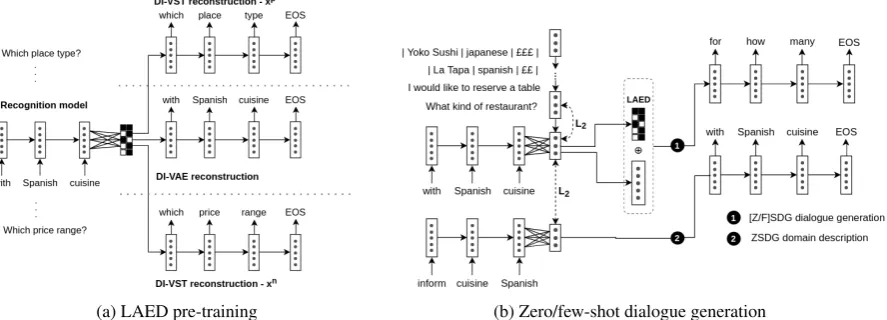
Figure 1: Model architecture. At the pre-training stage (1a), we train the discretized LAED dialogue representation on the Transfer dataset. We then train a zero/few-shot dialogue generation model on SMD with this representation incorporated (1b).
meaning. These properties of the model make it possible to achieve better cross-domain general-ization.
3.2 Unsupervised representation learning
As was the case with ZSDG, robust representa-tion learning helps achieve better generalizarepresenta-tion across domains. The most widely-adopted way to train better representations has been to lever-age a greater data source. In this work, we con-sider unsupervised, variational autoencoder-based (VAE) representation learning on a large dataset of unannotated dialogues. The specific approach we refer to is the Latent Action Encoder-Decoder (LAED) model of (Zhao et al.,2018). LAED is a variant of VAE with two modifications: (1) an op-timization objective augmented with mutual infor-mation between the input and the latent variable for better and more stable learning performance, and (2) discretized latent variable for the inter-pretability of the resulting latent actions. Just as in ZSDG, LAED is a hierarchical encoder-decoder model with the key component being a discrete-information (DI) utterance-level VAE. Two ver-sions of this model are introduced, with respective optimization objectives:
LDI-V AE =EqR(z|x)p(x)[logpG(x|z)]
−KL(q(z)kp(z)) (3)
LDI-V ST =EqR(z|x)p(x)[logpnG(xn |z)ppG(xp|z)]
−KL(q(z)kp(z))
(4)
whereRandG are recognition and generation components respectively, xis the model’s input,
zis the latent variable, and p(z)andq(z)are re-spectively prior and posterior distributions ofz.
DI-VAE works in a standard VAE fashion re-constructing the inputxitself, while DI-VST fol-lows the idea of Variational Skip-Thought recon-structing the input’s previous and next contexts:
{xn,xp}. As reported by the authors, the two
models capture different aspects of utterances, i.e. DI-VAE reconstructs specific words within an ut-terance, whereas DI-VST captures the overall in-tent better — see the visualization in Figure1a.
3.3 Proposed models1
In our approach, we simplify the ZSDG setup by not using any explicit domain descriptions, there-fore we only work with ‘dialogue’ batches. We also make use of Knowledge Base information without loss of generality (see Section5) — thus we work with data of the form{c,x,k, d}where
kis the KB information. We refer to this model as Few-Shot Dialogue Generation, orFSDG.
For learning a reusable dialogue representation, we use an external multi-domain dialogue dataset, the Transfer dataset (see Section4).
We perform a preliminary training stage on it where we train 2 LAED models, both DI-VAE and DI-VST. Then, at the main training stage, we use the hierarchical encoders of both models and in-corporate them with FSDG’s decoder. Thus, we have the following encoding function (which is
1Code is available at https://bit.ly/fsdg_
Model
Domain Navigation Weather Schedule
BLEU, % Entity F1, % BLEU, % Entity F1, % BLEU, % Entity F1, %
ZSDG 5.9 14.0 8.1 31 7.9 36.9
NLU ZSDG 6.1±2.2 12.7±3.3 5.0±1.6 16.8±6.7 6.0±1.7 26.5±5.4 NLU ZSDG+LAED 7.9±1 12.3±2.9 8.7±0.6 21.5±6.2 8.3±1 20.7±4.8 FSDG@1% 6.0±1.8 9.8±4.8 6.9±1.1 22.2±10.7 5.5±0.8 25.6±8.2 FSDG@3% 7.9±0.7 11.8±4.4 9.6±1.8 39.8±7 8.2±1.1 34.8±4.4 FSDG@5% 8.3±1.3 15.3±6.3 11.5±1.6 38.0±10.5 9.7±1.4 37.6±8.0 FSDG@10% 9.8±0.8 19.2±3.2 12.9±2.4 40.4±11.0 12.0±1.0 38.2±4.2 FSDG+VAE@1% 3.6±2.6 9.3±4.1 6.8±1.3 23.2±10.1 4.6±1.6 28.9±7.3 FSDG+VAE@3% 6.9±1.9 15.6±5.8 9.5±2.6 32.2±11.8 6.6±1.7 34.8±7.7 FSDG+VAE@5% 7.8±1.9 12.7±4.2 10.1±2.1 40.3±10.4 8.2±1.7 34.2±8.7 FSDG+VAE@10% 9.0±2.0 18.0±5.8 12.9±2.2 40.1±7.6 11.6±1.5 39.9±6.9 FSDG+LAED@1% 7.1±0.8∗ 10.1±4.5 10.6±2.1∗ 31.4±8.1∗ 7.4±1.2 29.1±6.6 FSDG+LAED@3% 9.2±0.8 14.5±4.8∗ 13.1±1.7 40.8±6.1 9.2±1.2∗ 32.7±6.1 FSDG+LAED@5% 10.3±1.2 15.6±4.5 14.5±2.2 40.9±8.6 11.8±1.9 37.6±6.1∗
[image:4.595.76.522.61.238.2]FSDG+LAED@10% 12.3±0.9 17.3±4.5 17.6±1.9 47.5±6.0 15.2±1.6 38.7±8.4
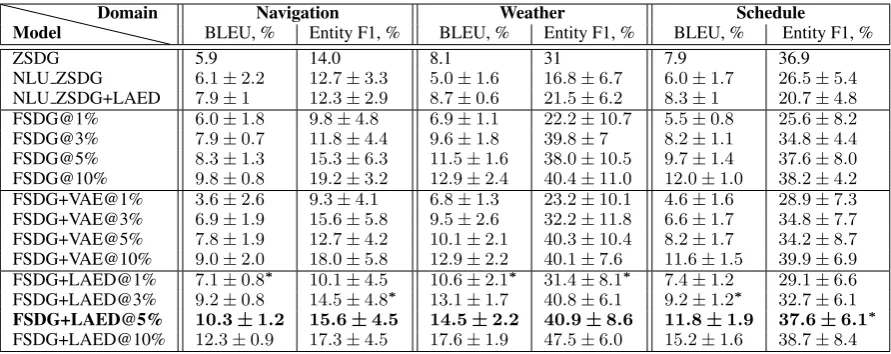
Table 1: Evaluation results. Marked with asterisks are individual results higher than the ZSDG baseline which are achieved with the minimum amount of training data, and in bold is the model consistently outperforming ZSDG in all domains and metrics with minimum data.
then plugged in to the Eq.1):
Fe(c,k, d) =Fe
DI-V AE(c,k, d)
⊕ FDIe -V ST(c,k, d)
⊕ FF SDGe (c,k, d)
(5)
where⊕is the concatenation operator. We refer to this model asFSDG+LAED.
We compare this LAED-augmented model to a similar one, with latent representation trained on the same data but using a regular VAE objective and thus providing regular continuous embeddings (we refer to it asFSDG+VAE).
LV AE =EqR(z|x)[logpG(x|z)]
−KL(qR(z)kp(z))
(6)
Finally, in order to explore the original ZSDG setup as much as possible, we also consider its version with automatic Natural Language Under-standing (NLU) markup instead of human tations as domain descriptions. Our NLU anno-tations include Named Entity Recognizer (Finkel et al.,2005), a date/time extraction library (Chang and Manning,2012), and a Wikidata entity linker (Pappu et al., 2017). We have models with (NLU ZSDG+LAED) and without LAED repre-sentation (NLU ZSDG). Our entire setup is shown in Figure1.
4 Datasets
We use the Stanford Multi-Domain (SMD) human-human goal-oriented dialogue dataset
(Eric et al., 2017) in 3 domains: appointment scheduling, city navigation, and weather informa-tion. Each dialogue comes with knowledge base snippet from the underlying domain-specific API. For LAED training, we use MetaLWOz (Lee et al., 2019), a human-human goal-oriented di-alogue corpus specifically designed for various meta-learning and pre-training purposes. It con-tains conversations in 51 domains with several tasks in each of those. The dialogues are collected using the Wizard-of-Oz method where human par-ticipants were given a problem domain and a spe-cific task. No domain-spespe-cific APIs or knowledge bases were available for the participants, and in the actual dialogues they were free to use fictional names and entities in a consistent way. The dataset totals more than40,000dialogues, with the aver-age length of11.9turns.
5 Experimental setup and evaluation
Our few-shot setup is as follows. Given the target domain, we first train LAED models (a dialogue-level DI-VST and an utterance-dialogue-level DI-VAE, both of the size 10×5) on the MetaLWOz dataset — here we exclude from training every domain that might overlap with the target one.
Next, using the LAED encoders, we train a Few-Shot Dialogue Generation model on all the SMD source domains. We use a random sample (1% to 10%) of the target domain utterances to-gether with their contexts as seed data.
them to the dialogue context, ending up with a setup similar to CopyNet in (Eric et al.,2017).
For the NLU ZSDG setup, we use 1000 random seed utterances from each source domain and 200 utterances from the target domain2.
For evaluation, we follow the approach of (Zhao and Esk´enazi,2018) and report BLEU and Entity F1 scores — means/variances over 10 runs.
6 Results and discussion
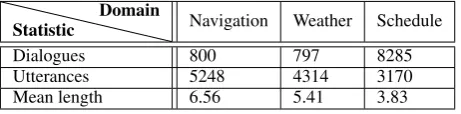
Our results are shown in Table 1. Our objective here is maximum accuracy with minimum train-ing data required, and it can be seen that few-shot models with LAED representation are the best performing models for this objective. While the improvements can already be seen with sim-ple FSDG, the use of LAED representation helps to significantly reduce the amount of in-domain training data needed: in most cases, the state-of-the-art results are attained with as little as 3% of in-domain data. At 5%, we see that FSDG+LAED consistently improves upon all other models in ev-ery domain, either by increasing the mean accu-racy or by decreasing the variation. In SMD, with its average dialogue length of 5.25 turns (see Ta-ble 4), 5% of training dialogues amounts to ap-proximately 200 in-domain training utterances. In contrast, the ZSDG setup used approximately 150
annotatedtraining utterances for each of the 3 do-mains, totalling about 450 annotated utterances. Although in our few-shot approach we use full in-domain dialogues, we end up having a comparable amount of target-domain training data, with the crucial difference that none of those has to be an-notated for our approach. Therefore, the method we introduced attains state-of-the-art in both ac-curacy and data-efficiency.
The results of the ZSDG NLU setup demon-strate that single utterance annotations, if not domain-specific and produced by human experts, don’t provide as much signal as raw dialogues.
The comparison of the setups with different la-tent representations also gives us some insight: while the VAE-powered FSDG model improves on the baseline in multiple cases, it lacks general-ization potential compared to LAED. The reason for that might be inherently more stable training of LAED due to its modified objective function
2The numbers are selected so that the domain description task is kept secondary.
which in turn results in a more informative, gen-eralizable representation.
Finally, we discuss the evaluation metrics. Since we base this paper on the work of (Zhao and Esk´enazi,2018), we have had to fully conform to the metrics they used to enable direct compar-ison. However, BLEU as the primary evaluation metric, does not necessarily reflect NLG quality in dialogue settings — see examples in Table2of the Appendix (see also Novikova et al. (2017)). This is a general issue in dialogue model eval-uation since the variability of possible responses equivalent in meaning is very high in dialogue. In future work, instead of using BLEU, we will put more emphasis on the meaning of utterances, for example by using external dialogue act tagging resources, using quality metrics of language gen-eration – e.g. perplexity – as well as more task-oriented metrics like Entity F1. We expect these to make for more meaningful evaluation criteria.
7 Conclusion and future work
In this paper, we have introduced a technique to achieve state-of-the-art dialogue generation per-formance in a few-shot setup, without using any annotated data. By leveraging larger, more highly represented dialogue sources and learning robust latent dialogue representations from them, we ob-tained a model with superior generalization to an underrepresented domain. Specifically, we showed that our few-shot approach achieves state-of-the art results on the Stanford Multi-Domain dataset while being more data-efficient than the previous best model, by not requiring any data an-notation.
Although being state-of-the-art, the accuracy scores themselves still suggest that our technique is not ready for immediate adoption for real-world production purposes, and the task of few-shot gen-eralization to a new dialogue domain remains an area of active research. We expect that such ini-tiatives will be fostered by the release of large di-alogue corpora such as MetaLWOz.
References
Angel X. Chang and Christopher D. Manning. 2012.
Sutime: A library for recognizing and normalizing time expressions. InProceedings of the Eighth In-ternational Conference on Language Resources and Evaluation, LREC 2012, Istanbul, Turkey, May 23-25, 2012, pages 3735–3740.
Kyunghyun Cho, Bart van Merrienboer, C¸ aglar
G¨ulc¸ehre, Dzmitry Bahdanau, Fethi Bougares,
Hol-ger Schwenk, and Yoshua Bengio. 2014. Learning
phrase representations using RNN encoder-decoder for statistical machine translation. InProceedings of the 2014 Conference on Empirical Methods in Nat-ural Language Processing, EMNLP 2014, October 25-29, 2014, Doha, Qatar, A meeting of SIGDAT, a Special Interest Group of the ACL, pages 1724– 1734.
J. Deng, W. Dong, R. Socher, L.-J. Li, K. Li, and L. Fei-Fei. 2009. ImageNet: A Large-Scale Hierarchical
Image Database. InCVPR09.
Jacob Devlin, Ming-Wei Chang, Kenton Lee, and
Kristina Toutanova. 2018. BERT: pre-training of
deep bidirectional transformers for language under-standing.CoRR, abs/1810.04805.
Mihail Eric, Lakshmi Krishnan, Francois Charette, and
Christopher D. Manning. 2017. Key-value retrieval
networks for task-oriented dialogue. InProceedings of the 18th Annual SIGdial Meeting on Discourse and Dialogue, Saarbr¨ucken, Germany, August 15-17, 2017, pages 37–49.
A. Eshghi, M. Purver, and Julian Hough. 2011. Dylan: Parser for dynamic syntax. Technical report, Queen Mary University of London.
Arash Eshghi. 2015. DS-TTR: An incremental, seman-tic, contextual parser for dialogue. InProceedings of Semdial 2015 (goDial), the 19th workshop on the semantics and pragmatics of dialogue.
Arash Eshghi, Igor Shalyminov, and Oliver Lemon.
2017. Bootstrapping incremental dialogue systems
from minimal data: the generalisation power of di-alogue grammars. InProceedings of the 2017 Con-ference on Empirical Methods in Natural Language Processing, EMNLP 2017, Copenhagen, Denmark, September 9-11, 2017, pages 2220–2230.
Jenny Rose Finkel, Trond Grenager, and
Christo-pher D. Manning. 2005. Incorporating non-local
information into information extraction systems by gibbs sampling. InACL 2005, 43rd Annual Meeting of the Association for Computational Linguistics, Proceedings of the Conference, 25-30 June 2005, University of Michigan, USA, pages 363–370.
Matthew Henderson, Blaise Thomson, and Jason D. Williams. 2014. The third dialog state tracking chal-lenge. In2014 IEEE Spoken Language Technology Workshop, SLT 2014, South Lake Tahoe, NV, USA, December 7-10, 2014, pages 324–329.
Sepp Hochreiter and J¨urgen Schmidhuber. 1997.
Long short-term memory. Neural Computation, 9(8):1735–1780.
Dimitrios Kalatzis, Arash Eshghi, and Oliver Lemon. 2016. Bootstrapping incremental dialogue systems: using linguistic knowledge to learn from minimal
data. In Proceedings of the NIPS 2016 workshop
on Learning Methods for Dialogue, Barcelona.
Diederik P. Kingma and Jimmy Ba. 2014. Adam:
A method for stochastic optimization. CoRR, abs/1412.6980.
Sungjin Lee, Hannes Schulz, Adam Atkinson, Jianfeng Gao, Kaheer Suleman, Layla El Asri, Mahmoud Adada, Minlie Huang, Shikhar Sharma, Wendy Tay,
and Xiujun Li. 2019. Multi-domain task-completion
dialog challenge.
Tomas Mikolov, Ilya Sutskever, Kai Chen, Gregory S.
Corrado, and Jeffrey Dean. 2013. Distributed
rep-resentations of words and phrases and their com-positionality. In Advances in Neural Information Processing Systems 26: 27th Annual Conference on Neural Information Processing Systems 2013. Pro-ceedings of a meeting held December 5-8, 2013, Lake Tahoe, Nevada, United States., pages 3111– 3119.
Jekaterina Novikova, Ondrej Dusek, Amanda Cercas-Curry, and Verena Rieser. 2017. Why we need new
evaluation metrics for nlg. In Proceedings of the
2017 Conference on Empirical Methods in Natural Language Processing (EMNLP).
Aasish Pappu, Roi Blanco, Yashar Mehdad, Amanda Stent, and Kapil Thadani. 2017. Lightweight multi-lingual entity extraction and linking. InProceedings of the Tenth ACM International Conference on Web Search and Data Mining, WSDM 17, New York, NY, USA. ACM.
Matthew E. Peters, Mark Neumann, Mohit Iyyer, Matt Gardner, Christopher Clark, Kenton Lee, and Luke
Zettlemoyer. 2018. Deep contextualized word
rep-resentations. In Proceedings of the 2018 Confer-ence of the North American Chapter of the Associ-ation for ComputAssoci-ational Linguistics: Human Lan-guage Technologies, NAACL-HLT 2018, New Or-leans, Louisiana, USA, June 1-6, 2018, Volume 1 (Long Papers), pages 2227–2237.
Igor Shalyminov, Arash Eshghi, and Oliver Lemon. 2017. Challenging neural dialogue models with nat-ural data: Memory networks fail on incremental
phenomena. In Proceedings of the 21st Workshop
on the Semantics and Pragmatics of Dialogue, Sem-Dial 2017.
Sainbayar Sukhbaatar, Arthur Szlam, Jason Weston,
and Rob Fergus. 2015. End-to-end memory
Stefan Ultes, Pawel Budzianowski, I˜nigo Casanueva, Lina Maria Rojas-Barahona, Bo-Hsiang Tseng, Yen-Chen Wu, Steve J. Young, and Milica Gasic.
2018. Addressing objects and their relations: The
conversational entity dialogue model. In Proceed-ings of the 19th Annual SIGdial Meeting on Dis-course and Dialogue, Melbourne, Australia, July 12-14, 2018, pages 273–283.
Tsung-Hsien Wen, Yishu Miao, Phil Blunsom, and
Steve J. Young. 2017. Latent intention dialogue
models. InProceedings of the 34th International Conference on Machine Learning, ICML 2017, Syd-ney, NSW, Australia, 6-11 August 2017, pages 3732– 3741.
Tiancheng Zhao and Maxine Esk´enazi. 2018.
Zero-shot dialog generation with cross-domain latent ac-tions. In Proceedings of the 19th Annual SIGdial Meeting on Discourse and Dialogue, Melbourne, Australia, July 12-14, 2018, pages 1–10.
Tiancheng Zhao, Kyusong Lee, and Maxine Esk´enazi.
2018. Unsupervised discrete sentence
Domain Context Gold response Predicted response
schedule <usr> Remind me to take my pills Ok setting your medicine Okay, settinga reminder to take <sys> What time do you need appointment for 7pm your pills at 7 pm.
to take your pills?
<usr> I need to take my pills at 7 pm.
navigate <usr> Find the address to a hospital Have a good day No problem. <sys> Stanford Express Care is
at 214 El Camino Real.
<usr> Thank you.
[image:8.595.72.303.515.572.2]navigate <usr> What is the weather forecast For what city would you For what city would you like for the weekend? like to know that? the weekend forecast for?
Table 2: Selected FSDG+LAED model’s responses
Domain #Dialogues Domain #Dialogues Domain #Dialogues UPDATE CALENDAR 1991 GUINESS CHECK 1886 ALARM SET 1681 SCAM LOOKUP 1658 PLAY TIMES 1601 GAME RULES 1590 CONTACT MANAGER 1483 LIBRARY REQUEST 1339 INSURANCE 1299 HOME BOT 1210 HOW TO BASIC 1086 CITY INFO 965
TIME ZONE 951 TOURISM 935 SHOPPING 903
BUS SCHEDULE BOT 898 CHECK STATUS 784 WHAT IS IT 776 STORE DETAILS 737 APPOINTMENT REMINDER 668 PRESENT IDEAS 664
GEOGRAPHY 653 SKI BOT 607 MOVIE LISTINGS 607
UPDATE CONTACT 581 ORDER PIZZA 577 EDIT PLAYLIST 574 SPORTS INFO 561 BOOKING FLIGHT 555 WEATHER CHECK 551 EVENT RESERVE 539 RESTAURANT PICKER 535 LOOK UP INFO 533 AUTO SORT 514 QUOTE OF THE DAY BOT 513 WEDDING PLANNER 510 MAKE RESTAURANT RESERVATIONS 510 AGREEMENT BOT 507 NAME SUGGESTER 499 APARTMENT FINDER 499 HOTEL RESERVE 497 PHONE PLAN BOT 496 DECIDER BOT 487 VACATION IDEAS 486 PHONE SETTINGS 473 POLICY BOT 447 PROMPT GENERATOR 446 MUSIC SUGGESTER 445 PET ADVICE 426 BANK BOT 367 CATALOGUE BOT 288
Table 3: MetaLWOz domains
A Appendices
A.1 Training details
We train our models with the Adam optimizer (Kingma and Ba, 2014) with learning rate 0.001. Our hierarchical models’ utterance encoder is an LSTM cell (Hochreiter and Schmidhuber, 1997) of size 256, and the dialogue-level encoder is a GRU (Cho et al.,2014) of size512.
Statistic
Domain
Navigation Weather Schedule
Dialogues 800 797 8285 Utterances 5248 4314 3170 Mean length 6.56 5.41 3.83
Table 4: SMD trainset statistics
A.2 MetaLWOz dialogue example
Domain: Ski
User Task: You want to know if there are good ski hills an hour’s drive from your current location. Bot Task: Tell the user that there are no ski hills in their immediate location.
BotHello how may I help you?
User Is there any good ski hills an hour’s drive from my current location?
BotI’m sorry to inform you that there are no ski hills in your immediate location
UserCan you help me find the nearest?
BotAbsolutely! It looks like you’re about 3 hours away from Bear Mountain. That seems to be the closest.
UserHmm.. sounds good
Bot Alright! I can help you get your lift tickets now! When will you be going?
UserAwesome! please get me a ticket for 10pax
BotYou’ve got it. Anything else I can help you with?
UserNone. Thanks again!