© 2019, IRJET | Impact Factor value: 7.211 | ISO 9001:2008 Certified Journal | Page 2559
COMPARATIVE PERFORMANCE ANALYSIS OF ROUTING PROTOCOLS IN MANET
USING NS-2
Mr. Ashutosh Padubidri
1, Mr.Davesh Singh Manral
2, Mr.Nikhil Sharma
3, Ms.Amunaganti Anusha
41,2,3,4
BE students, Department of Electronics and Telecommunication Engineering , Shivajirao . S . Jondhle college of
Engineering and Technology, Asangaon.
---***---Abstract -We are studying and analyzing the wireless ad hoc network and its protocols, using the new edge simulation method NS-2. By the overall study of main three routing protocols we are going to analyze AODV , DSDV and DSR with different functional parameters with the help of NS-2 simulator.The protocol designs will be improved to adapt themselves to changing scenario of the networks and this will be helpful in many applications.By comparing all parameters i.e end to end delay,Averaging Routing load,Packet Delivery Ratio etc we will get to know which protocol is better than the other in specified conditions.
Key Words: AODV, DSR , DSDV , NS - 2 ,wireless network simulator, mobility.
1.
INTRODUCTIONA routing protocol specifies how routers communicate with each other, distributing information that enables them to select routes between any two nodes on a computer network. A routing protocol shares this information first among immediate neighbors, and then throughout the network. Routing algorithms determine the specific choice of route. Each router has a prior knowledge only of networks attached to it directly
Proactive routing protocol (Table driven):-
Reactive Routing Protocol is a bandwidth efficient on- demand routing protocol for Mobile Ad-Hoc Networks
Reactive Routing protocol(On demand):-
In proactive or table-driven routing protocols, each node consistently maintains up-to-date routing information for all known destinations
1.1 AODV
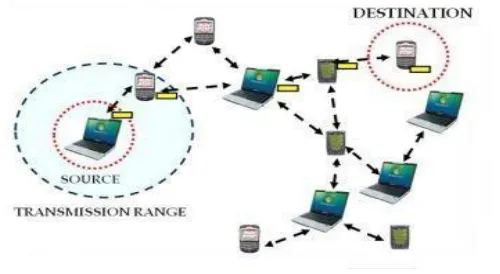
© 2019, IRJET | Impact Factor value: 7.211 | ISO 9001:2008 Certified Journal | Page 2560 Fig. AODV route lookup session
1.2 DSDV
[image:2.596.177.427.323.460.2]DSDV is one of the routing protocols which is based on Bellman - Ford routing algorithm. This Bellman - Ford routing algorithm has a routing loop problem which gets solved by DSDV3. For solving this problem, it uses sequence number for each entry in the routing table.This protocol can disperse the information of routing between nodes by the full dumps or by smaller incremental updates.
Fig. DSDV route session
1.3 DSR
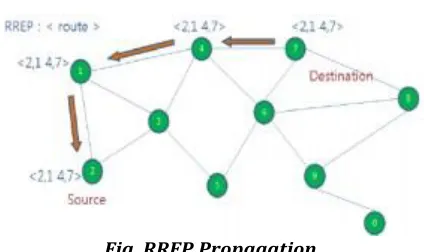
[image:2.596.182.409.560.697.2]DSR algorithm is one of the important routing protocol in ad hoc networks. This type of protocol uses less bandwidth in networks where the mobility is low. This is one of the efficient and simple routing protocol for ad hoc networks.DSR is able to support rapid topology changes.
© 2019, IRJET | Impact Factor value: 7.211 | ISO 9001:2008 Certified Journal | Page 2561 Fig. RREP Propagation
2.
REVIEW OF LITERATURE1. W.G Lol proposed a different perspective that using a simulation model the combined effect of node density and packet length,node density and mobility on the performance of a typical 802.11 MANET is investigated[1].
2. This is a common and realistic scenario in MANET where nodes move around and leave and join the network at any time[1]..So basically the idea is to analyze the performance of four diverse MANET routing protocols with different simulation model and configurations based on end-to-end delay throughput ,routing load and packet transmissions[1].
3. The major goal of this performance analysis in high mobility case under low, medium and high density scenario. unlike military applications most of the other applications of MANET require moderate to high mobility. Hence it becomes important to study impact of high mobility on performance of routing protocols.[2]
4. The main objective of this analysis is to ensure which protocol is best for mobile networks by comparing performance of DSR,DSDV and AODV protocols using NS-2[2].The protocols design will be improved to adapt themselves for all changing scenario of networks that will be helpful in many applications[2].
5. Mobile ad hoc network is a infrastructure less network. it has various applications in fields like military. Sharing of information among the armed forces is an important requirement of military [5].
6. The routing protocol is the key factor of MANET. The property of MANET is that it can be easily configured set-up and build[5].
7. Due to the infrastructure less network communication is dependent on co-operation of nodes[5].
8. A mobile ad hoc network is a self configuring network of mobile nodes that can be formed without any need of pre-established infrastructure or centralized administration. [7]
9.The widely accepted routing protocol designed to accommodate needs of such self organized networks do not possess possible threats aiming at disruption of protocol itself[6]
3. IMPLEMENTATION
A)
System requirement (Computer/Laptop):-1)
Atleast 4.5 GB memory2)
Atleast 2GB RAM3)
Linux OS (Ubuntu/Fedora)4)
NS-2 (NS 2.35 or Latest)© 2019, IRJET | Impact Factor value: 7.211 | ISO 9001:2008 Certified Journal | Page 2562
B)
Implementation method1). TCL file (.TCL)
TCL is a file extension for a script written in TCL. TCL (also pronounced tickle) stands for Tool Command Language. ...
TCL is a dynamic open source language used for building web and desktop applications. Whether on Windows, Mac OS X, or
Linux operating systems, TCL files can be opened and edited by WISH and TCLSH.
2) AWK file (.AWK)
AWK is a data file format created by AWK programs. AWK is a programming language used for processing text-based
data. AWK files contain information used for reading and scripting text-based data. AWK is similar to Perl.
3)Animation (.Nam)
Nam is a Tcl/TK based animation tool for viewing network simulation traces and real world packet trace data. The first
step to use nam is to produce the trace file. The detailed format is described in the TRACE FILE section. Usually, the trace file is generated by ns(1).
a. Trace file (.tr)
Trace File are trace (or dump) file that Oracle Database creates to help you diagnose and resolve operating problems.
Each server and background process writes to a trace file. When a process detects an internal error, it writes information
about the error to its trace file.
b. X-graph(.xg)
The x-graph program draws a graph on an X display given data read from either data files or from standard input if no
files are specified. X-graph in ns2 is used to plot the network parameter characteristics like throughput, delay, jitter,
latency etc.Interactive plotting and graphing.
4. RESULTS
fig: Number of nodes vs Packet delivery ratio
© 2019, IRJET | Impact Factor value: 7.211 | ISO 9001:2008 Certified Journal | Page 2563
Delivery Ratio increases gradually from nodes 10 to30 where as from nodes 30 to 60 a little negative inclination is observed in DSR protocol. So it is stated that the Packet Delivery Ratio is not constant in DSR where as it is constant in AODV and DSDV from nodes 20 to 50.
fig: Number of nodes vs Average routing load
In fig.2, it is identified that if the number of nodes Increases then the end to end delay remains constant in DSR routing protocol from nodes 10 to 50. In DSDV if number of nodes increases from 10 to 20 then it gradually decreases the end to end delay and then it remains approximately constant from nodes 20 to 50. The end to end delay varies according to number of nodes in AODV. In this case it is observed that DSR protocol is best in terms of minimum end to end delay.
fig: Number of nodes vs End to End delay
In Fig.3, if number of nodes increases from 10 to 50 the average routing load increases in all the routing protocols. It is observed from these three protocols DSDV has the lower average routing load. From this Perspective one can say that DSDV works with a very Low average routing load.
© 2019, IRJET | Impact Factor value: 7.211 | ISO 9001:2008 Certified Journal | Page 2564 5. CONCLUSIONS
Based on the study of different protocols that is comparison of different protocols which is based on the parameters such as end-to-end delay, packet delivery ratio, average routing load without queue, end-to-end delay the results of DSR protocol is observed to give the best result among the other protocols
It is observed that among the various parameters we have tested the result of DSR is giving better result. The losses that occur when we test the protocols on various parameters is less or to be said there is very minimal loss. So we conclude that DSR is the best protocol among other protocol with minimum loss as tested and it is shown by the graphs of different parameters.
6. REFERENCES
1) W.G Lol, "A study of MANET routing protocols: Joint node density packet length and mobility", Computers and Communications (ISCC) IEEE Symposium, pp. 515-520, 2010.
2) Aggarwal Akshai, Gandhi Savita, Chaubey Nirbhay. Performance analysis of AODV, DSDV and DSR in manets. International Journal of Distributed and Parallel Systems (IJDPS). 2011 November; 2(6):11.
3) Rao Meena, Singh Neeta. Performance evaluation of AODV BR routing protocol under varying node density and node mobility for MANETs. Indian Journal of Science and technology. 2015 August; 8(17):1-9.
4) R. F. Sophia Pearlin and G. Rekha. Performance Comparison of AODV, DSDV and DSR Protocols in Mobile Networks using NS-2. Indian Journal of Science and Technology. February 2016.
5) Suman Kumari, Sunil Maakar, "Traffic Pattern Based Performance Comparison of AODV DSDV & OLSR MANET Routing Protocols using Freeway Mobility Model", (IJCSIT), vol. 2, no. 4, pp. 1606-11611, 2011.
6) S. Ade, P.A. Tijare, "Performance Comparison of AODV DSDV OLSR and DSR Routing Protocols in Mobile Ad Hoc Networks", International Journal of Information Technology and Knowledge Management, vol. 2, no. 2, pp. 545-548, 2010.