Lean Project Implementation and Complexity
Involved
M. K. Agrawal
1, Surender Kumar
2Associate Professor, Department of Mechanical Engineering, GLA University, Mathura, U.P, India1
Professor, Department of Mechanical Engineering, GLA University, Mathura, U.P, India2
ABSTRACT: Implementation of Lean Manufacturing Project involves the complexity and risks which has to be managed properly to have the cost effective results. In this paper after giving the brief idea about the lean projects complexity and risks involved, a strategy has been designed to find out the solution to reduce the project complexities. A survey instrument has been designed to study the project complexity of a particular industry. MAUF approach has been used for computation of the complexity index for lean manufacturing projects. A case study of fabrication industry has been used to discuss the complexity of project in order to make implementation process easier. Results obtained are encouraging Designed procedure is quite simple and satisfactory and can be used by any industry; small, medium and large.
KEYWORDS: Lean Project, Complexity, Risk, MAUF, CPCI.
I. INTRODUCTION
Organizations perform work. Work generally involves either operations or projects, although the two may overlap. Operations and projects share many common characteristics; for example, they are:
Performance by people.
Constrained by limited resources. Planned, executed, and controlled.
Projects are often implemented as a means of achieving an organization’s strategic plan. Operations and projects differ primarily in that operations are ongoing and repetitive while projects are temporary and unique. A project can thus be defined in terms of its distinctive characteristics – a project is a temporary endeavor undertaken to create a unique product or service. For many organizations, projects are a means to respond to those requests that cannot be addressed within the organizations normal operational limits.
To understand the term in its totality the following definitions will be quite useful, though other definitions are also possible.
A temporary endeavor undertaken to create a unique product or service. Temporary means that every project has a definite ending point and unique means that the product or service differs in distinguishing way from all similar product or services [1].
An endeavor in which human, material and financial resources are organized in a novel way, to undertake a unique scope of work, of given specification, within constraints of cost and time, so as to achieve beneficial change defined by quantitative and qualitative objectives [2].
Projects are undertaken by organizations in order to deliver, construct, maintain or renew facilities. They are vehicles, consisting of a scope of work and a project organization, required to deliver facilities [2].
Project is a unique process, consisting of a set of coordinated and controlled activities with start and finished dates, undertaken to achieve an objective conforming to specific requirements including constraints of time, cost and resources. [3].
A project can be considered to be any series of activities and tasks that have a specific objective to be completed within certain specifications, have defined start and end dates, have funding limits (if applicable) and consume resources (i.e. money, people, equipment) [5].
A project is any undertaking that has definite, final objectives that represent specified values to satisfy some need or desire. It is normally characterized by limitations placed on time, cost, and resources such as people, skills, equipment and materials [6].
A project is a cluster of activities that is relatively separate and clear cut. It has a distinct mission and a clear termination point. A project might be a part of a broader program, yet its main theme lies in identifying a nice, neat work package within a bewildering array of objectives, alternatives, and activities [6].
A one-time unique endeavor by people to do something that has not been done that way before [7].
A human endeavor which creates change; is limited in time and scope; has mixed goals and objectives; involves a variety of resources; and is unique [8]
It appears that, there cannot be any single definition, which can truly describe all kinds of projects. But for the sake of this research work, the characteristics of a project may be limited to the following:
o It has a specific objective o It has a specific time constraint o It has a specific cost constraint o It consumes resources
o It is unique in nature
o It is often carried out to provide a new facility or process for a client/user o It is associated with change and therefore carry considerable risk
In fact, there cannot be two projects, which are alike in all respects. They will vary either in their purpose, strategy for implementation, location, people involved in the work or in several other ways. The non-repetitive nature of project work has made the project work more challenging. Having limited previous experience in the various aspects, there are lots of uncertainties associated with the decisions taken at the different stages of the project. Hence, decisions in projects carry considerable risks. Every project has risk and uncertainty associated with it. There simply cannot be a project without any risk and uncertainty.
Projects are undertaken at all levels of the organization. They may involve a single person or many thousands. Their duration ranges from a few weeks to more than five years. Projects may involve a single unit of one organization or may cross organizational boundaries, as in joint ventures and partnering. Projects are critical to the realization of the performing organization’s business strategy because projects are a means by which strategy is implemented. A project can be undertaken for variety of purposes varying widely from missionary purpose, like education for the under privileged children to business purpose like profit maximization through improving productivity and cost reduction. Typical examples of project include:
Performing a heart transplant Producing a film
Running a political campaign Launching a satellite
Developing a new product or service Developing and marketing a new medicine Implementing a change in an organization Designing a new transportation system
Constructing a building facility, highway, railways Manufacturing a new piece of machinery
Developing business procedure or process
Replacing an old manufacturing process by a new one
Increasing production capacity by addition of new manufacturing processes Building a new manufacturing unit like an integrated steel plant
The purpose of a project therefore may be: [2]
A social purpose, for example to achieve relaxation or enjoyment, or to raise funds for a worthy cause; A humanitarian purpose, for example to provide disaster relief.
While dealing with the subject in this study, the purpose will be limited to the first one, i.e., business purpose where the facilities are created in order to achieve at least one business goal. In a business organization, whether in public or private sector, an organization must grow at least for the sake of its survival. Moreover with fast changing business environment, challenges are becoming more diverse and intense in nature. The success in the projects undertaken determines the organizational success. The technological advancements, globalization of business, fast changing market conditions are some of the reasons for undertaking projects in the business and therefore, they carry within themselves the fate of the business, whether it will perish, survive or thrive in the present world of intense competition. All companies, whatever the nature of their business, encounter project management problems at some time. A company engaged in manufacturing will be vitally interested whenever a production facility or process is modernized or improved and project management techniques will be needed to ensure efficient installation and start-up of the new plant/process. Even a commercial company with no manufacturing base at all must exercise efficient project management when it enlarges or moves its offices. Project management techniques find their application in many situations far removed from the industrial project scene, helping to manage changes of premises, new installations, refurbishment or maintenance of existing plant and facilities, company relocations and so on.
II. THE PROJECT AS A CONVERSION PROCESS
The project is viewed as a conversion or transformation of some form of input into an output. Inputs are some form of want or need which is satisfied through the process. The project will take place under a set of controls or constraints – those elements generally from outside the project which either provide the basis for any assumptions, or limit the project. The mechanisms are those resources that make the transformation process possible, figure no.1.
.
Fig.1: Project as a conversion Process
Inputs
For projects of even moderate complexity there will be some form of project brief-a document which provides a statement of the want or need that is to be transformed by the project. There will be both explicitly stated requirements (original needs) and those which emerge during the course of the project due to the customer’s changing needs or perceptions (emergent needs).
Constraints
Time, cost, quality, technical and other performance parameters,
legal, environment, etc.
Management of the project
Mechanisms
People, techniques and tools, equipment,
organisation
Output
Project deliverable, products and/or services
Input Business need and
It is tempting to think of a project brief as an unequivocal statement from the customer. In practice this is rarely the case and there will always be a degree of interpretation required from the project team. Where there is a large creative element required to the project, the brief will need to provide guidance as to what the nature of the desire is, without putting unnecessary limits on the way it is achieved.
Constraints
The brief will also set out the constraints, which may take the form of:
Financial – the amount and timing of release of capital to the project, and the revenue or other benefit it should generate;
Legal-this may not be explicitly stated but there will be legal constraints, e.g. a building may not be constructed unless the planning permission for it has been obtained;
Ethical –Consumers are becoming as concerned about the ethical behavior of the companies they buy from as they ate about the environmental friendliness of the products they buy. While this is at present limited to certain sectors of the community, the need to behave in an ethical manner as well as being seen to behave ethically is a factor in the way that projects are managed;
Environmental – the deluge of environmental legislation that has been generated by the European Union has changed the role of environmental control from a subsidiary issue to one which is at the forefront of management thinking;
Logic constraints- the need for certain activities to have been completed before a project can start; Activation-action to show when a project or activity can start;
Time-the biggest constraint for most of the projects.
Quality- the standards by which both the product (the output of the process) and the process itself will be judged; Indirect effects-it is practically impossible for any change to take place in isolation. There will be ripple effects
which will need to be taken into account at the outset. The output of the project will be in the form of;
converted information, e.g. a set of specifications for a new product. a tangible product, e.g. a building.
changed people, e.g. through a training project, the participants have received new knowledge and so are parts of the transformation process as well as being a product of it.
Outputs
Output describes the ‘satisfied need’. This is a very wide interpretation of the possible outputs of a project and includes, for example, a new building as an output from a construction project; processed information, e.g. in the form of engineering drawings or a report; and people with the necessary skills for a task (the output of a project involving training). The outputs may be tangible or intangible.
Mechanisms
The means or mechanisms by which the output is achieved are as follows: People-those involved both directly and indirectly in the project;
Knowledge and expertise-brought to the project by the participants and outside recruited help (e.g. consultants);
Capital-the money that provides the resources;
Tools and techniques-the methods for organizing the potential work with the available resources; Technology- the available physical assets that will be performing part or all of the conversion process. The nature of the transformation process will be determined by the environment in which it is taking place.
III. WHAT IS LEAN PROJECT MANAGEMENT
Project management is the application of knowledge, skills, tools, and techniques to project activities to meet project requirements [9]. Project management is accomplished through the use of the processes such as: initiating, planning, executing, controlling, and closing. The project team manages the work of the projects, and the work typically involves:
Competing demands for : scope, time, cost, risk, and quality Stakeholders with differing needs and expectations.
Identified requirements.
When systems are structured to deliver the product while maximizing values and minimizing the wastes, they are said to be lean project management. Lean project management differs from traditional project management not only in the goals it pursue, but also in the structure of its phases, the relationships between phases and participants in each phase. It may include lean design, lean supply and lean assembly.
IV. EXECUTION STRATEGY
The execution of a project is a major task and a very important aspect of the project. It requires many proactive measures and experience to successfully execute a project. Therefore it is important that the project manager works out an execution strategy for the project in order to ensure successful project completion. This project execution strategy would involve various ways and means to execute the project related to [1][2][10][11] :
How to execute the project: Here we define the process to execute the project and the different resource requirements for the project like equipments, resources, material and manpower requirements etc. This would also involve the process and description on specifications and methodologies etc which would be used for the execution of the project.
Location of the project execution at various phases (onsite/offsite): The execution plan also specifies and clearly maintains the details of the working area of the project during the project lifecycle. Onsite and offsite project execution involves various factors to be considered and are therefore of prime relevance for the successful execution of the project. These may include factors such as equipment, resources, transportation, tools, etc among others.
Assigning responsibilities to the team: The project manager is required to clearly state and describe the responsibilities of various project team members including the project manager for a clear and undisputed execution of the project during it’s life cycle.
Scheduling of the project: All projects must be properly and systematically scheduled. Scheduling plans should be prepared for the project’s team members, manager, the principal company, user groups and the stakeholders to ensure that they fully aware of and can perform their duties in accordance with the schedule. This also ensures that the required resources can be properly planned for and are available on time.
Monitoring of the project: For the project to be completed as per the desired schedule in the given constraints, a project monitoring plan is required to be make and the tools and techniques used should be fully communicated to all concerned. Monitoring would involve deciding the ways and means to perform monitoring, parameters for monitoring and the tools and techniques used for monitoring.
Milestones and key dates for the project: The project schedule should also provide the key dates and milestones of the project. These are mentioned separately as key dates and milestones form in important component when interacting with the client. Generally these dates and milestones are also used to provide the project’s cash and fund flow details to the project manager and the organization.
Prioritization of time, cost, quality etc. for the project: As and when there is a deviation in the project schedule, the project manager is required to make some compromises, negotiations, etc, in order to get the project back on track. It is therefore of relevance that the prioritization of the key factors and constraints are done in advance for the smooth transition and execution of the project.
V. THE COMPLEXITY OF LEAN PROJECTS
Not all tools, techniques, and management ideas are universally applicable – the project that takes one person a week to complete clearly has very different managerial requirements from the multi-site, high-budget project. In order to provide meaningful consideration of the function of management in such a variety of setting, two classifications will be applied – complexity and the typology of projects. In general, there will be a high correlation between the level of complexity of a project and the strategic level.
The level of complexity of an activity is a function of three features:
The number of people, departments, organizations and nations involved, i.e. the organizational complexity; The volume of resources involved, time, capital, processes, i.e. the resource complexity or scale;
The level of innovation involved in the product or the project process, i.e. the technical complexity.
In general project complexity may be defined as 'consisting of many varied interrelated parts' and can be operationalised in terms of differentiation and interdependency. This definition can be applied to any project dimension relevant to the project management process, such as organization, technology, environment, information, decision making, and systems. So when referring to project complexity it is important to state clearly the type of complexity being dealt with [12]. In literature two types of project complexity are discussed by many researchers: Structural complexity and technological complexity.
Structural Complexity
Baccarini [13] proposes a definition of project complexity as “consisting of many varied interrelated parts'', which he defined in terms of the number of varied elements (differentiation) and the degree of interrelatedness between these elements or connectivity (interdependency). These measures are to be applied in respect to various project dimensions, and discussion is made about two of them:
i) In terms of organizational complexity, `differentiation' would mean the number of hierarchical levels, number of formal organizational units, division of tasks, number of specializations etc; `interdependency' would be the degree of operational inter- dependencies between organizational elements.
ii) In terms of technological complexity, `differentiation' would mean the number and diversity of inputs, outputs, tasks or specialties; `interdependency' would be the interdependencies between tasks, teams, technologies or inputs.
This clearly defines an important element of project complexity, perhaps the element which one think of most often when one considers a ‘complex' project: complexity is concerned with the underlying structure of the project.
For projects such as design-and-manufacture, or design-and build, a major source of project (structural) complexity is product (structural) complexity, where the product is the physical deliverable. A project to develop a more complex product must normally be a more complex project, but it is useful to distinguish the cause and effect of product type of complexity first. Product (structural) complexity, in the Baccarini sense, is the number of subsystems of a product and their inter- relationships (where an inter-relationship can mean, for example, that changes in the design to one subsystem produces cross-impacts and affect the design of the other system). Merely counting interdependencies is not sufficient, the nature of those interdependencies is also important. In a well-known paper, Thompson [14] looked at interdependencies and identified three types: pooled (in which each element gives a discrete contribution to the project, each element proceeding irrespective of the other elements), sequential (one element's output becomes another's input) and reciprocal. In the last of these types, each element's output becomes inputs for other elements, so the actions of each must be modified to the actions of others. While these are the main aspects of structural complexity, concerned with the multiplicity of project elements, two other aspects should be noted:
Technical Complexity and Uncertainty
The idea of Uncertainty is discussed in the paper by Turner and Cochran [16]. They classify projects by two parameters: how well defined the goals are, and how well-defined are the methods of achieving those goals. They then identify four distinct types of project, depending on whether the goals are well- or ill-defined, and whether the methods are well or ill-defined, and suggest different management and particularly different project start-up methods for the four types.
Dealing with the second dimension first, uncertainty in the methods to carry out a project will add complexity to the project. Turner and Cochran [16] point out that, if methods are uncertain, the fundamental building-blocks of project management will not be known: the work break down structure, the tasks required to complete the job and their sequence, the Organizational Breakdown Structure, etc; and even when they are planned, the plan will be subject to change. Clearly, then, some of the characteristics of Structural Complexity will occur here: as the team structures the work and refines the methods, there will be considerable interdependencies between project sub-teams; as methods are tried and re-planned, feed-back loops naturally occur, and so on.
Uncertainty in methods is well known to be related to complexity. For example a field study distinguish among good management styles and practices for different types of projects (for engineering projects). He classified projects by two parameters: system scope (assemblies, systems arrays- one component of our idea of Structural Complexity) and `technological uncertainty' (the newness of the technology to be used i.e. the uncertainty in the methods). We should note here that `Uncertainty' is being used in the broad sense, including both those elements which are stochastic but also those resulting from a lack of knowledge (i.e. epistemic uncertainties);
Project complexity
Structural uncertainty
Number of elements Interdependence of elements Uncertainty in goals Uncertainty in methods
VI. INCREASING COMPLEXITY OF LEAN PROJECT
It appears to be an accepted fact that the complexity of projects is increasing. Williams [17] points to two compounding causes for projects increasing in (structural) complexity. The first derives from the relationship between product complexity and project complexity discussed above. As new products are developed which extend, or improve upon, previous generations of product, those products become more (structurally) complex, because of extra functionality, or reduction in physical size, or closer intra-connectivity, or similar reasons. This means that the projects developing those products are appearing to increase in Structural complexity, with a larger number of project elements and, in particular, a greater degree of inter-element connectivity
The second cause compounds this increasing structural complexity is projects have tended to become more time-constrained [18] and the ability to deliver a project quickly is becoming an increasingly important element in winning a bid. Furthermore, there is an increasing emphasis on tight contracts, using prime contractor- ship to pass time-risk onto the contractor, frequently with heavy liquidated damages for lateness. As projects become shorter in duration, this enforces parallelism and concurrency, which by definition increases project complexity further.
Taking into consideration project management specific core characteristics, and classification of project complexity given in literature as discussed above a new classification of project complexity attributes has been proposed in this paper. Here, the project complexity is classified in nine main attributes/characteristics for the purpose of measuring the degree of project complexity or complexity index. These nine dimensions which affect the degree of project complexity and increase the difficulty in management of the project are shown in figure no.2.
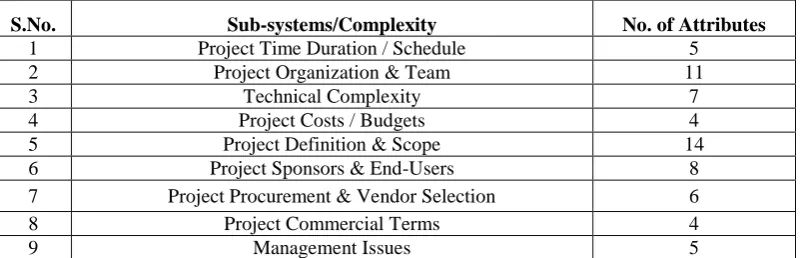
A survey instrument has been proposed and designed for each of the above mentioned nine project complexity in order to enumerate their utility value considering different attributes. Number of attributes considered for each sub-system complexity is given in table no.1. Since all these attributes are not equally important in their impact on total complexity, therefore, the next task is to enumerate the weights of each attribute/criteria on the basis of its importance or influence on the complexity of the project.
S.No. Sub-systems/Complexity No. of Attributes
1 Project Time Duration / Schedule 5
2 Project Organization & Team 11
3 Technical Complexity 7
4 Project Costs / Budgets 4
5 Project Definition & Scope 14
6 Project Sponsors & End-Users 8
7 Project Procurement & Vendor Selection 6
8 Project Commercial Terms 4
9 Management Issues 5
Table No.1 Effect on complexity
A B C D E F G H I
A: Project Time Duration / Schedule
B: Project organization & team
C: Technical complexity
D: Cost / Budgeting
E: Definition & scope of project
F. Sponsors & end users
G. Procurement and vendor selection
H. Project commercial terms
I. Management Issues
VII. MULTI ATTRIBUTE UTILITY FUNCTIONS (MAUF)
The multi attribute utility theory plays a vital role in solving the multiple objective decision-making problems. It provides a freedom of judgment to the Decision Maker, making it more realistic in nature. MAUF facilitates a high quality interactive analysis of the decision problem and presents a comprehensive structure for their evaluation.
Utility Function U(CVj)=U(cv1, cv2,,…,cvI) for any combination of ‘I’ attributes/criterions (cv1, cv2,...,cvI) for ‘J’ alternatives(CV1, CV2,..,CVJ) can be expressed as either (1) an additive model or (2) a multiplicative function of the Individual Attribute Utility Functions U1(cv1), U2(cv2),...,UI(cvI) [19]. Here, we have used the additive model, where each of the criterions is independent in nature. The Utility U(CVj) of j
th
alternative for I criterions (cv1, cv2,..., cvI) can be expressed as :
U(CVj) =
(
)
1
n
i
ij i
i
U
cv
w
…(1)Where wi is weight (scaling factors) for the ith project complexity attribute and Ui(cvij) is Utility of the outcome cvij for the ith project complexity attribute of jth alternative. Ui(cvij) is generally the preference of the decision maker regarding the importance of ith attribute of jth alternative. However, in this paper a survey instrument has been designed to seek the preferences of the decision makers (project mangers) regarding the utility value of the project complexity attributes. The set of the utility value of all of the criterion of an alternative are known as criterion vector. Similarly the weight vector assimilates all of the weights.
The formulation of MAUF and its parameters (weights) is a difficult task. Further determination of the importance of the various criterions in a multiple objective scenario is a critical step in the formulation of the MAUF. It is referred as
‘weight’ and denoted as ‘w’. In this paper the Weightage of criteria have been decided by visiting the industry under
consideration and detailed discussion with the officers, supervisors and workers involved in the process.
VIII. DESIGN OF SURVEY INSTRUMENT
The survey instrument is designed to enumerate the utility value of each project complexity criteria on same scale. All the nine dimensions/criterion of project complexity are further subdivided into a number of sub-criterion/questions. In the survey instrument the reference point for each of the sub criteria of nine attributes has been defined as the lowest level where the organization would treat an initiative as an independent project, and not a subproject or task in another project. The maximum level is also defined level before the project would become a program and/or be split into multiple smaller projects. Attaching numeric values (e.g. 0 and 10) to the low and higher ends of each sub-criteria/question will create a consistent reference scale. Once the opinion of the project managers has been received for each question on 0-10 scale the scores are aggregated for each of the attribute of complexity and is divided by the number of questions in the specific attributes. The value obtained is the utility value of that attribute in MAUF. The survey instrument along with weightage of each attribute for the industry under consideration is given below for table no.2.
1. PROJECT TIME DURATION / SCHEDULE
Factors Low Complexity (0) High Complexity (10) Complexity Rating (0-10)
1. Estimated Calendar Time For
Project 4 months or less Over 12 months 8
2. Activity Schedule All activities are independent All activities are interdependent. 7
3. Time Schedule Only one activity is on Critical Path. All activities are on critical paths. 4 4. Number of Organizations Affected
By Project 1 Over 5 6
5. Number of Project Sites /
geographic Locations Affected 1 Over 3 2
2. PROJECT ORGANIZATION & TEAM
Factors Low Complexity (0) High Complexity (10) Complexity Rating (0-10)
1. Number of departments, groups, contractors involved
Executed by a single organizational
unit Multiple delivery participants 3 2. Number of occupational specializations
utilized to accomplish the work <5 >10
8 5 3. Degree of operational interdependencies
and interaction between the project organizational elements
No interdependencies and interaction between organizational elements
Very high interdependencies and
interaction 8
4. Core Project Management Team - Size At
Peak < 4 members > 15 members 5
5. Man Hours For Project 5,000 or less Over 20,000 4
6. Project Manager Full-time Handles more than one projects 4
7. Project Team All resources available in-house. All resources from External
Organisations 3
8. Training of Project team Fully qualified resources are available without need of further training.
No in-house technological experience
available for the project 2
9. Full-Time Project Team Full-time Less than half of team full-time 3
10. Coordination between the team All worked together before Team members are strangers 4
11. Team’s Physical Location Entire Team located together Team located at several sites 3
Sum of project complexity rating / Number of factors 48/11=4.72
3. TECHNICAL COMPLEXITY
Factors Low Complexity (0) High Complexity (10) Complexity Rating (0-10)
1. Diversity of inputs and/or outputs. No diversity (Single input single output)
High diversity (high range of input and outputs).
3
2. Number of separate actions or tasks to produce the end product of a project.
4
3. Number of specialties (e.g. subcontractors or trades)
3
4. Interdependencies: between tasks, between teams; between different technologies and
between inputs.
5
5. Knowledge of techno-logy to be installed Previous experience No knowledge or expertise 4
6. Number of technologies involved? 4
7. Number of external-to-product interfaces? 3
4. PROJECT COSTS / BUDGETS
Factors Low Complexity (0) High Complexity (10) Complexity Rating (0-10)
1. Project cost Very less (in Millions) High(Multiple of billions) 3
2. Cost/Benefit Analysis Of Estimates Completely documented & proven estimates.
Estimates not documented. 5
3. Budget Liberal Extremely tight 6
4. Cost Accounting Uses a single cost account Uses all potential cost accounts 4
Sum of project complexity rating / Number of factors 18/4=4.5
5. PROJECT DEFINITION & SCOPE
Factors Low Complexity (0) High Complexity (10) Complexity Rating (0-10)
1. Business Area Well known New business area 3
2. Project Scope Well-defined & Well-understood Vague or Not clearly defined 3
3. Scope Elements / Project Objective Independent scope elements Unclear relation-ships between scope elements.
3
4. Project Deliverables Well-defined both in name & content Not defined 2
5. Project Benefits Well-defined Not defined or unclear 2
6. User Requirements Clearly defined Vague and complex 2
7. Alignment of technology with the strategic direction
Perfectly aligned Not known 5
8. Conversion Or New System New System Replacement or conversion of old system
6
9. Effects on Main Operations Little change Severe change 5
10. Procedural Changes Imposed By New System
Little change Severe change 5
11. Dependence On Other Projects & Development Efforts
0 2 or more 6
12. Dependence Of Other Systems On This Project
0 2 or more 4
13. Changes to Organizational Structure to Support New System
Little change Severe change 4
14. Policy Changes Required None Extensive changes 6
6. PROJECT SPONSORS & END-USERS
Factors Low Complexity (0) High Complexity (10) Complexity Rating (0-10)
1. Project Sponsors Single Multiple 3
2. Project Sponsor Involvement Identified and enthusiastic Unknown or passive sponsors 6
3. Customer Created for internal use only Multiple clients / impacted parties. 8
4. The level of User executive manage-ment commitmanage-ment
Understands value and supports completely
Skeptical / resistant 4
5. The level of commit-ent from business unit managers
Understands value and supports completely
Skeptical / resistant 5
6. Level of Commitment Of User Organization
Understands value and supports completely
Skeptical / resistant 3
7. User Participation On Project Team Full-time members No participation 6
8. Responsible User Knowledge Adequate Knowledge about user areas and also associated IT.
No user or IT knowledge 3
Sum of project complexity rating / Number of factors 38/8=4.75
7. PROJECT PROCUREMENT & VENDOR SELECTION
Factors Low Complexity (0) High Complexity (10) Complexity Rating (0-10)
1. Procurement Requirement Only internal resources, no procurement All external resources, each provided
by a different external party. 5
2. Requirements For New Non-Standard Equipment / Materials /
Software
No new non-standard requirement All new & non-standard 4
3. Availability of materials & tools Guaranteed availability No assurance of availability 3
4. Vendor Selection Database Available & updated Not existing 3
5. Experience with Vendors Excellent business relations Not good 2
6. Procurement Processes Formal procurement processes defined
and validated No formal procurement processes 3
Sum of project complexity rating / Number of factors 20/6=3.33
8. PROJECT COMMERCIAL TERMS
Factors Low Complexity (0) High Complexity (10) Complexity Rating (0-10)
1. Exposure of Penalties No associated penalties or liabilities. Severe penalties & liabilities on all fronts e.g Time, Cost, Performance,
Quality etc.
4
2. Type of Contract with Customer Cost-reimbursable. Fixed Price. 3
3. Legal and regulatory aspects (e.g., privacy) Well-defined Not taken care of 3
4. Type of Contract with Suppliers Fixed Time & Cost. Cost-reimbursable. 3
9. MANAGEMENT ISSUES
Factors Low Complexity (0) High Complexity (10) Complexity Rating (0-10)
1.Project Management Techniques And Approach In use, accepted and proven Techniques not used
3
2.Project Development Methodology Reliable & proven methodology agreed.
No existing methodology
8
3.Change Management Procedures Well-defined Do not exist 7
4.Quality Management Procedures Well-defined, operational & accepted QA/ QC processes &
procedures.
QA / QC system, processes & procedures not existent.
3
5.Risk No visible risks Highest risk level 4
Sum of project complexity rating / Number of factors 25/5=5.0
Table no.2
IX. CALCULATION OF CUMULATIVE PROJECT COMPLEXITY INDEX AND ITS IMPROVEMENT
By using equation no. 1. of MAUF, the value of Cumulative Project Complexity Index (CPCI) has been computed which is as:
Cumulative Project Complexity Index (CPCI) 5.4+4.77+3.7+4.5+4.0+4.75+3.33+4.25+5.0 9
In order to have the appropriate cost effective implementation of project the complexity index should be reduced and for the industry under consideration, the following areas are considered for improvement:
a) For subsystem 1, under attribute of 2 i.e. activity schedule, the activities are to be independent and well defined with proper justification so that the complexity rating may be brought down from 7 to 4.
b) In this industry activities are interdependent but we should try to design activities in such a way that each activity can be carried out independently as far as possible. Accordingly the complexity of attribute 2 in subsystem 1 will be reduced from 7 to 4.
c) The members in core project team should be reduced. This can be done by improving the flexibility of each member so that they can work in different phases of the project. By doing so, the complexity of attribute 4 in sub system 2 can be brought down from 8 to 5.
d) The estimate cost for benefit analysis should be accurate and well documented so that complexity of attribute 2 in subsystem 4 can be brought down from 5 to 2.
e) The technology should be perfectly aligned with strategic direction so that complexity of attribute 7 in subsystem 5 can be brought down from 5 to 2.
f) During project implementation, the changes required in the policies should be minimized so that the complexity of attribute 14 in subsystem 5 can be brought down from 6 to 3.
g) Involvement of project sponsors should be identified and make more enthusiastic. It will simplify the process and enhance the motivation of workers and management both. Accordingly the result will be more cost effective and encouraging. Therefore, by doing so the complexity of attribute 2&7 in subsystem 6 are reduced by 8 to 4 and 6 to 3 respectively.
h) Project development methodology should be carried out by using the reliable and proven techniques and if any change is required in management procedure should be well defined so that implementation of changes should be carried out easily. Accordingly the complexity of attributes 2& 3 in sub-system 9 are reduced from 8 to 4 & 7 to 2 respectively.
=4.41
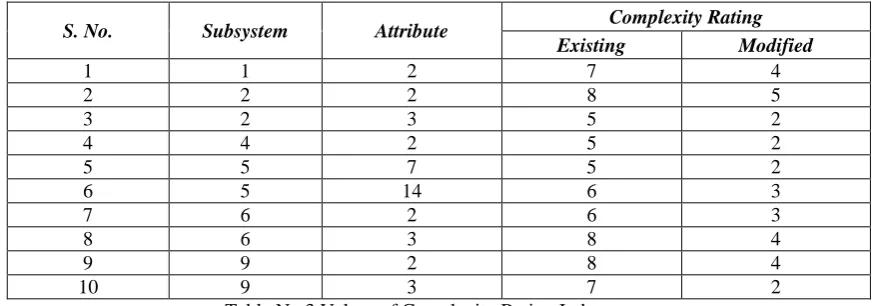
By implementing the above suggestions, the project complexity index will be modified as shown in table no.3.
S. No. Subsystem Attribute Complexity Rating
Existing Modified
1 1 2 7 4
2 2 2 8 5
3 2 3 5 2
4 4 2 5 2
5 5 7 5 2
6 5 14 6 3
7 6 2 6 3
8 6 3 8 4
9 9 2 8 4
10 9 3 7 2
Table No.3 Values of Complexity Rating Index
Similarly by again using equation no.1, the value of
Modified Cumulative Project Complexity Index (CPCI) 4.8+3.82+3.7+3.75+3.57+3.88+3.33+4.25+4.0
9
Therefore by managing the complexity of various subsystems, the complexity index of the project has been reduced from 4.41 to 3.90 (as calculated above). This is the continuous process and will continue further in order to reduce the complexity of lean project under consideration. The reduction of complexity index depends upon the resources of company both technical and financial. Reduced complexity of lean project will lead to smooth and efficient implementation of the lean project in a cost effective manner.
X. CONCLUSION
Classical project management techniques are unsuitable for dealing with complex lean projects. Conventional project management models do not account for compounding the effects of the complexity attributes. What is needed, then, are new ways of looking at modern, complex projects, new models and techniques for analyzing them, new methods for managing them in fact, new paradigms to underlie this approach to them.
To manage complex projects, complexity thinking should be applied during many phases of the project life cycle. Applying complexity thinking to the major decisions to be made about the project, specifically, adoption of the project complexity management approaches are as follows:
Conducting pre-project analysis to clarify the problem and solution. Preparing the business case for a new project proposal.
Initiating and planning a new project.
Calculating the CPCI by using designed survey instrument. Initiating and planning a new major phase of the project.
Reducing the complexity index in order to manage the risks involved. Recovering a troubled project.
REFERENCES
[1] Project Management Institute, A Guide to the Project Management Body of Knowledge (PMBOK)-USA, Project Management Institute, pp. 2-3, 38, 60-64, 111-122, 1996.
[2] Turner, J. Rodney., Handbook of Project-based Management. London, McGraw Hill Book Company, pp. 7-9, 20-23, 235-267, 284-303, 1993.
[3] IS 13999: 1994, ISO 8402:1994, Indian Standard Quality Management and Quality Assurance- Vocabulary (first Revision), New Delhi, Bureau of Indian Standard, 1994.
[4] Cleand, D.I. and King, W.R., System Analysis and Project Management. New York, McGraw Hill Book Company, pp. 70, 240-245, 1983.
[5] Kerzner, Harold, Project Management- A system Approach to Planning, Scheduling, and Controlling. New Delhi, CBS Publishers & Distributors, pp. 2, 71-80, 406-407, 1987.
[6] Verma Vijay K., Organizing Projects for Success-The Human Aspects of Project Management. Volume one, Sylva (USA), Project Management Institute, pp. 16-25, 1996.
[7] Iyer. P.P. Engineering Project Management with Case Studies, New Delhi. Wheeler Publishing, pp. 5-6, 1996. [8] Anderson. E.S., Grude, Haug K.V.T., and Turner J.R., Goal Directed Project Management. Kogan Page, 1987. [9] Choudhuri. S, Project Management. New Delhi, Tata McGraw Hill Publishing Co. Ltd, pp. 3, 5-10, 15-19, 1998.
[10] Chandra, Prasanna., Projects Planning, Analysis, Selection, Implementation and Review. Fourth Edition. New Delhi, Tata McGraw-Hill Publishing Co. Ltd., pp. 273-383, 1996.
[11] BS 6079:1996 Guide to Project Management. London, British Standard Institute pp. 28-29., 1996.
[12] T M Williams, The need for new paradigms for complex projects, International Journal of Project Management, 1999, Vol. 17, No. 5, pp. 269-273.
[13] Baccarini, D, The concept of project complexity- a review, International Journal of Project Management, 1996, 14, 201-204. [14] Thompson JD. Organizations in Action. McGraw-Hill, New York, 1967.
[15] Jones, RE and Deckro, RF, The social psychology of project management conflict. European Journal of Operational, Research, 1993, 64, 216±228.
[16] Turner, JR and Cochrane, RA, Goals-and-methods matrix: coping with projects with ill de®ned goals and/or methods of achieving them. International Journal of Project Management, 1993, 11, 93±102.
[17] Williams TM. Holistic methods in project management. Proceedings of INTERNET Symposium, St. Petersburg, Russia, 14±16 September 1995. ISBN 5-87115-011-x, 332±336.
[18] B. Wilkins, J. Barrett, The virtual construction site: a web based teaching/learning environment in construction technology, Automation in Construction 10 (2000) 169– 179.