A next-generation ground array for the detection of ultrahigh-energy cosmic
rays: the Fluorescence detector Array of Single-pixel Telescopes (FAST)
ToshihiroFujii1,∗,MaxMalacari2,JustinAlbury3,JoseA. Bellido3,LadislavChytka4,JohnFarmer2,PetrHamal4,Pavel Horvath4,MiroslavHrabovsky4,DusanMandat5,JohnN. Matthews6,XiaochenNi2,LiborNozka5,MiroslavPalatka5, MiroslavPech5,PaoloPrivitera2,PetrSchovanek5,StanB. Thomas6, andPetrTravnicek5
1Institute for Cosmic Ray Research, University of Tokyo, Kashiwa, Chiba, Japan 2Kavli Institute for Cosmological Physics, University of Chicago, Chicago, IL, USA 3Department of Physics, University of Adelaide, Adelaide, S.A., Australia
4Palacky University, RCPTM, Olomouc, Czech Republic
5Institute of Physics of the Academy of Sciences of the Czech Republic, Prague, Czech Republic
6High Energy Astrophysics Institute and Department of Physics and Astronomy, University of Utah, Salt Lake City, UT, USA
Abstract. The origin and nature of ultrahigh-energy cosmic rays (UHECRs) is one of the most intriguing and important mysteries in astroparticle physics. The two largest observatories currently in operation, the Telescope Array Experiment in central Utah, USA, and the Pierre Auger Observatory in western Argentina, have been steadily observing UHECRs in both hemispheres for over a decade. We highlight the latest results from both of these experiments, and address the requirements for a next-generation UHECR observatory. The Fluorescence detector Array of Single-pixel Telescopes (FAST) is a design concept for a next-generation UHECR observa-tory, addressing the requirements for a large-area, low-cost detector suitable for measuring the properties of the highest energy cosmic rays with an unprecedented aperture. We have developed a full-scale prototype consist-ing of four 200 mm photomultiplier-tubes at the focus of a segmented mirror of 1.6 m in diameter. Over the last three years, we installed three such prototypes at the Black Rock Mesa site of the Telescope Array Exper-iment. These telescopes have been steadily taking data since installation. We report on preliminary results of the full-scale FAST prototypes, including measurements of distant ultraviolet lasers and UHECRs. Futhermore, we discuss our plan to install an additional identical FAST prototype at the Pierre Auger Observatory. Possible benefits to the Telescope Array and the Pierre Auger Observatory include a comparison of the transparency of the atmosphere above both experiments, a study of the systematic uncertainty associated with their existing fluorescence detectors, and a cross-calibration of their energy andXmaxscales.
1 Ultrahigh-energy cosmic rays
Since ultrahigh-energy cosmic rays (UHECRs) are the most energetic particles in the universe, their origins are ostensibly related to extremely energetic astrophysical phenomena, such as gamma-ray bursts, active galactic nu-clei, or other exotic processes such as the decay or anni-hilation of super-heavy relic particles created in an early phase of the development of the universe [1]. However, their origin and acceleration mechanism above 1020eV are still unknown. Therefore, they are one of the most intrigu-ing and important mysteries in particle astrophysics and astronomy.
Following the detection of a cosmic-ray event with an energy of 1020eV by J. Linsley [2] in 1963, K. Greisen, G. T. Zatsepin and V. A. Kuzmin predicted the UHECR energy spectrum to be suppressed above 1019.7eV due to the interaction of high-energy particles with the 3 K cosmic microwave background radiation via pion produc-tion, the so-called GZK cutoff[3, 4]. If the GZK cutoff
∗e-mail: [email protected], Now at the Hakubi Center for
Advanced Research and Graduate School of Science, Kyoto University
exists, the origin of UHECRs is significantly restricted to nearby sources distributed non-uniformly within 50-100 Mpc. Additionally, UHECRs propagate with less de-flection by magnetic fields due to their enormous kinetic energies. As a result, the arrival directions of UHECRs should be correlated with the directions of extremely ener-getic sources or objects, leading to the possibility of next-generation particle astronomy with UHECRs, illuminating extremely energetic phenomena in the nearby universe.
Given the minute flux of UHECRs, less than one par-ticle per century per square kilometer at the highest ener-gies, a very large area must be instrumented in order to collect significant statistics. The energy, arrival direction, and mass composition of UHECRs can be inferred from studies of the cascades of secondary particles (Extensive Air Shower, EAS) produced by their interaction with the Earth’s atmosphere.
Figure 1.Overview of three important observables reported by the Pierre Auger Observatory and Telescope Array Experiment: energy spectrum [5–7] mass composition [8–10] and arrival direction [11–14] with energy ranges indicated above: 8 EeV (red), 57 EeV (blue) and 100 EeV (green).
for reconstruction of the shower development in the atmo-sphere by imaging ultraviolet fluorescence light from at-mospheric nitrogen excited by EAS particles. Two giant observatories, one in each hemisphere, the Pierre Auger Observatory (Auger) in Mendoza, Argentina [15] and the Telescope Array Experiment (TA) in Utah, USA [16, 17], combine the two techniques with arrays of particle detec-tors overlooked by fluorescence detecdetec-tors (FD).
2 Latest results from current UHECR
observatories
Figure 1 shows the latest results on the energy spectrum, arrival directions and mass composition of UHECRs re-ported by the Pierre Auger Observatory and the Tele-scope Array Experiment [5–14]. Both observatories have measured a dip around 1018.7eV and a suppression above 1019.7eV [5, 6]. The suppression is consistent with expec-tation from the GZK cutoff, however the shape of the sup-pression is discrepant between the two measurements [7].
The mass composition reported by Auger throughXmax (the depth in the atmosphere at which the EAS reaches its maximum energy deposit) suggests a transition from light nuclei at around 1018.3eV to heavier nuclei up to ener-gies of 1019.6eV [8, 9]. In addition, theXmaxdistributions measured by Auger and TA below 1019eV are consistent within systematic uncertainties [19, 20]. Recently Auger reported a new mass composition result using the surface detector array, sensitive to primary energies above 57 EeV, using measurements of the signal rise time [10]. How-ever, there is currently no mass composition result above 100 EeV.
Figure 1 also includes the measured arrival directions of UHECRs above 8 EeV, 57 EeV and 100 EeV,
respec-tively. The left sky-map is a flux map of UHECRs above 8 EeV reported by Auger, indicating an obvious dipole structure of 6.5% amplitude with a 5.2σsignificance [11]. The direction of maximum amplitude is 125◦ away from the galactic center, indicating an extragalactic origin for these ultrahigh-energy particles. An enhancement of the dipole amplitude above 4 EeV is also reported [21]. This dipole structure and its amplitude are consistent with ex-pectation if we assume the deflection of charged nuclei un-der the typical strength of the magnetic fields within our galaxy [22].
The central sky-map is a significance map of UHECR arrival directions above 57 EeV observed with both TA and Auger [13]. The maximum excess appears as a “hotspot” centered at a right ascension of 147◦ and a declination of 43◦ with a 3.4σ significance [12]. In addition, ar-rival directions of UHECRs are found to correlate with nearby extragalactic objects at a modest 2 ∼3σ signif-icance level [23, 24]. There seems to be no measured excess in the direction of the Virgo cluster. Recently, Auger reported a 4.0σcorrelation between the positions of nearby starburst galaxies and the arrival directions of 9.7% of their measured UHECR events above 39 EeV [25]. The remaining 90.3% of their measured events are consistent with an isotropic distribution. The right sky-map shows the arrival directions of UHECRs above 100 EeV. Curi-ously, two doublets (events having arrival directions within their corresponding uncertainties) can be seen, having a chance probability of 2.8σ[14].
unprece-Figure 2. Schematic view of the Fluorescence detector Array of Single-pixel Telescopes: one of the possible solutions for a future giant ground array [18]. As a reference, the ground coverage of TA and Auger make up only 10% of the ground coverage of a full-scale array of FAST detectors. The expected signal emitted from a UHECR with an energy of 57 EeV is shown in a simulation.
dented aperture, which is larger by an order of magnitude, and mass composition sensitivity above 100 EeV. In or-der to cover this enormous target volume, future detectors should be low-cost and easily-deployable. Worldwide col-laboration is essential in successfully building such a giant ground array.
3 Fluorescence detector Array of
Single-pixel Telescopes (FAST)
One of the possible solutions capable of fulfilling these re-quirements is a ground-based fluorescence detector array that is low-cost, easily-deployable, and has an unprece-dented aperture which is an order of magnitude larger than that of Auger and TA×4.
The Fluorescence detector Array of Single-pixel Tele-scopes (FAST) [https://www.fast-project.org] consists of compact FD telescopes featuring a smaller light collect-ing area and far fewer pixels than current generation FD designs, leading to a significant reduction in cost.
In the current FD design, a large mirror system of ∼3.5 m diameter reflects a 30◦×30◦patch of the sky onto a focal plane composed of several hundred photomultiplier tubes (PMTs). In the FAST design, the same field-of-view is covered by just four PMTs at the focal plane of a com-pact segmented mirror of 1.6 m in diameter [26].
A significant cost reduction is expected due to the compact design of FAST, with smaller light collecting op-tics, a smaller telescope housing, and a smaller number of PMTs and associated electronics. Each FAST station would consist of 12 telescopes, covering 360◦in azimuth
and 30◦ in elevation. Powered by solar panels and with wireless connection, they will be deployed in a triangular arrangement with a 20 km spacing.
Figure 2 shows a schematic view of FAST, and the expected signal from a UHECR shower with coincidence detections at three adjacent stations. An example of the ground coverage using 60 stations is also indicated with a comparison to Auger and TA coverages. To achieve an order of magnitude larger effective aperture than Auger and TA×4, 500 stations are required after accounting for the standard FD duty-cycle. The operation of a full-size FAST array will provide conclusive results on the origin and acceleration mechanism toward 100 EeV, and open the window to charged-particle astronomy using UHECRs.
3.1 Progress of developments on the FAST prototypes
A first test of the FAST concept was performed in 2014 using a single 200 mm PMT at the focus of a 1 m2Fresnel lens system at the Telescope Array site. Using the first pro-totype we detected 16 highly significant UHECR shower signals, and demonstrated excellent operational stability under conditions typical of field deployment [18].
Figure 3. The full-scale FAST prototype developed at the Joint Laboratory of Optics in Olomouc, Czech Republic and three FAST prototypes installed at Black Rock Mesa site of Telescope Array Experiment.
R5912-03, Hamamatsu) and active bases (mod. E7694-01, Hamamatsu) are installed at the focal plane of the seg-mented mirror in a 2×2 matrix, covering a 30◦×30◦field of view. The telescope frame is covered with a shroud to shield the optical system from dust and stray light.
3.2 Installation of three full-scale FAST prototypes at the Telescope Array site
In October 2016, September 2017, and October 2018, three full-scale FAST prototypes were installed at the Tele-scope Array site as shown in Figure 3. The combined field of view of the prototypes covers 30◦in elevation and 90◦ in azimuth. The telescope frames were assembled on site, before the PMTs were mounted in the camera box and the UV band-pass filter was installed at the telescope aperture. The telescopes were aligned astrometrically using a cam-era mounted to the exterior of the frame [27]. Following their installation, stable operation of the prototypes began via a remote connection, utilizing external air shower trig-gers from the adjacent TA fluorescence detector.
3.3 Data-taking system of the prototypes
High voltage is supplied to the four PMTs, which were cal-ibrated in the laboratory [28] to a nominal gain of 5×10⁴, by a high-voltage power supply (mod. N1470, CAEN). The PMT signals are amplified by a factor of 50 using a fast amplifier (mod. 777, Phillips Scientific), and passed through a 15 MHz low-pass filter before digitization by a 14-bit FADC (mod. SIS3316, Struck Innovative Systeme) at a 50 MHz sampling rate. The digitizer is hosted in a portable VME crate (mod. VME8008B, CAEN), together
with a controller (mod. V7768, GE Intelligent platforms) and a GPS unit (mod. GPS2092, Hytec) which provides event time stamps. When a fluorescence telescope in the adjacent TA building is triggered by a candidate UHECR shower, an external trigger is issued to the FAST DAQ with a typical rate of∼3 Hz.
3.4 Night-sky online monitoring systems
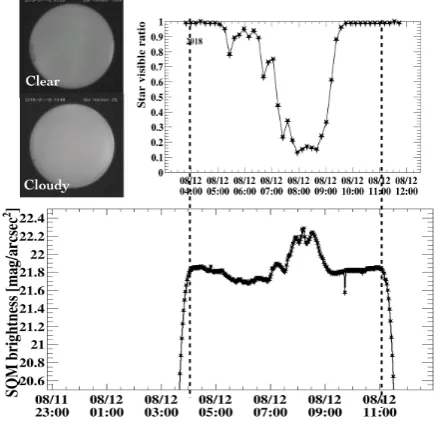
The FAST all sky camera (FASCam) and sky quality mon-itor (SQM) are two instruments attached to the first FAST telescope building for monitoring of the night-sky back-ground and cloud coverage. The FASCam and SQM are fully automated systems designed to measure the cloud coverage above the detector. Figure 4 shows measure-ments taken using these instrumeasure-ments as a function of time during a single night of observation. The “star visible ra-tio” quantifies the number of observed stars relative to the number of expected stars as given by a star catalog. The expected correlation between the “star visible ratio” and the night sky brightness as measured by the SQM can be seen.
Figure 4. Example of images taken on clear and cloudy nights. The “star visible ratio” measured by the FAST all sky camera (FASCam) and the brightness observed by the sky quality moni-tor (SQM) as a function of the observation time are shown.
4 Preliminary results using three FAST
prototypes
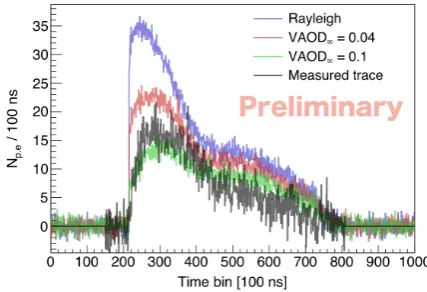
simulated expectation given a number of different atmo-spheric transparencies. In this example case, the measured trace is consistent with an atmosphere with a high aerosol loading.
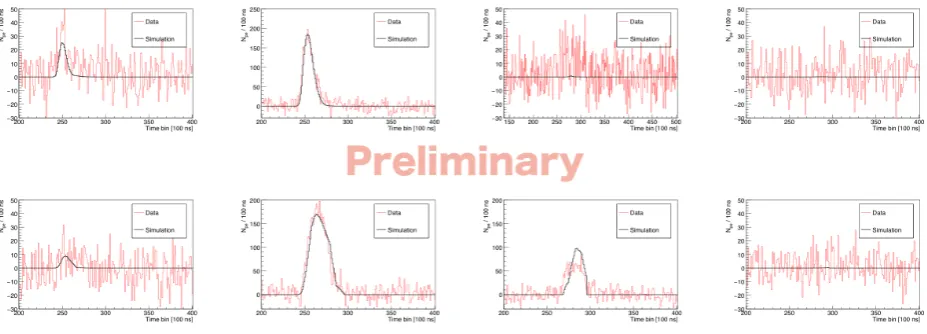
By October 2018, the total observation time of the FAST prototypes is 425 hours. By searching for coinci-dences with the showers reconstructed by the Telescope Array fluorescence detectors [29], cosmic ray air show-ers with energies above 1019eV are selected. A top-down reconstruction algorithm is implemented to determine the best-fix shower parameters by comparing the measured signal trace to a library of simulated templates. Figure 6 shows a comparison of the preliminary waveforms for the highest energy cosmic-ray event observed with the FAST prototypes. The preliminary reconstructed energy is∼2× 10¹⁹eV. The simulated waveforms corresponding to these parameters show reasonable agreement with the data, al-though further understanding of the telescope calibration factors are required to reduce the discrepancy.
Figure 5.The measured trace (black line) from a distant vertical UV laser (284 shots averaged) at a distance of 21 km compared to the expected signals assuming various atmospheric transparen-cies: pure Rayleigh scattering (blue), vertical aerosol optical depth (VAOD)=0.04 (red), and 0.1 (green).
4.1 Possible FAST applications
We plan to install an additional identical FAST prototype at the Pierre Auger Observatory in 2019. This identical FAST prototype will allow for a cross-calibration of the energy and Xmax scales of the Telescope Array and the Pierre Auger Observatory, as well as a comparison be-tween the atmospheric transparency at both sites, an im-portant source of systematic uncertainty in the fluores-cence technique.
5 Summary
Measurements of UHECRs made by the Telescope Ar-ray Experiment and the Pierre Auger Observatory have firmly confirmed the suppression of the energy spectrum at the highest energies, and uncovered intriguing large-scale
anisotropies in the arrival directions of UHECRs. A grad-ual transition to a heavier composition with increasing en-ergy and a lack of desired small-scale anisotropies have also been observed.
In order to achieve a future 30,000 km2 effective ground coverage, we have developed a low-cost, easily-deployable fluorescence detector optimized for the detec-tions of the highest energy cosmic rays. Three FAST pro-totypes have been installed at the Telescope Array site. We have analyzed vertical laser signals to investigate the at-mospheric transparency above the detector, and measured UHECRs with energies above 1019eV. We will continue the steady remote operation in order to further increase statistics.
Furthermore, we plan to install an identical FAST pro-totype at the Pierre Auger Observatory in order to perform a cross-calibration of the TA and Auger energy andXmax scales.
Acknowledgements
This work was supported by JSPS KAKENHI Grant Num-ber 18H01225, 15H05443, and Grant-in-Aid for JSPS Re-search Fellow 16J04564 and JSPS Fellowships H25-339, H28-4564. This work was partially carried out by the joint research program of the Institute for Cosmic Ray Research (ICRR) at the University of Tokyo. This work was sup-ported in part by NSF grant PHY-1713764, PHY-1412261 and by the Kavli Institute for Cosmological Physics at the University of Chicago through grant NSF PHY-1125897 and an endowment from the Kavli Foundation and its founder Fred Kavli. The Czech authors gratefully ac-knowledge the support of the Ministry of Education, Youth and Sports of the Czech Republic project No. LG15014, LE13012, LO1305.
References
[1] A.M. Hillas, Ann. Rev. Astron. Astrophys.22, 425 (1984)
[2] J. Linsley, Phys. Rev. Lett.10, 146 (1963) [3] K. Greisen, Phys. Rev. Lett.16, 748 (1966) [4] G. Zatsepin, V. Kuzmin, JETP Lett.4, 78 (1966) [5] I. Valino (Pierre Auger Collaboration), PoS
ICRC2015, 271 (2016)
[6] D. Ivanov, PoSICRC2015, 349 (2016)
[7] V. Verzi, D. Ivanov, Y. Tsunesada, PTEP 2017, 12A103 (2017),1705.09111
[8] A. Aab et al. (Pierre Auger Collaboration), Phys.Rev. D90, 122005 (2014),1409.4809
[9] A. Aab et al. (Pierre Auger Collaboration), Phys.Rev. D90, 122006 (2014),1409.5083
[10] A. Aab et al. (Pierre Auger Collaboration), Phys. Rev.D96, 122003 (2017),1710.07249
[11] A. Aab et al. (Pierre Auger Collaboration), Science 357, 1266 (2017),1709.07321
Figure 6. The waveforms of the highest energy cosmic-ray event observed with the FAST prototypes. The red histograms show the recorded data and the black curves indicate the best-fit signal from a top-down reconstruction.
[13] K. Kawata et al. (Telescope Array Collaboration), PoSICRC2015, 276 (2016)
[14] S. Troitsky et al. (Telescope Array Collaboration), PoSICRC2017, 548 (2018)
[15] A. Aab et al. (Pierre Auger Collaboration), Nucl. In-strum. Meth.A798, 172 (2015),1502.01323 [16] H. Tokuno, Y. Tameda, M. Takeda, K. Kadota,
D. Ikeda et al., Nucl. Instrum. Meth. A676, 54 (2012),1201.0002
[17] T. Abu-Zayyad et al. (Telescope Array Collabo-ration), Nucl. Instrum. Meth. A689, 87 (2012), 1201.4964
[18] T. Fujii et al., Astropart. Phys. 74, 64 (2016), 1504.00692
[19] E. Barcikowski et al. (Pierre Auger, Yakutsk Col-laborations), EPJ Web Conf. 53, 01006 (2013), 1306.4430
[20] V. de Souza (Pierre Auger and Telescope Array Col-laborations), PoSICRC2017, 522 (2018)
[21] A. Aab et al. (Pierre Auger), Astrophys. J. 868, 4 (2018),1808.03579
[22] A. di Matteo, P. Tinyakov, Mon. Not. Roy. Astron. Soc.476, 715 (2018),1706.02534
[23] T. Abu-Zayyad et al. (Telescope Array Collabora-tion), Astrophys.J.757, 26 (2012),1205.5984 [24] P. Abreu et al. (Pierre Auger Collaboration),
As-tropart.Phys.34, 314 (2010),1009.1855
[25] A. Aab et al. (Pierre Auger Collaboration), Astro-phys. J.853, L29 (2018),1801.06160
[26] D. Mandat et al. (FAST Collaboration), JINST 12, T07001 (2017)
[27] D. Mandat, M. Palatka, M. Pech, P. Schovanek, P. Travnicek et al., PoSICRC2017, 389 (2017) [28] M. Ave et al. (AIRFLY Collaboration),
As-tropart.Phys.42, 90 (2013),1210.6734
![Figure 1. Overview of three important observables reported by the Pierre Auger Observatory and Telescope Array Experiment: energyspectrum [5–7] mass composition [8–10] and arrival direction [11–14] with energy ranges indicated above: 8 EeV (red), 57 EeV (blue)and 100 EeV (green).](https://thumb-us.123doks.com/thumbv2/123dok_us/8123266.1353484/2.595.61.539.83.314/overview-important-observables-observatory-telescope-experiment-energyspectrum-composition.webp)
![Figure 2. Schematic view of the Fluorescence detector Array of Single-pixel Telescopes: one of the possible solutions for a futuregiant ground array [18]](https://thumb-us.123doks.com/thumbv2/123dok_us/8123266.1353484/3.595.63.533.79.344/figure-schematic-fluorescence-detector-telescopes-possible-solutions-futuregiant.webp)