1
Sulfonated Carbon Material as An Efficient Solid Acid Catalyst for
Biodiesel Synthesis via Oleic Acid Esterification Under High Voltage
Conditions
Mohammad Mahdavi
1a, Amir hosein Darabi
aa. Department of Chemistry, Malek-ashtar University of Technology, Shahin-shahr P.O. Box 83145/115,
Islamic Republic of Iran
Abstract
Sulfonated carbon was used as an efficient and reusable heterogeneous solid acid catalyst for the synthesis of biodiesel via esterification of oleic acid with methanol under high voltageconditions. Using an inexpensive and reusable catalyst, environmental benignity, excellent yields in short times, synthesis in atmospheric pressure and low temperature conditions are some of the important features of this protocol. In the final results were confirmed by GC.
Keywords:solid acid; sulfonated carbon; high voltage; biodiesel; oleic acid
1. Introduction
The growing demand to energy in the industrialized world, increasing use of non-renewable resources, concern over the economics of accessing fossil fuel reserves and magnify the global warming problems caused by rising CO2 emissions, is driving academic and commercial research into new routes to exploration of renewable sources of energy. Among many sources of renewable energy that play essential role in meeting renewable fuel targets, biodiesel has been paid much attention owing to non-toxic, biodegradable, production less harmful substances, reduction in the emission of CO2, SOx and environmental friendliness [1-9]. Non-edible oils [10], soybean oil [11] and rapeseed oil [12, 13] are starting materials for large-scale biodiesel production. However, most non-edible oils contain high free fatty acids and may require alternate approaches to produce biodiesel. The fatty acids differ in their carbon chain length and in numbers of double bonds. Biodiesel is currently synthesised via an Esterification reaction of long-chain fatty acids with alcohols [14]. Synthesis of biodiesel requires an efficient catalyst for the fast completion of the esterification reactions. The synthesis of biodiesel has been reported in the presence of diverse catalysts and conditions including Quntinite as a bifunctional heterogeneous catalyst [15], N-methyl-2-pyrrolidonium methyl sulfonate ([NMP][CH3SO3]) [16], Pt and Ni supported catalysts on SBA-15 and SBA-16 [17], [BHSO3MIM]HSO4 [18], Polystyrene-based solid acid catalyst [19], CaO as a solid base catalyst [20], Aminophosphonic acid resin D418 [21] and using
1
Corresponding author. M. Mahdavi, +98-314-591-4502; Fax:+98-314-591-4430;
Email address: [email protected], [email protected].
2
sonochemical reactors from waste cooking oil [22]. Synthesis of biodiesel compounds should be flexible, facile, rapid and useful from cost-effectiveness and industrial points of view. Since the lower catalytic activity of solid acids compared with solid bases, most of the solid acid-catalyzed esterification reactions generally accomplish under higher temperature and higher pressure. The use of base catalysts, although effective, are limited to use of refined vegetable oils, leading to the methods impracticable and uneconomical due to high feedstock cost and priority as food resources. The free fatty acid (FFA) present in the feedstock reacts with the alkaline catalyst and forms soap and decreases the ester yields. Solid acid catalysts have attracted considerable attention in recent years owing to their significant advantages that they are less sensitive to FFA contaminants and are able to esterify FFAs into fatty acid esters in parallel esterification without saponification and enhance the use of high acid value oil to be used as feedstock by combining several operational steps for synthesis of biodiesel [23,24]. Recently, carbon-based solid acid catalysts have expanded importance as they are highly efficient, sustainable, recyclable and eco-friendly [25]. In particular, sulfonated carbon catalyst (C-SO3H) from sucrose is very attractive due to its ease of preparation, low cost, high catalytic activity and ready availability of the sucrose. These advances have opened the door for the design of new catalysts for particular applications in the field of green production. In continue of our investigates on biofuel synthesis [26], we wish to report herein a highly efficient procedure for the esterification of oleic acid using sulfonated carbon as an efficient and robust catalyst under high voltage conditions (Scheme 1).
Scheme1:Esterification of oleic acid using carbon-SO3H under high voltage condition
2. Materials and methods
2.1. Materials
For elemental analysis, a CHNS/O System, PerkinElmer 2400 Series II, was used. Fourier transform infrared spectra (FT-IR) were recorded on a Nicolet IMACT 400D instrument. The gas chromatography analysis was done using the GC-clarus 580, Perkin Elmer USA. The oleic acid (rapeseed oil) and methanol were purchased from industrial sources.
3
The sulfonated carbon solid acid was prepared based on refrence No 25. So, about 10 g of sucrose was grounded and gradually added to 100 ml of concentrated H2SO4 (98 wt %) and the solution was stirred violently. By affecting sulfuric acid on sucrose powder, simultaneous reactions dehydration, sulfonation and carbonization got started then the solution was heated for 2 h in 523 °K. Some of the carbon atoms in hot sulfuric acid were oxidized to CO2 and a lot of foam was made during heating the mixture, but heating was necessary for decomposition of C-O -SO3H esters which were produced during the catalyst preparation. After cooling to ambient temperature, the mixture was filtered on a sintered glass and the solid was washed with distilled water until no sulfate ion was detected. The product was dried in an oven at 373 °K and then it was heated at 623 °K for removing any trapped sulfuric acid. The yield of sulfonated carbon was 65% of sucrose powder. The density of -SO3H groups on sulfonated carbon was determined by potentiometric titration (NaOH 0.01 N) and CHNS analysis.
2.3. Esterification of oleic acid by C -SO3H catalyst under high voltage conditions
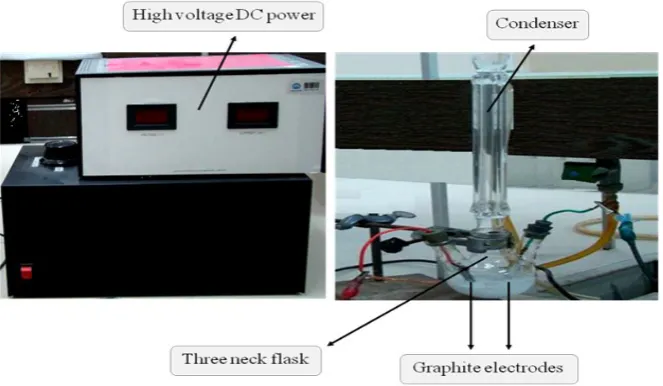
Esterrification of oleic acid were carried out in a three necked round bottom containing methanol, oleic acid and C-SO3H catalyst at 340 K. The round bottom included condenser and two graphite electrodes connected to high voltage DC device (Fig. 1). After the reaction, the result of high voltage process was purified by solvent evaporation and treatment with NaOH 50Wt% solution, to eliminate unreacted free fatty acids. The product was analyzed by high performance gas chromatography and Fourier transform infrared spectroscopy.
Fig. 1: The High voltage esterification apparatus.
3. Results and discussion
The density of -SO3H groups on sulfonated carbon was determined by potentiometric titration by NaOH (0.01N) and it was in agreement with CHNS analysis (CH0.54O0.27S0.09). The neutralization titration showed that 4.58 mmol of SO3H attached to 1g of carbon (acid density 4.58 mmol g-1).
4
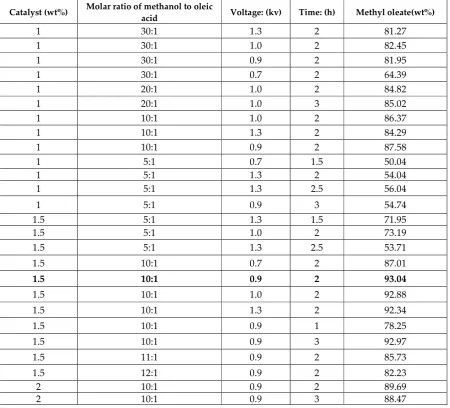
79.56% purity and the esterification process under high voltage showed a 74.02% conversion. Thus, the maximum yield of reaction was 93.04%.
Table 1: Esterification of oleic acid by sulfonated carbon catalyst at 340 K and high voltage condition.
Catalyst (wt%) Molar ratio of methanol to oleic acid Voltage: (kv) Time: (h) Methyl oleate(wt%)
1 30:1 1.3 2 81.27
1 30:1 1.0 2 82.45
1 30:1 0.9 2 81.95
1 30:1 0.7 2 64.39
1 20:1 1.0 2 84.82
1 20:1 1.0 3 85.02
1 10:1 1.0 2 86.37
1 10:1 1.3 2 84.29
1 10:1 0.9 2 87.58
1 5:1 0.7 1.5 50.04
1 5:1 1.3 2 54.04
1 5:1 1.3 2.5 56.04
1 5:1 0.9 3 54.74
1.5 5:1 1.3 1.5 71.95
1.5 5:1 1.0 2 73.19
1.5 5:1 1.3 2.5 53.71
1.5 10:1 0.7 2 87.01
1.5 10:1 0.9 2 93.04
1.5 10:1 1.0 2 92.88
1.5 10:1 1.3 2 92.34
1.5 10:1 0.9 1 78.25
1.5 10:1 0.9 3 92.97
1.5 11:1 0.9 2 85.73
1.5 12:1 0.9 2 82.23
2 10:1 0.9 2 89.69
2 10:1 0.9 3 88.47
The recycling and reusability of sulfonated carbon catalyst was also investigated in four runs. The results showed the catalyst can be reused several times without noticeable loss of catalytic activity (table 2). After each reaction, the catalyst was separated, washed with methanol and distilled water, and dried at 80 °C for subsequent reaction.
5
Catalyst reuse Yield of methyl oleate(%) (Time:2h)
Fresh 93.04
1 93.02
2 93.00
3 93.00
Molar raito of methanol to oleic acid: 10:1, catalyst: 1.5% wt.
Reaction temperature: 340 K, reaction time: 2h, voltage: 0.9 kv, pressure: 1atm The recovered catalyst was reused after washing with methanol and dry at 340 K
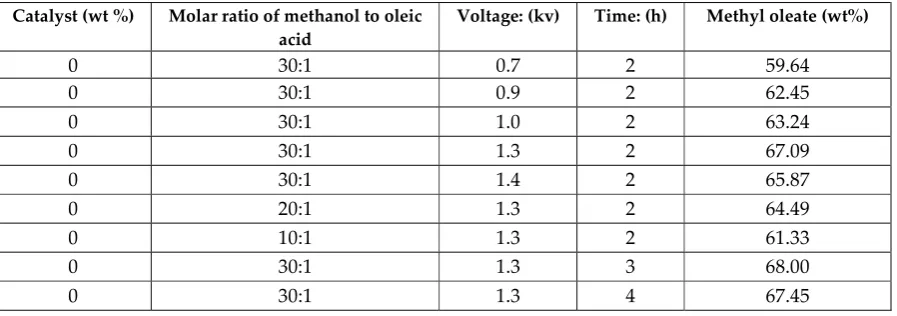
In the absence of catalyst, the reaction yields decreased substantially, and the catalyst had a promotional effect on the esterification of oleic acid (table 3).
Table 3: High voltage esterification of oleic acid at various conditions, in the absence of sulfonated carbon.
Catalyst (wt %) Molar ratio of methanol to oleic
acid Voltage: (kv) Time: (h) Methyl oleate (wt%)
0 30:1 0.7 2 59.64
0 30:1 0.9 2 62.45
0 30:1 1.0 2 63.24
0 30:1 1.3 2 67.09
0 30:1 1.4 2 65.87
0 20:1 1.3 2 64.49
0 10:1 1.3 2 61.33
0 30:1 1.3 3 68.00
0 30:1 1.3 4 67.45
When the temperature was remained constant, the voltage was also reached to a fixed level. After a course when the reaction reached to equilibrium, the electric current demonstrated a steady state condition. After that, by continuation the reaction the amperage was reduced. This new esterification method dose not obeys the electrochemical rules, because an electrochemical reaction for each equipollent of reactants needs exactly one Farad of electrical charge (96500 coulomb charges). The observed electric currents (21-76 mA) in these reactions are caused by the movement of ions between two electrodes and are not related to electrochemical reactions. In this paper, the energy consumption for 2 hr reaction time was about 0.0378-0.1368 kWh, (V.I.t=W.h) so the exchanged electric charge was in the range of 0.042-0.152 coulomb (Q=W/V). So, the exchanged electric charge is a definitive reason for a non-electrochemical reaction.
6
Scheme 2. Preparation sulfonated carbon catalyst from sucrose
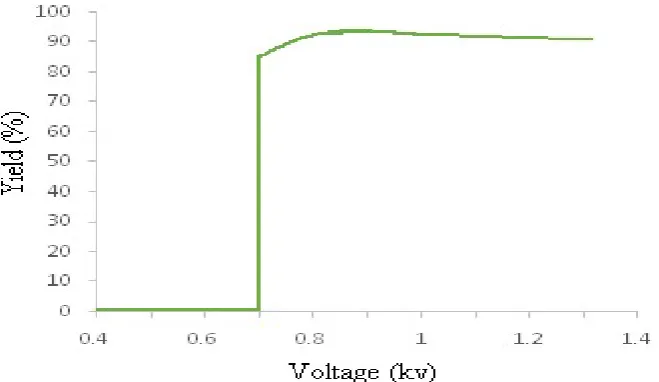
There is no need to use dry methanol for high voltage esterification. Because the produced water during the esterification reaction, did not affect the efficiency of the process. It seems that, under the high voltage condition the water hydrolysis to H+ and OH- ions and .has a positive effect for esterification reaction. In this new reaction, there is not any direct relationship between the voltage and yield of biodiesel (Fig. 2). In fact, the high voltage condition imposes polarization or ionization phenomena on reagents molecules, which speeds up the esterification reaction rate and reduces the reaction time.
Fig. 2: The yield of biodiesel synthesis versus the applied voltage (Molar ratio of methanol to oleic acid: 10:1 at 340 K)
The increase in temperature increases the mobility of the ions. These factors promote the accessibility of substrate molecules on the catalyst surface. Moreover the water of the esterification process has no considerable effect on reaction yield and this by-product disperses in methanol media. So it is not necessary to use dry methanol in the reaction. It seems that the water by-product has no effect on the catalyst.
The fatty acids weight percent in rapeseed oil (oleic acid) and conversion percent of oleic acid to methyl ester (FAME) were calculated by equation 1, according to the GC chromatograms data.
7
C (%) = Conversion percent∑ (A) = The surface area for all couriers
Ais = Surface area of the internal standard
Wis (mg) = Weight of the internal standard (methyl ester)
m (mg) = Weight of rapeseed oil or fatty acid to methyl ester
The total weight percent of fatty acids in rapeseed oil was 84.72% (79.56% oleic acid) (Fig. 3). The reminder was glycerin and other materials.
Fig. 3: The gas chromatogram of rapeseed oil (oleic acid) [C (%) = (4714-47-206.91/206.91)*(4.06/104.4)*100=84.72%]
The oleic acid content in raw material was about 79.56% and that the esterification process under high voltage showed a 74.02% conversion to methyl oleate. Thus, the process yield was 93.04%.
8
Fig. 4: The gas chromatogram of biodiesel (FAME) [C (%) = (11671.59-623.76/623.76)*(5.18/116.4)*100=78.82%]
4. Conclusion
In conclusion, we described an efficient synthesis and catalytic activity of sulfonated carbon as a highly effective heterogeneous and active catalyst for the preparation of methyl oleate and other fatty acid esters via esterification under high voltage conditions. The procedure offers several advantages including clean reaction profiles, available for the environmentally benign biodiesel production from crude vegetable oils, high yields, short reaction time, simplicity, catalyst reusability, and little catalyst loading. Performing the reactions under high voltage and green catalytic procedure that are considered relatively environmentally benign are some of the important features of this protocol.
5. Acknowledgment
The authors acknowledge a reviewer who provided helpful insights.
References
[1] A.F. Lee, J.A. Bennett, J.C. Manayil, K. Wilson, Heterogeneous catalysis for sustainable biodiesel production via esterification and transesterification. Chem. Soc. Rev. 43 (2014) 7887-7916.
[2] F. Ma, M.A. Hanna, Biodiesel production: a review. Bioresource Technol. 70 (1999) 1-15.
[3] I.N. Martyanov, A. Sayari, Comparative study of triglyceride transesterification in the presence of catalytic amounts of sodium, magnesium, and calcium methoxide. Appl. Catal. A Gen. 339 (2008) 45–52.
[4] G. Antolín, F.V. Tinaut, Y. Briceño, V. Castaño, C. Pérez, A.I. Ramírez, Optimisation of biodiesel production by sunflower oil transesterification. Bioresource Technol. 83 (2002) 111–114.
[5] D. Madhu, B. Singh, Y.C.Sharma, Studies on application of fish waste for synthesis of high quality biodiesel. RSC Adv. 4 (2014) 31462–31468.
[6] D.Y.C. Leung, X. Wu, M.K.H. Leung, A review on biodiesel production using catalyzed transesterification. Appl. Energ. 87 (2010) 1083–1095.
9
[8] Q. Shu, Z. Nawaz, J. Gao, Y. Liao, Q. Zhang, D. Wang, J. Wang, Synthesis of biodiesel from a model waste oil feedstock using a carbon-based solid acid catalyst: Reaction and separation. Bioresource Technol. 101 (2010) 5374–5384.
[9] P. Nair, B. Singh, S.N. Upadhyay, Y.C. Sharma, Synthesis of biodiesel from low FFA waste frying oil using calcium oxide derived from Mereterix mereterix as a heterogeneous catalyst. J. Clean Prod. 29-30 (2012) 82-90.
[10] N. Kapilan, T.P.A. Babu, R.P. Reddy, Study of variables affecting the synthesis of biodiesel from Madhuca Indica oil. Eur. J. Lipid. Sci. Technol. 112 (2010) 180–187.
[11] X. Liang, S. Gao, H. Wu, J.Yang, Highly efficient procedure for the synthesis of biodiesel from soybean oil. Fuel Process. Technol. 90 (2009) 701–704.
[12] N. Azcan, A. Danisman, Microwave assisted transesterification of rapeseed oil. Fuel 87 (2008) 1781– 1788.
[13] U. Rashid, F. Anwar, Production of biodiesel through optimized alkaline-catalyzed transesterification of rapeseed oil. Fuel 87 (2008) 265–273
[14] J. Hu, Z. Du, C. Li, E. Min, Study on the lubrication properties of biodiesel as fuel lubricity enhancers. Fuel 84 (2005) 1601–1606.
[15] N. Kondamudi, S.K. Mohapatra, M. Misra, Quintinite as a bifunctional heterogeneous catalyst for biodiesel synthesis. Appl. Catal. A Gen. 393 (2011) 36–43
[16] L. Zhang, M. Xian, Y. He, L. Li, J. Yang, S. Yu, X. Xu, A Brønsted acidic ionic liquid as an efficient and environmentally benign catalyst for biodiesel synthesis from free fatty acids and alcohols. Bioresource Technol. 100 (2009) 4368–4373.
[17] A.E. Barrón Cruz, J.A. Melo Banda, H. Mendoza, C.E. Ramos-Galvan, M.A.M. Melo, D. Esquivel, Pt and Ni supported catalysts on SBA-15 and SBA-16 for the synthesis of biodiesel. Catal. Today 166 (2011) 111-115.
[18] Y. Li, S. Hu, J. Cheng, W. Lou, Acidic ionic liquid-catalyzed esterification of oleic acid for biodiesel synthesis. Chin. J. Catal. 35 (2014) 396–406.
[19] Y. Chang, C. Lee, C. Bae, Polystyrene-based superacidic solid acid catalyst: synthesis and its application in biodiesel production. RSC Adv. 4 (2014) 47448-47454.
[20] X. Liu, H. He, Y. Wang, S. Zhu, X. Piao, Transesterification of soybean oil to biodiesel using CaO as a solid base catalyst. Fuel 87 (2008) 216–221.
[21] P. Yin, L. Chen, Z. Wang, R. Qu, X. Liu, Q. Xu, S. Ren, Biodiesel production from esterification of oleic acid over aminophosphonic acid resin D418. Fuel 102 (2012) 499–505.
[22] S.M. Hingu, P.R. Gogate, V.K. Rathod. Synthesis of biodiesel from waste cooking oil using sonochemical reactors. Ultrason. Sonochem. 17 (2010) 827-832.
[23] A. Patel, N. Narkhede. 12-Tungstophosphoric Acid Anchored to Zeolite Hβ: Synthesis, Characterization, and Biodiesel Production by Esterification of Oleic Acid with Methanol. Energ. Fuel 26 (2012) 6025−6032.
[24] D.E. López, J.G. Goodwin Jr, D.A. Bruce, S. Furuta. Esterification and transesterification using modified-zirconia catalysts. Appl. Catal. A Gen. 339 (2008) 76–83.
[25] V. Mirkhani, M. Moghadam, S. Tangestaninejad, I. Mohammadpoor Baltork, M. Mahdavi. Synthesis, characterization and investigation of catalytic activity of a highly sulfonated carbon solid acid in the synthesis of dihydropyrimidinones under solvent free conditions. J.I.C.S. 8 (2011) 608-615.