Towards Automatic Error Type Classification of Japanese Language
Learners’ Writing
HiromiOyama
GraduateSchoolofInformationScience NaraInstituteofScienceandTechnology
8916-5Takayama,Ikoma,Nara,Japan
MamoruKomachi GraduateSchoolofSystemDesign
TokyoMetropolitanUniversity
6-6Asahigaoka,Hino,Tokyo,Japan
YujiMatsumoto GraduateSchoolofInformationScience NaraInstituteofScienceandTechnology 8916-5Takayama,Ikoma,Nara,Japan
Abstract
Learner corpora are receiving special atten-tion as an invaluable source of educaatten-tional feedback and are expected to improve teach-ing materials and methodology. However, they include various types of incorrect sen-tences. Error type classification is an impor-tant task in learner corpora which enables clarifying for learners why a certain sen-tence is classified as incorrect in order to help learners not to repeat errors. To ad-dress this issue, we defined a set of error type criteria and conducted automatic clas-sification of errors into error types in the sentences from the NAIST Goyo Corpus and achieved an accuracy of 77.6%. We also tried inter-corpus evaluation of our system on the Lang-8 corpus of learner Japanese and achieved an accuracy of 42.3%. To know the accuracy, we also investigated the classification method by human judgement and compared the difference in classifica-tion between the machine and the human.
1 Introduction
Automatic error detection is one area that has been widely studied. One of the challenges in this work is generalizing the great number of error patterns. Given that the different types of learners’ errors are too numerous to detect, some researchers have broken down the error detection task according to the types of errors, such as spelling errors, mass count noun errors and preposition errors. If the error type classification is made in advance, it will help the automatic error detection system more ac-curate.
Classifying error types has other advantages. First, it will help resulting learner corpora useful in linguistic research. It can offer teachers with effective feedback on patterns of errors repeatedly
made by students. Secondly, through classifica-tion of errors, learners are able to correct their own errors by comparing acceptable and unacceptable sentences.
Learner corpora are useful for statistical analy-sis of learner output and provide positive and neg-ative examples that contribute to improving writ-ing skills. Accordwrit-ing to Ellis’s input theory (El-lis, 2003), both positive and negative input are required in learning a second language. Positive input provides grammatically correct and accept-able models of the language. Negative input is comprised of incorrect sentences that are made by non-native speakers. It teaches learners the sen-tences they should not produce. Learners’ writing skills are improved by exposure to both. A sys-tem to organize both correct sentences (for pos-itive evidence) and incorrect sentences that lan-guage learners are likely to produce (for negative evidence) would benefit language learners consid-erably. To master a foreign language, it is very effective to see where a problem lies and what caused it, rather than merely learning the correct expression.
We propose a machine learning-based approach on automatic error type classification in Japanese learners’ writing by looking at the local contextual cues around a target error.
In Section 2, we give a brief overview of previ-ous related work. Section 3 then outlines our an-notation schema for the Japanese learners’ errors. Then, we propose a machine learning-based ap-proach to automatic error type classification in the writing of learners of Japanese learners by look-ing at the local contextual cues around a target er-ror in Section 4. We discuss the experimental re-sults with both in-domain and out-of-domain set-tings and also compare the characteristics of the classification between the machine and the human
163
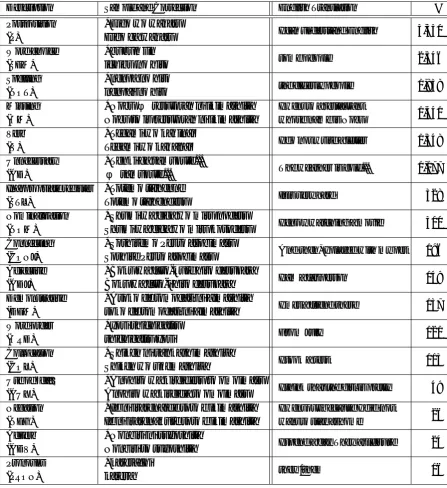
Table 1: Error types in the collapsed 17 class set
* in this table indicates missing of an element. * # indicates the number of instances.
Description Sample and Correction English Translation #
Postposition *Eigowowakaru
I can understand English 3,351
(P) Eigogawakaru
Word choice *bubun jin
some people 2,546
(SEM) ichibu no hito
Spelling *nenpano hito
theelderlypeople 1,838
(NOT) nenpaino hito
Missing *Nobu resutoran ni ikimashita I went to a restaurant
1,441
(OM) Nobuto iuresutoran ni ikimashita whose name isNobu
Verb *Tegami wo kakinai
Ido not writea letter 1,348
(V) Tegami wo kakanai
Unnecessary *Tenkiga samukute...
The weatheris cold... 1,177
(AD) samukute...
Inappropriate register *Totemo taihenne
It is very hard 328
(STL) Totemo taihendesu
Nominalization *Shumi wa eiga wo mirunodesu
I enjoywatchinga movie 300 (NOM) Shumi wa eiga wo mirukotodesu
Connecting *SoshitemoPet to asobimasu
And then,I played with my pet 196 (CONJ) SoshitePet to asobimasu
Adjective *Boku wa futo-kutehito desukara
I am afatperson 149
(ADJ) Boku wa futo-ihito desukara Demonstrative *Asokode tomodati ni aimashita
I met a friendthere 137 (DEM) sokode tomodati ni aimashita
Word order *yorishichigatsu
FromJuly 121
(ORD) shichigatsuyori
Collocation *Shikenni sankashimashita
Itook a test 113
(COL) Shikenwo ukemashita
Use of “da” *Anohito wa kireidesuto omoimasu
I thinkthatthe girl is pretty 49 (AUX) Anohito wa kireidato omoimasu
Negation *Ie ni irarenaidesoto e ikimashita I went outbecause I did not
26 (NEG) Ie ni irarenakutesoto e ikimashita want to stay at home
Adverb *Nonbirinisugoshita
I spend a day Theyat leisure 24
(ADV) Nonbiritosugoshita
Pronouns *karetachi
they/them 16
Table 2: The proportion of error types on the NAIST Goyo Corpus (top 10)
VN indicates learners from Vietnam, TH Thai, CN Chinese, ML Malaysia, MN Mongolia, KH Cambodia, KR Korea and SG Singapore
VN TH CN ML MN KH KR SG
Word choice (SEM) 35.0 27.0 17.2 22.8 29.2 12.8 25.2 23.8 Postposition (P) 21.8 23.1 20.6 24.2 22.1 17.4 17.3 30.6
Verb (V) 13.8 15.3 16.8 12.1 14.2 15.9 14.6 10.2
Spelling (NOT) 9.8 10.1 19.8 16.9 12.7 33.6 15.5 6.8
Phrase 6.2 7.0 2.6 7.3 5.2 1.7 3.4 4.9
Nominalization (NOUN) 2.5 2.6 3.5 1.4 3.4 2.0 4.4 2.9
Adjective (ADJ) 2.0 0.9 2.6 1.5 1.9 1.7 1.5 1.5
Whole alternation 2.0 2.6 1.2 3.4 0.7 1.4 2.4 2.4
Inappropriate register (STL) 1.7 1.2 2.3 6.0 4.1 6.1 3.1 6.3
Word order (ORD) 1.0 1.3 1.2 0.3 0.4 1.2 0.6 0.0
Table 3: Features
Features Error / Corrected samples
Error part ni
Correct part de
Error type Postposition
POS and root form of Error part Postposition, ni POS and root form of Corrected words Postposition, de
Word, POS at the window size of W±1 dare (who), Noun, mo (also), Postposition Word, POS at the window size of W±2 BOS, tabako (tobacco), Noun
Word, POS at the window size of W±3 BOS, wo (object-particle), Postposition
(y)as a correction and “particle (or postposition) error”(t)as its error type.
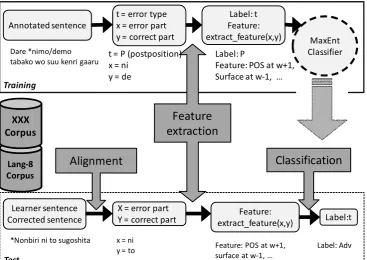
Then, we extracted the contextual information as features to train the Maximum Entropy classi-fier. We created multiple instances out of sentence pairs that contain multiple errors and corrections.
Table 3 shows that features and samples from “Dare demo tabako wo suu kenri ga aru (Everyone has right to smoke.)” as an example.
For the test data, after aligning the learners’ sen-tences and corrected sensen-tences, we extracted an error part, a correct part and also the contextual information with error type unknown. Finally, the test instance is judged by the classifier.
4.2 Data
We used the error-annotated corpus, which we call the NAIST Goyo Corpus. For the first ex-periment, we performed a 10-fold cross-validation with 13,152 instances from the NAIST Goyo Corpus (in-domain) .
For the second experiment, we used as test data
1,090 erroneous sentences from the Lang-8 cor-pus for an out-of-domain text. The Lang-88 of-fers a social network service (SNS) of multi lan-guage essay-correction for foreign lanlan-guage learn-ers. The service has over 400,000 registered mem-bers at present and supports 98 languages, facili-tating multilingual communication. When learn-ers write a passage in their target language, native speakers of the language on the web correct the er-rors for them. This service can provide a huge cor-pus of language learners’ essays, a useful resource for language teachers and learners (Mizumoto et al., 2011).
4.3 Features
Features include the error and the correct words, the part of speech (POS) and the contextual infor-mation with their surface forms. The context win-dow ranges from 1 to 3 before and after the target error and correct part.
Training
Annotated sentence
t = error type x = error part y = correct part
Label: t Feature:
extract_feature(x,y) MaxEnt
Classifier
Dare *nimo/demo
tabako wo suu kenri gaaru t = P (postposition)x = ni
y = de
Label: P
Feature: POS at w+1, Surface at w-1, …
Test
Learner sentence Corrected sentence
X = error part Y = correct part
Feature:
extract_feature(x,y) Label:t
*Nonbiri ni to sugoshita x = ni
y = to Feature: POS at w+1,
surface at w-1, …
Label: Adv Lang-8
Corpus
Classification
XXXCorpus
Alignment
Feature
extraction
Figure 1: Work flow
We used the Maximum entropy method for the classification9. We aligned the erroneous and correct sentences by the dynamic programming method (Fujino et al., 2012)10. We assign POS from UniDic-2.1.1 dictionary using the MeCab-0.99411.
To see how much this approach has contributed to the accuracy, we set a baseline where features are bags of words of both correct and error in-stances in place of the contextual information.
5 Result
5.1 Assessment measure
Recall (R) indicates the proportion of correctly classified sentences to the sentences belonging to each error type. Precision (P) indicates the cor-rectly classified sentences in proportion to the sen-tences classified by the system. F-measure (F) shows the harmonic mean of precision and recall. Accuracy (A) shows the proportion of correctly classified sentences to all sentences, which is the proportion of true positives to true negatives over
9
http://homepages.inf.ed.ac.uk/ lzhang10/maxent.toolkit.html
10
https://github.com/tkyf/jpair 11
http://mecab.googlecode.com/svn/ trunk/mecab/doc/index.html
all sentences.
5.2 Experiment in the NAIST Goyo Corpus
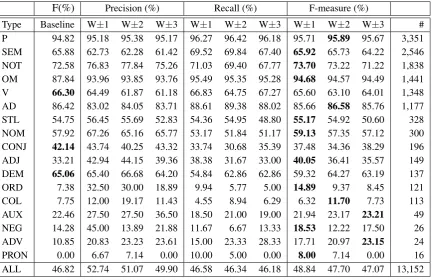
The accuracy of the 10-fold cross validation in the NAIST Goyo Corpus is 77.6% with a window size of 1 on both sides, 77.1% with a window size of 2 on both sides, and 76.6% with the window size of 3 on both sides. Table 4 shows the recall, precision and F-measure. The baseline is 76.9%. Classification performance of “Postposition (P)”, “Spelling (NOT)”, “Missing (OM)” and “Unnec-essary (AD)” show a high accuracy score, and lower accuracy with “Word order (ORD)”, “Collo-cation (COL)”, “Negation (NEG)” and “Pronoun (PRON)”.
The error types with high accuracy are mostly with the window size of 1, which indicates the very local information would suffice to some er-ror types such as “Word choice (SEM)”, “Spelling (NOT)”, “Missing (OM)”, “Inappropriate regis-ter (STL)”,“Nominalization (NOM)”, “Adjective (ADJ)”, “Word order (ORD)”, “Negation (NEG)” and “Pronoun (PRON)”.
Table 4: Results of 10-fold cross validation in the NAIST Goyo Corpus (F-measure) *# indicates the number of instances.
F(%) Precision (%) Recall (%) F-measure (%)
Type Baseline W±1 W±2 W±3 W±1 W±2 W±3 W±1 W±2 W±3 # P 94.82 95.18 95.38 95.17 96.27 96.42 96.18 95.71 95.89 95.67 3,351 SEM 65.88 62.73 62.28 61.42 69.52 69.84 67.40 65.92 65.73 64.22 2,546 NOT 72.58 76.83 77.84 75.26 71.03 69.40 67.77 73.70 73.22 71.22 1,838 OM 87.84 93.96 93.85 93.76 95.49 95.35 95.28 94.68 94.57 94.49 1,441
V 66.30 64.49 61.87 61.18 66.83 64.75 67.27 65.60 63.10 64.01 1,348
AD 86.42 83.02 84.05 83.71 88.61 89.38 88.02 85.66 86.58 85.76 1,177 STL 54.75 56.45 55.69 52.83 54.36 54.95 48.80 55.17 54.92 50.60 328 NOM 57.92 67.26 65.16 65.77 53.17 51.84 51.17 59.13 57.35 57.12 300
CONJ 42.14 43.74 40.25 43.32 33.74 30.68 35.39 37.48 34.36 38.29 196
ADJ 33.21 42.94 44.15 39.36 38.38 31.67 33.00 40.05 36.41 35.57 149
DEM 65.06 65.40 66.68 64.20 54.84 62.86 62.86 59.32 64.27 63.19 137
ORD 7.38 32.50 30.00 18.89 9.94 5.77 5.00 14.89 9.37 8.45 121 COL 7.75 12.00 19.17 11.43 4.55 8.94 6.29 6.32 11.70 7.73 113 AUX 22.46 27.50 27.50 36.50 18.50 21.00 19.00 21.94 23.17 23.21 49 NEG 14.28 45.00 13.89 21.88 11.67 6.67 13.33 18.53 12.22 17.50 26 ADV 10.85 20.83 23.23 23.61 15.00 23.33 28.33 17.71 20.97 23.15 24
PRON 0.00 6.67 7.14 0.00 10.00 5.00 0.00 8.00 7.14 0.00 16
ALL 46.82 52.74 51.07 49.90 46.58 46.34 46.18 48.84 47.70 47.07 13,152
types show a very low accuracy against their to-tal number. The reason being that they require more contextual information, which needs to be extracted from widely separated sentence con-stituents.
5.3 Experiment in the Lang-8 corpus
We performed classification on the Lang-8 data. Accuracy in the Lang-8 was 42.3% with a win-dow size of 1 on both sides, 40.0% with a winwin-dow size of 2 on both sides, and 41.6% with a window size of 3 on both sides. The baseline is 41.5%. Although we mentioned the error types with high accuracy are mostly with the window size of 1 in the NAIST Goyo Corpus, “Word choice (SEM)” in the Lang-8 performs the best score with a win-dow size of 3. We can assume that winwin-dow size of 3 gives enough information to the classifier if we use out-of-domain data, like the Lang-8.
Table 6 presents the confusion matrix of error types in the Lang-8. The table indicates that many sentences in the Lang-8 are likely to be classified into the “Word choice (SEM)” category. “Word choice (SEM)” achieves a rather high rate in the NAIST Goyo Corpus but it results in 34.5% with the Lang-8 corpus. The reason may come from
that the domain of vocabulary plays an important role and that the domain-sensitive feature is re-quired to improve the classification performance over those categories.
5.4 How do humans judge the error type?
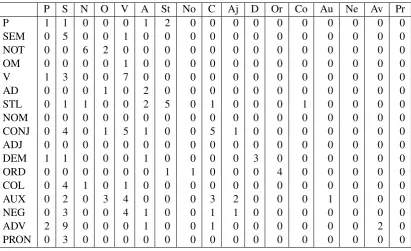
We also conducted an additional classification over error types by human judgement. We asked 11 Japanese teachers to judge 20 instances ran-domly taken from the Lang-8, especially the ones the machine misclassified. Similar to the ma-chine learning method, the most confusing type was “Word choice (SEM)” followed by “Verb (V)” as in Table 7.
Table 5: Results in the Lang-8 (F-measure)
F(%) Precision (%) Recall (%) F-measure (%)
Type Baseline W±1 W±2 W±3 W±1 W±2 W±3 W±1 W±2 W±3 #
P 75.79 69.23 68.22 68.93 83.72 84.88 82.56 75.79 75.65 75.13 86
SEM 24.44 20.92 20.88 23.37 74.76 78.64 66.02 32.70 32.99 34.52 103
NOT 42.65 40.30 37.04 32.76 38.03 28.17 53.52 39.13 32.00 40.64 71
OM 71.79 53.40 54.90 54.37 98.21 100.00 100.00 69.18 70.89 70.44 56
V 46.41 36.31 35.16 35.68 53.98 56.14 57.89 43.42 43.24 44.15 113
AD 63.95 57.53 55.71 51.95 67.74 63.93 65.57 62.22 59.54 57.97 62
STL 34.48 44.44 39.66 35.71 35.71 41.07 35.71 39.60 40.35 35.71 56
NOM 20.20 53.33 46.15 50.00 9.76 7.32 10.98 16.49 12.63 18.00 82
CONJ 45.22 65.00 66.67 57.58 35.62 16.44 26.03 46.02 26.37 35.85 73 ADJ 32.76 60.47 51.28 61.54 33.77 25.97 20.78 43.33 34.48 31.07 77
DEM 75.00 89.74 93.75 87.18 59.32 50.85 57.63 71.43 65.93 69.39 59
ORD 0.00 50.00 33.33 100.00 3.03 3.03 6.06 5.71 5.56 11.43 33
COL 5.56 16.67 66.67 22.22 3.45 6.90 6.90 5.71 12.50 10.53 29
AUX 7.55 50.00 33.33 37.50 6.00 2.00 6.00 10.71 3.77 10.34 50
NEG 15.09 100.00 75.00 75.00 4.17 6.25 6.25 8.00 11.54 11.54 53
ADV 12.82 75.00 33.33 26.67 4.69 4.69 6.25 8.82 8.22 10.13 64
PRON 0.00 0.00 0.00 0.00 0.00 0.00 0.00 0.00 0.00 0.00 23
ALL 33.75 51.90 47.71 48.26 36.00 33.90 35.77 34.01 31.51 33.34 1,090
Table 6: Confusion matrix over error type in Lang-8
*Row represents the actual classes and column represents the system predicted classes.
P S N O V A St No C Aj D Or Co Au Ne Av Pr
P 0 1 0 3 1 3 3 1 0 0 0 0 0 0 0 0 0
SEM 0 0 10 0 11 0 1 0 0 2 0 0 2 0 0 0 0
NOT 2 24 0 0 12 0 0 0 0 1 0 0 0 0 0 0 0
OM 0 0 0 0 1 0 0 0 0 0 0 0 0 0 0 0 0
V 1 37 4 2 0 0 4 1 1 0 0 0 2 0 0 0 0
AD 14 1 0 0 0 0 3 0 0 0 0 1 0 1 0 0 0
STL 0 6 1 7 15 3 0 1 0 0 0 0 1 2 0 0 0
NOM 3 24 3 21 10 9 0 0 0 2 1 0 0 0 0 1 0
CONJ 10 9 1 3 16 2 0 1 0 5 0 0 0 0 0 0 0
ADJ 0 35 7 0 5 1 1 0 2 0 0 0 0 0 0 0 0
DEM 0 17 2 1 0 1 1 1 1 0 0 0 0 0 0 0 0
ORD 0 26 2 1 0 1 0 0 1 1 0 0 0 0 0 0 0
COL 0 18 0 0 8 0 0 0 0 1 0 0 0 0 0 0 0
AUX 2 10 1 9 9 7 5 0 3 1 0 0 0 0 0 0 0
NEG 0 14 3 0 18 0 7 1 2 1 0 0 0 0 0 0 0
ADV 0 50 3 1 0 2 0 0 2 3 0 0 0 0 0 0 0
Table 7: Confusion matrix of the human judge over error type in Lang-8
*Row represents the actual classes and column represents the system predicted classes.
P S N O V A St No C Aj D Or Co Au Ne Av Pr
P 1 1 0 0 0 1 2 0 0 0 0 0 0 0 0 0 0
SEM 0 5 0 0 1 0 0 0 0 0 0 0 0 0 0 0 0
NOT 0 0 6 2 0 0 0 0 0 0 0 0 0 0 0 0 0
OM 0 0 0 0 1 0 0 0 0 0 0 0 0 0 0 0 0
V 1 3 0 0 7 0 0 0 0 0 0 0 0 0 0 0 0
AD 0 0 0 1 0 2 0 0 0 0 0 0 0 0 0 0 0
STL 0 1 1 0 0 2 5 0 1 0 0 0 1 0 0 0 0
NOM 0 0 0 0 0 0 0 0 0 0 0 0 0 0 0 0 0
CONJ 0 4 0 1 5 1 0 0 5 1 0 0 0 0 0 0 0
ADJ 0 0 0 0 0 0 0 0 0 0 0 0 0 0 0 0 0
DEM 1 1 0 0 0 1 0 0 0 0 3 0 0 0 0 0 0
ORD 0 0 0 0 0 0 1 1 0 0 0 4 0 0 0 0 0
COL 0 4 1 0 1 0 0 0 0 0 0 0 0 0 0 0 0
AUX 0 2 0 3 4 0 0 0 3 2 0 0 0 1 0 0 0
NEG 0 3 0 0 4 1 0 0 1 1 0 0 0 0 0 0 0
ADV 2 9 0 0 0 1 0 0 1 0 0 0 0 0 0 2 0
PRON 0 3 0 0 0 0 0 0 0 0 0 0 0 0 0 0 0
6 Conclusion
This paper presented an approach to classifying er-ror types in the writing of learners of Japanese lan-guage in an error annotated corpus. We performed classification experiment with the NAIST Goyo Corpus and the Lang-8 corpus. Although context features, such as what words precede or follow and error and correction, play in an important role in determining the error types, features considering a long distance dependency will be required for the categories with the low accuracy such as the “Col-location (COL)” , “Pronoun (PRON)” or “Word order (ORD)” categories.
For the inter-corpus experiment, the result was lower than the ones of in-domain corpus. We as-sume that the difference of domain has affected the performance. We consider how to compromise the difference of the domain since there are a variety of text data in a real setting.
For the experiment by the human judge-ment, we concluded that the types of “Word choice (SEM)”, “Missing (OM)” and “Unneces-sary (AD)” can be included in any other error types, which causes the confusion regardless of the machine or the human classification. Thus, in the error type classification, it is beneficial to keep two stages separate; to classify those three
types of ‘Word choice (SEM)”, “Missing (OM)” or “Unnecessary (AD)” in the first place and then to classify the other error types. We also found that many teachers consider the dependency of the er-ror part. We will take those aspects into the future trial.
Currently, a huge body of web-based corpora of language learners’ writing have being constructed. They are difficult to use directly for the linguis-tic or educational research because they have both correct and incorrect sentences altogether. Clas-sifying those miscellaneous texts into meaningful groups according to their errors will benefit lan-guage researchers by shedding light on the lin-guistic findings on how people learn the second language. It also provides learners feedback to in-form the reasons why the errors are made.
Acknowledgments
We are deeply grateful for the Lang-8 web orga-nizer to offer the text data for our classification experiment.
References
C. Brockett, W.B. Dolan, and M. Gamon. 2006. Cor-reting ESL errors using phrasal SMT techniques. In