A Model for Robust Chinese Parser
Keh-Jiann Chen*
Abstract
The Chinese language has many special characteristics which are substantially different from western languages, causing conventional methods of language pro-cessing to fail on Chinese. For example, Chinese sentences are composed of strings of characters without word boundaries that are marked by spaces. Therefore, word segmentation and unknown word identification techniques must be used in order to identify words in Chinese. In addition, Chinese has very few inflectional or grammatical markers, making purely syntactic approaches to parsing almost impos-sible. Hence, a unified approach which involves both syntactic and semantic information must be used. Therefore, a lexical feature-based grammar formalism, called Information-based Case Grammar, is adopted for the parsing model proposed here. This grammar formalism stipulates that a lexical entry for a word contains both semantic and syntactic feature structures. By relaxing the constraints on lexical feature structures, even ill-formed input can be accepted, broadening the coverage of the grammar. A model of a priority controlled chart parser is proposed which, in conjunction with a mechanism of dynamic grammar extension, addresses the problems of: (1) syntactic ambiguities, (2) under-specification and limited coverage of grammars, and (3) ill-formed sentences. The model does this without causing inef-ficient parsing of sentences that do not require relaxation of constraints or dynamic extension of the grammar.
Keywords: Chinese Parser, Robust Parser, Information-based Case Grammar, Branch-and-Bound Algorithm
1. Introduction
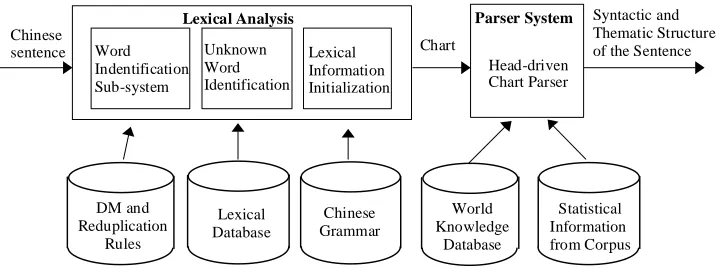
One of the steps in language understanding is producing the syntactic and semantic structure of a sentence. This step is called parsing. Other steps, such as inference, discourse analysis, and responding actions, can thus be performed accordingly. In general, sentence parsing is carried out by two different modules. The first module is a lexical analyzer which identifies the words in a sentence and provides their syntactic
* Institute of Information Science, Academia Sinica,Taipei, Taiwan. E-mail: [email protected]
and semantic information from a lexicon. From the output of the lexical analyzer, the second module produces the syntactic and semantic structure of the sentence. The syntactic structure and thematic role of each constituent are identified according to the grammar of the language. World knowledge is used in resolving structural ambiguities as well as in identifying thematic roles.
It is well known that context-free languages, such as programming languages, can be easily parsed. Except for some very exceptional context-sensitive constructions, natural languages are context-free languages. In addition, if the depth of center-embedded constructions is bounded, natural languages are regular languages. That is to say, there is theoretically an efficient and simple parser for natural languages.
Why then are there no natural language parsers that are practical and useful in general domain? Of course, there are parsers of limited success which can parse subsets of grammatical sentences in special domains. Stated simply, the difficulty is due to the complexity of the constraint relations between words, and not by the level of structural complexity. It is almost impossible to write a grammar that is precise and that fully describes the target natural language. Less constrained grammars may have better coverage, but they also tend to over-generate because of incorrect ambiguities in the grammar. Not only do these ambiguities cause a parser to incorrectly identify a parse as grammatical, they also frequently cause a parser to stop processing before finding a correct parse because its memory resources are exceeded. On the other hand, a more constrained grammar tends to have poor coverage (under-generates) because its syntactic and semantic constraints are too restrictive. Usually, a natural language grammar suffers from both over-generation and under-generation.
Agenda Chart
Expectation Formation
Check Combination
Pop Agenda Insert Agenda
success Add Active Edge
Add Inactive Edge
(2) First-come-first-serve Agenda Control
(3) A Head-driven Parsing Algorithm
Step 1: For each edge, do /*initialization*/ case 1: It is a potential phrasal head
/* potential phrasal heads are N, V, P.*/ Create an active edge for this word;
If it is a complete phrase, then create a new inactive edge for this phrase. /* such as N */
case 2: It is not not a phrasal head: /* such as Adj, Adv, Aspect.*/ Create an inactive edge for this word.
Step 2: For each active edge, pair it with each neighboring constituents to form a series of (head, neighbor) agenda items and add them to the agenda.
Step3: While the agenda is not empty Loop
For the (head, neighbor) agenda item that is first in the agenda Do
1. Check the form constraints of the head to determine which thematic roles can be taken on by the neighbor constituent.
2. If a role also satisfies the constraints posted by BP or AP rules as well as principles of grammatical functions, such as functional completeness and uniqueness conditions and the coherence condition [Bresnan 82, Chen & Huang 90], then create a new active edge for the thematic role and its head.
End While Loop.
The head-driven parsing algorithm will succeed in finding a parse for the input string if the input is covered by the grammar. However, it would fail on processing many sentences that are used in everyday situations. Why? Because grammars used by parsers do not fully and precisely describe the word-relations of the target natural language.
3. Difficulties of Parsing Chinese
Because of the complexity and flexibility of word usage in natural languages, there are many sentence structures of a target language which are not covered by any of the existing grammar representation for that language. Another inadequacy of current grammar representations is the over-simplification of grammar rules, causing multiple and spurious parses for a given input. For Chinese, there are additional difficulties at the stage of lexical analysis. Word identification is difficult in written Chinese since there are no blanks to mark word boundaries. In addition, when parsing real-life input, there are often many words that are not in the lexicon or that cannot be indentified by morpho-logical rules.
In order to parse a sentence with unknown words, the lexical analysis system must first be able to detect the existence of unknown words in the input. The identification process would then need to find the boundary of the unknown words and to determine their syntactic categories and semantic types. Since a single Chinese characters can be a mono-syllabic word and many unknown words tend to be multi-syllabic, detecting the existence of an unknown word is not an easy task. An unknown word that is multi-syllabic will often be incorrectly segmented into a sequence of low frequency monosyllabic words. The parser will then simply fail to parse the input rather than detect the existence of unknown words.
worse.A detailed discussion of Chinese word identification is out of the scope of this paper. Interested readers should refer to [Sun 96, Chen 96].
Even if the lexical analyzer were to function perfectly, the parser may still fail on the following types of sentences:
a. The sentence structure is not covered by the grammar.
b. The sentence is syntactically or semantically ambiguous, and the parser fails to find the most contextually appropriate parse.
c. The sentence structure is very complicated, causing the parser to run out of memory time resources before a result is reached. This is often the case with long sentences. d. The sentence is ill-formed.
The inherit complexity of natural languages makes it almost impossible to describe a language completely and accurately. The creation of new constructions, new word usages, idiomatic type substitutions, the occurance of unknown words, etc. make it almost impossible to describe the target language completely. The lack of a complete grammar is the reason why the parser fails to process the first type of sentence above. For the second and third types, the parser fails because of syntactic ambiguities. For instance, in Chinese, syntactic ambiguity is present in a grammar of Chinese for the following reasons.
a. Chinese is a weakly marked language with little inflection. Other than a few derived words with derivational suffixes, such as '- ', '- ¤ ', and '- ë ', there are no mor-phological inflections in Chinese.
b. Words may serve different grammatical functions in different context. Since there are no morphological inflections, it is impossible to establish a one-to-one relation between the functional role of a word and its part-of-speech. For example, in (4), the word '° ' may function as a subject [Chen & Hong 95] as in (4a), and it can also function as an adjective as in (4b).
(4) a »° l«ä
b °¾:lé
c. A thematic role can be instantiated by many different types of syntactic categories. For example, a time adverbial can be instantiated by a noun, a determiner-measure compound, a postpositional phrase, a prepositional phrase, or an adverb. This is illustrated in (5), respectively.
(5) ~ , ?£ , H , , DD
(6) a z!¼`
b !¼z`
c z!¼`
e. Flexible and creative word use.
(7) a M?ðÔ`
b M?ðêæ`
c M?ðü`
The sentences in (7b) and (7c) show that nouns can be used as stative verbs. f. An incomplete grammar.
Even after many years of education, a person will not have fully mastered all of the complex constructions and all of the uses of all of the words of their native language. Therefore, natural language grammars that are constructed by humans are usually not complete enough to describe the full range of the complex phenomena of a target target language. Therefore, any real grammar will suffer from under-coverage. g. An over-simplified grammar.
Grammars are usually written to capture syntactic patterns of a language. Grammati-cality constraints are stated in a simplified way to capture generalizations. However, in doing so, it is almost inevitable that any real grammar will suffer from over-gene-ration since generalization often have many exceptions.
From the above discussion, it seems that the degree of success of a natural language parser is very dependent on the grammar used. The parsing algorithm and the grammar must work together in order for the parser to achieve a high degree of success. The characteristics of Chinese mentioned above strongly suggests that for parsing Chinese sentences, both semantic and syntactic information should be used in determining the thematic structure of an input sentence. In fact, in [Chen 89], we found that the five major features that help to determine the thematic role of a constituent are:
a. the syntactic category and the semantic features of the constituent,
b. the predicate argument structures and the semantic restrictions on the arguments of a head,
c. word order,
d. oblique case assigners, including prepositions and postpositions, and e. world knowledge.
4. Information-based Case Grammar
Many contemporary grammar formalisms, such as GPSG [Gazdar 87], LFG [Bresnan 82], HPSG [Pollard 94], CUG [Uszkoreit 86], etc., adopt feature unification as their major processing mechanism. However, the five major features that help in identifying the thematic role of a constituent in Chinese cannot be easily represented in any of these formalism. These grammar formalisms are primarily designed to represent syntactic constraints. For Chinese, it is better to represent grammaticality constraints primarily as thematic constraints. That is, it is better to describe grammaticality constraints in terms of the linear order of thematic roles and their syntactic and semantic restrictions. Therefore, the Information-based Case Grammar (ICG) [Chen & Huang 90] formalism was designed to allow the grammar writer to write constraints primarily in terms of thematic constraints. ICG is designed to provide better coverage and accuracy by adopting a generative lexicon approach [Pustejovsky 95] which stipulates that the lexical entry for each word contains both the semantic and syntactic features of the word and how it may be used. For a phrasal head, the syntactic and semantic constraints on grammatical phrasal patterns are expressed in terms of thematic roles and are encoded as ID/LP (immediate dominance and linear precedence) rules [Gazdar 87]. A uniform feature structure is used for each lexical entry and is shown in (8). The attribute values for an entry are defined using an inheritence hierarchy, with null as a possible value.
(8) Semantic: meaning: features: arguments: adjuncts: Syntactic: class:
constraints: form:
basic patterns(BP): adjunct precedence(AP):
Many important features of conventional grammatical formalisms, such as ID/LP and feature based representation of GPSG[Gazdar 87], head driven principle of HPSG[Pollard 94], lexicalism approach of CUG[Uszkoreit 87], are retained in ICG. In addition, the representation is based on thematic roles with additional features to handle the complex structure of Chinese.
(9) à Quan "persuade":
Semantic: meaning: "persuade" features:
arguments: AGENT: GOAL: 1 THEME:
feature: +Human feature: +Human feature: +Event argument: AGENT: adjuncts: time, location, manner,...
Syntactic: class: V
constraints: form: time [ {NP, DM, PP, GP, ADV}, +time] location [{PP, ADV}, +location]
manner [ADV, +manner]
BP: AGENT [NP]< * < GOAL [NP] < THEME [VP] AP: 1. {time, location} < *
2. AGENT < manner < * 1
NP,VP
The entry of a word can be constantly refined without requiring any changes to the design of the parser. These refinements can be done to improve parser performance, without causing any side-effects. How the lexical data is managed is discussed below.
4.1 The Goals of Lexical Data Management
A formal ICG syntax is used to describe the lexical feature structures. Some of the important goals of lexical data management are:
(a) making the data more succinct and less redundant, (b) keeping the data consistent and error free, and (c) updating the data with or without global effect.
the global or non-global effect of updating the lexical data is controlled for in the fol-lowing way. If a property is shared by every word in a category then the feature structure of this category can be updated to include this property. This new property will auto-matically belong to all of the words in this category, achieving the desired global effect. On the other hand, the idiosyncrasies of an individual word can be kept at the leaf node. Updating a leaf node does not cause any undesirable side-effects because it only affects the feature structure of the individual word. As the grammatical information in the lex-icon improves, the parser will become more accurate and achieve greater coverage. Furthermore, the use of a taxonomy hierarchy provides a similarity distance between two categories. Robust parsing requires the parser to be able to relax the constraints and similarity distances are used by constraint relaxation techniques. This point will be elaborated on in section 5.
4.2 Advantages of the ICG Formalism
Due to its richer and more accessible encoding of thematic information, the ICG formalism is much easier to manipulate than other grammar formalisms. The preparation of lexical feature structures is straightforward. Complex syntactic structures such as coordinations, long-distance dependencies, control and binding, can be easily expressed in ICG [Chen & Huang 90, 91]. The inclusion of semantic constraints along with thematic constraints allows a more accurate grammar to be written for Chinese. Better grammar coverage and accuracy is achieved by gradually improving the lexical feature structures. New words, new word uses, and discovery of new phenomena can be encoded into lexical feature structures at different representational levels of the syntactic and semantic hierarchies without causing over-generation or other side-effects. The declar-ative property of ICG allows the grammar to be revised at any time without requiring the parsing algorithm to be changed. The ambiguities of syntactic structures can be resolved by semantic preference checking. The semantic preferences between a head and a modifier, or a predicate and its arguments, are represented in ICG by semantic restriction or by statistical association strengths between words or semantic classes [Resnik 93]. The association strengths can be estimated by the statistical value of mutual information computed from a large corpus [Church & Hanks 90]. For instance, the semantic restriction on the agent of the predicate 'persuade' is +human which is denoted by Agent [NP, +human] in ICG. Therefore, by using semantic hierarchy distance measures and association strength values, the following semantic preference relation [teacher > tiger > tree > color] can be derived for the agent of 'persuade'.
structural ambiguity. Furthermore a lexically-based representation has better information focusing. If a priority control parsing strategy is also used, the likelihood of the parser running out of memory on long sentences is reduced. The proposed priority control strategy is discussed in the next section. The present research has not yet addressed the problems of ill-formed input or creative word usage. So far it seems that the proposed ICG grammar formalism and chart parser can handle normal sentences. In the next section, a more robust parsing strategy is proposed which can handle abnormal cases by making reasonable guesses and yet still handle normal sentences quickly and efficiently.
5. A Robust Parsing Scheme
Natural languages are not static systems, but are constantly changing because the human mind is very creative and intelligent. New words, new word uses, and new constructions are constantly appearing. Any enumerative type of grammar representation is unable to handle changes in a language. For example, in (7), the ð 'very' construction is a very common expression that expresses the characteristic of the subject and has the structural pattern of THEME[NP] < DEGREE [ADV[' ð ']] < *[Vs] where Vs denotes a stative verb. As was shown in (7b) and (7c), the stative verb can substituted by what appears to be a noun (êæ 'treasure' and ü 'pig'). With an enumerative representation, both ê
æ and ü would have to also be listed as stative verbs. This approach makes grammar
writing tedious and endless because there do not appear to be any limitations on creative word uses [Pustejovsky 95]. In addition, representational ambiguities increase dramatically if no distinction is made between normal uses and creative uses. Creative word uses are strongly associated with particular constructions. For example, ü cannot function as a stative verb in most constructions. Therefore, it seems advantageous to separate normal from new and creative word uses. The same is true with new con-structions. For example, argument omission, abnormal word ordering, partial structures, noisy word insertion etc. are very common, especially in spoken language. Trying to handle these phenomena as part of the normal grammar only leads to an unnecessarily complex grammar. Therefore, any robust natural language parsing system must have the ability to predict, infer, and extend the grammar and lexicon to handle new words, word uses, and constructions.
extension to cover abnormal sentences. The core grammar, written in the ICG formalism, enumerates prototypical word usage and phrasal structures in the lexicon. It was argued in Section 4 that the core grammar can be expressed by the lexical feature structures of an ICG grammar. Grammar extension is accomplished by predicting and inferring, based upon the syntactic and semantic context, the required extension for a word. The specific method of dynamic grammar extension under the ICG framework will be discussed next.
5.1 The Evaluation Function and the Control of Grammar Extension
One of the most important functions of a robust parser is to evaluate the grammaticality and logical soundness of a phrase structure or a partial phrase structure for a string of words. Any grammar must allow structural ambiguities and so an evaluation scheme is needed to rate the possible structures at every step. A priority control strategy then uses these ratings to guide the parsing process. The degree to which the core grammar is extended depends on the degree to which the parser must construct structures with a worse rating in order to reach a parse for the input.
The evaluation function rates structures using integer values from 0 to N, where a value of 0 denotes a grammatically perfect structure (i.e. a syntactically and semantically proper structure). Therefore, the greater the evaluation score, the lower the preference. The set of phrase structures with preference scores of 0 can be defined as the language generated by the core grammar G0. Similarly, the extended grammar Gi denotes the grammar which generates the set of phrase structures with preference scores less than or equal to i. A robust parsing algorithm, based upon the priority controlled chart parsing algorithm, could first search for a parse of the input with the G0 grammar. If none is found, it could then search for a parse using the G1 grammar. Ill-formed sentences are thus parsed by gradually relaxing the grammaticality constraints from grammar G0 to G1, G2,..., until a parse is found using grammar Gi. The algorithm will always terminate if a grammar G* is defined to accept any input string. Therefore, normal sentences (i.e. sentences covered by the G0 grammar) are still parsed quickly since no grammar relaxation is required. There is only a performance cost when grammar relaxation is required to find a parse of the input.
5.2 A Robust Chart Parsing Model
A robust parser requires:
(i) an evaluation function which gives a preference score for each structure,
(ii) a sequence of grammars G0, G1, ..., Gn, G* where L(G0) < L(G1) < ... < L (Gn) < L(G*); G0 denotes the core language grammar; Grammar Gi+1 is an extension of of Gi, and G* is a universal grammar which generates any word sequences; L(Gi) denotes the language generated by the grammar Gi, and
(iii) a parser control mechanism which controls the parsing sequence such that there is no performance penalty when parsing normal sentences and best preference guesses are made on ill-formed input.
The above three requirements are closely related. Discrete values are needed for both structure preference scores and the related grammar extension (i.e. grammar Gi generates all and only the structures with scores less than or equal to i). For convenience, any non-discrete preference score can be normalized into finite integer values. The grammar G* guarantees that the robust parser system will terminate on every input string. The grammar G* may be a purely statistical preference grammar [Collin 96]. A bigram lexical dependence grammar is another possible choice [Collin 96]. If the parser fails to find a parse for an ill-formed sentence using grammar Gn, then the statistical grammar will guarantee that some result is produced for the input. The bottom-up chart parser introduced in Section 2 modified from a First-In-First-Out agenda control to a priority agenda control. The diagram illustrating a priority agenda control is shown in (11).
Priority Agenda Chart
Expectation Formation
Check Combination
Pop Agenda Insert Agenda
Success
Inactive Agenda
Relax Constraints
Add Active Edges Add Inactive Edges
The parser maintains a priority agenda and an inactive agenda. The parser always processes the edge pairs in the priority agenda with the lowest evaluation score first (i.e. the highest preference pairs first). The preference score of the edge pair is estimated by the sum of the preference scores of the two edges of the pair. If the edge pair successfully forms a new structure, a new edge is created with its own preference and a new expectation will be created as usual. A newly created edge pair is added to either the inactive agenda or the priority agenda depending the preference score of the edge pair. If the preference score is less than i of the current level of grammar extension Gi, then the new edge pair is added to the priority agenda; otherwise it is added to the inactive agenda. The parsing process relaxes the grammar constraint to Gi+1 when the priority agenda queue becomes empty. It does this by moving all edge pairs in the inactive queue to the priority agenda queue and starts the parsing process again with the current grammar extension set to Gi+1. Under such a control mechanism, normal sentences will be matched by grammar G0 without any unnecessary processing. If an ill-formed sentence does not match grammar Gn, then grammar G* makes the most probable guess on the structure of input word string.
In order to ensure that the above control algorithm works properly, the evaluation function must increase monotonically with the length of the processed structure (i.e. the preference score of any structure will not be better than the score of any of its substruc-tures). This requirement is a reasonable, since a structure that contains a bad substructure should not be better than that substructure. In fact, the evaluation function proposed below defines the evaluation score of a structure to be the accumulated sum of the penalty scores of grammatical constraint violations for each substructure plus any additional penalty incurred in forming that structure.
5.3 A Step Toward the Evaluation Function and Grammar Extensions
It is difficult to define a perfect evaluation function. A possible evaluation function is proposed based upon the framework of ICG. The grammar G0 is assumed to be the core grammar of Chinese in terms of the ICG formalism described in section 4. The core grammar G0 describes the set of normal phrasal structures which are syntactically and semantically proper. Grammar extensions are obtained by relaxing the syntactic, semantic, and structural constraints of G0.
(i) The Relaxation of Semantic Constraints
the suitability of teacher, tree, book, and color to be the agent of ~ is teacher < tree < book < color. The semantic constraint +animal can be relaxed into +animate, +physical, +entity in order to accept 'tree', 'book', and 'color' as agent of ~ , respectively. Distance measures between two conceptual nodes in the semantic hierarchy can be used as the preference measure for the evaluation function. A natural way of measuring semantic distance between two compared nodes in a taxonomy is the shortest path to their common ancestoral-node [Resnik 95]. The order of the preference teacher < tree < book < color agrees with the distance measures between the +animate, +physical, +entity nodes and the +animal node.
(ii) Relaxation of Syntactic Constraints
Similarly, the distance measure between syntactic categories can be defined either in terms of their distance on the syntactic taxonomy hierarchy or by tabulating the dis-tance values of each pair of syntactic categories. A syntactic constraint in ICG is rep-resented hierarchically. The major syntactic constraint for a thematic role is a set of categorial structures. Each categorial structure is a category hierarchy with at most three levels. For instance, the thematic role AGENT [PP[P3[' o ']] has the syntactic constraint levels of PP, P3, and ' o ' .The first level constraint is the phrasal category. The second level constraint restricts the lexical categories of the head of the phrasal category PP. The third level constraint is the specific word of the phrasal head. The relaxation of syntactic constraints can be done at any level. The relaxation of a higher level constraint means a higher level grammar extension.
(iii) The Relaxation of Structural Constraints
Similar to LFG [Bresnan 82], there are three well-formedness conditions which define the grammaticality of the thematic structures of the phrases in ICG:
a. completeness and functional uniqueness conditions, b. coherence conditions, and
c. linear precedence and syntactic form constraints.
con-straints. Therefore, there are three types of structural relaxations: role deletion, role insertion, and precedence reordering. The relaxation of more well-formedness conditions means a higher level of grammar relaxation.
Conceptually there exists a sequence of grammar extensions which correspond to the combination of different levels of constraint relaxation. In fact, grammar extensions are not actually carried out by creating a new sets of grammar rules. Rather, constraint relaxation of feature structures happens during parsing since the grammar rules relevant to the current parse are specified in the feature structure of each input word. The core grammar is a head-driven grammar (i.e. phrase structure patterns are specified in the feature structure of the phrasal head). The relaxation of semantic and syntactic features does not actually change the constraint features of the input words. Rather, by measuring the similarity distance between the candidate feature and the constraint feature, the preference score can be measured. Thus, the grammar level that the resulting structure belongs to can also be determined. However, if the head word of input is missing or type shifted, there will be insufficient information to perform grammar extension because the phrasal patterns (constraint features) are registered in the BP of head. In fact, in ICG, special constructions are not only registered in the phrasal head; they are also redundantly registered at key words of the constructions. For instance, the construction pattern of example (7), THEME<DEGREE[' ð ']<*[Vs], is also registered in the BP of the word
ð 'very'. There are no verbs in the sentences in (7b) and (7c). At some point during
grammar extension, the structural pattern in ð 'very', will be accepted as the basic pattern of the extended grammar and the type of êæ 'baby' and ü 'pig' will be shifted from N to Vs using the type coercion operation [Pustejovsky 95].
5.4 A Step by Step Example
The following is a step by step example which illustrates how priority control chart parsing and grammar extension work. Suppose that the input sentence is as shown in (7c). After lexical analysis, the feature embedded chart for (7c) is produced, as is shown in a simplified form in (12).
(12) M? ð ü
Cat:Nb Cat:D Cat:Na
Sem:+human Form:THEME[NP] Sem:+animal
DEGREE[D['ð ']] Adjunct:PROPERTY,QUANTITY,...
*[Vs] Form:PROPERTY[N,Vs,...]
BP:THEME<DEGREE<* QUANTITY[DM]
AP:QUANTITY<PROPERTY<*
The word string cannot be accepted as a complete G0 structure since there are no verbs in the word sequence. The potential structural hypothesis is NP, since ü 'pig' and
M? 'Zhangsan' are potential heads of NP. Therefore, step 2 of parsing algorithm (3)
creates the edge pairs (ð , ü ) and ( M? , ð ) and adds them to the priority agenda. At step 3, both edge pairs cannot form a new structure since the edge ð 'very' cannot meet any of the syntactic constraints for the adjuncts of the NP. Therefore, both edge pairs are moved to the inactive agenda. The priority agenda is now empty and no complete structure has been formed for the input word string (i.e. the core grammar G0 does not accept (12)). The grammar extension process now takes effect and the edge pairs with the best preference score in the inactive agenda are moved to the priority agenda. The preference score of these edge pairs becomes the current level of the grammar extension. Therefore, the grammar will be extended to fulfill the ð 'very' construction since the categorial type of the word ü 'pig' will be shifted from Na to Vs. On the other hand, the robust parsing algorithm might also consider ð as a property role of the noun
ü by relax the syntactic constraint of the thematic role PROPERTY to D and create a
new NP edge ðü 'very pig'. These two constructions, the ð construction and the NP construction, are now in competition with each other. Hopefully, the preference function will correctly rate the ð construction with a better preference score, causing the fol-lowing result to be reached.
(13) M? ð ü
THEME:NP DEGREE:D HEAD:Vs
6. Summary and Future Work
similar to branch-and-bound searching algorithm [Horowitz 78]. If the penalty value is incremental, then it is always finds the best solution.
The best solution is judged in terms of the value determined by the preference evaluation function. Therefore how good the best solution is depends heavily on the choice of the preference evaluation function. In section 5.3, a way of defining the evaluation function was proposed without giving a detailed definition. The evaluation score of a structure reflects the level of constraint relaxation or grammar extension required for accepting the structure. Therefore, one future task is to define in detail an evaluation function that is the best measure for semantic, syntactic, and structural dis-tance. Resnik in [Resnik 95] proposed a similarity distance measure between two nodes in a conceptual taxonomy hierarchy as a possible way to define the relaxation levels on semantic and syntactic constraints. Conceptually there is a hierarchy of extended grammars G0,G1,...,Gn. In fact the grammar rules for each extension do not need to be actually generated. It can be simulated by measuring the distance between structural hypotheses and the grammar G0. The lexically-based representation of the ICG grammar formalism encodes grammatical information in the lexical feature structure of words. The redundant encoding of special constructions on both key words and heads avoids the loss of important grammar rules caused by type shifting or missing heads. The hierarchical semantic and syntactic feature representation of ICG makes the grammar constraint relaxation easy and systematic. Under such a representation each level of grammar extension can be dynamically emulated from the core grammar G0.
References
Bresnan, J., The Mental Representation of Grammatical Relations, Cambridge: MIT Press,1982. Chao, Y.R., A Grammar of Spoken Chinese. Berkeley, CA: University of California Press, 1968. Chen, K.J. and C.S. Cha, "The Design of a Conceptual Structure and Its Relation to the Parsing
of Chinese Sentences," ICCPCOL'88, Toronto, 1988.
Chen, K.J., C.R. Huang and L.P. Chang, "The Identification of Thematic Roles in Parsing Mandarin Chinese," Proceedings of ROCLING II, Taipei, Taiwan, 1989, pp. 121-146. Chen, K.J. and C.R Huang, "Information-based Case Grammar," COLING'90, Vol.2, 1990,
pp.54-59.
Chen, K.J. and C.R Huang, "Resolution of Mandarin Chinese Unbounded Dependencies Based on Local Constraints," Proceedings of ICCPCOL'91, Taipei, 1991.
Chen, K.J. and S-H Liu, "Word Identification for Mandarin Chinese Sentences "Proceedings of
Chen, K.J. and M.W. Hong, "Verb-Object Phrase and modifier-Head Compounds in Mandarin VN Constructions", Proceedings of ROCLING VIII, 1995.
Chen, K.J., L.P. Chang and Evan Bai, "Unknown Word Identification for Chinese Sentences", in preparation, 1996.
Chiang, T-H, "The Study of Different Statistical Word Segmentation Models," Proceedings of
ROCLING'92, 1992.
Chien, L.F., K.J. Chen and L.S. Lee, "An Augmented Chart Data Structure with Efficient Word Lattice Parsing Scheme in Speech Recognition Applications". Speech Communication. 10, 1991, pp.129-144.
Church, K and P. Hank, "Word Association Norms, Mutual Information, and Lexicography,"
Computational Linguistics, Vol. 16,#1, 1990, pp.22-29.
Collion, M.J., "A New Statistical Parser Based on Bigram Lexical Dependencies," cmp-lg/9605012, 1996.
Gazdar, G., A. Franz, K. Osborne and R. Evans, "Natural Language Processing in the 1980s." CSLI, Stanford University, 1987.
Gazdar, G., E. Klein, G.K. Pullum and I.A. Sag, Generalized Phrase Structure Grammar. Cambrige: Blackwell, and Cambrige, Mass.: Harvard University Press, 1985.
Horowitz, E. and S. Sahni, Fundamentals of Computer Algorithm, chap.8, Computer Science Press, 1978.
Jiang., "Chinese Parsing:An Initial Exploration at LRC." Computer Processing of Chinese and
Oriental Language 1985, 2(2):127-138.
Lee, L-S, et al., "An Efficient Natural Language Processing System Specially Designed for the Chinese Language," Computational Linguistics, Vol.17, \#4, 1990, pp.347-374.
Li, C.N. and S.A Thompson, Mandarin Chinese. University of California Press, 1981.
Pollard, C. and I. Sag, Head-Driven Phrase Structure Grammar, Stanford: Center for the Study of Language and Information, Chicago Press, 1994.
Pustejovsky, J., The Generative Lexicon, MIT Press. Resnik,P.S.,(1993). "Selection and Information: A Class-based Approach to Lexical Relationships," Ph.D. dissertation, Department of Computer and Information Science, Univ. of Pennsylvania, 1995.
Resnik, P.S., "Using Information Content to Evaluate semantic Similarity in a Taxonomy,"
Proceedings of IJCAI-95, 1995.
Sun, M. S., " Word Segmentation and Unknown Word Identifications", Lecture note of ICCC 96 Conference, Singapore, 1996.
Uszkoreit, H., Categorial Unification Grammars. In Proceedings of COLING'86. Bonn: Uni-versity of Bonn. Also appeared as Report No. CSLI-86-66, Stanford: Center for the Study of Language and Information, 1986.