DOI : 10.32628/CSEIT195515
Comparative Simulation Evaluation of Infra-Red and Extended Rate PHY
(802.11g) on AODV Routing Protocol for 1 Mbps Data rate
Neeraj1, Jonish 2
¹M-Tech Department of CSE, IITB, Sonepat, Haryana, India
2Department of CSE, Sonepat, Haryana, India
ABSTRACT
In this paper analysis of Comparative performance of Infra Red WLAN and Extended Rate PHY (802.11g) WLAN standard is done for 1 mbps data rate for AODV Routing Protocol based on different routing protocols. OPNET Simulation tool is used by us and we created a network containing 25 mobile nodes with data rate 1 Mbps with transmission power 0.005 watts and buffer size 1024000 bits each node moves randomly in the network and simulation time was 2000 sec. Infra Red WLAN and Extended Rate PHY (802.11g) WLAN is compared in terms of 1 Mbps data rate for different QOS’s using AODV protocol. The simulation result of the research has practical reference value for further study.
Keywords : GRP, IRLAN, INFRA RED, MANET, QOS, OPNET, IEEE
I. INTRODUCTION
MANET is a dynamic distributed network. This dynamic nature makes the network topology to keep changes randomly. The mobility of nodes in MANETs results in frequent changes of network topology making routing in MANETs a challenging task. Routing protocol is the major issue in data communication’s performance of MANET. Protocols like AODV, DSR, GRP and OLSR in MANET helps node to send and receive packets and each node acts both as a router and as a host. Hence, routing protocol required is to be effective and accurate so as to handle mobility of nodes for giving best utilization to technology. Nodes are like laptop, computers and wireless phones have a limited transmission range for direct transmission. The success of communication depends on cooperation of other nodes. [5]
The Ad hoc On-Demand Distance Vector (AODV) algorithm enables dynamic, self-starting, multi-hop
routing between participating mobile nodes wishing to establish and maintain an ad hoc network. It is a relative of the Bellman-Ford distant vector algorithm, but is adapted to work in a mobile environment. In AODV, every node maintains a table, containing information about which neighbor to send the packets to in order to reach the destination. AODV allows mobile nodes to respond to link breakages and changes in network topology in a timely manner. [1]
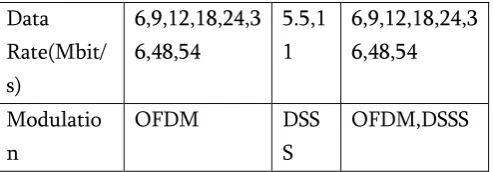
TABLE I. IEEE 802.11 CLASSIFICATIONS
Standard IEEE 802.11a IEEE 802. 11b
IEEE802.11g
Release Sept 1999 Sept 1999
Jun 2003
Bandwidth (MHz)
20 20 20
Frequency( GHz)
Data
TABLE II. WLAN CLASSIFICATIONS
WLAN Physical network on data rate 1 and 2 Mbps and transmission power 0.005 watts with buffer size 256000 bits the time of simulation was 1500 sec. TORA and GRP routing protocols were compared in terms of Download Response Time, Upload Response Time, Delay, Load and Media Access Delay in scenario for the simulation analysis and performances.
Anjali [2] analyzed the performance of AODV, OLSR and GRP routing protocols is evaluated for FTP based application traffic on IEEE 802.11 WLAN Standard and 48 Mbps data rate. The network performance is evaluated by using OPNET simulator based on various quantitative metrics- Network Load, Throughput, Retransmission Attempts and Media Access Delay by varying physical characteristics and number of nodes. A comparative performance analysis of these protocols
have been carried out in this paper and in the last conclusion will be presented which demonstrate that performance of routing protocols differs by varying the network and selection of accurate routing protocol according to the network ultimately influences the efficiency of the network in a magnificent way.
Kuldeep vats [5] analyzed the performance of DSR, OLSR and GRP routing protocols. They used OPNET simulation tool. They created a network containing 150 mobile nodes with the data rate of 18 mbps and transmit power of 0.11 watts. Each node moves randomly within the network range 10,000 sq m and Simulation time was 1000 sec. According to their simulation result OLSR presented the best performance and GRP presented low to OLSR and high to DSR or finally DSR presented the low performance (DSR<GRP<OLSR) is analyzed.
III. WIRELESS LAN PROTOCOLS
MANET has a number of routing protocols created to be implemented on it categorized in three different types according to the functionality
A. Proactive Protocols
Table-driven methods are also called Proactive methods which keep routes to all other nodes in the network also consider those nodes which does not received packets sent. Thus, the route is already available when a path to a particular destination is needed at a node and there is no extra delay due to route discovery. An example of Proactive Protocol is OLSR.
B. Reactive Protocols
on which packet is not sent. TORA is an example of Reactive Protocol.
C. Hybrid Protocols
It combine characteristics of both pro-active and re-active routing in order to find effective and reliable routes, without large control overhead, by locally using pro-active routing and inter-locally using re-active routing. In this method communication in MANET is possible when nodes are near to each other and the supposition that changes in topology are only important if they happen in the vicinity of a node.
IV.SIMLATION SETUP
We used software known as OPNET Modeler to work, which is a tool provided by the OPNET Technologies in order to undertake the comparative simulation evaluation; the version named OPNET Modeler 14.5 has been adopted for study [13]. OPNET is one of the most extensively used commercial simulators based on Microsoft Windows platform, which incorporates most of the MANET routing parameters compared to other commercial simulators. It simulates the network graphically and gives the graphical structure of actual networks and network components.
.
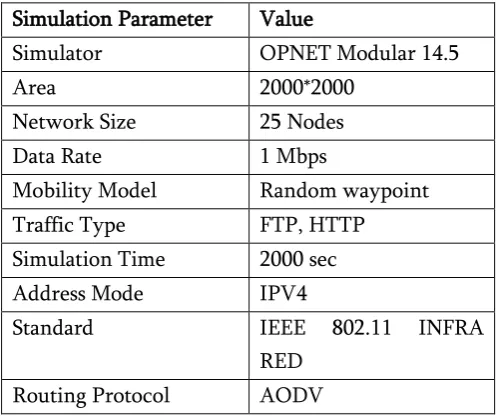
TABLE III. SIMULATION PARAMETERS
Simulation Parameter Value
Simulator OPNET Modular 14.5
Area 2000*2000
Network Size 25 Nodes
Data Rate 1 Mbps
Mobility Model Random waypoint
Traffic Type FTP, HTTP
Simulation Time 2000 sec
Address Mode IPV4
Standard IEEE 802.11 INFRA
RED Routing Protocol AODV
TABLE IV. AODV PARAMETERS
Attribute Value
Active Route Timeout 3.0
Hello Interval(sec) Uniform(1,1.1) Allowed Hello Loss 2
Local Repair Enabled
Addressing Mode IPV4
TABLE V. WIRELESS LAN PARAMETERS
Attribute Value
Physical Characteristics INFRA RED
Data Rate 1 Mbps
Short Retry Limit 7 Long Retry Limit 4 Max Receive Lifetime (sec)
0.5
Buffer Size(bits) 1024000 Roaming Capability Enabled Large Packet Processing Fragment
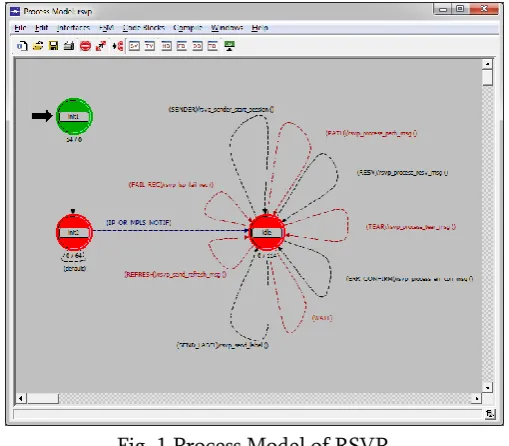
Fig. 1 Process Model of RSVP
V. PERFORMANCE MERICS
A. HTTP Object Response Time (sec)
Time elapsed between sending a request and receiving the response packet. Measured from the time a client application sends a request to the server to the time it receives a response packet. Every response packet sent from a server to an HTTP application is included in this statistic.
B. HTTP Upload Response Time (sec)
Time elapsed between sending a file and receiving the response. The response time for responses sent from any server to an HTTP application is included in this statistic.
C. FTP Traffic Sent (bytes/sec)
Average bytes per second submitted to the transport layers by all FTP applications in the network.
D. FTP Traffic Received (bytes/sec)
Average bytes per second forwarded to all FTP applications by the transport layers in the network.
E. AODV Packets Dropped Total (bits/sec)
It is the total no of Packets Dropped during the simulation till the full process completes for different data transmission LAN’s
VI.SIMULATION RESULTS AND ANALYSIS
Figure (3 - 8) below shows HTTP Download Response Time (sec), HTTP Upload Response Time (sec), FTP Traffic Sent, FTP Traffic Received & AODV packets Dropped Total in 25 mobile nodes scenario for IEEE 802.11 Infra Red standard and Extended Rate IEEE 802.11g standard at 1 Mbps data rate with AODV. The color scheme is showing the protocols behavior in different graphs which gives the average values. From these average values we will conclude the behavior of the IRWLAN and Extended Rate IEEE 802.11g.
A. HTTP Object Response Time (sec)
Fig. 2 Sample Sum for HTTP Object Response Time
(sec) in 1 Mbps for IRWLAN and Extended Rate
According to simulation, as we can see in Fig. 2, object response time in Infra Red WLAN is less than Extended Rate 802.11g. This shows Infra Red WLAN in 1 Mbps works best in terms of HTTP Object Response time.
B. HTTP Page Response Time (sec)
Fig. 3 Sample Sum for HTTP Page Response Time
(sec) in 1 Mbps for IRWLAN and Extended Rate
802.11g
According to simulation, as we can see in Fig. 3, HTTP Page Response time in Extended Rate 802.11g is higher than Infra Red WLAN while seeing the 1 Mbps. This shows Infra Red WLAN is better in terms of HTTP Page Response time.
C. FTP Traffic Sent (packets/sec)
Fig. 4 Sample Sum for FTP Traffic Sent (packets/sec) in 1 Mbps for IRWLAN and Extended Rate 802.11g
According to simulation, as we can see in Fig. 4, FTP Traffic Sent in Extended Rate 802.11g is more than Infra Red WLAN. This shows Extended Rate 802.11g works well in terms of FTP Traffic Sent.
D. FTP Traffic Received (bytes/sec)
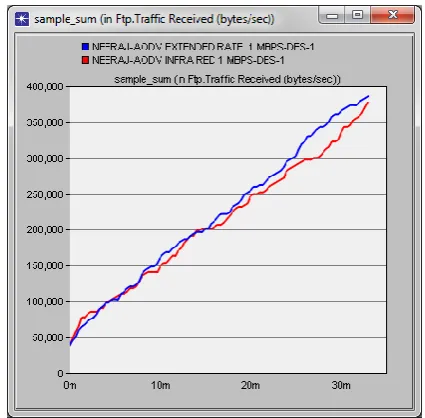
Fig. 5 Sample Sum for FTP Traffic Received (bytes/sec) in packets in 1 Mbps for IRWLAN and
According to simulation, as we can see in Fig. 5, FTP Traffic Received in Extended Rate 802.11g is more than Infra Red WLAN. This shows Extended Rate 802.11g is better in terms of FTP Traffic Received.
E. AODV Packets Dropped Total (bits/sec)
Fig. 6 Sample Sum for AODV Packets Dropped Total in 1 Mbps for IRWLAN and Extended Rate 802.11g
According to simulation, as we can see in Fig. 6, AODV Packets Dropped Total in Extended Rate 802.11g is slightly lower in WLAN. This shows Infra Red WLAN works well in terms of AODV Packets Dropped Total.
VII. CONCLUSION
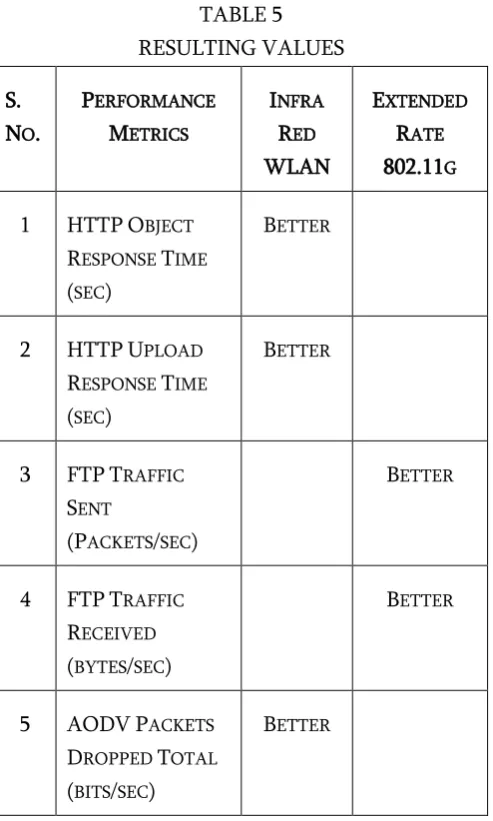
In this paper performance of Infra Red WLAN and Extended Rate 802.11g is evaluated with the use of AODV Protocol for metrics like HTTP Object Response Time (sec), HTTP Upload Response Time (sec), FTP Traffic Sent (bytes/sec), FTP Traffic Received (bytes/sec), AODV Packets Dropped Total (bits/sec)by using 25 nodes scenario with IEEE 802.11 Infra Red WLAN Standard and IEEE 802.11g Extended Rate in 1 Mbps. From the above discussion
we find out that Infra Red performs better in some cases and Extended Rate performs better in some cases as per the table below.
TABLE 5 RESULTING VALUES
S. NO.
PERFORMANCE METRICS
INFRA RED WLAN
EXTENDED RATE 802.11G
1 HTTP OBJECT RESPONSE TIME (SEC)
BETTER
2 HTTP UPLOAD RESPONSE TIME (SEC)
BETTER
3 FTP TRAFFIC SENT
(PACKETS/SEC)
BETTER
4 FTP TRAFFIC RECEIVED (BYTES/SEC)
BETTER
5 AODV PACKETS DROPPED TOTAL (BITS/SEC)
BETTER
Infra Red WLAN has large number of possibilities to be worked on. After seeing these results I wonder why these are not widely used. An infrared wireless LAN might do a better job of satisfying requirements for campus networks. The simulation result of the research has practical reference value for further study.
VIII. REFERENCES
Routing Protocol Based on Frequency Hopping”, IJCSMC, Vol. 3, Issue. 11, November 2014, pg. 523 – 531.
[2]. Anjali, Maninder Singh, “Performance Analysis of Proactive, Reactive and Hybrid MANET Routing Protocols on IEEE 802.11 Standard”, International Journal of Computer Applications,pp.1-8,Volume 54-No.12,September 2012.
[3]. Anjali, Maninder Singh, “Simulation and Performance Analysis of AODV, OLSR, GRP Routing Protocol by considering IEEE 802.11Standard”, IJARCSSE, Volume2, issue 6, pp-171-178,June 2012.
[4]. Ravinder Ahuja, “Simulation based Performance Evaluation and Comparison of Reactive, Proactive and Hybrid Routing Protocols based on Random Waypoint Mobility Model”, International Journal of Computer Applications, Vol. 7, No.11, pp. 20-24, Oct. 2010.
[5]. Kuldeep Vats, Monika Sachdeva and Dr. Krishan Saluja, “ Simulation and performance Analysis of OLSR, GRP, DSR Routing Protocol using OPNET”, International Journal of Emerging trends in Engineering and Development, Vol.2 ,Issue 2, pp 390-404, March-2012.
[6]. Pravin GhoseKar, Girish Katkar and Dr. Pradip Ghorpade, “Mobile Ad Hoc Networking: Imperatives and Challenges”,IJCA, pp. 153-158, 2010.
[7]. Xiaoyan Hong, Kaixin Xu and Mario Gerla, “Scalable Routing Protocols for Mobile Ad Hoc Networks”, IEEE Network, vol. 16, issue 4, pp 11-21, Aug.2002.
[8]. Mostafa Fazeli, “Assessment Of Throughput Performance Under OPNET Modeler Simulation Tools In Mobile Ad Hoc Networks (MANETs)” 3rd ICCI,CSN , IEEE 2011.
[9]. Ashish Shrestha and Firat Tekiner, “On MANET Routing Protocols for Mobility and Scalability.” In International Conference on Parallel and Distributed Computing, Applications and
Technologies, p.p. 451-456, November 2009. IEEE Computer Society.
[10]. Guo, L, and Peng, Y. (2010) “Performance evaluation for on-demand routing protocol based on OPNET modules in wireless mesh network” Computer and Electrical Engineering (Elsevier), vol. 37(2011), pp. 106-114.
[11]. T.H. Clausen, ”The optimized link state routing protocol evaluating through experiments and simulation” mind pass centre for distributed system, Aalborg university ,Denmark.
[12]. Wikipedia Internet :
http://en.wikipedia.org/wiki/IEEE_802.11g-2003
[13]. Opnet Technologies, Inc. “Opnet Simulator,” Internet: www.opnet.com.
Cite this article as :