DOI: 10.1534/genetics.107.072843
Genetic Mapping of Developmental Instability: Design,
Model and Algorithm
Jiasheng Wu,*
,†,‡Bo Zhang,
§Yuehua Cui,
‡Wei Zhao,
‡Li’an Xu,
§Minren Huang,
§Yanru Zeng,
†Jun Zhu* and Rongling Wu
†,‡,§,1*College of Agriculture and Biotechnology, Zhejiang University, Hangzhou, Zhejiang 310029, People’s Republic of China,†School of Forestry and Biotechnology, Zhejiang Forestry University, Lin’an, Zhejiang 311300, People’s Republic of China,‡Department
of Statistics, University of Florida, Gainesville, Florida 32611 and§The Key Laboratory of Forest Genetics and Gene Engineering, Nanjing Forestry University, Nanjing, Jiangsu 210037, People’s Republic of China
Manuscript received March 2, 2007 Accepted for publication March 27, 2007
ABSTRACT
Developmental instability or noise, defined as the phenotypic imprecision of an organism in the face of internal or external stochastic disturbances, has been thought to play an important role in shaping evo-lutionary processes and patterns. The genetic studies of developmental instability have been based on fluctuating asymmetry (FA) that measures random differences between the left and the right sides of bilateral traits. In this article, we frame an experimental design characterized by a spatial autocorrelation structure for determining the genetic control of developmental instability for those traits that cannot be bilaterally measured. This design allows the residual environmental variance of a quantitative trait to be dissolved into two components due to permanent and random environmental factors. The degree of de-velopmental instability is quantified by the relative proportion of the random residual variance to the total residual variance. We formulate a mixture model to estimate and test the genetic effects of quantitative trait loci (QTL) on the developmental instability of the trait. The genetic parameters including the QTL position, the QTL effects, and spatial autocorrelations are estimated by implementing the EM algorithm within the mixture model framework. Simulation studies were performed to investigate the statistical behavior of the model. A live example for poplar trees was used to map the QTL that control root length growth and its developmental instability from cuttings in water culture.
E
VERY live organism in the course of evolution is intricately equipped with developmental stability or canalization (Waddington1940) through collective mechanisms that buffer against the stochastic pertur-bations arising spontaneously from the cellular processes involved in the development of morphological struc-tures (Polak 2003). However, when stochastic pertur-bations of either environmental or genetic origin are beyond the capacity of the organism to produce a con-sistent phenotype, the organism will be forced to display some degree of developmental instability, manifested as the imprecision of developmental pathways and final morphological phenotypes (Waddington 1957; Zakharov1992; Palmer1994). Indeed, developmental instability embodies variation around the expected (tar-get) phenotype that should be produced by a specific genotype in a given environment, and the occurrence of developmental instability is due to small random er-rors accruing in development even when genetic and en-vironmental conditions are kept constant (Klingenberg 2004).In general, developmental instability produces a subtle difference in each step of development. But increasingly more evidence has been observed that the accumulation of these minor differences may have played an important role in the ultimate formation and evolution of a complex trait (reviewed in Leamy and Klingenberg2005). In nature, developmental instabil-ity may negatively affect the fitness of a biological organ-ism (Badyaevet al. 2000) and the yield of an economic trait and its components, such as seed size, seed number and photosynthetic rate (Souzaet al. 2005), through the investment of extra energy to buffer against various environmental fluctuations that are internal and ex-ternal to an organism. A widely accepted view is that developmental instability will be higher in the more stressed populations compared to the control or un-stressed populations (Pankakoskiet al. 1992; Graham et al. 2000; Pertoldiet al. 2006). Given the fundamental importance of developmental instability, it is essential for understanding its genetic causes and consequences (Polak2003; Leamyand Klingenberg2005) and fur-ther exploring how it responds to natural or artificial selection within an evolutionary and ecological context (Clarke1998).
1Corresponding author:Department of Statistics, 409 McCarty Hall C,
University of Florida, Gainesville, FL 32611. E-mail: [email protected]
Developmental instability is quantified by the amount of variation among phenotypes that would be produced by the same developmental blueprint under identical genetic and environmental conditions (Klingenberg 2004). In organisms like animals that display a bilateral symmetry, developmental instability is measured as fluc-tuating asymmetry (FA) that is due to random dif-ferences between left and right sides. Although FA is considered to be purely environmental in origin, it may also be under genetic control (Leamy1997; Markow and Clarke 1997; Palmer 2000; Fuller and Houle 2003). Empirical studies suggest that the heritability of FA is low (Pelabonet al. 2004), but in many cases it is significant, as observed in Scheineret al. (1991) and dem-onstrated by a meta-analysis of Møllerand Thornhill (1997a,b), although there is a controversy on this issue (Whitlock and Fowler 1997). Recent quantitative trait locus (QTL) mapping approaches (Lander and Botstein 1989; Lynch and Walsh 1998) have been performed to identify specific loci responsible for the variation of FA in mice (Leamyet al. 1998, 2002). These mapping studies allowed Leamy and Klingenberg (2005) to conjecture the nonadditive genetic architec-ture of FA composed of intralocus (dominance) and interlocus interactions (epistasis).
Plants, as organisms with modular construction, are very suitable subjects for detecting developmental in-stability caused by environmental disturbance. The anal-ysis of the asymmetry of plant structural traits can be used to determine deviations from the basic structural pattern, which is a measure of plant developmental in-stability. However, for important traits such as stemwood growth in forest trees and grain yield in crops, it is not possible to measure such asymmetry. Different from conventional FA measures, developmental instability for these traits can be measured by growing individual plants of the same genotype in a microsite with clonal rep-licates or recombinant inbred lines. Variation among phenotypes of different individuals within a clonal geno-type under a similar condition is thought to stem from developmental instability or noise.
In this article, we propose an experimental design based on genotypic replicates in space to map and es-timate the genetic effects of QTL on the developmental instability of a quantitative trait. A mixture model is constructed to separate different QTL genotypes in terms of observed marker information (Landerand Botstein 1989). The autoregressive model interpreted on a spatial scale is used to model the structure of the residual vari-ance matrix (Cressie1991). It assumes that the residual correlation between any two different copies of the same progeny genotype decays exponentially with the physical distance between these two replicates in the field. Also, the residual variance is postulated to be composed of two components due to permanent and random envi-ronmental factors. The random residual variance due to stochastic independent errors reflects the degree of
de-velopmental instability. The genetic control of devel-opmental instability can be determined by testing the difference in the random residual variance among QTL genotypes inferred from a molecular linkage map. The statistical model is constructed within the context of maximum likelihood and implemented with the EM al-gorithm (Dempsteret al. 1977). Simulation studies have been performed to investigate the statistical behavior of the model. We used a real example in poplars to validate the usefulness of the model.
THE MODEL
Experimental design: Consider a simple backcross
design in whichnprogeny are segregating in a 1:1 ratio at each locus. A genetic linkage map, aimed to identify segregating quantitative trait loci (QTL), is constructed with polymorphic markers genotyped through the ge-nome. Each backcross progeny is replicated with clones, recombinant inbred lines, or isogenic lines and planted in a randomized complete design. There are multiple replicates for each progeny planted in a plot. The number of replicates (R) can be small or large, depend-ing on the availability of materials. The shape of a plot can be a triangle, a rectangle, a square, and so on. With-out loss of generality, let each progeny have four copies laid out in a square plot with a loop 1/2/3/4/1 at a spacing ofd3dm. Thus, the physical distances between any two plants can be expressed as
d12¼d;for plants 1 and 2;
d23¼d;for plants 2 and 3; d34¼d;for plants 3 and 4;
d41¼d;for plants 4 and 1;
d13¼dpffiffiffi2;for plants 1 and 3;
d24¼dpffiffiffi2;for plants 2 and 4: ð1Þ
For other layouts, between-plant distances can always be calculated as long as the geometric shape of the plot and the number of copies are known.
Linear model:The phenotypic value of a quantitative
trait, yij, for progeny i at its jth replicate in a plot is
described by a linear model
yij¼ci1eij; ð2Þ
whereciis the genotypic value of progenyiandejis the
residual (or environmental) effect,eijN(0,s2).
Suppose there is a putative QTL in the backcross, with two genotypes,Qq (coded by 1) andqq (coded by 0), involved in the control of the trait. The genotypic value of progenyican be partitioned into two components, i.e., the genotypic value (mh) of QTL genotypeh(h¼1,
0) and the genetic effect (cijh) due to other loci rather
than the QTL under consideration. Because of the replicates of a progeny, the residual effect is partitioned into permanent (pi) and random environmental effect
yij¼
X1
h¼0
jhmh1cijh1pi1eij; ð3Þ
where jh is the indicator variable for QTL genotypes
defined as 1 for a considered QTL genotype and 0 other-wise,mhis assumed to be a fixed effect, andcijh,pi, and eijare assumed to be the random effects, withcijhN(0, s2
c),piN(0,s2p), andeijN(0,s2e).
Autocorrelation structure: Let yi ¼ {yij}Rj¼1 be the
vector of the observed value for the trait measured for progenyiplanted withRreplicates in a plot. Equations 2 and 3 are then written in matrix notation as
yi ¼Fici1ei
¼X
1
h¼0
jhFimh1Ficijh1Cipi1ei; ð4Þ
where Fi is an R-dimensional vector of all elements
equal to 1,Ciis anR-dimensional vector whose elements
describe the spatial positions of different replicates for progenyiwithin a plot,ei¼ feijg
R
j¼1, andei¼ feijg R j¼1.
TheR-dimensional residual covariance matrix of the phenotype vector (yi) among different replicates across
different progenies of the same QTL genotype is ex-pressed in terms of Equation 4 as
Si ¼FTiFis2c1Ris2p1Iis2e
¼FT
iFis2c1½ð1gÞRi1gIis2e; ð5Þ where matrixRispecifies the autocorrelation structure
of different replicates for progeny i within a plot, de-fined by the positions of replicatesCi(Cressie1991),
andIiis an identity matrix because the random
environ-mental effects are assumed to be independent among replicates.
Equation 5 partitions the variance within QTL geno-types into two parts, one being the genetic variance and the other being the residual environmental variance. The environmental variance is further partitioned into spatial and nonspatial components. The spatial com-ponent of the environmental variance is due to some permanent factors within a plot, such as moisture or nutritional gradients in a microsite. The nonspatial com-ponent of the residual environmental variance that does not depend on microenvironmental gradients is due to local unpredictable variability arising from random independent errors. The nonspatial component repre-sents the local variance of the residual error that is often called the ‘‘nugget variance’’ (Isaaks and Srivastava 1989). Thus, the relative magnitude of the spatial and nonspatial components, described by parameter g, re-flects the extent of the local variability due to devel-opmental instability. On the basis of this definition, we have the permanent environmental variances2
p¼(1
g)s2and the random environmental variances2
e¼gs2.
The spatial covariance matrix can be structured by various statistical models, such as the first-order au-toregressive ½AR(1) model, in which the variance is assumed to be constant over different plant positions within a plot and the spatial correlation drops off ex-ponentially with the distance between plant positions, so that a distance ofdbetween plant positions leads to a correlation of rd
. Considering a square plot, we model the spatial correlation matrix for progenyiby
Ri¼
1 rd rpffiffi2d rd
rd 1 rd rpffiffi2d
rpffiffi2d rd 1 rd
rd rpffiffi2d rd 1
2 6 6 6 4
3 7 7 7
5: ð6Þ
A similar modeling structure can also be used for other different layouts of the plot.
Likelihood function and computational algorithm: The likelihood function of the observed values (y) for the trait and marker information (M) can be expressed, by a mixture model (Landerand Botstein1989), as
LðVjy;MÞ ¼Y
n
i¼1
½-1jif1ðyiÞ1-0jif0ðyiÞ; ð7Þ
where V is the unknown vector including the QTL position, the QTL genotypic values (mh), the genetic
variance within QTL genotypes (s2
c), the permanent
environmental correlation (r), the residual variance (s2), and the proportion of the random residual vari-ance to the total residual varivari-ance (g).
The mixture proportions, -1jiand-0ji, are the QTL
genotype frequencies in the backcross. Because each backcross progeny has known marker genotypes, the likelihood function will be expressed in terms of known groups of marker genotypes. Let the putative QTL be predicted by a pair of flanking markers that bracket the QTL. Thus, the QTL genotype frequencies should be expressed for each of the four possible marker geno-types. These so-called conditional probabilities of QTL genotype given marker genotypes are derived in terms of the recombination fractions between the QTL and two flanking markers. For a dense map, these condi-tional probabilities can be approximated by the ratio (u) between the QTL–marker over marker–marker recom-bination fractions. We thereby use u to denote the chromosomal location of the QTL within the marker interval.
The multivariate normal distribution probability of the trait for QTL genotype h (h ¼1, 0), fh(yi), is
ex-pressed as
fhðyiÞ ¼
1 ð2pÞR=2jS
hj1=2
exp 1
2ðyiuhjiÞSh1ðyiuhjiÞT
;
where uhji¼Fimhis the vector of the genotypic values
hwithin a plot. We use Equation 5 to model the struc-ture of the covariance matrix in the above probability density function specifically for QTL genotypes. Assume that the QTL does not affect the spatial (permanent) residual variance, but it is responsible for the local (random) residual variance. Thus, by defining a QTL genotype-specific proportion of the local to total resi-dual variance,gh, and comparing its differences among
different QTL genotypes, we can test whether the de-velopmental instability of the trait studied is controlled by the hypothesized QTL.
The EM algorithm (Dempsteret al. 1977) is imple-mented to estimate the genotypic values and the pa-rameters that model the structure of the covariance matrix, all contained in vectorV¼(u,Q) withQ¼(mh, s2
c,gh,r,s2) (h¼1, 0). These unknown parameters can
be estimated by differentiating the log-likelihood func-tion of Equafunc-tion 7 with respect to each parameter, let-ting the derivatives be equal to zero, and solving the log-likelihood functions.
The log-likelihood function of the phenotypic values for a trait affected by a QTL is given by
logLðVjy;MÞ ¼X
n
i¼1
log½-1jif1ðyiÞ1-0jif0ðyiÞ;
with the derivative with respect to any elementV‘in the
unknown vector
@ @V‘
logLðVjy;MÞ
¼X
n
i¼1
f1ðyiÞð@-1ji=@uÞ1f0ðyiÞð@-0ji=@uÞ -1jif1ðyiÞ1-0jif0ðyiÞ
1-1jið@=@QÞf1ðyiÞ1-0jið@=@QÞf0ðyiÞ -1jif1ðyiÞ1-0jif0ðyiÞ
¼X
n
i¼1
-1jif1ðyiÞð1=-1jiÞð@-1ji=@uÞ1-0jif0ðyiÞð1=-0jiÞð@-0ji=@uÞ -1jif1ðyiÞ1-0jif0ðyiÞ
1-1jif1ðyiÞð@=@QÞlogf1ðyiÞ1-0jif0ðyiÞð@=@QÞlogf1ðyiÞ -1jif1ðyiÞ1-0jif0ðyiÞ
¼X
n
i¼1
P1ji 1
-1ji @-1ji
@u 1
@
@Qlogf1ðyiÞ
1P0ji 1
-0ji @-0ji
@u 1
@
@Qlogf0ðyiÞ
;
where we define
Phji ¼
-hjifhðyiÞ
-1jif1ðyiÞ1-0jif0ðyiÞ
; ð8Þ
which could be thought of as a posterior probability that progenyihas QTL genotypeh. We then implement the EM algorithm with the expanded parameter set {V,P}, whereP¼{Phji}. Conditional onP(the E step;
Equa-tion 8), we solve the log-likelihood equaEqua-tions
@ @V‘
logLðVjy; MÞ ¼0 ð9Þ
to get the estimates ofV(the M step). The E and M steps between Equations 8 and 9 are repeated until the
esti-mates converge to stable values that are regarded as the maximum-likelihood estimates (MLEs) of the parame-ters. A detailed procedure for the derivations of the MLEs is available upon request.
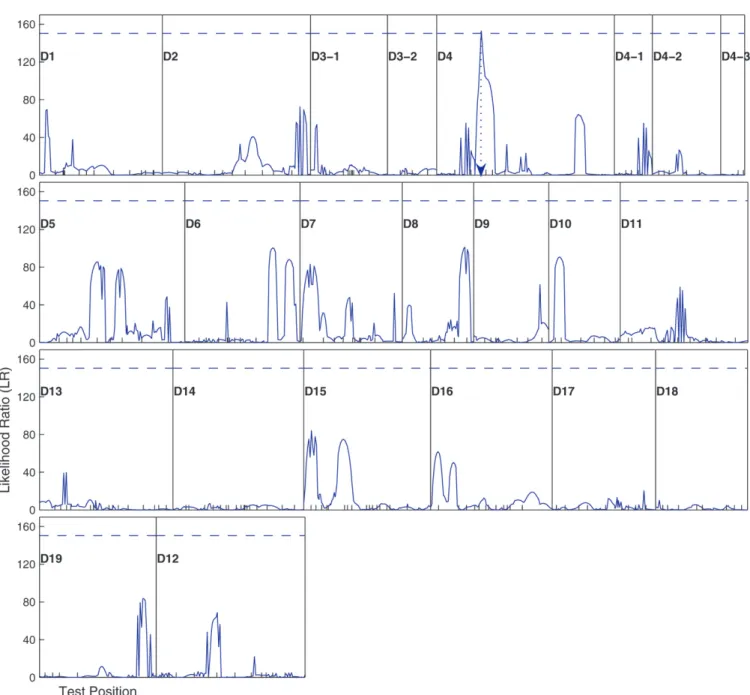
In practical computations, the QTL position param-eter can be viewed as a fixed paramparam-eter because a puta-tive QTL can be searched at every 1 or 2 cM on a map interval bracketed by two markers throughout the entire linkage map. The log-likelihood-ratio test statistic for a QTL at a particular map position is displayed graphi-cally to generate a likelihood map or profile. The geno-mic position that corresponds to a peak of the profile is the MLE of the QTL location.
HYPOTHESIS TESTS
The existence of QTL: On the basis of the MLEs of
two QTL genotypic values, we estimate the overall mean by ˆm¼ ðmˆ11mˆ0Þ=2 and the additive genetic effect of the QTL on the trait byaˆ¼ ðmˆ1mˆ0Þ=2. This design allows us to test the existence of a QTL, regardless of whether it affects only the trait or its developmental instability or both. This can be tested by formulating the following hypotheses:
H0: a ¼0 andg1¼g0[g
H1: at least one of equalities above does not hold:
ð10Þ
The log-likelihood valuesL0andL1under H0and H1are
calculated. The test is performed with a log-likelihood-ratio statistic
LR¼ 2½lnL0ðm˜;g˜;r˜;s˜2jyÞ lnL1ðVˆjy;MÞ; ð11Þ where the tildes and hat stand for the MLEs under the null and the alternative hypothesis, respectively. The LR statistic is plotted against test locations and a high LR corresponds to the position of QTL. Because the QTL position under H0of hypothesis (10) is not identifiable,
the distribution of the LR calculated is unclear. An empirical approach for determining the critical thresh-old that does not depend on the distribution is based on permutation tests, as advocated by Churchilland Doerge (1994). By repeatedly shuffling the relation-ships between marker genotypes and phenotypes, a series of the maximum-log-likelihood ratios are calcu-lated, from the distribution of which the critical thresh-old is determined.
The effect of the QTL on the trait can be tested using the hypotheses as follows:
H0: a¼0
H1: a6¼0: ð12Þ
the QTL position under the null hypothesis is identifi-able, a case different from hypothesis (10). The genetic variance of the trait contributed by the detected QTL is the variance between the two QTL genotypes, calculated by
s2 g¼
1 4a
2:
The total environmental variance is the summation of the residual environmental variance within each QTL genotype weighted by the frequencies of QTL geno-types, calculated as
s2e¼ 1
2R2 FS1F T1FS
0FT
:
Thus, the heritability of the trait explained by the QTL is calculated as
h2¼ s
2 g
s2g1s2c1s2e:
Genetic control of developmental instability: After
the existence of a QTL for the trait is confirmed, it is essential to test whether this detected QTL triggers an effect on the developmental instability of the trait. We can first test whether the nonspatial local variation is significant by formulating the hypotheses
H0: g1¼g0 ¼0
H1: at least one of equalities above does not hold:
ð13Þ
If H0of hypothesis (13) is accepted, this means that all
the residual variance is contributed by the spatial vari-ance and that there is no varivari-ance due to developmental instability. By contrast, if the null hypothesis of the test
H0: g1¼g0 ¼1
H1: at least one of equalities above does not hold
ð14Þ
is accepted, this indicates that the nonspatial compo-nent,i.e., the nugget effect, is only a source for the re-sidual variance.
The genetic control of developmental instability is tested by
H0: g1 ¼g0
H1: g1 6¼g0: ð15Þ If H0 of hypothesis (15) is rejected, this suggests that
developmental instability is under significant genetic control. The LR values for hypotheses (13)–(15) can be thought to follow ax2-distribution with 2 or 1 d.f., re-spectively. For each QTL genotype, the proportion of the nonspatial variance due to developmental noise relative to the total residual variance is calculated by
Hh¼
ghðFIFTÞs2
FShFT
: ð16Þ
Thus, by comparingHhbetween the two genotypes, we
determine how the QTL detected for the trait affects its developmental instability.
APPLICATION
Material: We used a real example for QTL mapping
in poplar trees to demonstrate the usefulness of our model. The study material, as described in Wu et al. (2002), was derived from the triple hybridization of Populus (poplar),Populus deltoides, andP. euramericana, which is an interspecific hybrid betweenP. deltoidesand P. nigra. Of .400 triple hybrids, 90 were randomly chosen to establish a mapping population for marker analysis and QTL identification. Given the heterozygous characteristic of forest trees, analysis of this mapping population is based on a pseudotest backcross design (Grattapagliaand Sederoff1994), in which markers and QTL are heterozygous in one parent but not in the second parent. According to this design, two genetic link-age maps each based on the gene segregation of a dif-ferent parent were constructed with difdif-ferent types of molecular markers (Yinet al. 2002). Our analysis here is based on aP. deltoides(D)-specific linkage map.
Ramets from each of the progeny used to construct linkage maps were made to study their rooting capacity. The ramets were water cultured in a randomized com-plete block design with three different blocks and a four-tree square plot. Root numbers were counted and the length of each root was measured at five weekly intervals starting at day 7. The total root length of each cutting was then estimated. In this study, the total root lengths at the last measurement point were used. A total of 75 trees containing complete marker and trait data are used.
Results: The mapping model with an algorithm
The two subsequent hypotheses (12 and 15) were made to test whether this QTL triggers an effect on root length growth and the developmental instability of the trait, respectively. The testing results suggest that the QTL has a significant additive effect on the root length (Table 1), explaining 19.9% of the total phenotypic variance for the trait. In addition, this QTL also displays a significant effect on the developmental instability of root length, with the nugget parameters being different between the two QTL genotypes (0.802 and 0.094; Table 1). Developmental instability explains different propor-tions of the residual variance for two different QTL
ge-notypes, respectively, as calculated by Equation 16, with such a proportion being larger for the larger genotype (29.2%) than for the smaller genotype (5.9%).
Monte Carlo simulation: We performed simulation
studies to investigate the statistical properties of the model for mapping developmental instability QTL. We mimicked the poplar example by simulating the back-cross of a low sample size (n¼75). A linkage group of length 200 cM is constructed with 10 evenly distanced markers for this backcross. To investigate the influence of sample size on parameter estimation, we performed further simulation studies by increasing sample size to Figure1.—The profiles of the log-likelihood ratios between the full and reduced (no QTL) model for root length growth across
200 and 500. Each progeny from this backcross is planted with a square plot of four copies. Assume that a QTL located at 48 cM from the first marker at the left of the linkage group affects a normally distributed trait. With the given additive genetic effect of the QTL, along with the parameters that specify the spatial and non-spatial structure of the covariance matrix (Equation 5; Table 2), the phenotypic values of the backcross are simulated under different heritability levels (h2 ¼0.1 and 0.4). The spatial correlation is modeled by the AR model (Equation 6).
The simulated data are subjected to statistical analyses by the mapping model proposed. For a small sample size like the one used for the poplar example, the model provides reasonable but not excellent estimates for all the parameters (including the QTL position, QTL ef-fects on the simulated trait and its developmental insta-bility, and covariance-structuring parameters) when the heritability of the simulated trait is low (Table 2).
How-ever, as the sample size increases, the precision of pa-rameter estimation increases remarkably. As expected, these estimates are more accurate and more precise with a high heritability. The model appears to have high power for the detection of significant effects on devel-opmental instability, even for a low sample size and a low heritability level (Table 2).
DISCUSSION
Because developmental systems are inherently ‘‘noisy’’ and frequently subject to random fluctuations, consid-erable variation can be observed in the rates of develop-ment and morphology even among genetically identical individuals under the most uniform experimental con-ditions (McAdams and Arkin 1997). This so-called developmental noise or instability has been thought to be related to the fitness and evolution of the organism (Møllerand Swaddle1997). The study of the genetic
TABLE 2
The MLEs of the QTL position and effect and covariance-structuring parameters under the assumption of the genetic control of developmental instability derived from 100 simulation replicates
n h2
Position
(at 48 cM) m¼10 a¼1 g1¼0.4 g2¼0.8 r¼0.9 s2 Power
0.1 75 49.48 10.013 0.928 0.337 0.767 0.870 4.634 81
(17.105) (0.170) (0.523) (0.224) (0.161) (0.129) (0.496)
0.1 200 48.16 10.005 0.951 0.361 0.789 0.879 4.612 100
(8.283) (0.120) (0.232) (0.150) (0.099) (0.089) (0.270)
0.1 500 47.52 10.004 0.992 0.387 0.794 0.894 4.631 100
(4.807) (0.062) (0.141) (0.107) (0.055) (0.063) (0.138)
0.4 75 47.08 10.010 1.002 0.326 0.773 0.869 0.754 100
(7.821) (0.073) (0.168) (0.209) (0.147) (0.121) (0.088)
0.4 200 48.38 9.997 0.989 0.374 0.803 0.894 0.763 100
(4.230) (0.048) (0.086) (0.150) (0.083) (0.093) (0.050)
0.4 500 47.78 10.001 1.001 0.386 0.795 0.896 0.771 100
(1.694) (0.029) (0.059) (0.106) (0.053) (0.068) (0.032)
The location of the QTL is described by the map distance (in centimorgans) from the first marker of the linkage group (100 cM long). The hypothesizeds2-value is 0.771 forh2¼0.4 and 4.628 forh2¼0.1. The square roots of the mean squared errors of the MLEs are given in parentheses.
TABLE 1
The results of QTL mapping for rooting capacity and its developmental instability in a pseudotest backcross design of poplar
Marker interval AG/CGA-395d–CA/CCG-680d
ˆ
m sˆ2
c aˆ g1ˆ g0ˆ rˆ sˆ
2
MLE 1.683 0.101 0.552 0.802 0.094 0.934 0.568
LR 152.9
LRT 34.2
LRD 66.5
control of developmental instability has been the sub-ject of great interest in evolutionary and developmental biology (Klingenbergand Nijhout1999; Leamyand Klingenberg2005) and agricultural genetics (Wu1997). Traditional quantitative genetic approaches have been used to estimate the genetic variability and heritability of developmental instability measured as FA for bilateral traits. Specific QTL have been identified for FA in mice with molecular genetic linkage maps (Leamyet al. 2002). In this article, we have framed a general design to esti-mate QTL that affect developmental instability for those traits whose developmental instability cannot be mea-sured in terms of FA. We have derived a statistical model and a computational procedure for testing and estimat-ing the effect of QTL on developmental instability with the data collected from a field trial.
The idea behind our model is the incorporation of the spatial autocorrelation model into the QTL map-ping framework. We have implemented a common form of spatial autocorrelation (Cressie1991) that involves both spatial and nonspatial,i.e., local or ‘‘nugget,’’ com-ponents (Isaaks and Srivastava1989). Thus, rather than estimating all elements contained within the co-variance matrix, our model estimates a few key param-eters that model the structure of the covariance matrix. Spatial components result from some predictable mi-croenvironments within a plot, whereas nonspatial com-ponents result from local unpredictable perturbations. Thus, the proportion of nonspatial relative to spatial variances can be regarded as the degree of developmen-tal instability. We derived the EM algorithm to estimate the parameters that structure the covariance matrix. The derived algorithm is robust, as seen from results through simulation studies, in that the model provides reasonable estimates of genotypic effects and spatial pa-rameters over a range of space including different sam-ple sizes and heritability levels.
The new model has been employed to identify a QTL that affects rooting capacity and its developmental in-stability from cuttings of poplar trees in a controlled water culture laid in a square plot with three blocks. We have detected a significant QTL on a linkage group constructed by AFLP markers in an interspecific hybrid population of two poplar species (Yinet al. 2002). On the basis of previous quantitative and molecular genetic studies, rooting capacity is found to be under strong genetic control in woody plants (Wang et al. 1988; Wullschleger et al. 2005). Several QTL for fine or coarse root biomass traits have been mapped on specific chromosomal locations for hybrid poplars between P. trichocarpa3P. deltoides(Wullschlegeret al. 2005). A smaller number of the root QTL detected in this study may be due to a small sample size and/or possible C-effects, a common phenomenon in vegetative prop-agation (Stelzeret al. 1998), that describe variation in trait performance among different ramets from dif-ferent tree positions. A structuring model for
approxi-mating the dependence of ramets can be proposed to remove C-effects that may have confounded the esti-mates of the genetic parameters in the poplar example. As a first conceptual exploration of its kind, our map-ping model was formulated in terms of interval mapmap-ping and it should be powerful to detect unlinked QTL for a quantitative trait. Its capacity to separate multiple linked QTL can be improved through the combination of in-terval mapping and partial regression analysis on all the markers except for the two that flank the QTL. This so-called composite interval mapping (Zeng 1994) that has proven to increase the resolution of QTL mapping can be readily integrated with our mapping model to more precisely identify positions and effects of QTL that control the developmental instability of a quantitative trait. Another immediate issue is to incorporate the effects of QTL3environment interactions on developmental instability when the trial is conducted under multiple different sites. Such a multisite trial is needed to avoid the inflated estimate of the genetic control of develop-mental instability. Our developdevelop-mental model and its extensions will prove their value to draw a detailed pic-ture of the developmental instability of complex phe-notypes for a variety of organisms in plants and animals.
We thank two anonymous reviewers for their constructive comments on this manuscript. This work is partially supported by grants (09-95671 and 30671704) from the National Natural Science Foundation of China and from the National Science Foundation (0540745).
LITERATURE CITED
Badyaev, A. V., K. R. Foresmanand M. V. Fernandes, 2000 Stress
and developmental stability: vegetation removal causes increased fluctuating asymmetry in shrews. Ecology81:336–345. Churchill, G. A., and R. W. Doerge, 1994 Empirical threshold
values for quantitative trait mapping. Genetics138:963–971. Clarke, G. M., 1998 Developmental stability and fitness: the
evi-dence is not quite so clear. Am. Nat.152:762–766.
Cressie, N. A. C., 1991 Statistics for Spatial Data. John Wiley & Sons,
New York.
Dempster, A. P., N. M. Lairdand D. B. Rubin, 1977 Maximum
like-lihood from incomplete data via EM algorithm. J. R. Stat. Soc. Ser. B39:1–38.
Fuller, R. C., and D. Houle, 2003 Inheritance of developmental
instability, pp. 157–186 inDevelopmental Instability. Causes and Con-sequences, edited by M. Polak. Oxford University Press, New York.
Graham, J. H., D. Fletcher, J. Tigueand M. McDonald, 2000 Growth
and developmental stability ofDrosophila melanogasterin low fre-quency magnetic fields. Bioelectromagnetics21:465–472. Grattapaglia, D., and R. R. Sederoff, 1994 Genetic linkage maps
ofEucalyptus grandis and Eucalyptus urophylla using a pseudo-testcross: mapping strategy and RAPD markers. Genetics 137:
1121–1137.
Isaaks, E. H., and R. M. Srivastava, 1989 Applied Geostatistics. Oxford
University Press, New York.
Klingenberg, C. P., 2004 Dominance, nonlinear developmental
map-ping and developmental stability, pp. 37–51 inThe Biology of Genetic Dominance, edited by R. A. Veitia. Landes Bioscience, Austin, TX.
Klingenberg, C. P., and H. F. Nijhout, 1999 Genetics of
fluctuat-ing asymmetry: a developmental model of developmental insta-bility. Evolution53:358–375.
Lander, E. S., and D. Botstein, 1989 Mapping Mendelian factors
underlying quantitative traits using RFLP linkage maps. Genetics
121:185–199.
Leamy, L., 1997 Is developmental stability heritable? J. Evol. Biol.
Leamy, L. J., and C. P. Klingenberg, 2005 The genetics and evolution
of fluctuating asymmetry. Annu. Rev. Ecol. Evol. Syst.36:1–21. Leamy, L. J., E. J. Routmanand J. M. Cheverud, 1998 Quantitative
trait loci for fluctuating asymmetry of discrete skeletal characters in mice. Heredity80:509–518.
Leamy, L. J., E. J. Routmanand J. M. Cheverud, 2002 An epistatic
genetic basis for fluctuating asymmetry of mandible size in mice. Evolution56:642–653.
Lynch, M., and B. Walsh, 1998 Genetics and Analysis of Quantitative
Traits. Sinauer, Sunderland, MA.
Markow, T. A., and G. M. Clarke, 1997 Meta-analysis of the
heri-tability of developmental sheri-tability: a giant step backward. J. Evol. Biol.10:31–37.
McAdams, H. H., and A. Arkin, 1997 Stochastic mechanisms in
gene expression. Proc. Natl. Acad. Sci. USA94:814–819. Møller, A. P., and J. P. Swaddle, 1997 Asymmetry, Developmental
Stability and Evolution. Oxford University Press, Oxford. Møller, A. P., and R. Thornhill, 1997a Developmental stability is
heritable. J. Evol. Biol.10:69–76.
Møller, A. P., and R. Thornhill, 1997b A meta-analysis of the
her-itability of developmental stability. J. Evol. Biol.10:1–16. Palmer, A. R., 1994 Fluctuating asymmetry analyses: a primer,
pp. 335–364 inDevelopmental Instability: Its Origins and Evolutionary Implications, edited by T. A. Markow. Kluwer, Dordrecht, The
Netherlands/Norwell, MA.
Palmer, A. R., 2000 Waltzing with asymmetry: Is fluctuating
asym-metry a powerful new tool for biologists or just an alluring new dance step? BioScience46:518–532.
Pankakoski, E., I. Koivisto and H. Hyvarinen, 1992 Reduced
developmental stability as an indicator of heavy metal pollution in the common shrew,Sorex araneus. Acta Zool. Fenn.191:137–144. Pelabon, C., T. F. Hansen, M. L. Carlsonand W. S. Armbruster,
2004 Variational and genetic properties of developmental sta-bility inDalechampia scandens. Evolution58:504–514.
Pertoldi, C., T. N. Kristensen, D. H. Andersenand V. Loeschcke,
2006 Developmental instability as an estimator of genetic stress. Heredity96:122–127.
Polak, M., 2003 Developmental Instability. Causes and Consequences.
Oxford University Press, New York.
Scheiner, S. M., R. L. Caplanand R. F. Lyman, 1991 The genetics
of phenotypic plasticity. III. Genetic correlations and fluctuating asymmetries. J. Evol. Biol.4:51–68.
Souza, G. M., J. O. F. Vianaand R. F. Oliveira, 2005 Asymmetrical
leaves induced by water deficit show asymmetric photosynthesis in common bean. Braz. J. Plant Physiol.17:223–227.
Stelzer, H. E, G. S. Foster, D. V. Shawand J. B. McRae, 1998
Ten-year growth comparison between rooted cuttings and seedlings of loblolly pine. Can. J. For. Res.28:69–73.
Waddington, C. H., 1940 Organizers and Genes. Cambridge
Univer-sity Press, Cambridge, UK.
Waddington, C. H., 1957 The Strategy of the Genes. Macmillan, New York.
Wang, M. X., M. R. Huang, S. X. Lu, X. Z. Xu, N. Xu et al.,
1988 Study of new clones of the Aigeiros poplars. III. Genetic variation of rooting characters. J. Nanjing For. Univ.12(1): 1–11. Whitlock, M. C., and K. Fowler, 1997 The instability of studies of
instability. J. Evol. Biol.10:63–67.
Wu, R. L., 1997 Genetic control of macro- and microenvironmental
sensitivities inPopulus. Theor. Appl. Genet.94:104–114. Wu, R. L., C. X. Ma, M. Chang, R. C. Littell, S. S. Wuet al., 2002 A
logistic mixture model for detecting major genes governing growth trajectories. Genet. Res.79:235–245.
Wullschleger, S. D., T. M. Yin, S. P. DiFazio1, T. J. Tschaplinski,
L. E. Gunteret al., 2005 Phenotypic variation in growth and
biomass distribution for two advanced-generation pedigrees of hybrid poplar (Populusspp.). Can. J. For. Res.35:1779–1789. Yin, T. M., X. Y. Zhang, M. R. Huang, M. X. Wang, Q. Zhugeet al.,
2002 The molecular linkage maps of the Populus genome. Genome45:541–555.
Zakharov, V. M., 1992 Population phenogenetics: analysis of
develop-mental stability in natural populations. Acta Zool. Fenn.191:7–30. Zeng, Z.-B., 1994 Precision mapping of quantitative trait loci. Genetics
136:1457–1468.
Communicating editor: M. W. Feldman
APPENDIX
In what follows, we derive the formulas for obtaining the MLEs of all the unknown parameters (V), except for the QTL position, when the experimental design used has a square plot. The formulas for other designs of a plot can be derived in a similar way. The log-likelihood equations for estimating the MLEs ofVfor a square plot whose spatial correlation matrix is modeled by the AR(1) are derived as
uh ¼
1 R
Pn i¼1Phjiyi
Pn i¼1Phji
;
s29¼ s2
nðR1Þ Xn
i¼1
X1
h¼0
PhjiðyiuhÞSh1ðyiuhÞT
;
gh9¼1 1
ah; r9¼fð1=dÞ;
where9denotes a subsequent iteration in the M step, and
ah¼
Ah
Rn
Xn
i¼1
PhjiðyiuhÞ
@Sh1
@ah ðyiuhÞ
T
;
f¼ Bh
Rn
Xn
i¼1
X1
h¼0
PkjiðyiuhÞ
@S1
h
@f ðyiuhÞ
T
;
Ah¼
a2
h ahf
ffiffi
2
p
a2
h4f212ahf
ffiffi
2
p
1f2pffiffi2
2ahf21a
hf2
ffiffi
2
p
1f3pffiffi24f21pffiffi2 ;
Bh¼
f2 a3
h14ahf2a2hf
ffiffi
2
p
1ahf2pffiffi21f3pffiffi24f21pffiffi2
2ahf21pffiffiffi2a
hf2
ffiffi
2
p
Considering a square plot, the residual variance matrix, denoted bySh, for QTL genotypehis modeled by
Sh ¼ ð1ghÞs2
1 rd rpffiffi2d rd
rd 1 rd r ffiffi2
p
d
rpffiffi2d rd 1 rd
rd r ffiffi2 p
d rd 1
2 6 6 6 6 4 3 7 7 7 7 51ghs
2I
¼s
2
ah
ah f f ffiffi2
p f
f ah f fpffiffi2
f ffiffi2 p
f ah f
f f ffiffi2 p
f ah
2 6 6 6 6 4 3 7 7 7 7 5;
whereah ¼1=ð1ghÞandf¼rd. The determinant and inverse of the matrix are derived;i.e.,
jShj ¼
s2 ah
4
ah1f ffiffi2 p
12f
ah1f ffiffi2 p
2f
ahf ffiffi2 p
2
;
Sh1¼
ahfpffiffi2
s6
a3hjShj
3
a2h1f ffiffi2 p
ah2f2 ðf
ffiffi
2
p
ahÞf 2f2f2
ffiffi
2
p
f ffiffi2 p
ah ðahf
ffiffi
2
p
Þf
ðahfpffiffi2Þf a2
h1f
ffiffi
2
p
ah2f2 ða
hf
ffiffi
2
p
Þf 2f2f2pffiffi2fpffiffi2a
h
2f2f2 ffiffi2 p
f ffiffi2 p
ah ðahf ffiffi2
p
Þf a2h1f ffiffi2 p
ah2f2 ðahf ffiffi2
p
Þf
ðahf
ffiffi
2
p
Þf 2f2f2 ffiffi2 p
f ffiffi2 p
ah ðahf
ffiffi
2
p
Þf a2h1f ffiffi2 p
ah2f2
2 6 6 6 6 6 4 3 7 7 7 7 7 5 : We have
@S1
h
@ah ¼
1
s2
a1 a2 a3 a2 a2 a1 a2 a3 a3 a2 a1 a2 a2 a3 a2 a1
2 6 6 6 4 3 7 7 7 5;
@Sh1
@f ¼
1
s2
b1 b2 b3 b2 b2 b1 b2 b3 b3 b2 b1 b2 b2 b3 b2 b1
2 6 6 6 4 3 7 7 7 5; where
a1¼2½ð2f
21f2pffiffi2Þa3
h1ð2f
3pffiffi25f21pffiffi2Þa2
h1ðf
4pffiffi24f212pffiffi2Þa
hf213
ffiffi 2
p
14f41pffiffi2
½a3
h1f
ffiffi 2
p
a2
h ðf
2pffiffi214f2Þa
hf3
ffiffi 2
p
14f21pffiffi22 ;
a2¼ fða
2
hf
2pffiffi214f2Þ
ða2
h12f
ffiffi 2
p
ah1f2
ffiffi 2
p 4f2Þ2;
a3¼½f
ffiffi 2
p
a4
h1ð2f
2pffiffi2
4f2Þa3
h1ð2f
21pffiffi21
2f3pffiffi2Þa2
h1ð2f
4pffiffi2
8f212pffiffi2Þa
h1f5
ffiffi 2
p
6f213pffiffi21
8f41pffiffi2
½a3
h1f
ffiffi 2
p
a2
h ðf2
ffiffi 2
p 14f2Þa
hf3
ffiffi 2
p
14f21pffiffi22 ;
b1¼2ah½ð
ffiffiffi
2 p
f2pffiffi212f2Þa3
h1ð2
ffiffiffi
2 p
f3pffiffi2 ð213p2ffiffiffiÞf21pffiffi2Þa2
h1ð
ffiffiffi
2 p
f4pffiffi22ð11p2ffiffiffiÞf212pffiffi2Þa
h1ð23
ffiffiffi
2 p
Þf213pffiffi214pffiffiffi2f41pffiffi2
f½a3
h1f
ffiffi 2
p
a2
h ðf2
ffiffi 2
p 14f2Þa
hf3
ffiffi 2
p
14f21pffiffi22 ;
b2¼ah½a
2
h12ð1
ffiffiffi
2 p
Þfpffiffi2a
h1ð12
ffiffiffi
2 p
Þf2pffiffi214f2
ða2
h12f
ffiffi 2
p
ah1f2
ffiffi 2
p
4f2Þ2 ;
b3¼ah½
ffiffiffi
2 p
fpffiffi2a4
h1ð2
ffiffiffi
2 p
f2pffiffi24f2Þa3
h1½2
ffiffiffi
2 p
f3pffiffi21ð42p2ffiffiffiÞf21pffiffi2a2
h1½2
ffiffiffi
2 p
f4pffiffi21ð412p2ffiffiffiÞf212pffiffi2a
h1
ffiffiffi
2 p
f5pffiffi218pffiffiffi2f41pffiffi2 ð412pffiffiffi2Þf213pffiffi2
f½a3
h1f
ffiffi 2
p
a2
h ðf
2pffiffi214f2Þa
hf3
ffiffi 2
p