Evaluation of SM-MIMO With STBC Codes
using Various Modulation Techniques
Prashant Yadav1, Dr. Rajesh Bansode2
P.G. Student, Department of Electronics and Telecommunication Engineering,Thakur college of Engineering and
Technology, Mumbai, Maharashtra, India1
Professor, Department of Information and Technology Engineering,Thakur college of Engineering and Technology,
Mumbai, Maharashtra, India2
ABSTRACT:Antenna technology in wireless communication uses diverse antennas at the transmitter and receiver side to exchange information. A new emerging technology called MIMO (Multiple Input Multiple Output) is generally used as antenna technology. MIMO gives rise to problems with multipath effect due to this inter-channel interference or inter-carrier interference occurs. To deal with problems of multipath effects a key emerging modulation called spatial Modulation is used. This new technology, spatial modulation when combined with high rate space time block code reduced BER of overall system. Hence both core STBC and antenna indices carry information over multiple paths. In this paper, Spatial Modulation with different QAM and also outage probability is designed which has low BER than other system. SM –MIMO scheme can be useful for high rate, low convolution and prominent wireless communication system such as LTE & Wi-max. This paper presents the simulation results of SM with 16-QAM, outage probability and random signal generator with MIMO system. The performance of space-time block codes with QPSK modulation is better than the performance of space-time block codes with 16-QAM modulation by approximately 5-6 db.
KEYWORDS:Multiple Input Multiple Output (MIMO), STBC, BPSK, QPSK, QAM, Spatial modulation, outage probability.
I. INTRODUCTION
MIMO system consists of diverse antennas at both the transmitter and receiver side. The principle goal of MIMO technology is to improve either the quality (BER) or the data rate of the communication by means of adequate signal processing techniques at both ends of the system. MIMO can acquire both multiplexing & diversity gain thus remarkably enlarges the system capacity as well as improving the reliability of the wireless link. The advantage of MIMO communication can be divided into three main categories: Spatial multiplexing for enhancing the data transmission rate, transmit diversity using space time coding. One inherent issue of the wireless channel is fading, which occurs as the signal travel diverse paths between transmit and receive antennas. In this case no reliable communication is possible. Fading can be mitigated by diversity or spatial multiplexing which means that the information is transmitted not only once but several times, hoping that at least one of the replicas will not undergo severe fading [1].
As a performed analysis two standard MIMO transmission strategies, a space-time block coding (STBC) and spatial multiplexing (SM), have been proposed. The increasing demand for high data rates and high spectral efficiencies has led to the development of spatial multiplexing systems [2].
II. RELATEDWORK
NaziaParveen& D.S. Venkateswarlupresents the Simulation results of 2 transmit and 2 receive antennas of Alamouti Scheme.This paper provides a basic overview of MIMO system, space time block coding. Thus they observed that BPSK modulation for 2x2 Alamouti STBC give better better for SNR of 13db with BER of 1.1e-0.005 when compare to MRC the Almoutischeme [1].
K.Bala, Murali Krishna & G. Ramesh Babu gives brief introduction about STBC-SM system design and its optimization. They present optimal ML decoder for the STBC-SM system.They give BER analysis for 4*4 MIMO systems using different modulation techniques and conclude that STBC-SM gives better BER as compared to other modulation techniques[2].
Multiple input multiple output (MIMO) systems give higher spectral efficiency and better performance without consuming extra bandwidth and power. Recent developments in the MIMO technologies focus on reducing computational and hardware complexity using different transmit and receive diversity schemes. Alamouti proposed a simple two branch transmit diversity scheme. It was then examined as space time block codes (STBC) for number of antennas and analyzed spatial modulation (SM) in which antenna index of the active antenna also carries the information resulting in increased spectral efficiency. SM systems are further investigated and a joint detection scheme is proposed to improve the performance in. SM system can be combined with STBC system to get two fold advantages of improved performance and better spectral efficiency [3].
Santumon.S.D& B.R. Sujatha This paper presents the Space-Time Block Codes (STBC) for wireless networks that uses multiple numbers of antennas at both transmitter and receiver. Author simulates the Alamouti scheme performance with coherent BPSK modulation. They give BER curves for the Alamouti scheme for QPSK and QAM modulations in Rayleigh channel [4].
III.RELATEDTHEORY
A. SPACE TIME BLOCK CODE: Space–Time Block Codes (STBCs) are the elementary sets of spatial temporal codes that utilize the diversity present in systems with number of transmit antennas [1]. Space-time block codes (STBC) are a generalized version of Alamouti scheme. These codes are orthogonal and can achieve full transmit diversity specified by the number of transmit antennas. In other words, space-time block codes are composite design of Alamouti space-time code, where the encoding and decoding schemes are the same as there in the Alamouti space-time code on both the transmitter and receiver. The data are assembled as a matrix which has its columns equal to the number of the transmit antennas and its rows equal to the number of the time slots required to transmit the data. At the receiver side, the received signals are first merged to form a single unit and then sent to the maximum likelihood detector where the decision rules are applied. Space-time block codes were planning to accomplish the maximum diversity order for the given number of transmit and receive antennas subject to the constraint of having a simple linear decoding algorithm [5]. B. SPATIAL MODULATION:A novel concept known as spatial modulation will be going to implement with
IV.METHODOLOGY
In this paper, we implement STBC Alamouti scheme with two transmit, two receive antenna over Rayleigh fading channel using BPSK, QPSK & 16-QAM modulation technique. Afterwards we implement STBC-SM scheme with BPSK, QPSK and 16-QAM modulation technique. For decoding Alamouti code, there are several method like zero forcing, minimum mean square estimation (MMSE), Brute force ML decoding etc. Best performance is given by Brute force ML decoder. Finally BER vs. SNR simulation results are compared between STBC & STBC-SM techniques [6].
A. System Model
Former, the Alamouti code is the prime STBC that yield full diversity at full data rate for twoor more number of transmit antennas. A block diagram of theAlamouti space-time encoder is shown in figure 1[5].
Figure 1 Block Diagram of Space Time Encoder
Here the information source to be transmitted is modulated and fed to the space time encoder. The space time encoder consists of two transmit antennas as part of the multiple input multiple output technology [3]. So here the information is transmitted through two separate antennas. Each transmitting and the receiving antenna pair has a channel, represented by different channel coefficients. These channel coefficients play a major role in the design of the system [7].
In the encoder is the two modulated symbols S1 and S2 in each encoding operation and sent up to the transmit antennas
in the form of a matrix is as follows:
S = − ∗ ∗ ...(1)
The first row represents the first transmission period and the second row the second transmission period. Where S1 is
sent from the first antenna and S2 from the second antenna in the first transmission period. Whereas −s2∗is sent from the
first antenna and s∗from the second antenna in the second transmission period. The two rows and columns of S matrix are orthogonal to each other.
The channel experienced between each transmit and receive antenna is randomly varying in time. However, the channel is assumed to remain constant over two time slots. The channels h1 and h2 are assumed to be known only at the receiver.
[8]. A block diagram of the Alamouti space-time decoder is shown in Figure 2. Inform
-ation Source
Modu -lator
− ∗ ∗
Alamouti Codes
[ ] =
In the decoder, the received signal is fed to the channel estimator. The estimated coefficients of the channel together with the combiner are given as the input to the maximum likelihood Detector. The detected signal is then fed to the demodulator. The demodulator gives the original information which it transmitted [9].
In the first time slot, the received signal is,
Y1 = h1s1 + h2s2 + n1...(2)
Y1 = [h1 h2] + n1 ...(3)
In the second time slot, the received signal is, Y2 = -h1 ∗+ h2 ∗+ n2...(4)
Y2 = [h1 h2] − ∗ ∗ + n2...(5)
Where Y1 & Y2 are the received symbols on first and second time slot respectively. Ni is the AWGN noise in the ith time slot where i = 1, 2. S1& S2 is the modulated signal from transmit antenna 1 & 2 respectively.h1 & h2 are channel coefficients between two transmit antennas[10]. Figure 3: Space-time block code scheme with two transmit and two receive antennas. Above figure shows STBC scheme of 2*2 antennas. The received signal at two receive antenna denoted by r1, r2, r3,&r4 for t and t+T respectively can be expressed by, r1 = h1 s1 + h2 s2 + n1...(6)
r2 = -h1 ∗+ h2 ∗+ n2...(7)
r3 = h3 s1 + h4 s2 + n3...(8)
In the receiver, SM detection includes two steps, the first is estimation of the index of transmit antenna, the second is symbol demodulation for this antenna. The combiner in figure builds the following two combined signal that are sent to the maximum likelihood detector[11].
= ∗ + ∗ + ∗ + ∗
………...(10)
= ∗ − ∗ + ∗ − ∗
………...(11)
V. STBC-SM
STBC-SM is a system which merges Space Time Block Code STBC and Spatial Modulation (SM). In this scheme, the transmitted data is dependent on the space, time and antenna indices. STBC-SM takes the benefits of this combination to attain high spectral efficiency which is realized using antenna indices to rely information. Besides, STBC-SM is raise for diversity and coding gain to minimize the BER which is the done using the space and time domains. Low complexity maximum likelihood (ML) decoder is used in this scheme which gains from the orthogonality of the STBC code.By using space time block code there is no expansion in bandwidth[12].
In the STBC-SM scheme, the transmitted information symbols or bits are enlarging not only to the space and time domains but also to the spatial (antenna) domain; therefore both cores STBC and antenna indices carry information. The proposed scheme is optimized by deriving its diversity and coding gains to exploit the diversity advantage of STBC. Hereby band efficiencies of the system are increased. STBC-SM allows the system to have more satisfactory performance in a fading environment and good performance with minimal decoding complexity. It can accomplish maximum diversity gain and receiver that use only linear processing to recover transmitted data[13].
VII.RESULTSANDDISCUSSIONS
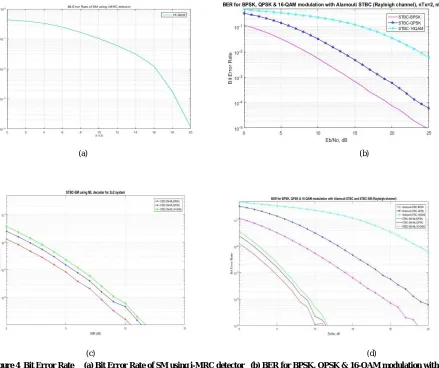
Alamouti space-time code is an orthogonal scheme that can achieve the full transmit diversity with two transmit antenna and two receive antenna. In this section, we present simulation result for the STBC-BPSK, QPSK & QAM modulation system with two transmit two receive antenna under Rayleigh fading channel. Also simulation results for the STBC-SM BPSK, QPSK & 16-QAM modulation are given.Finally the BER for various modulation schemes are compared.
Figure 4 Bit Error Rate (a) Bit Error Rate of SM using i-MRC detector (b) BER for BPSK, QPSK & 16-QAM modulation with Alamouti STBC (c) BER for BPSK, QPSK & 16-QAM modulation with STBC-SM (d) BER for BPSK, QPSK & 16-QAM
modulation with Alamouti STBC & STBC-SM
Table 1: SNR values for different BER for Alamouti STBC
Modulation No.of
Tx:Rx
SNR(dB)for BER 10 SNR(dB)for BER 10
Achieved Reported %
Increment
Achieved Reported %
Increment
BPSK 2:2 18 15 16.66 13 9.5 26.09
QPSK 2:2 23 20 13.04 18 15 16.66
16-QAM 2:2 25 22 12 25 20 20
Table 2: SNR values for different BER for STBC-SM
Modulation No.of
Tx:Rx
SNR(dB) for BER 10 SNR(dB)for BER 10
Achieved Reported %
increment
Achieved Reported %
increment
BPSK 2:2 7 5 28.51 4 3.5 12.5
QPSK 2:2 8 5.5 31.25 4 3 25
16-QAM 2:2 9 8 11.11 6 5 16.67
From the above table, Space-time block codes using BPSK, QPSK, and 16-QAM modulation techniques showed optimal results in terms of bit-error-rate.The performance of space-time block codes with BPSK modulation is more desirable than the performance of space-time block codes with QPSK modulation by approximately 5 db. The performance of space-time block codes with QPSK modulation is better than the performance of space-time block codes with 16-QAM modulation by approximately 5~6 db.The performance of STBC-SM with BPSK modulation is better than the performance of SM with QPSK modulation by approximately 1-2 db.The performance of STBC-SM with QPSK modulation is better than the performance of STBC-STBC-SM modulation by approximately 1-2 db. This shows that STBC-SM give better performance than Alamouti STBC scheme.
VI. CONCLUSION
In this paper, a novel space time block code with spatial modulation as an alternative to existing techniques such as SM and V-BLAST[vertical Bell laboratories layered space time] introduced which is detection algorithm to the receipt of multi antenna MIMO system.Alamouti scheme and MIMO with 16-QAM, random signal generator were covered and explained in details. New transmission scheme i.e. employs both APM techniques & antenna indices to convey information & exploits the transmit diversity potential of MIMO channel.I conclude that the SM-MIMO scheme can be useful for high-rate, low complexity, emerging wireless communication systems such as LTE and WiMAX.
REFERENCES
[1] NaziaParveen, D.S. Venkateswarlu,” Implementation of STBC using 2 Transmit & 2 Receive antennas,” International Journal of Engineering Technology & Advanced Engineering, volume 2, Issue 10, Oct-2012.
[2] K.BalaMurali Krishna, G. Ramesh Babu,” Preeminence of Space-Time Block Coded Spatial Modulation System Comparing To SM and V-Blast Systems by Evaluating Parameter Bit Error Rate”, International Journal of Engineering Research & Technology (IJERT), volume 2, Issue 9, September-2013
[3] Santumon.S.D and B.R. Sujatha, “Space Time Block coding (STBC) for wireless Network,” International Journal of Distributed and Parallel Systems (IJDPS), Vol.3, No.4, July 2012.
[4] E. Başar, Ü. Aygölü, E. Panayırcı and H. Vincent Poor, "Space-time block coding for spatial modulation," 21st Annual IEEE International Symposium on Personal, Indoor and Mobile Radio Communications, Instanbul, 2010, pp. 803-808
[5] JayeshDabi, Kamlesh Gupta, “Performance Analysis Of STBC Spatial Modulation Under Transmit Diversity And Multiplexing Gain”, International Journal of Engineering Science & Management (IJESM), Vol.2, Issue 2, April-June 2012, 189-195
[6] P. S. Kumar, M. G. Sumithra, R. Abilash and E. P. Kumar, “Performance analysis for Differential STBC and SFBC MIMO- OFDM Systems under different modulation schemes in a Rayleigh channel,” Electronics and Communication Systems (ICECS), 2014 International Conference on, Coimbatore, 2014, pp. 1-5.
[7] B. Kumbhani, V. K. Mohandas, R. P. Singh, S.Kabra and R. S. Kshetrimayum, “Analysis of space-time block coded spatial modulation in correlated Rayleigh and Rician fading channels”, 2015 IEEE International Conference on Digital Signal Processing (DSP), Singapore, 2015, pp. 516-520.
[10]Hong Liu, JianpingZheng and Ying Li, “Combining spatial modulation and VBLAST/STBC for correlated Rayleigh fading channels: Capacity and performance analysis,” Wireless Communications & Signal Processing (WCSP), 2013 International Conference on, Hangzhou, 2013, pp. 1-5
[11] K. Sundaravadivu and S. Bharathi, “STBC codes for generalized spatial modulation in MIMO systems,” Emerging Trends in Computing, Communication and Nanotechnology (ICE-CCN), 2013 International Conference on, Tirunelveli, 2013, pp. 486-490.
[12] P. Gogoi and K. K. Sarma, “STBC coded MISO and MIMO set-up in frequency selective wireless fading channels for BPSK and QPSK modulation schemes,” Computational Intelligence and Signal Processing (CISP), 2012 2nd National Conference on, Guwahati, Assam, 2012, pp. 158-164.