Optimised Irrigation System Using Wireless
sensor Network and GSM Modem
Shweta B. More1, D. L. Bhuyar2
M.E Student, Department of Electronics &Tele-communication, CSMSS’s College of Engineering, Aurangabad, India1
Assistant Professor, Department of Electronics &Tele-communication, CSMSS’s College of Engineering, Aurangabad,
India 2
ABSTRACT: At present there is less than 1% of fresh water available on earth. One of the important usage of fresh water is for agricultural production and the use of fresh water will continue to increase since growth in population and food demand increases. This lead to the necessity of automated controlling approach for irrigation system. This automated irrigation system is designed to have a control approach on water that is used in agricultural sector that also includes plant nurseries. The defined system here has a WSN(wireless sensor network) includes WSU(wireless sensor unit) and WIU(wireless information unit) which are used to maintain quantity of water by monitoring following parameters such as temperature, soil moisture, humidity and soil pH. The system is also powered by photovoltaic panels. The data inspection and irrigation scheduling can be monitored via GSM. This system can save maximum water and produce good yield compared to traditional methods of irrigation.
KEYWORDS: wireless sensor network (WSN), Automation, GSM module, Monitoring, Measurements, Microcontroller.
I. INTRODUCTION
India is basically agriculture based country. Agriculture sector depends on availability fresh water resource it is primarily important to manage and use it. Agriculture almost requires 85% use of fresh water and the percentage will keep on increasing if proper water management tools and techniques are not used. So it’s important to use agronomic and institutional improvements. Remote monitoring is an effective method in order to avoid interference environment and improve efficiency. This paper gives a review of automated control and monitoring systems based on existing technologies as GSM and X-bee.
II. RELEATED WORK
Many system are present now-a-days which are used to achieve water saving in agricultural sectors using advance technologies. One of the system is where plant water status was monitored and irrigation scheduled based on canopy temperature distribution of the plant, which was acquired with thermal imaging [2]. In addition, other systems have been developed to schedule irrigation of crops and optimize water use by means of a crop water stress index (CWSI) [3].
Irrigation systems can also be automated through information on volumetric water content of soil, using dielectric moisture sensors to control actuators and save water, instead of a predetermined irrigation schedule at a particular time of the day and with a specific duration. An irrigation controller is used to open a solenoid valve and apply watering to bedding plants (impatiens , petunia, salvia, and vinca) when the volumetric water content of the substrate drops below a set point [4].
An alternative parameter to determine crop irrigation needs is estimating plant evapotranspiration (ET). ET is affected by weather parameters, including solar radiation, temperature, relative humidity, wind speed, and crop factors, such as stage of growth, variety and plant density, management elements, soil properties, pest, and disease control [6]. Systems based on ET have been developed that allow water savings of up to 42% on time-based irrigation schedule [7]. A system developed for malting barley cultivations in large areas of land allowed for the optimizing of irrigation through decision support software and its integration with an infield
Wireless sensor network (WSN) driving an irrigation machine converted to make sprinkler nozzles controllable. The network consisted of five sensing stations and a weather station. Each of the sensing stations contained a data logger with two soil water reflectometers, a soil temperature sensor, and Bluetooth communication. Using the network information and the irrigation machine positions through a differential GPS, the software controlled the sprinkler with application of the appropriate amount of water [8].
A data acquisition system was deployed for monitoring crop conditions by means of soil moisture and soil, air, and canopy temperature measurement in cropped fields. Data were downloaded using a handheld computer connected via a serial port for analysis and storage [11].
III. AUTOMATED IRRIGATION SYSTEM
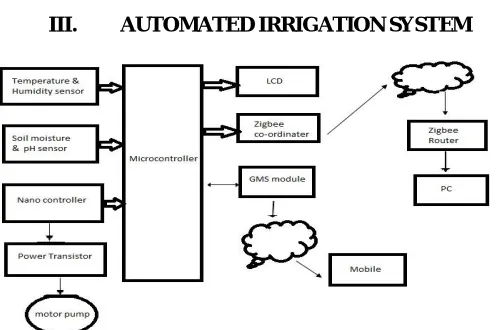
Figure No. 1: Block diagram of Wireless Sensor Network
Various type of irrigation systems are present namely a) Sprinkler irrigation, b) Drip irrigation, c) Surface irrigation, d) Localised irrigation etc. Methods like overhead sprinklers, flood type feeding system conditions there are chances of promotion of infection to plants since they usually wet the lower leaves and stems of plant and that stays wet long after irrigation is completed. Besides that the modern type of irrigation method that includes drip or trickle irrigation slowly applies less amount of water to plant root zone. Hence it avoid condition like moisture stress in plant with proper use of water resources.
The proposed system consist of two components namely wireless sensor unit (WSN’s) that consist of two components namely Wireless sensor unit (WSU’s) and Wireless information unit (WIU’s), linked by radio transceivers that allowed the transfer of soil moisture and temperature data, implementing a WSN that uses ZigBee technology. The WIU has a GSM module to transmit data to the mobile of farmer via the public cellular network .The information can be easily monitored remotely through graphical applications using a MATLAB stimulation.
A) Wireless sensor unit (WSU)
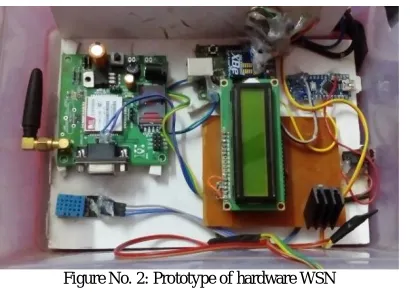
Wireless sensor unit consists of a microcontroller, power sources, RF Transceivers in-field configuration of a distributed sensor network several WSU’s can be deployed for automated irrigation system. Advances made in WSN technology have led to the development of low cost, low power, multifunctional sensor nodes. Sensor nodes enable environment sensing together with data process . We can set up different units that is more than one nodes depending upon the requirement each unit is based on a microcontroller ATMEGA 328 that controls the radio modem ZigBee S2(ZigBee OEM RF module by maxstream ,Inc a digi International brand ) and process the information from the soil moisture and pH sensor and temperature –humidity sensor DHT11.These components are powered by a rechargeable battery. The charge is maintained by a photovoltaic panel to achieve full energy. These above components like radio modem , rechargeable battery, electronic components, Microcontroller are encapsulated in a container . These components were selected to minimize the power consumption for the purpose application.
1) ATMEGA 328:
ZigBee (over IEEE 802.15.4) technology is based on short range WSN and it was selected for this battery-operated sensor network because of its low cost, low power consumption, and greater useful range in comparison with other wireless technologies like Bluetooth (over IEEE 802.15.1), UWB (over IEEE 802.15.3), and Wi-Fi (over IEEE 802.11) [67]. The ZigBee devices operate in industrial, scientific, and medical 2.4-GHz radio band and allow the operation in a so-called mesh networking architecture, which can be differentiated into three categories: 1) coordinator; 2) router; and 3) end device. [1]
ZigBee S2 is appropriate to establish communication between WSU and WIU because of its long range opertions and reliability of sensor networking architecture. The power requirements are its supply voltage 2.8 – 3.4 V, Operating Current (Transmit) is 40mA (@ 3.3 V), Operating Current (Receive) is 40mA (@ 3.3 V). Its operating frequency is ISM 2.4 GHz , Operating Temperature is -40 to 85º C (industrial). Supported Network Topologies are Point-to-point, Point-to-multipoint, Peer-to-peer & Mesh , Number of Channels (software selectable) are 16 Direct Sequence Channels. Performance based Indoor/Urban Range is up to 133 ft. (40 m), Outdoor RF line-of-sight Range is up to 400 ft. (120 m), RF Data Rate is 250,000 bps. The X-bee radio modem of each WSU is powered at 5V through a voltage regulator 7850.
3) Sensor:
The sensor array consists of four sensors namely soil moisture ,pH , temperature and humidity. The soil moisture –pH sensor its pH ranges from 0-10 its has 2 probes. Another is temperature –humidity sensor that is DTH11 it has greater accuracy . Its measurement is 20-50%Rh, 0-50 º C , Humidity accuracy ±5% rh , temperature accuracy ±2ºC, resolution 1, package 4 pin single row . Its power supply is 3-5.5V dc . to calibrate soil moisture , several samples were prepared with 1 kg of dry soil from the cropped area. The temperature sensor was calibrated through a reference mercury thermometer.
4) Photovoltaic Cells:
The power supply of the wireless sensor network is provided by batteries , with a solar panel –each solar panel has maximum power of 3W, rated voltage (Vmp) 6V, Rated current (Imp) 0.33A, Open circuit Voltage (Vcc) 10.8, Maximum system voltage 1000V , Size 180x180x17mm. It is also powered by adaptor for experimental purpose and as a backup option for rechargeable batteries.
B) Wireless Information Unit(WIU)
The data received from WSU that is soil moisture, pH, temperature and humidity are received here, identified, recorded analysed in WIU. It consists of GSM , X-bee ,Water module and power section , interface unit. The functionality of WIU is based on the microcontroller which is programmed to perform diverse task. The WIU is ready to transmit via X-bee the data for each WSU once powered. Then the microcontroller receives the information package transmits by each WSI that confirms WSN.
1)GSM modem:
It is a GSM mode RS232 interface with low cost (SIM 900). It’s a low cost RS232/Interface DB port. It has on board voltage regulator and has powered / singled LED indication. It has SMA connector for antenna connections. This module can be easily interfaced with it AT commands over TTL interface. The microcontroller sends AT commands to GSM module, it inquires the received signal strength indication.
2) Watering module:
Figure No. 2: Prototype of hardware WSN
IV. IRRIGATION SYSTEM OPERTAION
The proposed system is tested in a garden area and an experimental prototype was created to show it in a smaller size for a display of single node or we can say the single wireless sensor network unit was set up to measure the soil moisture, pH, temperature and humidity in the area where traditional irrigation practises were employed. The automated irrigation system corresponding to soil moisture, pH sensor was situated at the depth of 10cm in the root zone of the plant . This unit allowed irrigation monitoring at easy levels.
A.Transmitter section
Power is ON after this system is reset. Signals are read by different sensors and its output is given to microcontroller. The read data includes soil moisture and pH and temperature and humidity of the environment that real time data is displayed on LCD via Microcontroller. Output to microcontroller from sensor is taken through ADC is given to ZigBee through ZigBee coordinator.
B. Receiver section
At receiver side ZigBee come into picture. There is only one Tx and Rx pins Signal is send to microcontroller and parameters like temperature, humidity, soil moisture and pH are monitored. These parameters are monitored on computer using ZigBee S2 router port. The data is viewed both in HyperTerminal setup and the waveform display can be viewed through MATLAB stimulation data .This data can be used for data acquisitions which is used for monitoring. The motor is automatically be controlled using a Nano microcontroller. When the soil is dry the motor automatically starts watering the field till the required area is completely water with right amount. These data acquired is send to GSM where the respective mobile user gets the data by send a message to the WSN via GSM and WSN send the real time data to the user through SMS. This is how total working takes place of automation irrigation system. So that it can be used for proper environment to grow crops easily.
Table I: Data monitoring of the soil
Parameters Before After
Soil moisture 3 6
pH 6 3
Temperature 29 29
Figure No. 3: Dry conditions of soil Figure No. 4: Wet conditions of soil
The Graphs shown are stimulated using MATLAB, both the graphs shows the data acquisition condition of the system . Figure 1 shows the dry condition of the soil and Figure 2 shows the wet conditions of the soil. These data are sent to this PC via microcontroller. These data are the sensors reading of moisture, temperature, pH and humidity. The reading between 0 to 5 is of pH , the other reading between 0 to 10 is of moisture, the reading between 0 to 35 is of temperature and the reading between 0 to 45 is of humidity. The table describes the real time reading of the same.
V. CONCLUSION
The implemented irrigation system is found to be feasible and cost effective for minimising the usage of water resources. We have designed ZigBee wireless sensor network for monitoring the crop field area by deploying moisture sensors in the land to detect the places where the water level is low. From those results we can irrigate to that particular place only. So we can conserve water and minimize the problem of water logging in the land.
We used humidity sensor to sense the weather. By this the farmer can get idea about the climate. If there is any chance for rainfall, the farmer need not irrigate the crop field. Due to this we can conserve water and also power since we dint turn on motors. Nowadays in the crops the fertilizer level is increasing, which affects people. By using pH sensors we get the information about the soil and analyse the acid level of the soil. By which we can apply fertilizer to the place where it needs, also we can avoid over fertilization of the crops. Temperature is a randomly varying quantity in the environment of paddy field. Temperature reading gives information to the farmer. The overall cultivation can be increased effectively. Due to automation, man power is reduced and effective measures are taken to increase the yield.
The automated irrigation system will prove to be useful and reducing use of water and this will be useful for cultivators to check the level of chemical fertilizers etc. For one of the quality of minimum maintenance, the irrigation system can be adjusted to a variety of specific crop needs. The configuration of the automated irrigation system allows
it to be scaled up for larger greenhouses or open fields. The transmission system i.e. ZigBee is found to be cheaper and
faster than others. Besides the monetary savings in water use, the importance of the preservation of this natural resource justify the use of this kind of irrigation systems.
ACKNOWLEDGMENT
I would like to express my gratitude towards my, guide Prof. D.L. Bhuyar who is professor at CSMSS, Aurangabad
for their time to time help and valuable guidance.
REFERENCES
[2] X. Wang, W. Yang, A. Wheaton, N. Cooley, and B. Moran, “Efficient Registration of optical and IR images for automatic plant water stress Assessment,” Comput. Electron. Agricult., vol. 74, no. 2, pp. 230–237, Nov. 2010
[3] G. Yuan, Y. Luo, X. Sun, and D. Tang, “Evaluation of a crop water Stress index for detecting water stress in winter wheat in the North China Plain,” Agricult. Water Manag., vol. 64, no. 1, pp. 29–40, Jan. 2004.
[4] K. S. Nemali and M. W. Van Iersel, “An automated system for controlling Drought stress and irrigation in potted plants,” Sci. Horticult., Vol. 110, no. 3, pp. 292–297, Nov. 2006.
[5] S. A. O’Shaughnessy and S. R. Evett, “Canopy temperature based system Effectively schedules and controls center pivot irrigation of cotton,” Agricult. Water Manag., vol. 97, no. 9, pp. 1310–1316, Apr. 2010.
[6] R. G. Allen, L. S. Pereira, D. Raes, and M. Smith, Crop Evapotranspiration-Guidelines for Computing Crop Water Requirements—FAO Irrigation and Drainage Paper 56. Rome, Italy:FAO, 1998.
[7] S. L. Davis and M. D. Dukes, “Irrigation scheduling performance by Evapotranspiration-based controllers,” Agriculture. Water Managagement., vol. 98, No. 1, pp. 19–28, Dec. 2010.
[8] Y. Kim, R. G. Evans, and W. M. Iversen, “Remote sensing and control of An irrigation system using a distributed wireless sensor network,” IEEETrans. Instrum. Meas., vol. 57, no. 7, pp. 1379–1387, Jul. 2008.
[9] Suraj S.Avatade1, Prof.S. P. Dhanure, “Irrigation System Using a Wireless Sensor Network and GPRS”, International Journal of Advanced Research in Computer and Communication EngineeringVol. 4, Issue 5, May 2015
[10] Prof C. H. Chavan, Mr.P. V.Karande, “Wireless Monitoring of Soil Moisture, Temperature & Humidity Using ZigBee in Agriculture,” International Journal of Engineering Trends and Technology (IJETT) – Volume 11 Number 10 - May 2014
[11] D. K. Fisher and H. A. Kebede, “A low-cost microcontroller-based System to monitor crop temperature and water status,” Computer Electron.Agriculture., vol. 74, no. 1, pp. 168–173, Oct. 2010.
BIOGRAPHY
.
B. Prof.D.L. Bhuyar, Professor at CSMSS College of Engineering, Aurangabad, Maharashtra, India.