3091
Optical And Ionic Conductivity Studies Of Gel
Polymer Electrolytes Based On PVDF:CH
3
COOLi
G. Sunita Sundari, K. Sravanthi and Harikrishna Erothu
Abstract: Gel polymer electrolytes (GPEs) received much attention because of both characteristics like solid and liquid electrolytes and much more applicable towards lithium ion batteries (LIBs). A series of PEs at room temperature has been prepared and discussed. Polymer electrolyte (PE) films are prepared using solution casting technique based on poly(vinylidene fluoride) (PVDF) and lithium acetate (CH3COOLi) with different weight ratios (PVDF:
CH3COOLi wt %) (60:40, 70:30, 80:20 wt %). FTIR analysis used to know the various functional groups in PE samples. From optical absorbance studies,
the band gap values are studied and least value is 3.0 eV. From AC impedance studies, PVDF:CH3COOLi (60:40 wt %) shown the highest value of
conductivity is 6.785x 10⁻⁷ S/cm at 303 K.
Index Terms: Gel polymer electrolytes, Lithium salt, PVDF, Conductivity studies, UV-Visible spectroscopy. —————————— ——————————
1.
INTRODUCTION
Polymer electrolyte (PE) has been a very crucial material in many electronic devices like dye-sensitized solar cell (DSSC‘s), fuel cells sensors and super capacitors, lithium ion batteries as it acquires ion transport [1-2]. The intension of solvating inorganic salts in polymer develop ion conduction in electrolyte is known as solid polymer electrolyte (SPE). Choosing a suitable polymer host is necessary where the functional groups in the polymer will be called as solvating groups, which can dissolve most of metal cations by initiating a coordination bond between them [3]. The key factors that influence the resulting interactions between polymer-metal ions are like molecular weight, structure, inter-space between atoms, behavior of the atoms joined to the polymer backbone, amount of branching. When subjected to electric field the cations moves from one coordinated site to another because of weak coordination between the sites along polymer chain and to the cations [4]. Recently, gel-type polymer electrolyte (GPE) has become more priority in the polymer electrolyte field. In GPE, the liquid constituents are trapped in polymer host matrix which can be treated as both liquid-type and solid-type electrolytes due to many advantages in both, such as flexible, high safety and high ionic conductivity [5]. PVDF is selected as host polymer due to its attractive properties high transparency, structure itself due to the existence of fluorine, carbon functional groups cause affect on detachment of lithium salts which favours to increase in charge carrier concentration and also increases electrochemical stability. The existence of fluorine, hydrogen and carbon atoms develops polymers with chemical and thermal stability which holds their thermoplastic nature, also allows ease of fabrication. Crystalline nature of PVDF has given attention for high dielectric constant which is inversely proportional to attractive force between cation and anion of lithium salt, which makes ease of ionization of lithium
salt, which enhances ionic conductivity [6-8]. From experimental aspect, lithium ion batteries (LIBs) made up of GPEs should cope up with certain requirements such as excellent chemical stability, high ionic conductivity, electrochemical stability and favorable Li-ion transference number [9].
2.0
MATERIALS
Poly(vinylidene difluoride) (PVDF) with average molecular weight of ~ 320,000 g/mol and lithium acetate (CH3COOLi) from Sigma-Aldrich and DMF solvent used directly without any further purification.
2.1 Preparation method
Polymer electrolytes are prepared using solution casting technique with different ratios of (PVDF:CH3COOLi) (60:40, 70:30, 80:20 wt %). PVDF as host polymer and CH3COOLi as dopant salt, DMF as solvent for complexation. The blended solution stirred until to get homogeneous solution and dried in polypropylene dishes to get films.
2.2 Characterization
Polymer electrolytes (PVDF:CH3COOLi) with wt% (PVDF, 80:20, 70:30, 60:40) were subjected to different characterizations. FTIR spectroscopy revealed the presence of functional groups in material using Perkin Elmer Alpha-E spectrophotometer. Using JASCO V-670 spectrophotometer energy band gap of material is studied. Using HIOKI LCR HITESTER conductivity and dielectric studies are carried out with frequency range in between 42 Hz to 5000000 Hz.
3. Results and Discussion
3.1 FTIR
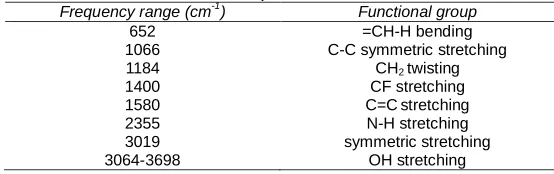
FTIR studies give the interaction of polymer electrolyte complexes and also defines the presence of various functional groups [10]. From Fig.1, FTIR spectra for various bending and stretching vibrations of molecules are recorded for PVDF:CH3COOLi (80:20, 70:30, 60:40 wt %). Different wave number regions are observed, the peak at 1066 (cm-1) is arised due to C-C symmetric stretching and sharp absorption peak at 1184 (cm-1) is observed due to CH2 twisting. Towards the higher wave number absorption peak observed at 1400 (cm-1) is of CF stretching vibration. A new peak is arising at 1580 (cm-1) due to addition of salt because of stretching vibration of C=C. The stretching of C-H and N-H bonds at ________________
Dr G. Sunita Sundari is an Associate Professor, Department of Physics, Koneru Lakshmaiah Education Foundation (KLEF), Green Fields, Vaddeswaram - 522 502, Guntur Dist., Andhra Pradesh, India., Mobile: +91 9396762244 . E-mail: [email protected]
Dr Harikrishna Erothu is an Associate Professor, Department of Chemistry and CAES, Koneru Lakshmaiah Education Foundation (KLEF), Green Fields, Vaddeswaram - 522 502, Guntur Dist., Andhra
Pradesh, India., Mobile : +91 7995621995. E-mail:
3092 2355 (cm-1) gives the absorption peak and is gradually
decreased with increasing of salt concentration. At 3019 (cm -1
), an absorption peak is arising due to symmetric stretching [11-12]. Because of OH functional group wide peak has appeared near 3064-3698 (cm-1). The shifting of absorption peak at 672 (cm-1) towards the lower wave number is due to = CH-H bending vibration [13-14].
Figure 1: FTIR spectra for PVDF:CH3COOLi (Pure PVDF,
80:20,70:30,60:40 wt %) polymer electrolytes
Table 1. FTIR Spectra of different functional groups from
absorption data
Frequency range (cm-1) Functional group
652 =CH-H bending
1066 C-C symmetric stretching
1184 CH2 twisting
1400 CF stretching
1580 C=Cstretching
2355 N-H stretching
3019 3064-3698
symmetric stretching OH stretching
3.2 Optical analysis
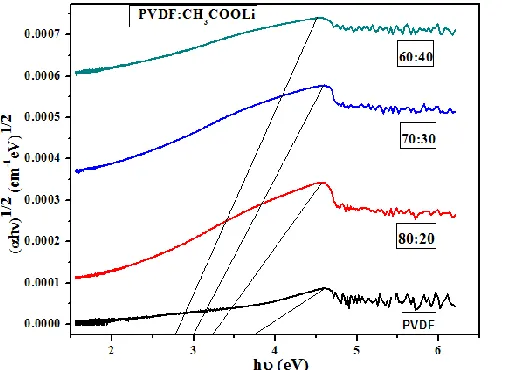
Optical analysis for different ratios of polymer electrolytes are shown in Fig. 2 (b), 2 (c) & 2 (d) with the wavelength region in between 200-8000 nm [15]. It is a direct method to calculate bandgap of the materials. From UV-Visible analysis optical band gap values are derived from Tauc‘s plot [16]. The absorption coefficient value is,
a(h) = T [k-Eg]
n (1)
Where, ‗Eg‘ energy band gap, ‗T‘ is constant structure of specimen, ‗k‘ is Planck‘s constant, ‗‘ represents frequency of incident light.
‗a‘ is absorption coefficient and photon energy is obtained as (2.303*A)/d (2)
Where ‗A‘ is absorbance, ‗d‘ represents thickness of the sample
From Fig. 2 (a), around 260-400 nm it clearly shows that by increasing salt ratio the absorption peak is decayed due to π − π* transition [17]. The energy of photon excites from lower level to higher energy level. The number of possible transitions can be described as absorption edge [18-19]. By increasing salt concentration for the ratio (PVDF: CH3COOLi) (60:40) has obtained least energy band gap and it is reduced from 4.3 (eV) to 3.0 (eV).
Fig. 2 (a) Absorption Spectra for PVDF:CH3COOLi (Pure
PVDF, 80:20,70:30,60:40 wt %) polymer electrolytes
Depending on the material, the energy band is of two types. Generally, both valence and conduction bands are overlapped in direct band gap, where there is no crystal momentum. In the indirect band gap crystal momentum is non-zero, both conduction and valence band are separated [20-21]. From Fig. 2 (b), 2 (c), 2 (d) and table 2 represents the absorption edge, direct and indirect energy band gap values. Since lithium is having small ionic radius and light in weight, it easily interacts with the polymer chain, where the fast-ionic moment takes place by hopping mechanism, finally results in the decreasing of energy band gap values.
Fig.2 (b) PVDF:CH3COOLi (Pure PVDF,80:20,70:30,60:40 wt
3093
Fig.2 (c) PVDF:CH3COOLi (Pure PVDF,80:20,70:30,60:40 wt
%) polymer electrolytes for Indirect energy band gap.
Fig.2 (d) PVDF:CH3COOLi (Pure PVDF,80:20,70:30,60:40 wt
%) polymer electrolytes for Absorption edge.
Table 2 Band gap values for PVDF:CH3COOLi based
polymer electrolytes Polymer electrolytes of
PVDF:CH3COOLi
Band gap energy
Eg
(eV) Direct band
gap (eV)
Indirect band gap (eV)
Pure PVDF 4.9 3.9 4.3
PVDF:CH3COOLi
(80:20)
4.2 3.4 3.7
PVDF:CH3COOLi
(70:30)
3.8 3.0 3.3
PVDF:CH3COOLi
(60:40)
3.50 2.8 3.0
4.0 CONDUCTIVITY STUDIES
AC conductivity studies provide the conductivity of the material [22]. Here in this case we have plotted impedance spectra for different ratios of PVDF:CH3COOLi (80:20, 70:30, 60:40) polymer electrolyte films with the help of HIOKI LCR HI-TESTER [23]. The cole-cole plots are drawn for both real and imaginary parts of impedance analysis by using the formula
σ = T/Rb*S (3)
Where ‗S‘ is polymer electrolyte area, ‗Rb‘ is bulk resistance and ‗T‘ as width of the sample.
In the case of impedance analysis with the addition of salt concentration for different ratios of polymer electrolyte films, a semi-circular arc appears towards higher frequency and as frequency decreases the structure deforms to spikes [24]. From Fig. 3 (a), (b) and (c), reveals that as salt concentration increases spikes are obtained due to the effect of blocking electrodes effect. As salt concentration increases the crystallinity of the polymer decreased and amorphous phase approaches and hence it results in highest ionic conductivity [25]. As per the result the highest conductivity obtained for the ratio PVDF:CH3COOLi (60 :40) is 6.785 10
-7 S/cm.
Fig. 3(a) Impedance Spectrum of PVDF:CH3COOLi (80:20 wt
%) polymer electrolyte.
Fig. 3(c) Impedance Spectrum of PVDF:CH3COOLi (60:40 wt
%) polymer electrolyte.
Table 3 Conductivity values for PVDF:CH3COOLi based
polymer electrolytes Combination of polymer electrolyte
PVDF: CH3COOLi (wt%)
Obtained Conductivity (S/cm)
80:20 3.854 10-9
3094
60:40 6.785 10-7
5.
CONCLUSION
Different weight percentages of polymer electrolyte films PVDF:CH3COOLi (Pure PVDF, 80:20, 70:30, 60:40 wt %) are prepared by solution casting method. From FTIR analysis, various functional groups are figured out due to interaction of polymer and salt complexes. UV-visible spectroscopic studies define that the rapid electronic transitions are taken place when the salt ratio is increased which results in decreasing the energy band gap and is reduced from 4.3 to 3.0 (eV) for the ratio PVDF:CH3COOLi (60:40 wt%). Impedance spectra revealed the effect of salt ratio results in enhancing the conductivity for the ratio PVDF:CH3COOLi (60:40 wt%) obtained is 6.785 10-7 S/cm. From all these results, the material could be a good ionic mediator for battery applications.
ACKNOWLEDGMENTS
The authors thankful to Koneru Lakshmaiah Education Foundation (KLEF) & Dr K. Swapna for supporting this work. Also thankful to UGC-DAE Kalpakkam CSR-KN/CRS-120/2018-19/1058 and SR/FST/PS-1/2018/35 - Department of Science & Technology, Government of India.
REFERENCES
[1] R. Ajay Kumar, A. Venkateswara Rao, ―Electrochemical studies of mesoporous and copper-modified mesoporous TiO2-anode material,‖ European Physical Journal Plus, 133, 179, 2018.
[2] J. Ramesh Babu, K. Ravindhranath, K. Vijaya Kumar, ―Structural and electrical properties of sodium citrate doped Poly(vinyl alcohol) Films for electrochemical cell applications,‖ Asian Journal of Chemistry, 227, 1049-1055, 2017.
[3] A. Venkateswara Rao, B. Ranjith Kumar, ―Structural, electrical and electrochemical studies on doubly doped LiMn2−x(GdNi)xO4 cathode materials for Li-ion batteries,‖ Materials Letters, 227, 250-253, 2018. [4] M. Seshu Kumar, S. Shahenoor Basha, M. C. Rao,
―Optical and transport properties of PVP-CH3COOK solid polymer electrolytes,‖ Rasayan Journal of Chemistry, 11, 613-619, 2018.
[5] D. Saritha, ―Electrochemical study of two structurally related compounds FeVMoO 7 and CrVMoO 7 synthesized by sol–gel method,‖ Journal of Chemical Sciences, 130, 7, 2018.
[6] S.K. Nippani, P. Kuchhal, G. Anand, V. K. Kambila, ―Structural, thermal and conductivity studies of PAN-LIBF4 polymer electrolytes,‖ Journal of Engineering Science and Technology, 11, 1595-1608 2016. [7] K. Sravanthi, G. Sunita Sundari, N. Krishna Jyothi, E.
Hari Krishna, ―Novel solid polymer electrolyte based on PMMA:CH3COOLi effect of salt concentration on optical and conductivity studies,‖ Polymer Bulletin, 76, 5463-5481, 2019.
[8] S. K. Shahenoor Basha,
G. Sunita SundariK. Vijay Kumar, M. C. Rao, ―Preparation and dielectric properties of PVP-based polymer electrolyte films for solid-state battery application,‖ Polym. Bull., 75, 925-945, 2018.
[9] T. Kamakshi, G. Sunita Sundari, E. Hari krishna, T. P. Rao, ―Synthesis and Characterization of Graphene
based Iron Oxide (Fe3O4) Nanocomposites,‖ Rasayan Journal of Chemistry, 11, 1113-1119, 2018. [10] M. C. Rao, S.S. Basha. ―Structural and electrical
properties of CZTS thin films by electrodeposition,‖ Results in Physics, 9, 996-1006, 2018.
[11] V. Durga Praveena, K. Vijay Kumar, ―Eco-friendly silver nano films for the adsorption of fluoride ions based on light scattering phenomenon,‖ International Journal of ChemTech Research, 9, 288-295, 2016. [12] V. S. Puli, V. K. Kumar, V. R. Regalla, A. Chatterjee,
―Microwave-assisted synthesis, characterization, and biological evaluation of phenylacrylamide derivatives of triazoles derived from oxazolones,‖ Asian Journal of Pharmaceutical and Clinical Research, 11, 285-290, 2018.
[13] V. Durga Praveena, K. Vijaya Kumar, ―Eco-friendly silver nano films for the adsorption of nitrite ions based on light scattering phenomenon,‖ International Journal of PharmTech Research, 9: 241-249, 2016. [14] R. Sujitha, K. Ravindhranath, ―Extraction of anionic
dye, Alizarin Red S, from industrial waste waters using active carbon derived from the stems of Achyranthes Aspera plant as bio-adsorbent,‖ Der Pharma Chemica, 8, 63-73, 2016.
[15] M. Venkateswarlu, S. Mahamuda, K. Swapna, A. Srinivasa Rao, A. M. Babu, S. Shakya, D. Haranath, G. V. Prakash, ―Luminescence spectral studies of Tm3+ ions doped Lead Tungsten Tellurite glasses for visible Red and NIR applications,‖ Journal of Luminescence, 75, 225-231, 2016.
[16] V. M. Krishna, S. Mahamuda, R. A. Talewar, K. Swapna, M. Venkateswarlu, A. S. Rao, ―Dy3+
ions doped oxy-fluoro boro tellurite glasses for the prospective optoelectronic device applications,‖ Journal of Alloys and Compounds, 762, 814-826, 2018.
[17] R. A. Talewar, S. Mahamuda, K. Swapna, M. Venkateswarlu, A. S. Rao, ―Spectroscopic studies of Sm3+ ions doped alkaline-earth chloro borate glasses for visible photonic applications,‖ Materials Research Bulletin, 105, 45-54, 2018.
[18] R. Ajay Kumar, V. G. Vasavi Dutt, C. Rajesh, ―Mesoporous TiO2 and copper-modified TiO2 nanoparticles: A case study,‖ European Physical Journal Plus, 133, 60, 2018.
[19] C. B. Annapurna Devi, S. Mahamuda, M. Venkateswarlu, K. Swapna, A. Srinivasa Rao, G. Vijaya Prakash, ―Dy3+
ions doped single and mixed alkali fluoro tungsten tellurite glasses for LASER and white LED applications,‖ Optical Materials, 62, 569-57, 2016.
[20] G. Sunita Sundari, K. Vijay Kumar , S. K. Shahenoor Basha, M. C. Rao, ―Structural and Optical Characterization of Organic Light Emitting Diodes,‖ Rasayan Journal of Chemistry, 10: 298-304, 2017. [21] S. K. Shahenoor Basha, G. Sunita Sundari, K. Vijay
Kumar, M.C. Rao, ―Spectroscopic properties of PVP based composite polymer electrolyte films for solid state battery application,‖ Rasayan Journal of Chemistry, 9, 348-354, 2016.
3095 [23] M. Rao, X. Geng, Y. Liao, S. Hu, W. Li, ―Preparation
and performance of gel polymer electrolyte based on electrospun polymer membrane and ionic liquid for lithium ion battery,‖ Journal of Membrane Science, 37, 399–400, 2012.
[24] S. B. Aziz, O. G. Abdullah, A. M. Hussein, H. M. Ahmed, ―From insulating PMMA polymer to conjugated double bond behavior: green chemistry as a novel approach to fabricate small band gap polymers,‖ Polymers, 9, 626, 2017.