CROSSING OVER IN HETEROZYGOTES CARRYING DIFFERENT MUTABLE ALLELES A T THE A, LOCUS
IN
MAIZE1M. G. NEUFFER
Department of Field Crops, University of Missouri, Columbia, Missouri
Received March 23, 1965
F major concern in present genetic research is the nature of the controlling elements involved in the unusual behavior of mutable loci. These elements, in their interaction with known genes, provide the basis for what are commonly called mutator systems. Although a great deal is now known about the behavior of these elements, there is still considerable doubt as to their exact nature. This paper reports the results of experiments designed to examine the relationship between crossing over and controlling elements for two distinct mutable systems involving the A, locus.
One well supported hypothesis regarding the action of mutator systems is that a mutator element Ac or Dt (depending on the system involved) causes a respond- ing element (Ds in the Ac-Ds system) to move to new sites in the chromosome complement, and that when the responding element comes to rest at or near a particular locus it causes the active gene residing there to become inactive, thereby producing in effect a recessive (inactive) mutant allele. This suppressed allele remains in the inactive condition until the mutator causes the suppressing element to move to a new site or to change its relationship to the resident gene. This overall process is stated in detail in several papers by MCCLINTOCK (1950, 1951, 1956) and has been likened ( MCCLINTOCK 1961 ) to repressor-operator systems in microorganisms (JACOB and MONOD 1961 )
.
In view of these considerations, the possibility that the mutable alleles at the
A , locus produced by the action of Dt ( a ” L - l ) and Ac-Ds (am-3, a*l) were the result of the action of a suppressor element residing near the locus, and that this element might be removable by crossing over, required a test.
An experiment designed to determine the effects of crossing over (in the regions immediately adjacent to the locus) on mutable alleles of A, and the effect of mutable loci on crossing over was designed as follows: A heterozygote composed of two distinguishable mutable alleles, typically one Dt-controlled and one Ac-
controlled but lacking these two mutator factors, was prepared. One chromosome segment of the heterozygote ( a a s h ) carried 01 (a dilute component of the com- pound Ab allele), a (a Dt-responding component with a low level of mutability) and sh, (a recessive shrunken endosperm character), all within a map distance of 0.25 units. The other segment ( a m S h ) carried either am-1 (a Dt-responding, highly mutable allele), am-$ (an Ac-responding moderately mutable allele), am-4
This work supported in part by National Science Foundation Grant 24204. Contribution from the Mlssour~ Agn- cultural Experiment Station. Journal Senes Number 3912
522
(an Ac-responding, highly mutable allele), or as ( a non-responding null allele which arose from a through the action of D t ) , and Sh,. The an”-9 and am-& alleles were obtained from DR. MCCLINTOCK and are identified by her symbols. The material was free from the mutators Dt and Ac so that the mutable alleles would behave as stable recessives that would not produce new mutant types as a result of being part of a mutable system. The heterozygotes were used as females and crossed by a homozygous as sh, Dt male stock which was recessive for the com- ponents of the A , locus and for Sh,. The male stock carried Dt in most cases so that response to it could be observed in the progeny. This response would occur after fertilization was accomplished and therefore could not influence the kinds of gametes formed by the heterozygote.
From the heterozygote a a sh/am Sh one would expect to get in addition to the parental types certain crossover gametes depending on whether a”% pairs with a
or a, just as formulated by
LAUGHNAN
(1952) for the tandem components of Ab.In the following diagram the alternative products are indicated. All may be recognized by appropriate tests.
1 2
_ _
--
(a, a a sh ( I ) a - S h am a sh
- S h (2) a a S h ana - sh
1 2
(b) a a sh
aIJl S h
(1) a am Sh
(2) (Y a Sh
a
- sh
a m sh
If either a or a”’ is actually A with a n associated suppressor element which is removable by crossing over, then A S h or A sh would be expected as crossover gametes, depending on the crossover and the location of the element. These would be easily recognized because they would be full colored kernels among a popula- tion of pale and colorless kernels. In the initial examination two of the crossover classes, aJJ1 a sh and aIJh sh, were expected to be phenotypically alike, hence they were grouped togethGG an’ sh. Two others, a am Sh and a a Sh, were found to be difficult to distinguish so they were grouped together as a a Sh.
Subsequent tests of the individual cases permitted their separation into proper classes. (Y am Sh, Q a Sh, and a Sh were distinguished by crossing on as sh, Ac (in the Ac-responding cu1tures)r - as sh, Dt (in the Dt-responding cultures). The presence of a high frequency of dots confirmed am; a low number of dots indicated the presence of a while the absence of dots identified N Sh. The classes a” a sh, a”& sh. and a sh were distinguished by crossing on as Sh, Ac, Dt. The resulting
seeds
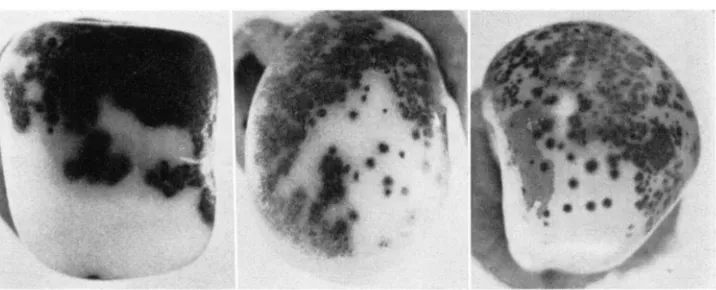
fromthefirst two had many colored dots and-e dotless areas resulting from the frequent mutation of am to as. If the case were am sh, then the endosperm (3n) would be as a’ am and the colorless sectors as as as while if the case were a”& a sh, then the endosperm would be am a as as and the colorless sectors as aas as with the result that a would p r o d u x a few dots within the borders of-&< otherwise stable sector (Figure 1 ) . The third class ( a s h ) had only a moderate rate of dotting. The - A S h and
-
A sh types of crossovGFcould be confirmed by establishing their phenotypes in the next generation and excluding the possibility of contamination.-
--
--
_ ____
CROSSING OVER WITH MUTABLE ALLELES 523
FIGURE 1.-Dotted kernels from the cross of a8 a8, Dt Di ears by either
e
or CP pollen. The constitution of the seed at left is an& a8 us as shown by the colorless sector which is a8 a8 a8. The other two are e aa8 a* as shown by the colorless sectors with scattered a type dots(e
a8 a")resulting from mutation of an' to a". The kernel on the right also has a pale sector ( e a * & ) ,
resulting from mutation of a'n to an, with a type dots within its borders.
The data in Table 1 represent the final disposition of all of the cases tested. A
considerable number of those cases observed as seeds failed to germinate or were eaten by rodents in the field. This was especially true among the shrunken cases.
To make comparisons more meaningful and to permit expression in frequencies, the total population examined for each allele was reduced in proportion to the number of cases which failed to receive a test. Such manipulation is justified because all known factors which caused loss except for the Sh vs. sh differences were external and not related to the type of case. Since the
sh
cases were more subject to loss than the Sh cases a different correction was applied to the popula- tion for each. Using the corrected population figure it was then possible to express the various classes in frequency per 10,000 gametes tested (Table 2).Removal of suppressor element: As stated earlier, if the suppression of A action to produce am were the result of a suppressor element located near the A locus, it might be possible to remove it by exchanges occurring in the immediate region of the gene. In these cultures such a removal should produce either A Sh or A sh
cases. Since none were found, the conclusion is reached that either such an ele- ment is so closely linked to A that removal by crossing over did not occur in
791,096 chances or that the element prevents exchange between its site and the gene. These experiments do not distinguish between these possibilities.
A report ( M ~ J J N T O C R 1965) appearing after this manuscript was accepted describes another mutable allele (a,"-$ controlled by Spm) which, in certain states, does product A , crossover cases, thus showing that the suppressor element is removed by crossing over. This same report refers
t3 an earlier descr:ption of the effects of Ds on crossing over as studied in a chromosome 9 seg- ment carrying Ds between the markers C, and Sh,.
Noncrossover exceptions: A considerable number of the a am Sh and a a Sh
cases, including all from am-$, proved not to be crossovers but instead grew into either a a sh or am Sh parental types or trisomics for chromosome 3 (Columns
5,
6, and 7, Table 1 ).
These also included some which arose in groups or sectors of two or more on an ear. It has been determined (NEUFFER 1964) that these pecu-.-
-
-TABLE I Disposiiion of apparent crossouer cases from the cross a a sh/am Sh
x
a*, Dt Allele Seeds tested examined am-1 312,057 a*$ 131,448 a*4 40,501 a* 307,090 Total 791,096 Dilute nonshrunken cases Colorless shrunken casess
3
CROSSING OVER WITH MUTABLE ALLELES
TABLE 2
Frequency of crossovers from the cross 01 a sh/am Sh x c h , Dt corrected for germination losses and expressed as number of cases per 10,000 seeds examined
525
Region 1 , type a Region 1 , type b
a S h am a s h a a m Sh a s h
Region 2, type a and b
a a S h a" sh a8 sh'
Allele Sh sh
a"-1 6.0 5.4 3.2 1.7 1.0 1.1 1.8 2.5 0.0
am-8 0.4 0.8 0.0 0.0 0.4 0.8 0.0 0.0 0.0
a*4 2.9 4.7 1.6 2.0 0.0 1.6 1.3 1.2 0.0
as 6.2 5.8 3.8 3.4 2.4 2.5
Total Total
~ _ _ _ _
~~ ~~
This column added for the a8 experiment, Such an sh cases were neither observed nor expmted as crossovers - from the other heterozygotes.
liar results may stem from mitotic nondisjunction of chromosome 3 in the early divisions of the germ line to produce sectors of trisomic megaspore mother cells. Following meiosis in these sectors, all four meiotic products are involved in devel- opment of the embryo sac. This unusual (for corn) tetrasporic embryo sac forma- tion produces endosperms carrying both parental chromosomes 3 associated with embryos that are either parental or trisomic.
Variations in frequency of crossovers: There are a number of variations evident in the data (Table 2). The heterozygote with the am-1 allele yielded all of the expected kinds of crossovers, assuming both types of pairing occurred; however, there are significant differences in the frequencies between members of reciprocal products, i.e., 01 Sh vs. am a sh and 01 a Sh vs. am sh, while the remaining pair,
a am Sh vs. a sh, are quite similar. A likely explanation of these differences is that the IargeTass of am sh (region 2) actually includes some am a sh cases which were not detected by the tests applied. This could be the result of either incon- clusive tests or actual interference of am with a mutability. A recheck of many of the cases using better tester stocks has revealed some misclassification; thus the former conclusion is the correct one. The indicated correction would make the data of a"-1 comparable to those for as, which are internally consistent for the regions tested.
The distribution of crossovers from a"-? is quite different in that no region 1 type a or region 2 cases were found. Also, the frequency of region 1 type b cases is much lower than for the other alleles tested. In addition there is a n apparent though not statistically significant (probability near .20) difference between the two classes of crossovers for region 1 b. This difference could be attributed to chance were it not similar to and in the same direction as a statistically significant
( P
<
. O l ) difference for the same crossover classes from the heterozygote in- volving the other Ac-induced allele, am-&.The data from the am-4 heterozygote also show certain significant inconsis- tencies, including the lack of the 01 am Sh class, an excess of the am a sh class, and an imbalance in the frequency of total S h vs. sh cases. The excess of am a sh cases is not of great importance because some misclassification between the am a sh and
a" sh classes may occur. If a correction in the direction of the am sh could be made the frequencies in region 1 type a and region 2 would be in harmony. The absence
__ ~
-
of the a am Sh class, on the other hand, cannot be explained as a misclassification because there is also a comparable reduction of the total number of Sh cases. The presence of the a sh class indicates that type b pairing and exchanges in region 1 do occur; t h e r e f z it appears that the am Sh crossovers have been eliminated. The addition of an appropriate number of cases of this class would bring the total Sh frequency to a level consistent with the total sh observed.
The data from the heterozygote involving as are consistent and in harmony with what might be expected. They do not distinguish, however, between types of pairing because the as allele is not directly recognizable in the as a s h and a as S h combinations.
D I S C U S S I O N
While the results of these tests are inconclusive regarding the validity of the suppressor hypothesis for explaining mutable loci, they do provide some informa- tion to be evaluated in the context of this hypothesis. The absence of reverted full A cases among the crossovers in a population of 791,096 gametes shows that a suppressor element if present must be closely associated with the gene, other- wise crossing over would have removed it. This could be due either to a real association with the locus or to a n apparent association caused by the disposition of the element to eliminate crossing over in the immediate neighborhood of the gene and reduce it progressively less at more distant positions.
Some general observations can be made from the data in Table 2. First, there is an overall decrease in crossing over between the outermost markers a! and sh, when compared to frequencies previously reported. I n terms of map units for the four alleles the distances were .113, .012, .077, and .121, respectively, all considerably below the figure of .25 for - A Sh reported by MAINS (1949) and the figure of .135 (obtained by doubling the frequency of a crossovers) for a ,8 re- ported by LAUGHNAN (1952). In the latter case only the 01 ,8 distance was reported, hence the total 01 Sh distance would be greater. The reduction observed in the present experiment is probably due to a combination of individual allelic tenden- cies for crossiver reduction and to a similar reduction for the a! a s h segment which is common in all the heterozygotes. That the a sh segment permits fewer than expected crossovers between its markers may o r may not be attributed to the fact that it carries the mutable allele a of the Dt system since a certain amount of variation may be expected among similar chromosome segments from different sources. However, the difference is large enough and so consistent with the be- havior of the other alleles studied that such a possibility cannot be discounted.
A second general observation is that in all four heterozygotes the frequency of crossovers in region 1, which is within the A complex, is higher than the fre- quency for region 2, which is between the A complex and an unrelated gene ( S h , )
.
This fact, taken with the first general observation, suggests that the cause of the overall reduction in crossing over between a! and S h results from a reductionin the a sh region and that the cause of this effect resides in the 01 a s h segment. In addition to the overall deviations from what was expected, there are a num- ber of interesting specific differences. The most striking is the absence of region 1
~
CROSSING OVER WITH MUTABLE ALLELES 527
type a and region 2 crossovers in the am*3 material. There is also a reduction i n the number of region 1 type b crossovers. These results may be explained by assuming that the element that controls am is acting in such a way as to prevent crossingover between an' and Sh and to reduce crossing over to the left of a'". Such an element could be located immediately to the right of a" with equal but diminishing effects on both sides or it could be at am with a stronger effect to right than to left. Such a n effect would also prevent the removal of the element by crossing over, as mentioned earlier in this discussion.
Other specific differences are found with the am-& heterozygote, where there is a clear but moderate reduction in total number of crossovers and a complete absence of one class of region 1 type b crossovers. The reduction in cases can be explained as for an1-3 with the requirement that the effect be less strong and balanced more equally to the right and left sides of am with a slightly greater effect to the left. The absence of the 1 b crossovers is more difficult to explain because it is hard to visualize a situation that would block exchange in one direc- tion but not in the other. There are, however, two possibilities that may be con- sidered. The first of these is that the gametes which carry a a" Sh may be lethal. This is not entirely unreasonable but would be easier to accept if the crossover were a deficiency type instead of a duplication for A , components. Another ex- planation would be that crossover suppression is strong to the left of ana, such that no crossovers occur in region 1 with type b pairing. The apparent a sh crossovers would then have to be attributed to some other origin such as mut&n of a to its null level or to intrachromosomal exchange such as that reported for this locus by LAUGHNAN (1955). The first of these (mutation of a) should be associated with a slight uniform excess of a sh with all the heterozygotes, but this is not the case. The second should providean excess of the a sh class, especially in the an&-$ and experiments, where crossing over is reduced. Such appears to be the case; however, the difference between 0.4 and 0.8 in the population tested is not statistically significant. These experiments do not provide the information needed to distinguish between lethal gametes and intrachromosomal exchanges as the cause of the discrepancy observed.
In conclusion, the following points may be made: 1. If a controlling element which suppresses A action to produce a mutable allele is present, it is difficult to remove by crossing over. 2. Whatever causes a mutable allele to occur also may inhibit crossing over in the vicinity of the gene component affected. 3 . The degree of inhibition and the position relative to the component differ with each case. 4. The degree of inhibition may be greater f o r those components under control of Ac than those controlled by Dt.
S U M M A R Y
Heterozygotes of the type a a s h / a m S h with four different alleles in the an% position were tested for the kinds and frequencies of crossover products. Three of the alleles tested showed pairing affinity for both and a while the other one (am-3) did not. The frequency of crossovers was much lower than expected,
528
especially in the case of the Ac-controlled alleles, a"-$ and am-). The frequency of exchange in the (Y a region was higher than in the a sh region. Finally, there were no full coloredcrossovers that might be expecteKf a suppressor element were removed by crossing over. It is concluded that crossing over does not easily remove suppressing elements that may be involved in the production of mutable alleles but that whatever causes mutable alleles to occur may inhibit crossing over in the vicinity of the affected gene to varying degrees and in differing posi- tions. Ac-controlled mutable alleles may have greater effects on crossing over than Dt-controlled alleles.
LITERATURE CITED
JACOB, F., and J. MONOD, 1961 On the regulation of gene activity. Cold Spring Harbor Symp. Quant. Biol. 26: 193-211.
LAUGHNAN, J. R., 1952 The action of allelic forms of the gene A in maize IV. On the compound nature of Ab and the occurrence and action of its Ad derivatives. Genetics 37: 375-395.
MAINS, E. B., 194.9 Heritable characters in maize. Linkage of a factor for shrunken endosperm with the a L factor for aleurone color. J. Heredity 4.0: 21-24.
MCCLINTOCK, B., 1950 The origin and behavior of mutable loci in maize. Proc. Natl. Acad. Sci. U.S. 36: 344-355. - 1951 Chromosome organization and genic expression. Cold Spring Harbor Symp. Quant. Biol. 25: 1 3 4 7 . - 1956 Controlling elements and the gene. Cold Spring Harbor Symp. Quant. Biol. 21: 197-216. - 1961 Some parallels between gene control systems i n maize and in bacteria. Am. Naturalist 95: 625-64+0.
-
1965 Restoration of A , gene action by crossing over. Maize Gen. Coop. News Letter 39: 42-51.Tetrasporic embryo-sac formation in trisomic sectors in maize. Science NEUFFER, M. G., 1964