Ascorbic acid and anthocyanins rich powders based
on the encapsulation of the Amazon
Myrciaria
dubia
fruit: effect of drying method and whey-based
carriers
ERICA OLIVEIRA DA SILVA Faculty of Agrarian Science, Federal University of Amazonas (UFAM) Manaus, Amazonas, Brazil FRANCISCA DAS CHAGAS DO AMARAL SOUZA JAIME PAIVA LOPES AGUIAR National Institute of Amazonian Research (INPA), Manaus, Amazonas, Brazil
JOSIANA MOREIRA MAR LAIANE SOUZA DA SILVA Laboratory of Nanostructured Polymers (NANOPOL) Federal University of Amazonas (UFAM), Manaus, Amazonas, Brazil JAQUELINE DE ARAÚJO BEZERRA Federal Institute of Education, Science and Technology of Amazonas (IFAM) Manaus, Amazonas, Brazil TATIANE PEREIRA DE SOUZA Faculty of Pharmaceutical Science, Federal University of Amazonas (UFAM) Manaus, Amazonas, Brazil CARLOS VICTOR LAMARÃO Faculty of Agrarian Science, Federal University of Amazonas (UFAM) Manaus, Amazonas, Brazil EDGAR APARECIDO SANCHES Laboratory of Nanostructured Polymers (NANOPOL) Federal University of Amazonas (UFAM), Manaus, Amazonas, Brazil PEDRO HENRIQUE CAMPELO Faculty of Agrarian Science, Federal University of Amazonas (UFAM) Manaus, Amazonas, Brazil Laboratory of Nanostructured Polymers (NANOPOL) Federal University of Amazonas (UFAM), Manaus, Amazonas, Brazil
Abstract
freeze-dried powders presented irregular structures while the spray-freeze-dried particles showed spherical-like morphology. Powders produced by spray-drying employing WPI as carrier presented better retention of bioactive compounds (~60 g ascorbic acid per 100 g-1 of powder and ~75 g anthocyanins content per 100 g-1 of powder). Particles produced by freeze-drying method presented better stability of anthocyanins and ascorbic acid. The findings detailed here propose the use of the freeze-drying methodology to encapsulate the M. dubia fruit powder, allowing the preservation of its bioactive compounds, besides antioxidant properties and ascorbic acid retention.
Key words: camu-camu, Amazon fruit, food encapsulation, whey
protein, freeze-drying, spray-drying, ascorbic acid.
1. INTRODUCTION
Tropical fruits have been attracting the consumer attention and the food industry due to their bioactive compounds, aromas and natural pigments. Camu-camu (Myrciaria dubia) is a native fruit from Amazon rainforest and widely recognized for its high ascorbic acid content (~3,000 mg.100 g-1). Moreover, recent studies have shown that
M. dubia presents great potential in food industry due to its phenolic compounds (gallic and ellagic acid) and anthocyanins (cyanidin-3-O -glicoside) [1–3].
Proteins have been extensively used as carriers in encapsulation processes due to its functional properties such as gel formation, emulsification, solubility and film formation. In addition, they can contribute with natural benefits of amino acid rich foods [8]. Moreover, milk proteins can form complexes interacting with small molecules of bioactive compounds, allowing the protection against degradation [9]. Whey protein isolate (WPI) and whey protein concentrate (WPC) have been widely used in food drying process, and promising results related to the stability of bioactive compounds have been reported [10,11]. On the other hand, whey protein hydrolysate is most frequently used for human nutrition, especially in sports. Few studies have been reporting its use as carriers in powdered foods [12]. In this context, the present work aims at to evaluate the effect of drying process (freeze-and spray-drying) and carriers (WPI, WPC and WPH) on the protection and stability of the encapsulated M. dubia
bioactive compounds. Furthermore, Moisture Content (MC), Activity Water (AW), Encapsulation Efficiency (EE) and the stability of Total Monomeric Anthocyanins (TMA) and ascorbic acid were evaluated.
2. MATERIALS AND METHODS
2.1. Materials
Ripe camu-camu (M. dubia) (SISGEN authorization AEEF518) were obtained in Rorainópolis, Brazil (0°23'27.3"S/61°48'22.5"W). The fruits were sanitized, pitted and crushed (pulp and peel) using an industrial metal crusher. The extract was filtered and maintained at -18 °C until the powder production. Whey protein isolate (WPI, Hillmar 9020 – 93.5 g protein.100 g-1 of powder and 1.5 g lactose.100 g-1 of powder),
whey protein hydrolysate (WPH, Hillmar 8390 – 78 g protein.100 g-1
of powder and 3 g lactose.100 g-1 of powder) and whey protein
concentrate (WPC, Hilmar 7000 – 83.4g protein.100 g-1 of powder and
2.2. Solution preparation
M. dubia juice and carriers (80:20 w/w) were homogenized using magnetic stirrers for 1 h and stored at 4 °C for 12 h allowing the biopolymer hydration. Then, the solutions were homogenized in a mechanical stirrer (T25 digital UltraTurrax, IKA, Germany) using 10,000 rpm for 5 min at 25 °C and submitted to the drying process.
2.3. Freeze- (FD) and Spray-drying (SD) processes
After homogenization, the solutions were rapidly frozen (ultrafreezer at -70 °C) and subjected to freeze-drying process (Lobov, USA). Samples were dried for 7 days until reach constant weight. After drying, powders were subjected to manual milling until granulometry smaller than 100 mesh. Powders were stored at 4 °C until further analysis.
Solutions were also dried using a spray-dryer equipment (model MSD 1.0, Labmaq, Brazil) with a two-fluid nozzle atomizer. The operational conditions were described in previous report [13]: inlet temperature of 170 °C, outlet temperature of 96 °C, air flow of 1.5 m³.min-1 and feed rate of 8 mL.min−1. Powders were stored at 4 °C until further analysis.
2.4. Scanning Electron Microscopy (SEM)
The powders morphology was evaluated using an NA3, TECSCAN, Czech Republic, at 25 °C and 20 keV. Powders were placed on aluminium stubs with carbon tape and coated with a gold thin layer prior to analysis.
2.5. Moisture content (MC) and activity water (AW)
MC was gravimetrically determined using an infrared thermobalance (MOC-120H, Shimadzu, Japan) at 105 °C. AW values were assessed by a Water Activity Meter device (Labtouch, Tecnal, Brazil) at 25°C.
2.6. Particle size and size distribution
Instruments Ltd., Malvern, UK) [14]. Samples were analysed on a wet basis, with dispersion in 99.5% ethanol. Polydisperse index was calculated according Eq. 01.
Eq. 01
where d90, d50 and d10 represent the volume diameters at 90%, 50%
and 10% of the cumulative volume, respectively.
2.7. Bioactive compounds quantification
Anthocyanins and ascorbic acid contents were quantified in the M. dubia pure extract and encapsulates. The values found in the extract before the encapsulation process were used as control for bioactive compounds retention [11].
2.8. Retention of bioactive compounds after drying process To evaluate the efficiency of the different drying treatments, the anthocyanins and ascorbic acid contents presented in the M. dubia
extract were used as parameters before and immediately after the drying process. The bioactive compounds retention (R, g bioactive compound.100 g-1 of powder) was calculated using the Eq. 02:
Eq. 02
where, BCencap is the bioactive compound of M. dubia encapsulated
extracted and BCextract is bioactive compound extracted before
encapsulation.
2.9. Total monomeric anthocyanins (TMA)
TMA content of the M. dubia extract and powders were determined by
the spectrophotometric method and expressed as cyanidin-3-O
-glucoside, which was identified as the major anthocyanin present in
M. dubia [15]. The molar absorptivity (Emolar) of
2.10. Ascorbic acid (AA) content
The AA content was quantified by high performance liquid chromatography (HPLC). A portion of 15 mL of the extractive solution
(3 mL metaphosphoric acid.100mL-1 of solution, 8 mL acetic acid.100
mL-1 of solution, 0.3 N sulfuric acid and 1 mM EDTA) and 5 mL of
ultrapure water (Milli-Q, Millipore, Germany) were mixed with the M.
dubia powder samples. The solution was homogenized and centrifuged for 30 min (5,000 rpm/4 °C). The supernatant was filtered through a filter with a porosity of 0.45 μm. The filtered solution was injected into an HPLC (Shimadzu, Japan). The chromatograms were obtained using a diode array detector (DAD) with wavelength of 245 nm, C18 column and mobile phase (NaH2PO4/EDTA) at pH 3 with a flow rate of 1 mL.min-1 and run time of 6 min [17]. The identification of AA was performed by comparing the retention times obtained for the standard and for the samples analysed under the same conditions. The DAA (dehydroascorbic acid) was reduced to AA with 40 mM dithiothreitol (DTT), thus determining the total AA content. The DAA quantification was performed by difference between the total AA content (after conversion from DAA to AA) and content (before the DAA conversion). Good linearity was found with high coefficient of linearity (R² = 0.9972).
2.11. Color
For the coloration analysis, the L* (brightness), a* (greenish to reddish), and b* (blueish to yellowish) parameters were measured using a colorimeter (UltraScan VIS®, Hunter Lab, USA).
2.12. Accelerated storage stability
2.13. Half-life time
The half-life of the encapsulates was evaluated considering that both bioactive compounds (anthocyanins and ascorbic acid) degrade following the first-order kinetics.
2.14. Statistical analysis
The R software was used for analysis of variance (ANOVA) to evaluate the effects of different carriers and drying processes on the properties of the M. dubia powders. Differences between the mean values obtained for each treatment were evaluated at 5 % significance level (p ≤ 0.05) using the Tukey´s test.
3. RESULTS AND DISCUSSION
3.1. SEM Analysis
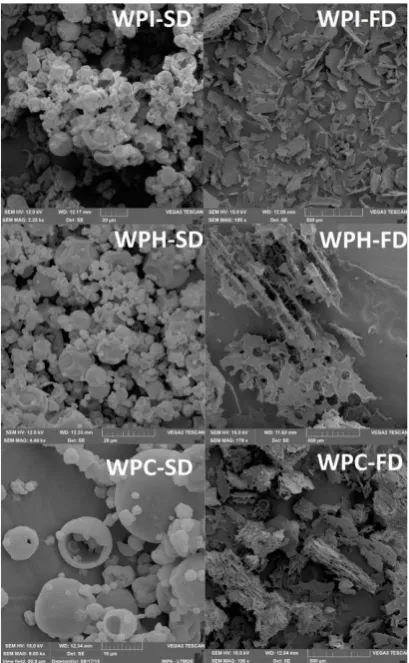
Microstructural analysis of encapsulated foods represents an important tool to evaluate the morphology and surfaces after the drying process. Figure 1 shows the SEM images of the M. dubia
powders.
Powder morphology was consistent with the different drying methods: for spray-dryer treatments, powders presented spherical morphology with a smooth surface without pores or cracks. In contrast, the powders obtained by the freeze-drying process showed irregular lamellar morphology with surface irregularities such as dents/concavities typical of this drying process. Morphology is a result of the breaking down of the spongy structure formed after the removal of ice crystals through sublimation [20].
different carriers. Furthermore, no difference in the particle structure was observed in encapsulates of linoleic acid and WPI or WPC produced by spray-drying [22].
Figure 1. SEM images of camu-camu powders. WPI: whey protein isolate; WPH: whey protein hydrolysate; WPC: whey protein concentrate; SD: spray-drying; FD: freeze-drying.
3.2. Moisture content (MC) and activity water (AW)
from 9.3 to 14.9 g water. 100 g-1 dry basis. The different drying methods were significant (p-value < 0.05), and the spray-drying treatments presented lower MC. Similar behaviour was also observed in studies on pulp and residue encapsulation of M. emarginata [6], M. dubia [23] and blackberry [7]. The different carriers did not present a significant difference (p-value > 0.05), which can be explained by the similar materials composition (all milk-based proteins). The presence of lactose in all milk-derived proteins may be an explanation for the relative humidity values, since these materials are more hygroscopic.
Table 1. Moisture Content (MC), Activity Water (AW), particle size and span of camu-camu powders.
Parameter WPI-SD WPH-SD WPC-SD WPI-FD WPH-FD WPC-FD
Moisture Content (g
water.100g-1 dry basis) 9.3 ± 0.2b 9.4 ± 0.2b 10.7 ± 0.1b 11.7 ± 0.2a 11.9 ± 0.1a 12.2 ± 0.1a
AW 0.32 ± 0.01b 0.29 ± 0.01b 0.28 ± 0.02b 0.37 ± 0.01a 0.37 ± 0.01a 0.36 ± 0.01a
Particle size (µm) 6.4 ± 0.9c 5 ± 1d 7.6 ± 0.5c 175 ± 22a 125 ± 11b 190 ± 12a
Span 1.5 ± 0.1c 1.8 ± 0.1c 1.9 ± 0.1c 2.4 ± 0.1b 2.6 ± 0.1a 2.9 ± 0.1a
Data are expressed as mean ± DP (n = 3). a-d Different superscript letters in the same
line indicate significant differences (p-value < 0.05) between the microparticles. WPI: whey protein isolate; WPH: whey protein hydrolysate; WPC: whey protein concentrate; SD: spray-drying; FD: freeze-drying.
To ensure less degradation and microbial growth, the AW values for food powders should be less than 0.3 [6]. Also, following the MC values, the different carriers were not significant (p-value > 0.05) for the WA values, but the different treatments caused a significant modification (p-value < 0.05), resulting in powders of higher AW values for the freeze-drying treatments. High AW values may favour the degradation of bioactive compounds, evidencing the greater degradation for the freeze-dried M. dubia powders. High AW values were also observed for sumac extract powder produced by freeze-drying process when compared to the spray-freeze-drying one [24].
3.3. Particle size evaluation
which may be related to the high sugar content (lactose) with low emulsifying and stabilizing activity, resulting in larger particles during the homogenization process. The smaller particle size obtained using the WPH treatments may be associated with the lower molecular chains of the hydrolysed proteins, allowing the formation of small droplets sizes. The uniformity of the microparticle size distribution was evaluated by the PDI values (Table 1). For all treatments, lower PDI values corresponded to narrower distributions.
3.4. Bioactive compounds retention
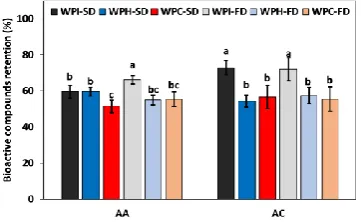
The retention of bioactive compounds is the most important parameter in encapsulation processes because it defines the process efficiency. Figure 2 shows the bioactive compounds retention of the produced powders.
Figure 2. Bioactive compounds retention of powders: ascorbic acid (AA), anthocyanins
content (AC). WPI: whey protein isolate; WPH: whey protein hydrolysate. a,b,c Same
letter in same bioactive compounds group not are significant (p-value > 0.05) (n=3).
difference for WPI treatments. In studies on M. dubia
microencapsulation [23], the authors observed that the powders produced by freeze-drying presented higher retention of AA than those observed using spray-drying. High temperatures during the spray-drying process can degrade thermolabile compounds. Furthermore, high ascorbic acid retention was also observed for freeze-dried M. dubia [1].
3.5. Total Monomeric Anthocyanins (TAM) content
TMA content from M. dubia extract was found around 133.45 ± 9.75
mg.100 g-1 dry basis. Similar result has been reported [26]. The TMA values based on the cyanidin-3-glucoside concentration during the
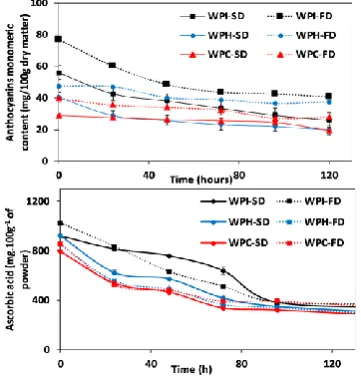
accelerated stability process is shown in Figure 3. The WPI
treatments showed high anthocyanin retention, followed by WPH and WPC, independent of the drying process. Carbohydrates present higher water adsorption capacity when compared to proteins. This fact may explain the greater degradation of the bioactive compounds encapsulated in WPC due to the higher concentration of lactose in this carrier [22]. During the accelerated stability test, anthocyanins encapsulated in WPI were rapidly degraded in 24 h, then reducing the degradation rate. This can be explained by the high concentration of anthocyanins in the powder, increasing the possibility of degradation. For WPC and WPH samples, no significant variation was observed in the TMA values.
Considering the different drying methods, the spray-drying treatments resulted in lower anthocyanin retention values than those observed for the freeze-dried samples evaluated immediately after the drying process. This behaviour is explained by the high temperatures used during the spray-drying process. Cyanidin-3-O-glucose (major
anthocyanins in M. dubia) presents good thermal resistance up to 70
protection than those obtained by spray-drying, corroborating with the reports on the anthocyanins stability of Aristotelia chilensis
powders [30].
Figure 3. Ascorbic acid (AA) and Total Monomeric Anthocyanins (TMA) contents of
powders storage at 60 °C. WPI: whey protein isolate; WPH: whey protein hydrolysate; WPC: whey protein concentrate; SD: spray-drying; FD: freeze-drying. Line are only to facilitate the interpretation (n=3).
3.6. Ascorbic acid (AA) content
The AA content from the M. dubia extract was found around 1545.89
± 12.22 mg.100 g-1 dry basis. The AA stability of encapsulated M.
moisture promoted compound degradation. This fact confirms our results for M. dubia since the Amazon humidity is greater than 80 %.
3.7. Color
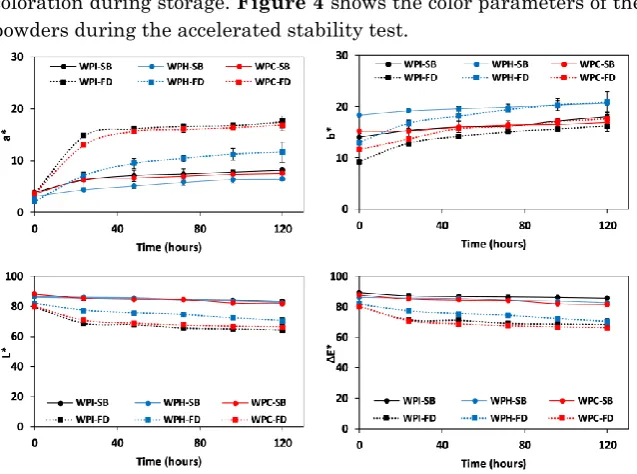
Foods with large amounts of bioactive compounds tend to lose their coloration during storage. Figure 4 shows the color parameters of the powders during the accelerated stability test.
Figure 4. Color parameters (L*, a*, b* and ΔE*) of powders storage at 60°C. WPI: whey protein isolate; WPH: whey protein hydrolysate; WPC: whey protein concentrate; SD: spray-drying; FD: freeze-drying. Line are only to facilitate the interpretation (n=3)
different materials, significant variation of L* was not observed and can be explained by the similar composition of carriers.
The results obtained for a* and b* showed that samples were in the first quadrant (+a* and +b*), indicating a tendency of coloration near yellow and red. Although the dominant color of the camu-camu extract is pink (+a* and -b*) - mainly due to the composition of anthocyanins in the shell - the results obtained can be explained by the coloration of the carriers (yellow) and the Maillard reactions caused by the proteins and lactose from carriers [35], resulting in brown compounds. The drying processes showed little difference between them. For blueberry powders obtained by spray- and freeze-drying [36], the authors also observed increased yellow color for WPI treatments, confirming the Maillard reaction.
The color of powdered foods may be affected by the type and concentration of carrier, natural color of food and non-enzymatic reactions between proteins and sugars at high drying temperatures [37]. The particles produced by spray-drying presented lower colour
variation (ΔE*) when compared to samples produced by freeze-drying.
This can be related to the values of the anthocyanin contents shown in
Figure 3 or the variation of the L* and b* parameters.
The spray-drying process produced more rigid and uniform polymer structures due to the denaturation of the proteins caused by the high temperature of the drying process. Thus, bioactive compounds are more protected from non-ideal storage conditions. Also, the light reflection effect resulting from the microstructural changes of the powder particles may contribute more to color changes than to the Maillard reaction [38]. Higher ΔE* was observed for fish oil, phytosterol esters and limonene particles obtained by freeze-drying when compared to spray-freeze-drying [20].
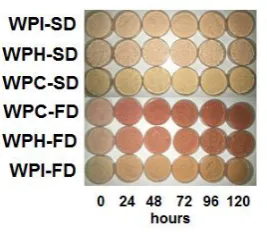
Regarding the different carriers, the treatments using WPC presented greater variation of color in relation to the other processes, corroborating the values of L*, a* and b*. Values of ΔE* above 5 were visually more notable, which may be related to the consumer acceptance [39]. The appearance of the powders during storage
Figure 5. Appearance of powders during the accelerated stability test. WPI: whey protein isolate; WPH: whey protein hydrolysate; WPC: whey protein concentrate; SD: spray-drying; FD: freeze-drying. Line are only to facilitate the interpretation
3.8. Degradation kinetic parameters
The stability of TMA and AA of M. dubia was investigated in this work since its application in the food industries is limited by its instability under specified conditions. Table 2 shows the degradation kinetic parameters of anthocyanins and AA of the encapsulated M. dubia extract. The half-life time of AA ranged from 101 to 443 days. The values of reaction rate constant (k) of the WPI samples were higher when compared to other treatments. These results may be in the opposite direction to the results of previous analyses, since the WPI treatments presented better results. This high degradation rate may be associated with the higher concentration of bioactive compounds encapsulated using WPI when compared to WPH and WPC. Other authors also observed that the half-life of berry extract bioactive compounds encapsulated using WPC was higher than WPI [40].
effect of the carrier on the retention of these bioactive compounds. This may be caused by the increased adsorption of water to the hydroxyl groups of the proteins that are exposed during the hydrolysis process, producing lower molecular weight peptides [41].
Table 2. Degradation kinetic parameters of anthocyanins and ascorbic acid of the encapsulated M. dubia extract.
Bioactive
Compound Parameter WPI-SD WPH-SD WPC-SD WPI-FD WPH-FD WPC-FD
Anthocyanins
k (10-3.h-1) 5.4 ± 0.3b 1.5 ± 0.4e 2.4 ± 0.1d 6.8 ± 0.2a 3.7 ± 0.4c 2.2 ± 0.3d t1/2 (h) 128 ±2e 443 ± 3a 288 ± 5c 101 ±2e 185 ± 3d 306 ± 3b R² 0.97 0.87 0.89 0.84 0.82 0.93
Ascorbic Acid
k (10-3.h-1) 6.5 ± 0.1b 6.9 ± 0.3a 6.5 ± 0.2b 6.4 ± 0.2b 6.7 ± 0.0b 5.1 ± 0.3c t1/2 (h) 105.0 ± 0.5b 99.0 ± 0.3b 107.0 ± 0.4b 108.0 ± 0.2b 103.0 ± 0.1b 135.0 ± 0.2a R² 0.91 0.98 0.96 0.97 0.96 0.87
Data are expressed as mean ± DP (n = 3). a-dDifferent superscript letters in the same
line indicate significant differences (p-value < 0.05) between the microparticles. Reaction rate constant (k); half-life time (t1/2); coefficient of determination (R²); WPI:
whey protein isolate; WPH: whey protein hydrolysate; WPC: whey protein concentrate; SD: spray-drying; FD: freeze-drying.
CONCLUSIONS
The powders produced by freeze-drying process presented higher MC and AW values. The bioactive compound retention values presented no significant variation for different carriers, since their compositions are very similar. For the different drying methods, powder produced by spray-drying presented better bioactive compound retention, while the freeze-dried powders presented better conservation of bioactive compounds during storage. The molecular structure of WPH proteins influenced water adsorption and increased the AA degradation rate. For future work, it is suggested that the powders can be applied in different food matrices aiming at adding nutritional value and diversifying the consumer market.
ACKNOWLEDGMENTS
REFERENCES
[1] A. Salomão-Oliveira, S.D.S. Costa, K.S.C.R. dos Santos, T.P. de Souza, H.A. Marinho, Ascorbic acid from lyophilized camu-camu fruit : stability and quality control of hard capsules, J. Basic Appl. Pharm. Sci. 37 (2016).
[2] C.F. Zanatta, E. Cuevas, F.O. Bobbio, P. Winterhalter, A.Z. Mercadante, Determination of anthocyanins from Camu-camu (Myrciaria dubia) by HPLC-PDA, HPLC-MS, and NMR, J. Agric. Food Chem. 53 (2005) 9531–9535. https://doi.org/10.1021/jf051357v.
[3] A. Fujita, D. Sarkar, S. Wu, E. Kennelly, K. Shetty, M.I. Genovese, Evaluation of phenolic-linked bioactives of camu-camu (Myrciaria dubia Mc. Vaugh) for antihyperglycemia, antihypFujita, A., Sarkar, D., Wu, S., Kennelly, E., Shetty, K., Genovese, M.I., 2015. Evaluation of phenolic-linked bioactives of camu-camu (Myrciari, Food
Res. Int. 77 (2015) 194–203.
https://doi.org/10.1016/j.foodres.2015.07.009.
[4] E.K. Silva, G.L. Zabot, M.A. Bargas, M.A.A. Meireles,
Microencapsulation of lipophilic bioactive compounds using prebiotic carbohydrates: Effect of the degree of inulin polymerization,
Carbohydr. Polym. 152 (2016) 775–783.
https://doi.org/10.1016/j.carbpol.2016.07.066.
[5] S. Abbas, C. da Wei, K. Hayat, Z. Xiaoming, Ascorbic Acid: Microencapsulation Techniques and Trends-A Review, Food Rev. Int. 28 (2012) 343–374. https://doi.org/10.1080/87559129.2011.635390.
[6] Y.R.R.S. Rezende, J.P. Nogueira, N. Narain,
Microencapsulation of extracts of bioactive compounds obtained from acerola (Malpighia emarginata DC) pulp and residue by spray and
freeze drying: Chemical, morphological and chemometric
characterization, Food Chem. 254 (2018) 281–291.
https://doi.org/10.1016/j.foodchem.2018.02.026.
[7] L. Franceschinis, D.M. Salvatori, N. Sosa, C. Schebor,
Physical and Functional Properties of Blackberry Freeze- and
Spray-Dried Powders, Dry. Technol. 32 (2014) 197–207.
[8] P. Labuschagne, Impact of wall material physicochemical characteristics on the stability of encapsulated phytochemicals: A
review, Food Res. Int. 107 (2018) 227–247.
https://doi.org/10.1016/j.foodres.2018.02.026.
[9] Y.D. Livney, Milk proteins as vehicles for bioactives, Curr.
Opin. Colloid Interface Sci. 15 (2010) 73–83.
https://doi.org/10.1016/j.cocis.2009.11.002.
[10] P.H. Campelo, E.L. do Carmo, R.D. Zacarias, M.I. Yoshida, V.P. Ferraz, R.V. de Barros Fernandes, D.A. Botrel, S. V. Borges, Effect of dextrose equivalent on physical and chemical properties of lime essential oil microparticles, Ind. Crops Prod. 102 (2017) 105–114. https://doi.org/10.1016/j.indcrop.2017.03.021.
[11] E.L. do Carmo, R.A.R. Teodoro, P.H.C. Félix, R.V. de B. Fernandes, É.R. de Oliveira, T.R.L.A. Veiga, S. V. Borges, D.A. Botrel, Stability of spray-dried beetroot extract using oligosaccharides and
whey proteins, Food Chem. 249 (2018) 51–59.
https://doi.org/10.1016/j.foodchem.2017.12.076.
[12] S. Yang, X.Y. Mao, F.F. Li, D. Zhang, X.J. Leng, F.Z. Ren, G.X.
Teng, The improving effect of spray-drying encapsulation process on the bitter taste and stability of whey protein hydrolysate, Eur. Food Res. Technol. 235 (2012) 91–97. https://doi.org/10.1007/s00217-012-1735-6.
[13] P.H. Campelo, E.A. Sanches, R.V. de B. Fernandes, D.A.
Botrel, S.V. Borges, Stability of lime essential oil microparticles produced with protein-carbohydrate blends, Food Res. Int. 105 (2018) 936–944. https://doi.org/10.1016/j.foodres.2017.12.034.
[14] E.K. Silva, M.A.A. Meireles, Influence of the degree of inulin
polymerization on the ultrasound-assisted encapsulation of annatto
seed oil, Carbohydr. Polym. 133 (2015) 578–586.
https://doi.org/10.1016/j.carbpol.2015.07.025.
[15] L.C. Neves, V.X. da Silva, J.A. Pontis, A. Flach, S.R. Roberto,
Bioactive compounds and antioxidant activity in pre-harvest camu-camu [Myrciaria dubia (H.B.K.) Mc Vaugh] fruits, Sci. Hortic.
(Amsterdam). 186 (2015) 223–229.
[16] R. V. Tonon, C. Brabet, M.D. Hubinger, Anthocyanin stability and antioxidant activity of spray-dried açai (Euterpe oleracea Mart.) juice produced with different carrier agents, Food Res. Int. 43 (2010) 907–914. https://doi.org/10.1016/j.foodres.2009.12.013.
[17] D. da S. Oliveira, P.P. Aquino, S.M.R. Ribeiro, R.P. da C. Proença, H.M. Pinheiro-Sant’Ana, Vitamina C, carotenoides, fenólicos totais e atividade antioxidante de goiaba, manga e mamão procedentes da Ceasa do Estado de Minas Gerais, Acta Sci. - Heal. Sci. 33 (2011) 89–98. https://doi.org/10.4025/actascihealthsci.v33i1.8052.
[18] N.L. Silva, J.M.S.S. Crispim, R.P. Vieira, Kinetic and
Thermodynamic Analysis of Anthocyanin Thermal Degradation in Acerola (Malpighia emarginata D.C.) Pulp, J. Food Process. Preserv. 41 (2017) 1–7. https://doi.org/10.1111/jfpp.13053.
[19] V.P. Rakic, A. Ota, S.F.M. Bornsek, M.N. Milijkovic, D.T. Sokolovic, N.E.P. Ulrih, The Colour and Stability of Cyanidin and Cyanidin 3-O-Β-Glucopyranoside, Adv. Technol. 3 (2014) 5–9.
[20] Q. Chen, F. Zhong, J. Wen, D. McGillivray, S.Y. Quek,
Properties and Stability of Spray-Dried and Freeze-Dried Microcapsules Co-Encapsulated with Fish Oil, Phytosterol Esters, and
Limonene, Dry. Technol. 31 (2013) 707–716.
https://doi.org/10.1080/07373937.2012.755541.
[21] M. Moayyedi, M.H. Eskandari, A.H.E. Rad, E. Ziaee, M.H.H. Khodaparast, M.T. Golmakani, Effect of drying methods (electrospraying, freeze drying and spray drying) on survival and viability of microencapsulated Lactobacillus rhamnosus ATCC 7469,
J. Funct. Foods. 40 (2018) 391–399.
https://doi.org/10.1016/j.jff.2017.11.016.
[22] K.O. Choi, J. Ryu, H.S. Kwak, S. Ko, Spray-dried conjugated linoleic acid encapsulated with Maillard reaction products of whey proteins and maltodextrin, Food Sci. Biotechnol. 19 (2010) 957–965. https://doi.org/10.1007/s10068-010-0134-7.
Vaugh): A Typical Amazonian Fruit, J. Food Sci. 00 (2017). https://doi.org/10.1111/1750-3841.13668.
[24] G. Caliskan, S.N. Dirim, The effect of different drying
processes and the amounts of maltodextrin addition on the powder properties of sumac extract powders, Powder Technol. 287 (2016) 308– 314. https://doi.org/10.1016/j.powtec.2015.10.019.
[25] Z. Zorić, Z. Pelaić, S. Pedisić, I. Elez Garofulić, D. Bursać Kovačević, V. Dragović–Uzelac, Effect of storage conditions on phenolic content and antioxidant capacity of spray dried sour cherry powder, LWT - Food Sci. Technol. 79 (2017) 251–259. https://doi.org/10.1016/j.lwt.2017.01.049.
[26] A. Souza, T. Oliveira, R. MATTIETTO, W. NASCIMENTO, A.
LOPES, Bioactive compounds in the peel of camu camu genotypes from Embrapa’s active germplasm bank, Food Sci. Technol. 38 (2017) 67–71. https://doi.org/10.1590/1678-457x.33716.
[27] P. Loypimai, A. Moongngarm, P. Chottanom, Thermal and pH
degradation kinetics of anthocyanins in natural food colorant prepared from black rice bran, J. Food Sci. Technol. 53 (2016) 461– 470. https://doi.org/10.1007/s13197-015-2002-1.
[28] P.M. Reque, R.S. Steffens, A. Jablonski, S.H. FlÔres, A. de O.
Rios, E. V. de Jong, Cold storage of blueberry (Vaccinium spp.) fruits and juice: Anthocyanin stability and antioxidant activity, J. Food
Compos. Anal. 33 (2014) 111–116.
https://doi.org/10.1016/j.jfca.2013.11.007.
[29] S. Murali, A. Kar, D. Mohapatra, P. Kalia, Encapsulation of black carrot juice using spray and freeze drying, Food Sci. Technol. Int. 21 (2015) 604–612. https://doi.org/10.1177/1082013214557843.
[30] C. Fredes, C. Becerra, J. Parada, P. Robert, The
microencapsulation of maqui (Aristotelia chilensis (Mol.) Stuntz) juice by spray-drying and freeze-drying produces powders with similar anthocyanin stability and bioaccessibility, Molecules. 23 (2018). https://doi.org/10.3390/molecules23051227.
[31] C.S. Favaro-Trindade, J.C. de Carvalho Balieiro, T.A.
Protection and controlled release, Food Res. Int. 52 (2013) 373–379. https://doi.org/10.1016/j.foodres.2013.03.028.
[32] F.E. de Matos-Jr, T.A. Comunian, M. Thomazini, C.S.
Favaro-Trindade, Effect of feed preparation on the properties and stability of ascorbic acid microparticles produced by spray chilling, LWT. 75 (2017) 251–260. https://doi.org/10.1016/j.lwt.2016.09.006.
[33] J.D.D. Hoyos-Leyva, A. Chavez-Salazar, F.
Castellanos-Galeano, L.A.A. Bello-Perez, J. Alvarez-Ramirez, Physical and chemical stability of L-ascorbic acid microencapsulated into taro starch spherical aggregates by spray drying, Food Hydrocoll. 83 (2018) 143–152. https://doi.org/10.1016/j.foodhyd.2018.05.002.
[34] L.S. Kuck, C.P.Z. Noreña, Microencapsulation of grape (Vitis labrusca Bordo) skin phenolic extract using gum Arabic, polydextrose, and partially hydrolyzed guar gum as encapsulating
agents, Food Chem. 194 (2016) 569–576.
https://doi.org/10.1016/j.foodchem.2015.08.066.
[35] A.S.L. Lim, Z. Burdikova, J.J. Sheehan, Y.H. Roos, Carotenoid
stability in high total solid spray dried emulsions with gum Arabic layered interface and trehalose-WPI composites as wall materials,
Innov. Food Sci. Emerg. Technol. 34 (2016) 310–319.
https://doi.org/10.1016/j.ifset.2016.03.001.
[36] S. Darniadi, P. Ho, B.S. Murray, Comparison of blueberry powder produced via foam-mat freeze-drying versus spray-drying: evaluation of foam and powder properties, J. Sci. Food Agric. 98 (2018) 2002–2010. https://doi.org/10.1002/jsfa.8685.
[37] I. Tontul, A. Topuz, Spray-drying of fruit and vegetable juices: Effect of drying conditions on the product yield and physical properties, Trends Food Sci. Technol. 63 (2017) 91–102. https://doi.org/10.1016/j.tifs.2017.03.009.
[38] P. Zhou, D. Liu, X. Chen, Y. Chen, T.P. Labuza, Stability of whey protein hydrolysate powders: effects of relative humidity and
temperature., Food Chem. 150 (2014) 457–62.
https://doi.org/10.1016/j.foodchem.2013.11.027.
content and antioxidant capacity of spray dried sour cherry powder,
LWT - Food Sci. Technol. 79 (2017) 251–259.
https://doi.org/10.1016/j.lwt.2017.01.049.
[40] M.A. Lila, M. Schneider, A. Devlin, N. Plundrich, S. Laster, E.A. Foegeding, Polyphenol-enriched berry extracts naturally modulate reactive proteins in model foods, Food Funct. 8 (2017) 4760– 4767. https://doi.org/10.1039/c7fo00883j.
[41] P. Zhou, D. Liu, X. Chen, Y. Chen, T.P. Labuza, Stability of whey protein hydrolysate powders: Effects of relative humidity and
temperature, Food Chem. 150 (2014) 457–462.