ISSN 2286-4822 www.euacademic.org
Impact Factor: 3.4546 (UIF)
DRJI Value: 5.9 (B+)
Model of Discovery Learning with the Help of
GeoGebra
LE VIET MINH TRIET, MSc.
Doctoral Student in Mathematics Education
Pacific College, Can Tho City
Vietnam
Abstract:
This paper presents a model for discovery learning with the
help of GeoGebra that provide opportunities for students to engage in
mathematical activities such as exploration, conjecturing, explanation,
and generalization. This model has been primarily developed to suit
the use of discovery learning method in dynamic environment –
GeoGebra. This model was used to design an example which aims at
consolidating students’ understandings on the concepts of center and
radius and developing the concepts of locus and perpendicular
bisector.
Key words:
Model of the discovery learning with GeoGebra; dynamic
mathematic software; guide discovery learning
1 INTRODUCTION
GeoGebra is dynamic mathematics software designed for
teaching and learning mathematics in secondary school and
college level. The question was raised that how to use GeoGebra
efficiently.
In this paper we introduce model teaching for GeGebra
which foster students’ capability to explore, conjecture, verify,
explain and make generalizations.
2 THEORETICAL BACKGROUND
Discovery learning
―Discovery learning‖ is a label that has been high profile in
discussions about education, including mathematical education,
since at least the 1940s. It has a long history in education
(Dewey, 1938; Bruner,1961). Discovery learning is a kind of
instructional method in which the teacher guided students
using some questions to help them in exploring, conjecturing
and constructing their knowledge. Bicknell-Holmes and
Hoffman (2000) describe the three primary attributes of
discovery learning. There are 1) exploring and problem-solving
to create, integrate, and generalize knowledge, 2) student
driven, interest-based activities in which the student
determines the sequence and frequency, and 3) activities to
encourage the integration of new knowledge into the learner’s
existing knowledge base. Since technology allows for more
student-centered approaches including active learning,
mathematical experiments, or discovery learning.
What is GeoGebra
GeoGebra can be used to visualize mathematical concepts as
well as to create instructional materials. On the other hand,
GeoGebra has the potential to foster active and
student-centered learning by allowing for mathematical experiments,
interactive explorations, as well as discovery learning.
Moreover, researchers agree that one of the most appreciated
affordances provided by GeoGebra is the possibility to make
investigations. Le Viet Minh Triet (2014) introduced two
different levels of use of GeoGebra in learning and teaching
mathematic (see Table 1)
Table 1: Level’s integrating GeoGebra
Level
Teacher
Student
Control
GeoGebra
Observe, make conjectures,
find the solution
Give
supporting if
the student
Self using GeoGebra to
explore, make conjectures
and find the solution
3 METHOD
Our study consists of two phases.
In the first step, we developed a model for teaching based on
the fundamental principles identified in our theoretical
background. The first step is described in detail in Sect. 4.1. To
illustrate and examine the model a concrete example of a task
situation was developed. Each component task in the example
was examined, and predictions about student performance were
made. The second phase is described in detail in Sect. 4.2
Teacher
students
GeoGebra
4 MODEL OF THE DISCOVERY LEARNING WITH
GEOGEBRA
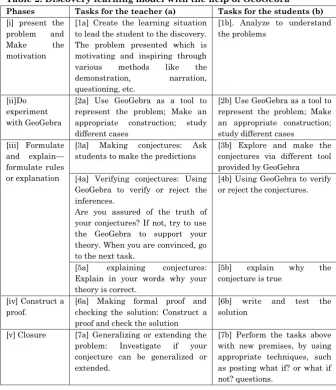
4.1 Discovery learning model with the help of GeoGebra
Table 2: Discovery learning model with the help of GeoGebra
Phases
Tasks for the teacher (a)
Tasks for the students (b)
[i] present the
problem
and
Make
the
motivation
[1a] Create the learning situation
to lead the student to the discovery.
The problem presented which is
motivating and inspiring through
various
methods
like
the
demonstration,
narration,
questioning, etc.
[1b]. Analyze to understand
the problems
[ii]Do
experiment
with GeoGebra
[2a] Use GeoGebra as a tool to
represent the problem; Make an
appropriate construction; study
different cases
[2b] Use GeoGebra as a tool to
represent the problem; Make
an appropriate construction;
study different cases
[iii] Formulate
and explain—
formulate rules
or explanation
[3a] Making conjectures: Ask
students to make the predictions
[3b] Explore and make the
conjectures via different tool
provided by GeoGebra
[4a] Verifying conjectures: Using
GeoGebra to verify or reject the
inferences.
Are you assured of the truth of
your conjectures? If not, try to use
the GeoGebra to support your
theory. When you are convinced, go
to the next task.
[4b] Using GeoGebra to verify
or reject the conjectures.
[5a]
explaining
conjectures:
Explain in your words why your
theory is correct.
[5b]
explain
why
the
conjecture is true
[iv] Construct a
proof.
[6a] Making formal proof and
checking the solution: Construct a
proof and check the solution
[6b] write and test the
solution
[v] Closure
[7a] Generalizing or extending the
problem:
Investigate
if
your
conjecture can be generalized or
extended.
[7b] Perform the tasks above
with new premises, by using
appropriate techniques, such
as posting what if? or what if
not? questions.
4.2 An example
The question (translated by me): ―Given two points A and B:
a) Draw a circle passing through the two points
b) How much such circles are there? What is the line that
contains all the centers of those circles‖ (p.98)
To solve this question with the help of GeoGebra, we
investigated students with the problem (*) which was restated
as follows: ―Let A and B be two fixed points. How many circles
can be constructed through A and B‖
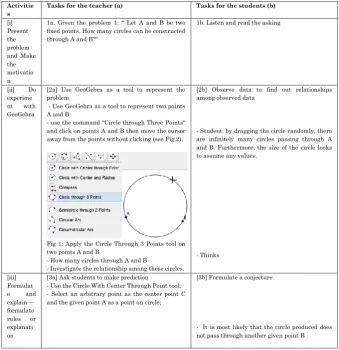
In the following table, the tasks are elaborated, and
predictions about student performances are made.
Table 3: An example for discovery learning model
Activitie s
Tasks for the teacher (a) Tasks for the students (b)
[i] Present the problem and Make the motivatio n
1a. Given the problem 1: ― Let A and B be two fixed points. How many circles can be constructed through A and B?―
1b. Listen and read the asking
[ii] Do experime nt with GeoGebra
[2a] Use GeoGebra as a tool to represent the problem
- Use GeoGebra as a tool to represent two points A and B
- use the command ―Circle through Three Points― and click on points A and B then move the cursor away from the points without clicking (see Fig.2).
Fig 1: Apply the Circle Through 3 Points tool on two points A and B
- How many circles through A and B
- Investigate the relationship among these circles.
[2b] Observe data to find out relationships among observed data
- Student: by dragging the circle randomly, there are infinitely many circles passing through A and B. Furthermore, the size of the circle looks to assume any values.
- Thinks
[iii] Formulat
e and
explain— formulate rules or explanati on
[3a] Ask students to make prediction - Use the Circle With Center Through Point tool; - Select an arbitrary point as the center point C and the given point A as a point on circle;
[3b] Formulate a conjecture.
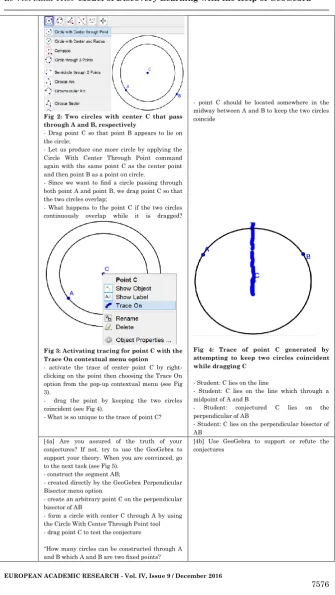
Fig 2: Two circles with center C that pass through A and B, respectively
- Drag point C so that point B appears to lie on the circle;
- Let us produce one more circle by applying the Circle With Center Through Point command again with the same point C as the center point and then point B as a point on circle.
- Since we want to find a circle passing through both point A and point B, we drag point C so that the two circles overlap;
- What happens to the point C if the two circles continuously overlap while it is dragged?
Fig 3: Activating tracing for point C with the Trace On contextual menu option
- activate the trace of center point C by right-clicking on the point then choosing the Trace On option from the pop-up contextual menu (see Fig 3).
- drag the point by keeping the two circles coincident (see Fig 4).
- What is so unique to the trace of point C?
- point C should be located somewhere in the midway between A and B to keep the two circles coincide
Fig 4: Trace of point C generated by attempting to keep two circles coincident while dragging C
- Student: C lies on the line
- Student: C lies on the line which through a midpoint of A and B
- Student: conjectured C lies on the perpendicular of AB
- Student: C lies on the perpendicular bisector of AB
[4a] Are you assured of the truth of your conjectures? If not, try to use the GeoGebra to support your theory. When you are convinced, go to the next task (see Fig 5).
- construct the segment AB;
- created directly by the GeoGebra Perpendicular Bisector menu option
- create an arbitrary point C on the perpendicular bisector of AB
- form a circle with center C through A by using the Circle With Center Through Point tool - drag point C to test the conjecture
―What can we say about the centers of these circle?"
Fig 5: A line to fit the trace of C with accompanying measurements to encourage and support student conjectures
- see that points A and B remain on the circle - an infinite number of circles which can pass through two point
Conjecturing: if the two circles continuously overlap, C lies on the d which is perpendicular bisector of AB while it is dragged
[5a] Explain in your words why your conjecture is right.
What can we say if C is the center and points A and B lie on the circle?
Inverse, what can we say if C lies in the perpendicular bisector of AB?
[5b]
the length of CA equals the length of CB because these two line segments are the radii of the same circle
Therefore, if C is the center of an arbitrary circle passing through points A and B, then C must be lying on the perpendicular bisector of AB - If C lies in the perpendicular bisector of AB, then the length of CA equals the length of CB. So that, C is the center of the circle passing through points A and B.
[iv] Construct a proof.
[6a] Construct a proof. [6b] Construct a proof.
Phase 1: Let C be the center of the circles passing through points A and B.
Then,
Implies that P lies on the perpendicular bisector of AB.
Phase 2: Let d be the perpendicular bisector of AB and C be the dynamic point on the d. We also see that,
Implies that, C is the center of the circle passing through points A and B.
[6a]
Check the solution
[6b]
Check the solution [v]
Closure
[7a]. Investigate if your conjecture can be generalized.
How many circles can be constructed through A, B and C:
a) if A, B and C are the nonlinear points? b) if A, B and C are the straight points?
[7b].
Perform the tasks above with new premises, by using appropriate techniques, such as posting what if? or what if not? questions.
Conclusion
if C is the center of an arbitrary circle passing through points A and B, then C must be lying on the perpendicular bisector of AB.
With three non-collinear points, we can draw one and only one circle.