Next Generation of HEP CPU Benchmarks
DomenicoGiordano1,4,∗,ManfredAlef2,4, andMicheleMichelotto3,4 1CERN
2Karlsruhe Institute of Technology (KIT) 3INFN Padova
4on behalf of the HEPiX Benchmarking Working Group
Abstract.
As of 2009, HEP-SPEC06 (HS06) is the benchmark adopted by the WLCG community to describe the computing requirements of the LHC experiments, to assess the computing capacity of the WLCG data centres and to procure new hardware. In the recent years, following the evolution of CPU architec-tures and the adoption of new programming paradigms, such as multi-threading and vectorization, it has turned out that HS06 is less representative of the rel-evant applications running on the WLCG infrastructure. Meanwhile, in 2017 a new SPEC generation of benchmarks for CPU intensive workloads has been released: SPEC CPU 2017. This report summarises the findings of the HEPiX Benchmarking Working Group in comparing SPEC CPU 2017 and other HEP benchmarks with the typical WLCG workloads mixes.
1 Introduction
Since its foundation in 1991, the HEPiX forum brings togethers worldwide IT professionals from the HEP laboratories and institutes [1], with the purpose of sharing experience on their common computing challenges. In 2006 a dedicated working group, the HEPiX Benchmark-ing WorkBenchmark-ing Group (here BWG), was established to cover the CPU benchmarkBenchmark-ing topic and, in particular, to address the identified discrepancies between the performance of the HEP applications and SI2K [2], the standard benchmark used at the time to measure the CPU performance. In 2009 the BWG suggested the adoption of a new HEP specific benchmark suite, HEP-SPEC06 (HS06) [3], based on a subset of the industry standard benchmark SPEC CPU2006 [4]. Since then HS06 has been used to describe experiment requirements, lab com-mitments, existing compute resources and specifications to procure new hardware. Therefore HS06 measurements of any CPU and motherboard models deployed in any WLCG [5] site has been collected [6].
Almost ten years after the review of SI2K, in 2016 evidences of discrepancies between HS06 and the HEP workloads were reported by some of the LHC collaborations [7]. In addition the adoption of public and private cloud resources generated interest in a family of benchmarks that could run much faster than HS06 while keeping adequate correlation with the HEP workloads. This situation revived the activity of the BWG.
The next sections describe the state of the art of the BWG’s activities, the achieved results, and the future plans.
2 HS06 overview
HS06 is composed by the SPEC CPU2006 benchmarks based on C++code, namedcpp_all
benchmark set. This set showed a good correlation with all the major HEP experiments’ ap-plications considered ten years ago [3]. The main explanation was that it has a mixture of integer and floating point instructions similar to the patterns observed for the experiments’
applications. Yet some noticeable differences exists: with respect to SPEC CPU 2016 the
running mode is not one of the two proposed defaults (namelyrateandspeed). The HS06
running mode is an adaptation of thespeedmode, modified to run on as many parallel and
independent instances as are the available threads of the CPU. For this reason it is called
mul-tiple speed. Other differences with respect to the original benchmark reside on the compiler
optimization flags, as the binaries are 32-bits.
In recent years, with the broad adoption of Intel Haswell and Broadwell CPU models, as well with the adoption by all the LHC experiments of 64-bits compiled applications, discrep-ancies have been highlighted between the HS06 scores and the average normalised time spent by the applications [7]. The discrepancies being more accentuated for the LHCb simulation applications. At the same time analysis on ATLAS and CMS WLCG jobs still proved that simulation applications were in good agreement with HS06 within 10% of resolution [8].
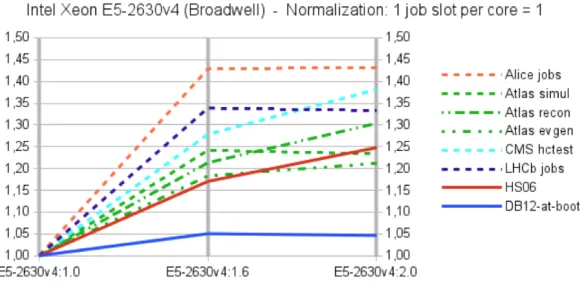
Moreover, with the advent of Simultaneous MultiThreading (SMT), the WLCG sites have configured their computing infrastructure to run a number of simultaneous applications per physical core spanning from one to two, driven by the WLCG applications’ memory re-quirement of at least 2 GB of memory available per processor. The BWG’s studies have highlighted the lack of a common scaling factor across WLCG applications and HS06, when
comparing the delivered performance of a different number of simultaneously running
appli-cations (fig. 1).
Figure 1.HS06 score and typical WLCG applications’ performance reported by Alice, ATLAS, CMS, and LHCb for three values (1, 1.6, 2) of simultaneously running applications per core. The benchmarked platform consists of several servers with Intel Xeon E5-2630 v4 processors at GridKa Tier-1 (KIT).
From the initial round of discussions and results, two aspects became evident, both re-quiring the adoption of new tools. Firstly it was necessary to extend the studies to the CPU
microinstructions, in order to compare at a fine-grained level the difference between the HEP
2 HS06 overview
HS06 is composed by the SPEC CPU2006 benchmarks based on C++code, namedcpp_all
benchmark set. This set showed a good correlation with all the major HEP experiments’ ap-plications considered ten years ago [3]. The main explanation was that it has a mixture of integer and floating point instructions similar to the patterns observed for the experiments’
applications. Yet some noticeable differences exists: with respect to SPEC CPU 2016 the
running mode is not one of the two proposed defaults (namelyrateandspeed). The HS06
running mode is an adaptation of thespeedmode, modified to run on as many parallel and
independent instances as are the available threads of the CPU. For this reason it is called
mul-tiple speed. Other differences with respect to the original benchmark reside on the compiler
optimization flags, as the binaries are 32-bits.
In recent years, with the broad adoption of Intel Haswell and Broadwell CPU models, as well with the adoption by all the LHC experiments of 64-bits compiled applications, discrep-ancies have been highlighted between the HS06 scores and the average normalised time spent by the applications [7]. The discrepancies being more accentuated for the LHCb simulation applications. At the same time analysis on ATLAS and CMS WLCG jobs still proved that simulation applications were in good agreement with HS06 within 10% of resolution [8].
Moreover, with the advent of Simultaneous MultiThreading (SMT), the WLCG sites have configured their computing infrastructure to run a number of simultaneous applications per physical core spanning from one to two, driven by the WLCG applications’ memory re-quirement of at least 2 GB of memory available per processor. The BWG’s studies have highlighted the lack of a common scaling factor across WLCG applications and HS06, when
comparing the delivered performance of a different number of simultaneously running
appli-cations (fig. 1).
Figure 1.HS06 score and typical WLCG applications’ performance reported by Alice, ATLAS, CMS, and LHCb for three values (1, 1.6, 2) of simultaneously running applications per core. The benchmarked platform consists of several servers with Intel Xeon E5-2630 v4 processors at GridKa Tier-1 (KIT).
From the initial round of discussions and results, two aspects became evident, both re-quiring the adoption of new tools. Firstly it was necessary to extend the studies to the CPU
microinstructions, in order to compare at a fine-grained level the difference between the HEP
workloads and HS06 (see Sec. 2.1). Second there was a need to perform the benchmark stud-ies in a more reproducible manner, to avoid some of the common pitfalls that are also faced by other communities [9] (see Sec. 2.2).
2.1 Trident analysis
The Trident tool [10] collects and analyses hardware and software counters while a given workload is running. It leverages the performance monitoring unit (PMUs) of modern pro-cessors to quantify the usage of the processing units, memory and IO subsystems.
Trident enables the unveiling of differences between the HEP workloads and HS06. For
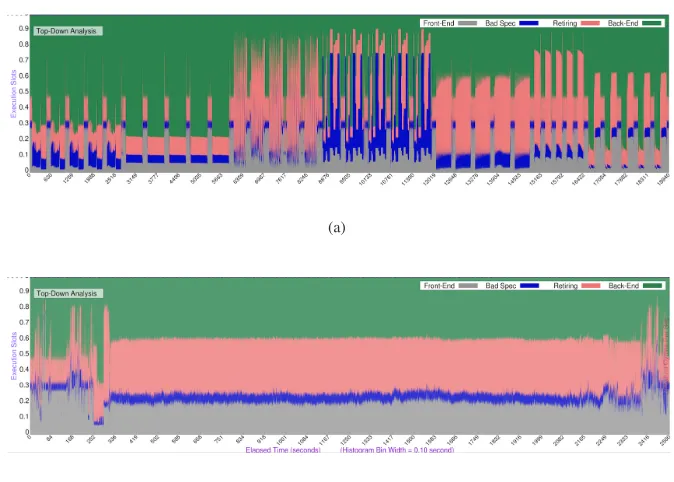
example Trident can show the classification of notional execution slots between used slots and unused slots, i.e. when execution opportunity is lost. Losses can happen within the front-end or back-end portion of the instruction pipeline due to availability or limits in resources, such instruction decodes latency or throughput, execution port availability and latency of memory access. In addition a loss may be classified as bad speculation when due to branch prediction. Figure 2 shows this comparison between HS06 and the ATLAS digitization and recon-struction sequence. In the case of HS06, the transitions of patterns correspond to the transition
between twocpp_allbenchmarks running in that particular phase of the suite (fig. 2(a)).
Sim-ilar remarks apply to the ATLAS case (fig. 2(b)). Differences are also found in the amount of
memory transactions and bandwidth usage. A detailed report about the Trident tool and the peculiarities of the HEP workloads is available [11].
(a)
(b)
2.2 Benchmarking suite
One of the efforts of the BWG has been to improve the measurement’s reproducibility and
to simplify the process of running benchmarks and collecting results. This goal has been
achieved by developing a toolkit, namedCERN benchmark suite[12], that allows to plug-in
any desired benchmark and to run a configurable sequence of benchmarks on a given comput-ing resource. The current list of supported benchmarks includes HS06, SPEC CPU 2017 [13], KV [14], Dirac Benchmark 2012 (DB12) [15] and Whetstone benchmark (WSN) [16] .
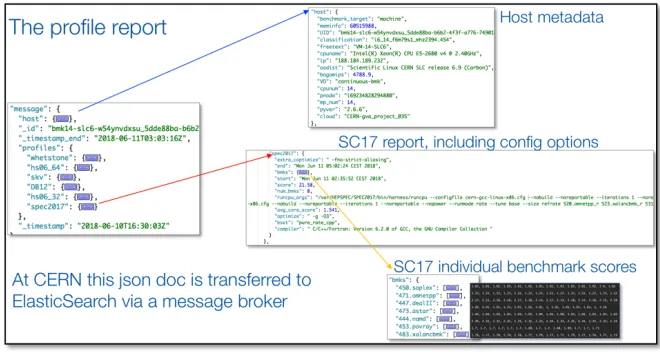
An-other benefit of the suite is the unified report generated after it runs. The report, inJSON
format, consists of a metadata section, with information about the server benchmarked, the running conditions, and of a data section with a hierarchical structure of benchmark results (fig. 3).
The suite is used at CERN for continuously benchmarking each CPU model running in the production infrastructure. It has speedup the measurement collection and analysis pro-cess. This is typically useful when prompt and accurate measurements are expected as, for example, the performance assessment for the mitigation measures related to the Spectre [17], Meltdown [18] and Foreshadow [19] vulnerabilities. The benchmarking suite is also
dis-tributed via dockercontainers to even simplify further installation and running processes.
Recently it has been used by other site managers in WLCG.
Figure 3.Structure of the profile report produced by the Benchmarking suite, here in the case of SPEC CPU 2017 (SC17).
3 Fast benchmarks
2.2 Benchmarking suite
One of the efforts of the BWG has been to improve the measurement’s reproducibility and
to simplify the process of running benchmarks and collecting results. This goal has been
achieved by developing a toolkit, namedCERN benchmark suite[12], that allows to plug-in
any desired benchmark and to run a configurable sequence of benchmarks on a given comput-ing resource. The current list of supported benchmarks includes HS06, SPEC CPU 2017 [13], KV [14], Dirac Benchmark 2012 (DB12) [15] and Whetstone benchmark (WSN) [16] .
An-other benefit of the suite is the unified report generated after it runs. The report, inJSON
format, consists of a metadata section, with information about the server benchmarked, the running conditions, and of a data section with a hierarchical structure of benchmark results (fig. 3).
The suite is used at CERN for continuously benchmarking each CPU model running in the production infrastructure. It has speedup the measurement collection and analysis pro-cess. This is typically useful when prompt and accurate measurements are expected as, for example, the performance assessment for the mitigation measures related to the Spectre [17], Meltdown [18] and Foreshadow [19] vulnerabilities. The benchmarking suite is also
dis-tributed via docker containers to even simplify further installation and running processes.
Recently it has been used by other site managers in WLCG.
Figure 3.Structure of the profile report produced by the Benchmarking suite, here in the case of SPEC CPU 2017 (SC17).
3 Fast benchmarks
Fast benchmarks require a few minutes to run instead of the several hours required by HS06. They are useful when the environment dynamic and the relatively short availability of com-puting resources make a long-running benchmark as HS06 impractical. Fast benchmarks are useful to estimate the delivered performance in commercial cloud and HPC opportunistic resources, and are helpful to forecast the duration of a given grid job in a WLCG worker node.
Among several applications studied by the BWG, the ATLAS KV and the DB12 are ap-preciated by the WLCG collaborations. KV tends to agree well with ATLAS and CMS sim-ulation workloads, DB12 (and the variant DB16) is in agreement with the Alice and LHCb job performance when DB12 runs inside the job. More discrepancies are seen when the DB12 measurement is performed following the same procedure as other benchmarks, i.e. when running as many parallel copies as there are hardware threads [20]. Evidence has been collected that shows short benchmarks are not robust enough to replace long-running
bench-marks when the scope of the measurement is to evaluate effects of the branch misprediction
rate or the kernel patches for the Meltdown and Spectre vulnerabilities.
4 SPEC CPU 2017
The SPEC CPU 2017 (SC17) [13] benchmark suite has been released on June 2017 by the SPEC organisation, and introduced this new suite as the replacement of SPEC CPU 2006. SC17 is larger and has a more complex codebase, with respect to its predecessor. It is shaped for multi-core and multi-threads applications. SC17 includes 43 individual benchmarks or-ganised into four suites, obtained combining integer and floating point applications with two
distinct running modes,speedandrate.
As done for HS06 ten years ago, the BWG is performing a detailed investigation of SC17, starting from the comparison with HS06. For this purpose only comparable configurations
have been considered. The benchmarks under examination have been restricted to the C++1,
and the selected running mode is rate, but with a number of spawn copies fixed to one.
In order to mimic themultiple speed running mode of HS06, parallel copies of SC17 are
spawned by an orchestrator script. These choices [21] allow to have the largest overlap with the application area of the HS06 benchmarks. For the same reasons the HS06 compiler
optimisation flags are retained2.
On this basis, the first objective has been to quantify how much SC17 differs from HS06
on the same hardware. Next objective has been to evaluate if all the individual benchmarks in the SC17 are independent or if, on the contrary, a subset of the benchmarks can be used to build a representative benchmark mix.
The measurements have been performed on several servers, covering seven different Intel
CPU models, from four different product families (Ivy Bridge, Haswell, Broadwell, Skylake),
and two AMD models (Opteron and Ryzen). The SMT was enabled in all the servers, and
the tests have been performed to profile the full physical node. Virtual Machines of different
CPU size have been used, running synchronously the benchmarks, so that the server load would be analogous to what is achieved running on a physical server with either the SMT enabled or disabled.
The following benchmarks have been collected for each server: SC17 and HS06 compiled at 64 bits, as well as HS06 compiled at 32 bits, as this the standard benchmark for WLCG.
A high linear correlation (0.975) between SC17 and HS06 has been found (fig. 4), with
a scale factor of 0.12 to convert the HS0664bits score to the SC17 score. The residual
ra-tio of the linear fit shows that the extrapolara-tion is within 5% of the measured value, i.e.
|SC17extrapolated
SC17measured −1|<5%.
This result highlights that the adopted SC17 benchmark set, pure_rate_cpp, does not
provide more information than HS06, at least for the range of CPU models currently adopted
1A dedicated benchmark set has been defined (pure_rate_cpp), consisting of the following benchmarks:
508.namd_r, 510.parest_r, 511.povray_r, 520.omnetpp_r, 523.xalancbmk_r, 526.blender_r, 531.deepsjeng_r, 541.leela_r.
Figure 4.SC17 score vs HS0664bitsscore, both normalised to the core count. The error bars represent
the 5% and 95% of the distribution for each given CPU model and VM core count. The marker size is proportional to the amount of data collected.
in WLCG. Therefore different scaling factors with respect to the HEP workloads are not
expected. We stress here that the initial focus has been on running conditions that remain similar to HS06 and to the current HEP workloads.
The second objective has been to evaluate if all the individual benchmarks in the SC17
pure_rate_cppare independent, or if there is at least one subset of this set that is as well rep-resentative of the performance of the full set. All the combinations of the eight benchmarks
have been built, for a total of7
k=1
8 k
=254 combinations.
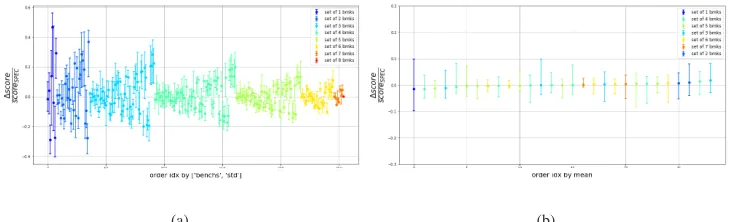
For each combination the SC17 score has been re-evaluated using only the individual scores of that combination. This has been possible thanks to the benchmark suite that stores
(a) (b)
Figure 5.Residual ratio ∆score
SC17scorewith respect to the original SC17pure_rate_cppfor each of the subsets
Figure 4.SC17 score vs HS0664bitsscore, both normalised to the core count. The error bars represent
the 5% and 95% of the distribution for each given CPU model and VM core count. The marker size is proportional to the amount of data collected.
in WLCG. Therefore different scaling factors with respect to the HEP workloads are not
expected. We stress here that the initial focus has been on running conditions that remain similar to HS06 and to the current HEP workloads.
The second objective has been to evaluate if all the individual benchmarks in the SC17
pure_rate_cppare independent, or if there is at least one subset of this set that is as well rep-resentative of the performance of the full set. All the combinations of the eight benchmarks
have been built, for a total of7
k=1
8 k
=254 combinations.
For each combination the SC17 score has been re-evaluated using only the individual scores of that combination. This has been possible thanks to the benchmark suite that stores
(a) (b)
Figure 5.Residual ratio ∆score
SC17scorewith respect to the original SC17pure_rate_cppfor each of the subsets
built from the eightpure_rate_cppbenchmarks’ scores (a) and for only the subsets compatible with the original SC17 within three sigmas (b). Error bars represent the full range [min,max]. The x value is the subset identifier.
the individual results of each benchmark and thread. From the sample of new scores the weighted average and standard deviation have been determined for each given CPU model
and running condition. Afterword the residual ratio ∆score
SC17score with respect to the initial SC17
pure_rate_cpphas been computed. The new scores have a residual ratio that span from less than 1% to more than 50% (fig. 5). Therefore it is possible to identify more than one subset being well in agreement with the original SC17 score, using just two or three benchmarks
(fig. 5(b)). As an example, the subset 508.namd_r, 510.parest_r, 531.deepsjeng_ris
com-patible with the original SC17, being the residual ratio within the range [-0.035, 0.017] with
average of−0.001±0.005.
Having shown that the individual SC17 pure_rate_cppbenchmarks are not fully
inde-pendent, it is possible to use one of those subsets of benchmarks that give the same score ratio, and consequently it is possible to reduce the running time of the suite without loosing
in sensitivity. The current running time is on average 2.5 hours/iteration, and scale inversely
with the score of a given CPU model. The next phase of the study will evaluate how each of those subsets correlates with the typical HEP job mix.
5 Requirements for a benchmark suite
The software and computing challenges for the HEP field, in particular due to the HL-LHC program [22], have implications on the benchmarking side. The selection of future CPU benchmarks shall take into account the foreseen evolution of the experiment software in order to better use the CPU resources. This implies that new HEP applications could and should
in the future perform differently in distinct CPU models with respect to the past applications,
and consequently should break the current linearity with HS06.
In this scenario, instead of looking for a third party benchmark suite that must represent the HEP applications, a suite of benchmarks built from the HEP applications themselves can represent the appropriate solution to guarantee the required correlation with the performance of the applications’ mix running in WLCG.
In order to build such suite, some requirements need to be fulfilled. First of all the suite should be easy to run, stable and accessible also by professionals external to the WLCG collaborations, such as hardware vendors and site procurement teams. This implies that no assumption should be made on the remote accessibility of the input data and the condition databases. In addition the long-term support of the suite is required, including its evolution to cope with major changes in the experiments’ software. Conditions such as strict version con-trol, tamper-proof repository, checksums and clear license statement should be guaranteed. This is feasible with the technologies and software practise already adopted, for example with cvmfs for library access, containers for isolation of a workload, and with continuous in-tegration procedures. But it is only possible if the WLCG community ensures the long term support.
6 Conclusions
HS06 is a decade old suite used to benchmark CPU resources for WLCG. Its adoption spans from the hardware vendors, to the site managers, funding agencies and software experts. It is stable, reproducible, accurate, however it is reaching the end of its life. Initial hints of lack of correlations with the HEP applications have been collected. Looking for suitable alternatives the HEPiX Benchmarking Working Group has evaluated SPEC CPU 2017 and a number of fast benchmarks.
The studies done so far do not show major advantage in adopting SPEC CPU 2017 with
the HS06 scores. Fast benchmarks can play a role in cloud contexts, where re-benchmarking is required, but the current proposed fast benchmarks cannot replace the accuracy of HS06, in particular in the procurement and accounting tasks.
A suite based on the workloads that HEP experiments run can be an alternative to indus-trial standard benchmarks. The adoption by the experiments of modern software development techniques simplifies the ability to package, distribute and maintain a field specific benchmark suite. The HEPiX Benchmarking Working Group is actively working to make this possible.
References
[1] HEPiX forum, www.hepix.org
[2] SPEC CINT 2000, https://www.spec.org/cpu2000/CINT2000/
[3] M. Michelotto et al., J. Phys. Conf. Ser.219, 052009 (2010) [4] J.L. Henning, SIGARCH Computer Architecture News34, 1 (2006) [5] Welcome to the Worldwide LHC Computing Grid, http://wlcg.web.cern.ch/
[6] Benchmarking Working Ggroup, https://w3.hepix.org/benchmarking.html
[7] P. Charpentier, Journal of Physics: Conference Series898, 082011 (2017)
[8] Cpu benchmarking with production jobs, https://indico.cern.ch/event/651342/
contributions/3024516/subcontributions/256445
[9] G. Shapira, Y. Chen, IEEE Transactions on Services Computing9, 152 (2016) [10] Trident gitlab repository, https://gitlab.cern.ch/UP/Trident
[11] S. Muralidharan et al., to appear in CHEP 2018 proceedings, EPJ Web of Conferences (2019)
[12] Cern Benchmark suite: gitlab repository, http://cern.ch/go/77JV
[13] SPEC CPU 2017, https://www.spec.org/cpu2017/
[14] A.D. Salvo, F. Brasolin, Journal of Physics: Conference Series219, 042037 (2010) [15] Dirac benchmark 2012, gitlab.cern.ch/mcnab/dirac-benchmark/tree/master
[16] H. Curnow, B. Wichman, Computer Journal19, 43 (1976)
[17] P. Kocher et al.,Spectre Attacks: Exploiting Speculative Execution, in40th IEEE Sym-posium on Security and Privacy (S&P’19)(2019)
[18] M. Lipp et al.,Meltdown: Reading Kernel Memory from User Space, in27th USENIX Security Symposium (USENIX Security 18)(2018)
[19] J. Van Bulck et al., Foreshadow: Extracting the Keys to the Intel SGX Kingdom with Transient Out-of-Order Execution, in27th USENIX Security Symposium (USENIX Se-curity 18)(Baltimore, MD, 2018), p. 991–1008
[20] Status report from Benchmarking Working Group, https://indico.cern.ch/event/609911/
contributions/2620190/
[21] Cern Benchmark suite: gitlab repository, http://cern.ch/go/tK6D