A Survey on Dynamic Power Management
Techniques in Wireless Sensor Network
Akansha Tomar
1, Prof. Gaurav Bhardwaj
2PG Student, Dept. of ECE, Rustamji Institute of Technology, BSF Academy, Tekanpur, M.P, India1 Assistant Professor, Dept. of ECE, Rustamji Institute of Technology, BSF Academy, Tekanpur, M.P, India2
ABSTRACT: Mobile Ad-hoc networks (MANETs) are self organized networks whose nodes are free to move randomly while being able to communicate with each other without the help of an existing network infrastructure. In MANET, the routing protocols have to route the packets depending on the MANET constraints such as battery power in addition to the shortest path [1]. The limited battery supply to mobile node in MANET requires that the routing protocols utilize power efficiently and thus maximize the network life time [2]. The energy aware deterioration in ad hoc networks is a very important aspect of the overall management of ad hoc networks. In this paper, the focus is on the reactive power-alert technique for communication between ad hoc network nodes by continuously alerting their energy status to neighbor nodes. Here the concentration is on reducing the energy consumption by proposing optimal path selection method. In this scheme a threshold value is set on the energy consumed by mobile nodes in ad-hoc network. If the energy level of any nodes in the network reaches a threshold level then such nodes are made inactive and inform other nodes not to establish connections with it in this sleep state [4]. In this paper, experimental results and a comparative analysis are presented based on the use of this threshold. The result shows significant improvement in the throughput and routing load which in turn increases the lifetime of the network. In wireless sensor network, nodes are usually powered by batteries with limited amount of energy [7]. This paper uses an Ad Hoc on Demand Multipath Routing Protocol for finding multiple paths to transfer the data from source node to destination node. The proposed work performed the energy efficient routing, when the sink node (base station) is in static state and all other neighbor nodes are in mobile state. Here gateway node acts as a relay for transmitting data from one group of node to another group. The performance of Ad hoc on Demand Multipath Routing Protocol is compared with Ad Hoc on Demand Distance Vector Routing Protocol. The simulation result shows that the proposed energy efficient routing algorithm consumes low energy and gives high throughput.
KEYWORDS: Mobile Ad-hoc networks (MANETs), Dynamic Power management (DPM), Node Alarming Mechanism (NOAL).
I.INTRODUCTION
A wide range of wireless sensor network applications are:
Underwater sensor networks that are used for monitoring of fisheries and coral reefs. The underwater sensor network is composed of mobile and static nodes.
The installation, deployment and maintenance process is accelerated by using WSN in volcanic monitoring. As these networks use equipments that are lighter, smaller and less power consumption. This application of WSN has many challenges that include data collection, event detection, high data rates and sparse deployment of nodes.
Other applications of WSN include:
(1) Outdoor/indoor monitoring of environment. (2) Monitoring of health.
(3) Factory and process automation.
II. DYNAMIC POWER MANAGEMENT
A dynamic power management (DPM) strategy ensures that power is consumed economically. The strategy can have a local or global, or both. A local DPM strategy aims to minimize the power consumption of individual nodes by providing each system with amount of power that is sufficient to carry out a task at hand. When there is no task to be processed, the DPM strategy forces some of the systems to operate at the most economical power mode or puts them into a sleeping mode. A global DPM strategy attempts to minimize the power consumption of the overall network by defining a network-wide sleeping state.
III. LITERATURE REVIEW
The problem of energy awareness in MANETs can be addressed at different layers. Many researchers have addressed the problem of optimizing the energy consumption in mobile nodes. Also presented below is a brief review of Work carried out by some authors on energy awareness in MANETs.
1 Node Alarming Mechanism (NOAL):
In this technique the authors suggest that an intermediate node having low energy would alarm its status to the others. By notifying its energy status to others, it can prevent others from sending more data to itself, which stops consuming more energy by forwarding data packets.
2 Low energy routing Protocols:
Here the authors propose a new scheme that uses sub-optimal paths occasionally to provide substantial gains. Multiple paths are found between source and destinations, and each path is assigned a probability of being chosen, depending on the energy metric. Every time data is to be sent, one of the paths is randomly chosen depending on the probabilities; hence none of the paths is used all the time, preventing energy depletion.
3 GPS-based Routing Algorithm method:
It makes use of the location dependent position information to route packets with the minimum required transmit energy. The key requirement of this technique is that the relative positions of nodes are available to all nodes.
4 Minimum Energy Routing:
This method proposes an on-demand routing algorithm which trades off more routing overhead for lower total energy. It is based on minimizing the amount of energy per bit required to get a packet from source to destination.
5 Battery cost-aware routing:
avoid the route with nodes having the least battery capacity among all nodes in all possible routes. The Conditional Max-Min battery capacity routing algorithm chooses the route with minimal total transmission power if all nodes in the route have remaining battery capacities higher than a threshold; otherwise routes including nodes with the lowest remaining battery capacities are avoided.
6 Lifetime Prediction Routing (LPR):
It is an on demand source routing protocol that maximizes the network lifetime by finding routing solutions that minimize the variance of the remaining energies of the nodes in the network. This uses battery lifetime prediction and favors the path whose lifetime is maximum. In Lifetime Prediction Each node tries to estimate its battery lifetime based on its past activity.
7 Localized Energy-Aware Routing (LEAR):
I t achieves a trade-off between balanced energy consumption and shortest routing delay, and at the same time avoids the blocking and route cache problems. This algorithm grants each node in the network, permission to decide whether to participate in route searching, which thus spreads the decision making process among all nodes. When a routing path is searched for, each mobile node relies on local information of remaining battery level to decide whether to participate in the selection process of a routing path or not.
It was observed that the previous work does not particularly address the issue of detecting unfaithful nodes (which run out of battery). Experimental results for a technique of EAODV algorithm with AODV protocol have been put forward. This technique identifies the unfaithful nodes & stops other nodes from establishing connection with them, so that the routing load will be minimized.
Year Test Method
/Technique
Key Findings
2008 PAMAS Protocol Power aware Multiple Access Protocol was proposed using radio interface of a Node.
2009
Analysis of AODV & DSR protocols
Here s e l e c t e d MANE T R e a c t i v e R o u t i n g p r ot o c o l s , Ad-hoc O n -demand Distance-vector (AODV) and Dynamic Source Routing (DSR) Protocol were analyzed in accordance with their finest performance of packets delivery rate, average end-to-end delay, and packet dropping.
2010
Ad-hoc on demand
Distance vector routing with path accumulation
2011 Energy & mobility aware clustering technique
Passive clustering or GRIDS algorithm (Geographically Repulsive Insomnious Distributed Sensors) was used.
2012 AODV-PA : AODV With Path Accumulation
Modify AODV to improve the source route accumulation feature of DSR.
2013
Energy Aware for low energy Ad-hoc sensor networks.
Proposed a new routing protocol that is suitable for low energy & low bit rate networks. Idea is to use the lowest energy path & utilize resources equitably.
2014 Lifetime Prediction Routing
This uses battery lifetime prediction and favors the path whose lifetime is maximum. In Lifetime Prediction Each node tries to estimate its battery lifetime based on its past activity.
2015 Localized Energy-Aware Routing
I t achieves a trade-off between balanced energy consumption and shortest routing delay, and at the same time avoids the blocking and route cache problems.
IV.WIRLESS SENSOR NETWORK
Wireless sensor networks are composed of independent sensor nodes deployed in an area working collectively in order to monitor different environmental and physical conditions such as motion, temperature, pressure, vibration sound or pollutants. The main reason in the advancement of wireless sensor network was military applications in battlefields in the beginning but now the application area is extended to other fields including industrial monitoring, controlling of traffic and health monitoring. Different constraints such as size and cost results in constraints of energy, bandwidth, memory and computational speed of sensor nodes.
A wireless sensor node in a network consists of the following components are: 1. Microcontroller
2. Radio transceiver 3. Energy Source (Battery)
WSN have the following distinctive characteristics are as follows: 1. They can be deployed large scale.
2. These network are scalable, the only limitation is the bandwidth of gateway node. 3. Wireless sensor networks have the ability to deal with node failures.
4. Another unique feature is the mobility of nodes.
6. They have dynamic network topology.
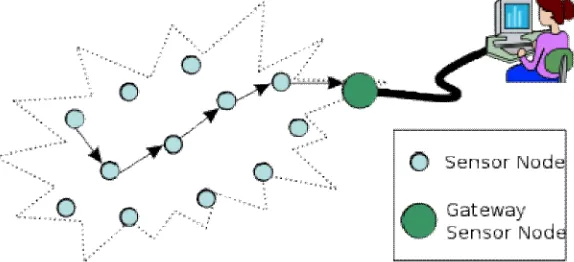
Further developments in this technology have led to integration of sensors, digital electronics and radio communications into a single integrated circuit (IC) package. Generally wireless sensor network have a base station that communicates through radio connection to other sensor nodes. The required data collected at sensor node is processed, compressed and sent to gateway directly or through other sensor nodes.
Figure 1: Wireless Sensor Network Architecture
V.CONCLUSION AND FUTURE WORK
The proposed algorithm aims at addressing the problem of improving the energy efficiency and thus maximizing the network lifetime of a MANET deployed in a typical military scenario. Current work tries to suggest methods to conserve and increase the battery life by suggesting an energy efficient routing approach for reactive MANETs.
As a future work, the reliability factor by using a link stability parameter to prevent unstable links from participating in route discovery procedure can be implemented to further improve the energy efficiency, as it would reduce link breakages which cause generation of route error messages leading to fresh route discovery procedure. The work can be extended to see performances with DSR, DSDV, OLSR, hybrid routing protocol and their characteristics be compared.
REFERENCES
[1] Charles E Perkins, ‘Ad-hoc Networking’, Pearson Education, Nov-2000, Perkins 47190.
[2] Kartik Chawda and Deepmala Gorana, ‘A Survey of Energy efficient Routing Protocols in MANET’, IEEE sponsored 2nd ICECS,
2015.
[3] C.Perkins,‘Adhoc On-demand Distance Vector (AODV) Routing’,RFC3561[S], 2003.
[4] D.Johnson, Y.Hu & D.Maltz, ‘The Dynamic Source Routing (DSR) Protocol for Mobile Ad-hoc Networking’, RFC 4728, Feb 2007.
[5] Hannan Xiao, ‘Energy consumption in Mobile Ad-hoc Networks’, National Conf on Recent Trend in Information, Telecommunication
and Computing, 2010, pp. 23-27.
[6] Vidyarthi SS, Vijayalakshmi S, Simha GAV and Shekar, ‘Energy efficient Enhanced-AODV protocol for Multi-Rover systems’,Ultra
Modern Telecommunications and Control Systems and Workshop (ICUMT), 2011 3rd International Con 2011, pp 1-5.
[7] Utkarsh, Mukesh Mishra and Suchismita Chinara, ‘ESAR: An Energy Saving Ad hoc Routing Algorithm for MANET’,IEEE-Fourth
International Conference on Advanced Computing, ICoAC 2012 MIT, Anna University, Chennai, 13-15 December 2012, pp 13-15.
[8] Shivashankar, Golla Varaprasad and Hosahalli Narayanagowda Suresh, ‘Implementing a new power aware routing algorithm based on
existing dynamic Source routing protocol for mobile ad-hoc networks’ IET Networks, 2014, Vol.3,Issue 2, ISSN 2047-4954, pp 137-142.
[9] Shivashankar, Hosahalli Narayanagowda Suresh, Golla Varaprasad Guruswamy Jayanthi,‘Designing Energy Routing Protocol with Power
Consumption Optimization in MANET’ IEEE transactions on Emerging Topics in Computing, Vol. 2, Issue 2, July 2014, ISSN 2168-6750, pp 192-197.
[10] Pallavi S. Katkar and Prof. (Dr.) Vijay R. Ghorpade” A Survey on Energy Efficient Routing Protocol forWireless Sensor Networks” (IJCSIT)
International Journal of Computer Science and Information Technologies, Vol. 6 (1) , 2015, 81-83.
[11] Samira Kalantary and Sara Taghipour” A survey on architectures, protocols, applications, and management in wireless sensor networks”
[12] Zain ul Abidin Jaffri and Sundas Rauf” A Survey on “Energy Efficient Routing Techniques in Wireless Sensor Networks Focusing On Hierarchical Network Routing Protocols” International Journal of Scientific and Research Publications, Volume 4, Issue 2, February 2014 1 ISSN 2250-3153
[13] Ms.Pallavi R ,Shreya Animesh ,Preetesh Shivam ,Raghunandana Alse Airody and Niraj Kumar Jha” Energy Conservation in Wireless
Sensor Networks Using Data Reduction Approaches: A Survey” International Journal of Computational Engineering Research,Vol, 03,Issue, 4 April 2013.
[14] Er. Palwinder kaur and Anand Nayyar” Conceptual representation and Survey of Dynamic Power Management (DPM) in Wireless Sensor
Network” International Journal of Advanced Research in Computer Science and Software Engineering Volume 3, Issue 3, March 2013.
[15] Edwin Prem Kumar Gilbert, Baskaran Kaliaperumal, and Elijah Blessing Rajsingh” Research Issues in Wireless Sensor Network Applications: