University of South Carolina
Scholar Commons
Theses and Dissertations
2016
Organizational Strategy Under Institutional
Pluralism: A Latent Variable Analysis Of
Institutional Effects On Organizational Behavior In
The United States Pharmaceutical Industry
Thomas Christopher Robinson University of South Carolina
Follow this and additional works at:https://scholarcommons.sc.edu/etd Part of theSociology Commons
This Open Access Dissertation is brought to you by Scholar Commons. It has been accepted for inclusion in Theses and Dissertations by an authorized administrator of Scholar Commons. For more information, please [email protected].
Recommended Citation
Robinson, T. C.(2016).Organizational Strategy Under Institutional Pluralism: A Latent Variable Analysis Of Institutional Effects On
Organizational Behavior In The United States Pharmaceutical Industry.(Doctoral dissertation). Retrieved from
ORGANIZATIONAL STRATEGY UNDER INSTITUTIONAL PLURALISM:ALATENT VARIABLE
ANALYSIS OF INSTITUTIONAL EFFECTS ON ORGANIZATIONAL BEHAVIOR IN THE UNITED
STATES PHARMACEUTICAL INDUSTRY
by
Thomas Christopher Robinson
Bachelor of Science
Georgia Institute of Technology, 2004
Master of Arts
Georgia State University, 2008
Submitted in Partial Fulfillment of the Requirements
For the Degree of Doctor of Philosophy in
Sociology
College of Arts and Sciences
University of South Carolina
2016
Accepted by:
Douglas L. Anderton, Major Professor
Jason L. Cummings, Committee Member
Andrea K. Henderson, Committee Member
Cole G. Chapman, Committee Member
ACKNOWLEDGEMENTS
Scholarship is a collaborative process and this dissertation would not have been
possible without help from other people. I would like to thank my advisor and mentor,
Dr. Douglas Anderton, who constantly provided me with advice on this project and
helped me to become a true scholar. I am grateful for the contributions of the rest of my
committee, Dr. Jason Cummings, Dr. Andrea Henderson, and Dr. Cole Chapman, who
proved great feedback and challenged me to produce better work. Additionally, I would
like to thank my fellow graduate students, Adrianne Dues, Calley Fisk, Daniela Negraia,
Derek Silva, Hatice Akca, Michelle Deming, and Nick Harder, who listened patiently to
ABSTRACT
The United States pharmaceutical industry is a dynamic organizational system
populated by organizations pursuing different strategies to reach different goals. The aim
of this dissertation is to examine the organizational field of the pharmaceutical industry to
determine if categories of pharmaceutical organizations exist based on organizational
strategy. This project applies the theoretical constructs of organizational fields and
institutional logics developed by institutional theorists to examine the institutional effects
on organizational strategies. This is a mixed methods project using historical analysis,
latent class analysis, and case studies to evaluate the drug development process. The
findings of this study show field level institutions do affect organizational strategy and
contribute to organizational diversity within a field. However, the findings suggest the
influence of institutional logics is neither straightforward nor without organizational
costs. The general findings of my research show organizations benefit when their
dominant logic aligns with the dominant logic of the field; while, misaligned logics
TABLE OF CONTENTS
ACKNOWLEDGEMENTS ... iii
ABSTRACT ... iv
LIST OF TABLES ... viii
LIST OF FIGURES ... ix
LIST OF ABBREVIATIONS ...x
CHAPTER 1:INTRODUCTION ...1
CHAPTER 2:INSTITUTIONAL THEORY AND ORGANIZATIONAL STUDIES ...7
2.1INTRODUCTION ...7
2.2EARLY PERSPECTIVES IN INSTITUTIONAL ANALYSIS AND ORGANIZATIONAL STUDIES ...10
2.3NEOINSTITUTIONAL AND INSTITUTIONAL THEORY IN SOCIOLOGY ...14
2.4INSTITUTIONS AND INSTITUTIONALIZATION ...23
2.5ORGANIZATIONAL FIELDS AND INSTITUTIONAL PLURALISM ...33
2.6ORGANIZATIONAL AGENCY AND STRATEGIC ACTION ...41
2.7INSTITUTIONS AND ORGANIZATIONAL LEGITIMACY ...48
2.8INSTITUTIONALIZATION,MEDICALIZATION, AND PHARMACEUTICAL REGIMES ...54
2.9CONCLUSION ...58
CHAPTER 3:CURRENT STAKEHOLDER DYNAMICS WITHIN THE PHARMACEUTICAL FIELD ..61
3.2PHARMACEUTICAL CORPORATIONS AND THE
FOOD AND DRUG ADMINISTRATION ...63
3.3PHARMACEUTICAL CORPORATIONS AND PATIENTS, OR THE POTENTIAL CONSUMER ...69
3.4PHARMACEUTICAL CORPORATIONS AND PHYSICIANS ...77
3.5PHARMACEUTICAL CORPORATIONS AND THE RETAIL PHARMACY SUPPLY CHAIN...85
3.6CONCLUSION ...95
CHAPTER 4:DEVELOPMENT OF THE UNITED STATES PHARMACEUTICAL FIELD ...98
4.1INTRODUCTION ...98
4.2EMERGENCE OF THE ORGANIZATIONAL FIELD, LATE 19THCENTURY TO 1910S ...100
4.3LABORATORY DEVELOPMENT AND INDUSTRY-ACADEMIC COLLABORATION,1920-1940 ...108
4.4SCIENTIFIC ADVANCEMENT AND THE RISE OF THE FDA,1945-1962 ...114
4.5THE BIOTECHNOLOGY REVOLUTION AND ORGANIZATIONAL CHANGE,1970S –1990S ...120
4.6THE ORGANIZATIONAL STRATEGIES OF BIG PHARMA ...134
4.7CONCLUSION ...144
CHAPTER 5:AQUANTITATIVE EVALUATION OF ORGANIZATIONAL STRATEGY ...146
5.1INTRODUCTION ...146
5.2DATA ...149
5.3METHODOLOGY ...159
5.4EXPLORATORY FACTOR ANALYSIS ...164
5.5STRUCTURAL EQUATION MODEL ...170
5.7CONCLUSION ...178
CHAPTER 6:FOUR CASE STUDIES ON DRUG DEVELOPMENT ...180
6.1INTRODUCTION ...180
6.2CASE STUDY DATA AND METHODOLOGY ...181
6.3TASIGNA (NILOTINIB) AND NOVARTIS:INNOVATOR CLASS ...189
6.4INVEGA (PALIPERIDONE) AND JOHNSON &JOHNSON:INNOVATOR CLASS ...193
6.5LUNESTA/ESTORRA (ESZOPICLONE) AND SEPRACOR:MODIFIER CLASS ...198
6.6LEVEMIR (INSULIN DETEMIR) AND NOVO NORDISK:MODIFIER CLASS ...203
6.7DISCUSSION:EVALUATION OF THE CLASSES ...207
6.8CONCLUSION ...218
CHAPTER 7:CONCLUSION ...220
7.1LIMITATIONS AND FUTURE DIRECTIONS ...220
7.2CONCLUSION ...224
REFERENCES ...227
APPENDIX A–POISSON MODEL TEST OF RESEARCH AND DEVELOPMENT VARIABLES ....249
LIST OF TABLES
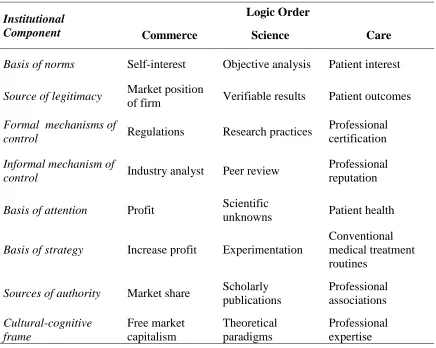
Table 2.1 Institutional Logic Ideal Types ...50
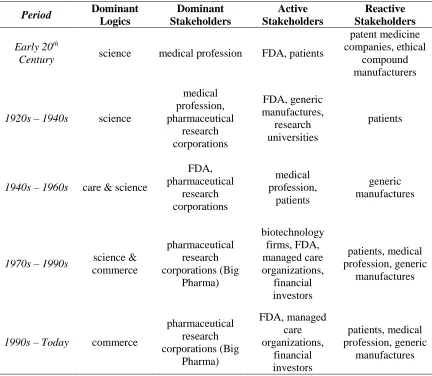
Table 4.1 Key Changes in the Pharmaceutical Field, Early 20th Century – 1990s ...144
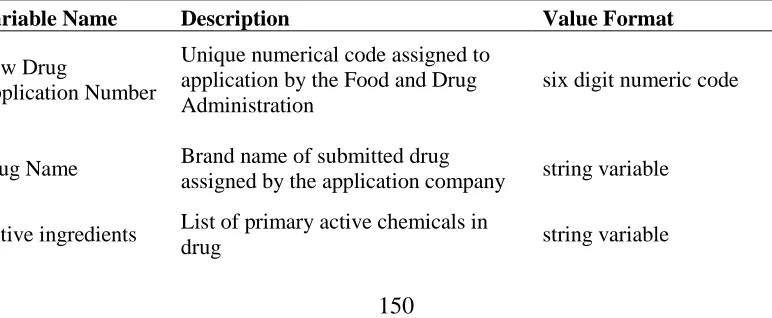
Table 5.1 Variables from the Food and Drug Administration Database of Approved Drug Applications, 1997-2014 ...150
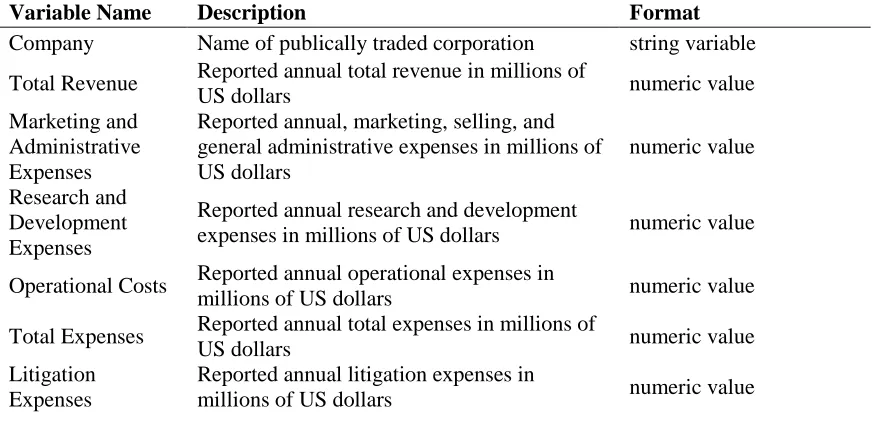
Table 5.2 Variables from the Mergent Online Database of Annual Corporate Reports, 1997-2014 ...153
Table 5.3 Therapeutic Class Categories...156
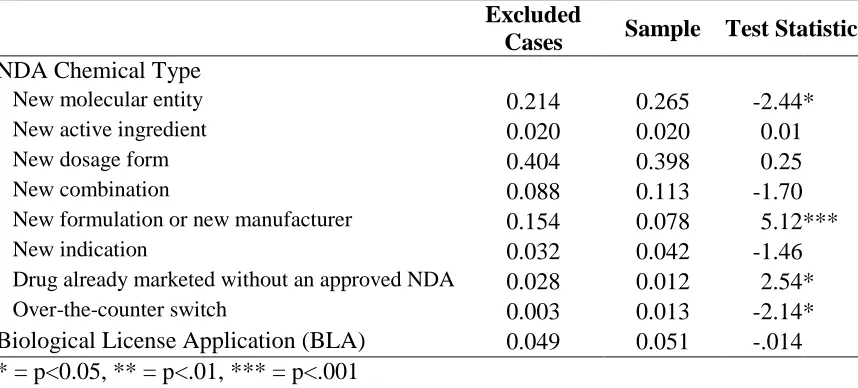
Table 5.4 Comparison of Sample to Excluded Cases of FDA Approvals ...157
Table 5.5 Descriptive Statistics by Company ...158
Table 5.6 Financial Variable Exploratory Factor Model ...165
Table 5.7 Chemical Type and Therapeutic Class Variable Exploratory Factor Model, Oblique Rotations ...167
Table 5.8 Summary of Information on Selected Number of Latent Classes for Drug Development Strategies ...174
Table 5.9 Means by Latent Class for Financial, Chemical Type, and Therapeutic Variables not Included in Latent Class Model ...176
LIST OF FIGURES
Figure 2.1 Theoretical Model of Pharmaceutical Corporations’
Relations to Other Field Stakeholders by Logic Order ...53
Figure 3.1 Stakeholder Connections in the United States Retail Pharmacy Supply Chain ...87
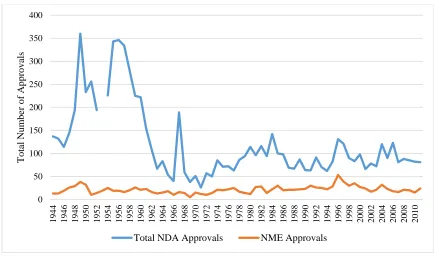
Figure 4.1 Approved FDA Submissions by Application Type, 1944-2014 ...140
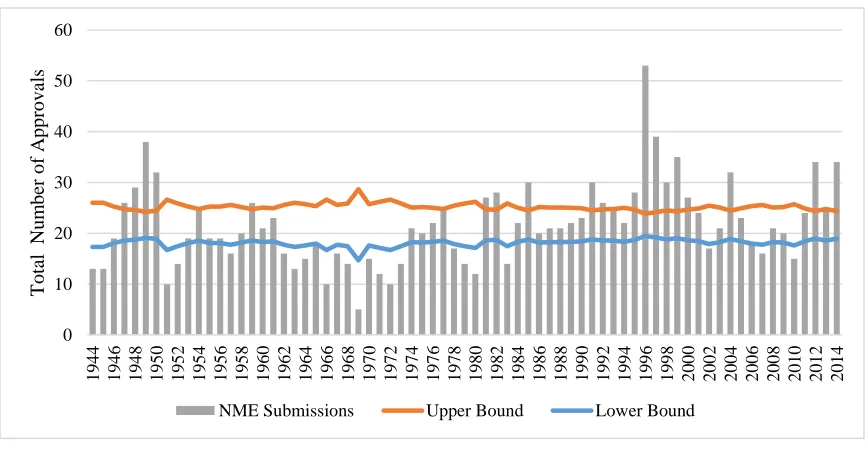
Figure 4.2 Number of NME Approvals per Year, 1944-2014 ...143
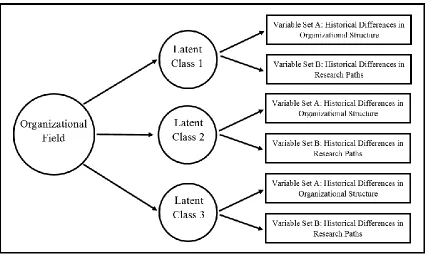
Figure 5.1 Model of Theoretical Prediction for Latent Class Formation ...148
Figure 5.2 Best Fit Structural Equation Model ...171
Figure 5.3 Fit Statistic Comparison between Class Solutions ...174
Figure 5.4 Class Prevalence Rates ...175
Figure 6.1 Model of Theoretical Prediction for Logic Order Effect on Organization Strategy ...180
Figure 6.2 Allocation of Financial Resources between Case Study Organizations ...213
LIST OF ABBREVIATIONS
ACCME ... Accreditation Council for Continuing Medical Education
ADR ... Adverse Drug Reaction
AMA ... American Medical Association
ANDA ... Abbreviated New Drug Application
ATC... Anatomical Therapeutic Chemical
BLA... Biologic License Application
DTCA ... Direct to Consumer Advertisement
FDA... Food and Drug Administration
FTC ... Federal Trade Commission
HMO ... Health Maintenance Organization
KOL ... Key Opinion Leader
NDA ... New Drug Application
NME ... New Molecular Entity
OTC... Over-the Counter
PBM ... Pharmacy Benefits Manager
PDUFA ... Prescription Drug User Fee Act
PAO... Patient Advocacy Organization
SEC ... Securities and Exchange Commission
SIC ... Standard Industrial Classification
CHAPTER1
INTRODUCTION
Several highly publicized events have raised public concern over organizational
practices within the United States pharmaceutical industry during the past few years. One
of the most recent incidents was the accusation of price gouging by executives at Turning
Pharmaceuticals last fall (Ramsey 2015); however, the practice of acquiring the patent
rights on a drug and then raising the drug’s price to generate profits is not uncommon. In
2011, Gilead spent $11 billion to acquire Pharmasset Inc., a small biotech company
started by researchers at Emory, for the intellectual property rights to the hepatitis C drug
it was currently testing (Tirrell 2011). Gilead currently prices Sovaldi, the brand name of
the approved hepatitis C drug, at approximately $84,000 for a 12-week treatment course
(Express Scripts 2015). Gilead publically argued the high cost of the drug was due to the
high cost of research and development; however, the available information on Pharmasset
Inc. indicates the research cost for developing Sovaldi up to phase II clinical trials was
only between $300 and $500 million (Sachs 2015).
The Sovaldi case reveals two reasons behind the high cost for prescription drugs
in the United States (1) market factors of speculation and (2) pharmaceutical corporations
acting strategically in pursuing organizational goals. As a small research company,
Pharmasset Inc. lacked the organizational capacities of a large multinational corporation,
such as Gilead, to manufacture and mass market a product. Pharmasset approached
but prior to the completion of clinical testing. However, rather than make an offer
significantly lower than the eventual purchase price, Pharmasset’s founder and largest
stock holder quoted $400 million as an acceptable offer at the time, Gilead waited until
clinical trial data showed Sovaldi was a marketable product before making the acquisition
bid (Berkort 2011).
This example indicates the United States pharmaceutical industry is a dynamic
organizational system populated by organizations pursuing different strategies to reach
different goals. The aim of this dissertation is to examine the organizational field of the
pharmaceutical industry to determine if categories of pharmaceutical organizations exist
based on institutionalized organizational strategy. This project applies theoretical
constructs developed by institutional theorists to examine how expectations from
different stakeholders create organizational fields of institutional pluralism legitimating
multiple organizational strategies.
Institutional theory research in organizational studies seeks to understand
organizational behaviors within the broader cultural context of a society. Key areas of
work within the theory are the institutional logics perspective and organizational fields.
The institutional logics perspective argues organizations align with societal logic orders,
whereby it is possible to identify which logic order dominates an organization’s strategy.
The organizational field is an analytical tool for evaluating how actors outside an
organization influence organizational behavior. Organizational field researchers examine
power relations to identify key stakeholders and the methods employed externally that
Drawing from an historical analysis and prior organizational research, I argue that
the organizational field of the pharmaceutical industry in the United States is composed
of several key stakeholders: pharmaceutical corporations, the federal government, third
party payers, professional medicine, and patients. These stakeholders coexist in an
interdependent system with varying levels of power that allow certain stakeholders
influence over other stakeholders and the ability to shape field structure. Drawing from
the institutional logics perspective, I propose that these stakeholders adhere to different
logic orders, which results in an organizational field of institutional pluralism that
legitimates multiple organizational strategies.
I use a mixed methods approach to evaluate my propositions by conducting three
distinct research projects. First, following the recent work of Neil Fligstein and Doug
McAdam (2012) that sought to develop a cohesive field theory approach for institutional
analysis, I conduct a historical analysis of the United States pharmaceutical industry. The
purpose of the historical analysis is to show that the pharmaceutical industry is a distinct
organizational field and to examine the changing field dynamics to identify the logic
orders and key stakeholders in the current field. The second project is a quantitative
analysis using a dataset of information on approved new drug applications by the Food
and Drug Administration and annual corporate financial data from a sample of
pharmaceutical corporations between 1997 and 2014. The purpose of the quantitative
analysis is to examine the sample of pharmaceutical corporations for latent classes and
determine if the identified factors of organizational strategy act as mechanisms creating
organizational heterogeneity within the field. The final research project is four case
purpose of the case studies is to evaluate if differences in organizational strategy can
explain class separation. The second purpose of the case studies is to compare the
identified organizational strategies with the framework of institutional logics to evaluate
if logic orders differ between classes.
This dissertation is organized around these three research projects. Chapter 2
presents an overview of institutional theory in organizational studies. I review the
literature on the specific components of the theory that are relevant to my work and list
the guiding questions of the project as well as the more detailed theoretical propositions
that I evaluated. Chapter 3 examines the major contemporary stakeholder relationships in
the pharmaceutical industry. Since this project was focused on pharmaceutical
organizations, I restricted my analysis to the direct relationships between pharmaceutical
organizations and the other main stakeholders in the field: the Food and Drug
Administration, professional medicine, patients, and the pharmaceutical supply chain.
Chapter 4 is the historical analysis. In this chapter, I present evidence showing the
pharmaceutical field developed as the result of distinct historical events and collective
action by the key stakeholders mentioned above. The changing field dynamics over the
past century indicate the field structure was continually reshaped by external factors and
altering power relationships in way that allowed multiple organizational strategies to
emerge.
Chapter 5 is the quantitative analysis of the drug submission and corporate
financial data. I use factor analysis to evaluate the data for latent constructs that can be
identified as organizational strategies. I use the identified strategies to build a structural
final model provides the variables used to conduct a latent class analysis that reveals two
organizational categories.
Chapter 6 is four cases studies, two from each latent class. Analysis of the case
studies provides contextual data on the specific organizational strategies of organizations
in each class. The qualitative data indicates the dominant institutional order of
organizations differs between classes, but that this difference is not the sole factor driving
class separation. The final chapter is a comprehensive evaluation of the historical,
quantitative, and qualitative data. My central conclusion is that institutional effects do
result in divisions within the field based on latent organizational strategy; however, it is
the processes of legitimation, rather than logic orders, which drive organizational
subgrouping in the field.
This project provides several contributions to the organizational studies literature.
One contribution is a novel approach to mixed-methods analysis that addresses the
challenge institutional theorists face in measuring institutional effects (Greenwood et
al.2014, Schneiberg and Clemens 2006, Scott 2014, Thornton et al. 2012). Bazeley’s
(2015) review of mixed methods research published in the top organization and
management journals revealed that most previous work utilizes a priori qualitative
analyses to inform the direction of quantitative research. This introduces the potential of
selection bias if the observed differences are not causal to the category separation. For
this project, I sought to reverse the common practice by using a quantitative analysis to
direct the qualitative analysis. Rather than relying on a priori indicators of institutional
orders, I sought to evaluate if a latent class analysis would indicate existing subgroups
aligns with the conceptual approaches proposed by researchers in the strategy-as-practice
literature (Vaara and Whittington 2012).
Another contribution to the literature is that this study addresses the issue recently
raised by Greenwood et al. (2014) that current organizational research focuses primarily
on the construction and maintenance of institutions rather than how institutions actually
effect organizations. Recent scholarship in the field of family business has illustrated how
the intersection of family and market institutions directly effects organizational strategy
in family firms, creating strategies that differ from publically traded companies (Cannella
et al. 2015, Gomez-Mejia et al 2011). While these studies in family business cut across
industry categories, my project adds to the literature by exploring the effects of
institutional pluralism on organizations within the same industry.
The findings of this study show institutions do affect organizational strategy and
contribute to organizational diversity within a field. The data indicate common
organizational practices do form coherent and divergent organizational strategies within a
field. However, the findings also suggest the influence of institutional logics is neither
straightforward nor without organizational costs. The general findings of my research
show organizations benefit when their dominant logic aligns with the dominant logic of
the field; while, misaligned logics require organizations to pursue alternative tactics to
CHAPTER 2
INSTITUTIONAL THEORY AND ORGANIZATIONAL STUDIES
2.1 Introduction
Sociologists argue that institutions are pivotal social phenomena that have
multidimensional effects on society; but institutions are latent constructs, which
complicates research seeking to understand their affects (Berger and Luckmann 1967,
Parsons 1980, Scott 2014, Weber 1978). Institutional theory is a branch of organizational
studies that focuses on analyzing institutional effects on organizations. The broad goal of
institutional theory is to understand how institutional effects produce similarities or
facilitate differences between organizations in the same environment. Through the
application of institutional theory as a framework for analysis, previous researchers have
gained valuable insights on organizational processes and structures (DiMaggio 1991, Rao
et al. 2003, Scott et al 2000). Moreover, recent developments and studies using
institutional theory indicate the theory continues to hold value for future work
(Greenwood et al. 2014, Powell and Sandholtz 2012, Quirke 2013).
The goal of this project is to explore if institutions influence the strategy of
pharmaceutical corporations. Institutional frameworks become incorporated into
organizational fields through stakeholder evaluations and expectations, and differences in
stakeholder power can lead to contradictions within a field as organization’s struggle to
competing institutional frameworks where multiple stakeholders hold different interests
in the outcomes of pharmaceutical research and on the behaviors of pharmaceutical
corporations.
Organizational strategy is one element of organizational behavior theoretically
subject to institutional effects. I choose to focus on organizational strategy because unlike
other aspects of organizational behavior, such as informal organizational culture, strategy
is constrained by the basic functions of an organization. The basic practice of a research
based pharmaceutical corporation is to develop marketable drugs that are advancements
over current treatments to improve patient lives. Since research based pharmaceutical
organizations operating in a capitalist market need to meet this expectation for survival,
identifying strategies used to achieve this goal provides a good source of material for
examining institutional effects. My central question is that if different institutional logics
exist within the organizational field and provide legitimacy to a range of strategies, then
will pharmaceutical corporations adopt different strategies of drug development or is
there a dominate institutional framework creating isomorphic pressure to adopt strategy.
As an exploratory project, I constructed two guiding questions drawn from the literature
to serve as the general frameworks of the analysis.
Question 1: Do multiple institutional logics exists in the pharmaceutical
organizational field and serve as potential sources of legitimacy for different
organizational strategies?
Question 2:Is pharmaceutical development an interorganizational1 negotiation
between field stakeholders whereby strategic action by pharmaceutical
corporations is necessary to address the claims of the other stakeholders in the
field: regulators, physicians, patients, and investors in order for a new product to
be successfully legitimized and adopted?
These questions frame my central arguments as an institutional analysis project and
position pharmaceutical corporations as the site of evaluation within the organizational
field. From these general questions, I develop two sets of specific theoretical
propositions, presented later in the chapter, to evaluate the quantitative and qualitative
data collected.
The counter argument to institutional theory is that organizational strategy results
from the aggregate of individual choices; therefore, similarities between organizations are
the result of market constraints or opportunities specific to industry and organizational
types but not attributable to latent conceptual frameworks. The organizational
environment affects strategy through options for action presented to managers following
rational decision-making processes not influenced by ideological trends or culture (March
1988). Organizational success or failure, then, depends on the ability and skills of
organization members over normative evaluations by outside stakeholders. This
framework for organizational studies treats organizational strategy as calculated and
impersonal but this stance is problematic because organizations are composed of
individuals who bring differing perceptions and connections with the social world into
the organization (Meyer and Rowan 1977, Selznick 1949). Even within the same
company, the rational decision of one manager might not be viewed as rational by
another manager.
The embeddedness of individuals within culture implies that broader social
ideologies become incorporated into organizations; therefore, the perspective of
organizational strategy as constructed by aggregating individual choices is rather sterile.
Institutional theory offers a framework for explaining organizational strategy that
recognizes the complexity of interactions between individuals, organizations, and society
and provides the tools for analyzing how similarities between organizational strategies
can result from societal level forces outside of the individual’s direct perception. This
chapter provides a brief history on institutional analysis in organizational studies and
discusses the contemporary theoretical concepts from institutional theory applied to
explore organizational strategy in the U.S. pharmaceutical field.
2.2 Early Perspectives in Institutional Analysis and Organizational Studies
Institutional analysis is fundamental to the discipline of sociology and a topic
discussed by many classical theorists. Emile Durkheim reified institutions as social facts
reflecting collective understanding and affecting individual behavior. In the preface to the
second edition of The Rules of Sociological Method, he advocated institutional analysis
as central within the discipline writing, “sociology can then be defined as the science of
institutions, their genesis and their functioning” (1981: 45). Max Weber contributed the
process of rationalization and ideal types to institutional analysis while additionally
recognizing the interdependent quality of their relationship with society (1978). Weber’s
detailed analysis of bureaucratic structure and authority systems was foundational to
demonstrated a multilevel institutional analysis between capitalist economies,
organizations, and workers (Adler 2009). Finally, Scott (2014) noted Herbert Spencer’s
application of an organic framework to social systems, highlighting the concept of
interdependence between systems components, as seminal to understanding modern
sociological work on institutions.
Later scholars in the 20th century appropriated these classical insights on
institutions within their research agendas and began focusing on the institutional analysis
of organizational behavior. Talcott Parsons (1980) integrated the concepts of Weber and
Durkheim to develop his functional perspective that highlighted institutionalization as a
key force creating and maintaining social order and solidarity. His AGIL model, based on
functionality within a system, proposes organizational behavior develops from a link
between functional requirements and structural arrangements. Berger and Luckmann
(1967) incorporated institutionalization into their broad perspective on the social
construction of reality, arguing that institutions act as elements of social control by
shaping individual perception and knowledge through channeling conduct in
predetermined directions. Organizational strategy then is viewed a product of pre-existing
cultural expectations. Parsons’ and Berger and Luckmann’s conceptualizations on
institutionalization framed institutions as macro-level elements for analyzing the
construction of social structure and how organizations are integrated into societies.
Other modern theorists incorporated the institutional perspectives of classical
scholars into their frameworks for understanding organizations as units of analysis. Philip
Selznick was one of the most important figures in the early school of institutional
proposes organizations can become institutionalized through a “process of organic
growth, wherein the organization adapts to the strivings of internal groups and the values
of the external society” (Perrow 1986: 167). Selznick’s work, and that of his students,
demonstrated that while organizations hold formal and official goals, interactions with
interests internal and external to the organization result in organizations being guided by
objectives other than those officially promoted (Scott 2014). Organizational strategy then,
instead of being merely a means to an end can become the end in itself when
organizational behavior becomes oriented to self-sustainment.
The work of James March and Herbert Simon (1958) represents another important
branch of organizational studies. March and Simon focused on the decision-making
process within organizations and, following Weberian thought, attempted to incorporate
rationalization into their explanations of organizational strategy (Perrow 1986). Their
work focused on how organizational structure simplified decision-making for individuals
by restricting the number of appropriate choices. The “garbage can” model is their
well-known concept of organizational strategy and argues solutions are generated every day
and stockpiled, thrown in the garbage can. When managers encounter problems, rather
than delegating employees to find a solution, they pull a pre-existing solution out from
the garbage can. The “garbage can” model represents the most significant contribution of
March and Simon’s work, the application of bounded rationality to organizational
strategy, that lead to richer analytical techniques for empirically analyzing the allocation
of attention in organizations (March 1988, Scott 2014).
Another pivotal contribution of Selznick, March and Simon, and their
organizations as open systems as opposed to previous scholars who analyzed
organizations as closed entities. This development allowed researchers to incorporate
non-organizational factors from the external social environment into explanations of
organizational behavior. An example of later work drawing on these developments is
Paul Hirsh’s (1975) comparative study between the phonograph record industry and
pharmaceutical manufacturing, which demonstrated the ability of organizations to control
aspects of their external environments that affect profitability. Importantly, Hirsh (1975)
showed how these external factors could be products of social construction, such as the
social prestige of the industry, in addition to technical or material factors. His findings
indicated organizations within each industry developed similar strategies while the
strategies were different between industries.
Some critics of these early open system researchers, however, pointed out their
work was still focused on explaining organizational strategy from the point of individual
organizations instead of considering organizational strategy as a product of collective
behavior. For example, Selznick’s research on the TVA was viewed as typical of the
exposé style research conducted by early institutionalists (Scott & Davis 2016). Perrow
(1986), for instance, criticized the early institutional school for this, stating the “school’s
view of organizations and society fails to connect the two” (173). This line of criticism
paved the way for the development of three notable theoretical frameworks in the 1970s:
resource dependency, population ecology, and institutional theory, which sought to
address the complex interdependent relationship between organizations and their
2.3 Neoinstitutional and Institutional Theory in Sociology
Contemporary institutional theory is a field of organizational studies that frames
organizations as open systems embedded within the larger social structure of a society.
The value institutional theory adds to organizational studies is the understanding that
cultural factors, such as differences in power relations between stakeholders, impact
organizational strategy on multiple levels by affecting individual perceptions of
legitimate organizational activities and goals, the role of organizations within society, and
the social structure supporting or constraining organizations (DiMaggio 1991, Fligstein
1991). Institutional theorists seek to understand how institutions and institutional
processes in the organizational environment collectively affect organizations instead of
focusing on explaining behaviors as firm specific behaviors (Scott 2014).
2.3.1 Early Works and Theoretical Cohesion
The origins of contemporary institutional theory lie in four studies conducted
during the late 1970s and early 1980s. While these four articles overlap conceptually,
they were not written intentionally as a cohesive collection for an emerging theoretical
paradigm. They are now considered the foundational works of the “new institutionalism
in organizational analysis” not only because of their direct influence on subsequent work
but because DiMaggio and Powell (1991) grouped them together as the first section of
their edited volume intended to delineate neoinstitutionalism as a distinct research
paradigm. As DiMaggio and Powell pointed out in the introduction to their anthology,
one of the needs for the book was to distinguish and consolidate sociological
institutionalism from the institutional work of scholars in other disciplines. To facilitate
“Institutionalized Organizations: Formal Structure as Myth and Ceremony” as new
institutionalism, or neoinstitutionalism, while older work was labeled old institutionalism.
However not every scholar accepts that there is a theoretical distinction between
old and new institutionalism. Philip Selznick (1996), who DiMaggio and Powell labeled
as a prominent old institutionalist, notably objected to this categorization scheme and
instead argued the work of current institutionalists represented the expansion and
development of sociological institutionalism in general not the emergence of a distinct
research paradigm. While there continues to be scholarly debate between the demarcation
of the terms new institutionalism and neoinstitutionalism, the work of sociologists in
institutional theory since these early papers has become theoretically cohesive and
recognizable as a distinct research field within organizational studies in general
(DiMaggio and Powell 1991, Hall and Taylor 1996, Tolbert and Zucker 1996, Scott
2014). I agree with Selznick’s point that the term neoinstitutionalism is a semantic
distinction rather than the demarcation of a novel theoretical field, so I use the general
term institutional theory throughout this project to represent the collective work within
this branch of organizational sociology.
The first pivotal article of institutional theory is the classic paper by John Meyer
and Brian Rowan (1977) who departed from existing organizational research paradigms
by emphasizing how organizations were guided by both informal (symbolic) and formal
(rational) properties. Meyer and Rowan’s research revealed that the importance
organizations place on symbolic value could extend to an organization adopting an
institutionalized practice even if it decreased operational efficiency. At the same time,
a practice without implementing it. Decoupling provides organizations with a crucial
advantage because it “enables organizations to maintain standardized, legitimating,
formal structures while their activities vary in response to practical considerations”
Meyer and Rowan (1977: 357). Meyer and Rowan framed institutionalism as a social
mechanism external to the organization and functioning as a rational myth that generated
isomorphism, organizational uniformity, within the organizational environment.
“Institutionalization involves the processes by which social processes, obligations, or
actualities come to take on rulelike statues in social thought and action” (Meyer and
Rowan 1977: 341). In other words, organizations will adopt practices because of
normative pressures to avoid the social label of a deviant or non-adopter.
Tolbert and Zucker (1996: 178) derived three major effects Meyer and Rowan’s
article had on research at the time connecting organizational behavior to institutions:
organizations are driven to adopt formal structures regardless of their efficacy to increase
legitimacy and survival, the social evaluation of an organization is partially an evaluation
on the appropriateness of the organizations formal structure, and the relationships
between daily activities and formal structure may be negligible or “loosely coupled.”
Meyer and Rowan’s (1977) work represented a key departure from other organizational
studies by focusing on the impact of symbolic structures in organizational behavior and
moving organizational studies beyond analyzing organizations individually to analyzing
organizations as embedded in relational networks.
The second important article on institutionalization is by Lynne Zucker (1977),
who was a student of Meyer’s (Scott 2014). Zucker (1977) drew on the then recent
institutionalization as a process that she tested in a laboratory experiment. Zucker (1977)
argued institutionalization was a process of objectification involving three aspects of
cultural persistence: transmission, maintenance, and resistance to change. The importance
of Zucker’s (1997) work was in operationalizing institutionalization as a measurable
property and reframing institutions as a variable of degrees, rather than a binary event.
Assessing institutional effects through a continuum allows researchers to study how
institutions produce differences between organizational strategy rather than treating
institutional effects as uniformly homogenizing. In her later work, Zucker developed an
expanded model of the institutionalization process that included innovation,
habitualization, and sedimentation as additional components to objectification (Tolbert
and Zucker 1996).
One of the most well cited and influential articles of institutional theory (and the
only work of institutional theory I’ve seen covered in an introductory sociology textbook)
is Paul DiMaggio and Walter Powell’s (1983) article on institutional isomorphism.
DiMaggio and Powell elaborated on the macro level nature of institutional effects on
organizational strategy by arguing institutions act as isomorphic factors on firms. They
defined three mechanism of institutional isomorphism: coercive, mimic, and normative.
Coercive isomorphism occurs through external acts of regulation. Mimic isomorphism is
the result of uncertainty resulting in organizations adopting the practices of successful
organizations to deal with ambiguity. Finally, normative isomorphism is the result of
cultural affects, primarily stemming from professionalization. Together these pressures
In their seminal work on institutional isomorphism, DiMaggio and Powell also
proposed the concept of organizational fields as a framework for the institutional analysis
of organizations. Organizational fields are defined as “those organizations that, in
aggregate, constitute a recognized area of institutional life: key suppliers, resource and
product consumers, regulatory agencies, and other organizations that produce similar
services or products” (DiMaggio and Powell 1983:148). The utility of the organizational
field framework for organizational studies is that framing organizational analysis around
an issue or process, as opposed to organizational types, reveals a wider range of
environmental factors and actors affecting organizational decisions; furthermore, the
organizational field framework underscores the need to consider historical context when
evaluating organizational behavior. As Scott (2014: 51) nicely summarized,
“Organizational fields help to bound the environments within which institutional
processes operate.”
The fourth foundational article is Richard Scott and John Meyer’s (1983) work
“The Organization of Societal Sectors.” In this article, Scott and Meyer proposed a
framework for the institutional analysis of organizations that was similar to DiMaggio
and Powell’s (1983) organizational field. Scott and Meyer created a typology perspective
arguing both technical and institutional forces shaped organizations and then proposed
the concept of societal sectors to understand this dynamic system. Societal sectors were
“defined to include all organizations within a society supplying a given type of product or
service together with their associate organizational sets: suppliers, financiers, regulators,
boundaries of societal sectors were functional, signifying that organizations operated in
interdependent systems not limited by geographic proximity (Scott and Meyer 1983).
2.3.2 Further Cohesion and Contemporary Directions
Several scholars since Powell and DiMaggio’s (1991) first attempt at
consolidation have developed other metatheoretical frameworks for institutional theory.
Richard Scott’s three pillars is one well-known model utilized by researchers to study
institutional effects on organizational strategy. Scott (1995, 2001, 2014) originally
proposed the three pillars almost 20 years ago as a method to integrate the major concepts
in institutional theory and since then has adapted and modified the framework to
incorporate developing research and criticisms. The basic argument of Scott’s framework
is that all institutions use the same set of processes to construct social structure and three
pillars categorize these processes: regulative, normative, and cultural-cognitive. These
pillars are similar to the three isomorphic mechanisms identified by DiMaggio and
Powell (1983) but the pillars framework defines each pillar through multiple dimensions
as an analytical approach for evaluating the distinct processes that lead to the
construction of organizational strategy and the effects of institutional intersections on
organizations.
The regulatory pillar gives prominence to the explicit regulatory processes of an
institution (Scott 2014). Organizational research applying the regulatory pillar focuses on
the rules, laws, and sanctions institutions impose and frames the logic of such institutions
as instrumental, or technical. Differences in power are important factors to measure
because coercion is the dominant mechanism of regulatory institutions. The normative
social obligations (Scott 2014). The normative framework evaluates organizational
strategy as the result of appropriateness and organizational legitimacy is tied to moral
assessments made by actors within the institutional system. The cultural-cognitive pillar
stresses how institutions create meanings through shared conceptions of social reality
(Scott 2014). Orthodoxy is the cultural-cognitive mechanisms used to generate
compliance suggesting organizational strategy is the result of normative pressures
because deviant actions are simply inconceivable by decision-making actors within
organizations.
While distinctive features define the three pillars, Scott argued that “in most
empirically observed institutional forms, we observe not one, single element at work but
varying combinations of elements” (2014: 70). The three pillars framework views
specific institutions as composed of elements from all the pillars but Scott pointed out
current institutional analysis research tends to focus on explaining institutions through
only one pillar, which one varies by discipline and researcher interest. This is a
significant component of the framework because the misalignment of these pillars within
an organizational field can generate contradictions and conflicts leading to institutional
change (Scott 2014). The three pillars framework is a valuable analytical tool for
institutional analysis and studying institutional effects on organizations but it is not as
efficient for studying organizations subject to competing institutional claims, referred to
as situations of institutional pluralism. The institutional logics perspective is a
metatheoretical framework that better addresses the development of organizational
The origin of the institutional logics perspective is the article written by Roger
Friedland and Robert Alford (1991) for Powell and DiMaggio’s (1991) anthology
(Thornton et al. 2012). The article was a theoretical departure from the other works in the
book and proposed a logic of institutions framework that, while not immediately taken up
by other scholars, has become an important and distinct perspective within institutional
theory over the past decade (Thornton et al. 2012). Friedland and Alford (1991:248)
defined an institutional logic as “a set of material practices and symbolic constructions
which constitutes its organizing principles and which is available to organizations and
individuals to elaborate.” This conceptualization of institutions departed from the
contemporary perspectives by arguing that institutions were limited to a core societal
level set and that institutions encompassed material practices as well as symbolic
systems.
The most important aspect of the institutional logic perspective is the
conceptualization of society as an interinstitutional system, meaning that the institutions
within any given society are interdependent with one another and change subject to
historically contingent affects (Thornton and Ocasio 2008, Thornton et al. 2012).
Conceptualizing society as an interinstitutional system shifts the focus of analysis from
institutions as having homogenous effects on organizational strategy to analyzing
differences in organizational strategy as emerging from contradictions between
institutional orders (Thornton and Ocasio 2008). Instead of being subject to the effects of
a singular institutional order, organizations are reframed as affected by multiple
institutional orders, placing them in positions of institutional pluralism; however,
resulting in the ability to categorize individual organizations by a dominant logic.
Differences between institutional orders result in conflicts at the organizational level and
produce heterogeneity within an organizational field because the salience of each logic
order varies between organizations and because organizations possess partial autonomy
that allows for organization in the same field to pursue dominant organizational strategies
aligned to different logics.
The concept of partial autonomy addresses how organizations negotiate
institutional contradictions. As Thornton et al. (2012) stated individuals and organizations
assume multiple roles and identities in society that can lead to contradictions between
identity and behavior. The concept of partial autonomy originates in the earlier work of
Meyer and Rowan (1977) on decoupling and proposes that while institutions constrain
actors, this constraint operates as a mechanism of degree providing actors with the ability
to loosely couple, or decouple, their identity from their behavior to negotiate
contradictions. Congruently partial autonomy also allows for organizational
heterogeneity because actors subject to the same competing institutional pressures have
the ability to respond differently. The institutional logics perspective is a valuable
expansion of institutional theory for conducting an organizational analysis in a complex
system because it departs from the earlier emphasis on the uniform effects of institutions
while still incorporating the significance of culture in affecting organizational strategy.
In summary, institutional theory has become a dominant paradigm in
organizational sociology (Scott 2014, Scott and Davis 2016, Thornton et al. 2012). Core
components include the recognition that symbolic and cultural mechanisms impact
in complex interdependent systems, and that the effects of institutions operate on multiple
social levels with differing strengths between organizations in the same environment. The
remainder of this chapter focuses on the following four concepts within institutional
theory: institutions and institutionalization as a dynamic social process, organizational
fields as a level of analysis, legitimacy as a symbolic mechanism guiding organizational
behavior, and organizational decisions as strategic actions shaped by the cognitive
framework of institutional orders.
2.4 Institutions and Institutionalization
This project is an institutional analysis, which requires me to identify measurable
factors of institutional effects. It is difficult to measure institutions primarily because they
are latent social constructions. The difficulty of the task is compounded by the fact that
while institutions are a basic concept in sociology, researchers do not use a uniform
definition for the term nor is the scholarly usage of the concept consistent (Abrutyn 2014,
Clemens and Cook 1999, Hall and Taylor 1996, Jepperson 1991, Scott 2014, Thornton et
al. 2012). Therefore, it is necessary to review the various definitions of institutions and
institutionalization used in previous organizational studies and develop a definition of
institutions for this study that allows me to address the issues set forth in the guiding
questions.
2.4.1 Conceptualization of institutions in Early Institutional Theory
In general institutional theory in organizational studies adheres to a
constructionist frame of institutions as macro level social forces external to the
organization that affect organizational behavior through cognitive-cultural mechanisms
action. The constructionist perspective of institutions in institutional theory originates
from the work of Berger and Luckmann (1967). They stated institutions were the result of
habitualized actions that become typified through reciprocation in social interaction; this
conceptualization frames institutions as predetermined patterns of behavior that are
historically contingent and mechanisms of social control (Berger and Luckmann 1967).
Institutionalization is a process of social interaction because many habits develop
in society but not all habits become institutions; institutionalization occurs only when a
habit becomes objectified (Berger and Luckmann 1967). Objectification is a state where
participants conceive of the action reflexively and when society members who are not
participants in the interaction recognize the habit (behavior) as distinct from the
individuals engaging in the activity. An institution then is a social mechanism external to
and coercive of the individual through normative processes (1967:58). The example
Berger and Luckmann (1967: 58) use to explain their concept is paternity. Paternity is
institutionalized because when a man states he is the father of a child, members within
the society who are strangers understand the meaning and associated role of that claim.
Ronald Jepperson’s (1991) article in Powell and DiMaggio’s anthology takes
Berger and Luckmann’s concept as a starting point for consolidating the various
definitions of institutions used in the institutional theory literature up to that point.
Jepperson’s article is now widely cited in the field as providing the definitive
conceptualization of an institution. According to Jepperson (1991), the core definition of
an institution is “an organized, established, procedure” (143) where “routine reproductive
institutions in society ranging from social abstractions, for example marriage, to specific
behaviors, for example a handshake.
There are several key conceptual ideas behind Jepperson’s varied list about how
institutions should be defined and measured by researchers. First is “whether we consider
an object an institution depends upon what we are considering to be our analytical
problem” (Jepperson 1991: 146). Operationalizing institutions around the research
question frames them as relative constructs existing within a specific context; therefore,
an institution can be more than a binary state, an institution can be dimensional relative to
the framework of analysis, as Zucker (1977, 1991) argued. Another key point is that
because institutions are macro level structures they “are not reproduced by ‘action,’ in
this strict sense of collective intervention in a social convention” (145), rather Jepperson
argued that taking action is a departure from institutionalized behavior. As normative
constructs within social structure, institutional reproduction occurs through conformity
that makes action a deviation from expectations.
Jepperson (1991) viewed theoretical conceptions of institutions that defined
institutions primarily as taken-for-granted structures as problematic because the concept
taken-for-granted was ambiguous and framed institutions as background elements rather
than dynamic phenomena. Institutions do not just constrain actors; they also empower
actors creating a constraint/freedom duality. Jepperson stated institutions possess a
taken-for-grantedness that is distinct from comprehension, conscious awareness, and
evaluation: “Institutions are taken for granted, then, in the sense that they are both
relative fixtures in a social environment and explicated (accounted for) as functional
structures, but this is not their defining property; institutions create opportunities for
actions by providing alternative paths. These alternative paths are actions that have not
been institutionalized. Within organizational studies Jepperson noted rules and cognitive
frameworks are considered the basic elements of institutional effects but cautioned on
measuring institutions as property variables for legitimacy, formal organization, and
context since determining causality is problematic because institutions do not operate
solely as top-down mechanisms. This last viewpoint reflects the process of
institutionalization discussed by Berger and Luckmann (1967) that individual habits can
diffuse through society from bottom-up processes to become institutions.
Zucker (1977) pointed out a key factor of institutions in organizational studies is
how institutions persist even if they are suboptimal. Like Jepperson (1991), she viewed
institutionalization as a matter of degree, specifically between three processes: cultural
persistence, maintenance of culture, and resistance to change. Moreover, in agreement
with Berger and Luckmann (1967) she argued that institutions must be perceived as
exterior and objective to the individual. Zucker’s (1977) classic article focused on the
micro foundations of institutions and in the reprint for Powell and DiMaggio’s (1991)
anthology, she added postscripts that address some conceptual issues with definitions for
institutions in institutional theory since the publication of the original paper.
The importance of Zucker’s (1991) postscripts is two specific problems in how
the organizational literature treats macro level institutionalization. First, the existence of
institutionalization as a social factor is simply taken-for-granted; by this, she argued not
enough research focused on the organizational level to unpack the process of
dependency perspectives; by this Zucker pointed out that the diffusion of technical
processes between organizations is not necessarily a result of institutional influence but
may represent the rational adoption of a technical advancement or innovation. In other
words, if a practice spreads through an organizational field, institutionalization should not
be the default explanation; the new practice could be a real improvement in
organizational practices that places non-adopters at a competitive disadvantage. Zucker’s
central point with these two critiques is organizational researchers need to pay attention
to the micro foundations of institutions to avoid treating institutions as black boxes at the
organizational level. Zucker took up her own critique a few years later by proposing a
component process of institutionalization that framed institutionalization as a stage
process, allowing for analysis of institutions at various points in their development
(Tolbert and Zucker 1996).
2.4.2 Conceptualization of Institutions from Outside Institutional Theory
Applying a clear definition of institutions is important for sociological analysis
because institutions link micro level processes of individual cognition with the macro
level processes of social structure. Mary Douglas (1986: 46) asserted, “minimally an
institution is a convention” which provides the cognitive structure to legitimize a social
grouping. Douglas’ (1986) perspective reflects the general framing of the concept in
institutional theory by arguing institutions are not just practical social arrangements,
which she contrast to an economic view, institutions have cultural meanings.
Institutions become embedded in society not as passive elements but as systems
that structure social life beyond daily routines (Douglas 1986). Douglas’ comparison of
illustrated how institutional systems defy rationalization because neither classification
system is logically superior and both created distinct cognitive schemas and industry
practices (1986: 105-108). What was important to the vintners in Douglas’ study was
how the institutional framework provided the means to construct categories of wine
within their region by structuring the knowledge of differences between wines. The
systems of wine classification also shaped the organizational identity of the vintners:
French wineries were defined by wine type while California wineries were categorized by
operational scale and scope. The fact these two categorization systems were not
compatible illustrates Douglas’ central point that institutionalization is not a process of
universal logics or economic rationalization but a culturally specific phenomena. The
effect of institutions to create and shape actors identities is a pivotal concept other
researchers have also found occurring in diverse settings including French cuisine (Rao et
al. 2003) environmental forestry organizations (Bartley 2007) and accounting firms
(Greenwood et al. 2002).
Douglas North (1990) applied the concept of institutions to organizational
strategy from an economic perspective. In North’s (1990) view institutions exist prior to
organizations as frameworks in which organizations develop and the relationship between
institutions and organizations is one of interdependence. “Both what organizations come
into existence and how they evolve are fundamentally influenced by the institutional
framework. In turn they influence how the institutional framework evolves” (North 1990:
5). A key aspect of North’s (1990) framework is how institutions function as constraints
and determine the opportunities in a society while leading to the creation of organizations
reduce uncertainty by establishing a stable (but not necessarily efficient) structure to
human interaction” (North 1990:6). North’s concept of institutions is more formal than
the other perspectives presented; however, this more structured relationship between
institutions and organizations is important to consider when conducting a quantitative
analysis of institutional effects on organizational strategy.
2.4.3 An Alternative Conceptualization of Institutions
Before condensing these perspectives on institutions and institutionalization into
the framework for this project, I think it is valuable to mention some dissenting
viewpoints on institutions. Seth Abrutyn’s (2014) recent work provides a concise
summary of the criticisms against the concept of institutions applied within much of
institutional theory and organizational studies. Abrutyn (2014) pointed out the concept of
institutions is not theoretically problematic for most sociologists but when confronted by
Jepperson’s (1991) list of institutions the question arises “Are institutions so broadly
defined that the differences between collectives, patterned action, role positions and
ideologies are less important that their similarities?” (6).
Abrutyn’s aim was not to dismiss the work of institutional theorists but to argue
these scholars overemphasize the cultural aspect of institutions by broadening the concept
of institutions to frame them as dynamic mechanisms around singular phenomena.
Abrutyn (2014) argued that there are a finite number of institutions and institutions are
distinct societal level phenomena that affect both structural and cultural elements. To
clarify Abrutyn’s position, a kinship system is an institution but marriage is not an
institution; marriage is only a component within a society’s kinship institution. Applying
tradition being an institution; instead, French winemaking becomes a component within
the French market institution and California winemaking becomes a component within
the American market institution. Hence, Abrutyn’s concept of institutions aligns with the
perspective of historical institutionalists who view institutions as broad and stable
societal level structures that are not reducible to smaller parts.
2.4.4 Conceptualizing Institutions for this Project
This project adheres to the dominant conceptualizations of institutions found in
the institutional theory literature. I conceptualize institutions as macro level phenomena
exerting influence on multiple social levels: individual, organizational, field, and societal,
and not limited to a small set of societal institutions. Institutions shape cognition through
both material and symbolic mechanisms. Institutions shape material aspects through
practices and cultural structures, and symbolically institutions provide meaning systems
for interpretation and understanding (Thornton et al 2012). Institutions create social
stability by laying out “the rules of the game” (North 1990), providing structure in daily
life that goes beyond simple routine. Institutions are more than social conventions; they
provide meaning and structure to social interactions beyond single events.
Institutions constrain perception and action but also support and empower actors
(Scott 2014) by providing mechanisms for agency. Institutions legitimize social
structures and behaviors but constrain actors by limiting choices to a range of legitimate
options. This form of social control is neutral but can create negative or positive
outcomes depending on social context. Institutions can provide paths for innovation when
actors find a more beneficial or rational process than the current one and require
uncertainty and risk by providing templates for decision-making through the construction
of normative expectations. Institutions can also empower individual actors by providing
them with the context and tools to initiate change.
Institutionalization is a social process that, once achieved, embeds the institution
in society in a taken-for-granted manner; however, embeddedness does not guarantee the
institution will continue to exist. Deinstitutionalization can, and has, occurred (Dacin and
Dacin 2008, Davis et al 1994). Institutions change due to both endogenous and
exogenous factors; therefore an institutional analysis should frame the institution under
study as historically contingent (Thornton et al. 2012). Institutions are also subject to
change through collective behavior. These mechanisms indicate that while institutions
provide stability for society they not are stable phenomena themselves. Rather
institutional maintenance, or reproduction, is an active and interdependent process.
The institutions within a society are interdependent. Change in one institution can
diffuse into other institutions. This interdependence between institutions also means
actors can find themselves in positions where competing institutional demands create
contradictions for action. These situations can illuminate the salience of a specific
institution for making decisions as well as expose the complexity of the underlying
institutional structure.
I apply my conceptualization of institutions on two levels. First, I propose the use
of pharmaceuticals is institutionalized in U.S. society through the acceptance of what
some scholars refer to as pharmaceutical regimes (Busfield 2010, Conrad and Lieter
2008, Williams et al. 2011). The pharmaceutical regime is an institutional regime
conditions of illness and disease or expect pharmaceutical usage to improve their general
quality of life. Institutional regimes occur around social phenomena when the
institutional rules and sanctions for inclusion exist outside of any specific organization
and monitoring occurs through collective action within a strategic action field (Jepperson
1991).
The purpose of utilizing the concept of pharmaceutical regimes is to construct the
boundaries of pharmaceutical development outside of pharmaceutical organizations. The
pharmaceutical regime exists at the societal level; therefore, the drug development
strategies of pharmaceutical corporations include the social negotiation for the inclusion
of a specific product into the regime, in addition to pharmacological development. The
acceptance of any one pharmaceutical product is not taken-for-granted but subject to
challenges requiring strategic action at the organizational level to convince other
stakeholders within the organizational field. This indicates that the structure of the
organizational field is dynamic with differing levels of influence between stakeholders
based on power and claims of authority. Therefore, for the inclusion of a new product
within the pharmaceutical regime it is necessary to legitimize a product to all of the
stakeholders.
The second conceptualization of institutions I propose comes from the
institutional logics perspective, which I discuss in detail later in the chapter. Here
institutions are conceptualized as combinations of social phenomena connected within a
dominant meaning system referred to as a logic order. Relevant to this project, these logic
orders serve to legitimize specific organizational structures and practices within society. I
pharmaceutical corporations adhering to a finite number of organizational strategies that
align with specific logic orders in order to gain legitimacy with the other stakeholders:
the Food and Drug Administration, medical professionals, patients, corporate owners, and
third party payers.
Logic orders serve as a normative force within an organization by creating the
templates for appropriate decision-making. Therefore, I propose that analyzing the
research and development decisions of a pharmaceutical corporation should reveal what
logic order dominates that organization’s strategy. My reasoning is institutionalization
results in organizational practices becoming routine, therefore, when analyzed over time
patterns of different practices should emerge within and between organizations.
2.5 Organizational Fields and Institutional Pluralism
The purpose for applying the organizational field framework in this project is to
frame pharmaceutical development as a collective process. Pharmaceutical development
in this respect does not refer to pharmacological discovery but the interorganizational
process necessary to bring a new drug into the pharmaceutical regime. The organizational
field framework allows me to incorporate non-pharmaceutical organizations in the
process of drug development because these organizations are stakeholders in the
pharmaceutical regime. These stakeholders also bring different logic orders into the
pharmaceutical field through their membership in other fields. This makes the
pharmaceutical field a site of institutional pluralism. I propose it is because of
institutional pluralism that pharmaceutical corporations have the opportunity to adopt an