University of South Carolina
Scholar Commons
Theses and Dissertations
2017
Intermodal Network Design and Expansion for
Freight Transportation
Fateme Fotuhiardakani University of South Carolina
Follow this and additional works at:https://scholarcommons.sc.edu/etd Part of theCivil Engineering Commons
This Open Access Dissertation is brought to you by Scholar Commons. It has been accepted for inclusion in Theses and Dissertations by an authorized administrator of Scholar Commons. For more information, please [email protected].
Recommended Citation
Fotuhiardakani, F.(2017).Intermodal Network Design and Expansion for Freight Transportation.(Doctoral dissertation). Retrieved from
INTERMODAL NETWORK DESIGN AND EXPANSION FOR
FREIGHT TRANSPORTATION
By
Fateme Fotuhiardakani
Bachelor of Science
Sharif University of Technology, 2008
Master of Science Shahed University, 2010
Submitted in Partial Fulfillment of the Requirements
For the Degree of Doctor of Philosophy in
Civil Engineering
College of Engineering and Computing
University of South Carolina
2017
Accepted by:
Nathan Huynh, Major Professor
Robert Mullen, Committee Member
Juan Caicedo, Committee Member
Pelin Pekgun, Committee Member
ii
iii
DEDICATION
This dissertation is dedicated to my life companion, Hamed, my beautiful daughter, Bahar
iv
ACKNOWLEDGEMENTS
I would like to sincerely thank my advisor, Dr. Nathan Huynh. Dr. Huynh is
certainly a tremendous mentor for me. I would like to thank him for supporting my research
and encouraging me to grow as a researcher. His advice, both on research and my career
have been priceless. I was fortunate to have Drs. Robert Mullen, Juan Caicedo and Pelin
v
ABSTRACT
Over the last 50 years, international trade has grown considerably, and this growth has
strained the global supply chains and their underlying support infrastructures.
Consequently, shippers and receivers have to look for more efficient ways to transport their
goods
.
In recent years, intermodal transport is becoming an increasingly attractivealternative to shippers, and this trend is likely to continue as governmental agencies are
considering policies to induce a freight modal shift from road to intermodal to alleviate
highway congestion and emissions. Intermodal freight transport involves using more than
one mode, and thus, it is a more complex transport process. The factors that affect the
overall efficiency of intermodal transport include, but not limited to: 1) cost of each mode,
2) trip time of each mode, 3) transfer time to another mode, and 4) location of that transfer
(intermodal terminal). One of the reasons for the inefficiencies in intermodal freight
transportation is the lack of planning on where to locate intermodal facilities in the
transportation network and which infrastructure to expand to accommodate growth. This
dissertation focuses on the intermodal network design problem and it extends previous
works in three aspects: 1) address competition among intermodal service providers, 2)
incorporate uncertainty of demand and supply in the design, and 3) incorporate mult
i-period planning into investment decisions. The following provides an overview of the
vi
This work formulated robust optimization models for the problem of finding
near-optimal locations for new intermodal terminals and their capacities for a railroad company,
which operates an intermodal network in a competitive environment with uncertain
demands. To solve the robust models, a Simulated Annealing (SA) algorithm was
developed. Experimental results indicated that the SA solutions (i.e. objective functio n
values) are comparable to those obtained using GAMS, but the SA algorithm can obtain
solutions faster and can solve much larger problems. Also, the results verified that
solutions obtained from the robust models are more effective in dealing with uncertain
demand scenarios.
In a second study, a robust Mixed-Integer Linear Program (MILP) was developed to
assist railroad operators with intermodal network expansion decisions. Specifically, the
objective of the model was to identify critical rail links to retrofit, locations to establish
new terminals, and existing terminals to expand, where the intermoda l freight network is
subject to demand and supply uncertainties. Addition considerations by the model include d
a finite overall budget for investment, limited capacities on network links and at intermoda l
terminals, and due dates for shipments. A hybrid genetic algorithm was developed to solve
the proposed MILP. It utilized a column generation algorithm for freight flow assignme nt
and a shortest path labeling algorithm for routing decisions. Experimental results indicate d
that the developed algorithm can produce optimal solutions efficiently for both small-s ized
and large-sized intermodal freight networks. The results also verified that the developed
model outperformed the traditional network design model with no uncertainty in terms of
vii
The last study investigated the impact of multi-period approach in intermodal network
expansion and routing decisions. A multi-period network design model was proposed to
find when and where to locate new terminals, expand existing terminals and retrofit weaker
links of the network over an extended planning period. Unlike the traditional static model,
the planning horizon was divided into multiple periods in the multi-period model with
different time scales for routing and design decisions. Expansion decisions were subject
to budget constraints, demand uncertainty and network disruptions. A hybrid Simulated
Annealing algorithm was developed to solve this NP-hard model. Model and algorit hm’s
application were investigated with two numerical case studies. The results verified the
superiority of the multi-period model versus the single-period one in terms of total
viii
TABLE OF CONTENTS
DEDICATION ... iii
ACKNOWLEDGEMENTS... iv
ABSTRACT ...v
LIST OF TABLES ... xi
LIST OF FIGURES ... xii
CHAPTER 1: INTRODUCTION...1
1.1 RESEARCH TOPIC 1- INTERMODAL NETWORK EXPANSION IN A COMPETITIVE ENVIRONMENT WITH UNCERTAIN DEMANDS ...3
1.2 RESEARCH TOPIC 2- RELIABLE INTERMODAL FREIGHT NETWORK EXPANSION WITH DEMAND UNCERTAINITIES AND NETWORK DISRUPTIONS ...3
1.3 RESEARCH TOPIC 3- A RELIABLE MULTI-PERIOD INTERMODAL FREIGHT NETWORK EXPANSION PROBLEM ...4
1.4 LIST OF PAPERS AND STRUCTURE OF DISSERTATION ...5
CHAPTER 2: BACKGROUND AND LITERATURE REVIEW ...6
2.1 INTERMODAL FREIGHT TRANSPORTATION ...6
2.2 COMPETITION BETWEEN INTERMODAL SERVICE PROVIDERS... 11
2.3 DECISION MAKING UNDER UNCERTAINITY... 14
2.4 UNCERTAINITY IN INTERMODAL NETWORK DESIGN... 15
2.5 MULTI-PERIOD PLANNING ... 19
ix
CHAPTER 3: INTERMODAL NETWORK EXPANSION IN A COMPETITIVE
ENVIRONMENT WITH UNCERTAIN DEMAND ... 24
3.1 INTRODUCTION ... 25
3.2 LITERATURE REVIEW AND BACKGROUND ... 27
3.3 MODELING FORMULATION ... 34
3.4 SOLUTION METHOD... 40
3.5 COMPUTATIONAL EXPERIMENTS ... 44
3.6 MANEGERIAL IMPLICATIONS... 55
CHAPTER 4: RELIABLE INTERMODAL FREIGHT NETWORK EXPANSION WITH DEMAND UNCERTAINITIES AND NETWORK DISRUPTIONS... 60
4.1 INTRODUCTION ... 61
4.2 LITERATURE REVIEW AND BACKGROUND ... 63
4.3 MODELING FRAMEWORK ... 70
4.4 SOLUTION METHOD... 75
4.5 NUMERICAL EXPERIMENTS... 81
4.6 CONCLUSIONS ... 101
CHAPTER 5: A RELIABLE MULTI-PERIOD INTERMODAL FREIGHT NETWORK EXPANSION PROBLEM... 103
ABSTRACT ... 104
5.1 INTRODUCTION ... 104
5.2 LITERATURE REVIEW ... 107
5.3 PROBLEM STATEMENT... 111
5.4 MATHEMATICAL MODEL ... 114
5.5 SOLUTION METHOD... 118
5.6 COMPUTATIONAL EXPERIMENTS ... 122
5.7 CONCOLUSIONS ... 137
x
xi
LIST OF TABLES
Table 3.1 Comparison of current paper and related studies capabilities ...33
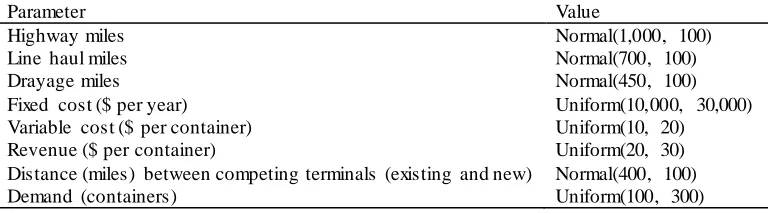
Table 3.2 Values of parameters used in numerical experiments ...44
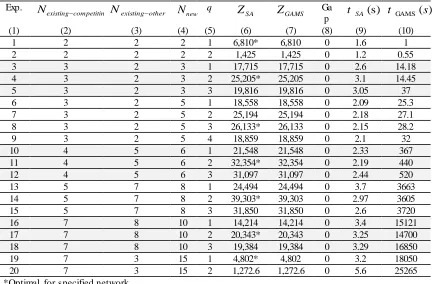
Table 3.3 Performance of SA compared against GAMS for test problems ...47
Table 3.4 Results for individual scenarios ...50
Table 3.5 Solutions of the robust models: Z for P1 and O for P3 ...51
Table 3.6 Impact of scenario probabilities on terminal selection ...52
Table 3.7 Solution of the robust model P1 for case study 2 ...54
Table 3.8 Effect of drayage distance thresholds on intermodal market shares and Locations ...56
Table 4.1 Values of parameters used in small networks ...83
Table 4.2 Routing results of the small case study...84
Table 4.3 Comparison of proposed hybrid GA algorithm versus EE algorithm for solving DINEP ...85
Table 4.4 Experimental results for singles scenarios ...92
Table 4.5 Robust problem results ...97
Table 5.1 parameters of small hypothetical network ...124
xii
LIST OF FIGURES
Figure 2.1 Illustration of an intermodal freight network ...7
Figure 2.2 Six options to move cargo between an OD pair (Woxenius, 2007) ... 8
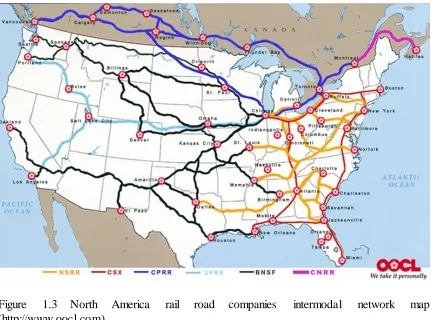
Figure2.3 North America rail road companies intermodal networks map...12
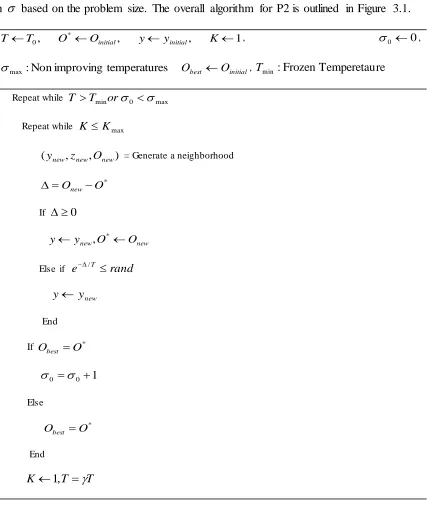
Figure 3.1Simulated annealing algorithm for solving P2 ...43
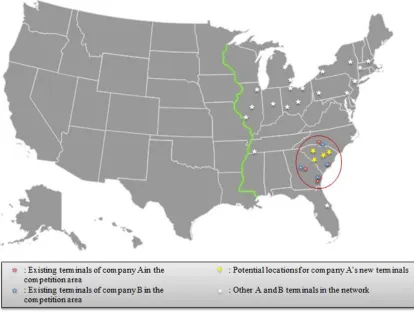
Figure 3.2 Map of study area for case study 1 ...48
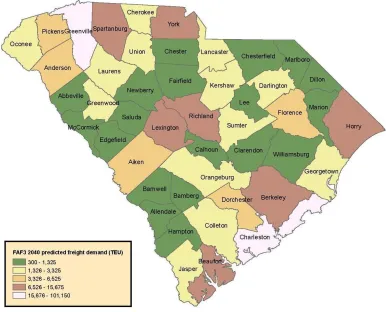
Figure 3.3 FAF3 2040 predicted freight demand for SC counties ...49
Figure 3.4 Network layout for case study 2 ...53
Figure 3.5 Change in market share by closing one existing terminal and opening new terminals...58
Figure 4.1 Chromosome representation ...77
Figure 4.2 Flowchart of the hybrid GA_CG algorithm ...81
Figure 4.3 Network of the small case study...82
Figure 4.4 Test case network: (a) Intermodal rail network; (b) Highway network ...88
Figure 4.5 Regret for each experiment...96
Figure 4.6 Earthquake risk map of US (http://geology.usgs.gov/) ...99
Figure 4.7 Tornado risk map in US (http://strangesounds.org/) ...100
Figure 5.1 A sample solution of the problem ...114
xiii
Figure 5.3 Network of the small case study...124
Figure 5.4 routing results of one OD pair under all outing subperiods of one expansion period for small case study...126
Figure 5.5 Test case network: (a) Intermodal rail network; (b) Highway network ...129
Figure 5.6 Optimal network representations of the case study ...134
1
CHAPTER 1: INTRODUCTION
An efficient transportation strategy with the minimum social and environmental costs is
very important due to the increasing need of freight transport and concerns for the global
warming. Intermodal transportation is the transportation of goods in the same loading unit
with successive modes of transport and without handling the goods while transferring them
between modes at intermodal terminals. It has the advantage of accessibility of road, load
capacity of rail, speed of air and economies of scale of barge. Containers are highly
standard loading units extensively used for intermodal freight transportation. Although the
use of more than one mode in intermodal transportation can reduce the carbon foot print
and total transportation costs, the road transportation dominates the other
modes/combination of modes for transporting goods over short and/or medium distances.
A significant portion of intermodal transportation costs is from transfer of loads at
terminals. Although the transportation cost per ton/mile is less for the intermodal option, it
cannot compensate the transfer cost while moving cargo over short and/or medium
distances. Hence, it becomes an option for moving the freights over the long distances.
In early ages of intermodal logistics, the most freight belonged to domestic sector
2
common as road transportation with shorter average travel times. However, the market
globalization raised the need of intermodal transportation as an alternative shipping option
for moving the freights over the long distances, i.e. between the countries and contine nts.
The huge amount of global freights also generated the domestic demands. This increased
the need for intermodal transportation in the countries with expanded lands, such as U.S.
The success of an intermodal network mainly depends on comprehensive collaboration of
its different modes due to their inherent differences in terms of cost, capacity, emission and
accessibility. The low level of maturity of intermodal transportation stems from poor
selection of terminal locations and connectivity of modes. Intermodal logistic providers
need to realign their existing networks to reach the maximum costs reduction, connectivit y
and efficiency.
The primary objective of this research is to address multiple real-world criteria in
intermodal network design and expansion decisions, which compared to traditiona l ly
designed projects, can provide cost savings for intermodal service providers. Three
mathematical models are developed and the appropriate meta-heuristic algorithms are
proposed to solve these models. These models are, 1) competitive intermodal network
expansion with uncertain demands, 2) reliable intermodal network expansion with demand
uncertainties and network disruptions, and 3) reliable multi-period intermodal network
expansion problem. These models are concerned with location optimization, freight flow
assignment and shared common objectives, such as minimizing the total cost (which may
include transportation, establishment and loss costs of unmet demand) or maximizing the
3
1.1 RESEARCH TOPIC 1- INTERMODAL NETWORK EXPANSION IN A
COMPETITIVE ENVIRONMENT WITH UNCERTAIN DEMANDS
The location of terminals is important for success of an intermodal transportation system
since the terminals transfer costs and times are the main portions of total transportatio n
cost and time of intermodal shipments. If a railroad company intends to build the new
terminals, it is important to consider the competitors offering the same service in
overlapping service areas. That company should not lose the business of its existing
terminals by building the new ones either. The first study of this dissertation addresses the
intermodal network expansion problem, including the networks competition. A robust
model is proposed to consider the uncertainty of future demand. Since this model is
NP-hard (non-deterministic polynomial-time NP-hard), a Simulated Annealing (SA) approach is
proposed to solve it for large size instances. The experimental results verify that this
algorithm can find optimal results faster than a well-known optimization solver (GAMS).
Readers are referred to chapter 3 of this dissertation for a comprehensive problem
description. A review of related background is also discussed along with the developed
methodologies to formulate and solve this problem in order to implement them for the
related case studies.
1.2 RESEARCH TOPIC 2- RELIABLE INTERMODAL FREIGHT NETWOR K
EXPANSION WITH DEMAND UNCERTAINITIES AND NETWOR K
DISRUPTIONS
An intermodal network is composed of links and terminals. Despite the critical effect of
terminals on the network efficiency, the expansion or maintenance of terminals connecting
links are very important as each network reliability stems from reliability of both links and
nodes. The second part of this dissertation studies the possible investment decisions for an
4
retrofit of higher-risk links in addition to building the new terminals. Natural or
human-made disasters occur in every infrastructure. Thus, a robust mathematical model is
proposed to include such future disruptions in network elements as well as uncertain future
demands. A hybrid Genetic Algorithm (GA) embedded with an intermodal label setting
algorithm is proposed to solve this NP-hard model. The experimental results of small size
case studies verify that it is faster than an Exhaustive Enumeration (EE) method to find the
optimal solutions (EE cannot find any solutions for medium and large size problems
either). The model and GA applications are also discussed for a large size case study. The
results confirm that this model can reduce the total network cost of an intermodal service
provider by considering the parameter uncertainties for investment decisions. Chapter 4 of
this dissertation presents the details of this problem, its related background and proposed
model with its algorithm. It also discusses the relevant results as well.
1.3 RESEARCH TOPIC 3- A RELIABLE MULTI-PERIOD INTERMODAL
FREIGHT NETWORK EXPANSION PROBLEM
Network expansion is typically a long term and time-consuming project requiring a high
investment budget. In the classical network expansion problems, all the decisions are made
at the beginning of the planning horizon within a short time. However, in a practical
situation, the companies start with a small network configuration and utilize the revenue
gained from goods transportation for capital investment needed for further network
expansions. This mitigates the financial burden on the company for such a comprehens ive
project as well as better network design due to changes in locations and amount of demand
over the planning horizon. The third work of this dissertation develops a model that
dynamically locates new intermodal terminals, expands existing intermodal terminals and
5
with limited budgets. It is assumed that network capacity might be reduced due to the
disruptions that might happen during expansion intervals. A shorter time scale is
considered for routing decisions in order to control the uncertainties of the network under
expansion intervals. The objective is minimization of total transportation and establishme nt
costs over all time periods. A hybrid SA algorithm embedded with a heuristic for freight
flow assignment is proposed to solve this model. The chapter 5 of this dissertation gives a
comprehensive overview of the proposed model and algorithm as well as their applicatio ns
in different networks.
1.4 LIST OF PAPERS AND STRUCTURE OF DISSERTATION
This dissertation is written following a manuscript format. Chapter 2 provides a brief
overview of intermodal network and highlights related studies. Chapters 3, 4 and 5 are the
works of the following research articles published and submitted in peer-reviewed journals.
1. Fotuhi, F., Huynh, N. (2015) Intermodal network expansion in a competitive
environment with uncertain demands. International Journal of Industrial Engineering
Computations, 6 (2): 285-304.
2. Fotuhi, F., Huynh, N. (2016) Reliable Intermodal Freight Network Expansion with
Demand Uncertainties and Network Disruptions. Networks and Spatial Economics,
1-29.
3. Fotuhi, F., Huynh, N. A Reliable Multi-Period Intermodal Network Expansion
Problem. Submitted to Journal of Computers and Industrial Engineering. March
2017.
6
CHAPTER 2: BACKGROUND AND LITERATURE REVIEW
This chapter presents an overview of intermodal network components and operations with
a review of related studies as well as the contribution of this dissertation to this field.
2.1 INTERMODAL FREIGHT TRANSPORTATION
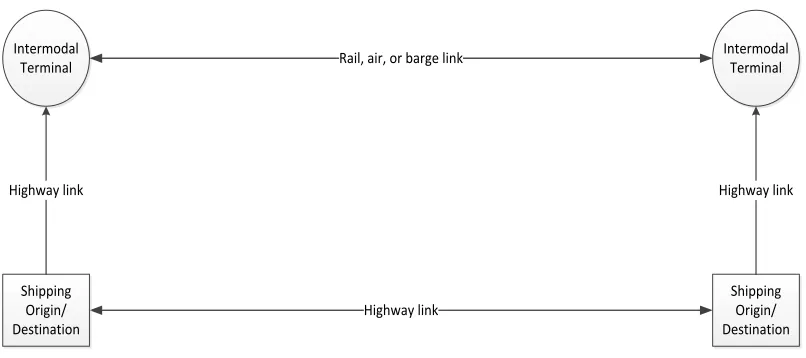
Intermodal freight transportation involves at least two modes of transport. Figure 2.1
illustrates a simple depiction of intermodal network that consists of shipping origins and
destinations, a highway network that connects all origins and all destinations, limited
number of intermodal terminals, and rail, air or barge networks that connect the various
intermodal terminals. Freight can be directly shipped only through the highway mode or
first shipped to a nearby intermodal terminal with truck, then to another intermoda l
terminal near the destination through another mode, such as rail, air or barge, and fina lly
delivered to the destination with truck. Drayage is the trucking part of this trip while the
transport among intermodal terminals is called long-haul. The optimal shipment method
depends on the distance between origin and destination, proximity of intermodal termina ls
7
and transfer costs. This dissertation considers road and rail as the only operation modes of
an intermodal network.
Figure 2.1. Illustration of an intermodal freight network.
Intermodal transportation is an interesting business option due to its low costs, such
as transportation, environmental and social costs. In a consolidation system, the low
volume cargos are moved to consolidation centers and bundled into the larger packages.
Then, rail, air and/or barge transport the shipments between intermodal terminals as
high-frequency and capacity transport modes with lower cost per load (discounted cost).
Consolidation centers are known as hubs. In traditional hub-and-spoke networks, each pair
of origins and destinations could use at most two hubs with no direct shipment between
them. Although intermodal transportation can be considered as a hub-based system, the
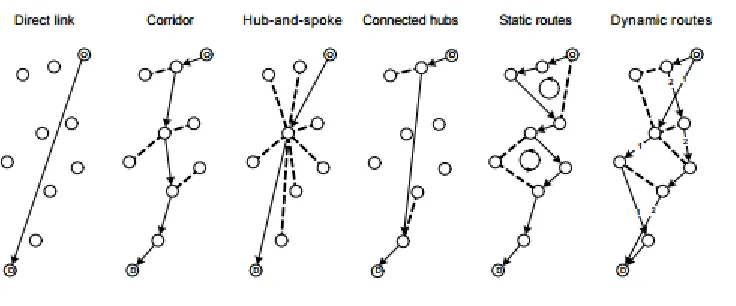
various network topologies other than hub-and-spoke can represent it (Figure 2.2). The
type of commodity is important for choosing the type of appropriate intermodal topology
(SteadieSeifi et al., 2014) especially for multi-commodity shipping businesses. Intermodal
option is not an option for some commodities, such as perishable items and live anima ls,
Highway link Shipping
Origin/ Destination
Shipping Origin/ Destination Intermodal
Terminal
Intermodal Terminal Rail, air, or barge link
8
due to long travel times. Thus, a direct shipment option is needed where trucks move these
specific cargo that the hub-and-spoke networks with no direct option cannot work for. This
research focuses more on connected hubs and dynamic routes topology of intermoda l
network design problems. However, the related studies about hub network design are
addressed in this dissertation due to similarities of intermodal and network design
problems.
Figure 2.2. Six options to move cargo between an OD pair (Woxenius, 2007).
The intermodal transportation involves multiple operators, such as drayage, termina l,
network and intermodal operators (Macharis and Bontekoning 2004). Drayage operators
schedule and plan the truck operations between terminals, shippers and/or receivers. The
terminal operators control the transfers between modes of a terminal. Network operators
are responsible for infrastructure planning and operations while the intermodal operators
select the route to move the freight in network.
Intermodal network design involves strategic, tactical and operational planning levels
(SteadieSeifi et al. 2014). Strategic planning relates with investment decisions for
infrastructure establishment. It requires huge capital investment and a long implementa t io n
9
layout design and construction of terminal and links are a few of these decisions. Tactical
planning uses the given infrastructure over the month or week time scales. For examp le,
choosing transportation modes, scheduling their trips and frequencies, and allocation of
their capacities to shipments are some of these decisions. Operational planning is about the
day-to-day decisions for a network. Like tactical level, the goal is finding the itinerar ies
and best allocation of shipments for an existing infrastructure. However, it is more flexib le
for real time changes in network elements and operators which can be due to availabilit y
of terminal or link, labor or driver, and train or truck. Accidents, weather changes,
equipment failure, labor strikes and employee sick days can cause routing plans changes.
This dissertation is mainly focused on strategic and tactical decisions however an
operational decision is studied in one of its models.
Arnold et al. (2001) proposed one of the very first intermodal network design models.
Their Mixed Integer Linear Programming (MILP) model found the optimal locations of
intermodal terminals and routed the freight over a network by minimizing the total
establishment and routing costs. Each demand has one set of origin and destination (shipper
and receiver) with truck and intermodal shipping options. Later in 2004, they proposed an
alternative model that considered intermodal terminals as network edges. This led to a huge
reduction in number of decision variables. Racunica and Wynter (2005) developed a model
to find the optimal locations of intermodal terminals in a rail/road network as well as train
frequencies over it. They also showed how much market a terminal can capture from
road-only option if added to the network. Groothedde et al. (2005) proposed an initial model for
road/inland-barge intermodal network. The barge was selected as an alternative mode due
10
study in Netherland. The results revealed that barge is more suitable for the stable part of
the trip and the road is more beneficial where dealing with variations in the demand over a
short period of time. Limbourg and Jourquin (2009) proposed a p-hub median model for
intermodal terminal location problem. Their model optimally locates p intermoda l
terminals over the network by minimizing the total transportation cost. They used the
demand density to choose potential locations of intermodal terminals in a European
intermodal network. All the aforementioned studies intended to minimize the system costs.
Intermodal transportation outperforms the road option in terms of total transportatio n
cost but it has longer travel time due to dwell time of terminals. Dwell time is the waiting
time of a container at a terminal while being transferred between modes. Based on a recent
study in US, the dwell time at a terminal is 24 hours by average (ITIC document). Ishfaq
and Sox (2010) added a time window constraint to their intermodal network design model
to prevent intermodal routes with long travel times. Each demand should arrive at its
destination no later than a predefined time window. Moreover, they considered more than
two modes in their model. Despite terminal locations decision and freight assignment, their
model chose which mode should operate in each terminal. A piecewise linear cost functio n
was considered for long-haul truck shipments as it decreases over the miles traveled. The
objective was to minimize total fixed cost of building terminals, transportation and modal
connectivity costs at terminals. Later, they formulated a hub location-allocation model for
intermodal network design ignoring the truck-only option (Ishfaq and Sox 2011).
Limited storage for containers and labor at terminals can cause limited capacity at
intermodal terminals in real life applications. By relaxing this constraint, the closest
11
intermodal network design models can significantly change freight allocation to the
network. Sorensen et al. (2012) improved Ishfaq and Sox (2011) model by adding the
capacity constraint at terminals. They also let shipments select truck-only option to avoid
lost demand due to limited capacity at intermodal routes. However, they did not incorporate
time window constraint in their model. Due to limited capacity, different fractions of a
specific order can use different routes. Lin et al. (2014) proposed an alternative model for
Sorensen et al. (2012) ones by reducing a huge set of decision variables. They showed that
the new model can find optimal solutions for larger size instances compared to the
Sorensen ones.
2.2 COMPETITION BETWEEN INTERMODAL SERVICE PROVIDERS
Most studies in intermodal network design assumed a central entity managing an unified
network of multiple intermodal service providers from different countries (Case of
European network). However, a different common case exists for network of regional or
large countries with extended lands (like US). Private railroad companies with
decentralized management offer intermodal services in this case. Although their init ia l
network had serviced different areas, their service areas started to overlap as their networks
and business were expanding. Figure 2.3 depicts a map of intermodal networks for five
class 1 railroad companies in US and one covering Canada. Norfolk Southern Rail Road
(NSRR), and CSX move freight within the East Coast and South East of US. Burlingto n
Northern Santa Fe (BNSF) and Union Pacific Rail Road (UPRR) covers the rest of US.
Canadian Pacific Rail Road (CPRR) starts from North part of US and goes all the way to
12
that these companies have overlapping service areas and they compete to attract more
demand to their own terminals in those areas to increase their market shares.
This example shows two real-world criteria which have not received enough attention
in previous studies of intermodal network design. First, most companies have existing
terminals operating in a network. Their main concern is how to expand their network by
locating the new intermodal terminals in order to survive in such a competitive market
rather than building a network from scratch (Gelareh et al. 2010). Second, the private
companies compete to attract more demand to their intermodal networks, specially those
having overlapping service areas. This criterion does not exist in networks operated by a
central entity.
13
Although a remarkable number of papers studied competition for facility location
problems, less work have been done for hub-type location problems. In 1999, Marianov
et al. presented the first model for competitive hub location problem. A new coming
company decided to build its network in an overlapping area with another company
offering the same service. The demand for each OD pair was captured by the new coming
company if its transportation cost was less than the competing company’s one. The
objective of this model was to come up with optimal locations for hubs to maximize the
market captured by the new company. Gelareh et al. (2010) developed a model for
competitive liner shipping hub network design. They assumed a new liner shipping
provider comes to a market and competes with an existing liner shipping company in terms
of transportation cost and service time. The new company intended to locate p new ports
in the network to capture the demand from the existing company and attract new demands
to its network. The objective was to minimize total cost and transportation time for the
new service provider.
In an early work, Huff (1964) studied the attraction of different markets for customers.
He developed a methodology (Huff’s gravity model) showing that attraction of an area has
a direct connection with attractiveness of that area (i.e. Size and variety of stores in a
shopping mall) and is inversely impacted by the distance (travel time) of that area to
customer’s location. Although his model was utilized mostly for retail store location
decisions, it was recently utilized for location decision of transportation hubs of an airline
company (Eiselt and Marianov 2009). They used this model to optimize market share for
a new coming airline company to a market competing with existing airline companies .
14
However, the model was limited to new-coming airline companies with no existing hubs.
This work uses a similar technique to find with locations for new intermodal terminals for
an intermodal service provider (Railway Company) with existing intermodal network.
2.3 DECISION MAKING UNDER UNCERTAINITY
Decision making environment is categorized as certainty, risk and uncertainty (Snyder
2006). Unlike a certain situation where all parameters are known, both risk and uncertaint y
conditions are random. Stochastic optimization problems pertain to risk situations where
there is a known probability distribution for random/unknown parameters. The goal of this
type of solutions is to optimize the expected value of an objective function. Under the
uncertainty situation, the parameters are unknown and there is no information about their
probabilities. Robust optimization arose to manage this type of problem with the goal of
optimizing the performance of worst-case scenario.
Both methods attempt to find a solution which performs well under any realizat ion of
the unknown parameter. If the decision maker knows what probability distribution an
unknown parameter follows, he can use stochastic optimization. Otherwise, robust
optimization will be utilized by considering a set of scenarios for possible values of an
unknown parameter. Robust optimization can address more problems despite its
disadvantages. Its main drawback is identifying the appropriate number of scenarios which
can comprehensively include all the possible future values of the unknown parameter(s).
On the other hand, the final solution optimizes the worst-case scenario which may have a
very low chance of occurrence. However, it is easy to implement and it allows the
correlation of unknown parameters, which is not applicable for stochastic optimizat io n.
15
robust optimization. Scenario relaxation algorithms are also useful to expedite the solution
time for these types of problems (Assavapokee et al. 2008). Real world historical freight
data is not easily accessible. Hence it is not possible to draw the appropriate distribut io n
for the uncertain parameters. Accordingly, this study utilizes the robust optimization to
address multiple uncertainties in the developed models.
2.4 UNCERTAINITY IN INTERMODAL NETWORK DESIGN
Design decisions (as long term plans) affect the fluctuations of the problem parameters,
such as cost, demand and supply over time. Moreover, these need huge investments with
less flexibility for the change over time. On the other hand, it is hardly possible to
accurately estimate the future values of unknown parameters. These confirm the need to
include the uncertainty in design problems. This work considers the demand and supply
uncertainties as discussed in the next sections.
2.4.1 DEMAND UNCERTAINITY
The demand for freight transport derives from commodity movements between shippers
and receivers. Variations in economic conditions, technological innovations and market
globalization lead to continuous fluctuations in freight demand over space and time as well
as modal share changes for demand movements. More companies are becoming interested
in intermodal option due to its cost, accessibility, and carbon emission benefits. Numerous
models have been developed to forecast the future amounts and locations of freight
demand, but their accuracy are still an unknown question (Lange & Huber 2015).
A few papers have considered the demand uncertainty in network design with
consolidation centers (terminals/hubs). Marianov and Serra (2003) developed a stochastic
16
demand follows a Poisson distribution. They solved their model with a tabu search
algorithm. Yang (2009) also considered the demand uncertainty in locating the hubs for an
airline company. He used the historical data from air freight market in China and Taiwan
and considered three levels for them (high, medium and low). Including the probabilit ies
of occurrence of each demand level, the two stages stochastic model minimized the total
fixed cost of opening hubs and expected routing costs of freight flow over the network.
Alumur et al. (2012) were among the first researchers who utilized the robust optimiza t io n
in hub network design problems. They included multiple scenarios to address uncertaint y
of the demand and set-up cost for hubs establishment. They showed how the results vary
for an uncertain situation compared to deterministic cases. Ghaffari-Nasab et al. (2015)
developed an alternate model for Alumur et al. (2012) by using a different robust
optimization approach. They only included the demand uncertainty and added the capacity
constraint at hubs to their model.
2.4.2 SUPPLY UNCERTAINITY
Capacity variations in network elements cause the supply uncertainty. These variatio ns
stem from scheduled or unscheduled events. Natural and/or human-made disasters are
among the unscheduled cases which can cause the most dramatic changes in infrastruc t ur e
capacities. On the other hand, maintenance and/or replacement projects due to aging of
existing infrastructure are other sources of capacity reduction whose occurrences the
network planner should know the time and location of. This study focuses on unscheduled
events since those are unexpected and inevitable to happen. Moreover, losses and damages
17
well as other areas doing businesses with it. Additionally, that area takes a long time and
needs a budget to recover from the disaster.
Ham et al. (2005) provided a brief overview of the impact of an earthquake in Midwest
on economy of US. They mentioned that almost 40% of commodity flows in US pertains
to Midwest, including the States of Illinois, Indiana, Iowa, Kentucky, Michigan, Missouri,
Ohio, Tennessee and West Virginia. About 45% of these commodities are transferred
between these states inside the Midwest region. The rest of commodities are
transported/received to/from other states in the US. The New Madrid Seismic Zone located
close to Memphis, Tennessee is a major earthquake zone which had the largest earthquake
of the US history in 1811. If the same earthquake happens there, it can ruin the
transportation network and production companies within the whole Midwest area. Limited
accessibility to areas far from the disrupted region due to the disruption in transportatio n
network affects the movement of commodities between the Midwest and the rest of US.
The results showed that the value of commodity flow decreases by one billion dollars due
to this earthquake. The mean shipment distance increases by 40 miles per shipment, which
increases the transportation cost. Although it might not look significant, this will be
remarkable for all the shipments through the whole network.
Pre-disaster and post-disaster mitigation strategies can reduce the vulnerability of the
network to the unforeseen incidents. Pre-disaster (protection) strategies identify the most
critical network components to reinforce them or adding new elements around them (i.e.
adding new links) within a limited budget available for the project (Snediker et al. 2008).
Post-disaster (recovery) actions use the limited recovery resources to reconstruct the
18
capacity during the recovery actions (Orabi et al. 2009). This study addresses the
pre-disaster activities that can improve the network resiliency facing the future disruptions.
A remarkable number of researchers studied the disruption’s impacts on transportatio n
networks and analyzed the pre-disaster projects. They showed how the protection projects
increased the network survivability and reduced the lost market as well as post-disaster
reconstruction costs. In an early work, Sohn et al. (2003) investigated the impact of a
hypothetical earthquake on demand loss of highway links. The analysis identified more
critical links to retrofit so they stay resilient if an earthquake happens in future. Later in
2006, Sohn analyzed the impact of a hypothetical flood in highway networks of Maryland.
To withstand the future floods, the different links were prioritized for retrofit based on
distance-only and distance-traffic criteria.
To find the most critical links of a network at the time of a hypothetical disaster,
Matisziw and Murray (2009) developed a mathematical model that evaluated the severity
of absence of a link in the network performance. Their model found the links which
maximized the commodity flow (connectivity) disruptions through the whole network.
This objective identified the links which may have the worst-case effect on the network
performance. To evaluate their model, they used the data of highway networks in the State
of Ohio as a case study.
Research in intermodal network disruptions area is still in its early stages. In an earlier
work, Miller-Hooks et al (2012) developed a mathematical model to identify which
preparedness (pre-disaster) or recovery (post-disaster) activities to select in order to
maximize the delivery of total demand to their destinations in case of disruptions. They
19
links and terminals. Burgholzer et al. (2013) developed a micro-simulation model to
identify the higher-risk links in an intermodal network with both passenger and freight
transport units. Unlike the previous studies, they simulated the transport of each individ ua l
unit to address the real-time congestion of network links due to the disruptions. For these
situations, they also tracked the total delay and individual routes taken by each entity. In
2014, Marufuzzaman et al. formulated a multimodal biofuel supply chain system that
considered the disruption risks in intermodal terminals. The objective was to minimize the
total expected transportation cost in normal and disrupted situations as well as the fixed
cost of opening new intermodal terminals. They tested their model on a new biofuel supply
chain network in the US Southeast region (with high risk of hurricane and flooding). This
case study concluded that their model preferred to locate the intermodal terminals far from
the higher risk areas.
2.5 MULTI-PERIOD PLANNING
Expansion decisions are multi-period in nature since it may not be practical to build or
expand enough terminals within a short time. The main reason is the limited invest me nt
budget in the beginning of planning horizon. On the other hand, the intermodal service
provider will not invest until the adequate demand exists for its intermodal network.
Multi-period programming helps the planner to gradually build the network over time. It breaks
the planning horizon into multiple periods and identifies the optimum expansion plan at
each period. This approach is beneficial in three folds. First, it removes the burden of huge
capital investment for expansion of the whole network within a short time. Secondly, it
provides the sufficient time for implementation of the expansion project without any
20
network with the revenue generated from the goods transportation through its existing
network. The expansion decisions are integrated with routing of freight flow over the
network, which is more volatile to changing demand and capacity. Disruptions cause the
variations of capacities. Multi-period planning expands the network over time so it can
better incorporate the recovery progress of disrupted infrastructure for the flow assignme nt.
There are a few research papers in the field of multi-period hub location concept.
Contreras et al. (2011) proposed the first model in this area. Their objective was locating
a set of un-capacitated hubs in a network over the planning horizon. They identified the
time of opening a hub and closing an open hub as well as allocation of the demand to the
pairs of hubs in each period. There was no direct shipment option between a shipper and a
receiver in their model. Later, Taghipouria n et al. (2012) used the multi-per iod
optimization to locate the virtual hubs in an airline network. Virtual hubs are spokes which
become a hub when the major hubs are out of service due to disruptions. In their model,
their hubs capacity is not limited and those hubs opened in one period might be closed in
the next periods. Gelareh et al. (2015) proposed a multi-period hub location problem for a
liner shipping provider. They assumed that hubs are not constructed in the liner shipping
industry but are leased to the liner service providers by their owners. Their objective was
identification of opening time, location and terms of contract of leased hubs. Alumur et al.
(2015) proposed a multi-period model for single and multiple allocation hub location
problems. They assumed that once a hub is opened, it never closes until the end of the
planning horizon. They minimized the total fixed cost of opening new hubs, capacity
expansion cost of existing hubs and transportation cost of the flow over the network. Their
21
destination. To the extent of author’s knowledge, there is only one work which studied the
multi-period intermodal network expansion problem (Benedyk et al. 2016). They proposed
a model to find the best expansion plan for each period by considering its variable demands.
The strategic variables of this model were the location of new terminals and expansion
sizes of existing terminals. Once these variables were determined, the OD pairs were
allocated to the network.
Although multi-period planning can better incorporate the real world uncertaintie s,
different time scales should be considered for strategic and operational decisions. Strategic
decisions are more stable over time while operational decisions are variable (Nagy and
Salhi, 2007). Albareda-Sambola et al. (2012) proposed a location-routing model with
different time scales for location and routing decisions. In their model, the planning horizon
is divided into multiple periods for routing decisions while location decisions are made in
a subset of these periods. Up to now, there is no published research for the topic of mult
i-period planning with different time scales for intermodal hub network design and
expansion problems.
2.6 CONTRIBUTIONS TO LITERATURE
Previous works have applied the operations research techniques to the intermodal network
design and expansion problems. The current research has included the follow ing
considerations from the real-world for modeling of the intermodal network expansion
problems.
1) competition of intermodal service providers (to maximize profit);
2) uncertainty in demand and supply (to minimize total cost) with robust optimization;
22
This dissertation also developed a number of meta-heuristic algorithms to solve the
larger-size examples of these models. These contributions are addressed in the following research
papers.
2.6.1 INTERMODAL NETWORK EXPANSION IN A COMPETITIVE ENVIRONMENT WITH UNCERTAIN DEMANDS
Contributions of this study to the literature are: by 1) a new mathematical model for
intermodal network expansion, 2) incorporating competition between intermodal service
providers, 3) including demand uncertainty in expansion decision, 4) developing a new SA
algorithm to solve this model which could significantly reduce computational time
compared to general optimization solvers, 5) studing practical aspects of the model using
a real world case study to investigate model’s real world application.
2.6.2 RELIABLE INTERMODAL FREIGHT NETWORK EXPANSION WITH DEMAND UNCERTAINITIES AND NETWORK DISRUPTIONS
This work contributed to the literature by: 1) a new integrated model for intermoda l
network expansion considering addition of new terminals, expanding existing termina ls
and retrofitting higher risk links of the network with a limited budget, 2) considering
demand and supply uncertainties, 3) developing GA for strategic decisions with a new
chromosome representation, 4) developing a new intermodal routing algorithm for freight
flow assignment, 5) bringing practical aspects of the model by using a real world
intermodal network and presenting managerial insights for intermodal service providers.
The results verified that this model can significantly reduce future costs for the network
23
2.6.3 RELIABLE MULTI-PERIOD INTERMODAL FREIGHT NETWORK EXPANSION PROBLEM
The last work in this dissertation improves the previous model by considering the follow ing
contributions: 1) considering multiple periods for expansion decisions, 2) assuming shorter
periods for routing decisions, 3) proposing a new SA algorithm to solve the mathemat ica l
model proposed for this problem ,4) studying different practical aspects of the proposed
model by using a real size case study and 5) proving the efficiency of multi-period decision
making in total network costs and resource utilization compared to the existing models in
24
CHAPTER 3: INTERMODAL NETWORK EXPANSION IN A
COMPETITIVE ENVIRONMENT WITH UNCERTAIN DEMAND
1
25 ABSTRACT
This paper formulated robust optimization models for the problem of finding near-optima l
locations for new intermodal terminals and their capacities for a railroad company, which
operates an intermodal network in a competitive environment with uncertain demands. To
solve the robust models, a SA algorithm was developed. Experimental results indicated
that the SA solutions (i.e. objective function values) are comparable to those obtained using
GAMS, but the SA algorithm can obtain solutions faster and can solve much larger
problems. Also, the results verified that solutions obtained from the robust models are
more effective in dealing with uncertain demand scenarios.
3.1 INTRODUCTION
Intermodal freight transport is the movement of goods in one and the same loading unit or
road vehicle, which uses successively two or more modes of transport without handling the
goods themselves in changing modes (United Nations, 2001). This research deals with the
locations of rail-highway intermodal terminals where the modal shift occurs. A significa nt
portion of the total cost and time in intermodal services is attributed to the drayage
movements and intermodal terminal operations. Thus, the location of an intermoda l
terminal plays an important role in improving efficiency and attractiveness of intermoda l
services (Sorensen, Vanovermeire and Busschaert, 2012).
Most of the intermodal terminal location studies in the literature solve for the optimal
locations without considering existing terminals in the network. This assumption is not
26
competitive environment, railroad companies are constantly looking to expand their
intermodal networks to meet customers’ demands and to increase market share. This is
often accomplished by incrementally adding a few new terminals at a time. Solving the
location problem that takes into account a company’s existing terminals as well as those of
competitors is more challenging. This study seeks to fill this gap in existing literature by
developing a mathematical model that addresses competition in intermodal termina l
location decisions. Competition involves new incoming terminals competing against
existing terminals in the network for market share.
There are a few additional challenges involved in developing the proposed model. The
first is uncertainty in demand. Demand for an intermodal terminal is the result of the
commodity flow originated or terminated in the region where the terminal is located
(Chiranjivi, 2008). Accurate long-range prediction of commodity flow is difficult because
of uncertainty in economic situations and changes in supply chain decisions, infrastruct ure,
and regulations. For example, most freight-related forecasts failed to predict the global
recession that started in 2009. Thus, it is crucial for a strategic model to explicitly account
for uncertainty in demand. The second challenge is determining the appropriate throughp ut
capacity for the new terminal to avoid the situation of under-equipping the terminal which
would lead to delays at the terminal (Nocera, 2009) or over-equipping the terminal which
would lead to underutilized staff and resources. Throughput capacity is the total number
of containers that can be processed by a terminal in a year and is usually expressed in TEUs
(Twenty-foot Equivalent Units) (Bassan, 2007).
The objective of this work is to develop a mathematical optimization model which
27
to determine the locations for the new intermodal terminals and their throughput capacities
while considering competition and uncertainty in freight demands. The developed model
contributes to the existing body of work on intermodal terminal location by explicit ly
incorporating competition and uncertainty in freight demand in the formulation. The
proposed model is applicable for intermodal networks where private rail carriers are
responsible for their own maintenance and improvement projects; the U.S. intermoda l
networks operate under this model.
3.2 LITERATURE REVIEW AND BACKGROUND
3.2.1 RAIL-HIGHWAY INTERMODAL TERMINAL LOCATION PROBLEM
Studies of terminal locations are performed at strategic planning level (Crainic, 1998)
which involves different stakeholders with different objectives (Sirikijpanichkul and
Ferreira, 2005). Over the years, the hub-based network structure has emerged as the
preferred method for moving intermodal shipments (Ishfaq and Sox, 2011). A hub is a
location where flow are aggregated/disaggregated, collected and redistributed (Arnold,
Dominique and Isabelle, 2004). Similar to hubs, intermodal terminals are the transfer
points at which containers are sorted and transferred between different modes (Meng and
Wang, 2011). The emergence of hub based intermodal networks indicates that economies
of scale are the principle force behind their preferred design (Slack, 1990). Also, because
intermodal networks are combinations of their respective modal networks, it is natural that
the hub network has emerged as the most suitable network design for intermodal logist ics
(Bookbinder and Fox, 1998).
In an intermodal hub network, smaller shipments are gathered and consolidated at
28
distribution centers and shipped to the terminals via drayage and then between a set of
transfer terminals (i.e. rail-highway intermodal terminals). Finally, trucks transport loaded
containers to their final destinations (Ishfaq and Sox, 2011). Rutten (1995) was the first to
find terminal locations which will attract enough freight volume to schedule daily trains to
and from the terminal. Arnold et al. (2004) developed a rail-highway intermodal termina l
location problem with each mode as a sub-graph and considered transfer links to connect
these sub-graphs to each other. Racunica and Wynter (2005) developed a model to find
terminals in a rail-highway intermodal network. They considered a nonlinear concave-cost
function to find these optimal hubs. Groothedde et al. (2005) developed a hub-based
network for the consumer goods market. They compared the single highway mode with a
highway-water intermodal. They showed that the intermodal approach is more effective
than the unimodal approach (with just highway). Limbourg and Jourquin (2009) proposed
a model to find hub locations in a rail-highway intermodal network. They developed a
heuristic to find hub locations for a road network and found rail links which passes through
these hubs. Meng and Wang (2011) proposed a mathematical program for a hub-and-spoke
intermodal network. The main difference between their model and earlier works is that it
considered more than one pair of hubs for moving containers from an origin to a
destination. Their work considered a chain of terminals to move shipments with differe nt
types of containers.
Mode choice has been incorporated into the hub location models. Ishfaq and Sox
(2010) developed an integrated model for an intermodal network dealing with air, highwa y
and rail modes. Their model allowed for direct shipment between origin and destinatio n
29
distribution of shipments among pairs of intermodal terminals by minimizing the total
transportation cost, transfer cost at the terminal and fixed cost of opening a hub. In their
later work, they proposed a rail-highway hub intermodal location-allocation problem
(Ishfaq and Sox, 2011). Their model found the optimal location of hubs as well as optimal
allocation of shipments for an OD pair to selected hubs. Their model considered the fixed
cost of opening a terminal, transportation cost, and the cost of delay at terminals. Sorensen,
Vanovermeire and Busschaert (2012) modeled a hub-based rail-highway intermoda l
network with the option of direct shipment. Different fraction of shipments for an OD pair
can use highway only or a combination of highway and rail (i.e. intermodal). Fotuhi and
Huynh (2013) proposed a model which jointly selected terminal location, shipping modes
and optimal routes for shipping different types of commodities. Their model allowed
decision makers to evaluate scenarios with more than two modes.
3.2.2 TERMINAL THROUGHPUT CAPACITY
The traditional capacitated facility location problem in which facilities have limited
capacities has been studied extensively. Drezner (1995) provided a survey of facilit y
location studies with limited capacity. Some researchers have investigated the location
planning problems with variable capacities. Verter and Dincer (1995) were the first to
integrate location decision and variable capacity planning for a new facility. They
developed a model to minimize the fixed cost of opening a new facility, variable cost for
capacity acquisition, and total transportation cost. In the transportation domain, Taniguc hi,
Noritake and Izumitani (1999) were the first to integrate location decision and capacity
planning (number of berths) for public logistic terminals in urban areas that serve only the
30
candidate locations and found the optimal number of berths for each terminal. Tang et al.
(2013) developed a model to find the best location for a logistics park, size of park and
allocation of customers to it. They considered different layouts for the park and their model
selected a lay out which can serve all demands. There has been limited work in capacity
planning of intermodal terminals (Ballis and Golias, 2004, Nocera, 2009). To date, no
study has examined intermodal terminal location and terminal size jointly.
3.2.3 COMPETITIVE LOCATION
All the aforementioned studies addressed the problem of designing a new network without
consideration of existing road networks and rail terminals. In 1999, Marianov et al.
developed a competitive hub location model that considered existing terminals in the
network. They assigned the demand for each OD pair to a pair of potential hubs to
maximize this newcomer’s market share. Transportation cost was the main factor for these
assignments. In 2009, Eiselt and Marianov proposed a model of competitive hub location
problem by incorporating a gravity model based on the work of Huff (1964). They
allocated the demand to pairs of new hubs based on their attractions to maximize market
share for the new hubs. Huff’s gravity model is a popular approach for estimating the
captured market share by a facility. Based on this model, the probability that a customer
chooses a facility is proportional to the attractiveness of the facility and is inversely
proportional to the distance to the facility. Eiselt and Marianov (2009) mentioned that their
model is suitable for a new incoming airline that has to compete with existing airlines.
Chiranjivi (2008) studied the environmental impact of adding a new terminal to an existing
rail-highway network. They introduced factors that made a terminal attractive and
31
network. Gelareh et al. (2010) studied the competitive hub location for a liner shipping
network. They considered a newcomer liner service provider which has to compete with
existing liner service companies. They introduced an attraction function to estimate the
total captured market share by a new terminal by considering the travel time from the origin
to the destination using that specific terminal and transportation rate. Lüer-Villagra and
Marianov (2013) formulated a new competitive hub location problem to find optimal
locations for a new airline company and optimal pricing to maximize their profits. They
modeled consumers’ behaviors using the Logit discrete choice model.
Table 3.1 provides a summary of capabilities of previous models and this study’s
proposed model, which extends the work of Eiselt and Marianov (2009) by considering
more than one mode for a competitive p-hub network as well as uncertainty in demand. It
enhances previous models in the area of intermodal terminal location problem by
considering competition. As explained previously, competition involves new incoming
terminals competing against existing terminals in the network for market share. Although
Limbourg and Jourquin (2009) considered existing intermodal terminals in their model,
they did not consider competition between the new terminals and existing ones. To our
knowledge, competition has not been addressed in any intermodal network design studies.
As indicated in Table 1, this paper advances the modeling of intermodal network design
by considering competition and the joint location and terminal throughput capacity
decisions. Additionally, it is the first intermodal network design study to use robust
optimization to address uncertainty in demand. A brief overview of robust optimization as
well as relevant literature is presented in the next subsection.