A preliminary version of this paper appears in the ACM Computer and Communications Security Conference (CCS), 2015. This is the full version.
Mass-surveillance without the State: Strongly
Undetectable Algorithm-Substitution Attacks
Mihir Bellare1 Joseph Jaeger2 Daniel Kane3
April 2017
Abstract
We present new algorithm-substitution attacks (ASAs) on symmetric encryption that im-prove over prior ones in two ways. First, while prior attacks only broke a sub-class of ran-domized schemes having a property called coin injectivity, our attacks break all randomized schemes. Second, while prior attacks are stateful, ours are stateless, achieving a notion of strong undetectability that we formalize. Together this shows that ASAs are an even more dangerous and powerful mass surveillance method than previously thought. Our work serves to increase awareness about what is possible with ASAs and to spur the search for deterrents and counter-measures.
1
Department of Computer Science and Engineering, University of California San Diego, 9500 Gilman Drive, La Jolla, California 92093, USA. Email: [email protected]. URL:http://cseweb.ucsd.edu/~mihir/. Supported in part by NSF grants CNS-1116800 and CNS-1228890 and a gift from Microsoft. This work was done in part while Bellare was visiting the Simons Institute for the Theory of Computing, supported by the Simons Foundation and by the DIMACS/Simons Collaboration in Cryptography through NSF grant CNS-1523467.
2
Department of Computer Science and Engineering, University of California San Diego, 9500 Gilman Drive, La Jolla, California 92093, USA. Email: [email protected]. URL: http://cseweb.ucsd.edu/~jsjaeger/. Supported in part by NSF grants CNS-1116800 and CNS-1228890.
Contents
1 Introduction 3
2 Notation and Definitions 6
3 ASA Framework 7
4 Attack and Analysis 10
5 Defenses 16
1
Introduction
The Snowden revelations have exposed a pervasive program of mass surveillance, one of whose potential mechanisms is an algorithm substitution attack (ASA) [19, 20, 3]. In the context of symmetric encryption which is our focus, your encryption code (which implements the prescribed encryption algorithm of the scheme) is replaced by big-brother created malware that aims to un-detectably exfiltrate your key through ciphertexts [3].
In this paper we present a new ASA on symmetric encryption that improves over the prior one of BPR [3] in two ways. First, while the prior ASA only broke a sub-class of randomized schemes having a property called coin injectivity, ours breaks all randomized schemes. Second, while the prior ASA was stateful, ours is stateless, achieving a stronger notion of undetectability that we motivate and formalize. Together this shows that ASAs are even more dangerous and powerful than previously thought.
ASAs. Alice expects that her encryption code is implementing the encryption algorithm SE.Enc
prescribed by her chosen symmetric encryption schemeSE. In an ASA [3], the code of SE.Enc has been replaced by big-brother designed malware A.Enc. When Alice calls her encryption routine, giving it keyKSE and messagem to encrypt, it isA.Encthat runs, producing a ciphertext cbased
not only on the given inputs but also on another, hardwired key we denote KA. Colluding with
A.Enc is an accomplice A.Ext who knowsKA and will pick up cby eavesdropping on the channel.
A.Enc aims to produce c in such a way that A.Ext can violate privacy of Alice’s communications, the most effective (from the point of view of big brother) attack being one that recoversKSE from
c.
One’s first reaction may be that a successful ASA is trivial. For example, let the subverted code A.Enc, given KA, KSE, m, set ciphertext c equal to the encryption key KSE. BPR [3] argue
that this is attack is unattractive to big brother because it isdetectable. Anyone (in particular the decrypter), obtainingc, will see that something is not right. BPR [3] put forth the goal of an ASA as being to violate privacy while remaining undetectable.
Undetectability.To rigorously explore ASAs, BPR [3] provide a formalization of undetectability.
Their viewpoint is that the detecter is the decrypter. It thus knows KSE and can check that a
ciphertext decrypts to an intended message. But it can do other checks as well. The definition models detecterD as an adversary given inputKSE and access to an encryption oracle Encthat,
given a messagem, returns ciphertextccomputed either viaSE.Enc on inputsKSE, mor viaA.Enc
on inputs KA, KSE, m. Undetectability requires that no efficient D should be able to tell which. The BPR attack. The question that emerges is whether it is possible to mount a successful but
undetectable ASA. BPR [3] address this in depth whenSE.Encis randomized. (Here and henceforth, a randomized scheme means a stateless scheme with non-trivial entropy in the ciphertexts. See Section 4 for a formal definition. A deterministic scheme, which has no entropy in the ciphertexts, does not qualify!) Randomized schemes are the most basic and common, making this question important. Their strongest result is represented by their biased ciphertext attack. We will first explain the attack and then discuss our work.
Let us view SE.Enc as a deterministic function of KSE, mand coins r, producing a ciphertext
as c ← SE.Enc(KSE, m;r). In the true encryption process, r is chosen at random. In the biased
ciphertext attack of BPR [3],A.Encalso producescasSE.Enc(KSE, m;r) but picksr, not uniformly
at random, but at random from a subset S of the set of all possible coins, where S is defined as the set of r so that a PRF F underKA, when applied to input c=SE.Enc(KSE, m;r), returns the
first bitKSE[1] ofKSE. This allowsA.Ext, givenKA, c, to retrieveKSE[1] =F(KA, c). The process
The difficulty is assessing undetectability. The ciphertextcproduced byA.Encis not distributed the same way as one produced by the true encryption process. Can a detection adversary D tell? This question turns out to be surprisingly difficult. BPR [3] provide a partial answer. Calling a schemeSEcoin injective if the mappingr7→SE.Enc(KSE, m;r) is injective for allKSE, m, they use
a combinatorial analysis [3, Lemma 1] to prove undetectability in this case. Based on this they move away from randomized, stateless schemes to obtain security via deterministic, stateful ones.
Shortcomings of prior work. The biased ciphertext attack has two shortcomings. Both are
noted in BPR [3] and left as open problems which we will resolve.
The first shortcoming is that the attack only applies to coin injective schemes. The basic question left un-answered here is, does there exist an ASA-secure randomized scheme, or are all randomized schemes subject to attack?
The second shortcoming is that in the biased ciphertext ASA, the subverted encryption algo-rithmA.Enc isstateful, maintaining stateσ across invocations. (The state in this case is an integer representing either which bit of the key A.Enc is trying to exfiltrate or taking a special value to indicate that exfiltration is complete and encryption should be be done as usual.) This renders the attack detectable in practice in simple ways. For example, a state reset, as can happen with a reboot or cloning to create a virtual machine, leads, in their attack, to detection. However, this is not captured by their definition of detectability, under which they prove their attack undetectable (for coin injective schemes). BPR [3] recognize this and comment that a stateless attack would be better, but that they do not know how to make their attack stateless.
Contributions in brief.We contribute (1) new definitions (2) new attacks and (3) new analyses. The definitions are for strong undetectability (which captures the above issues and can only be met by stateless schemes) and key recovery security, the latter reflecting the need to formalize not just security goals but attack goals. The attack is a new ASA shown to achieve both. The analyses establishing this resolve technical issues from BPR [3] via a different approach. As a by product, we resolve the above questions, presenting a stateless ASA that breaks all randomized encryption schemes and showing that the move to deterministic schemes for security, made by BPR [3], is a necessary one.
Strong undetectability. Our first contribution is to introduce and formalize a stronger notion
of undetectability called strong undetectability. Our formalization, in Section 3, uses the framework of the above discussed definition of BPR [3] but makes the oracleEnc more powerful with regard
both to inputs and outputs. It now takes input not just a message, but a key, allowing the detector to pick, rather than merely know, the encryption key KSE. It returns not just the ciphertext, but
the current stateσ of the encryption code.
The last means that as long as the good encryption algorithm SE.Enc is stateless (the case we are interested in here), statelessness ofA.Enc is a necessary (but not sufficient) condition for strong undetectability. That is, a strongly undetectable ASA must be stateless. A consequence of this is that the ASA will not be detectable upon system reset or cloning, meaning strong undetectability excludes the easy and natural methods of detection allowed by undetectability under BPR [3].
possible to evadeall forms of detection. We are trying to evade more forms of detection than prior work and figure out how “undetectable” a successful ASA can be.
The biased ciphertext ASA of BPR [3] will not be strongly undetectable due to its use of non-trivial state. The question this raises is whether strongly undetectable (and in particular stateless) ASAs are possible, and on which randomized encryption schemes. We will show that they are possible on all randomized schemes.
Key recovery.Beyond introducing and formalizing strong undetectability, we take a more
rigor-ous approach to attack goals. As is conventional in cryptography, BPR [3] formalize security goals, not attacker goals. Thus, they provide an indistinguishability style surveillance advantage, viewing the goal as being to ensure that this advantage stays small for undetectable ASAs. This is a good goal for the scheme designer to achieve, but its violation by an attacker means little. Big brother is after more, specifically recovery of the target key. We carefully formalize a framework for key recovery attacks in which we can compare different ones to differentiate between the effectiveness of different attacks and make rigorous claims about what our attacks achieve.
Our formalization introduces as a parameter a message distribution M, distinct from the ad-versary, that represents the messages encrypted by the encrypter. The larger the class of message distributions for which the attack succeeds, the more powerful the attack. Our ASA will succeed for all message distributions, which means that big brother recovers the target key regardless of what messages the sender sends. In particular, big brother would not need to pick or control the messages to succeed.
ASA. We now sketch our new ASA which we will show to achieve key recovery (for all message distributions) and strong undetectability for all randomized encryption schemes. Let the good key
KSE have length k, and let PRF F take outputs in the set {0,1} ×[k] where [k] = {1, . . . , k},
meaning an output is a pair (v, i) wherev is a bit and iis an index into the key. In our new ASA, the subverted encryption algorithm A.Enc, given KA, KSE, m, aims to pick r such that the (v, i)
returned byF(KA,SE.Enc(KSE, m;r)) satisfiesv=KSE[i], returningc←SE.Enc(KSE, m;r). A.Ext
can retrieve (KSE[i], i) =F(KA, c). In this way it gets thei-th bit of the key.
However, there are some difficulties with the above description. First, it may not be possible to directly and efficiently pickr in the way described. In our ASA, which is presented in detail in Section 4, A.Enc uses rejection sampling, repeatedly picking r at random until either the desired condition is met or it times out, when the latter happens being controlled by a parameter sof the attack. Second, we must use a series of q encryptions to allow A.Ext to recover the entire key, so that we must determine how to pick q, which is another parameter of the attack. The challenge is to prove both key recovery and strong undetectability without making any assumptions on the encryption scheme other than that it is randomized, and with good, concrete bounds enabling concrete and practical choices ofq, sthat make the attack both efficient and effective. The analyses we discuss next resolve these challenges.
Analyses.Theorem 4.1 proves that big brother, with our ASA, will indeed recover the target key,
with high probability even for relatively small values of the attack parameters q, s. Givenq, s and the key length k of the targeted randomized encryption schemeSE, the theorem gives a concrete lower bound on the key recovery advantage of our adversary as a function of q, s, k. The proof is a sequence of games. We begin, in a standard way, by exploiting the assumed PRF security of F
accumulates an error, the sum of these being our final bound. We show with a numerical example that a 128 bit key is recovered quite quickly.
Our approach to proving (strong) undetectability is entirely different from that used by BPR [3] to prove undetectability of their biased ciphertext attack, and it is this novel analysis that allows us to avoid extra assumptions like coin injectivity on the encryption schemeSE. While they use a combinatorial analysis [3, Lemma 1], we use a game sequence. Theorem 4.2 proves strong undetectability of our ASA assuming only thatSEis randomized (ciphertexts have non-trivial min entropy) and F is a PRF.
Related work. Simmons work on subliminal channels [15, 16, 17, 18] was an early indication of
the danger of ASAs. ASAs are part of the broader framework of kleptography studied by Young and Yung [19, 20, 21, 23, 22]. Their ideas seem prescient now. Back-doored blockciphers were studied in [12, 10, 11]. Goh, Boneh, Pinkas and Golle [7] show how to add key recovery to the SSL/TLS and SSH protocols. Cryptographic reverse firewalls [9] represent an architecture to counter ASAs via trusted code in network perimeter filters. Dodis, Ganesh, Golovnev, Juels and Ristenpart [6] provide a formal treatment of backdooring of PRGs, another form of subversion. Russell, Tang, Yung and Zhou [13] consider ASAs on one-way and trapdoor one-way functions. The survey by Schneier, Fredrikson, Kohno and Ristenpart [14] takes a broader look at subversion, providing useful categorizations. In independent work that we will discuss in more depth after giving our definitions, Degabriele, Farshim and Poettering [5] critique and refine the definitions of BPR [3]. Ateniese, Magri and Venturi [1] study ASAs on signature schemes in particular giving stateful attacks based on the methods of BPR [3]. We note that our methods can be employed to make their attacks stateless as well.
2
Notation and Definitions
Notation. If n is an integer then we let [n] = {1, . . . , n}. If x is a string then |x| denotes its
length while if S is a set then |S| denotes it size. By ε we denote the empty string. By x[i] we denote the i-th bit of a string x, for i ∈ [|x|]. By s←$S we denote picking s at random from set S. If A is a randomized algorithm theny ← A(x1, . . .;r) denotes runningA on inputs x1, . . .
and coinsr to deterministically obtain outputy, andy←$A(x1, . . .) denotes picking r at random and letting y ← A(x1, . . .;r). Definitions and proofs use code-based games [4]. See Fig. 1 for an
example of a game. If G is a game then Pr[G] denotes the probability that it returns true. We adopt the convention that the running time of an adversary means the worst case execution time of the adversary in the game that executes it, so that time for game setup steps and time to compute answers to oracle queries is included.
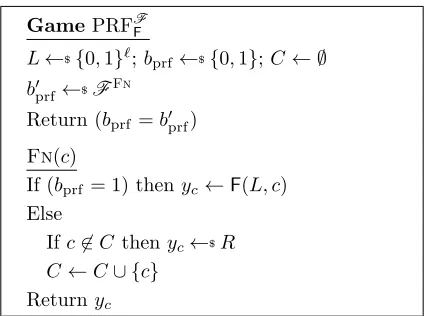
PRFs. We recall the definition as per [2, 8]. Let F:{0,1}`× {0,1}∗ → R be a function taking
a key L ∈ {0,1}` and input c ∈ {0,1}∗ to return an output F(L, c) ∈ R. Consider game PRFF F
associated to F and adversaryF. It provides the adversary with an oracleFnas shown. Let
AdvprfF (F) = 2 Pr[PRFFF ]−1
be the prf advantage of adversary F against function F. In proofs we will use the standard fact that it can also be expressed as
AdvprfF (F) (1)
GamePRFFF
L←${0,1}`;bprf←${0,1};C← ∅
b0
prf←$FFn
Return (bprf =b0prf)
Fn(c)
If (bprf = 1) thenyc←F(L, c)
Else
Ifc6∈C thenyc←$R C←C∪ {c}
Returnyc
Figure 1: Game used to define prf advantage of adversary F against functionF.
3
ASA Framework
We recall basic syntax of symmetric encryption. We then provide our novel definitions for ASAs, namely strong undetectability as well as adversary advantage in key recovery.
Symmetric encryption. A (symmetric) encryption scheme SE specifies the following. Via KSE
←${0,1}SE.kl, one selects a key of length SE.kl. Encryption algorithm SE.Enc takes KSE, message
m and coins r ∈ {0,1}SE.rl to deterministically obtain ciphertext c ← SE.Enc(K
SE, m;r). By
c←$SE.Enc(KSE, m) we denote the operation r←${0,1}SE.rl;c←SE.Enc(KSE, m;r). Decryption algorithm SE.Dec is deterministic and we require that
SE.Dec(KSE,SE.Enc(KSE, m;r)) =m
for all KSE, m, r.
ASAs.An algorithm substitution attack (ASA)Aspecifies the following. ViaKA←${0,1}A.kl, one selects a key of lengthA.kl. The subverted encryption algorithmA.EnctakesKA, KSE, mand current
stateσ to produce ciphertext c and updated state, (c, σ)←$A.Enc(KA, KSE, m, σ). (Denoting the state the same in input and output simply indicates an update of this variable.) The idea is thatAis specified by big brother. KeyKA is shared between the subverted encryption algorithmA.Enc and
its external accompliceA.Ext who aims, from subverted ciphertexts, to violate security ofSE. Note that conceptually, A is an adversary (the ASA) rather than a scheme, a departure in perspective from BPR [3]. We say that A.Enc is stateless if the updated state it returns is always the empty stringε, meaning its output for any inputsKA, KSE, m, σ has the form (c, ε). In this case we might
dropσ in both input and output, writingc←$A.Enc(KA, KSE, m).
We said that A’s goal is to violate security of SE. With no further conditions, this is too easy, as explained in Section 1. The goal for big brother is an attack that is undetectable yet violates security of SE. We now turn to formalizing each of these components.
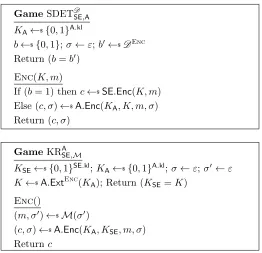
Strong undetectability. Consider game SDET of Fig. 2 associated to encryption scheme SE, ASA Aand a detection adversary D. It can obtain via oracle Encencryptions of messages of its
choice under keys of its choice, produced either viaSE.Enc(whenb= 1) or viaA.Enc (whenb= 0), and aims from examination of these ciphertexts to determineb. Let
AdvsdetSE,A(D) = 2 Pr[SDETDSE,A]−1.
GameSDETDSE,A
KA←${0,1}A.kl
b←${0,1};σ←ε; b0←$DEnc
Return (b=b0)
Enc(K, m)
If (b= 1) thenc←$SE.Enc(K, m)
Else (c, σ)←$A.Enc(KA, K, m, σ)
Return (c, σ)
GameKRASE,M
KSE←${0,1}SE.kl;KA←${0,1}A.kl;σ←ε;σ0 ←ε K←$A.ExtEnc(KA); Return (KSE=K)
Enc()
(m, σ0)←$M(σ0)
(c, σ)←$A.Enc(KA, KSE, m, σ)
Returnc
Figure 2: Games used to define detection and key recovery security of subversionA of encryption schemeSE.
The stateσ returned byEncwill always be the empty stringεin the caseb= 1 becauseSE.Enc
is stateless. Thus, ifD ever seesσ6=εin a reply to a Encquery, it knows thatb= 0, meaning the
subversion has been detected. Our formalization thus effectively implies that a subversion must be stateless to be undetectable. A consequence of this is that state reset, as can arise due to system reboot or cloning to create a virtual machine, will not allow the ASA to be detected, unlike for undetectability as per BPR [3]. This exclusion of some simple and natural forms of detection not covered by BPR [3] is the main consequence and intent of the new definition.
However there are other directions as well. The view of BPR [3] was that detection is performed by the decryptor. Detection through state reset continues that perspective, for this can in many cases lead to detection from the ciphertexts alone. But strong undetectability also moves towards a perspective where the encryptor, not just the decryptor, may be making some attempts at detection. We view the detector as having some sort of blackbox access to the encryption code, so that it can pick inputs and see all outputs written to memory. In particular, the detector not just knows, but can pick, the encryption key K, and it can see any state σ that the encryption code tries to maintain across invocations. Thus D can supply, in calls to Enc, not just the message, but any
key K ∈ {0,1}SE.kl of its choice for SE.Enc, getting in response not just the ciphertext c, but also
σ. This obviously significantly increases the power of the detector.
However we must be careful to note that we do not captureall possible detection strategies that a “real” detector in such a position could mount. For example the detector could measure the CPU time of an execution of the code and compare this with the expected CPU time of the real code. Or it could look at the number of calls to the underlying pseudo-random number generator that is being used to obtain coins. These and other detection methods are not covered by our definition.
detection effort and attack success. Our results indicate that detecting ASAs takes more effort than was previously thought.
We note that strong undetectability implies the BPR notion of undetectability. A proof may be given by reduction, the idea being as follows. Recall that in the detection game of BPR [3], the undetectability adversary D0 has access to an oracleKey that, given i, returns a key Ki←$ {0,1}SE.kl for useri, and an oracle
Encthat, given messageM andi, returns a ciphertext produced
by running eitherSE.Enc orA.Enc to encryptM underKi, the choice depending on the challenge
bit that D0 is trying to guess. Given such a D0, we build a strong undetectability adversary D with strong undetectability advantage at least the undetectability advantage of D0. Our adversary
D runsD0. When the latter makes a query Key(i), adversary D itself picks Ki←${0,1}SE.kl and returns it to D0. When the latter makes a query Enc(M, i), adversary D queries its own Enc
oracle with Ki, M to get back (c, σ) and returns c to D0. Finally D returns the same decision as
D0.
We note that the detectability game of BPR was explicitly multi-user, meaning it involved multiple keys. The strong undetectability game instead allows the adversary to query Enc with
any key of its choice. One advantage of this formulation, as we have just illustrated, is that muti-user security is a consequence.
Key recovery. The other side of the coin is what it means for an ASA to succeed, meaning
violate the security of the users of SE. One measure, formalized in BPR [3], is distinguishability, meaningA succeeds if it can distinguish encryptions of messages of its choice. Another measure is key recovery, meaning A succeeds if it finds KSE. Distinguishing is a strong measure for security
but a weak one for attacks (achieving it provides high security, but violating it entails little loss) while key recovery is a weak measure for security but a strong one for attacks (violating it is very damaging but achieving it means little for security). Since our focus is attacks, we target and formalize key recovery.
Game KR of Fig. 2 is parameterized by a message sampler algorithmMthat, given its current stateσ0 returns the next messagem to be encrypted and updated state. It represents the choice of messages made by the sender. Awins ifA.Ext recovers the keyKSE from the ciphertexts produced
by the subverted encryption algorithmA.Encon messages produced byM. (The stateσmaintained by the latter is entirely distinct from the stateσ0 ofM.) The key recovery advantage of Ais
AdvkrSE,M(A) = Pr[KRASE,M].
Parametrization by M allows a fine-grained taxonomy of key recovery attacks. The less they assume about M, the stronger they are. The strongest attack is one that works for any M. This corresponds to an attack that works regardless of what messages the encrypter chooses to encrypt. A somewhat weaker attack might work for certain message sequences, meaning some restricted class of samplers M. Our ASA is of the stronger type.
Discussion and extensions. Game SDET of Fig. 2 has been written for the case where
encryp-tion scheme SEis stateless, since this is the case of interest for our attacks. It can be extended to the case whereSEis stateful. In this case, when b= 1, algorithmSE.Enc takes the current state σ
as an additional input and returns not just ciphertextcbut also an updated stateσ. Additionally one should provide the adversary with a reset oracleResetthat resets the stateσ toε. The notion
BPR [3] had required any ASA Ato satisfy a decryptability condition which asked that cipher-texts produced under A.Enc(·, K,·,·) decrypted correctly under SE.Dec(K,·). We have dropped this condition, so that decryptability holds only to the extent that it is implied by strong unde-tectability, which we think is more realistic from a detection perspective. However, the ASAs we provide do meet the decryptability condition of BPR [3].
DFP [5] suggest that the BPR decryptability condition is too strong. They suggest a relaxation, and then provide an ASA that is undetectable under the BPR definition, meets their relaxed decryptability condition, and yet succeeds in that it violates the BPR subversion security definition. However the DFP attack does not succeed in violating our key recovery notion, and from a practical perspective, is weak. In the DFP attack,A.Enc(KA, K, m, σ) returnsK whenm=KA. That is, the
attack requires that the attacker can induce the encrpytor to encrypt the message m =KA. But
in practice this is quite hard and it is unlikely that a “real” sender will ever encrypt this message. Our attacks are much more powerful since the attacker succeeds regardless of what messages the encryptor encrypts. This is captured by the introduction of Min our key recovery definition and the fact that the attack succeeds regardless of its choice. In fact in our key recovery definition, the messages being encrypted in the attack cannot even depend on the subverter’s key KA, since the
latter is not given to M. The latter is why the DFP attack [5] does not succeed under our key recovery definition.
The issues here reflect, as we discussed above, that achieving a certain notion may provide good practical security, but violating the same notion may not constitute an effective practical attack. (That is, insecurity is not really the opposite of security. There is a lot in between.) Thus, achieving security under the BPR subversion notion is a good target for a scheme. But violating security under this notion need not be (and, in the case of DFP [5], is not) an effective attack. Conversely, our key recovery notion is a good one for attacks but not a good one for security: violating it constitutes a powerful attack, but achieving it provides only weak security. As an analogy, indistinguishability (semantic security) is accepted as a good security target for encryption schemes that one wants constructions to reach, but violating it is a weak attack.
4
Attack and Analysis
We present our ASA, having the following properties: (1) It is stateless and provenstrongly unde-tectable (2) It breaksanygiven encryption scheme that has a non-trivial amount of randomization, and (3) break here is in the strong sense of key recovery for arbitrary message distributions. The attack is simple to specify but the analysis is more challenging. We provide a careful analysis to establish both key recovery and strong undetectability with concrete bounds. From these results we can extract concrete values of the parameters for a concrete attack.
Preliminaries. As we discussed, we need SE to have non-trivial randomization. (Otherwise, a deterministic scheme is just a special case of a randomized scheme.) Formally, this means that ciphertexts have some min-entropy. To measure this we define the min-entropy H∞(SE) of the
schemeSEvia
2−H∞(SE)= max
KSE,m,c
Pr[SE.Enc(KSE, m;r) =c]
Here, withKSE, m, cfixed, the probability is over a random choice ofr from{0,1}SE.rl. Our results
will assume that 2−H∞(SE) is negligible. We note that we could use collision entropy in place of
min entropy.
A.Enc(KA, KSE, m, σ)
j←0
Repeat
j←j+ 1
r←${0,1}SE.rl
c←SE.Enc(KSE, m;r)
(v, t)←F(KA, c)
success←(KSE[t] =v) out-of-time←(j=s)
Until (successORout-of-time) Return (c, )
A.Ext(KA)
K←0SE.kl
Fori= 1, . . . , q do
c←$Enc()
(v, t)←F(KA, c)
K[t]←v
ReturnK
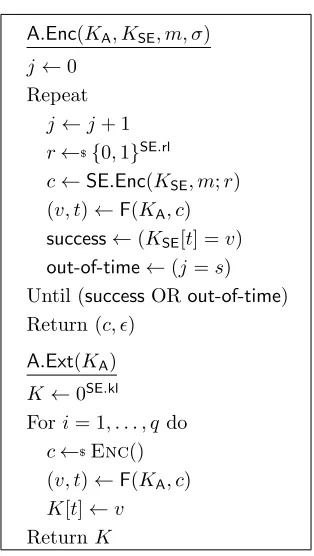
Figure 3: ASA Afor encryption schemeSE has algorithmsA.Enc and A.Extas shown above. Here
F:{0,1}A.kl× {0,1}∗→ {0,1} ×[SE.kl] is a PRF used in the attack andq, s≥1 are parameters of
the attack.
{0,1} ×[SE.kl] be a PRF and key length A.kl = F.kl, meaning KA will be a key for the PRF F
defining the function f(·) = F(KA,·). The algorithms A.Enc and A.Ext are shown in Fig. 3. Here
s, q≥1 are parameters of the attack. (We will show that quite small values of these suffice.) Subverted encryption algorithm A.Enc is given KA, KSE, message m and a state σ that it
ignores. (It will be stateless and thus it will always be that σ =ε.) Its goal is to pick r so that if
c=SE.Enc(KSE, m;r) and (v, t) =F(KA, c) then KSE[t] =v. It would then return c. WhenA.Ext
picks up c, it can compute (v, t) = F(KSE, c) and set K[t] = v. An appropriate choice of q will
ensure thatA.Exteventually gets all bits of the key, meaningK=KSEexcept with tiny probability.
Conceptually, then, we imagine A.Enc as trying to pick r at random subject to the constraint that if c =SE.Enc(KSE, m;r) and (v, t) =F(KA, c) then KSE[t] =v. However it is not clear how
to directly pick r in this way. Indeed, such an r may not even exist. To resolve this, A.Enc in Fig. 3 samples by picking r at random from the full space {0,1}SE.rl until either r satisfies the
desired condition (at which point the flagsuccessbecomestrue) or the process exceeds the number of allowed sampling attemptss(at which point the flag out-of-timebecomes true). The tradeoff is that for efficiency we wants to be quite small but the smaller it is the farther is the distribution ofr from the conceptually desired one. The theorems and analyses that follow will deal with these issues and show how to appropriately pick both sand q for an effective yet efficient attack.
Key recovery.The following theorem lower bounds the key recovery advantage of our ASAAof
Fig. 3, showing that it is close to one for reasonable values of the parameters, meaning the attack can efficiently and successfully recover the target key.
Game H0, H1
KSE←${0,1}SE.kl;σ0←ε C← ∅;T ← ∅
Fori= 1, . . . , qdo
j←0;out-of-time←false
(m, σ0)←$M(σ0)
Repeat
j←j+ 1;r←${0,1}SE.rl c←SE.Enc(KSE, m;r)
(v, t)←${0,1} ×[k]
If (c∈C) then
bad←true
(v, t)←(vc0, tc0)
(vc, tc)←(v, t)
C←C∪ {c}
success←(KSE[tc] =vc) out-of-time←(j=s) Until (successORout-of-time) IfsuccessthenT ←T∪ {t}
ElseT ←T\ {t}
Return (T 6= [k])
AdversaryF
KSE←${0,1}SE.kl;σ0 ←ε T ← ∅
Fori= 1, . . . , qdo
j←0;out-of-time←false
(m, σ0)←$M(σ0)
Repeat
j←j+ 1;r←${0,1}SE.rl c←SE.Enc(KSE, m;r)
(vc, tc)←$Fn(c)
success←(KSE[tc] =vc) out-of-time←(j=s) Until (successORout-of-time) IfsuccessthenT ←T∪ {t}
ElseT ←T\ {t}
If (T 6= [k]) then return 1 Else return 0
GameH4
KSE←${0,1}SE.kl;T ← ∅
Fori= 1, . . . , qdo Repeat
(v, t)←${0,1} ×[k]
Until (KSE[t] =v)
T ←T∪ {t}
Return (T 6= [k])
Game H2, H3
KSE←${0,1}SE.kl;T ← ∅
Fori= 1, . . . , qdo
j←0;out-of-time←false
Repeat
j←j+ 1
(v, t)←${0,1} ×[k] success←(KSE[t] =v)
If (j=sANDsuccess=false) then
bad←true out-of-time←true
Until (successORout-of-time) IfsuccessthenT ←T∪ {t}
ElseT ←T\ {t}
Return (T 6= [k])
GameH5
KSE←${0,1}SE.kl;T ← ∅
Fori= 1, . . . , qdo
t←$[k]; T←T∪ {t}
For`= 1, . . . , kdobad`←(`6∈T)
bad←(bad1∨ · · · ∨badk) Returnbad
Figure 4: Games and adversary for proof of Theorem 4.1.
which the adversary executes, so that the time of oracle calls is included. Thus for example the reason the time for Mdoes not show up in the time ofF below is that KR runsMalready. Theorem 4.1 Let SE be a symmetric encryption scheme and let k = SE.kl. Let F:{0,1}F.kl×
{0,1}∗ → {0,1} ×[k] be a PRF. Let q, s ≥ 1 and let A be defined as in Fig. 3. Let M be an arbitrary message distribution. Then we can build PRF adversary F such that
AdvkrSE,M(A)≥1−AdvprfF (F)−(q, s, k) (2)
where
(q, s, k)≤ke−q/k+q2−s+q2s2·2−H∞(SE)−1 . (3)
The running time ofF is about the sum of the running times ofA.Enc andA.Ext, and it makes at most qsoracle queries.
For example, the key for SE is typically an AES key so that k = SE.kl = 128. We could let
q = 128·7 = 896 ands= 13, which implies ke−q/k+q2−s ≤ 1/4. We can assume AdvprfF (F) is negligible. Then as long as H∞(SE) ≥ 28, our attack has advantage around 1/2. The q, s values
That M may be any distribution makes the ASA particularly strong. The distribution M represents the choice of messages made by the encryptor. We are saying the attack works regardless of these choices. It is thus a known message attack, not a chosen message attack.
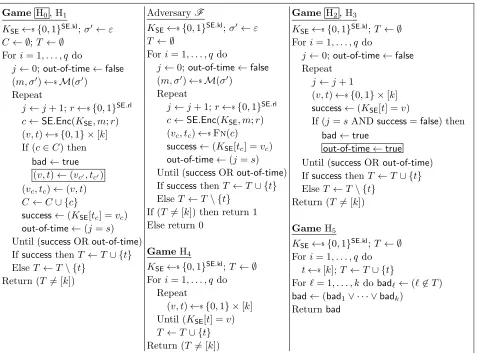
Proof of of Theorem 4.1: Game H0 of Fig. 4 includes the boxed code while H1 does not. Game
H0 implements game KR of Fig. 2 withAbeing as defined in Fig. 3, with two changes: (1)F(KA,·)
is replaced by a lazily sampled random function, and (2) the game returnstrue when key recovery fails rather than when it succeeds. Let prf adversaryF be as defined in the second panel of Fig. 4. It uses its Fnoracle where Awould useF(KA,·). It returns 1 when key recovery fails and 0 when
it succeeds. Letting bprf denote the challenge bit in game PRF, we have
Pr[PRFFF |bprf = 1] ≥ 1−AdvkrSE(A)
1−Pr[PRFFF |bprf = 0] = Pr[H0].
The reason the first equation above is an inequality rather than an equality is that A.Ext initially sets all bits ofK to 0 and, so, for a particular bit, it may by chance end up having the right value even when that bit is not set in the For loop. Now, using Eq. (1), we have
AdvprfF (F)
= Pr[PRFFF |bprf = 1]−(1−Pr[PRFFF |bprf = 0])
≥ 1−AdvkrSE(A)−Pr[H0].
Re-arranging terms, we have
AdvkrSE(A)≥1−AdvprfF (F)−Pr[H0].
We let
(q, s, k) = Pr[H0].
This establishes Eq. (2). We now proceed to upper bound(q, s, k). Since games H0,H1are identical
until bad, the fundamental lemma of game playing [4] says that
(q, s, k) = Pr[H0]≤Pr[H1] + Pr[H1 setsbad].
Game H1 sets bad when there is a collision in the ciphertexts. Since at most qs ciphertexts are
created we have
Pr[H1 setsbad] ≤
qs
2
·2−H∞(SE)
≤ q2s2·2−H∞(SE)−1 .
We now proceed to upper bound Pr[H1]. The ciphertexts being chosen in this game are not
relevant to its outcome, since (vc, tc) is chosen at random each time. Furthermore, the setting of
theout-of-timeflag only has an effect on the behavior of the game if the successflag is not already set at the time. This leads to game H2 of Fig. 4, which includes the boxed code. We have
Pr[H1] = Pr[H2]≤Pr[H3] + Pr[H3 setsbad],
the inequality by the fundamental lemma of game playing [4] because games H2,H3 are identical
untilbad. In game H3 the boxed code is not included, with the result that the repeat loop continues
GameI0
b←${0,1};C← ∅
b0←$DEnc; Return (b=b0)
Enc(K, m)
If (b= 1) then
c←$SE.Enc(K, m)
Else
j←0;out-of-time←false
Repeat
j←j+ 1;r←${0,1}SE.rl c←SE.Enc(K, m;r) (v, t)←${0,1} ×[k]
If (c∈C) then (v, t)←(vc0, tc0)
(vc, tc)←(v, t)
C←C∪ {c}
success←(K[tc] =vc)
out-of-time←(j=s) Until (successORout-of-time) Return (c, )
AdversaryF
b←${0,1} b0←$DEnc
If (b=b0) then return 1 Else return 0
Enc(K, m) If (b= 1) then
c←$SE.Enc(K, m)
Else
j ←0;out-of-time←false
Repeat
j←j+ 1;r←${0,1}SE.rl c←SE.Enc(K, m;r) (vc, tc)←$Fn(c) success←(K[tc] =vc)
out-of-time←(j =s) Until (successORout-of-time) Return (c, )
GameI1, I2
C← ∅
b0←$DEnc; Return (b0= 1)
Enc(K, m) j←0;
out-of-time←false
Repeat
j←j+ 1;r←${0,1}SE.rl c←SE.Enc(K, m;r) (v, t)←${0,1} ×[k]
If (c∈C) then
bad←true
(v, t)←(vc0, tc0)
(vc, tc)←(v, t)
C←C∪ {c}
success←(K[tc] =vc)
out-of-time←(j=s) Until (successORout-of-time) Return (c, )
Figure 5: Games an adversary for proof of Theorem 4.2.
We proceed to upper bound Pr[H3]. Since the sampling in H3 continues until success we have
Pr[H3] = Pr[H4] = Pr[H5].
We proceed to upper bound Pr[H5]. Let p` = Pr[H5 sets bad`] for ` ∈ [k]. Now we can use a
standard coupon collector problem analysis. For any particular`∈[k] we have
p` =
1−1
k
q
≤e−q/k .
Thus
Pr[H5]≤p1+· · ·+pk≤ke−q/k.
Putting the inequalities together yields Eq. (3).
Strong undetectability.The following theorem says that the ASA of our adversaryAof Fig. 3
is strongly undetectable.
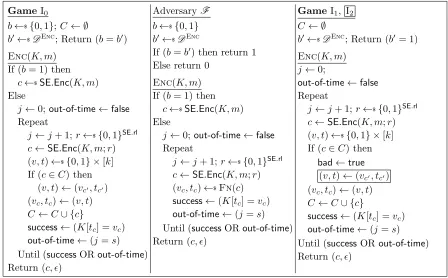
Theorem 4.2 Let SE be a symmetric encryption scheme and let k = SE.kl. Let F:{0,1}F.kl×
{0,1}∗ → {0,1} ×[k] be a PRF. Let q, s ≥ 1 and let A be defined as in Fig. 3. Let D be an
adversary against the strong undetectability of A that makes at most n queries to its Enc oracle.
Then we can build PRF adversary F such that
AdvsdetSE,A(D)≤2AdvprfF (F) +n2s2·2−H∞(SE). (4)
The running time of F is about that of D and it makes at most ns oracle queries.
lazily sampled random function. Let prf adversary F be as defined in the second panel of Fig. 5. It runs D, itself simulating the latter’s Encoracle, in the process appealing to its ownFn oracle.
Lettingbprf denote the challenge bit in game PRF, we have
Pr[PRFFF |bprf = 1] =
1 2 +
1 2Adv
sdet
SE,A(D)
1−Pr[PRFFF |bprf = 0] = Pr[I0].
Thus, using Eq. (1), we have AdvprfF (F)
= Pr[PRFFF |bprf = 1]−(1−Pr[PRFFF |bprf = 0])
= 1
2 + 1 2Adv
sdet
SE,A(D)−Pr[I0].
Re-arranging terms, we have
AdvsdetSE,A(D)≤2AdvprfF (F) + (2 Pr[I0]−1).
We proceed to upper bound 2 Pr[I0]−1. Consider games I1,I2 of Fig. 5. Game I2 includes the
boxed code while I1 does not. In both, (vc, tc) is picked at random. However, in I2, if it turns out
thatc was already seen, then the game corrects, resetting (vc, tc) to its prior value. As a result, I2
is equivalent to I0 with the challenge bit b in the latter set to b = 0, except it returns true when
b0 = 1 instead ofb0 = 0. On the other hand, in I1, the choice of (vc, tc) is independent of the choice
ofcand does not impact the distribution of the latter, making it equivalent to I0 withb= 1. Thus
we have
Pr[I1] = Pr[I0|b= 1]
Pr[I2] = 1−Pr[I0|b= 0].
Additionally, games I0,I1 are identical until bad. Via the fundamental lemma of game playing [4]
we have
2 Pr[I0]−1 = Pr[I0|b= 1]−(1−Pr[I0|b= 0])
= Pr[I1]−Pr[I2]
≤ Pr[I1 setsbad].
Game I1 setsbad whenever the same value of cis returned twice by SE.Enc. There arens queries
toEnc. Thus
Pr[I1 setsbad] ≤
ns
2
·2−H∞(SE)
≤ n2s2·2−H∞(SE)−1.
Putting everything together gives the desired Eq. (4).
Discussion. We do not expect that most users will mount involved detection efforts. But the
fills the gap. Our new ASA, achieving this and in particular being stateless, is harder to detect and thus more dangerous.
In a world of subversion, there are no panaceas. The extent to which big brother will risk detection in order to successfully recover a key is not known, but it would be natural that, all else being equal, big brother will pick the ASA that minimizes the chance of detection. This means an ASA like ours. Our work is intended to increase awareness and spur the search for deterrents.
5
Defenses
BPR [3] present schemes that are subversion resilient. They define unique ciphertext schemes, show they are subversion resilient, and then provide several ways to build them. These schemes are deterministic and stateful, meaning the encryptor and decryptor have to maintain a synchronized state.
Having strengthened the BPR undetectability condition to strong undetectability, a natural question is whether subversion resilience can still be achieved. In fact this strengthening makes no difference, and the schemes of BPR continue to achieve subversion resilience. This is because a subversion resilient scheme according to BPR [3] is one where any subversion satisfying the decrypt-ability condition cannot succeed in their subversion game. Decryptdecrypt-ability means that ciphertexts created by the subverted encryption algorithm decrypt properly under the real decryption algo-rithm, and it can be seen as represented a particular and fixed form of undetectability.
DFP [5] critique the BPR decryptability condition and instead suggest an alternative formu-lation of detectability represented by their DETECT game in which the subversion and detection adversaries run together, the latter getting a transcript of the interaction of the former with its oracles. They show that unique ciphertext schemes continue to achieve their notion. In this con-text, consideration of strong undetectability would involve modifying their game to a new one, SDETECT. For example one might return the state to the detection adversary as part of the transcript, and also add a reset oracle Reset to allow state reset. Then the question is whether
unique ciphertext schemes continue to meet this new definition. They do.
6
Acknowledgements
We thank Kaspar-David Buss for pointing out an error in the proof of Theorem 4.2. The April 2017 update of this paper corrects that error.
References
[1] G. Ateniese, B. Magri, and D. Venturi. Subversion-resilient signature schemes. Cryptology ePrint Archive, Report 2015/517, 2015. http://eprint.iacr.org/2015/517.
[2] M. Bellare, J. Kilian, and P. Rogaway. The security of cipher block chaining. In Y. Desmedt, editor,CRYPTO’94, volume 839 ofLNCS, pages 341–358. Springer, Aug. 1994.
[3] M. Bellare, K. G. Paterson, and P. Rogaway. Security of symmetric encryption against mass surveillance. In J. A. Garay and R. Gennaro, editors,CRYPTO 2014, Part I, volume 8616 of LNCS, pages 1–19. Springer, Aug. 2014.
[5] J. P. Degabriele, P. Farshim, and B. Poettering. A more cautious approach to security against mass surveillance. In G. Leander, editor, FSE 2015, volume 9054 of LNCS. Springer, Mar. 2015.
[6] Y. Dodis, C. Ganesh, A. Golovnev, A. Juels, and T. Ristenpart. A formal treatment of back-doored pseudorandom generators. In E. Oswald and M. Fischlin, editors,EUROCRYPT 2015, Part I, volume 9056 ofLNCS, pages 101–126. Springer, Apr. 2015.
[7] E.-J. Goh, D. Boneh, B. Pinkas, and P. Golle. The design and implementation of protocol-based hidden key recovery. In C. Boyd and W. Mao, editors,ISC 2003, volume 2851 ofLNCS, pages 165–179. Springer, Oct. 2003.
[8] O. Goldreich, S. Goldwasser, and S. Micali. How to construct random functions. Journal of the ACM, 33(4):792–807, Oct. 1986.
[9] I. Mironov and N. Stephens-Davidowitz. Cryptographic reverse firewalls. In E. Oswald and M. Fischlin, editors, EUROCRYPT 2015, Part II, volume 9057 of LNCS, pages 657–686. Springer, Apr. 2015.
[10] J. Patarin and L. Goubin. Asymmetric cryptography with S-boxes. In Y. Han, T. Okamoto, and S. Qing, editors,ICICS 97, volume 1334 ofLNCS, pages 369–380. Springer, Nov. 1997. [11] K. G. Paterson. Imprimitive permutation groups and trapdoors in iterated block ciphers. In
L. R. Knudsen, editor,FSE’99, volume 1636 ofLNCS, pages 201–214. Springer, Mar. 1999. [12] V. Rijmen and B. Preneel. A family of trapdoor ciphers. In E. Biham, editor,FSE’97, volume
1267 ofLNCS, pages 139–148. Springer, Jan. 1997.
[13] A. Russell, Q. Tang, M. Yung, and H.-S. Zhou. Cliptography: Clipping the power of klepto-graphic attacks. Cryptology ePrint Archive, Report 2015/695, 2015. http://eprint.iacr. org/.
[14] B. Schneier, M. Fredrikson, T. Kohno, and T. Ristenpart. Surreptitiously weakening crypto-graphic systems. Cryptology ePrint Archive, Report 2015/097, 2015. http://eprint.iacr. org/2015/097.
[15] G. J. Simmons. The prisoners’ problem and the subliminal channel. In D. Chaum, editor, CRYPTO’83, pages 51–67. Plenum Press, New York, USA, 1983.
[16] G. J. Simmons. The subliminal channel and digital signature. In T. Beth, N. Cot, and I. Ingemarsson, editors, EUROCRYPT’84, volume 209 of LNCS, pages 364–378. Springer, Apr. 1985.
[17] G. J. Simmons. A secure subliminal channel (?). In H. C. Williams, editor, CRYPTO’85, volume 218 ofLNCS, pages 33–41. Springer, Aug. 1986.
[18] G. J. Simmons. Subliminal communication is easy using the DSA. In T. Helleseth, editor, EUROCRYPT’93, volume 765 ofLNCS, pages 218–232. Springer, May 1994.
[19] A. Young and M. Yung. The dark side of “black-box” cryptography, or: Should we trust capstone? In N. Koblitz, editor,CRYPTO’96, volume 1109 ofLNCS, pages 89–103. Springer, Aug. 1996.
[20] A. Young and M. Yung. Kleptography: Using cryptography against cryptography. In W. Fumy, editor, EUROCRYPT’97, volume 1233 ofLNCS, pages 62–74. Springer, May 1997.
[21] A. Young and M. Yung. Monkey: Black-Box symmetric ciphers designed for MONopolizing KEYs. In S. Vaudenay, editor,FSE’98, volume 1372 of LNCS, pages 122–133. Springer, Mar. 1998.