The Perceptions Of TESL Teacher Trainees Towards The Effectiveness Of Microteaching Subject (SPA 2001) In Preparing Them For Teaching Practice
Zanariah Md Saleh & Nurfareza Binti Yahya Fakulti Pendidikan
Universiti Teknologi Malaysia
Abstract : Microteaching is a subject that helps teacher trainees in practicing their knowledge and skills of teaching to prepare themselves for teaching practice. In relation to this, a study was conducted to investigate the perceptions of UTM’s TESL teacher trainees towards the effectiveness of microteaching subject (SPA 2001) in preparing them for teaching practice. A total of 39 TESL teacher trainees were selected to be the respondents of this study. The instruments used in this study were questionnaire and interview. The questionnaire was adapted from previous studies done by Ngui Kuan Sang (1982/1983) and McGarvey and Swallow (1986). Interviews were also carried out on 4 respondents to gain further insight on the topic of this study. Data were analyzed descriptively using Statistic Package for Social Science (SPSS) version 16. The overall findings of the study show that the TESL teacher trainees perceived microteaching subject as effective in preparing them for teaching practice. However, there were problems faced by the trainees during teaching practice especially in handling students and teaching situations. Furthermore, the findings also revealed that the respondents highly valued the feedbacks given by their supervisor, peers and cooperative teacher. Finally, suggestions were also given on how to improve the microteaching subject for the benefit of TESL teacher trainees.
Keywords : perception teacher trainees, TESL, microteaching
Introduction
Teaching is well-known as an honourable profession all over the world. Teaching is the act of imparting students with knowledge so that they can use the knowledge in their academic life as well as in the future. Thus, teachers play an important role in educating our children today as they are also the ones who shape the youngsters so that the young generation will become the leaders of the nation in the future. According to Moore (1989), teachers play many roles such as an instructional expert, a manager as well as a counsellor to the students. The importance of the role of the teachers was further expressed by the Director-general of Education, Datuk Alimuddin Mohd Dom who stated that teachers as change agents were the driving force behind his mission to provide quality education (cited in The New Straits Times, September 8, 2007).
Statement Of Problem
Microteaching experience has been said to have strong links with teaching practice. This is because microteaching is considered as a platform for the teacher trainees to apply the theories that they had learned in their course in order to become an effective teacher. According to McGarvey and Swallow (1986), the experience gained, the skills learned and the practice that teacher trainees received in the microteaching class can be used to develop a “practical and penetrating understanding” of teaching and to build up an overall teaching ability.
However, the effectiveness of the microteaching subject in helping students to become skilled teacher trainees has been questioned by many educationists. Based on the research by McIntyre, MacLead and Griffiths (1977), teacher trainees claimed that their pre-service training seemed to be of little or no help to them. This was due to their dissatisfaction to the subjects taken by them in dealing with students’ attitude. Since microteaching is a course teaching peers, it was not really challenging for them as they were not teaching the real students. However, can they perform well in their teaching practice when they face the real classroom situation? This is the issue that needs to be addressed.
Furthermore, in the Malaysian context, Abdul Raof Latif and T. Subahan (1991) stated that many graduate teacher trainees today are lacking in professionalism to be teachers. They stated that this issue will be uttered over and over again by parents in order to improve the education quality of their children. The former Deputy Education Minister, Datuk Mahadzir Md. Khir even stated that some teachers were not creative enough in teaching which led to the boredom in the classroom (cited in Utusan Melayu, 2004, October 16). Furthermore, he also stated that one of the factors that students play truant was due to the incompetent teachers. The question now is why are these teachers incompetent and lacking in professionalism as a teacher? Did they get enough training before they started teaching? Thus, it is the aim of this research to find the root of the problems.
Apart from these two problems mentioned above, some of the TESL trainees claimed that they did not get the exact view of real classroom situation in their microteaching class such as in managing the class, the teaching materials, the lesson plan and many more. As a result, they had difficulties in facing the real situation and the environment of classroom situation when they went for their teaching practice. In fact, there had also been cases where the teacher trainees often changed to the bad old methods such as chalk and talk which they had experienced during their school days when they started to teach in schools. This tendency is also reinforced and influenced by the advice and example of old-fashioned headmasters and senior teachers at the school they go to (Hill and Dobbyn, 1979).
All three issues mentioned above lead back to the training that trainees received and the subjects which they had to take before they graduated from their specialised education program. Questions were raised as to whether teacher trainees had been given enough preparation before they go to teach? Were the subjects taken by teacher trainees helping them to become effective teachers? These are two important questions that would be address in this study to ensure that quality graduate teachers are produced
Objectives Of The Study
The objectives of this research are:
2. To investigate whether the microteaching subject meets the needs of the students in carrying out their teaching practice.
3. To recommend ways to improve the microteaching class.
Significance Of The Study
Through this research, it is hoped that there are solutions to improve the microteaching subject (SPA 2001) that can be beneficial to various parties such as the TESL students, the syllabus designers and also the Faculty of Education which offers the TESL course.
Firstly, the findings of this research will help the syllabus designers to improve the microteaching subject. They can plan ways to improve the microteaching subject (SPA 2001) since some trainees are still lacking in teaching skills and knowledge during the teaching practice. They may also revise the syllabus and improve the quality as well the effectiveness of the subject. The syllabus designer can come out with a more comprehensive microteaching subject that will enable TESL trainees to teach more effectively. In addition, with the improvement of the syllabus and the microteaching subject, the TESL trainees will be well-equipped with the skills needed in order to become a qualified future teacher. This also can actually improve the Faculty of Education’s image.
This research is also significant to the TESL trainees themselves. Hopefully, through this research, it will make the teacher trainees aware of the importance and the benefits of microteaching subject as it is a platform for them to practice teaching in order to face the real teaching situation. In this way, they will not be demotivated when they go for their teaching practice. Moreover, from the findings of this research, it is hoped that the teacher trainees will be better prepared to face teaching situations. They need to improve their teaching techniques, skills and approaches of teaching to become skilful, knowledgeable and efficient future teachers who can conduct effective lessons so that there will not be any problem occurring when they go out for teaching practice.
Research Design
The researcher used both quantitative and qualitative research methodology. The quantitative data was collected through questionnaire while the qualitative data was collected through interview sessions. Both data from questionnaire and interview sessions complimented each other in the findings and data analysis.
The reason why questionnaire were used for this research was because it was very convenient and could cover a wide population. Furthermore, questionnaire was used in collecting the data because according to Azizi et. al. (2007), questionnaire has a high validity because the questions in the questionnaire are standardized questions and it has clear instructions. Moreover, each respondent received one set of the same questionnaire which leads to standard responses from all the respondents. As for this research, the data from the questionnaire then were analyzed using a data analysis package, Statistical Package for Social Science called SPSS which gave accurate results. Thus, using questionnaire helped the researcher gained accurate data.
Merriam (2001) also agreed with Azizi et. al. (2007) that interviews are relevant due to the fact that there are less change in the meaning, impact and quality of the real situation from the data collected.
For this research, semi-structured interviews were conducted. There are several benefits of using semi-structured interview. One of the benefits according to Gillham (2005) is that the interview sessions are more flexible and controlled by the interviewer. Another benefit stated by Gillham is that semi-structured interview provides a balance between structure and openness with the use of prompts. Thus, the interviews in this research were carried out to gain additional data in a natural setting in which the respondents were more relaxed in answering the questions.
Respondents Of The Study
The respondents of the study were 39 fourth year TESL students from the Faculty of Education, UTM. They were 36 females and 3 males and their age ranged from 20 to 26 years old. The respondents had taken the microteaching subject when they were in their second year, third semester. Besides, they had undergone teaching practice when they were in their third year, first semester.
Research Instrument
This research used two research instruments which were questionnaire and interview.
Questionnaire : One of the research instruments used was questionnaire. It is a quantitative method used in collecting data. Altogether, there were 54 questions asked in the questionnaire. This questionnaire consists of two types of questions. There were Likert scale questions and one open-ended question. The items in the questionnaire were adapted from questionnaires used by previous researchers of the same study. They were Ngui Kuan Sang (1982/1983) and McGarvey and Swallow (1986).
They were three sections in the questionnaire and they were:
Section A : Personal Information : This section collects the information on respondents’ personal information. It contains questions asking about the respondents’ gender, course and Malaysian University English Test (MUET) result.
Section B: Microteaching and Teaching Practice : This section is divided into three parts. The first part is the respondents’ perceptions of the microteaching subject, the second part is the respondents’ perceptions of teaching practice and the third part is the respondents’ perceptions on the effectiveness of microteaching subject in preparing them for their teaching practice. The questions in this questionnaire consist of Likert scale type of questions. The scales are as follows:
Table 1 : Likert Scale
Interview
Another instrument for this research was interview. This qualitative method of collecting data was utilized to support the quantitative data from the questionnaire. The interview sessions were conducted in a semi-structured way.
For this research, four fourth year TESL students were interviewed. Altogether, there were a total of 9 structured questions asked during the interview. There were also several prompt questions asked to get more information from the respondents.
Data Analysis
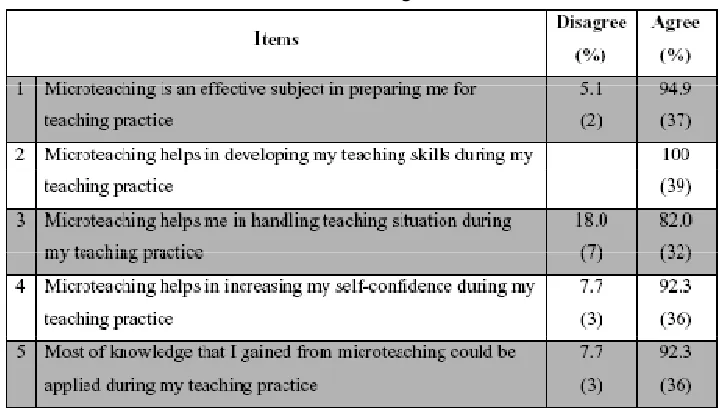
Based on Table 2 discussed in the previous section, it is clear that 94.9 percent TESL trainees perceived the microteaching subject as effective in preparing them for teaching practice in meeting the needs of such as the trainees developing their teaching skills, handling teaching situation and increasing their self-confidence.
Table 2 : TESL Teacher Trainees’ Perceptions towards Microteaching Subject in Preparing Them for Teaching Practice
The biggest percentage was all the respondents (100%) agreed that microteaching helps them in developing their teaching skills during their teaching practice. Besides that, 92.3 percent agreed that microteaching helped to increase their self confidence during their teaching practice. On top of that, the same percentage (92.3%) of the respondents agreed that knowledge gained from microteaching could be applied during their teaching practice. As mentioned by one respondent (respondent C) during the interview,
‘…I think microteaching gives us opportunity to get the experience of teaching as well as preparing the lesson plan, planning the activities and preparing the teaching materials.’
In conclusion, based on the 5 items asked it shows that TESL trainees perceived microteaching subject as effective in meeting their needs in preparing them for teaching practice.
The respondents were asked an open ended question on how to improve the microteaching subject. The following were the suggestions given by the respondents. First of all, the respondents suggested that the students should be given more opportunity to teach in the microteaching class. This is because the current practice now is that students are given only 2 opportunities to practice their teaching. Other than that, some of the respondents also suggested that the duration of the subject should also be increased as well. This is because the time given for microteaching class is only one hour. According to one of the interviewed respondents (respondent C), the credit for the subject should be increased so that trainees can have more than 2 chances to practice teaching. According to the interviewee, it is the only way for the trainees to prepare before they go for teaching practice. Increasing credit hour also means that the duration of microteaching class will be increased. In this way, they will have more time to practice teaching.
Another suggestion given by the respondents is to increase the number of students in the microteaching class. In other words, the class will be bigger and it will closely resemble real teaching situation in school. Apart from increasing the number of students, they also suggested that there should be a session where they can teach real students instead of their peers. This opinion was voiced out by the interviewed respondent (respondent B), who mentioned…
‘...not really effective...can invite real students so that trainees know how to deal with real students…know how to control class’
These needs are very important so that the trainees would not be surprised by the real teaching situation as one of the interviewed respondent (respondent D) who claimed that the teaching situation was different between microteaching class and teaching practice. While the other respondent (respondent B) stated that she was very surprised to find out that the students are not very proficient in English although they are in Form 4. She added that,
‘Although they are in Form 4, they did not know the meaning of the word knowledge’ The above situation highlights the needs to prepare the trainees what they might encounter when they go for teaching practice. However, the mock students should give more challenge to the ‘teacher’ to make the microteaching closer to natural setting. In other words, peers should actively participate and act like real students.
Other than that, there are some suggestions made for the supervision and feedback act as a tool so that microteaching subject will be more effective. According to one of the respondent, she suggested that the supervisor should comment critically and suggest other things for the trainees to handle different level of students and to improve their performance in teaching so that the trainees know where they are lacking and can improve themselves. Other than that, there are respondents (respondent B and respondent D) from the interview who suggested that…
‘…should include peer evaluation...other than lecture comment, students can seek opinion from peers as they can share knowledge as well as responses and comments.’
‘After every session of microteaching, the comment should be discussed so students will have the chance to improve their teaching…directly and critically…’
Moreover, one respondent did suggest on the technology used in microteaching. She said that the microteaching class should be updated with the latest technology such as computer and projector so that it will encourage the students to use multimedia in teaching.
students will only choose easy topics so that they can gain more marks rather than challenging themselves with difficult topics.
With these suggestions, it is hoped that the subject can be improve in order to equip the trainees with all the practices and theories before they go for their teaching practice.
Discussion
Based on the findings of the study, the following are some conclusions that can be made. First of all, it can be concluded that TESL teacher trainees perceived the microteaching as an effective subject in preparing them for teaching practice especially in planning the lesson. However, there were problems faced by the teacher trainees in the implementation of the lesson. They had problem especially in the class control and in finding solutions to the problem arisen during teaching practice. This was because they were not trained to deal with real classroom situation in the microteaching class. In contrast, the teacher trainees did not have problem in microteaching class because they are teaching their peers instead of real students.
Furthermore, the TESL teacher trainees perceived supervision and feedback given by the supervisor and the cooperative teacher during microteaching and teaching practice as important. They valued the feedback given by the supervisor and the cooperative teacher because the criticism and advice given by them helped to develop the trainees’ confidence in teaching as well as improving their teaching skills. Besides that, the trainees also valued the comments made by their peers with regards to their teaching.
Other than that, based on the findings of the study, TESL teacher trainees agreed that microteaching is an effective subject in meeting the needs in preparing them for teaching practice such as developing their teaching skills, handling teaching situation and increasing their self-confidence during their teaching practice. Besides, the trainees view microteaching subject as a platform for them to practice and improve the knowledge learned and most of them can be applied during their teaching practice.
Another significant finding was the suggestions made by the TESL teacher trainees to improve the effectiveness of the microteaching subject. The main recommendation suggested by the trainees is to lengthen the duration of microteaching class so that they will have more chances or opportunities to practice teaching.
In short, the TESL teacher trainees perceived microteaching as an effective subject in preparing them for their teaching practice.
References
Amobi, A. F. (2005) Preservice Teachers' Reflectivity on the Sequence and Consequences of Teaching Actions in a Microteaching Experience. Teacher Education Quarterly. Retrieved on August 13, 2007 online on http://findarticles.com/p/articles/mi_qa3960/is_200501/ai_n9522069
Ananthakrishnan, N. (1993). Microteaching as a Vehicle of Teacher Training: Its Advantages and Disadvantages. Retrieved on July 17, 2007 online on http://www.jpgmonline.com/text.asp?1993/39/3/142/613
Benton-Kupper, J. (2001). The Students’ Perspectives: Microteaching Experience. Retrieved on
August 13, 2007 online on http://findarticles.com/p/articles/mi_qa3673/is_200107/ai_n8995901
Fakulti Pendidikan, Universtiti Kebangsaan Malaysia (1986). Forum Latihan Megajar: Latihan Mengajar dan Profession Perguruan. Bangi: Universiti Kebangsaan Malaysia.
Gillham, B. (2005). Research Interviewing: The Range of Techniques. England: Open University Press.
Hill, L. and Dobbyn, M. (1979). A Teacher Training Course for Teachers of EFL: Lecturer’s Book. London: Cassell Ltd.
Holden, S. (1979). Teacher Training (eds). Hong Kong: Modern English Publications Ltd.
Isahak Haron and Koh Boh Boon (1982). Asas-asas dalam Amalan Pedagogi. Malaysia: Utusan Publication & Distributors Sdn. Bhd.
Koh Soo Ling (September 8, 2007) Profile: 'Teachers, stand up and be counted'. The New Straits Times. Retrieved on February 26, 2008 online http://www.nst.com.my
McIntyre, D., MacLeod, G. and Griffiths, R. (1977). Investigations of Microteaching. London: Croom Helm Ltd.
McGarvey, B. and Swallow, D. (1986). Microteaching in Teacher Education and Training. London: Croom Helm Ltd.
Merriam, S. B. (2007). Qualitative Research and Case Study Application in Education: Revised and Expanded from Case Study Research in Education. San Francisco: Jossey-Bass Publishers.
Ngui Kuan Sang. (1982/1983). Satu Kajian Mengenai Penggunaaan Pengajaran Mikro di Fakulti Pendidikan, Universiti Malaya. Jurnal Pendidikan, 9, 65-73.
Paintal, I. (1980). Microteaching: A Handbook for Teachers. Delhi: Oxford University Press. Protherough, R. and Atkinson, J. (1991). The Making of English Teachers. Philadelphia: Open
University Press.
Rosnani Hashim (1998). Teacher Training and Work Success: A Case Study of the Effectiveness of the International Islamic University Malaysia (IIUM) Diploma in Education Programme. Kuala Lumpur: Department of Education International Islamic University Malaysia.
Saravanan, V. (1990). Teacher education of English Language teachers: developing awareness. AARE Annual Conference 1990. Retrieved on August 18, 2007 online on http://www.aare.edu.au/90pap/sarav90463.txt
Turney, C et. al. (1976). Sydney Micro Skills: Series 4 Handbook. Sydney: Sydney University Press
Trott, A. J. (Ed.). (1977). Selected Microteaching Paper. London: Kogan Page Limited.