Assessing the effectiveness of Problem Based Learning (PBL) using Quality
Function Deployment (QFD): Students Perspective
Jafri Mohd. Rohani
a,∗, Mohd Ariffin Abu Hassan
b, Syed Ahmad Helmi Syed Hassan
aMohd. Kamaruddin Abd. Hamid
b, Khairiyah Mohd.Yusof
ba Faculty of Mechanical Engineering, Universiti Teknologi Malaysia, 81310 UTM Skudai, Johor, MALAYSIA, b
Department of Chemical Engineering, Faculty of Chemical & Natural Resources Engineering, Universiti Teknologi Malaysia, 81310 UTM Skudai, Johor, MALAYSIA.
Abstract
The paradigm shifts from traditional chalk-and-talk teaching method to a more innovative teaching style and method in engineering education is the key in transforming the way engineers are prepared to solve complex problems for the 21st century. Rather than presenting the content first, PBL presents the students with an ill-structured, ambiguous, complex and messy problem and with no clear solution. PBL will increase the student’s comprehension, retention, and application of basic engineering skills. This article demonstrates a case study of how we address the student’s concern in PBL environment for making it successful using QFD approach. This results of this QFD assessment revealed that the major concerned voice by the students should be considered by the lecturer for continuous teaching improvement for making PBL effective.
Keywords: Problem Based Learning; Quality Function Deployment
∗ Corresponding author. Tel.: +607-5534568; Email: [email protected]
1. Introduction
Colleges and university have applied a variety of educational strategies to optimize common practices to improve student enrollment, curriculum enhancement and innovative learning environment due to intense competition and globalization. Due to intense competition for student recruitment, the university administration must understand and measure the performance of every process on a continuous basis. Student learning process should be the core business for any university to be recognized as a center of higher learning institution. The element of learning process consists of inputs, processes and output. The input would include student’s needs, faculty participation and university support. The process would involve administration practices, research, teaching and students services. The outputs would include competent and employable graduate, satisfied employers, research publications and others. This article will focus only student learning process and methodology, namely Problem Based Learning (PBL).
2. Problem Based Learning (PBL)
Problem Based Learning is a curriculum development and delivery system that recognizes the need to develop problem solving skills as well as the necessity of helping students to acquire necessary knowledge and skills. Indeed, the first application of PBL was in medical schools which rigorously test the knowledge base of graduates [1]. PBL utilizes real world problems, not hypothetical case studies with neat, convergent outcomes. It is in the process of struggling with actual problems that students learn both content and critical thinking skills. Problem based learning thus has several distinct characteristics which may be identified and utilized in designing such curriculum. These are:
a) Reliance on problems to drive the curriculum - the problems do not test skills; they assist in development of the skills themselves.
Problem-Based Learning
Session O5-001
c) Students solve the problems - teachers are coaches and facilitators.
d) Students are only given guidelines for how to approach problems - there is no one formula for student approaches to the problem.
e) Authentic, performance based assessment - is a seamless part and end of the instruction.
2.1 Quality Function Deployment (QFD)
PBL is student centered. Understanding the students perceived needs and concerns is the key for making PBL successful. A better tool to understand students’ perceived needs is Quality Function Deployment (QFD). QFD is a quality improvement methodology that is based on obtaining customers’ input by directly interviewing them. It is a design and planning tool that matches customers’ needs with the necessary corresponding system design elements. This structured and systematic approach helps in understanding the customers’ needs and the results can be used to prioritize the most important system design elements, enabling efforts and resources to be focused on improving those that most effectively match the customers’ needs. QFD is widely and successfully being used in product and process design. It uses cross-functional teams to determine customer requirements and to translate them into product designs and specification through highly structured and well-documented methods [2]. This powerful method can help pinpoint those areas of customer concern. It will prevent an organization from producing a product or offered a service totally based on ambiguous ideas but try to fulfill customer s priority requirement. QFD provide a mechanism for multifunctional teams to capture the knowledge and develop a full set of accurate requirements and fully integrate those requirements into systems designs.
Fox [3] had highlighted some of the key issues on the QFD concept:
a) QFD is a planning process as opposed to a tool for problem solving or analysis.
b) The customers’ wants and needs, their requirements are the inputs to the matrix. The process cannot begin without these inputs. QFD essentially forces an organization to get in touch with the people who use its products.
c) It used a matrix to display into vital to the project in brief outline format.
d) This collection of information in the matrix format facilitates examination, cross checking and analysis. It helps and organization set competitive targets and determines the priority action issues.
The ultimate benefits of QFD are increased market share and larger profits. These benefits are possible simply because QFD play a major role in creating products and services with reduced cost, improved quality, features that satisfy customers and significantly shorter development time. It helps development personnel maintain a correct focus on true requirements and minimizes mis-interpreting customer needs. As a result, QFD is an effective communications and planning tool.
Barbara and Kriss [4] noted that Dr. Yoji Akao who was a chairman of the QFD Research Committee of the Japan Society for Quality Control (JSQC) developed the original version of QFD methodology. He is an Industrial Professor at Tamagawa University who develop the approach called the matrix of matrices which includes 30 matrices in total. This method creates linkages with Value Engineering and Reliability Charts such as Failure Modes and Effect Analysis (FMEA), shows gigantic process and far reaching. Then the American through its quality organization known as American Supplier Institute (ASI) in Dearborn Michigan introduced the simple four phased approach. This QFD method consist only four main matrices which are product planning (House of Quality), part planning, process planning and manufacturing planning (refer Figure 1).
This article tries to develop only the first QFD matrix also known as House of Quality (HoQ).. Here the authors try to show how the QFD matrix (product planning matrix) can be used to capture the students’ wants and needs from a PBL environment. Then how its can be translated to the PBL design elements as to prepare a guideline for the lecturer to propose a teaching methodology and charateristics that addresses students’ concern. It defines methods of translating priority issues (customer concern) through a highly structured and robust approach.
2.1.1 The Voice of Student (VoS)
Figure 1. American Supplier Institute (ASI) four-phased approach
According to Barbara and Kriss [4] supporting techniques and tools in developing a core QFD matrix include brainstorming, affinity diagramming and tree diagramming. This method stimulate the team’s creativity, develop and organize into quickly through a structured process and provide visualization of relationship various detail levels which can reveal any gaps or holes in the sequence of information.
3. An application of QFD in Problem Based Learning
In this section we will discuss how the QFD has been applied to assess the effectiveness of PBL method in Process Control & Dynamic, Semester 1 2004/5 at Faculty of Chemical & Natural Resources Engineering (FKKKSA), University Teknologi Malaysia. There were 40 third year students participated in this case study and all students have been exposed to PBL environment. The students have been broken down into their respective PBL group and a short briefing on QFD was given. . The students were asked to address their concern on PBL that they have gone through.
3.1 House of Quality
Once students’ needs and concerns are identified, preparation of the product planning matrix or house of quality can begin. This matrix is used to translate “the whats” or students’ needs into “the hows” or means to satisfy the students’requirements.
3.2 The whats
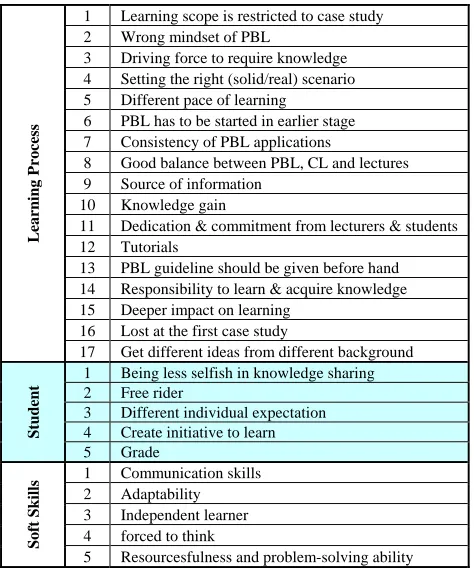
Normally “the whats” will be broken down and arranged into cluster levels of information. (Refer Table 1)
Table 1. “The whats”
1 Synchronizing of free time 2 Time constrainst 3 Time consuming
Time
4 Too much workload
1 Over-reliance of certain members 2 Competency in Team-Working 3 Efficiency of a group 4 Formations of group
5 Guidance among team members 6 Copying among group
7 Learn how to deal with different kind of peoples 8 Practicing teamworking
9 Burden to teach group members 10 Members not committed 11 Free rider
12 Members do not prepared 13 Too dependent to group members 14 Imbalance workload & dominance 15 Each member has different commitment
Team Member
16 Job delegation 1 Lack of PBL facilities
2 Need different study environment 3 Size of the class
4 No. of Students
Facility
5 Source of information and references 1 Lecturers should undergo proper training 2 No discussion after submission 3 Comprehensive evaluation 4 Suitable Subject of PBL
Lecturer
Problem-Based Learning
Session O5-001
1 Learning scope is restricted to case study 2 Wrong mindset of PBL
3 Driving force to require knowledge 4 Setting the right (solid/real) scenario 5 Different pace of learning
6 PBL has to be started in earlier stage 7 Consistency of PBL applications
8 Good balance between PBL, CL and lectures 9 Source of information
10 Knowledge gain
11 Dedication & commitment from lecturers & students 12 Tutorials
13 PBL guideline should be given before hand 14 Responsibility to learn & acquire knowledge 15 Deeper impact on learning
16 Lost at the first case study
Learning Process
17 Get different ideas from different background 1 Being less selfish in knowledge sharing 2 Free rider
3 Different individual expectation 4 Create initiative to learn
Student
5 Grade
1 Communication skills 2 Adaptability 3 Independent learner 4 forced to think
Soft Skills
5 Resourcesfulness and problem-solving ability
3.3 The hows
Once a list of students’ concern “the whats” has been completed the next step is to establish the technical requirement to respond to students’ requirements. During these phase the team of PBL lecturers must prepare the PBL system design elements that correspond the students’ concern (refer Table 2).
Table 2. “The hows”
PBL system design elements
Pose questions randomly on members in a team Establish students' roles and rotate them Limit subjects with PBL 2 per semester Give short PBL training at beginning of semester Give incentive for groups to that volenteer in presentation Forming groups according to established guidelines
Ensure students prepare before coming for class to have in-class discussion
Apply autorating(Individual mark for team assignments)
Give proper guidance during problem identification stage, especially for the first case study
Use real case studies from industries Give individual pop quiz
Give incentive for students who actively partcpate in class Explain team working concepts at the beginning of semester New lecturers for particular subject should work with mentor with PBL experience
Evaluate peers for every case study Give individual tests and final examination Apply lecturer's evaluation on students participation Identify subjects with PBL for all semesters for the course Counsel individual groups
Give tutorial for thorough coverage of subject Give motivation periodically about PBL
Prepare well for PBL cases, facilitation and closure Lecturers undergo PBL training
Give more weightage in grades for case studies Recommend suitable textbooks and references
Limit credit hours to 16 for student taking subject with PBL Establish discussion group on internet
Define credit hours obligation for engineering subjects Give mini lectures for subject areas not covered by case study Collect reflection-learning journal for each case study Group students from the same course
Give assigments from textbook Assign one lecturer for a specific section Limit number of students to max. of 60 per class Specify topics covered with PBL & CL Give handout on PBL beginning of semester Return graded case studies promptly Record attendence
Have regular meetings among lecturers for multi-section subjects Collect logbook after every case study
Provide suitable classroom setting
Disallowed new students from entering class after first week of semester
Give detailed sillabus schedule with learning outcomes Require students to turn in minutes of the meeting for every case study
Instruct students to keep neat and organised logbook Provide detailed format of case study report
4. Results and Discussion
In the first matrix we have mainly two relationships; one is the relationship between the students’ concern and PBL system design elements.
4.1 The relational matrix
Figure 2. Pareto Chart
4.2 Matrix discussion and analysis
From the Pareto Chart (figure 2), the top ten PBL system design elements that addresses the students’ concern are as follows:
1. Pose questions randomly on members in a team. 2. Establish students’ roles and rotate them.
3. Limit subjects with PBL two per semester. 4. Give short PBL training at beginning of semester. 5. Give incentive for group to volunteer for
presentation. 6. The groups are formed according to established guidelines.
Problem-Based Learning
Session O5-001
9. Give proper guidance for problem identification. 10. Use real case studies from industries.
From this finding it can be concluded that these top ten items must be prioritized when designing the PBL system for this subject in future. This finding is agreeable with the study being conducted by Peterson [5]. Peterson in his 13 years of conducted PBL in his management education has identified three critical success factors for PBL implementation, namely, 1. Orienting students to this new instructional strategy. 2. Pick the problem 3. Form the teams. In our case study, we have also identified the key PBL design elements that need to be emphasized that could lead to pinpoint the areas to concentrate on for continuous teaching quality improvement of meeting student satisfaction as shown in Figure 2.
As this case study is a preliminary study of the using of QFD in assessing the PBL effectiveness, a more bigger sample that include other section and classes that has already practice PBL that to be conducted to generalize the findings.
5. Conclusion
QFD is a quality tool that assists the tracking of the students’ concerns in the PBL environment. QFD shows the new methods of integrating the students’ concern correspond with the PBL system design element, which aims at increasing the student satisfaction in a new learning environment. It is the only comprehensive tools that aiming to satisfying the students needs by seeking out either spoken or hidden needs and translating these items through its QFD matrix. This study has shown how QFD can be used in improving PBL environment. This study provides the basic guidance of the QFD process in PBL learning environment. It is shown in this study how the basic HoQ could be used to capture and identify the most desirable student’s requirements. This tends to bring the designer of PBL or the development team of PBL lecturer to come out with the best and innovative PBL new instruction methodology.
References
[1] Boud, D. and G.I. Feletti, (Eds), The Challenge of
Problem-Based Learning, 2nd Ed., Kogan Page, London, 1997
[2] Mark A. Vonderembse and T.S. Ragunathan (1997).
Quality Function Deployment’s Impact on Product Development International Journal of Quality Science Vol 2 No.4 1998 pp. 253-271.
[3] Fox J. (1993). Quality Through Design: The Key to
Succesful Product. London: Mc Graw Hill
[4] Barbara A. B and Kriss D. B. (1995). The Road Map to
Repeatable Success:Using QFD to Implement Change.
CRC Press Inc.