Decomposing the ASASA Block Cipher
Construction
Itai Dinur1, Orr Dunkelman2, Thorsten Kranz3, and Gregor Leander3
1
D´epartement d’Informatique, ´Ecole Normale Sup´erieure, Paris, France 2
Computer Science Department, University of Haifa, Israel 3
Horst G¨ortz Institute for IT-Security, Ruhr-Universit¨at Bochum, Germany
Abstract. We consider the problem of recovering the internal specifi-cation of a general SP-network consisting of three linear layers (A) in-terleaved with two Sbox layers (S) (denoted by ASASA for short), given only black-box access to the scheme. The decomposition of such general ASASA schemes was first considered at ASIACRYPT 2014 by Biryukov et al. which used the alleged difficulty of this problem to propose several concrete block cipher designs as candidates for white-box cryptography. In this paper, we present several attacks on general ASASA schemes that significantly outperform the analysis of Biryukov et al. As a result, we are able to break all the proposed concrete ASASA constructions with practical complexity. For example, we can decompose an ASASA structure that was supposed to provide 64-bit security in roughly 228 steps, and break the scheme that supposedly provides 128-bit security in about 241time. Whenever possible, our findings are backed up with experimental verifications.
Keywords: Block cipher, ASASA, white-box cryptography, integral crypt-analysis, differential cryptcrypt-analysis, Boomerang attack.
1
Introduction
In this paper we consider generic substitution permutation networks consisting of linear layers interleaved with Sbox layers. The linear layers considered are arbitrary linear bijections on the full state, whereas the Sbox layers partition the state into several fixed-size parts and apply a non-linear permutation to each part in parallel. Special cases of this general set-up include a large variety of well-known block ciphers, most prominently the AES.
Such constructions are far from being new. The first construction, due to Patarin and Goubin, is the ASAS construction, i.e., two rounds of a linear layer (A) followed by an Sbox layer (S) [14]. The scheme was later broken by Biham, exploiting the fact that the Sboxes were chosen to be non-bijective [1] (which allowed for a simple differential attack).
and linear layers, given only black-box access to the SP-network and its inverse. The attack is a generalization of the integral attack [11] (a.k.a. square attack) originally proposed by Knudsen as an attack on the cipher SQUARE [7]. It is thus a structural attack in nature, exploiting the fact that the SASAS construction is composed of only three permutation layers over a smaller alphabet interleaved with linear layers, but ignoring the actual specification of these layers.
Besides the very general results of [4], several papers have focused on special cases of the above scenario where more information about the internal structure is known. Most prominently, a case that has received considerable attention is where only the Sboxes are unknown but the specification of the linear layers is completely revealed to the attacker (see e.g. [5,15]).
Here we focus not on a special case of the most general setting but rather on the natural complement of the SASAS structure, namely ASASA. That is, we consider an n-bit SP-network consisting of three linear (or affine) layers, interleaved with two Sbox layers, where each Sbox is a permutation overb bits. Our main motivation for analyzing this particular set-up was given by a recent proposal from ASIACRYPT 2014 [3] which constructed block ciphers with the additional property of having memory-hard white-box implementations (see [3] for details). Such a block cipher is represented as a box (or a few black-boxes) describing how each input is mapped to an output. The goal of the adversary is to find a succinct representation of the given black-box mapping, which in our case implies recovering (or decomposing) the actual specifications of the affine and Sbox layers.
Since the security of generic ASASA constructions was not previously an-alyzed, the authors of [3] supported their designs by claiming that they resist standard attacks (such as differential and integral cryptanalysis, and boomerang attacks), essentially due to the external affine layers that hide the internal struc-ture of the Sboxes. The best generic attack on the ASASA construction proposed in [3] is a variant of the attack by Biryukov and Shamir on the SASAS structure, and is extremely inefficient, having time complexity of 2b(n−b). For example, [3] claims that an ASASA scheme with a block size ofn= 16 and an Sbox size of
b= 8 provides security of 28(16−8)= 264.
It should be noted that [3] also uses a special case of the ASASA structure with expanding Sboxes to construct strong white-box cryptography (again we refer to the paper for details) and that this part has been recently broken [8] by algebraic cryptanalysis. However, those attacks do not seem to carry over to the general ASASA case that we consider here.
1.1 Our Contribution
Table 1 shows the effectiveness of our attacks when applied to the instances given in [3] in detail.
ASASA instance Security claim [3] Our attack complexity (Section 3.3)
2×8-bit 64 bits 28 bits
2×10-bit 100 bits 35 bits
3×8-bit 128 bits 41 bits
Table 1.Attack complexities for the ASASA instances suggested in [3].
More precisely, we present and analyze three different attack strategies. The first attack follows the general idea of an integral attack and is thus a structural attack. The second and third attacks on the other hand are statistical attacks: the second attack is based on a Boomerang attack, making use of boomerang distinguishers in the known-plaintext setting. The authors of [3] were aware of the existence of such boomerang distinguishers, but left the possibility of exploiting them efficiently in an attack as an open problem, which we address. Finally, the third attack is a variant of a differential attack making use of non-random behaviour of the differential distribution table. The running time of the integral attack is roughlyn·23n/2, the Boomerang has an attack complexity of roughly 23n/2+3b/2and the differential attack a complexity of 22n..
The integral attack is generally the most efficient attack and should be used whenever possible. However, this attack is applicable with the claimed complex-ity only to ASASA constructions in whichb >√n. In cases whereb≤√n, the Boomerang attack is generally the most efficient attack, as its time complex-ity is at most 23n/2+3√n/2. However, the success and efficiency of the integral and boomerang attacks are based on some assumptions on ASASA instances in which the linear and Sbox layers are chosen at random. These assumptions seem rather natural and were verified whenever possible on random instances of ASASA with small state sizes. Nevertheless, it is clear that our assumptions do not hold for all ASASA instances, and in such cases (which seem rather sparse), one can try to apply the differential attack which has a higher time complexity of 22n, but is based on different assumptions. Finally, we note that we focus on ASASA constructions in which all Sboxes have the same size, but our algorithms easily generalize to schemes built with difference Sbox sizes.
2
Preliminaries
Let
F:Fn2 →Fn 2
be the ASASA construction with k Sboxes on b-bits each (n=kb). More pre-cisely,F is constructed as
F =L2◦S1◦L1◦S0◦L0
where Li are linear bijections onFn2 and Si consist of parallel applications of k
b-bit Sboxes. That is,
Si(x1, . . . , xk) =
S(1)i (x1), . . . , S (k) i (xk)
withxi∈Fb2
If we can recover the first linear layer, we are left with the SASA construction that can be decomposed very efficiently as shown in [4]. Thus, the aim of our attacks is to recover L0 (or L2 by considering the inverse of F). For this, first note that it is impossible – and unnecessary – to recoverL0exactly. This is due to the fact that a given ASASA instance is not uniquely determined byF. More precisely, replacingL0 by
L00= T1 T2 .. . Tk
◦L0
andS0(i) by
S0(i)0 =S0(i)◦Ti−1,
whereTi:Fb2→Fb2are linear bijections, results in the same ASASA instanceF. This observation motivates the following definition.
Definition 1. Two linear bijections L andL0 onFn2 are ASASA-equivalent if
there exist linear bijectionsTi onFb2 such that
L0 = T1 T2 .. . Tk ◦L
For recovering L0 (up to equivalence) we are actually going to recover the subspaces
Vi=L−01(Ui) where
Ui ={(x1, x2, . . . , xk) |xj∈Fb2 andxj= 0 ifj6=i}.
As formalized in the proposition below, given the set ofVi’s basically determines
Proposition 1. Given k subspaces Vi of dimension b it holds that any linear
bijectionL:Fn
2 →Fn2 such thatL(Vi) =UiwithUias above is ASASA equivalent
toL0.
Proof. We considerT =L◦L0−1and observe thatT maps inputs fromUi toUi since
T(Ui) =L(L−01(Ui)) =L(Vi) =Ui.
As a result,T representskparallel linear bijectionsTi overFb2andLis ASASA equivalent toL0:
L◦L−01=T ⇒L=T◦L0
u t
Thus, after recovering the spaces Vi we can set-up linear equations for L0 and any bijective linear mapping fulfilling all those linear equations will be a valid solution forL0.
More precisely,L0 can be written as
L0=
L(1,1)0 L(1,2)0 . . . L(1,k)0 L(2,1)0 L(2,2)0 . . . L(2,k)0
..
. ... . .. ...
L(k,1)0 L(k,2)0 . . . L(k,k)0
whereL(i,j)0 areb×bsubmatrices overF2. Then, for any element (x1, . . . , xk)∈
Vi⊆(Fb2)k we obtainbequations
L(j,1)0 x1+L (j,2)
0 x2+. . .+L (j,k)
0 xk = 0 ∀j∈ {1, . . . , k}, j6=i. Choosingb linearly independent vectors from everyVi leads to a system of
k(k−1)b2=k2b2−kb2
linearly independent equations overF2withk2b2unknowns forL0. This system of equations has 2kb2 solutions and we know that the invertible solutions are exactly the linear bijections that are ASASA equivalent to L0. The number of such linear bijections for a givenL0 isNbk where
Nb= b−1 Y i=0
(2b−2i) = 2b2 b Y i=1
(1−2−i) = 2b2pb
is the number of invertibleb×bmatrices andpbis the probability that a randomly chosenb×bmatrix is invertible. Accordingly, the fraction of invertible solutions for the system of linear equations is
2kb2pk b 2kb2 =p
Thus, if we know the set ofVi’s for an ASASA constructions withk b-bit Sboxes, we try outpk
b solutions on average. Sincepb>2−1.792, it holds that
pkb >2−1.792k
when considering constructions with up to k Sboxes. This step is completely separated from the attacks that find the set ofVi’s. Accordingly, the complexities donot multiply and as we will see this step does not dominate the overall attack complexity.
Note that it is sufficient to knowVπ(i) for an unknown permutation π. The solution will then be a matrix which is ASASA equivalent toL0 with its rows permuted according toπ. This is also a valid solution as additionally permuting the Sboxes inS1 and the columns inL1 results in the same ASASA instance.
3
Integral Attack
In this section we describe our integral attack on the ASASA construction. We start by describing a basic integral attack that recovers the subspaces Vi for
i ∈ {1, . . . , k} in time complexity of about n·22n. Finally, we optimize the attack and reduce its time complexity to aboutn·23n/2.
The analysis of the attack assumes that the parameters of the ASASA con-struction satisfy b > k, or equivalently b > √n (and k < √n). Moreover, it assumes that the algebraic degree of the Sbox layers S0 and S1 and their in-verses is the maximal possible value of b−1.4 We note that if the Sboxes are selected at random, then this will be the case with high probability. Addition-ally, the analysis is based on more subtle and heuristic (but natural) assumptions that we specify later in this section.
The starting point of the attack is the following integral property, which was used to devise a related attack in the original ASASA paper [3]. We begin with a short definition, followed by the property and its proof.
Definition 2. Given a setR andx∈Fn2, define R+x,{x+y | y∈R}
Proposition 2. Let x∈Fn2 andi∈ {1, . . . , k}, then P y∈Vi
F(x+y) =0.
Similar properties have been used before in integral and related attacks, most notably in the cryptanalysis of the SASAS structure [4]. It is possible to prove this property combinatorially (as done in [4]), but here we give an algebraic proof, as it is more relevant to the rest of this section. The proof is based on the use of high-order derivatives (see [10,12] for details about high-order differential cryptanalysis).
4
Proof. Due to the linearity of L0, we have L0(x+Vi) = L0(x) +L0(Vi) =
L0(x)+Ui. Namely, Sboxiis active inS0(its input attains all 2bpossible values), while all other Sboxes are inactive, as their inputs are fixed to the correspondingb
bits ofL0(x). SinceS (i)
0 is a permutation, thenS0(L0(x) +Ui) =S0(L0(x)) +Ui, which is an affine subspace of dimension b. We are interested in computing the sum of outputs (over F2) of this subspace through the remaining layers
L2◦S1◦L1, which is equivalent to evaluating ab-order derivative of these layers on theirnoutput bits. Therefore, in order to show that P
y∈Vi
F(x+y) =0, it is
sufficient to show that the algebraic degree of every output bit ofL2◦S1◦L1 is less than b, which implies that all of theb-order derivatives are zero.
All theb-bit Sboxes in the scheme (and inS1) are bijective, and therefore, their algebraic degree is at mostb−1, implying that the degree of S1 is upper bounded by b−1. SinceL1 andL2 are affine, the degree of L2◦S1◦L1 is less
thanb, proving the claim. ut
In the attack we sum over the encryption values of larger affine subspaces, and use the following (more general) property.
Proposition 3. Let x∈Fn2,i∈ {1, . . . , k}, and letR be a linear subspace such
that Vi ⊆R , then P y∈R
F(x+y) =0.
Proof. WriteRas a direct sum of orthogonal subspacesR=Vi⊕R0. Then X
y∈R
F(x⊕y) = X y1∈R0,y2∈Vi
F(x+y1+y2) = X y1∈R0
(X
y2∈Vi
F((x+y1) +y2)) =0,
using the previous property. ut
When we select at random a linear subspaceR of a fixed dimensiondsuch that b ≤d < n, Proposition 3 implies that we can potentially distinguish be-tween the case Vi ⊆R (where P
y∈R
F(y) = 0), and the caseVi *R (assuming
P y∈R
F(y)6=0). Distinguishing between these two cases is very useful, as it
nar-rows down the search for Vi from the full n-dimensional space to the smaller space R of dimension d < n. Assuming that we find two subspacesR1 6= R2 such thatVi⊆R1andVi ⊆R2, thenVi⊆R1TR2, which further narrows down the search for Vi. We then continue the search until we find sufficiently many subspaces such that their intersection gives theb-dimensional subspaceVi. This gives rise to the attack given in Algorithm 1.
The success and complexity of the attack are determined by the two quanti-ties defined below.
Definition 3. Let R be a subspace chosen at random by Algorithm 1 and fix i∈ {1, . . . , k}. The covering probability is defined as
Input : An integerd
Output: SubspacesVi fori∈1, . . . , k 1 begin
// The set of candidate subspaces 2 Candidates←− ∅;
3 F ound←−0;
4 whileF ound < kdo
5 Pick a subspaceRof dimensiondat random;
6 s←− P
y∈R
F(y);
7 if s=0 then
// Iterate over found subspaces 8 forj←1tosize(Candidates)do
9 R0←−RT
Candidates[j];
10 if R0=Candidates[j]then
// R contains a previously found subspace
11 go to4;
12 if dim(R0)< bthen
// The dimension of R0 is too small
13 go to8;
14 s0←− P
y∈R0
F(y);
15 if s0=0 then
// Narrow down subspace 16 Candidates[j]←R0;
17 if dim(R0) =bthen
// Found a subspace of dimension b
18 VF ound←R0;
19 F ound←F ound+ 1;
20 go to4;
// Store R, as it does not narrow down any previously
found subspace
21 N ewIndex←size(Candidates) + 1; 22 Candidates[N ewIndex]←R;
Definition 4. Let Rbe a subspace chosen at random by Algorithm 1. The false alarm probability is defined as
pf ,P r[ X y∈R
F(y) =0|Vi*R for eachi∈ {1, . . . , k}]
.
Our analysis is based on the two assumptions below. The validity of these assumptions depends on the concrete ASASA scheme and we cannot prove them in general. The assumptions are discussed at the end of Section 3.2.
Assumption 1 The are no false alarms in Line 15 of Algorithm 1. Namely, if s0=0, then there existsVi such that Vi ⊆R0.
This assumption guarantees that if the algorithm halts, it returns the cor-rect answer. This assumption can be somewhat relaxed, as noted at the end of Section 3.2.
Assumption 2 Ford = n−k, the false alarm probability in Line 7 of Algo-rithm 1 satisfiespf <2−n/2. Namely,
P r[X y∈R
F(y) =0|Vi*R for eachi∈ {1, . . . , k}]<2−n/2
.
Note that if P y∈R
F(y) is uniformly distributed when Vi * R for eachi ∈
{1, . . . , k}, thenpf = 2−n. Assumption 2 is weaker and only requirespf <2−n/2. The analysis of the algorithm is rather involved, and we start with a high level description.
3.1 Analysis Overview
We estimate the time complexity of the algorithm based on several propositions which are stated below and proved in Section 3.2.
Proposition 4. Let R be an affine subspace of dimension d > b chosen at random by Algorithm 1, then
pc≥2b(d−n)·(1−2b−d−1)≈2b(d−n).
Proposition 5. Letebe the number of subspaces Rthat Algorithm 1 considers before halting, then
e≈n·p−c1.
Proposition 6. The expected total time complexity of Algorithm 1 is about
Plugging the value of pc obtained from Proposition 4 into the value of e, obtained from Proposition 5, we get
e≈n·p−c1≈n·2b(n−d).
Plugging this value of e into the total time complexity of the attack obtained from Proposition 6, we can conclude that it is preferable to select the largest dimension d which does not significantly affect pf. However, according to the upper-bound of Proposition 7, we cannot takedtoo large, as this will result in
pf = 1, causing the algorithm to fail (or to be extremely inefficient). We note that unlike the previous propositions, the upper bound ondis not directly used in the complexity analysis of the attack, but rather restricts the possible choice of parameters.
Proposition 7. Assume that the parameters of the ASASA construction satisfy b > k andd > n−k, thenpf = 1.
Since we requirepf <1, we select the maximal possible value for which this may occur, namelyd=n−k. According to Proposition 4,
pc≈2b(d−n)= 2−bk= 2−n.
Plugging the value pc = 2−n into the expression obtained in Proposition 5, we get
e≈n·p−c1≈n·2n.
The total time complexity of the attack is estimated in Proposition 6 as (2d·e)·(1 +e·p2
f), wheree≈n·2n. According to Assumption 2,pf <2−n/2, implying that 1 +e·p2
f ≈1 and the time complexity of the algorithm is about 2d·e≈n·22n,
sinced=n−k≈nwhenk <√n.
3.2 Detailed Analysis
In this section we prove the propositions stated above and consider the assump-tions 1 and 2.
Proof of Proposition 4 Let (a1, . . . , ab) be an arbitrary basis ofVi. We have
Vi⊆Rif and only ifaj∈Rforj∈ {1, . . . , b}. SinceRis a randomd-dimensional subspace, then P r[a1 ∈R] = 2d−n. Next, sincea1 and a2 are linearly indepen-dent P r[a2 ∈ R | a1 ∈ R] = 2d−n−2−n, and P r[{a1, a2} ⊆ R] = P r[a1 ∈
R]·P r[a2∈R |a1∈R] = 2d−n·(2d−n−2−n). In general, forj >1
and therefore
pc=P r[{a1, . . . , ab} ⊆R] =
P r[{a1, . . . , ab} ⊆R | {a1, . . . , ab−1} ⊆R]·P r[{a1, . . . , ab−1} ⊆R] =
P r[a1∈R]· b Y j=2
P r[{a1, . . . , aj} ⊆R| {a1, . . . , aj−1} ⊆R]>
b Y j=1
(2d−n−2j−2−n) =
(2d−n)b·
b Y j=1
(1−2j−2−d)≥
2b(d−n)·(1−2b−d−1),
where the last inequality can be easily proved by induction. ut
Proof of Proposition 5 We estimate e as follows. Fix i ∈ {1, . . . , k} and let R1, . . . , Rt be t randomd-dimensional subspaces under the restriction that
Vi⊆Rj for eachj∈ {1, . . . , t}. Since each subspaceRj is of dimensionn−k, it is easy to see that for t=n/k=b, with good probability,
t T j=1
Rj =Vi (as every subspace in the sequence is expected to reduce the dimension of the intersection by aboutk, until the intersection is equal toVi). Therefore, after aboutb·p−c1 choices of random subsets, we expect thatVi will be recovered in Line 18. Note that this assumes that there are no false alarms in Line 15, as such false alarms will disrupt the sequence
t T j=1
Rj, stored in memory.5 In order to recover all Vi fori∈ {1, . . . , k}, we need to try about
e≈log(k)·b·pc−1< n·p−c1
random subsets of dimensiond=n−k. ut
Proof of Proposition 6 The time complexity of summing over all the d -dimensional subspaces in Line 6 of the attack is e·2d. Moreover, there are additional operations on the set of candidates that we need to take into account. At the end of the attack, the size of the stored subspaces inCandidatesdepends on pf and is about e·pf, in addition to the k subspaces which are not false alarms. Therefore, at the end of the attack size(Candidates) ≈ k+e·pf ≈
e·pf. Every candidate subspace R is intersected with all previous subspaces in Candidates, and the sum over the intersection R0 is computed. In total, the
5
We also assume that we did not selectR such thatVi ⊆R andVj ⊆Rfori6=j.
amount of additional work for the candidates is dominated by Line 14 and is about (e·pf)2·2d. The total time complexity of the attack is about
e·2d+ (e·pf)2·2d= (2d·e)·(1 +e·p2f).
u t
Proof of Proposition 7 Assume thatd > n−k, and we want to show thatpf = 1. Since R is a linear subspace, the expression P
y∈R
F(y) evaluates a derivative
of F of order higher than n−k for each of the n output bits. Therefore, it is sufficient to show that deg(F)< n−k+ 1, which implies that the outcome of the derivation is zero regardless ofR. In other words,P r[P
y∈R
F(y) =0] = 1, and
this holds in particular if Vi*R for eachi∈ {1, . . . , k}, implyingpf = 1. The fact thatdeg(F)< n−k+ 1 is derived from a theorem due to Boura and Canteaut in [6] (stated below in a slightly modified form).
Theorem 1 ([6]). Let H be a permutation of Fn2 and letGbe a function from
Fn2 toFn2. Then we have
deg(G◦H)< n− bn−1−deg(G) deg(H−1) c
.
In our case, letH =L1◦S0◦L0andG=L2◦S1, thendeg(G) =deg(H−1) =
b−1 (as assumed at the beginning of the section). Therefore,
deg(F)< n− bn−1−b−1
b−1 c=n− b
bk−b b−1 c=
n− b(b−1)(k−1) + (k−1)
b−1 c=
n−(k−1) +bk−1
b−1c=n−k+ 1,
ask < b.
u t
Assumptions on False Alarms Assumption 1 states that false alarms do not occur in Line 15 of Algorithm 1. A false alarm in Line 15 occurs in case there are false alarms for both R and the smaller subspace R0 ⊆ R. This event is significantly less likely thanpf, but may occur nevertheless. Therefore, we relax the assumption and slightly modify the algorithm to deal with such false alarms: in cases0 = 0 in Line 15, before updating the candidate list we add an additional filtering to test the condition Vi ⊆ R0. This is done by selecting at random a vector x which is not in R0, and testing whether P
y∈span({x}SR0)
The additional filtering will not result in deterioration in performance (again, assuming false alarms in Line 15 do not occur often).
Recall that in the attack we evaluate arbitraryd-order derivatives ofF, and therefore the value ofpfin Assumption 2 depends on the density of monomials of degree (at least)din its algebraic normal form. We select the maximal possible valued=n−kfor which it is theoretically possible that deg(F)≤d, orpf <1 (and in particular, we assume that pf < 2−n/2). Indeed, as shown above, the bound due to [6] implies that deg(F) < n−k+ 1, but does not rule out the possibility that deg(F) = n−k. Moreover, the trivial bound on the algebraic degree ofF gives deg(S0)·deg(S1) = (b−1)·(b−1)≥(
√
n)2=n > n−k, and does not contradict the possibility thatdeg(F) =n−k.
Our experiments of toy ASASA variants confirm our assumption aboutpf. In fact, for ASASA schemes with 2 or 3 Sboxes, P
y∈R
F(y) was almost uniformly
distributed whenVi *R for eachi∈ {1, . . . , k}, namelypf ≈2−n.
3.3 Optimized Integral Attack
The basic integral attack sums the outputs ofe≈n·2nsubspaces, each contain-ing 2d= 2n−k ≈2nelements. Therefore, its total time complexity is aboutn·22n. The complexity of summing over the subspaces can be significantly reduced if we choose correlated subspaces instead of picking them at random. More specif-ically, as we show next, it is possible to sum over the outputs of 2n/2 carefully chosen subspaces in about 2ntime. This reduces the complexity of the attack to aboutn·23n/2 under the assumption thatp
f <2−3n/4, which is stronger than the assumption made in the basic attack.
One way to optimize the summation process is to divide then-bit block into two equal halves (assuming n is even). First, for each value of the n/2 most significant bits (MSBs), compute the sums over the outputs of all possible 2n/2 values of then/2 least significant bits (LSBs). This gives an array of partial sums of size 2n/2which is computed in time 2n. Next, choose a subspace of dimension
d−n/2 from then/2 MSBs, and sum over the outputs of the bigger subspace of dimensiondthat includes the n/2 LSBs. Using the recomputed array, this can be done in time 2d−n/2. Repeating the process for 2n/2 subspaces of dimension 2d−n/2, the sums over the outputs of all of them can be computed in about 2d time using the precomputed array. In total, we sum over the outputs of 2n/2 subspaces in about 2n time, as claimed.
In general, instead of dividing the bits of the block into two halves, we can work with two orthogonal subspaces of dimension n/2. The pseudocode of the general procedure is given in Algorithm 2.
Input : An integerd > n/2
Output: Sums on outputs of 2n/2 d-dimensional subspacess
j
1 begin
2 Pick a subspaceT of dimensionn/2 at random;
// Array of 2n/2 auxiliary sums
3 A←−A[1, . . . ,2n/2];
// Iterate over the n/2-dimensional subspace orthogonal to T
4 foreachx∈T⊥do
// A is accessed using an n/2-bit representation of x
5 A[x]← P
y∈T
F(x+y);
6 forj←1to2n/2 do
7 Pick a subspaceT0⊂T⊥of dimensiond−n/2 at random;
8 sj← P
x∈T0
A[x];
Algorithm 2:Efficient Sum over Subspaces
over these subspaces are computed by running the procedure of Algorithm 2 aboutn·2n/2times.6
Recall form Proposition 6 that the work spent on false alarms is about 2d·(e· pf)2≈23n·(pf)2. Therefore, in order to run in the claimed time complexity of aboutn·23n/2, we need to strengthen Assumption 2, and assume that the false alarm probability satisfies pf <2−3n/4 (and this assumption was supported by our experiments, as noted above).
Analysis of Covering Probability Fix a subspace T of dimension n/2 and write Vi = Wi ⊕Wi0, where Wi ⊆ T and Wi0 ⊆ T⊥. For a random subspace
T0 ⊆T⊥ of dimensiond−n/2,Vi ⊆T⊕T0 if and only ifWi0 ⊆T0. In order to estimatepc, we distinguish between two cases according to the Sbox sizeb: either
b = n/2, or b ≤n/3. Ifb ≤n/3, the worst (and likely) case for our attack is
dim(Wi0) =dim(Vi) =b, and in this case (reusing the analysis of Proposition 4)
pc remains about 2−n for our choice ofT0 of dimensiond0 =n/2−k (up to the small multiplicative factor 1−2b−d0−1= 1−2b+k−n/2−1≈1.
Forb=n/2 the previous worst-case analysis assumesdim(Wi0) =dim(Vi) =
n/2 and givespc = 0, as we need to cover then/2-dimensional subspaceWi0with a smaller subspaceT0 of dimension n/2−2. It is possible to show that in this casepc remains roughly 2−n using the randomness in the choice ofT. However, it is somewhat simpler to slightly tweak the algorithm, and use subspaces T
of dimension n/2−3, implying dim(T⊥) =n/2 + 3 and d0 = dim(T0) =d− (n/2−3) =n/2 + 1. Therefore, even ifdim(Wi0) =dim(Vi) =n/2, then pc ≥
6
Note that in order to recover the final subspacesVi, the basen/2-dimensional
2−n·(1−2b−d0−1) = 2−n·(1−2−2)≈2−n. The tweaked algorithm sums over 2n/2 subspaces of dimension 2n−2 in time 2n/2·2d0 = 2n+1 which it is slower compared to what is claimed, but only by a small multiplicative factor of 2.
4
Boomerang Attack
4.1 Distinguishing Boomerang Attack on the Core S1◦L1◦S0
The boomerang attack [16], introduced by Wagner in 1999, allows for break-ing a cipher with short high-probability differentials (rather than one long low-probability differential). When we consider the core of the ASASA construction, theS1◦L1◦S0layer, it can be easily identified that very good short differentials exist for theS0 and theS1◦L1layers.7For each such layer, it is easy to see that many single active Sbox differentials exist.
Consider the first layer S0, it is easy to see that one can pick any of the
k·(2b−1) possible input differences composed of a single active Sbox, and obtain differentials (which in this degenerate case correspond to differential character-istics), each with probability of at least 2·2−b. Similarly, one can findk·(2b−1) possible output differences composed of a single active Sbox in the second layer. Again, each such differential has a probability of at least 2·2−b.
One advantage of the boomerang attack, is that once the input difference to the first layer is fixed, or once the output difference of the second layer is fixed, one can use multiple differentials (see [2] for the full analysis). So a simple boomerang distinguisher for the core ofS1◦L1◦S0can be easily constructed as follows:
– Pick an input differenceαwith one active Sbox, – Pick an output differenceδwith one active Sbox,
– Generate c·22b boomerang quartets (pick a pair with input difference α, encrypt, XOR each ciphertext with δ, and decrypt the newly obtained ci-phertexts), and expect a boomerang quartet.
We note that for a random permutation, inc·22b boomerang quartets, we expect cd·22b·2−bk quartets such that the newly decrypted plaintexts satisfy that their difference isα(as this is anbk-bit condition). For the core we discuss the probability of a quartet to become a right one is:
pboomerang= X β,gamma
Pr2[α S0
−→β]·Pr2[γ S1◦L1
−−−−→δ]
=
X β
Pr2[α S0
−→β] | {z }
(∗)
· X
γ
Pr2[γ S1◦L1
−−−−→δ] !
| {z } (∗∗)
≥2−b+1·2−b+1= 2−2b+2 7
The last transition follows the fact that the sums (∗) and (∗∗), reach minimal value for Sboxes which are 2-differentially uniform, i.e., for any given non-zero input (or output) difference to (from) the Sbox, there are exactly 2b−1 possible output (input) differences, each with probability 2·2−b.
Hence, for c = 1/4, we expect one right boomerang quartet for the core
S1◦L1◦S0. Moreover, as the actual number of right quartets follows a Poisson distribution, for c = 1/4, we indeed expect to get (at least) one quartet with probability 63%. Obviously, increasingc allows a better success rate.
To conclude, there are several (actually, (k·(2b−1))2) boomerang distin-guishers for the core. Each such distinguisher can be applied using 1/4 ·22b quartets, i.e., 22b adaptive chosen plaintexts and ciphertexts. The identification of the right quartets is immediate, and the memory complexity is restricted to storing a single quartet each time.
4.2 Extending the Attack to L2◦S1◦L1◦S0
The main problem that prevents a simple adaptation of the above attack to two full layers is the fact that due to theL2layer, we cannot identify by whichδwe need to XOR the ciphertexts to obtain the new ciphertexts. This prevents an adaptive chosen plaintext and ciphertext attack, and forces us to use a chosen plaintext attack (as we can still control the αdifference). To this end, we just transform the above boomerang attack into an amplified boomerang attack [9] (or the rectangle attack [2]).
The amplified boomerang attack starts with pairs of plaintexts (Pi, Pi0 =
Pi⊕α), encrypted into (Ci, Ci0). If the amplified boomerang condition holds for some quartet ((Pi, Pi0),(Pj, Pj0)), then we know that the partial encryption ofPi andPj throughS1◦L1◦S0have differenceδ(of one active Sbox), and that the same holds forPi0, Pj0. Unlike the case of the boomerang attack on the core, we do not have the differencesPi⊕Pj andPi0⊕Pj0exposed to us asδ. However, we know that L2is a linear transformation, namely,
S1(L1(S0(Pi)))⊕S1(L1(S0(Pj))) =δ⇒L2(S1(L1(S0(Pi))))⊕L2(S1(L1(S0(Pj)))) =L2(δ)
⇒Ci⊕Cj =L2(δ)
S1(L1(S0(Pi0)))⊕S1(L1(S0(Pj0))) =δ⇒L2(S1(L1(S0(Pi0))))⊕L2(S1(L1(S0(Pj0)))) =L2(δ)
⇒Ci0⊕Cj0 =L2(δ)
⇒Ci⊕Cj =Ci0⊕Cj0 ⇒Ci⊕Ci0 =Cj⊕Cj0
The analysis of the number of right amplified quartets is relatively straight-forward, and we obtain that of the c2·2n+2b possible quartets8 about 4c2 are right quartets. Hence, for the correct value of L2(δ) we expect to encounter 4c2 quartets (identified as collision in the hash table).
Given the large number of quartets, we expect wrong quartets to offer col-lisions in the hash table. There are going to be (about) additional c2·22b such collisions in the table, but as they happen randomly, they are going to be scat-tered over the 2n possibleL
2(δ) values. Hence, as long as 4c2· c2·22b−n, we expect the right value to be identified.
The result is an attack that takes c·2n/2+b chosen plaintexts, time, and memory, and identifies L2(δ). We later show how to transform this knowledge into (partial) key recover attack onL2.
A Small (and somewhat insignificant) Technicality We note that the probability estimation that we have used assumes that the Sbox in use is differ-entially 2-uniform. Obviously, if the Sboxes are chosen at random, it is highly unlikely that this condition holds. In these circumstances, the probability of the boomerangpboomerang is actually slightly higher.
We can use [13] to evaluate the way the difference distribution table behaves for an Sbox chosen at random. Namely, an entry in the difference distribution table of an b-bit Sbox (besides those involved with input/output zero), has a value distributed according to 2·P oi(1/2). As a result, the sums (∗) and (∗∗) are expected to obtain the value:
(∗) =X β6=0
P r2[α S0
−→β] = 2b−1·2−2b·
2b−1
X i=0
(2∗i)2·e−1/2·(1/2)i/i!
≈3·2−b
(compared with the value 2·2−b which is a lower bound).
A Small (but Important) Technicality We note that the amplified boomerang attack is being run in parallel for allk·(2b−1) possible values ofδ, each resulting in about 4c2 quartets. Hence, we can obtain almost an exhaustive list of all the output differences ofL2 that originate from a single active Sbox.
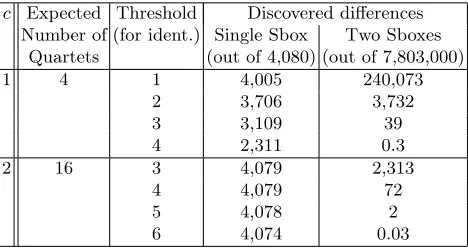
Due to the nature of the amplified attack, we do notneed additional data to find all these values. They are just suggested by the different boomerangs. The only thing we need to take into account is that we want all k·(2b −1) boomerangs to “succeed” (i.e., have enough quartets). In Table 2 we give an example of parameters that follows AES’ ones (k= 16, b= 8, n= 128).
One additional technicality is the fact that there is some (non-zero) chance that differential characteristics withtwoactive Sboxes in the second-layer, may
8
also be encountered. A simple analysis reveals that the expected number of quartets for a given two-active-Sboxes differences is 4c2·2−b. Moreover, there are
k
2
·(2b−1)2 possible such differences. Hence, to avoid too much noise from these cases we must demand that about k2/2·22b random variables fol-lowing a Poisson distribution with a mean value of about 4c2·2−b+1 will not interfere with the correct differences (whose number of right quartets follows a Poisson distribution with a mean value of 4c2).9Luckily, it is easy to see that for reasonable values of c, the problem is far from causing trouble. Obviously, the problem generalizes to more active Sboxes in the second layer, but it is (again) of no affect on the main result. We list in Table 2 also the expected number of two-active Sboxes differences that might pass for a cipher with AES’ parameters.
c Expected Threshold Discovered differences Number of (for ident.) Single Sbox Two Sboxes
Quartets (out of 4,080) (out of 7,803,000)
1 4 1 4,005 240,073
2 3,706 3,732
3 3,109 39
4 2,311 0.3
2 16 3 4,079 2,313
4 4,079 72
5 4,078 2
6 4,074 0.03
Table 2.Number of differences discovered by the (amplified boomerang) attack as a functioncfor AES’ parameters (k= 16, b= 8, n= 128).
This leads to the following problem: once we have all thesek·(2b−1), can we recover all (or part) ofL2? which we address next.
Partial Key Recovery At this point, we obtaink·(2b−1) output differences
L2(δi,j) where δi,j is a difference of j in the i’th Sbox (and zero in all other Sboxes). We now show how to divide these difference into thekdifferent Sboxes (as the order between them can be fixed arbitrarily, given that any order can be “adjusted” by usingL1).
9
The simplest method to do so, is to actually increase a bit the data/time complexity, and look for two active Sboxes in the second layer. It is easy to see that once we identify allδi,j’s values, then a difference in two active Sboxes can be written as∆=δi,j⊕δi0,j0, i.e.,L2(∆) =L2(δi,j⊕δi0,j0) =L2(δi,j)⊕(δi0,j0).
This holds only when i 6= i0, and thus, we can identify when two of the one active Sbox differences do not share an Sbox (as there will be a corresponding two active Sbox difference for them). Hence, the separation into different Sboxes can be done quite immediately, resulting in an attack that requiresc·2n/2+3b/2 chosen plaintexts, and about the same amount of time.
4.3 Attacking the Full Structure
We now turn our attention to the full ASASA construction. The main problem with directly applying the amplified boomerang attack to the full construction is that we cannot have a difference in the first Sbox layer in only a single Sbox. Luckily, the solution to the problem is to perform another birthday para-dox argument, and use a known-plaintext boomerang. The known-plaintext boomerang was first mentioned in [16], and its a natural extension of the boomerang (and the amplified boomerang attack). A random set ofc·23n/4+b/2known plain-texts, containsc2/2·23n/2+b pairs at the entrance toS0, i.e., offersc2/2·2n/2+b pairs with any given input difference, including those with a single active Sbox. As shown earlier, such amount of pairs is sufficient to generate right amplified boomerang quartets.
The only remaining task is the identification of the quartets ((P1, P2),(P3, P4)) themselves. If both (P1, P2) and (P3, P4) are pairs which are part of the quar-tet, in other words, have the same difference in a single byte after L0 (i.e.,
L0(P1⊕P2) =L0(P3⊕P4) with a single active Sbox), thenP1⊕P2=P3⊕P4. As before, we can also detect that L2(C1)⊕L2(C2) =L2(C3)⊕L2(C4). This suggests that finding the quartets ((P1, P2),(P3, P4)) can be easily done by:
– For all pairs of plaintext (Pi, Pj) store in a hash tablePi⊕Pj||Ci⊕Cj(along withPi andPj).
– Collect all collisions in the table as candidate quartets, and analyze them as before.
Given c·23n/4+b/2 known plaintexts, we expect c2/2·23n/2+b pairs, and in total c4/2·23n+2b quartets.10 Hence, we expect c4/2·2n+2b quartets to be suggested by the collisions in the table, out of whichc4/2 are right quartets that suggest the correct differences in the plaintexts and in the ciphertexts. These differences are of course, differences that become an active single Sbox (either throughL0or the inverse ofL2). Hence, once again, it is possible to identify all the differences that are transformed into a single active Sbox (on both sides of the scheme). Again, increasing the data complexity a bit (toc·23n/4+3b/4known
10
plaintexts), allows finding all the differences that go to a single active Sbox, by working with differences of two active Sboxes.
To conclude, one can easily identify thek·(2b−1) differences that lead to a single active Sbox thoroughL0 orL2, using a known plaintext boomerang. The attack takes c·23n/4+3b/4 plaintexts, and has memory and time complexity of
c2/2·23n/2+3b/2.
5
Differential Attack: Using the DDT
We denote by
δ(α) :=|{F(x) +F(x+α)|x∈Fn2}|
the number of possible output differences for a given input difference.
The basic idea is that the number of possible output differences depends on the number of active Sboxes in the first layer of Sboxes. More precisely, we rely on the following assumption.
Assumption 3 The number of possible output differences is (expected to be) smaller if only one Sbox is active in the first layer compared to the case when more than one Sbox is active in the first layer.
So the attack starts by computingδ(α) for all non-zeroαvalues. This takes time 22n and will be the bottleneck of the attack. Afterwards the list of allδ(α) is sorted in increasing order. We denote the sorted list byT withT0corresponding toαwith the smallestδ(α) value.
The assumption is now that the top of the list contains mostly input-differences
αsuch that
L(α) = (β1, . . . , βk)
with only one βi ∈ Fb2 non-zero. In other words, the top of the list contains mainly elementsαsuch thatα∈Vi for some (unknown) 1≤i≤k.
For recoveringVi we next have to sort thoseαvalues into different bins such that twoαvalues are in the same bin iff they are both in the same subspaceVi. We explain how to recover the firstVi, without loss of generalityV0, in detail. Recovering the remaining ones is very similar and will only be briefly sketched. We start by considering the firstt entries in the sorted table T. Choosingt
such that tbis smaller than 22n makes sure that this step is not the bottleneck of the attack. In most cases (as long asb≤22k) it would be sufficient to choose
t≤22k, as
22k
b
≤ 22kb= 22n.
The idea now is to identify a basis of V0. For any choice of b (linearly in-dependent) elements α1, . . . , αb among the first t elements of T we compute a penalty value
P({α1, . . . , αb}) :=
X
u∈span({α1,...,αb}),u6=0
δ(u),
According to assumption 3 there are now two cases to be considered. First, if all
αi values actually belong to V0 the penalty P({α1, . . . , αb}) is simply the sum over allδ(u) values foru∈Viand thus expected to be small. Second, if at least one αj does not belong toV0, at least (2b−1−1), that is roughly half, of the elements in span({α1, . . . , αb}) do not belong to any Vi and thus the penalty value is expected to be significantly higher.
Thus, this procedure allows to identify a basis ofV0. As will be shown below in the experimental results, this is successful with very good probability.
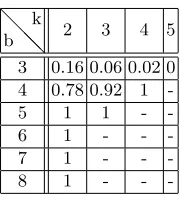
After recoveringV0 we simply remove all elements inV0from the listT and repeat the same procedure again. Experimentally, the overall success probability, i.e., the probability that we recover allVicorrectly is again rather high, as shown in Table 3 below.
@ @@ b
k
2 3 4 5
3 0.16 0.06 0.02 0 4 0.78 0.92 1
-5 1 1 -
-6 1 - -
-7 1 - -
-8 1 - -
-Table 3. Result of 100 runs of the attack for various parameters. In each run a new random ASASA instance has been generated. The numbers correspond to the success probability to recover all Vi correctly. The dashes correspond to experiments we did
not run due to limited resources.
It can be seen that the success probality increases for increasingkandbwith the exception ofb= 3. The reason for this exception might be linear components that occur in the randomly chosen 3-bit Sboxes.
6
Conclusion
in locating them as they are hidden by the external linear layers. Reciprocally, as soon as such a property has been detected, information on the linear layers can be easily deduced, and combining the data gathered from several properties allows to peel off the external linear layers efficiently. While our integral attack is the most efficient, it is not always applicable, and in such cases the other attacks should be considered. Moreover, we feel that the boomerang and differential attack vectors provide additional value, which could be further increased in the future if they are improved.
As our most efficient attacks have time complexity of roughly 23n/2, it seems that ASASA schemes must have a large block size nin order to be considered as secure candidates for white-box cryptography. However, this requires their black-box representations to be extremely large and inappropriate for practical use (e.g., in order to guarantee a minimal security level of 64 bits, an ASASA scheme requires storage of about 243 words, which is more than 10 terabytes). A natural future work item is to study the security of general SP-networks with more layers (e.g. ASASAS), and in particular, investigate if any of the attacks presented here can be generalized or improved on these constructions.
References
1. Eli Biham. Cryptanalysis of Patarin’s 2-Round Public Key System with S Boxes (2R). In Bart Preneel, editor,Advances in Cryptology - EUROCRYPT 2000, Inter-national Conference on the Theory and Application of Cryptographic Techniques, Bruges, Belgium, May 14-18, 2000, Proceeding, volume 1807 ofLecture Notes in Computer Science, pages 408–416. Springer, 2000.
2. Eli Biham, Orr Dunkelman, and Nathan Keller. The Rectangle Attack - Rectan-gling the Serpent. In Birgit Pfitzmann, editor, Advances in Cryptology - EURO-CRYPT 2001, International Conference on the Theory and Application of Crypto-graphic Techniques, Innsbruck, Austria, May 6-10, 2001, Proceeding, volume 2045 ofLecture Notes in Computer Science, pages 340–357. Springer, 2001.
3. Alex Biryukov, Charles Bouillaguet, and Dmitry Khovratovich. Cryptographic Schemes Based on the ASASA Structure: Black-Box, White-Box, and Public-Key (Extended Abstract). In Palash Sarkar and Tetsu Iwata, editors, Advances in Cryptology - ASIACRYPT 2014 - 20th International Conference on the Theory and Application of Cryptology and Information Security, Kaoshiung, Taiwan, R.O.C., December 7-11, 2014. Proceedings, Part I, volume 8873 ofLecture Notes in Com-puter Science, pages 63–84. Springer, 2014.
4. Alex Biryukov and Adi Shamir. Structural Cryptanalysis of SASAS.J. Cryptology, 23(4):505–518, 2010.
5. Julia Borghoff, Lars R. Knudsen, Gregor Leander, and Søren S. Thomsen. Slender-Set Differential Cryptanalysis. J. Cryptology, 26(1):11–38, 2013.
6. Christina Boura and Anne Canteaut. On the Influence of the Algebraic Degree of F-1 on the Algebraic Degree of G◦F.IEEE Transactions on Information Theory, 59(1):691–702, 2013.
8. Henri Gilbert, J´erˆome Plˆut, and Joana Treger. Key-Recovery Attack on the ASASA Cryptosystem with Expanding S-boxes. InCRYPTO 2015, Lecture Notes in Com-puter Science. Springer, 2015. to appear.
9. John Kelsey, Tadayoshi Kohno, and Bruce Schneier. Amplified Boomerang Attacks Against Reduced-Round MARS and Serpent. In Bruce Schneier, editor,Fast Soft-ware Encryption, 7th International Workshop, FSE 2000, New York, NY, USA, April 10-12, 2000, Proceedings, volume 1978 ofLecture Notes in Computer Science, pages 75–93. Springer, 2000.
10. Lars R. Knudsen. Truncated and Higher Order Differentials. In Bart Preneel, ed-itor,Fast Software Encryption: Second International Workshop. Leuven, Belgium, 14-16 December 1994, Proceedings, volume 1008 of Lecture Notes in Computer Science, pages 196–211. Springer, 1994.
11. Lars R. Knudsen and David Wagner. Integral Cryptanalysis. In Joan Daemen and Vincent Rijmen, editors, Fast Software Encryption, 9th International Workshop, FSE 2002, Leuven, Belgium, February 4-6, 2002, Revised Papers, volume 2365 of
Lecture Notes in Computer Science, pages 112–127. Springer, 2002.
12. Xuejia Lai. Higher Order Derivatives and Differential Cryptanalysis. In ”Sympo-sium on Communication, Coding and Cryptography”, in honor of James L. Massey on the occasion of his 60’th birthday, pages 227–233, 1994.
13. Luke O’Connor. On the Distribution of Characteristics in Bijective Mappings. J. Cryptology, 8(2):67–86, 1995.
14. Jacques Patarin and Louis Goubin. Asymmetric cryptography with S-Boxes. In Yongfei Han, Tatsuaki Okamoto, and Sihan Qing, editors,Information and Com-munication Security, First International Conference, ICICS’97, Beijing, China, November 11-14, 1997, Proceedings, volume 1334 ofLecture Notes in Computer Science, pages 369–380. Springer, 1997.
15. Tyge Tiessen, Lars R. Knudsen, Stefan K¨olbl, and Martin M. Lauridsen. Security of the AES with a Secret S-box. InFSE 2015, Lecture Notes in Computer Science. Springer, 2015. to appear.