Analysis of Optimized Energy TDMA
Scheduling By Non-Negotiable Interferences
R.Devendra Reddy1, K.Venkata Ramana
Assistant Professor, Department of CSE, Srikalahasteeswara Institute of Technology, Andhra Pradesh, India 1
Research Scholar, Department of CSE, Srikalahasteeswara Institute of Technology, Andhra Pradesh, India2
.
ABSTRACT: The optimized Time Division Multiple Access (TDMA) schedules can achieve high power efficiency, zero conflict, and reduced end-to-end delay. Based on the network-wide flow distribution, the energy is calculated. Based on the optimization model and transmission power on every link, we then propose an algorithm for deriving the TDMA schedules, utilizing the slot reuse concept to achieve minimum TDMA frame length. We present a new MAC protocol, which is referred to as Hybrid MAC (HMAC), which is suitable for WSNs in terms of energy efficiency, latency, and design complexity. HMAC combines channel-allocation schemes from existing contention-based and time-division multiple-access (TDMA) based MAC protocols to allow the understanding of tradeoffs between different performance metrics. Our future protocol (HMAC) combines energy-efficient features of the existing contention-based and time-division multiple access (TDMA)-based MAC protocols and adopts a short frame structure to speed up packet delivery. HMAC provides routing technique for coarse-grained quality-of-service (QoS) support at the MAC layer. In this project, we are going to implement an analysis of slot reuse with non-negligible interference and fixed frame length.
KEYWORDS: TDMA Scheduling, HMAC, Wireless Sensor Networks
I. INTRODUCTION
Wireless sensor networks have been proposed for a wide range of monitoring applications such as traffic and seismic monitoring, and fire detection [2]. Such networks consist of a group of nodes, with sensing, signal processing and wireless communication capabilities and limited battery energy. The nodes must quickly report the results to a data collection node or access point. Since the nodes are battery-powered, the medium access control (MAC) protocol is critical in determining network lifetime.
The medium access control (MAC) layer is a major consumer of sensor energy [2]. Different media access methods result in different time and energy efficiencies. Among those proposed MAC protocols, including Contention based access and Contention free access. TDMA is a suitable access method for wireless sensor networks. First, TDMA can save energy by eliminating collisions, avoiding idle listening, or entering inactive states until being allocated time slots. Secondly, as a collision-free access method, TDMA can bound the delays of packets and guarantee reliable communication.
rate (and hence higher energy consumption) to satisfy a deadline [4]. We therefore try to find a TDMA schedule that minimizes the number of time slots.
We present a new hybrid MAC protocol- H-MAC, for sensor networks. HMAC is simple and scalable since each node does not have to maintain neighborhood information. HMAC provides routing layer common-grained quality-of-service (QoS) support at the MAC layer. To the best of our knowledge, very few existing MAC layer works handle such QoS issues in WSNs. Our proposed protocol (HMAC) combines energy-efficient features of the existing contention-based and time-division multiple access (TDMA)-based MAC protocols and adopts a short frame structure to expedite packet delivery.
II. RELATED WORK
As to the aspect of TDMA scheduling against time performance, some references have studied how to minimize packet delay [3], how to improve fairness [5], how to maximize parallel operation [6], and how to shorten the total slot cost to finish a set of transmission tasks [7]. By setting up a convex optimization model, Cui et al. [4] adopted relaxation methods to solve the problem, and got a pareto optimal energy-delay curves, where the power consumption on switching was neglected. Sridharan et al. [7] developed a linear programming formulation and presented a distributed solution, which outperformed than random MAC in terms of fairness and delay etc. To minimize the overall transaction time, which was modeled as a graph partitioning problem, Gandham et al. [5] proposed a distributed edge-colouring algorithm. In order to save time for data collection, Ergen et al. [6] proposed three algorithms based on colouring method in graph theory. However, these two references did not consider the energy saving problem in sensor networks.
Hybrid MAC protocols [6], combine different medium access techniques to improve network performance. Zebra MAC (Z-MAC) [8] is built on B-MAC [4] and aims to improve channel utilization and latency under different network situations to overcome the shortcomings of both carrier sense multiple access (CSMA) and TDMA schemes. Based on the traffic load in the network, Z-MAC can act as CSMA in a low-traffic situation or like TDMA in a high-traffic situation. Funnelling-MAC specifically handles the funnel effect issue in areas with more intensive traffic load and eliminates collisions that frequently happen in such areas. Funnelling-MAC adopts a TDMA scheduling on nodes in the traffic intensive region while allowing nodes far away from the sink to compete channel access in a CSMA fashion. Similar to TDMA based MAC protocols, Hybrid MAC solutions incur high design complexity.
III. TDMA SCHEDULING FOR SLOT ASSIGNMENT
We build a cross-layer nonlinear optimization model to achieve energy efficiency with specified link reliability and bandwidth constraints. Scheduling algorithm for slot assignment in clustered WSNs .In the scheduling algorithm incorporates the slot reuse concept (from cellular networks) is calculating the schedules based on the optimal flows derived from the proposed optimization model. To derive a relationship between the delay incurred by a data packet at each backbone network node of the cluster (along its path to the sink) and the TDMA frame length . By reducing the TDMA frame length through slot reuse, the delay is minimized.
A. Slot assignment algorithm
The node-based scheduling algorithm has been adapted from classical multi-hop scheduling algorithm developed for general ad hoc networks with the idea of scheduling as many non-conflicting set of nodes as possible in each time slot . By following the two conditions are based on collision avoiding and get the clever time slot ‘s’.
Condition 1:Node 1 is not the sender or receiver of a previously scheduled link using slot s, and the link of node 1to be scheduled with slot ‘s’ does not have the same receiver as that of a previously scheduled link currently assigned slot ‘s’. Condition 2: Scheduling slot ‘s’ as a slot used by one of node 1’s links causes negligible interference occurred we can assign new slot.
1. for all each link (i, j) € E[G] do
2. F[i, j] ← 0; S[i, j] ← 0
4. Q[G] ← NIL
5. while More than one link (i, j) € E[G] do 6. while More than one link (i, j) €E[G]
where S[i, j] = 0 7. do
8. Randomly select a link (i, j) € E[G] such that
9. F[i, j] = 0 and S[i, j] = 0
10. Add link (i, j) to Q[G]
11. UPDATE NETWORK CONFIGURATION(G,E, Q, S) 12. end while
13. Select a link (i, j) € Q[G] such that D[i, j]/R[i, j] is minimal 14. for each required slot m in Mi do
15. Try assigning slot s = 1;
16. while any of the 3 interference criteria is not 17. satisfied do
18. Try assigning the next slot s[i,j] = s + 1; 19. end while
20. Assign slot s to required slot m of node i; 21. end for
22. F[i, j] ←0 and D[i, j] ← 0
23. for all link (m, n) € Q[G] where D[m, n] _= 0 do
24. D[m, n] ← D[m, n] − D[i, j] × R[m, n]/R[i, j]
25. end for
26. UPDATE NETWORK CONFIGURATION(G,E, Q, S) 27. end while
S[i, j] is a link-blocking parameter that indicates whether link (i, j) is interfered by any other active links. F[i, j] indicates whether the demand of link (i, j) is already scheduled in the current schedule period link (i, j) is delivering data with the traffic demand D[i, j].U[G] is a subset of the nodes whose demands have not been satisfied. P[G] is a subset of the wireless links along the selected path. A wireless link (i, j) is an element of E[G] if and only if node i and node j are within the maximum transmission range of each other Graph ---- > G, E--- > element. Q[G] be the subset of the links whose demands are satisfied
B. H-MAC
An effort to combine the best of both channel access schemes, we plan a hybrid protocol that includes scheduled And unscheduled periods in a slotted frame. The scheduled portion of the frame allows nodes to communicate without Collision and guarantees a certain data rate available to each node in the network, while the unscheduled portion Allows nodes to adapt to changing traffic conditions. Additionally, the scheduled portion allows nodes to distribute State information quickly and reliably.
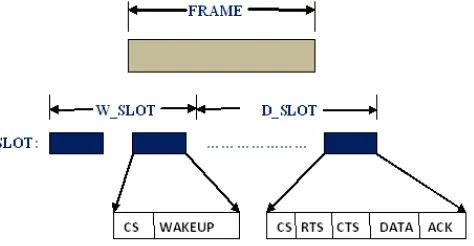
Time is planned into no overlapping frames, and each frame contains multiple very short wakeup slots (W_SLOT)and multiple data slots (D_SLOT), as shown in Fig. 1. The number of W_SLOTs can be set according to the density of the network, and the number of D_SLOTs can be set based on the possible traffic load in the network and end-to-end delay requirements. Each W_SLOT contains a carrier sensing (CS)and wakeup message (WAKEUP) period, and each D_SLOT includes CS and periods for RTS/CTS/DATA/ACK messages. The reason why we provide the CS periods at the start of both wakeup slots and data slots is that possible simultaneous transmissions could be initiated by multiple senders within region. Under such a scenario, channel access conflicts can happen during both receivers’ wakeup period and data transmission period when some receivers share the same wakeup slot or some senders happen to choose the same data slot. To reduce such channel access conflicts, all senders should perform CS to check the channel availability after backing off by some duration. The move back time is randomly distributed within a fixed contention window.
Each node turns on its radio during its own wakeup slot and sleeps during all the other wakeup slots. Each sender randomly picks up a data slot and announces the data slot number along with the receiver’s node identifier via a “WAKEUP” message in the receiver’s wakeup slot. Upon reception of a “WAKEUP” message, a node checks the embedded node identifier in the “WAKEUP” message. If it is the intended receiver, then the node turns on its radio for the incoming data packet in the specified data slot; otherwise, it just sleeps. If a broadcast address is included in the “WAKEUP” message, then all nodes receiving this message should wake up in the specified data slot simultaneously.
IV. ENERGY MODEL
Energy model describes the energy consumption as the multiplication of the power consumption and the operation time. The power consumption during the transmit mode, the receive mode, and the idle mode, are denoted by Pt Pr and
Pic respectively. When a source node spends T Seconds transmitting a packet, the radio dissipates
The power consumption during
Transmit mode ETx(T)=PtT
Receive mode ERx(T)=PrT
Idle mode
Ei(T)=PiT
Each source node transmits a control packet during its scheduled slot, and remains idle for (N-1) slots. After receiving the transmission schedule from the cluster-head, each source node sends its data packet to the cluster-head over its scheduled time slot. Therefore, the energy Consumption by each source node during a single session is:
Esn=PtTc+(N-1)PiTc+PrTch+PtTd
non-source node
Em=NPiTc +PrTch
Cluster-head node during a single session is Ech=ni(PiTc+ PtTd)+(N-ni) PiTc+PtTCh
The total system consumed energy
Esi=niEsn+(N-ni)Ein+Ech
V. PERFORMANCEMETRICS
Packet delivery ratio (PDR) measures the percentage of data packets generated by nodes that are successfully delivered, expressed as
Packet latency measures the average time it takes to route a data packet from the source node to the hub. It is expressed as.
Energy Consumption: To measures the energy expended per delivered data packet. It is expressed as
VII.CONCLUSION
The scheduling algorithm can be useful to WSNs with non uniformly distributed traffic and different link transmission power. Results announce the advantage of the cross-layer optimization model in energy conservation, and the effectiveness of the scheduling algorithm in reducing the TDMA frame length. This is particularly suitable for WSNs in terms of energy efficiency, latency, and packet-delivery ratio. HMAC combines energy-efficient schemes from existing contention-based and TDMA-based MAC protocols for WSN to improve network performance. Future work is needed to extend the proposed framework to the scenarios of slot reuse with an channel-reservation technique and unchanging frame length.
REFERENCES
[1] LiqiShi, Student Member, IEEE, and Abraham O.Fapojuwo, Senior Member, IEEE,” TDMA Scheduling with Optimized Energy Efficiency and Minimum Delay in Clustered Wireless Sensor Networks” IEEE Trans. Mobile Computing, vol. 9, no. 7, July 2010.
[2] Ergen, S.C., Varaiya, P.: TDMA: Scheduling Algorithms for Sensor Networks, Technical Report, Department of Electrical Engineering and Computer Sciences U.C.Berkeley.
[3] Polastre, R. Szewczyk, C. Sharp and D. Culler, The Mote Revolution: Low Power Wireless Sensor Network Devices,Hot Chips 16: A Symposium on High Performance Chips,August 2004.
[4] E. Uysal-Biyikoglu, B. Prabhakar and A. El Gamal, Energy-efficient Packet Transmission over a Wireless Link, [5] IEEE/ACM Transactions on Networking, vol.10, issue.12, pp. 487-499, August 2002.
[6] HepingWang,Xiaobo Zhang,Farid Nait- Abdesselam,Cross-layer Optimized MAC to Support Multihop Qos Routing for Wireless Sensor Networks, IEEE Trans. Vehicular TECH,Vol.59,no.5,June 2010.
[7] ZMAC:A Hybrid MAC for Wireless Sensor Networks InjongRhee, Ajit Warrier, Mahesh Aia and Jeongki MinDept. of Computer Science, North Carolina State University Raleigh, NC 27695.
[8] V. Rajendran, K. Obraczka, and J.J. Garcia-Luna-Aceves, “Energy-Efficient, Collision-Free Medium Access Control for Wireless Sensor Networks,” Proc. First ACM Conf. Embedded Networked Sensor Systems (Sensys ’03), pp. 181-192, Nov. 2003.
[9] S.C.Ergen and P. Varaiya, “TDMA Scheduling Algorithms for Sensor Networks,” technical report, UC Berkeley,july2005. [10] T.S.Rappaport,WirelessCommunications:PrincipleandPractice,second ed. Prentice Hall, 2001.
[11] Z. Chen and A. Khokhar, “Self organization and energy efficient TDMA MAC protocol by wake up for wireless sensor networks,” in Proc. IEEE ,SECON, Oct. 2004, pp. 335–341.