POR: Reliable data delivery for mobile adhoc
Network using ADMR Protocol
1 J. Chaitanya Kumar, 2Dr. Sunil Vijaya Kumar Gaddam ,3 E.Sudrashan 1
M.Tech Research Scholar, Department of CSE,
2
Principal, Alfa College of Engineering and Technology
3
Assistant Professor, Head of the Department, CSE Alfa College of Engineering and Technology, Allagadda, Kurnool
Andhra Pradesh, India
Abstract
:-In exceedingly powerful dynamic mobile ad hoc networks, there exist transmission issues, for example, delivering data packets, packet delay, time delay, node mobility etc., especially in substantial scale networks. The presented Position-based Opportunistic Routing (POR) protocol makes utilization of the stateless property of Geographical routing and the broadcast environment of remote medium. In any case this protocol is inclined to over heading issue and in addition absence of information privacy. To knock this issue, the proposed protocol is Adaptive Demand Driven Multicast Routing Protocol (ADMR) has been planned particularly for utilization in the ad hoc network environment. ADMR, source-based sending trees are made at whatever point there is minimum one source and one
Receiver in the network. Senders are not needed to advertise their aim to begin or quit sending information to the group, or to attach the gathering to that they have to send. Receivers vivaciously amend to the sending pattern of senders and versatility in the network with a specific end goal to productively balance overhead and conservation of the multicast routing state as nodes in the network move or wireless transmission conditions in the network change. ADMR additionally locates when portability in the network is so high it is not possible proficiently keep up multicast routing state.
Keywords:
POR; ADMR; Mobile ad hoc network; Multicast Routing; Geographical routing; Opportunistic routing ; GEAR Routing Protocol
I. INTRODUCTION
A mobile ad-hoc network (MANET) may be a
[1] Self-configuring infrastructure less
network of mobile devices connected by wireless. . Every device in a MANET is free to move severally in any direction, and might
therefore change amendment its links to completely different devices oftentimes. Each node ought to forward traffic unrelated to its own use, and then be a router. The primary
militarization every device to ceaselessly maintain the data needed to properly route traffic. Such networks would possibly operate by themselves or may even be connected to the larger Internet. MANETs square measure a unit of wireless ad-hoc networks that usually has routable networking atmosphere on prime of a Link Layer ad-hoc network. The network is restricted as a result of it doesn’t believe a antecedent infrastructure, like routers in wired networks or access points in managed (infrastructure) wireless networks. Instead,
each node participates in routing by
forwarding info for various nodes, and then the determination of that node forward knowledge is formed dynamically supported the network property. To boot to the classic routing, ad-hoc networks can use flooding for forwarding the info. A commercial hoc network typically refers to any set of networks where all devices have equal standing on a network and square measure liberated to go together with the other ad-hoc network devices in link vary. As a result of node quality in ancient topology-based MANET routing protocols [2], Position primarily based routing protocols square measure achieved, since the network is incredibly dynamic. Maintaining a route is hard in fastly dynamical configuration. If the trail breaks, knowledge packets can wander away and discovery procedures are going to be time overwhelming. Dynamically ad-hoc routing protocols build forwarding choices supported geographical position of a packet’s destination. Rather than destination node’s position, each node has got to recognize solely its own position and so the position of its neighbors to forward the packets. Once the network is extremely dynamic, position-based routing is employed. In position based mostly
position of the destination. In mobile ad-hoc networks (MANETS), geographic routing
protocols allow unsettled routing. A
geographic routing protocol uses the
placement info of mobile nodes. It’s high
quantifiability. While not complicated
modification to MAC protocol, a position-based opportunist routing is achieved. IEEE 802.11 provides collision dodging. This theme uses the advantage of greedy forwarding and opportunist routing. This POR protocol [3] may collects the info to the all neighboring nodes and send it. And single channel getting to be performed, whenever the link failure is happens best forwarder doesn’t forwards the packets then suboptimal candidates as transmit the packets insure amount of your time. Here a number of the specified reliable info is delivered, once a packet loss is occurred.
II. LITERATURE ANALYSIS
A. Position Based Opportunistic Routing Protocol (POR)
The outline of POR is focused around
geographic routing and opportunistic
forwarding. The nodes are thought to be mindful of their own area and the positions of their immediate neighbors. Neighborhood area data can be traded utilizing one-bounce
reference point or piggyback in the
radios, which can be actualized as intermittent signal, and additionally by answers when asked for by the source. At the point when a source node needs to transmit a packet, it gets the area of the end of the line first and after that connects it to the Packet header. Because of the end of the line node's development, the multi bounce way may separate from the genuine area of the last objective and a packet would be dropped regardless of the possibility that it has as of now been conveyed into the area of the goal. To manage such issue, extra check for the objective node is presented. At each one bounce, the node that advances the packet will check its neighbor rundown to see whether the end is inside its transmission range. In the event that yes, the packet will be specifically sent to the end, like the terminus area forecast plan portrayed in [5]. By performing such distinguishing proof check before voracious sending focused around area data, the impact of the way difference can be truly lightened. In ordinary artful sending, to have a packet got by different applicants, either IP show or a combination of steering and Macintosh convention is embraced. The previous is defenseless to MAC impact due to the absence of crash evasion help for telecast packet in present 802.11, while the last obliges complex coordination and is not simple to be actualized. In POR, we utilize comparative plan as the Macintosh multicast mode portrayed in. The packet is transmitted as unicast (the best forwarder which makes the biggest positive advancement at the terminus is situated as the following jump) in IP layer and different gatherings are attained utilizing Macintosh capture attempt. The utilization of
RTS/CTS/Information/ACK essentially
diminishes the impact and all the nodes inside the transmission scope of the sender can listen stealthily on the packet effectively with higher likelihood because of medium reservation. As the information packets are transmitted in a multicast-like structure, each of them is related to a novel tuple (src_ip, seq_no) where src_ip is the IP location of the source node and seq_no is the relating arrangement number. Each node keeps up a monotonically expanding arrangement number, and an Id_cache to record the ID (src_ip, seq_no) of the packets that have been as of late gotten. On the off chance that a packet with the same ID is gotten once more, it will be disposed of. Else, it will be sent without a moment's delay if the receiver is the following hop, or reserved in a Packet List in the event that it is gotten by a sending competitor, or dropped if the receiver is not tagged. The packet in the packet Rundown will be conveyed in the wake of sitting tight for a specific number of time spaces or disposed of if the same packet is gotten again amid the holding up period (this certainly implies a finer forwarder has officially completed the assignment).
B. Greedy Perimeter Stateless Routing (GPSR)
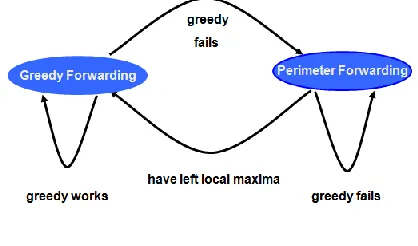
Fig 1 a)Greedy Forwarding b) Perimeter forwarding
Then again, as opposed to sending this guide occasionally and add to the network congestion, GPSR piggybacks the area signal on every message that is sent or sent by the node. Each node in GPSR has an area table of its own. At whatever point a message needs to be sent, the GPSR tries to discover a node that is closer to the goal than itself and advances the message to that node. Though, this strategy comes up short for topologies that don't have a uniform flow of nodes or contain voids. Subsequently, the GPSR adjusts to this circumstance by presenting the idea of edge routing using the right-hand chart traversal guideline. Each bundle transmitted in GPSR has a settled number of retransmits [1, 9]. This data is given to the node by the medium access (MAC) layer that is obliged to be agreeable to the IEEE 802.11 standard. This may render the GPSR convention unusable in its ordinary structure for WSN. The GPSR does not illustrate all the more on the move made in the event that a message is not able to be transmitted even in edge mode. At last GPSR prohibits the utilization of intermittent show of the area guides and piggybacks these signals on the messages sent by every node. As a Solid topographical routing convention
specific area and holding a guarantee in giving steering backing in WSN. Numerous late research meets expectations in WSN are
building applications utilizing GPSR
convention. Then again, GPSR is not initially intended for sensor arranges, a few issues are obliged to be altered before it is connected in sensor networks
Fig 2.a Assembling GPSR together
C.GEAR Routing Protocol:
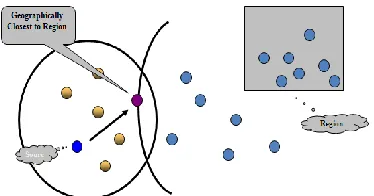
GEAR algorithm uses energy aware and geographically informed neighbor selection heuristics to route a packet towards the target region. Within a region, it uses a recursive
geographic forwarding technique to
Fig 2.b Assembling GEAR together
The principle thought of GEAR is utilizing the location information. The procedure of sending a packet to all the nodes in the target area comprises of two phases: 1. Sending the packets towards the target region: GEAR utilizes a land and vitality alert neighbor determination heuristic to course the packet towards the target area. There are two cases to consider:
(a) When a closer neighbor to the terminus exists: GEAR picks a next-jump node among all neighbors that are closer to the end of the line.
(b) When all neighbors are further away: In this case, there is an opening. GEAR calculation picks a next-jump node that minimizes some expense estimation of this neighbor. GEAR
Certainties: Rigging it underpins for
Geographic packet forwarding, extended
general network lifetime, high Scalability, routing adaptability, mobility Support, nearly
Stateless, Provincial Backing and
Augmentation of GPSR
Suppositions
Each inquiry packet has target area
indicated in the first bundle
Each node knows its position (GPS)
and remaining vitality level
Each node knows its neighbors' position
(guide) and their remaining vitality levels
links (Transmission) are bi-directional GEAR
Modes
• GEAR has two modes of operation for
bundle sending
• Energy-aware Regional Forwarding
• Recursive Geographic Forwarding /
Restricted Flooding
III. PROBLEM STATEMENT
This paper principally helps the issue of
information conveyance in exceedingly
changing versatile specially appointed
network. The main characteristic of ad hoc network is node mobility. Keeping up a course is troublesome one, due to quick changing network topology. Position based sharp routing convention is functioning admirably for the network is exceedingly dynamic.por convention which exploits stateless property of telecast nature. The POR is planned at focused around geographic steering and sharp sending. In geographic routing uses the area data of portable nodes. In POR convention voracious sending calculation is utilized. Ravenous sending tries to bring the message closer to the end in each one stage utilizing just local data. Along these lines each node advances the message to the neighbor that is best suited from an area motivation behind read. The most suitable neighbor will be the person who minimizes the separation to the end of the line in every step that node is termed as eager node. Ravenous sending will lead into a deadlock, wherever there is no neighbor closer to the goal. In the event that the best forwarder neglects to transmit the packet at interims a specific time, the other applicant that molded in the region a request may transmit the bundle. So the transmission won't be intruded, subsequent to there are a few competitors to transmit bundles. POR's top notch heartiness is accomplished by abusing potential multipath on the fly, on a for every bundle premise. The POR conquers the impediment of the
points over the framework in information conveyance in the exceedingly rapid MANET framework. However regarding bundle over heading and security the POR fall wretchedly and the framework accomplishes impressive misfortune.
IV. ADAPTIVE DEMAND DRIVEN
MULTICAST ROUTING
Adaptive Demand Driven Multicast Routing convention [4] (ADMR), another on-interest multicast steering convention for remote specially appointed networks that endeavors to decrease however much as could reasonably be expected any non-on interest parts among the convention. In ADMR, source-based sending trees are made at whatever point there is at least one source and one recipient inside the network.ADMR likewise distinguishes when versatility inside the network is simply excessively high to allow auspicious multicast state setup and support, without obliging GPS or other situating data or extra control movement. At the point when such high versatility is identified, ADMR briefly changes to flooding of each information bundle, and before long, the convention again makes an endeavor to work productively with multicast routing, on the grounds that the portability inside the network may have diminished.
The novel gimmicks of ADMR include:
• ADMR utilizes no occasional network wide surges of control packets.
• ADMR can catch high portability without the utilization of GPS or other situating data.
A. Information Structures
The multicast sending state for ADMR is kept up provincially by every node inside the accompanying three tables:
1. Sender Table
Legitimately contains one entrance for each multicast gathering address that this node is a dynamic sender. Each entrance inside the Sender Table incorporates the current between packet time for this node sending to the gathering, and a check of continuous keep-alive packets sent to the gathering since the last information bundle sent to the gathering by this node.
2. Enrollment Table
Coherently contains one passage for each blend of multicast gathering location and sender address that this node is either a recipient part or a sender. Each passage inside the Enrollment Table incorporates a banner to point if this node may be a receiver, a banner to point if this node may be a forwarder, the current between packet time for the sender sending to this gathering, and the current estimation of the keep-alive tally from bundles got for the gathering.
A. Node Table
Intelligently contains one passage for each other node in the network from that this node has gotten a tree overwhelmed or network overflowed ADMR packet. Each entrance inside the Node Table incorporates the grouping number from the ADMR header of
the premier late such packet, and a bitmap speaking to various past succession quantities of packets from this sender, used to catch and toss copy bundles all through a surge: if the bit comparing to some arrangement number amid this bitmap is situated, the bundle is thought to be a copy; all grouping numbers preceding that relating to the first bit inside the bitmap are likewise thought to be copies (or are of no any investment and are tossed). This utilization of a bitmap is like the information structure proposed for against replay assurance inside the IP Security conventions [5]. Each entrance in the Node Table moreover incorporates the past bounce address, taken from the Macintosh layer sending source location of the bundle got from this sender with this grouping number that contained the base jump check in its ADMR header. To oversee space in the Node Table, new passages should be made just as required and existing entrances should be held in a LRU design.
B. Multicast Packet Sending
Fig. 4: Multicast data Packet Forwarding
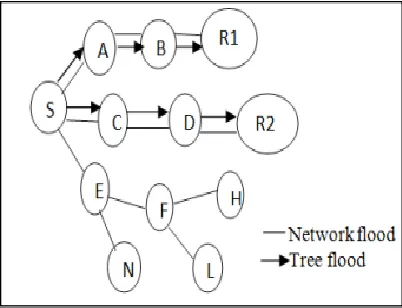
At the point when a node gets such a packet, it checks its Membership Table section for this gathering and source to figure out whether it ought to forward the packet; the packet subsequently streams along the tree from the sender to the gathering receivers however is not compelled to take after particular extensions in the tree and is consequently ready to naturally be sent around briefly broken connections or fizzled sending nodes in the tree (Figure 4). In the event that, rather, the surge sort signal in the ADMR header shows a system surge for the bundle, the packet will be overflowed among all nodes. For either sort of surge, every Node Table and the arrangement number in a packet ADMR header dependably confine any node that ought to forward the bundle to do so at generally once. The surge of
a packet obliged to the nodes in the multicast sending tree as a tree surge, and to the more general kind of surge of a bundle through all nodes as a system surge (Figure 5). This utilization of flooding inside the multicast sending tree is like the "sending gathering" idea presented in the FGMP convention [6] and utilized likewise as a part of ODMRP [7], aside from that our sending state is particular to every sender instead of being imparted for the whole gathering. At the point when a sender utilizing ADMR sends a multicast bundle, it surges inside the multicast appropriation tree just towards the bunch's recipients, though with FGMP or ODMRP, the packet likewise surges back towards some other senders that are not beneficiaries. In spite of the fact that this distinction obliges us to keep up source-particular state in sending nodes, such state is obliged in any case with a specific end goal to help the source-particular
multicast administration model [8].
Furthermore, even FGMP and ODMRP oblige source-particular state at every node, since they must distinguish copy bundles amid a surge inside the sending gathering, and any kind of packet identifiers utilized for this copy discovery when there may be numerous gathering senders
Fig. 5: Tree flood Vs Network flood Fig. 6: New Source S
C. New Multicast Source
When a node S originates a multicast packet for some group G for which it is not currently an active sender, it will not have a Sender Table entry for G. In this case, node S creates and initializes a new Sender Table entry for G. The inter-packet time in this entry may be set to a default value, may be assumed based on the IP port numbers used in the packet, or may be specified by the sending application if an API is available for this purpose. After sending this packet, node S buffers for a short time subsequent multicast packets that it might originate to group G, rather than sending them immediately as they are generated, in order to allow the routing state in the network to be formed for receivers interested in this group and sender. Once S receives at least one RECEIVER JOIN packet, S then begins sending any buffered packets to the group as normal multicast packets. The packet exchange which takes place when a new source becomes active is depicted in Figure 6. Most subsequent multicast packets for group G from node S will be flooded only within the members of the multicast forwarding tree established for this group and sender (a tree flood). However, it is possible that some interested receivers did not receive this initial packet from S. To allow for such occurrences, node S uses a network flood rather than a tree flood for certain of its subsequent existing multicast data packets The time between each packet selected to be sent as a network flood is increased until reaching a slow background rate, designed to tolerate
factors such as intermittent wireless
interference or temporary partition of the ad hoc network.
D. Tree Pruning
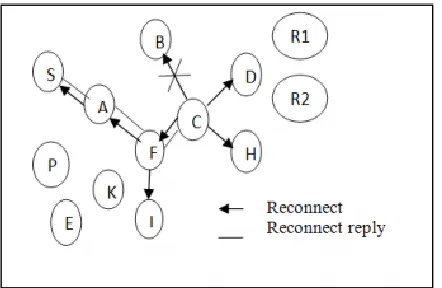
Each forwarder node in the multicast forwarding tree for group G and source S automatically expires its own state and leaves the tree when it determines that it is no longer necessary for multicast forwarding. Similarly, the multicast source S automatically expires its state and stops transmitting multicast data packets when it determines that there are no downstream receiver members of the group for this source; the sender continues to send certain of its subsequent
Fig. 7: Source S Responds with Reconnect Reply
Multicast packet as infrequent background network flood packets, but otherwise defers sending other multicasts for this group until receiving at least one new RECEIVER JOIN packet
V. CONCLUSION
source node to transmits packets to the end and
it moves to the end node without
correspondence voids. By utilizing this protocol the absence of security issue has been found in the past techniques for information conveyance will be overcome and the exactness of information conveyance has been expanded. The ADMR principle gives great packet delivery and lessens copy transferring and decreases time deferral contrast with existing system with utilizing POR.
REFERENCES
[1] S.Sharon Ranjini, G.ShineLet, “Position-based Opportunistic Routing for Highly Dynamic MANETS” International Journal of Advanced Research in Computer Engineering & Technology (IJARCET) Volume 2, Issue 2, February 2013.
[2] Karthikeyan.R, Sasikala.K, Reka.R, “A Survey On Position – Based Routing In Mobile Ad Hoc Networks” International
Journal of P2P Network Trends and
Technology (IJPTT) -Volume3Issue7-August 2013.
[3] M. Chandrika , N. Papanna,” Comparison and Simulation of POR and E-POR Routing Protocols in MANETs” International Journal of Computer Science and Mobile Computing IJCSMC, Vol. 2, Issue. 5, May 2013, pg.425 – 429.
[4] J. G. Jetcheva and D.B.Johnson, “Adaptive Demand driven Multicast Routing in multi-hop wireless ad hoc network,” Second Symposium
on Mobile Ad Hoc Networking and
Computing, pp.33-44,2001.
[5] D. Son, A. Helmy, and B. Krishnamachari, “The Effect of Mobility Induced Location Errors on Geographic Routing in Mobile Ad
Hoc Sensor Networks: Analysis and
Improvement Using Mobility Prediction,” IEEE Trans. Mobile Computing, vol. 3, no. 3, pp. 233-245, July/Aug. 2004.
[6] C.-C. Chiang, M. Gerla, and L. Zhang,
(1998a):” Forwarding Group Multicast
Protocol (FGMP) for multihop, mobile wireless networks,”ACM-Baltzer Journal of Cluster Computing, vol. 1, no. 2, pp. 187–196.
[7] Sung-Ju Lee, Mario Gerla, and Ching-Chuan Chiang “On demand multicast routing
protocol” Wireless Adaptive Mobility
Laboratory, Computer Science Department. University of California Los Angeles, CA 90095-1596
[8] J.J. Garcia-Luna-Aceves and E.L.
Madruga. A Multicast Routing Protocol for Ad-HocNetworks. In Proceedings of the IEEE
Con on Computer Communications,
INFOCOM 99, pages 784–792, March 1999.