Using Mel-Frequency Cepstral Coefficients
in Missing Data Technique
Zhang Jun
Department of Computer Science, City University of Hong Kong, Kowloon, Hong Kong, China
School of Electronic and Communication Engineering, South China University of Technology, Guangzhou 510640, China Email:zhj [email protected]
Sam Kwong
Department of Computer Science, City University of Hong Kong, Kowloon, Hong Kong, China Email:[email protected]
Wei Gang
School of Electronic and Communication Engineering, South China University of Technology, Guangzhou 510640, China Email:[email protected]
Qingyang Hong
Department of Computer Science, City University of Hong Kong, Kowloon, Hong Kong, China Email:[email protected]
Received 19 February 2003; Revised 16 June 2003; Recommended for Publication by Mukund Padmanabhan
Filter bank is the most common feature being employed in the research of the marginalisation approaches for robust speech recognition due to its simplicity in detecting the unreliable data in the frequency domain. In this paper, we propose a hybrid approach based on the marginalisation and the soft decision techniques that make use of the Mel-frequency cepstral coefficients (MFCCs) instead of filter bank coefficients. A new technique for estimating the reliability of each cepstral component is also presented. Experimental results show the effectiveness of the proposed approaches.
Keywords and phrases:MFCC, missing data techniques, robust speech recognition.
1. INTRODUCTION
In spite of many years of efforts, the robustness of speech recognition in the noisy environment is still a fundamen-tal unsolved issue in today’s automatic speech recognition (ASR) systems. Recently, missing data theory [1,2,3,4] is proposed as an operationalization to improve the robustness of the ASR decoding process. Experimental results show that it can significantly restore the ASR performance with little prior assumptions made about the characteristics of the envi-ronment noises. However, most of the previous marginalisa-tion approaches are only derived and tested for the filter bank features due to the convenience of detecting the unreliable data in the frequency domain. Most often, cepstral features are the parameterisation of choice for many speech recog-nition applications. For example, the Mel-frequency cepstral coefficient (MFCC) [5] representation of speech is proba-bly the most commonly used representation in speech
recog-nition and recently being standardized for the distributed speech recognition (DSR) [6]. Generally, cepstral features are more compactible, discriminable, and most importantly, nearly decorrelated such that they allow the diagonal covari-ance to be used by the hidden Markov models (HMMs) ef-fectively. Therefore, they can usually provide higher base-line performance over filter bank features. Applying miss-ing data techniques to cepstral features is obviously attractive and natural.
information while using the clean speech models. If we re-gard these components as reliable data, then the marginal-isation approach should also be applied to the cepstral fea-tures. Its performance will depend on how severely the noise distorts the cepstral feature. Fortunately, it can be seen that even the full band features that smear distortions over the entire vector are much more affected by band-limited noises than those features that localize the spectral distortions, they do perform well in many full band noises. This phenomenon is also reported in [7,8,9]. It means that in many cases, the full band features are not more affected by the noise than the subband ones. Therefore, it can be expected that the cepstral marginalisation will also perform well under such situations. To implement the cepstral marginalisation approach, we propose a new technique to evaluate the reliability of each feature component in the Mel-cepstrum domain. Two cri-teria for detecting the reliable cepstral components are pre-sented and combined together to form a more accurate joint decision. Then the marginalisation approach is applied to the MFCCs by using this combined criterion. Based on the pro-posed cepstral marginalisation approach, a cepstral soft de-cision approach is also developed to further improve the ro-bustness of the MFCC recognizer.
2. CEPSTRAL MARGINALISATION
2.1. Detection of the reliable cepstral features
The major difficulty of the cepstral marginalisation is how to determine the reliable/unreliable components of the speech data. In this paper, we propose two ways to estimate the in-fluence of noises on the cepstral component. One is based on the speech enhancement and the other is based on a noise mask model. By setting the threshold, a criterion for select-ing the reliable data can be obtained from each method. Af-ter that, we combine these two criAf-teria together and propose a soft technique to determine the final reliable/unreliable de-cision for each cepstral component.
Assume that the noise is added in the time domain. Let
cy(i) andcx(i) denote theith MFCC components of the noisy speech and the clean speech, respectively, where 1 ≤i ≤I,
I is the dimension of the MFCC vector. Thency(i) can be and N(j) denote the jth filter bank outputs of the linear power spectra of the noisy speech, clean speech, and noise, respectively. Thencn(i) can be expressed as
cn(i)=cx(i)−cy(i)= hancement techniques like the spectral subtraction,X(j) can be estimated, so the estimation ofcn(i) can be given by the garded as unreliable. So the first criterion for choosing a reli-able component can be given by the following:
cy(i)> β1cˆn(i). (4)
Obviously, speech enhancement algorithms cannot al-ways give accurate estimations of the clean features, espe-cially when the SNR is low. It can be seen that an unreliable component with a small ˆcn(i), which is caused by the inac-curacy of the enhancement, cannot be detected using (4). To overcome this defect, we propose to use another method to estimate the influence of the noises. For additive noises,cy(i) can be expressed as
cy(i)=
Assume that either the clean speech or the noise will domi-nate in each filter bank channel and the channel output can be approximated to the dominating one. For each channel, a threshold can be applied to determine which signal is domi-nating. ThenY(j) can be expressed as threshold factor which can be determined in the experiment. Substituting (6) in (5), we have the following:
According to (7), another criterion for choosing the reliable components can be given by
an “and” operation to achieve such a decision, that is, a com-ponent will be considered as reliable when conditions (4) and (8) are satisfied.
2.2. Detection of the reliable delta cepstral coefficients
In traditional ASRs, the time derivatives are usually added to the static parameters to enhance the recognizer performance. The marginalisation approach can also be applied to these coefficients. In the filter bank marginalisation, one solution to this problem is called the “strict mask” [10]. It treats the derivatives as missing if any of the features involved in their calculations are missing. The strict mask is sufficient for fil-ter bank features because the reliable features tend to be clus-tered into time-frequency blocks. However, it may not be fea-sible for cepstral features since the missing mask pattern is more random. Applying the strict mask will cause the sparse-ness of the reliable derivatives, thus, we propose to use an-other way to detect the reliable derivatives. It is also based on the combination of the enhancement and noise mask meth-ods that are described inSection 2.1.
Usually, the delta coefficients can be calculated using the following expression:
The noise of the delta cepstral coefficients can be ex-pressed as
So, one criterion for choosing the reliable delta cepstral components can be given by
∆cy(i)> β3∆cˆn(i). (12)
On the other hand, with the noise mask approximation, ∆cy(i) can be expressed as
So, another criterion for choosing the reliable delta cep-stral components can be given by
T
Combining these two criteria, a delta cepstral component can be decided as reliable when conditions (12) and (14) are satisfied.
2.3. Marginalisation
Using (4), (8) and (14), the reliable cepstral and delta cepstral components can be picked out from the whole feature vec-tors. For the continuous density HMM (CDHMM) recogni-tion system with diagonal-only covariance, the marginalised probability of observations can be given by
px|Cm=
wherexis the observation vector,Cmis themth state of the HMM model, wmnis the weight factor associated with the
nth Gaussian component of the stateCm, andµmn andσ2 mn are the mean and variance of the Gaussian PDF.
3. SOFT DECISION
3.1. Noisy speech model
Due to the cepstral transformation, even a little noise that ex-ists in some frequency bands will affect all the feature compo-nents. So, in a noisy environment, each cepstral component will always have a portion of the noise in the clean speech. Obviously, it is more sensible to adjust the weight of each component according to its influence level than using a bi-nary decision of reliable or unreliable.
Given a noisy observation, the components that are less affected by the noise will have distributions close to the clean ones while those severely affected will be more uncertain and might have much different characteristics. According to [4], the distribution of a noisy observation can be modeled as a weighed sum of a known distribution that is obtained dur-ing the traindur-ing process and an unknown distribution for the uncertain data. We model the noisy speech in a similar way. While using the diagonal-only covariance, the probability of a noisy observation can be given by
and where p2(xi) denotes the distribution of uncertain data. When no prior knowledge about this distribution is avail-able, it can be assumed that the uncertain data will have a uniform distribution in the range of values observed during training as
p2
xi= x 1
i,max−xi,min, (18)
wherexi,maxandxi,minare the maximum and minimum val-ues of theith component observed in the training data.
In the acoustic backing-offapproach,εirefers to the prior probability of observing a reliable datum and needs to be de-termined in advance. It is obviously that this assumption is not suitable for real world applications. Instead of setting up a static value in advance, we adjustεiaccording to the noise level of each cepstral component. These levels are estimated using the two methods described inSection 2.
3.2. Weights adjustment
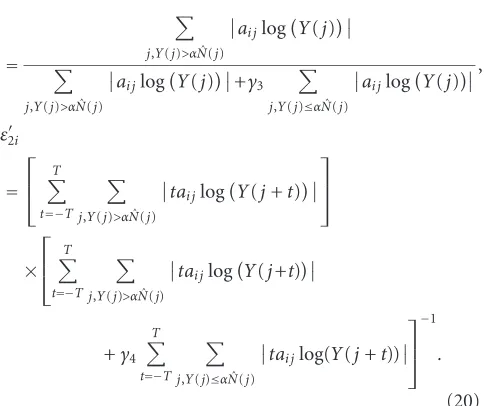
Letεiandεidenote the weights for theith cepstral and delta cepstral components, respectively. Using the enhancement method, we can adjust them by
ε1i=
Using the noise mask method, the weights can be ad-justed as
These weights can also be combined together to improve the performance. We calculate the combined weights by
εi=minε1i,ε2i,
ε
i =minε1i,ε2i.
(21)
4. EXPERIMENTS
Clean speech data for training and testing are taken from the TI46 speaker-dependent isolated word corpus. Digits 0– 9 spoken by all male speakers are used. There are 26 utter-ances of each digit from each speaker: 10 of these utterutter-ances are designated as training tokens and the other 16 are desig-nated as testing tokens. Speech data are sampled at 12500 Hz and linearly quantified with 12 bits. Four noises from the NOISEX-92 [11] database with distinct characteristics: white noise, F16 noise, pink noise, and factory noise, are artificially added to the clean speeches with different SNRs.
Each digit is modeled by an HMM which composes of five no-skip straight-through emitting states. Each state has three diagonal Gaussian mixtures. Both filter bank co-efficients and MFCCs are used in the experiments. Input speeches are segmented into overlapping frames with 25 mil-liseconds length and 10 milmil-liseconds shift. Twenty triangular filters are uniformly distributed on a Mel-frequency scale and their log energy outputs form the 20-dimension filter bank coefficients. Twelve MFCCs are computed using DCT trans-formation on these filter bank coefficients. The delta coeffi -cients are computed and appended to the basic acoustic vec-tors in the front-end. We use the HTK tools 3.0 [12] for both the feature extraction and the HMM model training.
4.1. Evaluation of the proposed approaches
The performance of the proposed approaches is evaluated with the four types of noises. For the cepstral marginalisa-tion and soft decision approaches, a simple nonadaptive lin-ear spectral subtraction in (22) is employed as an enhance-ment preprocess:
ˆ
X(j)=maxY(j)−Nˆ(j),λY(j), (22)
whereλis the flooring factor, which is set to 0.05 in the ex-periments. The first 20 frames of noisy speeches are assumed to be the noises. Their average power spectra are used to es-timate ˆN(j). We empirically setα,β1–β4, andγ1–γ4to 1.0. The HTK recognition process is modified according to (15) and (16) to implement the marginalisation and soft decision approaches.
Table 1shows the average recognition rates of the base-line MFCC recognizer and the proposed approaches. For comparison, the results of the spectral subtraction (SS), cep-stral mean subtraction (CMS), and filter bank marginalisa-tion with SNR criterion plus strict mask are also listed in the table. Here, “MG” refers to marginalisation and “SD” refers to soft decision.
Table1: Average recognition rates of various techniques for the four types of noises.
Clean 25 dB 20 dB 15 dB 10 dB 5 dB 0 dB
MFCC D 100.00 99.59 97.64 87.91 58.61 25.78 11.50
MGCC D+SS 100.00 99.50 98.54 92.17 75.24 49.25 22.54
MFCC D+CMS 100.00 98.89 97.90 89.85 64.65 29.71 12.09
FBANK D+SS+MG 99.92 99.90 99.73 98.83 88.29 64.42 35.71
MFCC D+SS+MG 100.00 99.94 99.84 98.61 93.36 75.45 42.79
MFCC D+SS+SD 100.00 99.90 99.79 99.53 98.22 90.02 51.23
Table2
(a) Average recognition rates of the cepstral marginalisation approaches with different criteria for the four types of noises.
Clean 25 dB 20 dB 15 dB 10 dB 5 dB 0 dB
SS 100.00 99.50 98.54 92.17 75.24 49.25 22.54
Criterion 1 100.00 99.82 99.71 98.28 91.99 71.06 36.40
Criterion 2 100.00 99.71 99.06 95.43 81.10 51.92 21.22
Combined criterion 100.00 99.94 99.84 98.61 93.36 75.45 42.79
(b) Average recognition rates of the cepstral SD approaches with different weights for the four types of noises.
Clean 25 dB 20 dB 15 dB 10 dB 5 dB 0 dB
Weight 1 100.00 99.80 99.69 99.44 97.56 84.40 42.36
Weight 2 100.00 99.88 99.74 99.08 94.91 79.52 43.53
Combined weight 100.00 99.90 99.79 99.53 98.22 90.02 51.23
white noise, slightly better for the F16 noise and pink noise, and significantly better for the factory noise. The cepstral SD approach is superior to both marginalisation approaches for all types of noises. These results confirm our prediction that the cepstral marginalisation can work well for many kinds of full band noises, and also show the effectiveness of the SD approach.
4.2. Combination of the criteria and the weights To show the effectiveness of our combined criteria for the cepstral marginalisation, Table 2a lists the average recogni-tion rates of different criteria for the four types of noises. Here, criterion 1 refers to the criteria shown in (4) and (12), criterion 2 is from (8) and (14), and the combined criterion is from (4), (8) and (14). The results of the SS are also listed in the table.
It can be seen that the recognition rates are improved whenever the marginalisation approaches are applied with criterion 1, criterion 2, or the combined criterion. For in-dividual criteria, criterion 1 gives better performance than criterion 2. This is probably because criterion 1 is more closely related to the enhancement preprocess. Nevertheless, the combined criterion is able to achieve the highest recog-nition rates. Thus, it can conclude that the joint decision is more accurate than the individual one.
The average recognition rates of the cepstral SD approach with the individual or combined weights are also listed in the
Table 2b. Here, weight 1 is used from (19), weight 2 is derived from the (20), and the combined weight refers to (21). As the combined criterion does in the cepstral marginalisation,
the combined weight also gives the best performance in the cepstral SD approaches.
4.3. Influence of different types of noises to the cepstral feature
One of the major factors that affect the performance of the marginalisation and SD approaches is how severely the noises distort the features. If we consider the effect of cepstral dis-tortions to be additive, the normalized mean square error (NMSE) can be used to evaluate the distortion level of a cepstral component [13]. To show the impacts of diff er-ent types of noises to the MFCCs, we compute the NMSE between the corresponding components of the clean and noisy MFCCs when the SNR is 10 dB. The results are listed inTable 3.
Table3: NMSE of the 12 MFCCs for the four types of noises when the SNR is 10 dB.
C1 C2 C3 C4 C5 C6 C7 C8 C9 C10 C11 C12
White 2.53 0.79 0.96 0.52 0.94 0.47 0.96 0.72 0.97 0.89 0.80 1.07
F16 1.02 0.47 0.60 0.41 0.65 0.44 0.80 0.67 2.09 2.15 0.73 0.85
Pink 1.24 0.53 0.70 0.41 0.75 0.43 0.77 0.67 0.88 0.80 0.76 0.88
Factory 0.85 0.52 0.59 0.38 0.72 0.42 0.75 0.66 0.88 0.79 0.69 0.97
white noise is the largest. This phenomenon explains why the cepstral marginalisation approach performs worse under the white noise condition.
5. CONCLUSION
In this paper, we propose the new cepstral marginalisa-tion and cepstral soft decision approaches for the MFCCs. In the experiments on the TI46 speaker-dependent isolated word corpus and four types of noises from the NOISEX-92 database, it shows that the proposed approach can effi -ciently improve the performance of the MFCC recognizer and give higher average recognition rates than the filter bank marginalisation. It shows that the marginalisation approach that is applied to the features rather than filter bank represen-tations can also perform well when these features are not too severely affected by the environment noises. The cepstral soft decision approach gives the best performance in the experi-ments. It is believed that further improvement can be gained when the weights are determined in a more precise manner.
ACKNOWLEDGMENT
This work was supported by the City University Strategic Grant 7001416 and 7001488.
REFERENCES
[1] M. Cooke, A. Morris, and P. Green, “Missing data techniques for robust speech recognition,” inProc. IEEE Int. Conf. Acous-tics, Speech, Signal Processing (ICASSP ’97), vol. 2, pp. 863– 866, Munich, Germany, April 1997.
[2] A. Morris, M. Cooke, and P. Green, “Some solution to the missing feature problem in data classification, with applica-tion to noise robust ASR,” inProc. IEEE Int. Conf. Acoustics, Speech, Signal Processing (ICASSP ’98), vol. 2, pp. 737–740, Seattle, Wash, USA, May 1998.
[3] M. Cooke, P. Green, L. Josifovski, and A. Vizinho, “Ro-bust automatic speech recognition with missing and unreli-able acoustic data,”Speech Communication, vol. 34, no. 3, pp. 267–285, 2001.
[4] J. de Veth, B. Cranen, and L. Boves, “Acoustic backing-offas an implementation of missing feature theory,” Speech Com-munication, vol. 34, no. 3, pp. 247–265, 2001.
[5] S. B. Davis and P. Mermelstein, “Comparison of parametric representations for monosyllabic word recognition in contin-uously spoken sentences,” IEEE Trans. Acoustics, Speech, and Signal Processing, vol. 28, no. 4, pp. 357–366, 1980.
[6] ETSI ES 201 108 V 0.08, “Speech Processing, Transmission and Quality Aspects (STQ); Distributed Speech Recognition; Front-End Feature Extraction Algorithm; Compression Algo-rithm,” 1999.
[7] S. Okawa, E. Bocchieri, and A. Potamianos, “Multi-band speech recognition in noisy environments,” in Proc. IEEE Int. Conf. Acoustics, Speech, Signal Processing (ICASSP ’98), pp. 641–644, Seattle, Wash, USA, May 1998.
[8] A. Morris, A. Hagen, H. Glotin, and H. Bourlard, “Multi-stream adaptive evidence combination for noise robust ASR,”
Speech Communication, vol. 34, no. 1-2, pp. 25–40, 2001. [9] R. Hariharan, I. Kiss, and O. Viikki, “Noise robust speech
parameterization using multiresolution feature extraction,”
IEEE Trans. Speech, and Audio Processing, vol. 9, no. 8, pp. 856–865, 2001.
[10] J. P. Barker, L. Josifovski, M. P. Cooke, and P. Green, “Soft decisions in missing data techniques for robust automatic speech recognition,” inProc. International Conference on Spo-ken Language Processing (ICSLP ’00), vol. 1, pp. 373–376, Bei-jing, China, October 2000.
[11] A. Varga and H. J. M. Steeneken, “Assessment for automatic speech recognition: II. NOISEX-92: a database and an exper-iment to study the effect of additive noise on speech recog-nition systems,” Speech Communication, vol. 12, no. 3, pp. 247–251, 1993.
[12] S. Young, D. Kershaw, J. Odell, D. Ollason, V. Valtchev, and P. Woodland, The HTK Book (for HTK Version 3.0), Cam-bridge University Technical Services, CamCam-bridge, UK, 2000. [13] J. Huerta and R. Stern, “Speech recognition from GSM codec
parameters,” inProc. International Conference on Spoken Lan-guage Processing (ICSLP ’98), vol. 4, pp. 1463–1466, Sydney, Australia, November 1998.
Zhang Junwas born in Guangdong province, China, in 1975. He received his B.S and M.S. degrees from Zhong Shan University, China, in 1997 and 2000, respectively, and his Ph.D. degree from the South China University of Technology, China, in 2003, all in electronic and communication engineering. He worked as a Re-search Assistant in the City University of Hong Kong from August 2002 to May 2003. He is currently in the School of Electronic and Communication Engineering, South China University of Technol-ogy. His research interests include robust speech recognition and low bit rate speech coding.
Sam Kwongreceived his B.S. and M.S. de-grees in electrical engineering from The State University of New York at Buffalo, USA and University of Waterloo, Canada, in 1983 and 1985, respectively. In 1996, he obtained his Ph.D. degree from the Univer-sity of Hagen, Germany. From 1985 to 1987, he was a Diagnostic Engineer with the Con-trol Data Canada where he designed the di-agnostic software to detect the manufacture
Wei Gangwas born in January 1963. He re-ceived the B.S., M.S., and Ph.D. degrees in 1984, 1987, and 1990, respectively, from Ts-inghua University and South China Univer-sity of Technology. He was a visiting scholar to the University of Southern California from June 1997 to June 1998. He is currently a Professor at the School of Electronic and Communication Engineering, South China University of Technology. He is a committee
member of the National Natural Science Foundation of China. His research interests are signal processing and personal communica-tions.