R E S E A R C H
Open Access
Efficient cooperative compressive spectrum
sensing by identifying multi-candidate and
exploiting deterministic matrix
Jia Li
1, Qiang Wang
1*, Wenjie Yan
2and Yi Shen
1Abstract
Cooperative spectrum sensing exploits the spatial diversity to improve the detection of occupied channels in cognitive radio networks (CRNs). Cooperative compressive spectrum sensing (CCSS) utilizing the sparsity of channel occupancy further improves the efficiency by reducing the number of reports without degrading detection performance. In this paper, we firstly and mainly propose the referred multi-candidate orthogonal matrix matching pursuit (MOMMP) algorithms to efficiently and effectively detect occupied channels at fusion center (FC), where multi-candidate identification and orthogonal projection are utilized to respectively reduce the number of required iterations and improve the probability of exact identification. Secondly, two common but different approaches based on threshold and Gaussian distribution are introduced to realize the multi-candidate identification. Moreover, to improve the detection accuracy and energy efficiency, we propose the matrix construction based on shrinkage and gradient descent (MCSGD) algorithm to provide a deterministic filter coefficient matrix of lowt-average coherence. Finally, several numerical simulations validate that our proposals provide satisfactory performance with higher probability of detection, lower probability of false alarm and less detection time.
Keywords: CCSS; MOMMP; Multi-candidate identification; MCSGD; Deterministic matrix
Introduction
Cognitive radio (CR), as a promising technology to improve the spectrum efficiency in wireless communica-tion, has drawn great attentions in recent years [1]. By detecting the channel states or spectrum holes, the CR users are allowed to communicate over the spectrum allo-cated to primary users (PUs) when they are not fully utilizing it. Spectrum sensing is the key technology for the above application [2]. Considering that the detection of a single CR user may suffer from the wireless channel fading and the hidden terminal problem, cooperative spectrum sensing (CSS) exploiting several spatially distributed CR users is introduced to improve the detection performance for whole CR networks (CRNs) [3].
Although CSS benefits from cooperative gain to improve the detection accuracy, cooperation overhead
*Correspondence: [email protected]
1Department of Control Science and Engineering, Harbin Institute of Technology, 150001 Harbin, China
Full list of author information is available at the end of the article
is also incurred at the same time, which refers to any extra sensing time, delay, energy, reports, and operations devoted to CSS [4–6]. Traditionally, in centralized CSS, fusion center (FC) collects all sensing data and then makes decisions on channel occupancy. However, significant bandwidth is required due to the reporting over a wired high-speed backbone. One natural idea to address such issue is that each CR user reports a summary statistic. Considering that sparse signals can be exactly recovered from their fewer measurements than what are usually con-sidered necessary in compressive sensing (CS) theory [7], cooperative compressive spectrum sensing (CCSS) using linear combinations as summary statistics is feasible. This is guaranteed by the recent studies on the actual spectrum utilization efficiency, which have revealed that a large por-tion of the licensed spectrum experiences low utilizapor-tion, i.e., the channel occupancy is sparse. Thus, the energy effi-ciency of CRNs can be improved by reducing the number of reports.
A novel CCSS model exploiting a frequency selective fil-ter equipped at each CR user to linearly combine multiple channel states was firstly introduced in [8]. Meanwhile, two detection algorithms respectively based on matrix completion and jointly sparse recovery were also pro-posed to recover the channel occupancy, while the rela-tively faster jointly sparse recovery algorithm still involves multiple constrained optimization sub-problems. Actu-ally, many researchers have paid their attention to the design of jointly sparse recovery algorithm. In [9], a decen-tralized consensus optimization algorithm was derived to estimate the spectrum, where an l1-regularized least
square problem was solved at each CR user. To further save the transmission burden by exchanging only the esti-mated joint support with neighbor users, Ling et al. [10] introduced several centralized or decentralized reweighed
lq algorithms (q = 1,2). However, the above algorithms are of too high computational complexity, which limits their application in real-time and large-scale system. In [11], for the support with infinite cardinality, a continuous to finite (CTF) block consisting construction of a finite frame and recovering the joint support was proposed in recovery stage. However, in this paper, the support has finite cardinality, which makes the above block inappli-cable. Recently, based on the idea of matching pursuit (MP) algorithm [12], three more efficient algorithms were consecutively proposed in [13, 14]. Unfortunately, they suffer from the non-orthogonality between selected atoms and residual data, which reduces the possibility of exactly detecting more occupied channels. Actually, just like the extension from MP to orthogonal MP(OMP) algorithm [15], the orthogonal projection (or least square) technique can overcome the above shortcoming. To further improve the efficiency, one simple and intuitive idea is to reduce the number of required iterations by identifying multi-candidate in each iteration, resulting the multi-multi-candidate orthogonal matrix matching pursuit (MOMMP) algo-rithm. One such algorithm, based on the subspace pursuit (SP) algorithm [16], has been introduced in [17]. However, it requires a priori knowledge of the unknown and varying sparsity, which make it practically inapplicable. Respec-tively motivated by the idea of generalized OMP (gOMP) [18] algorithm and that of stagewise OMP (StOMP) algo-rithm [19] and adaptive OMP (AOMP) algoalgo-rithm [14], this paper proposes two simple approaches to realize the multi-candidate identification.
In addition to the design of detection algorithm, the selection of filter coefficient matrix also greatly affects the detection performance due to the essential jointly sparse recovery problem. According to the CS theory, one can guarantee an exact recovery when the filter coefficient matrix satisfies the restricted isometry property (RIP) [20]. Although random matrices under Gaussian distribu-tion have been proven to obey the RIP with overwhelming
probability, it is NP-hard to certify that a random matrix indeed satisfies RIP. Therefore, it is of interest to find or construct a deterministic RIP matrix. In addition, a deter-ministic matrix benefits the energy efficiency of CSS since its elements do not need to be transmitted and it reduces the number of required reports with detection accuracy constraint. Till now, some researchers have focused on the matrix construction [21, 22]. Along this research line, we propose a novel shrinkage function and gradient descent method to construct a deterministic matrix, which is of lowt-coherence and improves the detection effectiveness and efficiency.
The main contributions of this paper can be stated as:
1.) We propose the MOMMP algorithms to reduce detection time without degrading detection accuracy, in which multi-candidate identification and
orthogonal projection are respectively implemented in each iteration to detect several occupied channels and recover partial state data;
2.) We introduce two simple approaches to realize the multi-candidate identification. In threshold-based MOMMP (TMOMMP) algorithm, a certain number of coordinates are identified in each iteration, and a threshold-based scheme is then utilized to redeclare the occupied channels. Furthermore, in MOMMP based on Gaussian distribution (MOMMP-GD) algorithm, an uncertain number of coordinates are identified in each iteration according to the
distribution of energy of row vectors in identification matrix;
3.) We propose the matrix construction based on shrinkage and gradient descent (MCSGD) algorithm to construct a deterministic filter coefficient matrix, which is of lowt-averaged coherence;
4.) The advantages of integrating MOMMP and MCSGD algorithms are higher probability of exactly detecting occupied channels, less detection time, and unnecessary transmission of the components of deterministic filter coefficient matrix.
The rest of this paper is organized as follows. The second section briefly reviews the CS theory and the sys-tem model of CCSS. In the third section, the proposed TMOMMP and MOMMP-GD algorithms are described in detail. The proposed MCSGD algorithm providing deterministic matrix as well as its experimental valida-tions are presented in the fourth section. Several numer-ical experiments validating detection accuracy and time are shown in the fifth section, followed by the Conclusions section.
System model of cooperative compressive spectrum sensing (CCSS)
Compressive sensing (CS) theory
Compressive sensing, as an emerging framework for effi-cient sampling and compression of sparse signals, demon-strates that sparse signals can be recovered from their fewer measurements than what are considered necessary [7].x∈Rnis said to be a sparse signal with sparsitys(s n)if|| ≤ s, where = {i|xi = 0,i = 1,. . .,n}denotes its support. Assume the measurement signaly ∈ Rp is perturbed as
y=x+e (1)
where∈Rp×n(p< n)is the measurement matrix with each normalized column termed as atom, andeis a noise
vector. The recovery ofxcan be achieved by solving the followingl0(or pseudo)-norm minimization problem
˜
x=arg min
x x0s.t.y−x2≤ε (2)
System model
We consider a CRN withmCR users that locally sense the state of nchannels. A channel is either occupied by its licensed PU or unoccupied, corresponding to the states 1 and 0, respectively. Traditionally, each CR user orderly sendsnstates to the centralized FC to make global deci-sions on channel occupancy. Suppose that there is at most one PU on each channel and onlys(s < n) channels are occupied, the channel occupancy can be described as a vector of length nand sparsity s. Due to each CR user can only sense limited channels at a time and the limita-tion of energy reservalimita-tion and hardware implementalimita-tion, it is impossible for each CR user to detect allnchannels simultaneously.
The CCSS model in [8] proposes to exploit a frequency selective filter in each CR user to obtainp(p < n)linear combination of multiple channel states. In this way, each CR user will send onlyplinear combinations to FC, which can be described as a compression by a filter coefficient matrixF∈Rp×n. We set an×ndiagonal matrixRto rep-resent the states ofnchannels, where thej(1 ≤j ≤n)th diagonal entry is the state of thejth channel (0 or 1). Thep
reports from each CR user forms the vectorF·diag(R)∈ Rp×1, whose elements are orderly collected by the FC. The channel gain betweenmCR users andnchannels can be described in anm×nchannel gain matrixC[34], whose (i,j)th component is written as
Ci,j=Pj(di,j)−α/2|hi,j| (3)
wherePjis the transmitted power of PU usingjth channel,
di,jdenotes the distance between the PU usingjth channel andith CR user,αis the propagation loss factor, andhi,jis the channel fading gain. Here, we considerhi,j=1,∀i,jfor additive white Gaussian noise (AWGN) channel and|hi,j| following independent Rayleigh distribution for Rayleigh channel [34].
Utilizing a filter coefficient matrixF∈Rp×non each CR user, we obtain the measurement dataM ∈ Rp×m. Con-sidering the inevitable perturbation in transmission,Mis further perturbed as
M=FRCT+N=FX+N (4)
where X = RCT ∈ Rn×m denotes the state data, and
N ∈ Rp×m is a Gaussian noise in reporting channel. In this way, the number of reports is reduced from nmto
possi-bly make some entries ofMmissing. Therefore, the entries of received dataMEare described as
MEi,j=
where the index setE denotes the successfully received locations inM.
According to the definition ofRand the expression in (4), the detection can be achieved by solving a jointly sparse recovery problem. To guarantee the uniqueness and existence of its solution,Fshould satisfy the RIP [20]. Considering that CCSS only focuses on the locations of occupied channels, i.e., the nonzero elements indiag(R), we propose to alternatively find the nonzero rows ofX.
Multi-candidate orthogonal matrix matching pursuit (MOMMP) algorithms
The description of MOMMP algorithm
Through an ideal transmission, i.e., lossless and noise-free, the receivedMEis written as
ME =M=F:,1X1,:+ · · · +F:,nXn,:=
j∈
F:,jXj,: (6)
where⊂ {1,·,n}is the support ofdiag(R). The following identification matrix is firstly generated
B=FTME=FTFX
According to the normalized columns in F, we further express theith row ofBas
Bi,:=Xi,:+
j=i
F:,TiF:,jXj,: (8)
Thus, we achieve the perfect detection of occupied chan-nels by locating all the nonzero rows of B when F is orthogonal. However, it is the factp << n that makes the above case impossible. To be specific, the lower bound of the absolute inner product of distinct columns inF ∈ Rp×n, i.e., the following Welch bound [35], makes all the rows ofBnonzero.
μw=
(n−p)(n−1)−1p−1 (9)
Fortunately, the normalized columns ofF still guarantee thatBis a proximity toXdue to|F:,TiF:,j|<<|F:,TiF:,i| =1 for alli=j. This meansith row ofBis of large norm ifith row ofXis nonzero. Therefore, we alternatively compute
Bi,:1, 1 ≤i≤ nto judge whetherXi,:is a null vector or
not in sense of probability.
Following the idea of MMP and revised MMP (RMMP) algorithms in [13], we can detect one occupied channel in each iteration and terminate the detection aftersth iter-ation. However, the actual sparsity s is often unknown
since it corresponds to the instantaneous spectrum occu-pancy of PUs which is dynamically varying. Although the typically available upper boundsmax, which can be
mea-sured from the maximum spectrum utilization observed statistically over a time period, provides a conservative determination ofs, the cost is still high due toO(s) iter-ations in detection. In CRNs, the detection time shall be small enough compared with the channel coherence time and user dynamics, such that transmission opportunities can be utilized before the spectrum occupancy profile has changed. Thus, it is still worth investigating how to reduce the detection time without obviously degraded accuracy.
An intuitive idea is to reduce the number of required iterations by detecting multi-candidate occupied channels or identifying multi-candidate coordinates in each itera-tion, which has been investigated in [14]. Begin with the set of coordinates indexing detected channels = ∅, we detect several occupied channels in thelth iteration by identifying set ϒl, where |ϒl| ≥ 1. This is followed by the set expansion = ∪ϒl. To combat the non-orthogonality between the selected atoms and the resid-ual data [14], which conversely affects the possibility of exactly detecting more occupied channels, we implement an orthogonal projection process to compute the partial state data as X,: = F:,†M. Finally, the residual data is
updated asYr = M−F:,X,:. In this way, the issue of
repeated detection is addressed due to the following result
F:,TYr =F:,T
With the aid of multi-candidate identification and orthogonal projection techniques, we respectively improve the detection efficiency and effectiveness. In this paper, the algorithms following the above idea are collectively referred to as multi-candidates orthogonal MMP (MOMMP). In the following content, based on two different approaches achieving multi-candidate, we propose two simple MOMMP algorithms.
Threshold-based MOMMP (TMOMMP) algorithm
Inspired by the idea of the gOMP algorithm, we propose to detectkoccupied channels in each iteration, wherek≥1 is a fixed integer. Based on the availablesmax, we
termi-nate the detection by determining a maximum iteration number itermax.
In each iteration,hl=[Bl
1,:1,·,Bln,:1]}is firstly
expanded as = ∪ϒl. Finally, the partial state data
X,: is computed and the residual dataYr is updated. In terms of its termination, we choose to preset the maxi-mum iteration number itermax = smax/k, whereais
the smallest integer that is larger thana.
According to expression in (10), no channel is repeat-edly detected. Therefore, at leastsmaxchannels are finally
declared as occupied, demonstrating ⊂ . Different from the classic sparse signal recovery based on Lemma 3.1 in [19], CCSS aims to exactly obtain=since that − = ∅indicates the existence of false alarm. Thus, to reduce the probability of false alarm, it is necessary to refine the obtainedor eliminate the coordinates in− . In this paper, we propose the following threshold-based method to achieve the refinement
=iXi,:1≥λ1,i=1,·,n
(11)
whereλ1 > 0 is a preset decision threshold. Empirically,
the threshold is set asλ1= ρ1+t1m·σ1, whereρ1is the
aver-age 1-norm value of all the nonzero rows inX,σ1is the
standard deviation of all the noise components, t1 is a
parameter selected from [ 2.5, 3.5]. In practice, a conser-vative determination of the unknownσ1can be obtained
from the statistical observation over a time period. Considering that the modification mainly stems from the threshold-based refinement, we refer to the above algorithm as TMOMMP, which is presented in Algorithm 1.
Algorithm 1TMOMMP Algorithm
Input: Measurement data ME; filter coefficient matrix
F; candidates numberk; maximum iteration number itermax.
1: Initialize the set = ∅, residual data Yr = ME, recovered dataX=0;
2: foreachl∈[ 1, itermax]do
3: Generate the identification matrixBl=FTYr; 4: Identify the setϒl={coordinates corresponding to
theklargest entries ofhl=[Bl
MOMMP based on Gaussian distribution (MOMMP-GD) algorithm
In addition to the above multi-candidate identification in the former subsection, the direction of identifying an uncertain number of coordinates is still worth studying
[19]. Here, we propose to take full advantages of energy distribution of row vectors of identification matrix.
In each iteration, we firstly determine the available set −and generate the vectorhl =[Bl
l1,:1,. . .,B
l ld,:1],
where = {1,·,n},d = |−|andldenotes iteration counter. According to the experimental results in [14] and the propertyBll
i,:1≤ √
m· Bl
li,:2, we conclude that the
elements ofhlwill also approximately follow the Gaussian distribution. This means only several entries ofhlare large and the others are concentrated on some certain positive constant. Thus, we propose to iteratively identify the coor-dinates, whose corresponding values in hl are near the peak. Byρ2andσ2, we respectively denote the mean and
standard deviation of hl. Selecting a parameter t2 from
[ 2.5, 3.5], we fix the thresholdλ2=ρ2+t2∗σ2. Secondly,
we identify the setϒl=l
ihli > λ2, i=1,·,d
. Through checking whether there is no newly identified coordinate, the detection makes a judgment of termination. If not, the set is expanded as = ∪ϒl. Finally, the partial state data is computed asX,: = F:,†ME and residual data is
updated asYr=ME−F:,X,:.
Due to the Gaussian distribution of elements ofhl, we referred to the above algorithm as MOMMP-GD algo-rithm and show it in Algoalgo-rithm 2. Compared with the similar AOMP algorithm in [14], we propose to calculate the 1-norm of each row vector and computeX,: rather
thanXϒl,:. The above modifications significantly improve the probability of exact detection, which can be seen from the extensive numerical experiments. Meanwhile, the MOMMP-GD algorithm adaptively terminates the detection without a prior knowledge ofsmaxand the
stan-dard deviation of all the noise components, which is more promising in CRNs with fewer statistical observations.
Deterministic matrix from MCSGD algorithm To improve the detection accuracy, based on the expres-sion in (8), we construct a deterministic matrix by reduc-ing the value of|F:,TiF:,j|,∀i = jwhile preserving that of
|F:,TiF:,i|,∀i ∈ to be 1. On the other hand, the system model in the second section indicates that the compo-nents ofFis required to guarantee an exact recovery of
X and should be transmitted to the FC, which practi-cally increases the energy consuming a lot. Fortunately, the above issue can be alleviated by utilizing a determin-istic matrixFsince it can be constructed and stored in FC beforehand and its transmission becomes unnecessary.
Algorithm 2MOMMP-GD Algorithm
Input: Measurement dataME; filter coefficient matrixF. 1: Initialize the set= ∅,residual dataYr =ME,
recov-ered dataX = 0, iteration counterl = 1, terminator
Ter=0; and break the loop; else, go to the next step; 8: Expand the set=∪ϒl;
be a pessimistic measure in CS [21]. Thus, we also adjust our main objective to the reduction of the following t -averaged coherence [21], which is defined as the average of all absolute and normalized inner products between dif-ferent columns inF (that is, the off-diagonal elements in Gram matrix G = FTF) that are above the predefined thresholdt.
Fort = 0, we obtain the average of all the absolute off-diagonal entries ofG. Astgrows, the value ofμt(F)grows and approaches the coherenceμfrom below.
The description of MCSGD algorithm
In this subsection, we briefly describe how the pro-posed MCSGD algorithm minimizesμt(F). Our approach is inspired by designing optimized projections by using shrinkage process in [21] and gradient descent process in [22]. Consider the following convex setHwhich con-tains the ideal ETFs, the deterministic matrix construction problem can be solved by projecting ontoHalternatively
H=H∈Rn×n,Hi,i=1,Hi,j≤μw,for i=j
(13)
where the Welch boundμwis described in (9).
Initializing F as a Gaussian random matrix with nor-malized columns, we firstly find H ∈ H that mini-mizes FTF−H2F, and then update F that minimizes FTF−H2F. Thet-averaged coherence ofFwill be grad-ually reduced. The iterations are carried on until the difference ofμt(F)between two consecutive iterations is
under a tolerable precision or the algorithm has reached a maximum iteration number. After the final iteration, we obtain the optimized and deterministic matrix F. Now, let us briefly present the proposed MCSGD algorithm in Algorithm 3.
Algorithm 3MCSGD Algorithm
Input: Welch boundμw, shrinkage scaling factorγ, max-imum number of external iterations iterext, maximum
number of internal iterations iterint, stepsizeβ,
toler-able precisionε.
1: InitializeF as a Gaussian random matrix with nor-malized columns, iteration counterq = 0 andt =
μw;
2: Calculate thet-averaged coherenceμ0 = μt(F)and Gram matrixG=FTF;
3: Find the followingH∈Husing the shrinkage process
Hi,j=
4: UpdateFusing the gradient descent process for eachl∈[ 1, iterint]
Output: The optimized matrixF.
FindHusing shrinkage process
The problem of findingH∈His written as
min
According to the definition of Frobenius matrix norm, the minimum can be obtained for matrix H with shrinkage operation to Gram matrixG[21]. In this part, we intro-duce another simple but effective shrinkage function to obtain the minimumH.
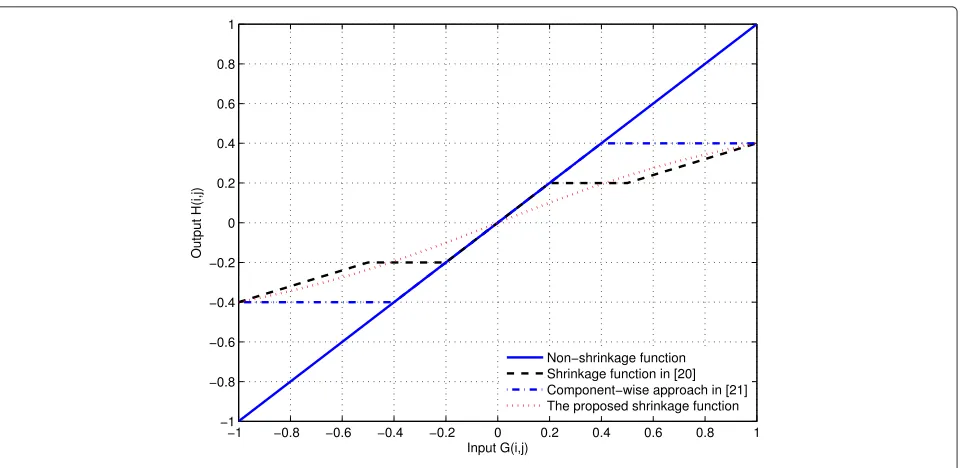
Hi,j= adjust the shrinkage range of the elements inG.
are described graphically in Fig. 1. Take γ = 0.4 as an example, and the variable range of the input valu-ables is [−1, 1]. The variable range of the output value with non-shrinkage function remains the same, while that with the other three techniques are [−0.4, 0.4]. The above results demonstrate that the shrinkage function reduces the variable range of values from [−1, 1] to [−0.4, 0.4], i.e., the relatively-large absolute off-diagonal entries inG
are effectively reduced.
Gaussian random matrix F ∈ R400×500 is adopted to validate the proposed MCSGD algorithm. The input parameters are fixed as: β = 0.01, iterext = 200,
iterint = 100 and ε = 10−4. Selecting shrinkage
fac-tor γ from {0.4, 0.55, 0.65, 0.75}, we present the corre-sponding t-averaged coherence μt(F) in Fig. 2. Obvi-ously, the value ofμt(F)decreases with iterations. More-over, a smaller γ requires fewer iterations to provide a lower μt(F). These simulations experimentally demon-strate the effectiveness of shrinkage process in MCSGD algorithm.
UpdateFusing gradient descent process
After the implementation of the above shrinkage process, we get a temporalH ∈ H. The next issue to address is how to updateF. In each iteration of the algorithm in [21], singular value decomposition (SVD) method is applied to reduce the rank ofH. Afterwards, its square-root is built and the minimumF is found. However, the above algo-rithm will create some large values that are not present in the original Gram matrix. Large off diagonal values in
Gruin completely the original signal recovery algorithms some times.
In face of the above shortcoming and inspired by [22], we alternatively apply a gradient descent method to solve the second minimization problem and updateF. Denote the cost function J = FTF−H2F, the minimization problem is solved by the gradient descent processFi,j ←
Fi,j− η∂∂FJi,j, where η > 0 is the stepsize. According to matrix analysis [36], the following result holds
∂J
∂F =
∂ ∂FTr
FTF−H
T
FTF−H
=4F
FTF−H
(16)
where Tr{·}denotes the trace operation. Thus, the update process is written as
F(l+1)=F(l)−βF(l)
F(Tl)F(l)−H
(17)
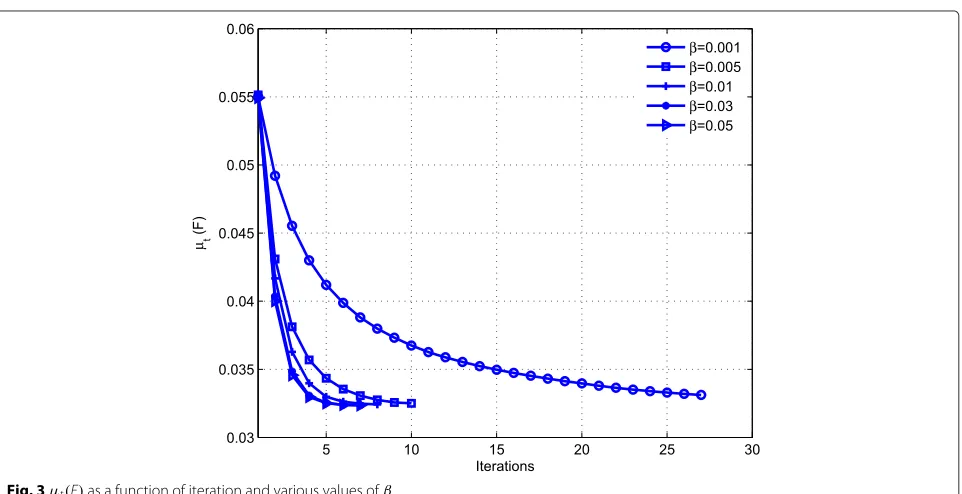
wherelis the iteration counter and stepsizeβ=4η. The effect of stepsize β is also experimentally inves-tigated. The input parameters are same as that in the previous subsection exceptγ = 0.4. For eachβselected from{0.001, 0.005, 0.01, 0.03, 0.05}, the value oft-averaged coherence μt(F) is regarded as a function of iterations in Fig. 3. It can be seen that both μt(F) and number of required iterations decrease as β increases, and they finally become stable whenβ≥0.03.
MCSGD analysis
According to the result in [37], we mention that construct-ing ETFs usconstruct-ing alternatconstruct-ing minimization methods have a global minimum subject to an appropriate initialization. In detail, there exist at least one accumulation point for
Fig. 2μt(F)as a function of iteration and various values ofγ
minG,HG−H2F, and the minimization leads to a global minimum after infinite number of iterations.
As shown in Algorithm 3, we also solve the matrix con-struction problem by adopting the alternating projection method from the macro perspective. To be specific, both the shrinkage process and the gradient descend process are used to update H andF by solving two minimiza-tion problems in the alternating projecminimiza-tion procedure, and the above procedure will be repeated for a number of
iterations. Due to the operations in alternating projec-tion, the structure ofG=FTFandHchanges frequently. Such operations make the setHcannot maintain the con-vex sets all the time, which makes the whole problem a nonconvex one. Since the set H is generally noncon-vex, alternating projection may not converge as one might wish. However, it appears that norm convergence always occurs in practice [37]. The convergence of first process is guaranteed only if γ is chosen not far from 1, then
the structures ofGandHwill be changed smoothly and slowly, and their distance becomes shorter in norm mea-sure. Although smallerγ leads to much faster convergence rate,γcannot be set too small since it will cause all the off-diagonal entries of Gram matrix breakthrough the Welch bound and even approach to zero, which may lead to badly non-convergence [21]. Facing the above tradeoff, accord-ing to the simulation results in the former subsection, we chooseγ = 0.4 as a reasonable choice. Referring to sec-ond minimization, the proposed method offers a gradient descent method to update theFwhich guarantees grad-ual reduction of cost functionJand convergence to a local minimum [22].
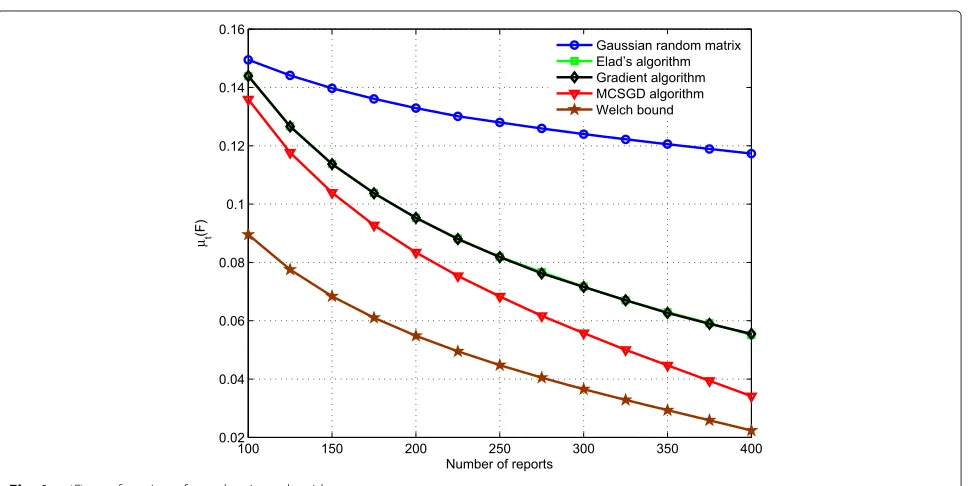
After the convergence analysis, we perform simulations to experimentally validate the construction performance of MCSGD algorithm. The Gaussian random measure-ment matrix and deterministic matrices from Elad’s algo-rithm [21] and Gradient algoalgo-rithm [22] are involved in comparison. For each p varying from 100 to 400 with increment 25 and fixed n = 500, their values of t -averaged coherence μt(F) as well as the corresponding Welch bound are computed and shown in Fig. 4. For each
p, the value oft-averaged coherence ofF from MCSGD algorithm is much lower than that of other algorithms and closer to the Welch bound. Therefore, the proposed MCSGD algorithm stands out as the best algorithm to provide deterministic matrixF.
Combining the above theoretical and experimental results, we conjecture that the deterministic matrix F
constructed by MCSGD algorithm further improves the
detection performance of MOMMP algorithms. Refer-ring to the realization of deterministic matrixFon each CR user, frequency-selective surfaces (FSSs) [38] and random filtering [39, 40] can be utilized as effective approaches.
Numerical experiments
In this section, we validate the detection accuracy and time of two MOMMP algorithms by performing numer-ical experiments under different sampling rates, SNRs, numbers of CR users, and reports, where the determinis-tic matrixFfrom MCSGD algorithm is utilized as a filter coefficient matrix.
Simulation setting
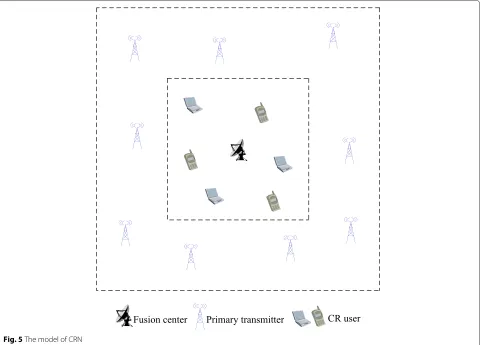
Consider the following CRN:mCR users are uniformly and randomly located within a 500×500 m2area centered at the FC, and they cooperatively detect the presence of PUs within a 1000×1000 m2area centered at the same
FC, to which n = 500 channels are licensed. Suppose that onlyschannels are occupied, and their locations are chosen uniformly at random. A simple model of CRN is illustrated in Fig. 5. Rather thannchannel states, onlyp
linear combinations are reported by each CR user. Thus, the measurement data M ∈ Rp×m instead of state data
X ∈ Rn×m is transmitted frommCR users to FC, where the deterministic matrixF ∈ Rp×n from MCSGD algo-rithm is adopted as filter coefficient matrix. During the transmission,Mis corrupted by Gaussian noiseN with SNR varying from−15 to 30 dB.
Fig. 5The model of CRN
To quantify the compression and loss of reports, we respectively define sampling rate and loss rate as follows
sampling rate= |E|
m×n; loss rate= |E|
m×p (18)
where |E| means the number of reports received at the FC. After the implementation of MOMMP algorithms, the detection performance is evaluated by computing the fol-lowing probability of detectionPDand probability of false alarmPF
PD=
No.Hit
No.Hit+No.Miss; PF =
No.False No.False+No.Miss
(19)
where No.Hit is the number of exact detections of the presence of PUs, No.Miss is the number of miss detec-tions, No.False is the number of false alarms.
At the beginning, we investigate the influence of
can-didates number k upon the detection of TMOMMP
algorithm. The reason for this is that the corresponding itermax =smax/kwill greatly affect the detection time.
Therefore, a reasonable k requiring less detection time while providing equivalent detection accuracy should be
determined. Selectingkfrom{1, 5, 10, 20}and determin-ing its corresponddetermin-ing itermaxsubject tok∗itermax=smax=
100, we experimentally obtain all equivalent values ofPD andPF. For the sake of paper length, we omit the presen-tation of their experiment results and fixk = 20 in the following experiments. In addition, to verify the average performance of our proposals in detecting occupied chan-nels, we repeat the experiment with the same scenario
Q=50 times and show their average values ofPDandPF as well as detection times.
Detection accuracy versus sampling rate
Considering that sampling rate generally demonstrates the transmission loss and report compression, we firstly perform numerical simulations to demonstrate its influ-ence upon the detection performance. Fix the following parameters: number of occupied channels=50, number of reportsp = 400 and SNR = 15 dB. Actually, the case
[17] and centralized reweighedlq(CRLq) algorithms(q= 1, 2) in [10] are also involved for comparison. Actually, instead of the time varyingsin practice, onlysmax = 100
is available and then utilized in TMOMMP and JSR-MO algorithms.
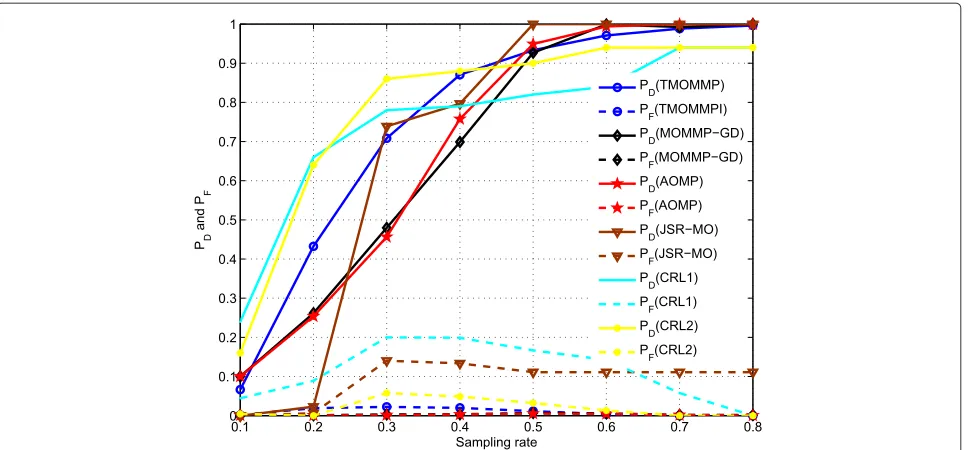
For each sampling rate varying from 0.1 to 0.8 with increment 0.1, we calculate its correspondingPD andPF for AWGN fading channel and plot them in Fig. 6. Obvi-ously, from the perspective of PD, CRL1 and CRL2 are superior to others in case of serious loss since they can provide higher PD when sampling rate is small. How-ever, when sampling rate exceeds a threshold, namely 0.5, they are caught up with or even surpassed. On the other hand, CRL1 and CRL2 take thousands of seconds to finish the detection while others require a few seconds, which are shown in next subsection. Generally speaking, among all other greedy-type algorithms, the JSR-MO algorithm seems to be the best except when sampling rate falls between 0.1 and 0.2. Unfortunately, when sampling rate is larger than 0.2, the higher PF provided by JSR-MO will reduce the throughput [24] since some unoccupied channels are declared as occupied and not allocated to CR users. Compared with AOMP algorithm, the pro-posed MOMMP-GD algorithm significantly outperforms up to sampling rate = 0.6. Afterwards, both MOMMP-GD and AOMP algorithms provide perfect detection, i.e.,
PD≈1 andPF≈0. The above superiority experimentally demonstrates the positive effect of 1-norm in measuring the row vector and orthogonal projection in recovering state data. Moreover, the TMOMMP algorithm is supe-rior to AOMP algorithm when sampling rate falls between
0.25 and 0.45. In terms of PF, the proposed TMOMMP and MOMMP-GD algorithms provide almost the same detection as AOMP algorithm. Therefore, these results indicate that the MOMMP-GD algorithm is more suitable for practical application with serious transmission failure. To validate the robustness of our proposal, we also exploit the Rayleigh fading channels. Keep the above parameters unchanged, we obtain the correspondingPD andPF in Fig. 7. Overall, although CRL1 and CRL2 can provide higher PD when sampling rate ≤ 0.4, the sig-nificantly high PF and computational complexity limit their application in practice. With respect to PD, the proposed TMOMMP algorithm is almost the best one in case of serious loss, and JSR-MO algorithm outper-forms only when 0.45 ≤ sampling rate ≤ 0.7. Moreover, the proposed TMOMMP and MOMMP-GD algorithms always outperform AOMP algorithm except when 0.5 ≤ sampling rate≤0.7 the AOMP algorithm is slightly supe-rior to TMOMMP algorithm. From the perspective of
PF, the MOMMP-GD algorithm is equivalent to AOMP algorithm while the TMOMMP algorithm degrades when 0.2 ≤ sampling rate ≤ 0.5, which are much better than CRL1, CRL2, and JSR-MO algorithms. Comparing the results in Figs. 7 and 6, we conclude that better detection performance is obtained when Rayleigh fading channel is utilized as a sensing channel. For instance, to obtainPD≥ 0.9 from all three algorithms, sampling rate = 0.47 is enough for Rayleigh fading channel while sampling rate= 0.52 for AWGN fading channels. Thus, the above results demonstrate that a proper choice of algorithm greatly benefits the detection in certain fading channel.
Fig. 7PDandPFas functions of sampling rate for Rayleigh fading channel
Combining the above results, we conclude that our proposal provide higher probability of exactly detecting occupied channels.
Detection time versus sampling rate
In addition to detection accuracy, computational com-plexity is also an important evaluation indicator. The reason is that, in order not to interfere the PUs, CR users should detect the their presence with a high probability and vacate the channels or reduce transmit power within a certain amount of time. In other words, the time window for detection should be small enough. In each window with fixed duration, the first part is used for performing spectrum sensing and the rest is reserved for transmitting data. During the sensing interval, all CR users keep quiet as enforced by protocols, e.g., at the media access con-trol layer. Therefore, an efficient detection algorithm can benefit the improvement of throughput.
In this part, we choose detection time to demonstrate the detection efficiency. During the simulations in Fig. 6, we record the consumed time for each trial and then cal-culate the average detection time for each algorithm. Note that, CRL1 and CRL2 are not compared in Fig. 8 since that they involve massive calculation and are time-consuming. It is obvious that, among all the compared algorithms, the proposed MOMMP-GD and AOMP algorithms out-perform as they consume almost the same and least time to finish the detection, and the proposed TMOMMP algorithm is slightly worse than them. Unfortunately, the JSR-MO algorithm always takes the most time and is the worst one. Therefore, we validate the superiority of
our proposals with respect to computational complex-ity. Whenever on the same parameter for Rayleigh fading channels, the obtained average detection times are almost the same as that for AWGN fading channel. Therefore, we validate that our proposals are superior with respect to computational complexity, which are of great significance to the real-time CRNs.
Detection accuracy versus SNR
Considering the measurement data is inevitably perturbed in transmission, we investigate the robustness of our pro-posals. Fixings = 50,p= 400, and sampling rate = 0.8, and varying SNR from−15 to 30 dB with increment 5 dB, we adopt AWGN fading channel and validate the detec-tion performance of our proposals. From Fig. 9, we can see that the value ofPDincreases with SNR. At a high noise level, e.g., SNR =−5 dB, the TMOMMP algorithm is obvi-ously superior to MOMMP-GD algorithm in the sense of
PD while the MOMMP-GD algorithm significantly out-performs with respect to PF due to the non-existence of false alarm. In MOMMP-GD algorithm, high noise level will destruct the property of approximate Gaussian distribution, which results in the identification of fewer coordinates and hence smallPDandPF. On the contrary, as for TMOMMP algorithm in the same scenario, the range of difference between hi,∀i ∈ and hi,∀i ∈/ is reduced. Thus, a largerλ1is required to identify
suit-able coordinates. However, the utilization oft1makesλ1
Fig. 8Average detection time as a function of sampling rate for AWGN fading channel
Detection accuracy versus number of CR users
Compared with spectrum sensing implemented by single CR user, CSS exploits the spatial diversity from several cooperating CR users to improve the detection perfor-mance. However, its energy consumption overhead can be significant if the number of cooperating CR users or the number of reports is large. The second issue will be dis-cussed in the next subsection. The algorithm requiring
fewer cooperating CR users while providing an equiva-lent detection performance is more promising to improve the whole energy efficiency. Here, we investigate the influ-ence of number of cooperating CR users m upon the detection performance over AWGN fading channel. Set-tings = 50,p = 400, sampling rate = 0.6, and SNR = 15 dB, and varyingmfrom 1 to 10, we obtain and present the correspondingPD andPF in Fig. 10. Obviously, the
Fig. 10PDandPFas functions of number of CR users for AWGN fading channel
MOMMP-GD algorithm is always superior to TMOMMP algorithm except whenmis about 2. To be specific, with detection accuracy constraintPD ≥0.95, the TMOMMP algorithm requiresm≥ 5 CR users while the MOMMP-GD algorithmm=4 CR users.
Detection accuracy versus number of reports
Compared with the conventional CSS, CCSS utilizes a deterministic F ∈ Rp×n to obtain p incoherent linear
combinations of n reports on each CR user, achieving report compression. Then, a problem intuitively arises: how many linear combinations are enough to guarantee an exact detection ofsoccupied channels. Here, we cal-culatePDandPF for different values ofpto address the above problem. The input parameters are fixed ass=50, loss rate = 1, and SNR = 15 dB. For eachpvarying from 100 to 400 with increment 25, we obtain the correspond-ing PD andPF in Fig. 11 to illustrate the influence ofp
over AWGN fading channel. Obviously, the TMOMMP algorithm always provides higherPDthan MOMMP-GD
up to p = 225. However, only when p ≥ 175, the
TMOMMP algorithm is also superior with respect toPF. Thus, the TMOMMP algorithm is empirically validated to be a competitive detection algorithm.
Conclusions
In this paper, we firstly proposed MOMMP algorithms to efficiently detect occupied channels in CRN, in which multi-candidate identification reduces the number of required iterations but does not degrade the detection accuracy. Secondly, two common but different approaches were introduced to realize the multi-candidate identifi-cation. With a prior knowledge ofsmax, the TMOMMP
algorithm iteratively identified a fixed number of coordi-nates till a preset maximum iteration number, followed by a threshold-based refinement. Alternatively, without any prior knowledge, the MOMMP-GD algorithm iteratively identified an uncertain number of coordinates until there was no new coordinate. And then, deterministic matrix of low t-average coherence from the proposed MCSGD algorithm further improved the efficiency of CRN since the number of reports was reduced with detection per-formance constraint and the transmission of deterministic filter coefficient matrix was unnecessary. Finally, numer-ical simulations under different influencing factors were performed to validate that our proposals provide satisfac-tory performance with respect to PD, PF and detection time. Specifically, our proposals are more suitable for practical application with serious transmission failure and noise perturbation. In the further, we will investigate the application of the proposed MOMMP algorithms in other jointly sparse recovery problems.
Competing interests
The authors declare that they have no competing interests.
Acknowledgements
This work was financially supported by National Science Foundations of China (No.61174016).
Author details
1Department of Control Science and Engineering, Harbin Institute of
Technology, 150001 Harbin, China.2School of Computer Science and Engineering, Hebei University of Technology, 300401 Tianjin, China.
Received: 9 February 2015 Accepted: 29 August 2015
References
1. J Mitola, GQ Maguire Jr, Cognitive radio: making software radios more personal. Pers. Commun. IEEE.6(4), 13–18 (1999)
2. Y Zeng, Y-C Liang, AT Hoang, R Zhang, A review on spectrum sensing for cognitive radio: challenges and solutions. EURASIP J. Adv. Sign. Process. 2010, 15 (2010)
3. A Ghasemi, ES Sousa, inNew Frontiers in Dynamic Spectrum Access Networks (DySPAN), 2005 First IEEE International Symposium on. Collaborative spectrum sensing for opportunistic access in fading environments, (2005), pp. 131–136
4. J Lundén, V Koivunen, A Huttunen, HV Poor, Collaborative cyclostationary spectrum sensing for cognitive radio systems. IEEE Trans. Signal Process. 57(11), 4182–4195 (2009)
5. L Zhang, Q Wu, G Ding, S Feng, J Wang, Performance analysis of probabilistic soft SSDF attack in cooperative spectrum sensing. EURASIP J. Adv. Signal Process.2014(1), 1–9 (2014)
6. J Wang, S Feng, Q Wu, X Zheng, Y Xu, G Ding, A robust cooperative spectrum sensing scheme based on Dempster-Shafer theory and trustworthiness degree calculation in cognitive radio networks. EURASIP J. Adv. Signal Process.2014(1), 1–12 (2014)
7. DL Donoho, Compressed sensing. IEEE Trans. Inf. Theory.52(4), 1289–1306 (2006)
8. J Meng, W Yin, H Li, E Hossain, Z Han, Collaborative spectrum sensing from sparse observations in cognitive radio networks. IEEE J. Selected Areas Commun.29(2), 327–337 (2011)
9. F Zeng, C Li, Z Tian, Distributed compressive spectrum sensing in cooperative multihop cognitive networks. IEEE J. Selected Topics Signal Process.5(1), 37–48 (2011)
10. Q Ling, Z Wen, W Yin, Decentralized jointly sparse optimization by reweighted minimization. IEEE Trans. Signal Process.61(5), 1165–1170 (2013)
11. M Mishali, YC Eldar, From theory to practice: Sub-nyquist sampling of sparse wideband analog signals. IEEE J. Sel. Top. Signal Process.4(2), 375–391 (2010)
12. SG Mallat, Z Zhang, Matching pursuits with time-frequency dictionaries. IEEE Trans. Signal Process.41(12), 3397–3415 (1993)
13. L Jiao, J Chen, J Wu, X Wang, S Zhang, Efficient collaborative spectrum sensing with low sample rate. Wirel. Pers. Commun.67(4), 923–936 (2012)
14. C Jianrui, L Jiao, J Wu, X Wang, Compressive spectrum sensing in the cognitive radio networks by exploiting the sparsity of active radios. Wirel. Netw.19, 661–671 (2013)
15. JA Tropp, AC Gilbert, Signal recovery from random measurements via orthogonal matching pursuit. IEEE Trans. Inf. Theory.53(12), 4655–4666 (2007)
16. W Dai, O Milenkovic, Subspace pursuit for compressive sensing signal reconstruction. IEEE Trans. Inf. Theory.55(5), 2230–2249 (2009) 17. S Jin, X Zhang, inGlobal Communications Conference (GLOBECOM), 2014
IEEE. Collaborative compressive spectrum sensing with missing observations for Cognitive Radio networks, (2014), pp. 828–833 18. J Wang, S Kwon, B Shim, Generalized orthogonal matching pursuit. IEEE
Trans. Signal Process.60(12), 6202–6216 (2012) 19. DL Donoho, Y Tsaig, I Drori, J-L Starck, Sparse solution of
underdetermined systems of linear equations by stagewise orthogonal matching pursuit. IEEE Trans. Inf. Theory.58(2), 1094–1121 (2012) 20. EJ Candes, The restricted isometry property and its implications for
compressed sensing. C. R. Math.346(9), 589–592 (2008)
21. M Elad, Optimized projections for compressed sensing. IEEE Trans. Signal Process.55(12), 5695–5702 (2007)
22. V Abolghasemi, S Ferdowsi, S Sanei, A gradient-based alternating minimization approach for optimization of the measurement matrix in compressive sensing. Signal Proc.92(4), 999–1009 (2012)
23. Y Wang, Z Tian, C Feng, Sparsity order estimation and its application in compressive spectrum sensing for cognitive radios. IEEE Trans. Wireless Commun.11(6), 2116–2125 (2012)
24. H Sun, W-Y Chiu, A Nallanathan, Compressive power spectral density estimation. Commun. Lett. IEEE.16(11), 1812–1815 (2012) 25. MA Lexa, ME Davies, JS Thompson, J Nikolic, inAcoustics, Speech and
Signal Processing (ICASSP), 2011 IEEE International Conference on. Compressive power spectral density estimation, (2011), pp. 3884–3887 26. DD Ariananda, G Leus, Compressive wideband power spectrum
estimation. IEEE Trans. Signal Process.60(9), 4775–4789 (2012) 27. C-P Yen, Y Tsai, X Wang, Wideband spectrum sensing based on
sub-nyquist sampling. IEEE Trans. Signal Process.61(12), 3028–3040 (2013) 28. D Dony Ariananda, D Romero, G Leus, inSensor Array and Multichannel
Signal Processing Workshop (SAM), 2014 IEEE 8th. Cooperative compressive power spectrum estimation, (2014), pp. 97–100
30. D Cohen, YC Eldar, Sub-nyquist sampling for power spectrum sensing in cognitive radios: A unified approach. IEEE Trans. Signal Process.62(15), 3897–3910 (2014)
31. O Mehanna, N Sidiropoulos, Frugal sensing: Wideband power spectrum sensing from few bits. IEEE Trans. Signal Process.61(10), 2693–2703 (2013) 32. G Leus, DD Ariananda, Power spectrum blind sampling. IEEE Signal
Process. Lett.18(8), 443–446 (2011)
33. D Romero, G Leus, Wideband spectrum sensing from compressed measurements using spectral prior information. IEEE Trans. Signal Process. 61(24), 6232–6246 (2013)
34. Wireless communications: principles and practice, 2nd Edition. (Prentice Hall, New Jersey, NJ, USA, 2012)
35. JA Tropp, Greed is good: Algorithmic results for sparse approximation. IEEE Trans. Inf. Theory.50(10), 2231–2242 (2004)
36. Matrix analysis, 2nd Edition. (Cambridge university press, New York, NY, USA, 2012)
37. J Tropp, IS Dhillon, RW Heath Jr, T Strohmer,et al, Designing structured tight frames via an alternating projection method. IEEE Trans. Inf. Theory. 51(1), 188–209 (2005)
38. R Mittra, CH Chan, T Cwik, Techniques for analyzing frequency selective surfaces-a review. Proceedings of the IEEE.76(12), 1593–1615 (1988) 39. JA Tropp, MB Wakin, MF Duarte, D Baron, RG Baraniuk, inAcoustics, Speech
and Signal Processing, 2006. ICASSP 2006 Proceedings. 2006 IEEE
International Conference on. Random filters for compressive sampling and reconstruction, vol. 3, (2006), pp. III 872–III 875
40. J Zhang, Y Ban, D Zhu, G Zhang, Random filtering structure-based compressive sensing radar. EURASIP J. Adv. Signal Process.2014(1), 1–11 (2014)
41. Federal Communications Commission and others, Spectrum policy task force report. ET Docket.2(135), (2002)
42. MH Islam, CL Koh, SW Oh, X Qing, YY Lai, C Wang,et al, inCognitive Radio Oriented Wireless Networks and Communications, 2008. CrownCom 2008. 3rd International Conference on. Spectrum survey in Singapore: Occupancy measurements and analyses, (2008), pp. 1–7
Submit your manuscript to a
journal and benefi t from:
7Convenient online submission 7Rigorous peer review
7Immediate publication on acceptance 7Open access: articles freely available online 7High visibility within the fi eld
7Retaining the copyright to your article