Proceedings of the Third Conference on Machine Translation (WMT), Volume 2: Shared Task Papers, pages 345–354
Robust
parfda
Statistical Machine Translation Results
Ergun Bic¸ici
Department of Computer Engineering, Bo˘gazic¸i University orcid.org/0000-0002-2293-2031
bicici.github.com
Abstract
We build parallel feature decay algorithms (parfda) Moses statistical machine transla-tion (SMT) models for language pairs in the translation task.parfdaobtains results close to the top constrained phrase-based SMT with
an average of2.252 BLEU points difference
on WMT 2017 datasets using significantly less computation for building SMT systems than that would be spent using all available cor-pora. We obtain BLEU upper bounds based on target coverage to identify which systems used additional data. We use PRO for tuning to decrease fluctuations in the results and post-process translation outputs to decrease trans-lation errors due to the casing of words. F1 scores on the key phrases of the English to Turkish testsuite that we prepared reveal that
parfdaachieves2ndbest results.
Truecas-ing translations before scorTruecas-ing obtained the best results overall.
1 Introduction
Statistical machine translation is widely prone to errors in text including encoding, tokeniza-tion, morphological variations and the mass they take, the size of the training and language model datasets used, and model errors. parfda is an instance selection tool based on feature de-cay algorithms (Bic¸ici and Yuret, 2015) we use to select training and language model instances to build Moses phrase-based SMT systems to trans-late the test sets in the news translation task at WMT18 (WMT,2018). As we work towards tools that can be used for multiple languages at the same time, we aim to obtain robust results for compar-ison and record the statistics of the data and the resources used. Our contributions are:
• a test suite for machine translation that is out of the domain of news task to take the chance of taking a closer look at the current status of
SMT technology used by the task participants when translating 10 sentences taken from lit-erary context in Turkish, which shows that parfdaphrase-based SMT can obtain2nd
best results on this test set,
• parfda results for language pairs in the translation task and data statistics,
• comparison of processing alternatives for translation outputs to obtain better results,
• upperbounds on the translation performance using lowercased coverage to identify which models used data in addition to the parallel corpus,
• a set of rules that fix tokenization errors in Turkish using Moses’ (Koehn et al.,2007) to-kenization scripts.
We obtain parfda Moses phrase-based SMT (Koehn et al.,2007) results for the language pairs in both directions in the WMT18 news trans-lation task, which include English-Czech (en-cs), English-Estonian et), English-German (en-de), English-Finnish (en-fi), English-Russian (en-ru), and English-Turkish (en-tr). Building a language independent system that can perform well in translation tasks is a challenging task and SMT systems participating at WMT18 have been largely built dependent on the translation direction.
2 parfda
Parallel feature decay algorithms (parfda) ( Bi-cici, 2016) parallelize feature decay algorithms (FDA), a class of instance selection algorithms that use feature decay, for fast deployment of ac-curate SMT systems. We use parfdato select parallel training data and language model (LM)
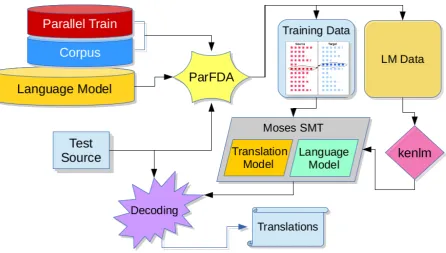
Figure 1:parfdaMoses SMT workflow.
data for building SMT systems. parfda runs separate FDA5 (Bic¸ici and Yuret,2015) models on randomized subsets of the available data and com-bines the selections afterwards. Figure1 depicts parfda Moses SMT workflow. The approach also obtained improvements using NMT ( Ponce-las et al.,2018).
We obtain transductive learning results since we use source sentences of the test set to select data. However, decaying only on the source test set features does not necessarily increase diversity on the target side thus we also decay on the tar-get features that we already select. With the new parfda model, we select about 1.7 million
in-stances for training data and about15million
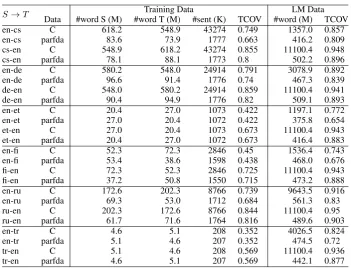
sen-tences for each LM data not including the selected training set, which is added later. Table1 shows size differences with the constrained dataset (C). We use3-grams to select training data and2-grams
for LM data. TCOV lists the target coverage in terms of the 2-grams of the test set. We also use
CzEng17 (Bojar et al., 2016) for en-cs and SE-TIMES2 (Tiedemann,2009) for en-tr.
We set the maximum sentence length to126and
train 6-gram LM using kenlm (Heafield et al.,
2013). For increasing the robustness of the op-timization results, we use PRO (Section2.1) and we use varying n-best list size. For word align-ment, we use mgiza (Gao and Vogel,2008) where GIZA++ (Och and Ney, 2003) parameters set
max-fertility to 10, the number of iterations to 7,3,5,5,7 for IBM models 1,2,3,4, and the HMM model, and learn 50 word classes in three itera-tions with the mkcls tool during training. The de-velopment set contains up to4000sentences
ran-domly sampled from previous years’ development sets (2011-2017) and remaining come from the de-velopment set for WMT18. Table2lists the cov-erage of the test set.
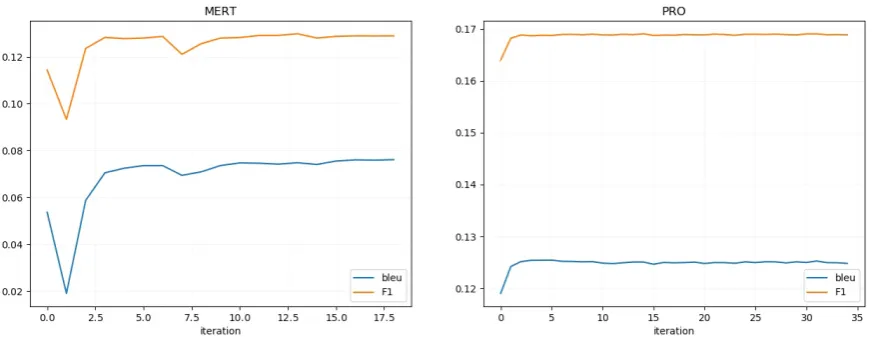
2.1 Robust Optimization Results with PRO Pairwise ranking optimization (PRO) (Hopkins and May, 2011) is found to obtain scores that monotonically increase, with results that are at least as good as MERT (Och, 2003), and with a standard deviation that is three times lower than MERT. We use PRO for tuning to obtain ro-bust results due to fluctuating scores with MERT. PRO tuning performance graph is compared with MERT performance plot in Figure 2. We used monotonically increasing n-best list size at the start to increase robustness by using multiples of 50 until the 8th iteration, 350 every 10th, and 150 in the remaining. We only need 4 iterations to find parameters whose tuning score reach1%close to
the best tuning parameter set score (Figure3).
2.2 Testsuite for en-tr and tr-en
Figure 2: Comparison of MERT and PRO tuning on en-tr using results from 2017 and 2018 respectively.
10 2 10 1 100 101
%
0 5 10 15 20 25 30
iteration
1 1 3
3 12
12 31
1 3 4
4 13
13 13
1 4 4
7 21
23 23
1 1 5
5 8
8 8
1 1 6
6 6
6 6
1 2 2
3 4
4 6
PRO iterations required for convergence
en-cs en-de en-et en-fi en-ru en-tr
10 2 10 1 100 101
%
0 5 10 15 20 25 30
iteration
1 1 3
4 11
11 11
1 1 3
3 10
12 26
1 2 2
2 2
2 2
1 2 2
2 23
24 28
2 2 4
9 32
32 32
3 3 5
5 15
25 25
PRO iterations required for convergence
[image:3.595.82.523.268.437.2]cs-en de-en et-en fi-en ru-en tr-en
Figure 3: The number of iterations PRO would need to reach∆%close to the best tuning score.
look at the current status of SMT technology used by the task participants to translate 10 sentences taken from literary context in Turkish. The sen-tences and their translations are provided in Ap-pendixA.
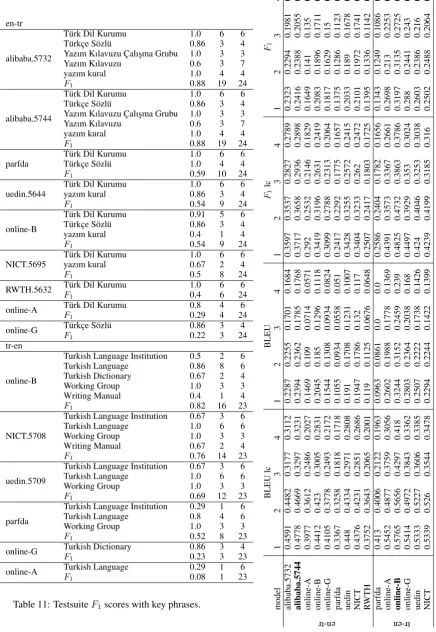
Table3details the testsuite results on en-tr and tr-en where the best translations of parfda are selected based on their BLEU (Papineni et al.,
2002) andF1(Bic¸ici,2011) scores:
en-tr lctc1 align en-tr ts lctc1 align tr-en tc2 align tr-en ts tc1 align
wheretcandlctcare defined in Section2.3. We count tokens of translation as non-translation when they are found in the test source, are not a number or punctuation, and are consid-ered by the SMT model’s phrase table or the lex-ical translation table as a token whose translation differs from the source token. We have access to the lexical tables of parfda SMT models and
among the tr-enlctcentries (Table4),2.7%
con-tain a translation the same as the source. Accord-ing to the testsuite results usAccord-ing translations from task participants, only RWTH andparfda con-tained non-translations and RWTH had only a to-ken non-translated. The scores for up ton-grams
in Table 12 show that alibaba.5744 achieves the best results in en-tr and online-B achieves the best results in tr-en in all scores. When we look at some of the OOV tokens in en-tr, we observe that low-ercasing and then truecasing might help.
We identified 5 key phrases for both en-tr and tr-en that we would like to see translated cor-rectly (Table5). Some are trimmed to make them closer to their root form so that suffixes can be added without decreasing identification rates. Ap-pendixApresentsF1 scores based on the
S→T Data #word S (M) #word T (M)Training Data#sent (K) TCOV #word (M)LM DataTCOV
en-cs C 618.2 548.9 43274 0.749 1357.0 0.857
en-cs parfda 83.6 73.9 1777 0.663 416.2 0.809
cs-en C 548.9 618.2 43274 0.855 11100.4 0.948
cs-en parfda 78.1 88.1 1773 0.8 502.2 0.896
en-de C 580.2 548.0 24914 0.791 3078.9 0.892
en-de parfda 96.6 91.4 1776 0.74 467.3 0.839
de-en C 548.0 580.2 24914 0.859 11100.4 0.941
de-en parfda 90.4 94.9 1776 0.82 509.1 0.893
en-et C 20.4 27.0 1073 0.422 1197.1 0.772
en-et parfda 27.0 20.4 1072 0.422 375.8 0.654
et-en C 27.0 20.4 1073 0.673 11100.4 0.943
et-en parfda 20.4 27.0 1072 0.673 416.4 0.883
en-fi C 52.3 72.3 2846 0.45 1536.4 0.743
en-fi parfda 53.4 38.6 1598 0.438 468.0 0.676
fi-en C 72.3 52.3 2846 0.725 11100.4 0.943
fi-en parfda 37.2 50.8 1550 0.715 473.2 0.888
en-ru C 172.6 202.3 8766 0.739 9643.5 0.916
en-ru parfda 69.3 53.0 1712 0.684 561.3 0.83
ru-en C 202.3 172.6 8766 0.844 11100.4 0.95
ru-en parfda 61.7 71.6 1764 0.816 489.6 0.903
en-tr C 4.6 5.1 208 0.352 4026.5 0.824
en-tr parfda 5.1 4.6 207 0.352 474.5 0.72
tr-en C 5.1 4.6 208 0.569 11100.4 0.936
tr-en parfda 4.6 5.1 207 0.569 442.1 0.877
Table 1: Statistics for the training and LM corpora in the constrained (C) setting compared with the parfda
selected data. #words is in millions (M) and #sents in thousands (K). TCOV is target2-gram coverage.
SCOV TCOV
1 2 3 4 5 1 2 3 4 5
en-cs 0.9635 0.8612 0.6212 0.3305 0.1334 0.9718 0.7587 0.4042 0.165 0.0553
en-de 0.9657 0.8646 0.627 0.3261 0.1253 0.9362 0.7939 0.5254 0.2534 0.0904
en-et 0.8912 0.6821 0.3717 0.1345 0.0376 0.8095 0.4308 0.1664 0.0528 0.0136
en-fi 0.9135 0.7339 0.4477 0.1889 0.0619 0.834 0.4595 0.1895 0.0612 0.0165
en-ru 0.9682 0.8683 0.6444 0.3581 0.1567 0.9703 0.78 0.4572 0.2076 0.0812
[image:4.595.123.475.58.326.2]en-tr 0.8286 0.5817 0.2807 0.0905 0.0226 0.7944 0.3613 0.12 0.0282 0.006
Table 2: Test set SCOV and TCOV forn-grams.
best in en-tr among 9 models and 4th best among 6 in tr-en. Key phrase identification is important since when scores are averaged, important phrases that are missing only decrease the score by 1
|p|N|p|
for BLEU calculation for a phrase of length |p|
overN|p|phrases with length|p|.
2.3 Comparing Text Processing Settings for SMT
Experiment management system (EMS) (Koehn,
2010) of Moses prepares translations as follows: truecase input
→ translate input
→ clean output (XML tags)
→ detruecase output
Truecasing updates the casing of words accord-ing to the most common form observed in the whole training corpus. EMS does not truecase the translations of an SMT model when training data are already truecased. However, each casing of
words are a different entry in the phrase table and the casing we are interested in might be missing in the translations. Therefore, truecasing (tc) before detruecasing makes sense.
The casing of the text affects the number of to-kens in the data sets. A casing of a token might appear in the phrase table but not its lowercased (lc) version. In EMS, truecasing is applied on the input. We experiment with truecasing lower-cased text (lctc) to decrease the number of out-of-vocabulary words in the translations and to re-duce the number of uniquen-grams, dataset sizes,
and the binary LM size by about2%.
We process tokenized Turkish text using a set of rules since Moses’ (Koehn et al., 2007) tok-enization scripts can encounter toktok-enization errors in Turkish. A simpler approach was also tried for fixing tokenization of Turkish by removing space for unbalanced single quotes (Ding et al.,
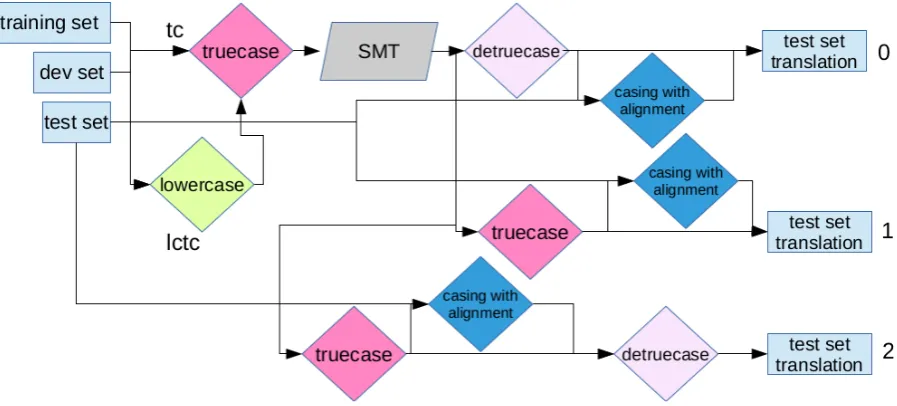
Figure 4: SMT text processing comparison of truecasing after lowercasing (lctc) and truecasing (tc).
testset setting % sent. OK non-trans. non-trans. % not in PT/lex oov % oov BLEU F1
en-tr tclctc1 align1 align 60.961.1 19411933 18.7418.81 220 13241290 12.512.8 0.08830.0746 0.13020.1406
en-tr ts lctc1 align 60.0 5 3.4 0 4 2.7 0.051 0.105
tr-en tclctc2 align2 align 38.944.8 35493028 17.620.7 2312 26432132 12.415.4 0.10550.1192 0.17080.1567
[image:5.595.71.515.302.373.2]tr-en ts tc1 align 20.0 32 17.7 0 24 13.3 0.0 0.1011
Table 3: Best performing en-tr and tr-en translation results detailed with their types of errors.
setting N (lexical) % (wS ==wT)
en-tr tclctc 928K890K 2.912.68
tr-en tclctc 891K860K 3.022.74
Table 4: Lexical translation table comparison.
phrase count
en-tr
T¨urk Dil Kurumu 6
T¨urkc¸e S¨ozl¨u 4
Yazım Kılavuzu C¸alıs¸ma Grubu 3
Yazım Kılavuzu 7
yazım kural 4
tr-en
Turkish Language Institution 6
Turkish Language 6
Turkish Dictionary 4
Working Group 3
Writing Manual 4
Table 5: Key phrases we look for in the translations.
test source sentences using the word alignment in-formation (Ding et al.,2016). Using alignment in-formation is more complicated since not all align-ments are 1-to-1. We also experiment with finding the casing of the input words in the development and test sets according to the form found in the translation tables to replace them before decoding. Figure 4 compares tc and lctc approaches to text processing for SMT. Both can use the align-ment information for casing words.
Table 6 compares the results using transla-tions that contain the alignment information and the unknown words where tc 0 is the base-line. The additional Moses decoder parameter is --print-alignment-info. We obtain the highest en-tr score using the alignments for cas-ing but scores decrease for en-de and de-en. For which translation directions it helps can be seen in the lctc 0 row. The difference between the base and the lowercased results are the gain we can achieve if we fix casing accordingly. Usingtc translation as a start, the gain on average is about
1.1BLEU points (0.011BLEU). The best setting
[image:5.595.71.275.431.502.2] [image:5.595.72.279.570.721.2]BLEU cs-en de-en et-en fi-en ru-en tr-en en-cs en-de en-et en-fi en-ru en-tr sum tc0 alignbase 0.2296 0.3332 0.1766 0.15360.2134 0.1851 0.1684 0.1427 0.233 0.12690.247 0.1286 0.1567 0.2669 0.1182 0.10160.1455 0.1637 0.1138 0.095 0.1821 0.0830.1934 0.0823 2.18771.8526 tc1 align 0.2239 0.318 0.1718 0.1493 0.2464 0.12690.2127 0.1845 0.1682 0.1416 0.2329 0.1261 0.1506 0.2543 0.1117 0.0961 0.1918 0.08240.1455 0.1625 0.1137 0.0948 0.182 0.083 2.12321.8475 tc2 align 0.2295 0.3331 0.1765 0.15350.2136 0.1945 0.1681 0.1458 0.2347 0.12730.25260.1284 0.1566 0.2669 0.1182 0.10130.1469 0.1645 0.1151 0.0965 0.1827 0.08160.1989 0.0823 2.19781.8713
lc 0.2394 0.3447 0.184 0.1614 0.26320.1373 0.1622 0.2727 0.1216 0.1053 0.2048 0.089 2.2856
lctc0align 0.1869 0.2736 0.1523 0.129 0.1901 0.10660.2113 0.2443 0.1661 0.1266 0.211 0.1043 0.1339 0.1251 0.0975 0.0875 0.1671 0.06160.1448 0.1603 0.1114 0.0941 0.1644 0.0882 1.71121.8268 lctc1align 0.1817 0.2602 0.1484 0.1252 0.1901 0.10640.2105 0.2437 0.1658 0.1247 0.211 0.1032 0.1294 0.1149 0.0934 0.0828 0.1656 0.06390.1447 0.1585 0.1113 0.094 0.1642 0.0887 1.6621.8203 lctc2align 0.1896 0.275 0.1552 0.1303 0.1974 0.10830.2121 0.2583 0.1663 0.1304 0.2125 0.1055 0.1369 0.127 0.1005 0.0887 0.1712 0.06320.1468 0.1611 0.1125 0.0954 0.1648 0.0871 1.74331.8528 lc 0.2445 0.3452 0.1871 0.1634 0.25060.1402 0.1651 0.2781 0.1212 0.1056 0.1803 0.0978 2.2791
Table 6:parfdatokenized and cased results with different text processing settings. Baseline istc0 (initalic). boldlists the best for a translation direction.
BLEU cs-en de-en et-en fi-en ru-en tr-en en-cs en-de en-et en-fi en-ru en-tr
parfda2018 0.2322 0.3343 0.1741 0.1547 0.2485 0.1267 0.1529 0.2674 0.1203 0.0968 0.1970 0.0821 parfda2018F1 0.2551 0.344 0.2123 0.1936 0.2685 0.1768 0.1921 0.2891 0.1613 0.1494 0.2214 0.1314
TopC NMT 2018lc 0.348 0.499 0.315 0.258 0.358 0.291 0.266 0.489 0.258 0.192 0.348 0.207
TopC NMT 2018 0.339 0.484 0.307 0.249 0.349 0.28 0.26 0.483 0.252 0.182 0.348 0.20
-parfda 0.1068 0.1497 0.1329 0.0943 0.1005 0.1533 0.1071 0.2156 0.1317 0.0852 0.1510 0.1179
avg difflc 0.1288
Table 7:parfdaresults compared with the top results in WMT18 and their difference.1
parfda results at WMT18 are in Table 7 us-ing BLEU over tokenized text. We compare with the top constrained submissions at WMT18 in Table 7 and at WMT17 in Table 8. 2
Perfor-mance compared with the top constrained (TopC) phrase-based SMT improved to 2.252 in 2017
from3 BLEU points difference on average
com-pared with WMT16 results, which is likely due to the new parfda model and phrase-based SMT being less common in 2017.parfdaMoses SMT system can obtain 0.6 BLEU points close to the
top result in Finnish to English translation in 2017. All top models use NMT in 2018 and most use backtranslations, which means that their TCOV is upper bounded by LM TCOV.
3 Translation Upper Bounds with TCOV We obtain upper bounds on the translation perfor-mance based on the target coverage (TCOV) ofn
-grams of the test set found in the selectedparfda training data (Bicici,2016) but using lowercased text this time. For a given sentenceT0, the number
of OOV tokens are identified:
OOVr = round((1−TCOV)∗ |T0|) (1)
2Due to different tokenization rules used by
mteval-v14.pl in matrix.statmt.org, parfda
BLEU scores are higher than the scores in Table6.
where|T0|is the number of tokens in the sentence.
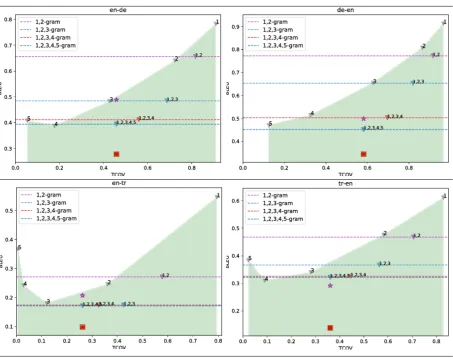
We obtain each bound using 500 such instances and repeat for 10 times. TCOV BLEU bound is optimistic since it does not consider reorder-ings in the translation or differences in sentence length. Each plot in Table9locates TCOV BLEU bound obtained from each n-gram and from n
-gram TCOVS combined up to and including n
and locates the parfdaresult and F locates the top constrained result. In en-de and en-tr, the top model achieves a higher score than the TCOV BLEU bound, which indicates that data additional to the constrained training data was used. In both, backtranslations were used.
4 Conclusion
We useparfdafor selecting instances for build-ing SMT systems usbuild-ing less computation overall and results at WMT18 provides new data about using the current phrase-based SMT technology towards rapid SMT system development. Our data processing experiments show that lowercas-ing and then truecaslowercas-ing data can improve SMT models and translation results provided that we can find the casing correctly and truecasing trans-lations before scoring can improve the results. Our
BLEU cs-en de-en fi-en lv-en ru-en tr-en en-cs en-de en-fi en-lv en-ru en-tr parfda2017 0.2276 0.2613 0.1987 0.1549 0.2812 0.1172 0.1381 0.1851 0.1282 0.1303 0.218 0.097
TopC NMT 2017 0.309 0.351 0.19 0.308 0.179 0.228 0.283 0.207 0.183 0.298 0.165
-parfda 0.0814 0.0897 0.0351 0.0268 0.0618 0.0899 0.0979 0.0788 0.0527 0.0800 0.0680
avg diff 0.0693
TopC phrase 2017 0.265 0.205 0.168 0.315 0.126 0.191 0.216 0.145 0.142 0.253 0.098
-parfda 0.0374 0.0063 0.0131 0.0338 0.0088 0.0529 0.0309 0.0168 0.0127 0.035 0.001
[image:7.595.74.528.171.530.2]avg diff 0.02252
Table 8:parfdaresults compared with the top results in WMT17 and their difference.
Table 9:parfdaresults () andOOVrTCOV BLEU upper bounds for de and tr.
method of tuning with PRO provides robust re-sults and the BLEU bounds we obtain show which systems used additional training data. We are of-ten interested to conserve the semantic conof-tent in the translations andparfdaMoses phrase-based SMT achieves 2nd best results on the tr-en
test-suite in our evaluations with key phrases.
Acknowledgments
The research reported here received financial sup-port in part from the Scientific and Technologi-cal Research Council of Turkey (T ¨UB˙ITAK) with-out contribution to the content nor responsibility thereof. We also thank the reviewers’ comments.
References
2018. Proc. of the Third Conference on Machine
Translation. Association for Computational
Lin-guistics, Brussels, Belgium.
Ergun Bic¸ici. 2011. The Regression Model of Machine
Translation. Ph.D. thesis, Koc¸ University.
Supervi-sor: Deniz Yuret.
Ergun Bic¸ici and Deniz Yuret. 2015. Optimizing in-stance selection for statistical machine translation
with feature decay algorithms. IEEE/ACM
Transac-tions On Audio, Speech, and Language Processing
(TASLP), 23:339–350.
First Conference on Statistical Machine Translation
(WMT16), pages 252–258, Berlin, Germany.
Asso-ciation for Computational Linguistics.
Ondˇrej Bojar, Ondˇrej Duˇsek, Tom Kocmi, Jindˇrich Li-bovick´y, Michal Nov´ak, Martin Popel, Roman
Su-darikov, and Duˇsan Variˇs. 2016. CzEng 1.6:
En-larged Czech-English Parallel Corpus with
Process-ing Tools Dockered. Springer International
Publish-ing, Cham.
Shuoyang Ding, Kevin Duh, Huda Khayrallah, Philipp Koehn, and Matt Post. 2016. The jhu machine
trans-lation systems for wmt 2016. In Proceedings of
the First Conference on Machine Translation, pages
272–280, Berlin, Germany. Association for Compu-tational Linguistics.
Qin Gao and Stephan Vogel. 2008. Software
Engineer-ing, TestEngineer-ing, and Quality Assurance for Natural
Lan-guage Processing, chapter Parallel Implementations
of Word Alignment Tool. Association for Computa-tional Linguistics.
Kenneth Heafield, Ivan Pouzyrevsky, Jonathan H. Clark, and Philipp Koehn. 2013. Scalable modified
Kneser-Ney language model estimation. InProc. of
the 51st Annual Meeting of the Association for
Com-putational Linguistics, pages 690–696, Sofia,
Bul-garia.
Mark Hopkins and Jonathan May. 2011. Tuning as
ranking. In Proceedings of the 2011 Conference
on Empirical Methods in Natural Language
Pro-cessing, pages 1352–1362. Association for
Compu-tational Linguistics.
Philipp Koehn. 2010. An experimental management
system. The Prague Bulletin of Mathematical
Lin-guistics, 94:87–96.
Philipp Koehn, Hieu Hoang, Alexandra Birch, Chris Callison-Burch, Marcello Federico, Nicola Bertoldi, Brooke Cowan, Wade Shen, Christine Moran, Richard Zens, Chris Dyer, Ondrej Bojar, Alexandra Constantin, and Evan Herbst. 2007. Moses: Open source toolkit for statistical machine translation. In Proc. of the 45th Annual Meeting of the Association for Computational Linguistics Companion Volume
Proc. of the Demo and Poster Sessions, pages 177–
180. Association for Computational Linguistics.
Franz Josef Och. 2003. Minimum error rate training in statistical machine translation. Association for
Computational Linguistics, 1:160–167.
Franz Josef Och and Hermann Ney. 2003. A systematic comparison of various statistical alignment models.
Computational Linguistics, 29(1):19–51.
Kishore Papineni, Salim Roukos, Todd Ward, and Wei-Jing Zhu. 2002. BLEU: a method for automatic evaluation of machine translation. InProc. of 40th Annual Meeting of the Association for
Computa-tional Linguistics, pages 311–318, Philadelphia, PA,
USA.
Alberto Poncelas, Gideon Maillette de Buy Wenniger, and Andy Way. 2018. Feature decay algorithms for
neural machine translation. In Proc. of the 21th
Conference of the European Association for
Ma-chine Translation (EAMT), Spain.
Jorg Tiedemann. 2009. News from OPUS - A col-lection of multilingual parallel corpora with tools
and interfaces. In N. Nicolov, K. Bontcheva,
G. Angelova, and R. Mitkov, editors, Recent
Advances in Natural Language Processing,
A en-tr and tr-en Testsuite Sentences English 1 The Turkish Language Institution’ s Turkish Dictionary and Writing Manual W orking Group has reached the twenty-se venth edition of the Written Manual. 2 To say upfront; to mak e the writing rules lasting and rooted to reach unity in writing, no changes ha ve been made in the established rules in this edition as well. 3 Turkish Language Institution’ s principles of taking the manual published in 1996 as the basis for traditional writing structures and the principle of taking the middle path to end discussions in writing are also follo wed in this edition. 4 This edition of the Writing Manual is prepared in parallel with the last edition of the Turkish Dictionary and ne w issues that emer ge with the use of language are attached to rules and issues that were not addressed in pre vious editions are con verted into rul es. 5 Turkish Dictionary and Writing Manual W orking Group re vie ws hundreds of examples about ev ery rule and considers usage statistics with the principle of vie wing writing as habit and custom. 6 After using Latin alphabet for more than eighty years we can say that Turkish writing has been traditionalized ag ainst some Latin sourced problems. 7 W ithout a doubt, Turkish Language Institution’ s w ork for 80 years has played an important role in this. 8 The task of preparing, writing, and distrib uting writing manual is gi ven to Turkish Language Institution according to the c¸ subitem of the 10th item in 664 numbered decree la w based on the 134th item in the constitution. 9 Since its establishment, Turkish Language Institution has been trying to fulfill its duty on determining writing rules and publication of writing manuals. 10 Turkish Language Institution Turkish Dictionary and Writing Manual W orking Group has diligently w ork ed on each writing rule and writing to end discussions in writing and to spread writing rules and styles that ev erybody will accept and use. Turkish 1 T ¨urk Dil K urumu G ¨uncel T ¨urkc ¸e S ¨ozl ¨uk ve Y azım Kıla vuzu C¸ alıs ¸ma Grub unun yaptı ˘gı c¸alıs ¸malarla Y azım Kıla vuzu yirmi yedinci baskısına ulas ¸mıs ¸ bulunuyor . 2 Hemen belirtelim; yazım kurallarını kalıcı hˆale getirmek, k¨okles ¸tirmek, b¨oylece yazımda birli ˘gi sa ˘glamak amacıyla bu baskıda da yerles ¸mis ¸ kurallarla ilgili olarak herhangi bir de ˘gis ¸ikli ˘ge gidilmemis ¸tir . 3 T ¨urk Dil K urumunun 1996 yılında yayımladı ˘gı kıla vuzda yazımı gelenekles ¸mis ¸ bic ¸imleri esas alma, yazımdaki tartıs ¸malara son verme amacıyla yazımda orta yolun tutturulması ilk esi bu baskıda da g¨ozetilmis ¸tir . 4 Y azım Kıla vuzu’nun bu baskısı T ¨urkc ¸e S ¨ozl ¨uk’ ¨un son baskısıyla es¸ g¨ud ¨um ic¸ erisinde hazırlanmıs ¸, dilde yas ¸anan gelis ¸meler sonucunda ortaya c¸ıkan yazımla ilgili yeni sorunlar bir kurala ba ˘glanmıs ¸, ¨onceki baskılarda de ˘ginileme yen konular yazım kuralı hˆaline getirilmis ¸tir . 5 G ¨uncel T ¨urkc ¸e S ¨ozl ¨uk ve Y azım Kıla vuzu C¸ alıs ¸ma Grub u, her kuralla ilgili y¨uzlerce ¨orne ˘gi g¨ozden gec ¸irirk en yazımın bir alıs ¸kanlık ve gelenek oldu ˘gu ilk esiyle kullanım sıklıklarını g¨oz ¨on ¨unde bulundurmus ¸tur . 6 Seksen yılı as¸ kın bir s¨uredir kullanmakta oldu ˘gumuz Latin kaynaklı T ¨urk yazısıyla kimi sorunlara kars ¸ın artık yazımın gelenekles ¸ti ˘gini s¨oyle yebiliriz. 7 Bunda hic ¸ kus ¸kusuz, T ¨urk Dil K urumunun seksen yıla ulas ¸an c¸alıs ¸maları ¨onemli bir rol oynamaktadır . 8 ¨ Ulk emizde yazım kıla vuzu hazırlamak, yazmak ve yayımlamak g¨ore vi, Anayasa’nın 134. maddesine dayalı olarak c¸ıkarılan 664 sayılı Kanun H ¨ukm ¨unde Kararname’nin 10. maddesinin c¸ fıkrasıyla T ¨urk Dil K urumuna verilmis ¸tir . 9 T ¨urk Dil K urumu, kurulus ¸undan bu yana yazım kurallarının belirlenmesinde ve yazım kıla vuzlarının yayımlanmasında kendisine d¨us ¸en g¨ore vi yerine getirme ye c¸alıs ¸maktadır . 10 T ¨urk Dil K urumu G ¨uncel T ¨urkc ¸e S ¨ozl ¨uk ve Y azım Kıla vuzu C¸ alıs ¸ma Grub u, yazımda yas ¸anan tartıs ¸maları sona erdirmek ve herk esin benimse yece ˘gi, kullanaca ˘gı yazım kurallarını ve yazım bic ¸imlerini yaygınlas ¸tırmak ilk esiyle her kuralın, her yazılıs ¸ın ¨uzerinde titizlikle durmus ¸tur .
en-tr
alibaba.5732
T¨urk Dil Kurumu 1.0 6 6
T¨urkc¸e S¨ozl¨u 0.86 3 4
Yazım Kılavuzu C¸alıs¸ma Grubu 1.0 3 3
Yazım Kılavuzu 0.6 3 7
yazım kural 1.0 4 4
F1 0.88 19 24
alibaba.5744
T¨urk Dil Kurumu 1.0 6 6
T¨urkc¸e S¨ozl¨u 0.86 3 4
Yazım Kılavuzu C¸alıs¸ma Grubu 1.0 3 3
Yazım Kılavuzu 0.6 3 7
yazım kural 1.0 4 4
F1 0.88 19 24
parfda T¨urk Dil KurumuT¨urkc¸e S¨ozl¨u 1.01.0 64 64
F1 0.59 10 24
uedin.5644 T¨urk Dil Kurumuyazım kural 1.00.86 63 64
F1 0.54 9 24
online-B
T¨urk Dil Kurumu 0.91 5 6
T¨urkc¸e S¨ozl¨u 0.86 3 4
yazım kural 0.4 1 4
F1 0.54 9 24
NICT.5695 T¨urk Dil Kurumuyazım kural 1.00.67 62 64
F1 0.5 8 24
RWTH.5632 T¨urk Dil KurumuF1 1.00.4 66 246
online-A T¨urk Dil KurumuF1 0.80.29 44 246
online-G T¨urkc¸e S¨ozl¨uF1 0.860.22 33 244
tr-en
online-B
Turkish Language Institution 0.5 2 6
Turkish Language 0.86 8 6
Turkish Dictionary 0.67 2 4
Working Group 1.0 3 3
Writing Manual 0.4 1 4
F1 0.82 16 23
NICT.5708
Turkish Language Institution 0.67 3 6
Turkish Language 1.0 6 6
Working Group 1.0 3 3
Writing Manual 0.67 2 4
F1 0.76 14 23
uedin.5709
Turkish Language Institution 0.67 3 6
Turkish Language 1.0 6 6
Working Group 1.0 3 3
F1 0.69 12 23
parfda
Turkish Language Institution 0.29 1 6
Turkish Language 0.8 4 6
Working Group 1.0 3 3
F1 0.52 8 23
online-G Turkish DictionaryF1 0.860.23 33 234
[image:10.595.74.511.98.731.2]online-A Turkish LanguageF1 0.290.08 11 236
Table 11: TestsuiteF1scores with key phrases.
BLEU lc BLEU F1 lc F1 model 1 2 3 4 1 2 3 4 1 2 3 4 1 2 3 4 en-tr alibaba.5732 0.4591 0.4482 0.3177 0.3112 0.2287 0.2255 0.1701 0.1684 0.3597 0.3537 0.2827 0.2789 0.2323 0.2294 0.1981 0.1958 alibaba.5744 0.4778 0.4669 0.3297 0.3231 0.2394 0.2362 0.1785 0.1768 0.3717 0.3658 0.2936 0.2898 0.2416 0.2388 0.2055 0.2033 online-A 0.3977 0.3612 0.2486 0.2027 0.1469 0.109 0.0714 0.0571 0.292 0.2532 0.2146 0.1829 0.1649 0.141 0.135 0.1156 online-B 0.4412 0.423 0.3005 0.2831 0.2045 0.185 0.1296 0.1118 0.3419 0.3196 0.2631 0.2419 0.2083 0.1896 0.1711 0.1557 online-G 0.4105 0.3778 0.2493 0.2172 0.1544 0.1308 0.0934 0.0824 0.3099 0.2788 0.2313 0.2064 0.1817 0.1629 0.15 0.1346 parfda 0.3367 0.3258 0.1818 0.1718 0.1055 0.0934 0.0558 0.051 0.2417 0.2292 0.1775 0.1657 0.1375 0.1286 0.1123 0.105 uedin 0.448 0.4334 0.2971 0.2808 0.191 0.1708 0.1231 0.1007 0.3428 0.3255 0.2572 0.2415 0.2033 0.189 0.1678 0.1551 NICT 0.4376 0.4231 0.2851 0.2686 0.1947 0.1786 0.132 0.117 0.3404 0.3233 0.262 0.2472 0.2101 0.1972 0.1741 0.1629 R WTH 0.3752 0.3643 0.2065 0.2001 0.119 0.1125 0.0676 0.0648 0.2507 0.2417 0.1803 0.1725 0.1395 0.1336 0.1142 0.1094 tr-en parfda 0.413 0.4006 0.2122 0.1963 0.0963 0.0861 0.0 0.0 0.2586 0.2404 0.1782 0.1656 0.1343 0.1249 0.1086 0.1011 online-A 0.5452 0.4877 0.3759 0.3056 0.2602 0.1988 0.1778 0.1369 0.4391 0.3573 0.3367 0.2661 0.2698 0.213 0.2253 0.1782 online-B 0.5765 0.5656 0.4297 0.418 0.3244 0.3152 0.2459 0.239 0.4825 0.4732 0.3863 0.3786 0.3197 0.3135 0.2725 0.2679 online-G 0.5414 0.4972 0.3843 0.3362 0.2803 0.2364 0.2038 0.168 0.4497 0.3929 0.353 0.3024 0.288 0.2441 0.243 0.2045 uedin 0.5333 0.5227 0.3606 0.3385 0.2507 0.2222 0.1738 0.1426 0.424 0.4046 0.3253 0.3038 0.2603 0.2386 0.216 0.1961 NICT 0.5339 0.526 0.3544 0.3478 0.2294 0.2244 0.1422 0.1399 0.4239 0.4199 0.3185 0.316 0.2502 0.2488 0.2064 0.2055