Before And After Impact Study of Accidents on Elevated Roads - Case Study
1Vinit Verma, 2Mr. Gyanendra Singh
1Assistant Professor, Civil Engineering Department (SGTIET, Gurgaon), Haryana
2Assistant Professor, Civil Engineering Department (DCRUST,Murthal), Haryana
ABSTRACT
Road network provides the arterial network to
facilitate trade, transport, social integration and economic development. It facilitates specialization, extension of markets and exploitation of economies of scale. It is used for the smooth conveyance of both people and goods. Now days, elevated roads are built to ease the traffic between two points to enhance accessibility and flexibility of operations. Case study represents before and after accidents impact on Panipat-flyover stretch. This study examines the impact of the construction of Panipat Expressway over the traffic scenario of the city. This study presents accident data analysis over a period of 11 years (2003-2013) which includes collection of 5.5 years (Jan 2003- June 2008) data before construction and 5.5 years (July 2008 – Dec 2013) data after construction. The results suggest that increased provision of elevated roads is likely to reduce accidents. Journey and running speed is also improved due to construction of elevated roads. Elevated roads also reduce traffic congestion and conflicts resulting in a safer and more efficient circulation of traffic in the city.1. INTRODUCTION
The development of roads and highways
related infrastructure has picked up
significantly in the recent times along with a
significant increase in the vehicle ownership and also the number of larger and heavier vehicles on the road network. With the proposed expressway system being gradually completed, a new requirement has risen. Since the roadside developments are high and the land acquisition for new roads would be difficult, one option is the use of elevated expressways constructed above the existing highways. Elevated roads have been proposed to ease congestion on busy roads of the city so that cities can get rid of the huge number of heavy vehicles that congest its roads. Traffic congestion has become synonymous with life in major cities with hundreds of cars being added to the city roads every day. Elevated roads involve “simple connectivity between two parallel stretches for better traffic management”. In order to mitigate road traffic congestion, several urban authorities in India have taken up initiatives for construction of flyovers at major intersections. A flyover is meant to support traffic and is constructed to reduce congestion on city roads. They are essential feature of urban road development and they are resorted for ‘grade separation’ – avoidance of crossings on the same level.
Panipat Elevated Expressway was built to ease
the traffic on NH-1 between
traffic and congested road crossings created serious congestion. The congested junctions and thick concentrations of industries around Panipat created hurdles in movement of heavy flow of vehicles. This study examines the impact of the construction of Panipat Expressway over the traffic scenario of the city. This study presents accident data analysis over a period of 11 years (2003-2013) which includes collection of 5.5 years (Jan 2003- June 2008) data before construction and 5.5 years (July 2008 – Dec 2013) data after construction.
2 GENERAL ROAD SAFETY
SCENARIO IN INDIA
The movement of people and goods is essential to achieving economic growth in a country and improving the lifestyle of its citizens. Moreover, the mobility and safety of any transportation system must be well balanced to realize the maximum benefits from the investments made on building and maintaining a highway infrastructure. Expansion in the road network, surge in motorization and a rising population of a country contribute towards increasing numbers of road accidents, accident related injuries and fatalities and all these factors viz road network, the numbers of registered motor vehicles and the population of India.
With the expansion in road network,
motorization and urbanization in the country, the number of road accidents have surged. Road traffic injuries and fatalities have emerged as a major public health concern, with Road traffic injuries having become one of the leading causes of deaths, disabilities and hospitalizations which impose severe socio-economic costs. Road safety is an issue of national concern, considering its magnitude and
gravity and the consequent negative impacts on the economy, public health and the general welfare of the people. Today, Road traffic injuries are one of the leading causes of deaths, disabilities and hospitalizations, with severe socioeconomic costs. Expansion in road network, surge in motorization and a raise population of a country contribute towards increasing numbers of road accidents.
2.1 ROAD ACCIDENT STATISTICS
OF INDIA
Between 1970 and 2012. Number of road accidents increased by 4.3 times accompanied with 9.5 times increase in road accidents fatalities and 7.3 times increase in the number of persons injured in road accidents in India. [3]
During 2012, a total of 4,90,383 road accidents were reported by all States/Union Territories. Of these, about 25.1 per cent (1,23,093) were fatal accidents. The number of persons killed in road accidents were 1,38,258, i.e. an average of one fatality per 3.5 accidents. The proportion of fatal accidents in total road accidents has consistently increased since 2003 from 18.1 per cent to 25.1 per cent in 2012
According to World Health Organization [4],
India leads the world in Road accident deaths. There are 1, 42,485 Number of people killed in India in a year. There is one fatal accident every 3.7 minutes in which 16 people die every hour in India which equals to 390 deaths happening every day.
Two wheelers contribute for 40% of these fatal accidents.
Table 1: Total Number of Accidents and Number of Persons Involved in India: 2002-2012
3.
CONSTRUCTION
OF
FLYOVERS ON LARGE SCALE
The increase in urban traffic congestion has become a serious concern. In order to mitigate
road traffic congestion, several urban
authorities in India have taken up initiatives for construction of flyovers at major intersections. A flyover is meant to support traffic and is constructed to reduce congestion on city roads. They are essential feature of urban road development and they are resorted for ‘grade separation’ – avoidance of crossings on the same level. India being no stranger to
congestion and traffic woes began constructing flyovers as early as ‘60s. They are built to
increase the capacity of roads for
accommodation of more traffic by providing additional road space overhead, minimizing the acquisition of built up lands.
conditions and the traffic impacts of such flyovers.
The scope of improvement of intersection at-grade or widening existing roads is very limited in urban areas. In order to minimize the surface level conflict and to provide a relief to mixed traffic, spatial separation in the form of flyovers is planned at major intersections in the congested cities of India. Flyovers at major urban intersections can be instrumental in
reducing traffic congestion and delay.
However, in most of the cases a comprehensive planning approach has not been adopted, either due to lack of fund or ignorance about the planning perspective of such proposals. Flyovers have changed the face of urban India and paved way to progress. They have enhanced the network of roads.
4. NEED OF THE STUDY OF
IMPACT OF FLYOVERS
Flyover is a bridge constructed along an
intersecting highway over an at-grade
intersection. It allows two –direction traffic to flow at free flow speed on the bridge. The flyover is one of the methods for solving traffic problems at at-grade junctions on highways including capacity, congestion, long delay and queue length. But there is very less literature available on flyovers. So, there is a need of research work to be carried out on impact of flyovers
4.1 OBJECTIVES OF STUDY
The main aim of this before and after study is to evaluate the accident impacts of the construction of flyover over the traffic situation on NH-1 in Panipat city. Main objective is to
assess the impacts of Panipat expressway on traffic injuries and fatalities on project road in before and after period.
4.2 SCOPE OF THE STUDY
The scope of this study is limited to the study of accident before & after impacts of Panipat expressway but this could be extended to evaluate the impacts of any flyover or improvement in the road condition. In the present scenario of construction of a large number of flyovers and bypasses in the cities through NHDP or by other agencies this study may be beneficial to the working engineers and planners.
5. PROJECT ROAD
Panipat is an industrial city located on the busy NH-1. In recent years, there had been a big increase in the number of vehicles passing through the city. Keeping in view the magnitude of traffic, which was affecting the general life along the national highway; it was necessary to construct such a fly-over. Panipat Elevated Expressway is an Indian elevated expressway located in Panipat, Haryana. Expressway was built to ease the traffic on
NH-1 between Delhi and Amritsar .NH-1
connecting Delhi-Panipat-Ambala-Amritsar
very high. It brought relief to a large number of road users in Panipat and to the people proceeding to Punjab, Jammu & Kashmir and Himachal Pradesh who were earlier facing traffic jams on NH-1. The stretch falls in urban area of Panipat with central portion thickly built up and remaining is having industrial and residential structures on both sides. Land use all among the road is mostly industrial and commercial. The central portion is very intensely built up with several hotels, schools, colleges, police station, hospitals, bus stand etc. Lying on NH-1 between km 86 and km 96, the six-lane expressway was expected to decongest the busy Delhi-Amritsar route. It is India’s first BOT (Build Operate & Transfer) project to be completed well ahead of schedule.
6. METHODOLOGY ADOPTED
Various factors are required to evaluate the safety effects of a specific improvement to compare its net benefit to other improvement options as well as to justify its implementation. The typical method of evaluating the safety improvements of a treatment is comparing the
crash prevalence associated with the
transportation facility before and after the treatment implementation (a before-and after study).
This before-and-after study determined the safety effect of an improvement by comparing the crash rate expected without implementing the improvement with the crash rate observed after the improvement. A hypothesis is set that road improvement reduces road accidents as assumed by road authorities. Appropriate statistical methods are used for testing. The scientific design of “before and after” framework provided basis for analysis data to ascertain the validity of assumption. With and
without designs allows the measurement of
impacts by comparing. Qualitative and
quantitative data is required to test the hypothesis.
7. USE OF BEFORE AND AFTER IN
HIGHWAY SAFETY
It is common practice that road sites are modified in order to achieve improvements. Few years after, engineers have to assess frequently whether the safety measures adopted at particular location of road have been really effective in reducing the number of accidents. Before and after evaluations are conducted to assess the safety effectiveness of a given type of improvement or an improvement program as a whole. These studies range from simple before and after comparisons of accident counts to the more complicated empirical approaches.
Before and after data on accidents can be evaluated
• To determine the effectiveness of the
safety improvements
• To determine the effectiveness of specific
countermeasures and combination of safety treatments in alleviating traffic crash and injury problems
• To perform an economic analysis of the
implemented safety treatments.
• To study the effects of road change.
7.1 CHI SQUARED DISTRIBUTION METHOD [6]
It is adopted for comparing accident
allowable deviation from the theoretical analysis.
Let b be the number of accidents before the improvement and a be the number of accidents after the improvement. And the factor C be the control ratio.
where, X2norm= minimum values of Chi Square at which probability of deviation of laws of accident occurrence after reconstruction P from the laws existing before reconstruction does not exceed permissible values (usually 5%).
If the value of X2 is greater than X2norm , it means change is effective . if the value of X2 is smaller than X2norm it means there is no real change due to improvements. Regression analysis is used for calculating control ratio C which is defined as mathematical measure of average relationship between two or more variables in terms of the original units of data.
Line of the regression passes through the point
Where
And ,
8.
ACCIDENT
DATA
COLLECTION
The problem of accident is a very acute in Panipat city due to complex flow pattern of vehicular traffic, presence of mixed traffic
along with pedestrians. Information on
accidents is received from the police station as FIR (First Information Report). These cover the period of 11 years (2003-2013) which includes collection of 5.5 years (Jan 2003- June 2008) data before construction and 5.5 years (July 2008 – Dec 2013) data after construction. It is found that no work has been carried out on this expressway.
9. ACCIDENT DATA ANALYSIS
Road accidents are a human tragedy, which involves high human suffering. They impose a huge socio-economic cost in terms of untimely deaths, injuries and loss of potential income. I found that no work has been carried out on this expressway. The records covered the period of 11 years (2003-2013) which includes collection of 5.5 years (Jan 2003- June 2008) data before construction and 5.5 years (July 2008 - Dec 2013) data after construction. A detailed study was made of road accidents and comparisons made with results of before and after period. Regression equations were derived which relates accidents to improvement features of the road.
9.1 ROAD ACCIDENT STATISTICS AND COMPARISON:-
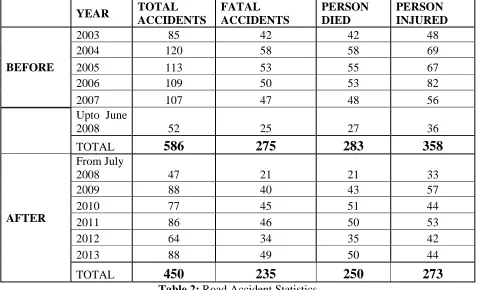
61% of the total accidents registered are occurred on project road. This fraction of 1036 road accidents which occurred on NH-1 stretch (85:00 to 97:00) from 2003 to 2013 includes 510 fatal accidents in which 533 people loss their life and 631 are injured. This shows that
approximately 49% accidents are fatal
accidents.Table-2 gives the numbers of accidents occurred from 2003 to 2013. There were 586 accidents occurred in the 5.5 years Before period (average 97 accidents per year) , and 450 accidents in the five years after period(average 75 accidents per year). There were 586 accidents in the 5.5 years Before, and 450 accidents in the 5.5 years, After. Thus there were 136 fewer accidents in the After period, an average saving of 22.6 per year, which represents a 23% reduction. In the ‘Before’ period, there were 283 casualties. In the ‘After’ period, there were 250 casualties. There has
been an 11% reduction in casualties since completion of the scheme.
YEAR TOTAL
ACCIDENTS
FATAL ACCIDENTS
PERSON DIED
PERSON INJURED
BEFORE
2003 85 42 42 48
2004 120 58 58 69
2005 113 53 55 67
2006 109 50 53 82
2007 107 47 48 56
Upto June
2008 52 25 27 36
TOTAL
586
275
283
358
AFTER
From July
2008 47 21 21 33
2009 88 40 43 57
2010 77 45 51 44
2011 86 46 50 53
2012 64 34 35 42
2013 88 49 50 44
TOTAL
450
235
250
273
9.2 COMPARISON OF TOTAL ACCIDENTS OCCURRED:
The following chart gives the comparative profile of total accidents in before and after period.
Figure 1: Number of Total Accidents in Before
and After Period
9.3 COMPARISON OF FATAL
ACCIDENTS OCCURRED
The following chart gives the comparative profile of fatal accidents in before and after period.
Figure 2: Number of Fatal Accidents in
Before and After Period
9.4 COMPARATIVE ANALYSIS OF ACCIDENTS AND PERSONS AFFECTED
Figure 3: Accidents profile in Before and After Period
9.5 SIGNIFICANCE OF IMPROVEMENT ON TOTAL ACCIDENTS
Solving this, control point C = 1.464
χ 2= [450-586x1.46]2
(450+586)1.46
= 10.93
For χ 2 5% significance level and one degree of
freedom = 3.841
As χ 2 (observed) > 3.841, it provides a strong
evidence that the improvement was effective and reduction in number of total accidents is not merely due to chance alone.
9.6 SIGNIFICANCE OF IMPROVEMENT ON FATAL ACCIDENTS
Solving this, control point C = 1.02
χ 2 = [235-275x1.02]2
(235+275)1.02
=3.9
For 5% significance level and one degree of freedom = 3.841
χ 2 (observed) > 3.841
Concluded that difference in fatal accident have reduced due to improvement.
10. CONCLUSION
The following results show that increased provision of elevated roads is likely to reduce accidents. Chi square method provides strong evidence that the improvement was effective and reduction in number of total accidents is not merely due to chance alone.
The number of accidents in the study area fell from 98 per year ‘Before’, to 75 per years ‘After’ the scheme, representing a drop of 23%. The change is statistically significant.
The proportion of fatal accidents to the total
has increased from 0.469 ‘Before’ to
0.522‘After’.
Number of fatalities has been decreased from 45.8 accidents per year to 39.17 accidents per year.
Persons injuries also reduced 358(60 persons per year) to 273 (45 persons per year)
REFERENCES:
Mohan D. The road ahead: Traffic injuries and fatalities in India. Transportation Research and Injury Prevention Programme. Indian Institute of Technology, Delhi, 2004
Road safety in India : Challenges and Opportunities by Dinesh Mohan, Omer Tsimhoni, Michael Sivak, Michael J. Flannagan The University of Michigan Transportation Research Institute Ann Arbor, January 2009.
Road Accidents in India 2012, Ministry of Road Transport & Highways Govt. Of India.
Global status report on road safety 2013: Supporting a decade of action., World Health Organization 2013
http://internationaltransportforum.org/irtadpublic/index.h tml
Gupta SC, Kapoor VK 2000. Fundamentals of Mathematical statistics. S Chand and Sons, New Delhi, India.