Encrypted Data in Cloud Computing
Jin Li1
, Qian Wang1
, Cong Wang1
, Ning Cao2
, Kui Ren1
, and Wenjing Lou2 1 Department of ECE, Illinois Institute of Technology
{jli25, qwang, cwang, kren2}@iit.edu
2 Department of ECE, Worcester Polytechnic Institute, {ncao, wjlou}@ece.wpi.edu
Abstract. As Cloud Computing becomes prevalent, more and more sensitive information are being centralized into the cloud. For the protection of data privacy, sensitive data usually have to be encrypted before outsourcing, which makes effective data utilization a very chal-lenging task. Although traditional searchable encryption schemes allow a user to securely search over encrypted data through keywords and selectively retrieve files of interest, these techniques support onlyexactkeyword search. That is, there is no tolerance of minor typos and format inconsistencies which, on the other hand, are typical user searching behavior and happen very frequently. This significant drawback makes existing techniques unsuitable in Cloud Computing as it greatly affects system usability, rendering user searching expe-riences very frustrating and system efficacy very low. In this paper, for the first time we formalize and solve the problem of effective fuzzy keyword search over encrypted cloud data while maintaining keyword privacy. Fuzzy keyword search greatly enhances system usability by returning the matching files when users’ searching inputs exactly match the predefined keywords or the closest possible matching files based on keyword similarity semantics, when exact match fails. In our solution, we exploit edit distance to quantify keywords similarity and develop two advanced techniques on constructing fuzzy keyword sets, which achieve op-timized storage and representation overheads. We further propose a brand new symbol-based trie-traverse searching scheme, where a multi-way tree structure is built up using symbols transformed from the resulted fuzzy keyword sets. Through rigorous security analysis, we show that our proposed solution is secure and privacy-preserving, while correctly realizing the goal of fuzzy keyword search. Extensive experimental results demonstrate the efficiency of the proposed solution.
1
Introduction
Cloud Computing, the new term for the long dreamed vision of computing as a utility [1], enables convenient, on-demand network access to a centralized pool of configurable computing resources (e.g., networks, applications, and services) that can be rapidly deployed with great efficiency and minimal management overhead [2]. The amazing advantages of Cloud Computing include: on-demand self-service, ubiquitous network access, location independent resource pooling, rapid resource elasticity, usage-based pricing, transference of risk, etc. [2, 3]. Thus, Cloud Computing could easily benefit its users in avoiding large capital outlays in the deployment and management of both software and hardware. Undoubtedly, Cloud Computing brings unprecedented paradigm shifting and benefits in the history of IT.
However, data encryption makes effective data utilization a very challenging task given that there could be a large amount of outsourced data files. Moreover, in Cloud Computing, data owners may share their outsourced data with a large number of users. The individual users might want to only retrieve certain specific data files they are interested in during a given session. One of the most popular ways is to selectively retrieve files through keyword-based search instead of re-trieving all the encrypted files back which is completely impractical in cloud computing scenarios. Such keyword-based search technique allows users to selectively retrieve files of interest and has been widely applied in plaintext search scenarios, such as Google search [4]. Unfortunately, data encryption restricts user’s ability to perform keyword search and thus makes the traditional plain-text search methods unsuitable for Cloud Computing. Besides this, data encryption also demands the protection of keyword privacy since keywords usually contain important information related to the data files. Although encryption of keywords can protect keyword privacy, it further renders the traditional plaintext search techniques useless in this scenario.
To securely search over encrypted data, searchable encryption techniques have been developed in recent years [5–13]. Searchable encryption schemes usually build up an index for each keyword of interest and associate the index with the files that contain the keyword. By integrating the trapdoors of keywords within the index information, effective keyword search can be realized while both file content and keyword privacy are well-preserved. Although allowing for performing searches securely and effectively, the existing searchable encryption techniques do not suit for cloud computing scenario since they support only exact keyword search. That is, there is no tolerance of minor typos and format inconsistencies which, on the other hand, are typical user searching behavior and happen very frequently. As common practice, users may search and retrieve the data of their respective interests using any keywords they might come up with. It is quite common that users’ searching input might not exactly match those pre-set keywords due to the possible typos, such as Illinois and Ilinois, representation inconsistencies, such as PO BOX and P.O. Box, and/or her lack of exact knowledge about the data. To give a concrete example, statistics from Google [4] shows that only less than 77% of the users’ searching input exactly matched the name of Britney, detected in their spelling correction system within a three-month period. In other words, searching based on exact keyword match would return unnecessary failures for more than 23% search requests of Britney, making the searching system ineffective with low usability. This significant drawback of existing schemes signifies the important need for new techniques that support searching flexibility, tolerating both minor typos and format inconsistencies. That is, secure fuzzy search capability is demanded for achieving enhanced system usability in Cloud Computing. Although the importance of fuzzy search has received attention recently in the context of plaintext searching by information retrieval community [14–17], it is still being overlooked and remains to be addressed in the context of encrypted data search.
In this paper, we focus on enabling effective yet privacy-preserving fuzzy keyword search in Cloud Computing. To the best of our knowledge, we formalize for the first time the problem of effective fuzzy keyword search over encrypted cloud data while maintaining keyword privacy. Fuzzy keyword search greatly enhances system usability by returning the matching files when users’ searching inputs exactly match the predefined keywords or the closest possible matching files based on keyword similarity semantics, whenexact match fails. More specifically, we use edit distance to quantify keywords similarity and develop two novel techniques, i.e., an wildcard-based technique and a gram-based technique, for the construction of fuzzy keyword sets. Both techniques eliminate the need for enumerating all the fuzzy keywords and the resulted size of the fuzzy keyword sets is significantly reduced. Based on the constructed fuzzy keyword sets, we further propose an advanced symbol-based trie-traverse searching scheme, where a multi-way tree structure is built up using symbols transformed from the fuzzy keywords. Through rigorous security analysis, we show that the proposed solution is secure and privacy-preserving, while correctly realizing the goal of fuzzy keyword search. Extensive experimental results demonstrate the efficiency of the proposed solution.
description of our proposed schemes. Section 6 and 7 present the security and performance analysis, respectively. Finally, Section 8 concludes the paper.
2
Related Work
Plaintext fuzzy keyword search. Recently, the importance of fuzzy search has received
at-tention in the context of plaintext searching in information retrieval community [15–17]. They addressed this problem in the traditional information-access paradigm by allowing user to search without using try-and-see approach for finding relevant information based on approximate string matching. The approximate string matching algorithms among them can be classified into two categories: on-line and off-line. The on-line techniques, performing search without an index, are unacceptable for their low search efficiency, while the off-line approach, utilizing indexing tech-niques, makes it dramatically faster. A variety of indexing algorithms, such as suffix trees, metric trees andq-gram methods, have been presented. At the first glance, it seems possible for one to directly apply these string matching algorithms to the context of searchable encryption by com-puting the trapdoors on a character base within an alphabet. However, this trivial construction suffers from the dictionary and statistics attacks and fails to achieve the search privacy.
Searchable encryption. Traditional searchable encryption [5–13] has been widely studied in
the context of cryptography. Among those works, most are focused on efficiency improvements and security definition formalizations. The first construction of searchable encryption was pro-posed by Song et al. [6], in which each word in the document is encrypted independently under a special two-layered encryption construction. Goh [7] proposed to use Bloom filters to construct the indexes for the data files. For each file, a Bloom filter containing trapdoors of all unique words is built up and stored on the server. To search for a word, the user generates the search request by computing the trapdoor of the word and sends it to the server. Upon receiving the request, the server tests if any Bloom filter contains the trapdoor of the query word and returns the corre-sponding file identifiers. To achieve more efficient search, Chang et al. [10] and Curtmola et al. [11] both proposed similar “index” approaches, where a single encrypted hash table index is built for the entire file collection. In the index table, each entry consists of the trapdoor of a keyword and an encrypted set of file identifiers whose corresponding data files contain the keyword. As a complementary approach, Boneh et al. [8] presented a public-key based searchable encryption scheme, with an analogous scenario to that of [6]. In their construction, anyone with the public key can write to the data stored on the server but only authorized users with the private key can search. As an attempt to enrich query predicates, conjunctive keyword search, subset query and range query over encrypted data, have also been proposed in [12, 18]. Note that all these ex-isting schemes support only exact keyword search, and thus are not suitable for Cloud Computing.
Others.Private matching [19], as another related notion, has been studied mostly in the context
of secure multiparty computation to let different parties compute some function of their own data collaboratively without revealing their data to the others. These functions could be intersection or approximate private matching of two sets, etc. [20]. The private information retrieval [21] is an often-used technique to retrieve the matching items secretly, which has been widely applied in information retrieval from database and usually incurs unexpectedly computation complexity.
3
Problem Formulation
3.1 System Model
O w n er o
uts
o
urce
F ile s
outs
ou rce
E ncry pte d
F iles
Tra
p do
o
rs
of
s
e
a
rch
r
equ
e
s t
File
r
et
r
i
ev
a
l
F uzz y
keyw ord set I
n dex
U sers
C lo ud se rv e r
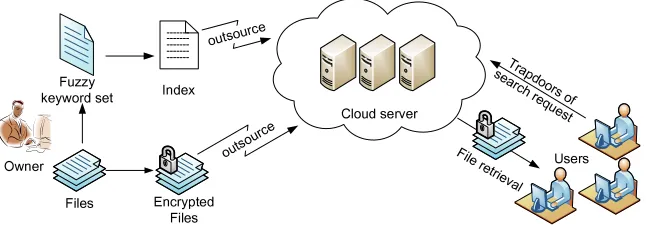
Fig. 1: Architecture of the fuzzy keyword search
the data owner and users is appropriately done. An authorized user types in a request to selectively retrieve data files of his/her interest. The cloud server is responsible for mapping the searching request to a set of data files, where each file is indexed by a file ID and linked to a set of keywords. The fuzzy keyword search scheme returns the search results according to the following rules: 1) if the user’s searching input exactly matches the pre-set keyword, the server is expected to return the files containing the keyword3
; 2) if there exist typos and/or format inconsistencies in the searching input, the server will return the closest possible results based on pre-specified similarity semantics (to be formally defined in section 3.4). An architecture of fuzzy keyword search is shown in the Fig. 1.
3.2 Threat Model
We consider a semi-trusted server. Even though data files are encrypted, the cloud server may try to derive other sensitive information from users’ search requests while performing keyword-based search overC. Thus, the search should be conducted in a secure manner that allows data files to be securely retrieved while revealing as little information as possible to the cloud server. In this paper, when designing fuzzy keyword search scheme, we will follow the security definition deployed in the traditional searchable encryption [11]. More specifically, it is required that nothing should be leaked from the remotely stored files and index beyond the outcome and the pattern of search queries.
3.3 Design Goals
In this paper, we address the problem of supporting efficient yet privacy-preserving fuzzy keyword search services over encrypted cloud data. Specifically, we have the following goals: i) to explore different mechanisms for constructing storage-efficient fuzzy keyword sets; ii) to design efficient and effective fuzzy search schemes based on the constructed fuzzy keyword sets; iii) to validate the security and evaluate the performance by conducting extensive experiments.
3.4 Preliminaries
Edit DistanceThere are several methods to quantitatively measure the string similarity. In this
paper, we resort to the well-studied edit distance [22] for our purpose. The edit distanceed(w1, w2) between two wordsw1 andw2is the number of operations required to transform one of them into the other. The three primitive operations are 1) Substitution: changing one character to another in a word; 2) Deletion: deleting one character from a word; 3) Insertion: inserting a single character into a word. Given a keywordw, we letSw,d denote the set of wordsw′ satisfyinged(w, w′)≤d
for a certain integerd.
Fuzzy Keyword SearchUsing edit distance, the definition of fuzzy keyword search can be for-mulated as follows: Given a collection ofnencrypted data filesC= (F1, F2, . . . , FN) stored in the
cloud server, a set of distinct keywordsW ={w1, w2, ..., wp}with predefined edit distanced, and a
searching input (w, k) with edit distancek(k≤d), the execution of fuzzy keyword search returns a set of file IDs whose corresponding data files possibly contain the wordw, denoted asF IDw: if
w=wi∈W, then returnF IDwi; otherwise, ifw6∈W, then return{F IDwi}, whereed(w, wi)≤k.
Note that the above definition is based on the assumption thatk≤d. In fact,dcan be different for distinct keywords and the system will return{F IDwi} satisfyinged(w, wi) ≤min{k, d} if exact
match fails.
Trapdoors of Keywords Trapdoors of the keywords can be realized by applying a one-way
functionf, which is similar as [5, 7]: Given a keywordwiand a secret keysk, we can compute the
trapdoor ofwi asTwi=f(sk, wi).
4
Constructions of Effective Fuzzy Keyword Search in Cloud
The key idea behind our secure fuzzy keyword search is two-fold: 1) building up fuzzy keyword sets that incorporate not only the exact keywords but also the ones differing slightly due to minor typos, format inconsistencies, etc.; 2) designing an efficient and secure searching approach for file retrieval based on the resulted fuzzy keyword sets. In this section, we will focus on the first part, i.e., building storage-efficient fuzzy keyword sets to facilitate the searching process.
4.1 The Straightforward Approach
Before introducing our constructions of fuzzy keyword sets, we first propose a straightforward approach that achieves all the functions of fuzzy keyword search, which aims at providing an overview of how fuzzy search scheme works.
Assume Π=(Setup(1λ), Enc(sk,·), Dec(sk,·)) is a symmetric encryption scheme, where skis
a secret key,Setup(1λ) is the setup algorithm with security parameterλ,Enc(sk,·) andDec(sk,·)
are the encryption and decryption algorithms, respectively. The scheme goes as follows: We can begin by constructing the fuzzy keyword setSwi,dfor each keywordwi∈W (1≤i≤p) with edit
distanced. The intuitive way to construct the fuzzy keyword set ofwiis to enumerate all possible
wordsw′
ithat satisfy the similarity criteriaed(wi, wi′)≤d, that is, all the words with edit distance
dfromwiare listed. For example, the following is the listing variants after a substitution operation
on the first character of keywordCASTLE:{AASTLE,BASTLE,DASTLE,· · ·,YASTLE,ZASTLE}. Based on the resulted fuzzy keyword sets, the fuzzy search is conducted as follows: 1) To build an index for wi, the data owner computes trapdoors Tw′
i = f(sk, w
′
i) for each wi′ ∈ Swi,d with a secret
key sk shared between data owner and authorized users. The data owner also encrypts FIDwi
as Enc(sk,FIDwikwi). The index table {({Tw′i}wi′∈Swi,d,Enc(sk,FIDwikwi))}wi∈W and encrypted
data files are outsourced to the cloud server for stroage; 2) To search withw, the authorized user computes the trapdoorTwofwand sends it to the server; 3) Upon receiving the search requestTw,
the server compares it with the index table and returns all the possible encrypted file identifiers
{Enc(sk,FIDwikwi)}according to the fuzzy keyword definition in section III-D. The user decrypts
the returned results and retrieves relevant files of interest.
This straightforward approach apparently provides fuzzy keyword search over the encrypted files while achieving search privacy using the technique of secure trapdoors. However, this approach has serious efficiency disadvantages. The simple enumeration method in constructing fuzzy key-word sets would introduce large storage complexities, which greatly affect the usability. Recall that in the definition of edit distance, substitution, deletion and insertion are three kinds of operations in computation of edit distance. The numbers of all similar words ofwi satisfyinged(wi, wi′)≤d
ford= 1,2 and 3 are approximately 2k×26, 2k2
×262
, and 4 3k
3
×263
, respectively. For example, assume there are 104
Algorithm 1Wildcard-based Fuzzy Set Construction 1: procedureCreateWildcardFuzzySet(wi, d)
2: if d >1then
3: Call CreateWildcardFuzzySet(wi, d−1);
4: end if 5: if d= 0then 6: SetS′
wi,d={wi};
7: else
8: for(k ←1 to|S′
wi,d−1|)do
9: forj←1 to 2∗ |S′
wi,d−1[k]|+ 1do
10: if jis oddthen
11: Set fuzzyword asS′
wi,d−1[k]; 12: Insert⋆at position⌊(j+ 1)/2⌋;
13: else
14: Set fuzzyword asS′
wi,d−1[k];
15: Replace⌊j/2⌋-th character with⋆;
16: end if
17: if fuzzyword is not inS′
wi,d−1 then
18: SetS′
wi,d=S
′
wi,d∪ {fuzzyword};
19: end if
20: end for
21: end for 22: end if 23:end procedure 24: end procedure
4.2 Advanced Techniques for Constructing Fuzzy Keyword Sets
To provide more practical and effective fuzzy keyword search constructions with regard to both storage and search efficiency, we now propose two advanced techniques to improve the straightfor-ward approach for constructing the fuzzy keyword set. Without loss of generality, we will focus on the case of edit distance d= 1 to elaborate the proposed advanced techniques. For larger values ofd, the reasoning is similar. Note that both techniques are carefully designed in such a way that while suppressing the fuzzy keyword set, they will not affect the search correctness, as will be described in section 5.
Wildcard-based Fuzzy Set ConstructionIn the above straightforward approach, all the
vari-ants of the keywords have to be listed even if an operation is performed at the same position. Based on the above observation, we proposed to use an wildcard to denote edit operations at the same position. The wildcard-based fuzzy set ofwi with edit distancedis denoted asSwi,d={S
′
wi,0, S
′
wi,1,
· · ·,S′
wi,d}, whereS
′
wi,τ denotes the set of words w
′
i with τ wildcards. Note each wildcard
repre-sents an edit operation onwi. The procedure for wildcard-based fuzzy set construction is shown in
Algorithm 1. For example, for the keywordCASTLE with the pre-set edit distance 1, its wildcard-based fuzzy keyword set can be constructed asSCASTLE,1= {CASTLE, *CASTLE, *ASTLE,C*ASTLE,
C*STLE,· · ·,CASTL*E,CASTL*,CASTLE*}. The total number of variants onCASTLEconstructed in this way is only 13 + 1, instead of 13×26 + 1 as in the above exhaustive enumeration approach when the edit distance is set to be 1. Generally, for a given keywordwi with lengthℓ, the size of
Swi,1 will be only 2ℓ+ 1 + 1, as compared to (2ℓ+ 1)×26 + 1 obtained in the straightforward
approach. The larger the pre-set edit distance, the more storage overhead can be reduced: with the same setting of the example in the straightforward approach, the proposed technique can help reduce the storage of the index from 30GB to approximately 40MB.
Gram-based Fuzzy Set ConstructionAnother efficient technique for constructing fuzzy set
Algorithm 2Gram-based Fuzzy Set Construction 1: procedureCreateGramFuzzySet(wi, d)
2: if d >1then
3: Call CreateGramFuzzySet(wi, d−1);
4: end if 5: if d= 0then
6: S′
wi,d={wi};
7: else
8: for(k ←1 to|S′
wi,d−1|)do
9: forj←1 to 2∗ |S′
wi,d−1[k]|+ 1do
10: Set fuzzyword asSw′i,d−1[k];
11: Delete thej-th character;
12: if fuzzyword is not inS′wi,d−1 then
13: SetS′
wi,d=Sw′i,d∪ {fuzzyword}
14: end if
15: end for
16: end for 17: end if 18:end procedure 19: end procedure
for approximate string search [23–25], we use gram for the matching purpose. We propose to uti-lize the fact that any primitive edit operation will affect at most one specific character of the keyword, leaving all the remaining characters untouched. In other words, the relative order of the remaining characters after the primitive operations is always kept the same as it is before the operations. With this significant observation, the fuzzy keyword set for a keywordwi withℓ
single characters supporting edit distanced can be constructed as Swi,d ={S
′
wi,τ}0≤τ≤d, where
S′
wi,τ consists of all the (ℓ–τ)-gram from wi and with the same relative order (we assume that
d≤ℓ). For example, the gram-based fuzzy setSCASTLE,1for keywordCASTLEcan be constructed as
{CASTLE,CSTLE,CATLE,CASLE,CASTE,CASTL,ASTLE}. Generally, given a keywordwi withℓ single
characters, the size ofS′
wi,τ isC ℓ−τ
ℓ , and the size ofSwi,disC ℓ ℓ+Cℓ−
1
ℓ +· · ·+C
ℓ−d
ℓ . Compared to
wildcard-based construction, gram-based construction can further reduce the storage of the index from 40MB to approximately 10MB under the same setting as in the wildcard-based approach. The procedure for gram-based fuzzy set construction is shown in Algorithm 2.
5
Efficient Fuzzy Searching Schemes
As shown in section 4, the size of fuzzy keyword set is greatly reduced using the proposed advanced techniques. However, the above constructions introduce another challenge: How to generate the search request and how to perform fuzzy keyword search? In the straightforward approach, because the index is created by enumerating all of fuzzy words for each keyword, there always exists matching words for the search request as long as the edit distance between them is equal or less than d. To design fuzzy search schemes based on the fuzzy keyword sets constructed from wildcard-based or gram-based technique, we compute the searching request regarding (w, k) as
{Tw′}w′∈S
w,k, where Sw,k ={S
′
w,0, Sw,′ 1, · · ·,Sw,k′ } is generated in the same way as in the fuzzy
keyword set construction. In this section, we will show how to achieve fuzzy keyword search based on the fuzzy sets constructed from the proposed advanced techniques. For simplicity, we will only consider the fixeddin our scheme designs. In this section, we start with some intuitive solutions, the analysis of which will motivate us to develop more efficient ones.
5.1 The Intuitive Solutions
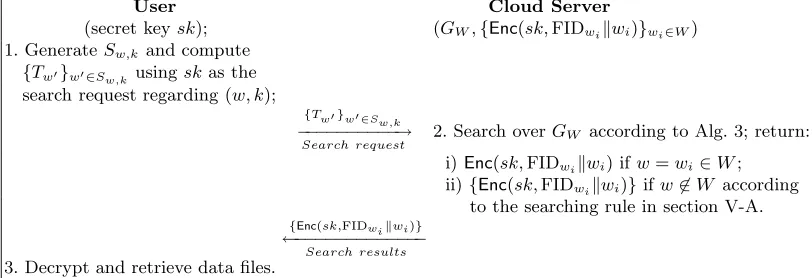
User Cloud Server
(secret keysk); (GW,{Enc(sk,FIDwikwi)}wi∈W)
1. GenerateSw,k and compute
{Tw′}w′∈S
w,kusingskas the
search request regarding (w, k);
{Tw′}w′ ∈Sw,k
−−−−−−−−−−→
Search request 2. Search overGW according to Alg. 3; return:
i)Enc(sk,FIDw
ikwi) ifw=wi∈W;
ii){Enc(sk,FIDw
ikwi)}ifw6∈W according
to the searching rule in section V-A. {Enc(sk,FIDwikwi)}
←−−−−−−−−−−−−−
Search results
3. Decrypt and retrieve data files.
Fig. 2: Protocol for the symbol-based trie-traverse fuzzy keyword search
follows: (1) In the index building phase, for each keywordwi∈W, the data owner computes
trap-doorsTw′
i=f(sk, w
′
i) for all wi′∈Swi,dwith secret keysk. Then he computesEnc(sk,FIDwikwi)
and outsources the index table {{Tw′ i}w
′
i∈Swi,d,Enc(sk,FIDwikwi)} together with the encrypted
data files to the cloud server; (2) Assume an authorized user types inw as the searching input, with the pre-set edit distance k. The searching input is first transformed to a fuzzy set Sw,k.
Then, the trapdoors{Tw′}w′∈S
w,k for each elementw
′ ∈S
w,k are generated and submitted as the
search request to the cloud server; (3) Upon receiving the search request, the server first compares
{Tw′}w′∈S′
w,0 with the index and returns the search result asEnc(sk,FIDwkw) if there exists an exact match. Otherwise, the server will compare all the elements of{Tw′}w′∈S′
w,τ (1≤τ≤k) with
the index for the file collection and return all of the matched results {Enc(sk,FIDwikwi)}. The
user now can obtain{FIDwikwi}through decryption and retrieve files of interest.
In fact, the correctness of the search result is based on the following observation: Assume the search request{Tw′}w′∈S
w,k forwand the index{Twi′}w′i∈Swi,d for keywordwiare computed with
edit distancekandd, respectively. As long as the edit distance satisfiesed(w, wi)≤k, there would
always exist at least one match between the elements inSw,kand the ones inSwi,d. Therefore, the
search correctness is still maintained according to the fuzzy keyword search definition in 3.4 (The security proof of the listing approach will be given in section 6 for both the wildcard-based and the gram-based fuzzy keyword set constructions). The scheme also supports for variable d, and the results in section 6 will still hold by replacing the condition ed(w, wi) ≤kwith ed(w, wi)≤
min{k, d}. To further hide the keyword length information, dummy trapdoors can be added such that all of the fuzzy sets have the same size. In this listing approach, both the searching cost and the storage cost at the server side areO(τ|W|), whereτ= max{{|Swi,d|}wi∈W}.
Another solution is to explore Bloom filter [26] to represent the fuzzy keyword set Swi,d for
each keyword wi with edit distance d, namely, the trapdoor set {Tw′ i}w
′
i∈Swi,d is inserted into
keyword wi’s Bloom filter as the index stored on the server. Now by binding the encrypted file
identifiersEnc(sk,FIDwikwi) towi’s Bloom filter, a per keyword index is generated to track the
data files. Upon receiving the search request {Tw′}w′∈S
w,k, the server tests which Bloom filters
contain 1’s in allr locations for each elementw′∈S
w,k and returns the search results, assuming
there are r independent hash functions h1, . . . , hr used in the construction of Bloom filter. In
this solution, the server will only need to store a bit array of m bits instead of the trapdoor information for all fuzzy set regarding wi. Compared to the listing scheme, both storage cost
and searching cost are now O(|W|). However, due to the property of Bloom filter, there exists probability of falsely recognizing an unrelated wordw′
i as in{Tw′ i}w
′
i∈Swi,d. For a keywordwiand
its corresponding Bloom filter with a bit array ofmbits, the probability of a false positive is then
f = (1−(1−1/m)r|Swi,d|)r≈(1−e−r|Swi,d|/m)r. While the Bloom filter above is built for each
keywordwi∈W, it can also be built based on each file. The intuition behind this idea is to insert
fuzzy setSwi,d of all the keywords belonging to the same file into a single Bloom filter, a search
request{Tw′}w′∈S
Φ α α α α α α α α α α α α α Ă Ă
F ID
α α α α α α Ă Ă Ă
F ID F ID
F ID F ID F ID F ID
α α α
F ID
. . . . . . . . . . . . . . . . . . α α α α α α Ă Ă Ă
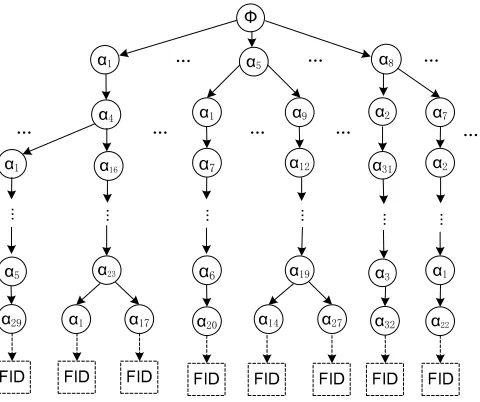
Fig. 3: An example of integrated symbol-based index for all words in the fuzzy keyword set.
file’s Bloom filter. Note that the search cost associated with this solution isO(|N|), whereN is the number of data files.
5.2 The Symbol-based Trie-Traverse Search Scheme
To enhance the search efficiency, we now propose a symbol-based trie-traverse search scheme, where a multi-way tree is constructed for storing the fuzzy keyword set{Swi,d}wi∈W over a finite
symbol set. The key idea behind this construction is that all trapdoors sharing a common prefix may have common nodes. The root is associated with an empty set and the symbols in a trapdoor can be recovered in a search from the root to the leaf that ends the trapdoor. All fuzzy words in the trie can be found by a depth-first search. Assume∆={αi}is a predefined symbol set, where
the number of different symbols is| ∆|= 2n, that is, each symbol α
i ∈∆ can be denoted byn
bits. The scheme, as described in Fig. 2, works as follows:
(1) Assume the data owner wants to outsource the file collection C with keyword set W, he computesTw′
i as αi1· · ·αil/n for eachw
′
i ∈ Swi,d (i = 1,· · ·, p), where l is the output length of
one-way function f(x). A treeGW covering all the fuzzy keywords ofwi ∈ W is built up based
on symbols in ∆. The data owner attaches the Enc(sk,FIDwikwi) to GW for i = 1, . . . , p and
outsources these information to the cloud server;
(2) To search files containingwwith edit distancek, the user computesTw′ for eachw′∈Sw,k
and sends{Tw′}w′∈S
w,k to the server;
(3) Upon receiving the request, the server divides eachTw′into a sequence of symbols, performs
the search overGW using Algorithm 3 and returns{Enc(sk,FIDwikwi)}to the user.
Note that by dividing the keying hash value intol/nparts, eachn-bit of the hash value repre-sents a symbol in∆. The hash value of each fuzzy wordw′
i∈Swi,dis deterministic because with the
same inputskandw′
i, the outputαi1· · ·αil/nis unique. Moreover, no information aboutwiwill be
leaked from the outputαi1· · ·αil/n. In this scheme, the paths of trapdoors for different keywords
are integrated by merging all the paths with the same prefix into a single trie to support more effi-cient search. The encrypted file identifiers will be indexed according to its address or name and the index information will be stored aat the ending node of the corresponding path. Such an example of symbol-based trie is given in Fig. 3. With the returned search results{Enc(sk,FIDwikwi)}, the
user may retrieve the files of his interest after decrypt and obtain{FIDwikwi}. For each request,
Algorithm 3SearchingTree 1: procedureSearchingTree({T′
w})
2: fori←1 to|{T′
w}|do
3: setcurrentnodeasrootofGw;
4: forj←1 tol/ndo
5: Setαasαjin thei-thTw′;
6: if nochildofcurrentnodecontainsαthen
7: break;
8: end if
9: Setcurrentnodeaschildcontainingα;
10: end for
11: if currentnodeisleaf nodethen
12: Appendcurrentnode.F IDstoresultIDset; 13: if i= 1then
14: returnresultIDset;
15: end if
16: end if 17: end for
18: returnresultIDset; 19:end procedure 20: end procedure
5.3 Supporting Multiple Users
In this section, we consider a natural extension from the previous single-user setting to multi-user setting, where a data owner stores a file collection on the cloud server and allows an arbitrary group of users to search over his file collection. Let BE = (KeyGenBE,EncBE,DecBE) be a broadcast
encryption scheme providing revocation-scheme security against a coalition of all revoked users [27]. Additionally, letπbe a pseudo-random permutation.
The index computation is almost the same as the single-user setting except for each trapdoor
Tw, a pseudo-random permutation π(ξ,·) is applied with a secret key ξwhich is encrypted with
the broadcast encryption scheme and stored on the server.
To search with (w, k), an authorized user computes trapdoors{π(ξ, Tw′)}w′∈S
w,k with a secret
keyξwhich is distributed by the data owner.
Upon receiving the request, the server recovers the trapdoors by computing π−1
(ξ,π(ξ,Tw′)).
Because the keyξcurrently used is only known by the server and the set of currently authorized users, the search request is valid only if the user is not revoked. Each time a user is revoked, the data owner picks a new ξ and stores it on the server encrypted such that only non-revoked users can decrypt it. After the update, the server will use the new ξ to compute π−1
(ξ,·) for following search requests. Furthermore, the revoked users cannot recover the currentξand thus, their requests will not yield valid trapdoors after the server appliesπ−1
(ξ,·).
6
Security Analysis
In this section, we analyze the correctness and security of the proposed fuzzy keyword search schemes. At first, we show the correctness of the schemes in terms of two aspects, that is, com-pleteness and soundness.
Theorem 1. The wildcard-based schemes satisfy both completeness and soundness. Specially, upon
receiving the request of w, all of the keywords{wi}will be returned if and only if ed(w, wi)≤k.
The proof can be derived based on the following Lemma:
Lemma 1. The intersection of the fuzzy sets Swi,d and Sw,k for wi and w is not empty if and
Proof. First, we show that Swi,d∩Sw,k is not empty when ed(w, wi) ≤ k. To prove this, it is
enough to find an element inSwi,d∩Sw,k. Letw=a1a2· · ·asandwi=b1b2· · ·bt, where all these
aiandbj are single characters. Aftered(w, wi) edit operations,wcan be changed towi according
to the definition of edit distance. Letw∗ =a∗
1a∗2· · ·a∗m, whereai∗=aj or a∗i =∗if any operation
is performed at this position. Since the edit operation is inverted, from wi, the same positions
containing wildcard atw∗ will be performed. Becauseed(w, w
i)≤k,w∗is included in bothSwi,d
andSw,k, we get the result thatSwi,d∩Sw,k is not empty.
Next, we prove that Swi,d∩Sw,k is empty if ed(w, wi)> k. The proof is given by reduction.
Assume there exists an w∗ belonging to S
wi,d∩Sw,k. We will show that ed(w, wi) ≤ k, which
reaches a contradiction. First, from the assumption thatw∗∈S
wi,d∩Sw,k, we can get the number
of wildcard inw∗, which is denoted byn∗, is not greater thank. Next, we prove thated(w, w
i)≤n∗.
We will prove the inequality with induction method. First, we prove it holds whenn∗= 1. There are nine cases should be considered: If w∗ is derived from the operation of deletion from bothw
i
andw, then,ed(wi, w)≤1 because the other characters are the same except the character at the
same position. If the operation is deletion fromwiand substitution fromw, we haveed(wi, w)≤1
because they will be the same after at most one substitution from wi. The other cases can be
analyzed in a similar way and are omitted. Now, assuming that it holds when n∗ =γ, we need to prove it also holds when n∗ = γ+ 1. If ˆw∗ = a∗
1a∗2· · ·a∗n ∈ Swi,d∩Sw,k, where a
∗
i = aj or
a∗
i =∗. For an wildcard at positiont, cancel the underlying operations and revert it to the original
characters in wi andw at this position. Assume two new elements wi∗ andw∗ are derived from
them respectively. Then perform one operation at positiont ofw∗
i to make the character ofwi at
this position be the same withw, which is denoted byw′
i. After this operation,w∗i will be changed
to w∗, which has only k wildcards. Therefore, we have ed(w′
i, w) ≤γ from the assumption. We
know that ed(w′
i, w) ≤ γ and ed(w′i, wi) = 1, based on which we know that ed(wi, w) ≤ γ+ 1.
Thus, we can get ed(w, wi) ≤ n∗. It renders the contradiction ed(w, wi) ≤ k because n∗ ≤ k.
Therefore,Swi,d∩Sw,k is empty ifed(w, wi)> k.
The following Theorem says that in the gram-based search schemes, the satisfied keywords will be returned, as well as some keywords which are not desired. In concrete, the returned keywords may also include keyword wi as the answer for the request of (w, k) even if ed(w, wi) > k. For
example, to search with the request (CAT,1), the keywordCASTLEwill be returned if (CASTLE,3) is stored in the index, even if the edit distance of CATandCASTLEis greater than 1. Thus, with the returned results, the user should filter the keyword set by further computing the edit distance.
Theorem 2. The gram-based fuzzy keyword search schemes satisfy the completeness. Specially,
upon receiving the request of (w, k), all of the keywordswi will be returned if ed(w, wi)≤k.
The proof of the Theorem can be obtained through the following Lemma:
Lemma 2. AssumeSwi,d andSw,k are built with edit distancedandkforwiandw, respectively.
The setSwi,d∩Sw,k is not empty when ed(wi, w)≤min{d, k}.
Proof. Leted(w1, w2) =d, after at mostdoperations on the characters ofw1, it can be transformed to w2. Without loss of generality, assume |w1| ≥ |w2|. It means that the remaining |w1| – d characters inw1 are untouched and they are equal to a (|w1|–d)-character sequence inw2, which belongs toSw1,k1∩Sw2,k2 whend≤min{k1, k2}.
History: an interaction between the data user and the cloud server, which is determined by a file collection D = (F1, F2, . . . , Fn) and a set of keywords searched by the client, denoted as
Hq = (D, w1, . . . , wq).
View: what the cloud server actually sees during the interaction of a given historyHq
un-der some secret key K, including the index I∗ of D, the trapdoors of the queried keywords
{Tw′}w′∈{S
w1,···,Swq}, the number of files, their ciphertexts (C1,· · · , Cn), denoted asVK(Hq). Trace: the precise information leaked about the history Hq, including the file identifiers of
keyword wi, which is denoted as {F IDwi}1≤i≤q (outcome of each search), the equality pattern
Πq for each search (search pattern), and the size of the encrypted files, denoted asT r(Hq), where
Πq is regarded as a symmetric binary matrix where Πq[i, j] = 1 if any element in {Tw′}w′∈S wi
matches an element in{Tw′}w′∈S
wj, and Πq[i, j] = 0 otherwise, for 1≤i, j≤q.
We have the security result for our search schemes as follows:
Theorem 3. Both our fuzzy keyword search schemes meet the semantic security.
Proof. Due to the space limitation, we only give the proof for the fuzzy keyword search scheme in Section V-A. The proof of other schemes follow similarly, and thus omitted here.
To prove the semantic security of our fuzzy keyword searchable encryption scheme, it is equiv-alent to describe a simulatorS such that, givenT r(Hq), it can simulate the adversary’s view of
VK(Hq) with probability negligibly close to 1, for any q ∈ N, any Hq and K ←R KeyGen(1k).
Note that T r(Hq) = (FID(w1), . . . , FID(wq), {|Ci|}1≤i≤n, Πq), and VK(Hq) = (C1, . . . , Cn,
I∗, {T
w′}w′∈{S
w1,···,Swq}). We will show that the simulator S can generate a viewV ∗
q with trace
T r(Hq), which is indistinguishable fromVK(Hq). Further, note that the security parameters of the
PRFf(·), hash functionsπ(·) and encryptionsEnc(·) are known to S. Without loss of generality, we denote the identifier of individual file as id(Fi) =iwhere{1≤i≤n}.
For q = 0, S builds the set V0∗ = {1,2, · · ·, n, e∗1, e∗2, · · · , e∗n, I∗, C1∗, . . . , Cn∗,} such that
e∗i ← {0,1}|Fi| andI∗= (T
∗
,C∗), whereT∗ andC∗ are generated as follows:
– To generate T∗, for 1 ≤ i ≤Pni=1 | Swi,d |, S selects a random ti with the same length of
trapdoor, and setsT∗[i] =ti;
– To generateC∗, for 1≤i≤n,S selects a randome′
iwith the same length of|F IDwi|and sets
C∗[i] =e′
i;
– To generate{Ci}1≤i≤n,S chooses a randome∗i ∈ {0,1}|Fi|and sets Ci∗=e∗i.
Built in this way, we claim that no probabilistic polynomial-time adversary can distinguish betweenV∗
0 andVK(H0). Otherwise, an algorithm can be built to distinguish between at least one of the elements of V∗
0 and VK(H0), which is impossible because of the semantic security of the symmetric encryption and the pseudo-randomness of the trapdoor.
For q ≥1, S builds the set V∗
q ={1,2,· · ·, n, e∗1, e∗2, · · ·, e∗n, I∗, {Tw∗′}w′∈{S
w1,···,Swq} such thate∗
i ← {0,1}|Fi|andI∗= (T∗,C∗), whereT∗ andC∗ are generated as follows: – For 1≤i≤Pni=1|Swi,d|, S selects a randomti and setsT
∗
[i] =ti as the simulation ofT∗; – For 1≤i≤n,S selects a randome′
i ∈Zp and setsC∗[i] =e′i as the simulation ofC∗. Then,
attachC∗[i] behindT∗[i];
– To generate {T∗
w′}w′∈{S
wi}, it computes{f(K, w
′)} and attaches an encryptedF ID
wi from
T r(Hq).
It also simulates {C∗
i}1≤i≤n by choosing a random ei ∈ {0,1}|Fi| and sets Ci∗ = ei. Built in this way, we claim that no probabilistic polynomial-time adversary can distinguish between
V∗
q andVK(Hq). Otherwise, an algorithm can be built to distinguish between at least one of the
elements ofV∗
q andVK(Hq), which is impossible because of the semantic security of the symmetric
encryption and the pseudo-randomness of the trapdoor. As a result, the simulator generates the view of V∗
q = {1,2, · · ·, n, e∗1, e∗2, · · ·, e∗n, I∗,
{Tw′}w′∈{S
500 1000 1500 2000 2500 3000 3500 2
3 4 5 6 7 8 9 10 11
Number of distinct keywords
Fuzzy set construction time (ms)
(a)
500 1000 1500 2000 2500 3000 3500 200
400 600 800 1000 1200 1400
Number of distinct keywords
Fuzzy set construction time (ms)
(b)
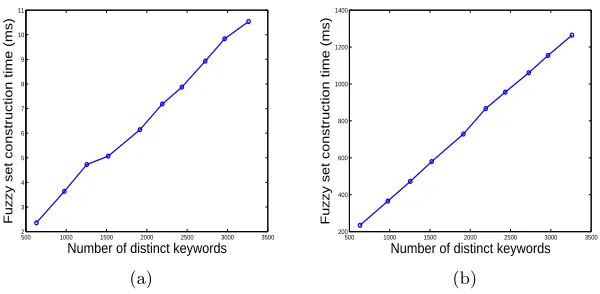
Fig. 4: Fuzzy set construction time using wildcard-based approach: (a)d= 1, (b)d= 2.
onI∗ via{T∗
w′}w′∈S
wi for eachi. We claim that there is no probabilistic polynomial-time
adver-sary can distinguish betweenV∗
q andVK(Hq). Otherwise, based on a standard hybrid argument,
the adversary could distinguish at least one of the elements ofV∗
q andVK(Hq). This is impossible
because each element inV∗
q is indistinguishable from its counterpart inVK(Hq). More specifically,
the simulated encrypted ciphertext is indistinguishable because of the semantic security of the symmetric encryption. The indistinguishability of index is based on the assumption that no one could tell the difference between the output of pseudo-random function and a random string.
Based on the above analysis, we have proven the result of this theorem.
7
Performance Analysis
We conducted a thorough experimental evaluation of the proposed techniques on real data set: the recent ten years’ IEEE INFOCOM publications. The data set includes about 2,600 publications. We extract the words in the paper titles to construct the core keyword set in our experiment. The total number of keywords is 3,262 and their average word length is 7.44. Our experiment is conducted on a Linux machine with an Intel Core 2 processor running at 1.86GHz and 2G DDR2-800 memory. The performance of our scheme is evaluated regarding the time cost of fuzzy set construction, the time and storage cost of index construction, the search time of the listing approach and the symbol-based trie-traverse approach.
7.1 Performance of Fuzzy Keyword Set Construction
In section 4, we propose two advanced techniques for the construction of fuzzy keyword sets, which both can be employed in our proposed fuzzy search schemes. In our experiment, we only focus on the wildcard-based fuzzy set construction because it provides the sound results compared to the gram-based fuzzy set construction as discussed in section 6. Fig. 4 shows the fuzzy set construction time by using the wildcard-based approach with edit distanced= 1 and 2. We can see that in both cases, the wildcard-based approach is very efficient and the construction time increases linearly with the number of keywords. The cost of constructing fuzzy keyword set under d= 1 is much less than the case ofd= 2 due to the smaller set of possible wildcard-based words.
7.2 Performance of Fuzzy Keyword Search
Efficiency of Index Construction Given the fuzzy keyword set constructed using
500 1000 1500 2000 2500 3000 3500 0
10 20 30 40 50 60 70 80 90 100
Number of distinct keywords
Index constructiion time (ms)
The listing approach The trie−traverse approach
(a)
500 1000 1500 2000 2500 3000 3500 0
50 100 150 200 250 300 350 400 450
Number of distinct keywords
Index construction time (ms)
The listing approach The trie−traverse approach
(b)
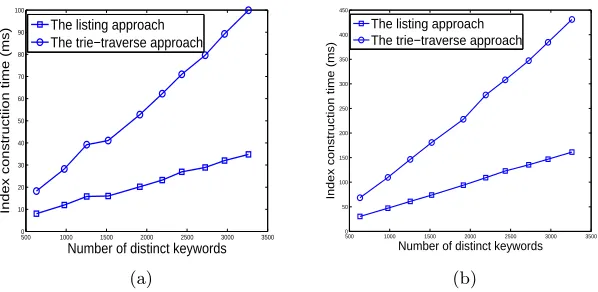
Fig. 5: (a) Index construction time for edit distanced= 1. (b) Index construction time for edit distance
d= 2.
500 1000 1500 2000 2500 3000 3500 0
5 10 15 20 25 30 35
Number of distinct keywords
Search time (ms)
The listing approach (d=1,k=0) The listing approach (d=1,k=1) The trie−traverse approach (d=1,k=0) The trie−traverse approach (d=1,k=1)
(a)
500 1000 1500 2000 2500 3000 3500 0
50 100 150 200 250 300 350
Number of distinct keywords
Search time (ms)
The listing approach (d=2,k=0) The listing approach (d=2,k=1) The listing approach (d=2,k=2) The trie−traverse approach (d=2,k=0) The trie−traverse approach (d=2,k=1) The trie−traverse approach (d=2,k=2)
(b)
Fig. 6: (a) Searching time for edit distanced= 1. (b) Searching time for edit distanced= 2.
Fig. 5 shows the index construction time for edit distanced= 1 and d= 2. Similar to the fuzzy keyword set construction, the index construction time also increases linearly with the number of distinct keywords. Compared to the listing approach, the index construction of the trie-traverse approach includes the process of building the searching tree additionally, thus its time cost is larger than that of listing approach. However, the whole index construction process is conducted off-line, thus it will not affect the searching efficiency. Table 1 shows the index storage cost of the two approaches. The symbol-based trie-traverse approach consumes more storage space than the listing approach due to its multi-way tree structure. This additional storage cost, however, is not a main issue in our setting, as such index information only take up a small amount of storage space on the cloud server.
Efficiency of Search We evaluate the search performance as the number of keywords increases.
Fig. 6 shows the comparisons of average search time between the listing approach and the symbol-based trie-traverse approach. According to the definition of fuzzy keyword search, the types of searching inputs (e.g., k= 0 ork= 1) may affect the searching result. The experimental results show that for the fixed value ofd, better search efficiency can be achieved when the search input exactly matches some predefined keyword. This is becauseS′
Table 1: The index storage cost.
Index size (d= 1) Index size (d= 2)
The listing approach 1.6MB 6.6MB
The trie-traverse approach 13.0MB 48.8MB
8
Conclusion
In this paper, for the first time we formalize and solve the problem of supporting efficient yet privacy-preserving fuzzy search for achieving effective utilization of remotely stored encrypted data in Cloud Computing. We design two advanced techniques (i.e., wildcard-based and gram-based techniques) to construct the storage-efficient fuzzy keyword sets by exploiting two significant observations on the similarity metric of edit distance. Based on the constructed fuzzy keyword sets, we further propose a brand new symbol-based trie-traverse searching scheme, where a multi-way tree structure is built up using symbols transformed from the resulted fuzzy keyword sets. Through rigorous security analysis, we show that our proposed solution is secure and privacy-preserving, while correctly realizing the goal of fuzzy keyword search. Extensive experimental results demonstrate the efficiency of our solution.
As our ongoing work, we will continue to research on security mechanisms that support 1) search semantics that takes into consideration conjunction of keywords, sequence of keywords, and even the complex natural language semantics to produce highly relevant search results. and 2) search ranking that sorts the searching results according to the relevance criteria.
References
1. D. Parkhill, “The challenge of the computer utility,” Addison-Wesley Educational Publishers Inc., US, 1966.
2. P. Mell and T. Grance, “Draft nist working definition of cloud computing,” Referenced on June. 3rd, 2009 Online at http://csrc.nist.gov/groups/SNS/cloud-computing/index.html, 2009.
3. M. Armbrust and et.al, “Above the clouds: A berkeley view of cloud computing,” Tech. Rep., Feb 2009. [Online]. Available: http://www.eecs.berkeley.edu/Pubs/TechRpts/2009/EECS-2009-28.html 4. Google, “Britney spears spelling correction,” Referenced online at http://www.google.com/jobs/
britney.html, June 2009.
5. M. Bellare, A. Boldyreva, and A. O’Neill, “Deterministic and efficiently searchable encryption,” in Proceedings of Crypto 2007, volume 4622 of LNCS. Springer-Verlag, 2007.
6. D. Song, D. Wagner, and A. Perrig, “Practical techniques for searches on encrypted data,” inProc. of IEEE Symposium on Security and Privacy’00, 2000.
7. E.-J. Goh, “Secure indexes,” Cryptology ePrint Archive, Report 2003/216, 2003, http://eprint.iacr. org/.
8. D. Boneh, G. D. Crescenzo, R. Ostrovsky, and G. Persiano, “Public key encryption with keyword search,” inProc. of EUROCRYP’04, 2004.
9. B. Waters, D. Balfanz, G. Durfee, and D. Smetters, “Building an encrypted and searchable audit log,” inProc. of 11th Annual Network and Distributed System, 2004.
10. Y.-C. Chang and M. Mitzenmacher, “Privacy preserving keyword searches on remote encrypted data,” inProc. of ACNS’05, 2005.
11. R. Curtmola, J. A. Garay, S. Kamara, and R. Ostrovsky, “Searchable symmetric encryption: improved definitions and efficient constructions,” inProc. of ACM CCS’06, 2006.
12. D. Boneh and B. Waters, “Conjunctive, subset, and range queries on encrypted data,” in Proc. of TCC’07, 2007, pp. 535–554.
13. F. Bao, R. Deng, X. Ding, and Y. Yang, “Private query on encrypted data in multi-user settings,” in Proc. of ISPEC’08, 2008.
14. X. Yang, B. Wang, and C. Li, “Cost-based variable-length-gram selection for string collections to support approximate queries efficiently,” inProc. of ACM SIGMOD’08, 2008.
16. A. Behm, S. Ji, C. Li, , and J. Lu, “Space-constrained gram-based indexing for efficient approximate string search,” inProc. of ICDE’09.
17. S. Ji, G. Li, C. Li, and J. Feng, “Efficient interactive fuzzy keyword search,” inProc. of WWW’09, 2009.
18. E. Shi, J. Bethencourt, T.-H. H. Chan, D. Song, and A. Perrig, “Multi-dimensional range query over encrypted data,” inIEEE Symposium on Security and Privacy, 2007.
19. J. Feigenbaum, Y. Ishai, T. Malkin, K. Nissim, M. Strauss, and R. N. Wright, “Secure multiparty computation of approximations,” inProc. of ICALP’01.
20. K. N. A. Beimel, P. Carmi and E. Weinreb, “Private approximation of search problems,” inProc. of 38th Annual ACM Symposium on the Theory of Computing, 2006, pp. 119–128.
21. R. Ostrovsky, “Software protection and simulations on oblivious rams,” Ph.D dissertation, Mas-sachusetts Institute of Technology, 1992.
22. V. Levenshtein, “Binary codes capable of correcting spurious insertions and deletions of ones,” Prob-lems of Information Transmission, vol. 1, no. 1, pp. 8–17, 1965.
23. S. Chaudhuri, V. Ganti, and R. Motwani, “Robust identification of fuzzy duplicates,” in Proc. of ICDE’05.
24. A. Arasu, V. Ganti, and R. Kaushik, “Efficient exact set-similarity joins,” inProc. of VLDB’06, 2006, pp. 918–929.
25. K. Chakrabarti, S. Chaudhuri, V. Ganti, and D. Xin, “An efficient filter for approximate membership checking,” inProc. of SIGMOD’06.
26. B. Bloom, “Space/time trade-offs in hash coding with allowable errors,”Communications of the ACM, vol. 13, no. 7, pp. 422–426, 1970.