Composable Zero-Knowledge Protocols
?Jan Camenisch1, Stephan Krenn2, and Victor Shoup3
1 IBM Research – Zurich, R¨uschlikon, Switzerland [email protected]
2
Bern University of Applied Sciences, Biel-Bienne, Switzerland, and University of Fribourg, Switzerland
3 Department of Computer Science, New York University, USA [email protected]
Abstract. Zero-knowledge proofs of knowledge (ZK-PoK) for discrete logarithms and related problems are indispensable for practical cryptographic protocols. AtEurocrypt 2009, Camenisch, Kiayias, and Yung provided a specification language (theCKY-language) for such protocols, which allows one to modularly design and analyze cryptographic protocols: protocol designers just need to specify the statement they want to prove in zero-knowledge and are ensured that an efficient proof protocol exists and indeed proves the specified statement, provided that the specification was in the CKY-language. However, as specifications in the CKY-language are realized by so-called Σ-protocols, the resulting protocols only satisfy the classical notion of zero-knowledge proofs of knowledge, whichnot retained if they are composed with themselves or with other protocols, e.g., when used as building blocks for higher-level applications. This problem can be tackled by moving to the Universal Composability (UC) framework, which guarantees retention of security when composing protocols and, in particular, when using them as building blocks in arbitrary contexts. While there exists generic transformations from
Σ-protocols to protocols that are secure under this stronger security notion, these transformation are often not efficient enough for the design of practical protocols.
In this paper we are aiming for practically efficient ZK-PoK in the UC-framework by introducing a specification language akin to the CKY-language and a compiler such that protocols specified in our language are UC-secure and efficient. To this end we propose an extension of the UC-framework addressing the problem that UC-secure zero-knowledge proofs are always proofs of knowledge, and state a special composition theorem which allows one to use the weaker – but more efficient and often sufficient – notion of proofsof existence in the UC-framework for the first time. We believe that our contributions enable the design of practical protocols that are UC-secure and thus themselves can be used as building blocks.
Keywords:Universal Composability; Protocol Design; Zero-Knowledge; Proof of Knowledge;
?
1 Introduction
The probably most demanding task when designing a practical cryptographic protocol is to define its security properties and then to prove that it indeed satisfies them. For this security analysis it is often assumed that the “world” consists only of one instance of the protocol and only of the involved parties, rather than of many parties running many instances of the same protocol as well as other protocols at the same time. While this approach allows for a relatively simple analysis of protocols, it does not properly model reality and therefore provides little if any security guarantees. Also, this approach does not allow for a modular usage of the protocols, i.e., when a protocol is used as a building block for another protocol, the security analysis must be all done from scratch.
To address these problems, a number of frameworks have been proposed over the years, e.g., [3,17,58]. The so-calledUniversal Composability (UC) framework by Canetti [17] seems to be the one that is most prevalent. The probably most fundamental result in this model is its very strong composition theorem: once a protocol is proved secure in this model, it can be used in arbitrary contexts retain-ing its security properties. This allows one to split a protocol into smaller subroutines so that the security analysis becomes easier as each subprotocol can be analyzed separately. In particular, each protocol only has to be analyzed once and for all, and the analysis does not have to be repeated for each specific context.
This modularity and the high security guarantees suggest that protocols should always be de-signed and proven secure in the UC-framework rather than in an ad-hoc way. However, only a fraction of the protocols found in the literature is proved UC-secure, examples including oblivious transfer [57] and encryption- [40,41,52], signature- [1,39,70] and commitment schemes [45]. Further-more, only very few UC-secure protocols are actually deployed in the real world, e.g., [19,38]. We believe that one main reason for this is the high computational overhead coming along with most UC-secure protocols compared to those which have not been proved secure in the UC-framework.
When designing practical cryptographic protocols, efficient zero-knowledge proofs of knowledge (ZK-PoK) for discrete logarithms and related problems have turned out to be indispensable. On a high level, these are two party protocols between a prover and a verifier which allow the for-mer to convince the latter that it possesses some secret piece of information, without the verifier being able to learn anything about it. This allows protocol designers to enforce a protocol partic-ipant to assure other parties that its actions are consistent with its internal knowledge state. The shorthand notation for such proofs, introduced in [16], has been extensively employed in the past and contributed to the wide employment of these protocols in cryptographic design. This nota-tion suggested using, e.g., PK[(α) :y=gα] to denote a proof of the discrete logarithm α= loggy, and it appeared in many works to describe quite complex discrete logarithm based relations, e.g., [2,5,7,8,9,10,12,15,31,34,42,47,48,50,51,64,65,66,67,68,69]. This informal notion was recently formal-ized and refined by Camenisch, Kiayias and Yung who have provided a specification language (CKY-language) for such protocols [13]. The language allows for the modular design and analysis of cryptographic protocols: protocol designers just needs to specify the statement the ZK-PoK shall prove and, if the specification is in the CKY-language, they are ensured that the proof protocol ex-ists and indeed proves the specified statement. Their realizations are based on so-calledΣ-protocols, which satisfy the classical notion of ZK-PoK. Unfortunately, these protocols are not UC-secure and thus cannot be used for protocol design in the UC-framework. While generic transformations from
Our Contributions. In this paper we aim at closing the gap between high security guarantees and practical usability and efficiency for ZK-PoK. To this end, we first present an exhaustive language and a compiler which allow protocol designers to efficiently and modularly specify and obtain UC-ZK protocols. We then give an extension of the UC-framework allowing protocol designers to also make usage of the more efficient proofs of existence (as opposed to proofs of knowledge) for the first time, which we also incorporate into our language. Let us explain this in more detail.
A language for UC-ZK protocols. We provide an intuitive language for specifying ZK-PoK for dis-crete logarithms akin to the CKY-language [13] where the specification also allows one to assess the complexity of the specified protocol. We then provide a compiler which translates these specifica-tions into concrete protocols. Even though this compiler is mainly based on existing techniques, it offers unified and unambiguous interfaces and semantics for the associated protocols and function-alities for the first time. It thus enables protocol designers to treat specifications in our language as black-boxes, while having clearly defined security guarantees.
Proving existence rather than knowledge. In the UC-framework, all proof protocols are necessarily proofs of knowledge. This is, because the prover must provide the witness of the statement to be proved to the UC-ZK ideal functionality as otherwise the functionality would typically not be able to verify the correctness of a statement in polynomial time. However, when designing higher-level protocols, is often only necessary to prove that some computation was done correctly, but not to show that the secret quantities are actually ‘known’. This difference can be exploited to obtain much more efficient protocols: in the security proofs for proofs of knowledge the simulator needs to be able to extract the witness from the adversary – a requirement which is computationally expensive to achieve in the UC-framework, and which is not needed for a proof that a protocol step was done correctly.
To allow protocol designer to also make use of these more efficient protocols (which are not proofs of knowledge any more), we extend our language and provide the necessary framework to prove UC-security. Loosely speaking, we therefore formulate the so-calledgullible ZK ideal functionalityFgZK, and provide a special composition theorem which allows protocol designers to use existence-proofs “as if they were ideal functionalities”, if they are later instantiated as described in our compiler. On a high level the theorem states that proving the correctness of a protocol using FgZK in a slightly non-UC-compliant way is sufficient for the protocol whereFgZK is instantiated as described in our compiler to be UC-secure in the standard sense.
Related Work. The UC-framework has first been introduced by Canetti [17]. The notion ofΩ
-protocols was introduced in [32,33], and so far the most efficient UC-secure zero-knowledge proofs of knowledge have been proposed in [49]. Further, [28] analyzes UC-ZK in the presence of global setup [18]. The idea of committed proofs was first mentioned in [37]. We combine the techniques of [37,49] to compile proof specifications in our language to real protocols. In particular this allows us to realize proofsof existence.
A language for specifying discrete logarithm based ZK-PoK was presented by Camenisch and Stadler in [16] and later refined in [13], but neither of their realizations are UC-secure. Nevertheless, our notation is strongly inspired by theirs. In fact, our language has already turned out to be very useful to describe ZK-PoK in a companion paper[11], and in this paper we fulfill the promises given therein.
guarantees under bounded-concurrent self-composition and not on full UC-security. Prabhakaran and Sahai [59,60] also suggest generalizations of the UC-framework in which functionalities can be realized that cannot be realized in the plain UC-framework. Their work differs from ours in that they leave the standard model of polynomial time computation by granting the adversary access to some super-polynomially powerful oracle (“imaginary angel”), while our approach works in the standard computational model. Furthermore, they suggest generic solutions for ZK-PoK while we are aiming at practically efficient protocols.
Roadmap. After introducing some notation, recapitulating fundamental theory and presenting
two running examples in§2, we describe a basic language for specifying UC-secure ZK-PoK protocols in detail in §3. In §4 we show how proofs of existence rather than knowledge can be UC-realized, resulting in much more efficient protocols, and extend our language accordingly. We show how such specifications can be compiled to actual protocols in§5. Finally, in§6 we give several extensions to our basic language.
2 Preliminaries
Let us introduce some notation first. By s ∈R S we denote the uniform random choice of some element s in set S. For bitstrings n and m, the bitwise XOR is written as n⊕m. The group of signed quadratic residues [36] for some modulusnis denoted bySRn. We recap some properties of
this group in §A.3. For two random ensembles, ≈s denotes statistical indistinguishability. Finally, two party protocols between parties P and V with common inputy and private input w to P are written as (P(w),V)(y).
We assume that the reader is familiar with the notion of Σ- and Ω-protocols, and only give informal definitions here. A protocol (P(w),V)(y) is called aΣ-protocol[22], if it is an honest verifier ZK-PoK in the non-UC model, consisting of three messages being exchanged (a commitment t, a challenge c ∈R C ={0,1}k, and a response r), such that the secret w can be computed from any
two valid protocol transcripts with the same commitment but different challenges. A protocol is called anΩ-protocol [33], if it further takes a common reference stringσ as additional input, such that knowing a trapdoor toσit is possible to compute the prover’s secret input from any successful run of the protocol. For formal definitions we refer to§A.1.
We further say that an Ω-protocol f-extractable, if it is not possible to compute w from any successful run, but only f(w) for some function f. In particular, we will make use of two types of
f-extractable protocols: one the one hand we will usef(w1, . . . , wn) = (w1, . . . , wk) for somek≤n,
i.e., protocols which only allow to extract parts of the witness. On the other hand, we will have
f(w1, . . . , wn) = (w1, . . . , wn,A(w1, . . . , wn)), i.e., functions f which in addition to all witnesses
additionally output some additional values depending on these witnesses. These constructions will allow for an efficiency speedup compared to using plainΩ-protocols, while still ensuring appropriate security guarantees for many applications.
2.1 The UC-Model
We next want to briefly recapitulate the Universal Composability (UC) framework [17].
By a party we refer to a probabilistic polynomial time (PPT) interactive Turing machine. Each partyP is uniquely determined by a pair (PIDP,SIDP), wherePIDP andSIDP are itsparty ID and
they are participants of the same instance of a protocol. The only purpose of party IDs is to be able to distinguish between different participants of the same protocol instance. Following [11], we assume that session IDs are structured as pathnames. That is, for a protocol with session ID SID, the session ID of any of its subprotocols is given bySID/subsession, wheresubsessionis a unique local identifier, containing the party IDs of all participating parties and shared public parameters. The main concept of the UC framework is that of UC-emulation. Loosely speaking, a protocolρ
UC-emulates some protocol φ, if ρdoes not affect the security of anything else than φwould have, no matter how many other instances of ρ or arbitrary other protocols are executed concurrently. This implies that ρ can safely be used on behalf of φ without compromising security. The most interesting case is whereφis someideal functionality F, which can be thought of as an incorruptible trusted party that takes inputs from all parties, locally computes a certain cryptographic task, and hands back outputs to each participating party. Ideal functionalities are secure by definition, and can therefore be seen as “formal specifications” of cryptographic tasks. Now, if ρ UC-emulates
F, one can infer that ρ does not leak any information to an adversary than F would have, and therefore securely realizes the task at hand in arbitrary contexts. For a more precise description we refer to [17] and §A.2.
A protocolρmay itself make use of some ideal functionalityFas a subroutine. In this case,ρis called anF-hybrid protocol. If not stated otherwise, all protocols we are going to present areFach -hybrid protocols, where Fach is an ideal functionality realizing authenticated (but not necessarily private) channels. The functionality takes as input a message xfrom some sender, which it simply forwards to a receiver. The adversary Alearns the messagex, and is allowed to change its content before it is delivered to the receiver, whenever the sender is corrupted. See §A.2 for a formal description ofFach.
The corruption model underlying our discussion is adaptive corruptions with erasures. This can be seen as a bit of a compromise: while only considering static corruptions would not properly reflect reality, assuming secure data erasures is necessary to obtain efficient protocols in this setting. However, even if implementing erasures might be difficult, it is not impossible.
The Basic UC-ZK Ideal Functionality. In the following we discuss the basic ideal
zero-knowledge functionality, which is formally specified in Figure 1. It is parametrized by two binary relations,R, R0, which have the following meaning: the relation Rspecifies the set of inputs (y, w) the functionality accepts from an honest prover. For such inputs, the functionality informs the verifier that the prover knows a witness for y, while an adversary does not learn w. Yet, if the prover is corrupted, it is allowed to supply inputs from a binary relationR0⊇R, in which case the ZK property does not have to be satisfied any more.
The relationRmight itself be parametrized by system parameters, specifying, e.g., the concrete groups being used. We will model all such parameters as public coin parameters, i.e., the environ-ment might know the random coins being used to generate the system parameters. This is helpful if the same parameters are used in other protocols as well, e.g., to sign messages.
The functionality defined in Figure 1 differs from the standard one found in the literature in two ways. Firstly, we delay revealing the claimed statementytoV andAuntil the last possible moment, and only give `(y) to the adversary in the first step, where` is a leakage function, which roughly gives some information about the “size and shape” of y toA (to be precise, `() is a parameter of
FZKas well which will be disregarded in the remainder of our discussion). This approach prevents the simulator from being over-committed in our constructions, and to the best of our knowledge
The zero-knowledge functionality FZKR,R0
1. Wait for an input (prove, y, w) fromP such that (y, w)∈R ifP is honest, or (y, w)∈R0 ifP is corrupt. Send (prove, `(y)) toA. Further wait for a messagereadyfromV, and sendreadytoA.
2. Wait for a messagelockfromA.
3. Upon receiving a messagedonefromA, senddonetoP. Further wait for an inputprooffromAand send (proof, y) toV.
Corruption rules:
. IfP gets corrupted after sending (prove, y, w) and before Step 2,Ais given (y, w) and is allowed to change this value to any value (y0, w0)∈R0 at any time before Step 2.
Fig. 1: The basic zero-knowledge functionality FZKR,R0, parametrized by two binary relations R, R0
such thatR0 ⊇R [11].
we give an illustrative example of an efficient protocol which can be proved to be UC-secure using our formalization, but not using the standard one. Secondly, we allow corrupt parties to supply witnesses from a larger set than honest parties. This relaxation stems from the soundness gap of most known efficient constructions for ZK-PoK for discrete logarithms in the non-UC case [27] (which are underlying the constructions for UC-ZK protocols): there, the verifier can only infer that the prover knows a witnesswsuch that (y, w)∈R0, whereas an honest prover is ensured that for (y, w) ∈R the verifier cannot learn the secret. We will discuss the precise relation betweenR
and R0 later in§5 and§B. The same formalization of the ZK functionality was also used in [11].
2.2 Running Examples
We next introduce two running examples, which we are going to use throughout the discussion to illustrate our techniques.
Example 2.1 (Running Example 1). Let be given an integer commitment y ∈ SRn for some safe
RSA modulus n. Let further be given two generators g, h of SRn. In this example, a prover is
interested in proving knowledge of integers w, rsuch that y=gωhρ and ω≥0. ut
Numerous practically relevant applications require such proof goals as basic building blocks for more complex protocols, e.g., [8,12].
Example 2.2 (Running Example 2). Let be given a cyclic group H of prime order q, and two generators, g, h of H. Let further be given a triple (u1, u2, e) ∈ H3, and let one be interested in proving that (u1, u2, e) is a valid encryption ofgα ∈ Hfor some α∈Zq known to the prover under
the semantically secure version of the Cramer-Shoup cryptosystem [25,37]. That is, the task is to prove that (u1, u2, e) is of the form (gρ, hρ, gαcρ) for a publicly knownc∈ H. ut This example stems from [11], where such proofs are repeatedly needed in the context of credential-authenticated key-exchange and identification protocols.
3 A Language For Specifying UC-ZK Protocols
blocks of higher-level applications, and will thus often be deployed when UC-realizing cryptographic tasks.
Taking this as a motivation, we describe an intuitive language for specifying universally com-posable zero-knowledge protocols. The language is strongly inspired by the standard notation for describing zero-knowledge proofs of knowledge in the non-UC case which was introduced in [16]. We stress that similar to there, our notation does not only specify proof goals (i.e., what one wants to prove), but concrete protocols. That is, together with the techniques presented in §5 and §B, each statement in our language describes a unique protocol. Especially for our results given in §4, this unambiguity is important.
We start by describing a basic language, which allows one to specify arbitrary Boolean com-binations of protocols proving knowledge of discrete logarithms (or representations) in arbitrary groups. In many cases the complexity of the resulting protocol can be inferred directly from the proof specification.
A protocol proving knowledge of integers ω1, . . . , ωn satisfying apredicate φ(ω1, . . . , ωn) is
de-notes as follows:
K ω1∈ I∗(mω1), . . . , ωn∈ I
∗(m
ωn) : φ(ω1, . . . , ωn). (1) Here, each witness ωi belongs to some integer domain I∗(mωi). The predicate φ(ω1, . . . , ωn) is a Boolean formula containing ANDs (∧) and ORs (∨), built fromatomic predicates of the following form:
y=
u Y
i=1
gFi(ω1,...,ωn)
i .
The gi and y are elements of some commutative group, and eachFi ∈Z[X1, . . . , Xn] is an integer
polynomial. Similar to [16], we make the convention that values of which knowledge has to be proved are denoted by Greek letters, whereas all other quantities are assumed to be publicly known.
In the following we want to discuss the single components of our basic language in more detail.
Groups. Different atomic predicates may use different groups. Besides efficiently evaluable group
operations we only require that group elements are efficiently recognizable, and that the group order does not contain any small prime divisors, where “small” can be seen as an implementation dependent parameter which typically will have 160−256 bits. In particular, we do not make any intractability assumption for the groups. However, if the group order is unknown, this can be exploited for efficiency gains, as we will discuss in§6.4.
We stress that the group of quadratic residues modulo a safe RSA modulus n (i.e., n = pq, wherep, q,p−12 ,q−12 are prime, denoted byQRn) does not satisfy the above requirements, as group
membership cannot be efficiently verified. We recommend using the group of signed quadratic residues, recapitulated in §A.3, instead. However, for the case that using the quadratic residues cannot be avoided, we will show how the requirement of no small divisors can be dropped, if the soundness guarantees may be loosened slightly in§6.3.
Predicates. We allow predicates to be arbitrary combinations of atomic predicates by the Boolean
Domains. In general, we allow the secret valuesω1, . . . , ωn to be arbitrary integers. However, for
implementation issues, it is necessary to specify an integermωi such that
ωi∈ I(mωi) :={l∈Z : −mωi ≤l≤mωi}
for eachωi. The value ofmωi (and therefore the size of the interval) can be chosen arbitrarily large, and is only needed for the resulting protocol to be statistically zero-knowledge for anyωi∈ I(mωi). The protocols resulting from the constructions given in §5 will then guarantee that the prover knows witnesses in a slightly larger interval, i.e., they prove knowledge of witnessesω∗i satisfying
ω∗i ∈ I∗(mωi) :={l∈Z : −tmωi ≤l≤tmωi},
where t is an implementation dependent parameter, which usually will have about 160−256 bits and which is independent of the groups used in the predicate. In particular,I∗(m
ωi) is thus uniquely defined even ifωiis used across different atomic predicates. More precisely, we roughly havet≈2k+l,
where 2−k is the success probability of a malicious prover, andl is a security parameter controlling the tightness of the statistical ZK property of the protocol.
Formally, the gap betweenI(mωi) andI ∗(m
ωi) is achieved by allowing corrupt provers to hand in values satisfying a relation R0 ⊇ R to the ideal functionality, whereas honest parties have to supply values inR, cf.§2.1.
As a special case, we allow to define I∗(m
ωi) =I(mωi) =Zq, if (i) the secretωi only occurs in atomic predicates for which the order of the group is known, and (ii) the integer q is a common multiple of all these group orders.
Induced Relation. Each proof specification spec of the form (1) induces two binary relations,
R = R(spec) ⊆ R0(spec) = R0, and a protocol π = π(spec) the compilation of which will be discussed in§5. The protocol π will be proved to UC-emulateFZKR,R0, i.e., for inputs (y, w)∈R the protocol ensures the prover to not leak any information about w to the verifier, while the verifier is guaranteed that the prover supplied an input (y0, w0)∈R0.
Let us now illustrate our basic language by means of our two running examples.
Example 3.1 (Running Example 1). As our basic language defined above does not allow one to specify algebraic properties of witnesses directly, we first have to resolve the conditionω ≥0 to the form (1). We do this by applying the technique proposed in [46]. That is, we prove thatω can be written asω=P4
i=1χ2i for someχi∈Z. This relation then can easily be rewritten as an expression
in our basic language.
As discussed above, it is necessary to know an intervalω lies in. Let it be given by [−T, T], i.e.,
mω =T. Then, clearly, we have that mχi =b
√
Tc for i= 1, . . . ,4. Also, for y to be blinding, we can assume thatmρ=bn/4c.
The proof goal is thus given by:
K ρ∈ I∗(bn/4c),{χi}4i=1 ∈ I ∗
(b√Tc),: y=gχ21+χ22+χ23+χ24hρ. ut
Example 3.2 (Running Example 2). In this case, all secret values, i.e.,αand ρ, are elements of Zq,
whereq is the order ofH. We therefore can specify the protocol by the following expression K α, ρ∈Zq : u1=gρ ∧ u2 =hρ ∧ e=gρcα.
In particular note that the requirement that ordH does not have small prime divisors is satisfied
4 Proving Existence Rather Than Knowledge
As we will see in detail in the next section, realizing proofs of knowledge in the UC-framework is a computationally expensive task. On a high level this is because the simulator needs to be able to extract the secret witness without rewinding, and the most efficient currently known way to achieve this is to include a Paillier encryption of the witness into the proof. Now, in larger protocols, zero-knowledge proof protocols are often only used to ensure that a computation was done correctly, and indeed the simulator does not require the witnesses in the security proof. This is for instance the case in Example 2.2, where proving the existence of a ρ is sufficient to imply the required wellformedness of the ciphertext.
Thus, what would often be sufficient is a functionality realizing the following steps:
1. Wait for an input (prove, y, w) fromPsuch that there is a ˜wsatisfying (y,w˜)∈Randf( ˜w) =w, and send (prove, `(y)) toA. Further wait for a message ready fromV, and send readytoA. 2. Wait for a message lock fromA.
3. Upon receiving a messagedone from A, senddonetoP. Further wait for an input prooffrom
A and send (proof, y) to V.
That is, one is aiming for a functionality which checks whether the prover knows some (partial) information ˜w=f(w) for a full witnessw, and informs the verifier if this is the case. However, the problem is that by definition any zero-knowledge proof in the UC-Framework is always a proof of knowledge. This is, because in general the existence of ˜w cannot be checked efficiently, and thus the witness has to be given as an input for the functionality to be able to check whether or not the statement is true. In this section we give a framework for how proof protocols that are not proofs of knowledge but only proofs of existence can still be used to construct UC-secure protocols and be exploited for a considerable efficiency gain.
We first extend our basic language by the additional E -quantifier. Its semantics is that for secrets quantified under E (instead of K ) only their existence (instead of their knowledge) is proved to the verifier. Having said this, a generalized specification of a proof goal looks as follows:
K {ωi ∈ I∗(mωi)}
n i=1 : E
χj ∈ I∗(mχj)
m
j=1 : φ(ω1, . . . , ωn, χ1, . . . , χm) (2) The computational costs of values quantified by E are the same as for ZK-PoK in the non-UC setting, as they are compiled to standardΣ-protocols. In particular the computationally expensive Paillier encryption [54] of these values can be avoided. We will detail the compilation in§5.
Before stating our composition theorem, we have to introduce some definitions.
The gullible zero-knowledge functionality FgZKR,R expects the prover to supply an imagey and a pair (w, x) as inputs, and always informs the verifier that (y,(w, x))∈R0, no matter whether this is the case or not, cf. Figure 2. For an honest prover, w will be the part of the witness for which knowledge has to be proved, whereasx is the part for which only existence has to be proved. Upon corruption of the prover, the adversary only learnsyandw, but notx. This is to model the intuitive goal of proofs of existence more appropriately. However, it therefore is important that submittingx
toFgZK and securely erasing it is possible in one step, i.e., the prover cannot be corrupted between submission and erasure ofx.
Our special composition theorem guarantees that ρπ/FR,R
0
The gullible zero-knowledge functionality FgZKR,R0
1. Wait for an input (prove, y,(w, x)) fromP and send (prove, `(y)) toA. Further wait for a messageready
fromV, and sendreadytoA. 2. Wait for a messagelockfromA.
3. Upon receiving a messagedonefromA, senddonetoP. Further wait for an inputprooffromAand send (proof, y) toV.
Corruption rules:
. IfP gets corrupted after sending (prove, y,(w, x)) and before Step 2,Ais given (y,(w,⊥)) and is allowed to change this value at any time before Step 2.
Fig. 2: The gullible zero-knowledge functionality FgZKR,R0 always informs the verifier that the proof was correct.
Definition 4.1. Let A∗ denote the dummy adversary attacking some FgZKR,R0-hybrid protocol. We
call an environmentZ nice, if the statements it requiresA∗ to send to FgZKR,R0 acting as a prover are true with overwhelming probability. That is, with overwhelming probability Z prompts A∗ to send pairs(y,(w, x))to FgZKR,R0, for which there is an w˜ satisfying(y,w˜)∈R andf( ˜w) =w.
In analogy to the standard case we now define UC-emulation with respect to nice environments:
Definition 4.2. Let ρ be anFgZKR,R0-hybrid protocol. We say that ρUC-emulates a protocol φwith
respect to the dummy adversaryA∗ and nice environments, if there is an efficient simulatorS such that no nice environment can distinguish whether it is interacting with ρ and A∗ or withφ and S. That is, for every nice environment Z it holds that
EXEC(ρ,A∗,Z) ≈ EXEC(φ,S,Z).
Here, EXEC(ρ,A,Z) denotes the random variable given by the output ofZ when interacting with
ρ and A, and analogously for EXEC(φ,S,Z).
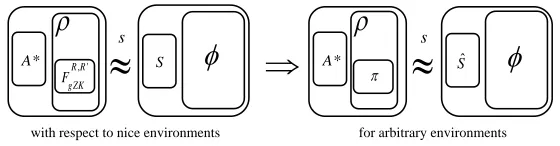
Having said this, we can now state our special composition theorem, which allows a protocol designer to use zero-knowledge proofs of existence in a UC-compliant way. The theorem is illustrated in Figure 3. On a high level, the theorem allows one to use zero-knowledge proofs of existence as black-boxes in protocol design, as if they were zero-knowledge proofs of knowledge. If a protocol
φ uses such a proof as a subroutine, one only has to prove the UC-security of the FgZKR,R0-hybrid variant ofφ, and this only with respect to nice environments.
Theorem 4.3. Let spec be a proof specification of the form (2), and let R = R(spec), R0 =
R0(spec), and π=π(spec). Let further ρ be an FgZKR,R0-hybrid protocol, such that ρ UC-emulates a protocolφwith respect to the dummy adversary and nice environments, and letρ, φbe subroutine
re-specting. Thenρπ/F
R,R0
gZK UC-emulatesφ(in the standard sense) with respect to adaptive corruptions
if securely erasing data is possible.
Proof (Sketch). Due to space limitations we omit a full proof here, and only give the underlying intuition. Let therefore S be the simulator for nice environments, which exists by assumption. We have to show that there exists an efficient simulator ˆS such that for arbitrary environmentsZ we have that
EXEC(ρπ/FR,R
0
s
with respect to nice environments for arbitrary environments
s
' ,R R gZK F
*
A S
*
A Sˆ
Fig. 3: Illustration of Theorem 4.3: for proving thatρπ/F
R,R0
gZK UC-emulatesφ, it is sufficient to show
thatρ emulates φfor nice environments.
The idea is that ˆS runs a copy ofSand one ofA∗internally, and all messages sent to or received from Z are routed through the simulated A∗. In general, all communication is further forwarded toS, and ˆS outputs whatever S does. The only exception is made when encountering a call toπ
between two parties, P and V. In this case ˆS internally executes the protocol on the given inputs and behaves as follows (independent of the corruption state of the parties):
. If the run is successful, then with overwhelming probability the input was correct (i.e., Z
“behaved nicely”), as the underlying Σ-protocol is an interactive proof system [35]. Thus, ˆS
outputs whatever S outputs on the same inputs.
. If however the run of π is not successful, the given input was incorrect. In this case, ˆS behaves asS in the case that noproof-message had been sent by the attacker.
The remainder of the proof works similar to that in [49]. The main difference is that in the real protocol an honest prover that gets corrupted also hands all witnesses quantified by E to the attacker. This can be simulated because of the usage of the committed proof technique [37]: ˆS may choose these secrets arbitrarily at random whenever necessary. It then computes the corresponding imagey0, and opens the commitment made in its first message accordingly. As in [49], this is possible because of the trapdoor property of the used commitment scheme. ut
Summarizing, this modeling for the first time allows one to use ZK proofs of existence in the UC-framework. We believe that this decrease of the computational costs of UC-secure protocol can contribute substantially to a broader employment of such protocols in practical applications.
5 Compiling Specifications to Protocols
Due to space limitations we here only give a brief overview about how protocol specifications are compiled into protocols. All details of the construction can be found in §B, where we also show how to estimate the costs of the protocol resulting from a specification of the form (1) in advance.
. First, the proof specification is rewritten to a predicate which only contains atomic predicates having homogeneous linear relations in their exponents. This can be done by applying standard techniques [6,23,27,30,46,63], cf. §B.1.
. In a second step, the prover computes integer commitments to all secret witnesses quantified by K , see §B.2.
. Next, using the technique proposed in [27], each conjunctive term in the specification (i.e., each subformula ofφnot containing any OR connectives) is translated into aΣ-protocol which additionally proves that the witnesses used are the same as in the integer commitments, cf.§B.3.
. As a fifth step, the Σ-protocol is transformed into an Ω-protocol [32,33]. This is achieved by Paillier-encrypting the witnesses quantified by K [54], and proving that the encrypted witnesses are the same as in the integer commitments. See§B.5 for details of this step.
. Finally, using a simulation sound trapdoor commitment [49] and the committed-proof idea of [37], theΩ-protocol is transformed into a protocol UC-emulatingFgZKR,R0. For details, see§B.7.
If the initial proof goal did not contain any secret values quantified by E , one can show that the resulting protocol UC-emulates the ideal functionality FZKR,R0 with respect to adaptive corruptions if securely erasing data is possible. If this is not the case the protocol is still secure for static party corruptions. On a very high level, the idea is that the required simulator can simulate a run of the Ω-protocol for the challenge received from the verifier, and then use the trapdoor of the commitment scheme to open its commitment in the correct way. See [49] for a full proof.
If the initial proof goal contains E -quantifiers, the resulting protocol can be used as an instan-tiation of the gullible zero-knowledge functionalityFgZKR,R0, cf. Theorem 4.3.
Let us discuss the potential speed-up and the semantical consequences coming along with the usage of the E -quantifier by means of our two running examples.
Example 5.1 (Running Example 1). For being able to see the speed-up, we first have to resolve the polynomial relation of Example 3.1. Using the technique from [46], we obtain the following equivalent proof specification:
K {ρi}4i=1 ∈ I ∗
(bn/4c),{χi}4i=1 ∈ I ∗
(b√Tc), ρ0∈ I∗((4b√Tc+ 1)bn/4c) : 4
^
i=1
yi =gχihρi ∧ y=y1χ1y
χ2
2 y
χ3
3 y
χ4
4 hρ
0
Now one can see that if one additionally proves knowledge of ω, ρ, the quantifiers of all χi, ρi and ρ0 can be changed to existence quantifiers without changing the semantics, as the existence of all these values follows from Lagrange’s Four Square Theorem and they can be computed efficiently from ω, ρ by using the algorithm of Rabin and Shallit [61]. We thus obtain the following proof specification:
K ω∈ I∗(T), ρ∈ I∗(bn/4c) : E {ρi}4i=1 ∈ I ∗
(bn/4c),{χi}4i=1 ∈ I ∗
(b√Tc),
ρ0 ∈ I∗((4b√Tc+ 1)bn/4c) : y =gωhρ ∧
4
^
i=1
yi =gχihρi ∧ y=y1χ1y
χ2
2 y
χ3
3 y
χ4
4 hρ
0
While not touching the semantics of all, this last rewriting yields a significant efficiency speedup, as only Paillier encryptions for 2 instead of 9 values are required. Overall, the prover thus saves 14 Paillier encryptions and evaluations of the integer commitment scheme. Similarly, the verifier’s
computational complexity is reduced by 7 such operations. ut
Example 5.2 (Running Example 2).The following specification is sufficient for proving the required wellformedness of the ciphertext:
K α∈Zq : E ρ∈Zq : u1=gρ ∧ u2 =hρ ∧ e=gρcα.
This observation reduces the complexity of the prover’s first algorithm in the resulting protocol by 2 Paillier encryptions (namely, that of ρ and the corresponding randomness in the underlying
Σ-protocol), and 2 evaluations of the integer commitment scheme. ut
Here, the underlying Ω-protocol is f-extractable, where f is of the form f(w1, . . . , wn) =
(w1, . . . , wk) for k < n, such that the remaining wi cannot be computed. This implies that in
general it is not possible to construct an ideal functionality which captures the semantics of an expression such as (2), as it would have to run in probabilistic polynomial time by definition [17].
6 Enhancing the Basic Language
Even if the basic language presented in§3 allows one to describe almost arbitrary algebraic prop-erties of and relations among the secret values, the corresponding specifications sometimes become hard to interpret, as these properties may not be specified explicitly. Also, the requirements that all witnesses must be integer exponents, and that the groups orders must not have small divisors, may seem overly restrictive.
For those reasons we next give some enhancements of our basic language, which allow one to drop any of these conditions. More precisely, we will first define a set of macros for specifying algebraic properties of the secret witnesses, and then give conditions under which knowledge of group elements can be proved instead of integers. Finally, we show how small divisors in the group order can be handled by loosing the soundness guarantees of the protocol slightly.
6.1 Using Macros to Specify Algebraic Properties of Witnesses
The language described in§3 does not allow to directly specify algebraic properties of the secrets or algebraic relations among them, and thus it becomes inconvenient to use for complex proof goals. We therefore extend the set of atomic predicates by so-calledmacros, which allow one to directly describe algebraic properties of the integer witnesses ωi. In particular, we allow additional atomic
predicates of the following forms, all of which can easily be translated into polynomial relations:
. ω ≥0. Such statements can easily be translated into statements of the above form by proving
knowledge of integers χ1, . . . , χ4 such that ω=P4i=1χ2i, see [46].
More generally, we also allow expressions of the form ω∈[a, b], wherea, b∈Zare public. Such an expression is equivalent to ω−a≥0 ∧ b−ω ≥0. Ifb−ais even, this can be rewritten to the even more efficient proof goal (ω−m)2 ≥d2, wherem= a+2b andd= b−2a.
If the length of the interval is very small, i.e., b−a ≈ 5, it might even be more efficient to perform an OR-proof, and to show thatω =a∨ω=a+ 1∨ · · · ∨ω=b.
. gcd(ν1, ν2) = 1, where eachν1, ν2 can be either public or private. As before, such expressions
can be rewritten to a polynomial form by introducing additional integers α1, α2 and proving knowledge of α1, α2, ν1, ν2 such thatα1ν1+α2ν2= 1.
Example 6.1 (Running Example 1). Using the first of our specific macros, a protocol for proving knowledge of a non-negative opening of the integer commitmenty can be described as follows:
K ω∈ I∗(T), ρ∈ I∗(bn/4c) : y=gωhρ ∧ ω≥0 ut
Before moving to the next extension of our basic language, we point out that using macros impedes the possibility of estimating the computational costs of the protocol from its specification, which was a favorable property of our basic language. This can be seen by comparing Example 6.1 to Example 3.1: the seemingly simple macrow≥0 entails 5 atomic predicates, and 9 secret witnesses, and thus conceals very much of the computational costs of the resulting protocol.
As an important remark we note that every auxiliary variables χi, which has to be introduced
when resolving any of these macros, can be quantified by E . This can easily be seen by noting that considering the resulting Ω-protocol as f-extractable for f(w) = (w,A(w)), where A is the algorithm the honest prover used to compute theχi from ω.
6.2 Proving Knowledge of Group Elements
Sometimes it is required to prove knowledge of group elements instead of integers, which is not possible in our basic language. For instance, one might be interested in proving possession of a digital signature on a given message, which, in the case of CL-signatures [14], essentially boils down to proving knowledge of a group element ω such thate(ω, z) =y, whereeis a bilinear map, and y, z are publicly known.
We thus also allow one to specify protocols proving knowledge of a preimage ω ∈ G under some group homomorphism ψ :G → H, if ψ satisfies two basic properties: (i) the finite group G
comes along with a generatorgand an upper boundB on its order, and (ii) the discrete logarithm problem is hard inH. Then expressions of the following form, which, of course, can arbitrarily be combined with expressions of the basic language, may be used:
K ω∈ G : y=ψ(ω).
When compiling protocol specifications containing such expressions, one first has to perform the following steps, and then proceeds as in §5. The idea of the construction is to first blind the secret preimage ω using g, and then to prove knowledge of the blinding:
1. Set m0 = 2lB, whereB is the given upper bound on ordG, andl is a security parameter. 2. Choose ω0 ∈RI(m0), and set u =gω0ω, where g is a generator of G. Further, sety0 =ψ(u)/y,
and g0=ψ(g).
3. Rewrite the proof goal to
K ω0 ∈ I∗(m0) : y0 =g0ω0,
and add u to the commitment of the underlyingΣ-protocol.
6.3 Allowing Small Divisors in the Group Order
The protocol resulting from the construction in §5 now convinces the verifier that the prover knows secret values ω∗i ∈ I∗(mωi), and that there existsµ∈ H, such that the following is satisfied:
µ u Y
i=1
gli(ω∗1,...,ωn∗)
i =y and µ
d= 1.
That is, knowledge of the witnesses is only proved “modulo a factor with small order”.
Example 6.2. Let n = pq be a safe RSA modulus, and let lcm(p−1, q−1) = 2. As we have ordZ∗n= 4p
−1 2
q−1
2 , we haved= 4. Thus, the construction of§5 yields protocols that only guarantee that the prover knows a representation up to a factor of order 4. (Actually we get d = 2 and soundness modulo a square root of unity by the Carmichael function.) ut
6.4 Using Private Coin System Parameters to Avoid Integer Commitments
In the construction given in§B.5 an integer commitment has to be computed for every secret value
ωi. This was necessary to ensure that the values used in the public values yj and in the
Paillier-encryptions are equal over the integers. In the following we give sufficient conditions under which these integer commitments can be avoided.
Proposition 6.3. Let, for some secretωi and every subformula only containing ANDs of predicate
φ, the following condition be satisfied:ωi appears at least once as an exponent in a group, which (i)
can be modeled as a private coin system parameter, and for which (ii) computing the group order from its description is computationally hard. Then no integer commitment is needed for ωi.
While the second condition is straightforward to check, the former conditions requires some more discussion. In §2.1 we required all system parameters specifying the binary relation R to be modeled as public coin system parameters. This implies that random coins for generating the group description, and thus also the group orders, have to be assumed to be known, and thus theyj
cannot be seen as integer commitments to theωi, but as commitments modulo the order at most.
In general, modeling the parameters as public coin cannot be avoided, as system parameters can potentially be used across various protocols of different types. Now, if a group is also used in, e.g., a signature scheme, then typically the factorization of the group order is known to the signer, which could lead to serious security issues in the UC-ZK protocols if this factorization is assumed to be unknown. However, if for instance an RSA modulus n can be assumed to be issued by a trusted party which does not (have to) give the prime factors of n to any party, then SRn could
safely be modeled as a private coin system parameter.
References
1. M. Abe and M. Ohkubo. A framework for universally composable non-committing blind signatures. In M. Matsui, editor,ASIACRYPT ’09, volume 5912 ofLNCS, pages 435–450. Springer, 2009.
2. G. Ateniese, D. X. Song, and G. Tsudik. Quasi-efficient revocation in group signatures. In M. Blaze, editor,
FC ’02, volume 2357 ofLNCS, pages 183–197. Springer, 2002.
3. M. Backes, B. Pfitzmann, and M. Waidner. The reactive simulatability (RSIM) framework for asynchronous systems. Information and Computation, 205(12):1685–1720, 2007.
4. M. Bellare and O. Goldreich. On defining proofs of knowledge. In E. F. Brickell, editor,CRYPTO ’92, volume 740 ofLNCS, pages 390–420. Springer, 1993.
6. S. Brands. Rapid demonstration of linear relations connected by boolean operators. In W. Fumy, editor, EURO-CRYPT ’97, volume 1233 ofLNCS, pages 318–333. Springer, 1997.
7. E. Bresson and J. Stern. Efficient revocation in group signatures. In K. Kim, editor,PKC ’01, volume 1992 of
LNCS, pages 190–206. Springer, 2001.
8. E. Brickell, J. Camenisch, and L. Chen. Direct anonymous attestation. In V. Atluri, M. Backes, D. A. Basin, and M. Waidner, editors,ACM CCS ’04, pages 132–145. ACM Press, 2004.
9. L. Bussard, R. Molva, and Y. Roudier. History-based signature or how to trust anonymous documents. In C. D. Jensen, S. Poslad, and T. Dimitrakos, editors,iTrust, volume 2995 ofLNCS, pages 78–92. Springer, 2004. 10. L. Bussard, Y. Roudier, and R. Molva. Untraceable secret credentials: Trust establishment with privacy. In
PerCom Workshops, pages 122–126. IEEE, 2004.
11. J. Camenisch, N. Casati, T. Groß, and V. Shoup. Credential authenticated identification and key exchange. In T. Rabin, editor,CRYPTO ’10, volume 6223 ofLNCS, pages 255–276. Springer, 2010.
12. J. Camenisch and E. V. Herreweghen. Design and implementation of the idemix anonymous credential system. In V. Atluri, editor,ACM CCS ’02, pages 21–30. ACM Press, 2002.
13. J. Camenisch, A. Kiayias, and M. Yung. On the portability of Generalized Schnorr Proofs. In A. Joux, editor,
EUROCRYPT ’09, volume 5479 of LNCS, pages 425–442. Springer, 2009.
14. J. Camenisch and A. Lysyanskaya. Signature schemes and anonymous credentials from bilinear maps. In M. K. Franklin, editor,CRYPTO ’04, volume 3152 ofLNCS, pages 56–72. Springer, 2004.
15. J. Camenisch and V. Shoup. Practical verifiable encryption and decryption of discrete logarithms. In D. Boneh, editor,CRYPTO ’03, volume 2729 ofLNCS, pages 126–144, 2003.
16. J. Camenisch and M. Stadler. Efficient group signature schemes for large groups (extended abstract). In B. Kaliski, editor,CRYPTO ’97, volume 1294 ofLNCS, pages 410–424. Springer, 1997.
17. R. Canetti. Universally composable security: A new paradigm for cryptographic protocols. InFOCS ’01, pages 136–145. IEEE, 2001. Revised version available athttp://eprint.iacr.org/2000/067.
18. R. Canetti, Y. Dodis, R. Pass, and S. Walfish. Universally composable security with global setup. In S. Vadhan, editor,TCC ’07, volume 4392 ofLNCS, pages 61–85. Springer, 2007.
19. R. Canetti and H. Krawczyk. Security analysis of IKE’s signature-based key-exchange protocol. In M. Yung, editor,CRYPTO ’02, volume 2442 ofLNCS, pages 143–161. Springer, 2002.
20. R. Canetti, Y. Lindell, R. Ostrovsky, and A. Sahai. Universally composable two-party and multi-party secure computation. InSTOC ’02, pages 494–503. ACM Press, 2002.
21. R. Canetti and T. Rabin. Universal composition with joint state. In D. Boneh, editor,CRYPTO ’03, volume 2729 ofLNCS, pages 265–281. Springer, 2003.
22. R. Cramer. Modular Design of Secure yet Practical Cryptographic Protocols. PhD thesis, CWI and University of Amsterdam, 1997.
23. R. Cramer and I. Damg˚ard. Zero-knowledge proofs for finite field arithmetic; or: Can zero-knowledge be for free? In H. Krawczyk, editor,CRYPTO ’98, volume 1462 ofLNCS, pages 424–441. Springer, 1998.
24. R. Cramer, I. Damg˚ard, and B. Schoenmakers. Proofs of partial knowledge and simplified design of witness hiding protocols. In Y. Desmedt, editor,CRYPTO ’94, volume 839 ofLNCS, pages 174–187. Springer, 1994. 25. R. Cramer and V. Shoup. A practical public key cryptosystem provably secure against adaptive chosen ciphertext
attack. In H. Krawczyk, editor,CRYPTO ’98, volume 1462 ofLNCS. Springer, 1998.
26. I. Damg˚ard. OnΣ-protocols, 2004. Lecture on Cryptologic Protocol Theory; Faculty of Science, University of Aarhus.
27. I. Damg˚ard and E. Fujisaki. A statistically-hiding integer commitment scheme based on groups with hidden order. In Y. Zheng, editor,ASIACRYPT ’02, volume 2501 ofLNCS, pages 77–85. Springer, 2002.
28. Y. Dodis, V. Shoup, and S. Walfish. Efficient constructions of composable commitments and zero-knowledge proofs. In D. Wagner, editor,CRYPTO ’08, volume 5157 ofLNCS, pages 515–535. Springer, 2008.
29. R. Fischlin and C. Schnorr. Stronger security proofs for RSA and Rabin bits. Journal of Cryptology, 13(2):221– 244, 2000.
30. E. Fujisaki and T. Okamoto. Statistical zero knowledge protocols to prove modular polynomial relations. In B. Kaliski, editor,CRYPTO ’97, volume 1294 ofLNCS, pages 16–30. Springer, 1997.
31. J. Furukawa and S. Yonezawa. Group signatures with separate and distributed authorities. In C. Blundo and S. Cimato, editors,SCN’ 04, volume 3352 ofLNCS, pages 77–90. Springer, 2004.
32. J. A. Garay, P. MacKenzie, and K. Yang. Strengthening zero-knowledge protocols using signatures. In E. Biham, editor,EUROCRYPT ’03, volume 2656 ofLNCS, pages 177–194. Springer, 2003.
33. J. A. Garay, P. MacKenzie, and K. Yang. Strengthening zero-knowledge protocols using signatures. Journal of Cryptology, 19(2):169–209, 2006.
35. S. Goldwasser, S. Micali, and C. Rackoff. The knowledge complexity of interactive proof-systems. InSTOC ’85, pages 291–304. ACM Press, 1985.
36. D. Hofheinz and E. Kiltz. The group of signed quadratic residues and applications. In S. Halevi, editor,
CRYPTO ’09, volume 5677 ofLNCS, pages 637–653. Springer, 2009.
37. S. Jarecki and A. Lysyanskaya. Adaptively secure threshold cryptography: Introducing concurrency, removing erasures. In B. Preneel, editor,EUROCRYPT ’00, volume 1807 ofLNCS, pages 221–242. Springer, 2000. 38. H. Krawczyk. HMQV: A high-performance secure Diffie-Hellman protocol. In V. Shoup, editor,CRYPTO ’05,
volume 3621 ofLNCS, pages 546–566. Springer, 2005.
39. K. Kurosawa and J. Furukawa. Universally composable undeniable signature. In L. Aceto, I. Damg˚ard, L. Gold-berg, M. Halld´orsson, A. Ing´olfsd´ottir, and I. Walukiewicz, editors,ICALP (Part II) ’08, volume 5126 ofLNCS, pages 524–535. Springer, 2008.
40. R. K¨usters and M. Tuengerthal. Universally composable symmetric encryption. InComputer Security Founda-tions Symposium – CSF 09, pages 293–307. IEEE, 2009.
41. P. Laud and L. Ngo. Threshold homomorphic encryption in the universally composable cryptographic library. In J. Baek, F. Bao, K. Chen, and X. Lai, editors,Proceedings of the 2nd International Conference on Provable Security – ProvSec 08, volume 5324 ofLNCS, pages 298–312. Springer, 2008.
42. T. Van Le, K. Quoc Nguyen, and V. Varadharajan. How to prove that a committed number is prime. In K.-Y. Lam, E. Okamoto, and C. Xing, editors,ASIACRYPT ’99, volume 1716 ofLNCS, pages 208–218. Springer, 1999. 43. Y. Lindell. Bounded-concurrent secure two-party computation without setup assumptions. InSTOC ’03, pages
683–692. ACM Press, 2003.
44. Y. Lindell. Protocols for bounded-concurrent secure two-party computation in the plain model.Chicago Journal of Theoretical Computer Science, 2006(1):1–50, 2006.
45. Y. Lindell. Highly-efficient universally-composable commitments based on the DDH assumption. In EURO-CRYPT ’11, 2011. (to appear).
46. H. Lipmaa. On diophantine complexity and statistical zero knowledge arguments. In C.-S. Laih, editor, ASI-ACRYPT ’03, volume 2894 of LNCS, pages 398–415. Springer, 2003.
47. A. Lysyanskaya and Z. Ramzan. Group blind digital signatures: A scalable solution to electronic cash. In R. Hirschfeld, editor,FC ’98, volume 1465 ofLNCS, pages 184–197. Springer, 1998.
48. P. MacKenzie and M. Reiter. Two-party generation of dsa signatures. In J. Kilian, editor,CRYPTO ’01, volume 2139 ofLNCS, pages 137–154. Springer, 2001.
49. P. MacKenzie and K. Yang. On simulation-sound trapdoor commitments. In C. Cachin and J. Camenisch, editors,EUROCRYPT ’04, volume 3027 ofLNCS, pages 382–400. Springer, 2004.
50. E. Mykletun, M. Narasimha, and G. Tsudik. Signature bouquets: Immutability for aggregated/condensed sig-natures. In P. Samarati, Peter Y. A. Ryan, D. Gollmann, and R. Molva, editors,ESORICS ’04, volume 3193 of
LNCS, pages 160–176. Springer, 2004.
51. T. Nakanishi, M. Shiota, and Y. Sugiyama. An efficient online electronic cash with unlinkable exact payments. In K. Zhang and Y. Zheng, editors,ISC ’04, volume 3225 ofLNCS, pages 367–378. Springer, 2004.
52. R. Nishimaki, Y. Manabe, and T. Okamoto. Universally composable identity-based encryption.IEICE Transac-tions on Fundamentals of Electronics, CommunicaTransac-tions and Computer Sciences, E91-A(1):262–271, 2008. 53. National Institute of Standards and Technology. FIPS PUB 186-3: Digital Signature Standard (DSS). National
Institute for Standards and Technology, Gaithersburg, MD, USA, June 2009.
54. P. Paillier. Public-key cryptosystems based on composite degree residuosity classes. In J. Stern, editor, EURO-CRYPT ’99, volume 1592 ofLNCS, pages 223–238. Springer, 1999.
55. R. Pass and A. Rosen. Bounded-concurrent secure two-party computation in a constant number of rounds. In
FOCS ’03, pages 404–413. IEEE, 2003.
56. T. P. Pedersen. Non-interactive and information-theoretic secure verifiable secret sharing. In J. Feigenbaum, editor,CRYPTO ’91, volume 576 ofLNCS, pages 129–140. Springer, 1991.
57. C. Peikert, V. Vaikuntanathan, and B. Waters. A framework for efficient and composable oblivious transfer. In D. Wagner, editor,CRYPTO ’08, volume 5157 of LNCS, pages 554–571. Springer, 2008.
58. B. Pfitzmann and M. Waidner. Composition and integrity preservation of secure reactive systems. In ACM CCS ’00, pages 245–254, 2000.
59. M. Prabhakaran and A. Sahai. New notions of security: achieving universal composability without trusted setup. InSTOC ’04, pages 242–251. ACM Press, 2004.
60. M. Prabhakaran and A. Sahai. Relaxing environmental security: Monitored functionalities and client-server computation. In J. Kilian, editor,TCC ’05, volume 3378 ofLNCS, pages 104–127. Springer, 2005.
61. M. Rabin and J. Shallit. Randomized algorithms in number theory. Communications in Pure and Applied Mathematics, 39(S1):239–256, 1986.
63. N. P. Smart, editor. Final Report on Unified Theoretical Framework of Efficient Zero-Knowledge Proofs of Knowledge. http://www.cace-project.eu, 2009. CACE Project Deliverable.
64. D. Xiaodong Song. Practical forward secure group signature schemes. InACM CCS ’01, pages 225–234. ACM press, 2001.
65. W. Susilo and Y. Mu. On the security of nominative signatures. In C. Boyd and J. Manuel Gonz´alez Nieto, editors,ACISP ’05, volume 3574 ofLNCS, pages 329–335. Springer, 2005.
66. C. Tang, Z. Liu, and M. Wang. A verifiable secret sharing scheme with statistical zero-knowledge. Cryptology ePrint Archive, Report 2003/222, 2003. http://eprint.iacr.org/.
67. P. Tsang and V. Wei. Short linkable ring signatures for e-voting, e-cash and attestation. In R. H. Deng, F. Bao, H. Pang, and J. Zhou, editors,ISPEC ’05, volume 3439 of LNCS, pages 48–60. Springer, 2005.
68. P. Tsang, V. Wei, T. Chan, M. Ho Au, J. K. Liu, and D. S. Wong. Separable linkable threshold ring signatures. In A. Canteaut and K. Viswanathan, editors,INDOCRYPT ’04, volume 3348 ofLNCS, pages 384–398. Springer, 2004.
69. V. Wei. Tracing-by-linking group signatures. In J. Zhou, J. Lopez, R. H. Deng, and F. Bao, editors,ISC ’05, volume 3650 ofLNCS, pages 149–163. Springer, 2005.
70. J. Zhou, Y. Zhu, T. Chang, and Y. Zhang. Universally composable key-evolving signature. InCISIM ’07, pages 97–102. IEEE, 2007.
A Basics and Definitions
For self-containment we here recapitulate the basic definitions used in the main part of this paper.
A.1 Σ- and Ω-Protocols
We first want to recapitulate the basic notions ofΣ- andΩ-protocols, which constitute fundamental building blocks of the protocols constructed in§5 and §B.
On a high level, a Σ-protocol [22] is a three-move protocol between two parties, which realizes a zero-knowledge proofs of knowledge with respect to honest-but-curious verifiers in the non-UC setting:
Definition A.1. Let R be a binary relation, and let LR be the associated language. AΣ-protocol
for R then is a two party protocol ((P1,P2)(w),V)(y, σ) between a prover and a verifier, satisfying the following properties:
. 3-move form: First, the prover computes(t, r) =P1(y, w, σ), and sends the commitmentt to
the verifier, whereasrdescribes its internal state after executingP1. The verifier draws a random challenge c from some predefined challenge set C, and sends it to the prover, who replies with a response s=P2(y, w, c, r, σ). Upon receiving s, the verifier computes a bit b =V(y, t, c, s, σ) and accepts the protocol run if and only if b= 1.
. Completeness: Whenever both parties follow the protocol and (y, w) ∈R, the verifier always
accepts.
. Special soundness: There is an efficient algorithm E, which on input y ∈ LR, σ and two
accepting protocol transcripts (t, c1, s1) and (t, c2, s2) satisfying c1 6= c2 outputs w0 such that (y, w0)∈R.
. Special honest-verifier zero-knowledge: There exists an efficient algorithm M such that
the following is satisfied: on input y ∈ LR, σ and c ∈ C, M outputs tuples (˜t, c,˜s) which are
(statistically) indistinguishable from real protocol transcripts with challenge c.
It can be shown that anyΣ-protocol satisfies the standard definition of ZK-PoK [4] with knowl-edge error 1/2k with respect to honest verifiers, e.g., [26]. That is, having rewindable black box access to a prover making the verifier accept with probability larger than 1/2k, it is possible to compute the witness in a time proportional to the prover’s advantage. Yet, in the UC model the no-tion of rewindable blackbox access is not applicable any more. Thus, it must be possible to extract the prover’s private input already after one successful execution of the protocol. To circumvent this problem, Garay et al. introduced the notion of Ω-protocols in [32]. On a high level, anΩ-protocol is aΣ-protocol using a common reference string for which there is a trapdoorτ toσ which allows one to extract witness without having to rewind the prover.
Definition A.2. Let R be a binary relation. A two party protocol ((P1,P2)(w),V)(y, σ) is called
an Ω-protocol for R, if it is a Σ-protocol which additionally satisfies the following requirements:
. Common reference string: A common reference string σ is drawn according to some
prede-fined distribution, and is given to (P1,P2) and V as an additional common input.
. Trapdoor extraction: There exists a pair of algorithms (E1,E2) satisfying the following two
conditions: (i) algorithmE1 outputs pairs (σ0, τ0), such that the distribution ofσ0 is statistically indistinguishable from that of uniformly chosen common reference strings, and (ii) if for some
t there exist two accepting transcripts (t, c1, s1) and (t, c2, s2) satisfying c1 6=c2, we have that (y,E2(y, τ0, σ0, t, c, s))∈R for all c, ssuch that V(y, t, c, s, σ0) = 1.
We call an Ω-protocol f-extractable, if algorithmE2 does not output a witness fory, but only
f(w) for some w satisfying (y, w) ∈ R. By allowing this relaxation we will show how to achieve higher efficiency in the resulting protocols, while still ensuring appropriate security guarantees for many practical applications.
A.2 The Concept of UC-Emulation
After having given an informal definition of UC-emulation in the main part of the paper, let us now describe formally what it means that a protocol ρ UC-emulates another protocol φ. Namely, for every efficientattacker A onρ, there has to be an efficientsimulator S forφsuch that no efficient environment Z can distinguish whether it is interacting with ρ and A, or withφ and S. That is, the simulator S performs an equivalent attack on φasA did onρ.
Let EXEC(ρ,A,Z) denote the random variable given by the output ofZ when interacting with
ρ and A, and let EXEC(φ,S,Z) be defined analogously.
Definition A.3. For PPT protocols ρ and φwe say that ρ UC-emulatesφ, if for any PPT
adver-sary A there exists a PPT simulatorS such that for any PPT environment Z it holds that
EXEC(ρ,A,Z) ≈s EXEC(φ,S,Z).
When proving thatρ UC-emulates φ, it is sufficient to show that there exists a PPT simulator for the dummy adversary A∗, which often simplifies the security analysis significantly [17]. The dummy adversary is an adversary which is completely under control of the environmentZ and only forwards messages from Z to the parties participating in ρand vice versa.
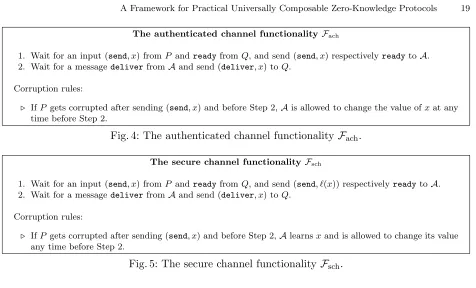
The authenticated channel functionalityFach
1. Wait for an input (send, x) fromP andreadyfromQ, and send (send, x) respectivelyreadytoA. 2. Wait for a messagedeliverfromAand send (deliver, x) toQ.
Corruption rules:
. IfP gets corrupted after sending (send, x) and before Step 2,Ais allowed to change the value ofxat any time before Step 2.
Fig. 4: The authenticated channel functionalityFach.
The secure channel functionalityFsch
1. Wait for an input (send, x) fromP andreadyfromQ, and send (send, `(x)) respectivelyreadytoA. 2. Wait for a messagedeliverfromAand send (deliver, x) toQ.
Corruption rules:
. IfP gets corrupted after sending (send, x) and before Step 2,Alearnsxand is allowed to change its value any time before Step 2.
Fig. 5: The secure channel functionalityFsch.
Theorem A.4. Let π, φ, ρ be PPT protocols such that ρ UC-emulates φ, and φ, ρ are subroutine
respecting. Then πρ/φ UC-emulatesπ, whereπρ/φ denotes the same protocol asπ with all instances
of φ being substituted by instances of ρ.
Typically, one assumes that the communication channel being used is at least authenticated, but not necessarily private. That is, the functionality Fach delivers a message together with the ID of its sender to the receiver. The attacker is only allowed to change the content (but not the ID of the sender) for corrupted parties. See Figure 4 for a formal description ofFach. Secure (or private) channels are realized by the functionality Fsch (cf. Figure 5) in which an attacker does not even learn the content of a message, but only some information leakage `(x) (such as the length of x, etc.).
A.3 The Group of Signed Quadratic Residues
Letnbe a Blum integer, i.e.,n=pqwherep, q are primes congruent 3 modulo 4, and let elements ofZ∗nbe represented by elements of the set{−n−12 , . . . ,
n−1
2 }. Thesigned quadratic residues modulo
n[29,36], denoted by SRn, are then given by
SRn={|x| : x=y2 for somey∈Z∗n},
where|.|denoted the absolute value. The group operation is then defined by
(gh)SRn :=|(gh)Z∗n|.
We will omit the subscripts if there is no danger of confusion.
It is well known thatSRnis a group of order p−12 q−12 , which does not contain small prime factors
have that SRn consists of all elements in {0, . . . ,n−12 } whose Jacobi symbol is equal to 1. See [62]
for how to compute the Jacobi symbol. We finally note that SRn is a cyclic group whenever QRn
is, and that for a generator g ofQRn we have that|g|generates SRn.
For a detailed discussion of the group of signed quadratic residues we refer to [36].
B Compilation Details
In the following we show how proof specifications are compiled into concrete protocols. We consider a specification of the form
K ω1 ∈ I∗(mω1), . . . , ωn∈ I
∗(m
ωn) : E χ1 ∈ I ∗(m
χ1), . . . , χn0 ∈ I
∗(m
χn0) :
φ(ω1, . . . , ωn, χ1, . . . , χn0).
B.1 Resolving Algebraic Relations to Discrete Logarithm Based Proofs
In a first step, all non-linear polynomial relations occurring in the exponents of atomic predicates have to be resolved. Principally, this can be done using either standard technique found in the literature, e.g., [6,23,27,30,46,63]. However, in many of these constructions the computationally inexpensive E -quantifier can be used for certain auxiliary witnesses.
In particular, this is the case for all randomnesses which are used to blind additional commit-ments when resolving multiplicative relations. As an example, consider the case where one wants to prove knowledge of the square root contained in a Pedersen commitment [56]. That is, one wants to perform the following proof:
K ω, ρ∈Zq : y=gω2hρ.
Standard techniques resolve this polynomial expression to
K ω, ρ1, ρ2 ∈Zq : y0 =gωhρ2 ∧ y=y0ωhρ1.
However, it is easy to see that the following statement would still be equivalent to the original proof goal, which saves the evaluation of two integer commitments and Paillier encryptions, as will be shown in the following sections:
K ω, ρ1 ∈Zq : E ρ2 ∈Zq : y0=gωhρ2 ∧ y=y0ωhρ2.
Furthermore, if working over the integers, auxiliary commitments may already be computed using the common reference string used in §B.2, and can then be reused there without any further computations.
After this step, all atomic predicates in the reformulated proof specification are of the form
y=
u Y
i=1
glj(ω1,...,ωn,χ1,...,χn0)
j
for homogeneous linear functionslj(ω1, . . . , ωn, χ1, . . . , χn0), where theωi are quantified by K , and
B.2 Computing Integer-Commitments
Next, an integer commitment ˜yωi has to be computed for each secret witnessωi. To this end, we assume the availability of a common reference string ˜σ of the following form:
. A triple (˜n,˜g,h˜) where ˜nis a safe RSA modulus of unknown factorization, and ˜g,˜hare generators of the signed quadratic residues modulo ˜n, such that their relative discrete logarithms are also unknown [27,30].
Then the following computations are performed:
. For each witness ωi, the prover draws ˜wi ∈R[−bn˜/4c,b˜n/4c] and computes ˜yi= ˜gωi˜hw˜i. It sets
˜
y = (˜y1, . . . ,˜yn) and similarly for ˜w. Here and in the following, bac denotes the largest integer
smaller then a.
Clearly, if in the previous step a commitment of this form has already been introduced in the rewriting process, it can be reused here, and no new commitment has to be computed.
B.3 From Predicates to Σ-Protocols
The construction proposed in this section has to be performed for each conjunctive clause, i.e., for each subformula ofφwhich only contains Boolean ANDs:
K ω1 ∈ I∗(mω1), . . . , ωn∈ I
∗(m
ωn) : E χ1 ∈ I ∗(m
χ1), . . . , χn0 ∈ I
∗(m
χn0) :
v ^
j=1
yj = uj
Y
i=1
glji(ω1,...,ωn,χ1,...,χn0)
ji (3)
Consider next a relation as (3). We now construct a correspondingΣ-protocol, which in addition proves that the integer commitments ˜yi are indeed well formed. The protocol therefore takes ˜σ = (˜n,˜g,˜h) as additional input.
. In its first round, the prover computes (t, r) =P1(y, w, x,σ˜) as follows:
− It computes{w˜i}ni=1,{˜yi}ni=1 as in §B.2 by using ˜σ.
− It draws randomnesses ri ∈R [−2l+kmωi,2
l+km
ωi] for i = 1, . . . , n, where l is a security parameter controlling the tightness of the zero-knowledge property. It further draws ri0 ∈R
[−2l+kmχj,2
l+km
χj] forj = 1, . . . , n 0 and ˜r
i ∈R[−2l+kb˜n/4c,2l+kbn˜/4c] for alli;
− it computes commitments for eachyjby settingtj = Quj
i=1g
lij(r1,...,rn,r01,...,r0n0)
ij forj= 1, . . . , v;
further, commitments for all ˜yi are computed as ˜ti= ˜gri˜h˜ri.
− it outputsr = (r1, . . . , rn, r01, . . . , rn00,˜r1, . . . ,˜rn,w˜1, . . . ,w˜n)
and t= (t1, . . . , tv,˜t1, . . . ,˜tv,˜y1, . . . ,˜yn).
. Upon receiving c∈ C, the prover computes s=P2(y, w, x, c, r,σ˜) as follows:
− It sets si =ri+cωi fori= 1, . . . , n ands0j =r0j+cχj forj= 1, . . . , n0;
− it computes ˜si = ˜ri+cw˜i fori= 1, . . . , n;
− it outputss= (s1, . . . , sn, s01, . . . , s0n0,˜s1, . . . ,˜sn).
. The algorithm Voutputs 1 if and only if the following five conditions are satisfied:
− For allj= 1, . . . , uit holds thattjycj = Quj
i=1g
lji(s1,...,sn,s01,...,s
0
n0)
ji , and
− for all i= 1, . . . , n it holds that ˜ti˜yic= ˜gsi˜h˜si, and
− for all i= 1, . . . , n we have si ∈[−2l+kmωi−(2
k−1)m ωi,2
l+km ωi+ (2