
Public Key Compression and Modulus Switching for Fully
Homomorphic Encryption over the Integers
Jean-S´ebastien Coron1, David Naccache2, and Mehdi Tibouchi3
1 Universit´e du Luxembourg [email protected]
2 ´
Ecole normale sup´erieure
NTT Information Sharing Platform Laboratories
Abstract. We describe a compression technique that reduces the public key size of van Dijk, Gentry, Halevi and Vaikuntanathan’s (DGHV) fully homomorphic scheme over the integers from ˜O(λ7) to ˜O(λ5). Our variant remains semantically secure, but in the random oracle model. We obtain an implementation of the full scheme with a 10.1 MB public key instead of 802 MB using similar parameters as in [8]. Additionally we show how to extend the quadratic encryption technique of [8] to higher degrees, to obtain a shorter public-key for the basic scheme.
This paper also describes a new modulus switching technique for the DGHV scheme that enables to use the new FHE framework without bootstrapping from Brakerski, Gentry and Vaikuntanathan with the DGHV scheme. Finally we describe an improved attack against the Approximate GCD Problem on which the DGHV scheme is based, with complexity ˜O(2ρ) instead of ˜O(23ρ/2).
1 Introduction
Fully Homomorphic Encryption. An encryption scheme is said to be fully homomorphic when it is possible to perform implicit plaintext additions and multiplications while manipulating only ciphertexts.
The first construction of a fully homomorphic scheme was described by Gentry in [10]. Gentry first obtained a “somewhat homomorphic” scheme, supporting only a limited number of ciphertext multiplications due to the fact that ciphertext contain a certain amount of “noise” which increases with every multiplication, and that decryption fails when noise size passes a certain bound. As a result, in the somewhat homomorphic scheme, the functions that can be homomorphically evaluated on ciphertexts are polynomials of small, bounded degree. The second step in Gentry’s framework consists in “squashing” the decryption procedure so that it can be expressed as a low degree polynomial in the bits of the ciphertext and the secret key. Then, Gentry’s key idea, called “bootstrapping”, is to evaluate this decryption polynomial not on the ciphertext bits and the secret-key bits (which would yield the plaintext), but homomorphically on the encryption of those bits, which gives another ciphertext of the same plaintext. If the degree of the decryption polynomial is small enough, the noise in the new ciphertext can become smaller than it was the original ciphertext, so that this new ciphertext can be used again in a subsequent homomorphic operation (either addition or multiplication). Using this “ciphertext refresh” procedure the number of permissible homomorphic operations becomes unlimited and one obtains a fully homomorphic encryption scheme. To date, three different fully homomorphic schemes are known:
a previous work by Smart and Vercauteren [15]. For their most secure setting (claiming 72 bit security) the authors report a public key size of 2.3 GB and a ciphertext refresh procedure taking 30 minutes on a high-end workstation.
2. van Dijk, Gentry, Halevi and Vaikuntanathan’s (DGHV) scheme over the integers [9]. This scheme is conceptually simpler than Gentry’s scheme, because it operates on integers instead of ideal lattices. Recently it was shown [8] how to reduce the public key size by storing only a small subset of the original public key and generating the full public key on the fly by combining the elements in the small subset multiplicatively. Using some of the optimizations from [11], the authors of [8] report similar performances: a 802 MB public key and a ciphertext refresh in 14 minutes.
3. Brakerski and Vaikuntanathan’s scheme based on the Learning with Errors (LWE) and Ring Learning with Errors (RLWE) problems [3, 4]. The authors introduce a new dimension reduction technique and a new modulus switching technique to shorten the ciphertext and reduce the decryption complexity. A partial implementation is described in [12], without the fully homomorphic capability.
Recently Brakerski, Gentry and Vaikuntanathan introduced a remarkable new FHE framework, in which the noise ceiling increases only linearly with the multiplicative level instead of exponentially [5]; this implies that bootstrapping is no longer necessary to achieve fully homomorphic encryption. This new framework has the potential to significantly improve the practical FHE performance. The new framework is based on Brakerski and Vaikuntanathan’s scheme [3, 4], and more specifically on their new modulus switching technique, which efficiently transforms a ciphertext encrypted under a certain modulusp into a ciphertext under a different modulusp0 but with reduced noise.
Public Key Compression. The first of our contributions is a technique to reduce the public key size of DGHV-like schemes [9] by several orders of magnitude. In the DGHV scheme the public key is a set of integers of the form:
xi =qi·p+ri
wherep is the secret-key ofη bits, qi is a large random integer ofγ−η bits, andri is a small random
integer of ρ bits. The scheme’s semantic security is based on the Approximate GCD Problem: given a polynomial number of xi’s, recover the secret p. To avoid lattice attacks, the bit-size γ of the xi’s
must be very large: [8] takesγ '2·107 forη = 2652 andρ= 39, and the full public key claims a 802 MB storage.
Our technique proceeds as follows. First generate the secret-keyp. Then, use a pseudo-random number generator f with public random seed seto generate a set of γ-bit integers χi (i.e. theχi’s are
of the same bit-size as thexi’s). Finally, compute small corrections δi to theχi’s such thatxi =χi−δi
is small modulop, and store only the small correctionsδi in the public key, instead of the full xi’s.
Knowing the PRNG seedseand theδi’s is sufficient to recover thexi’s.
Therefore instead of storing a set of large γ-bit integers we only have to store a set of much smaller η-bit integers, where η is the bit size of p. The new technique is fully compatible with the DGHV variant described in [8]; with the previous set of parameters from [8] one obtains a public key size of 4.6 MB for the full implementation, instead of the 802 MB required in [8]! The technique can be seen as generating theγ−η most significant bits of thexi’s with a pseudo-random number
generator, and then using the secret keypto fix the η remaining bits so thatxi modpis small. While
As an aside, we briefly explain how a similar technique can also be applied to Brakerski and Vaikuntanathan’s scheme. However, our technique does not seem to adapt readily to Gentry’s scheme.
Under our variant, the encryption scheme can still be proved semantically secure under the Approximate GCD assumption, albeit in the random oracle model. This holds for both the original DGHV scheme form [9] and the variant described in [8] in which the public key elements are first combined multiplicatively to generate the full public key. Unlike [8, 9], we need the random oracle model in order to apply the leftover hash lemma in our variant, because the seed of the PRNG is known to the attacker (as part of the public key).
We report the result of an implementation of the new variant with the fully homomorphic capability. As in [8] we use the variant with noise-freex0 =q0·p. We also update the parameters from [8] to take
into the account the improved attack from Chen and Nguyen against the Approximate GCD problem [7]. We obtain a level of efficiency very similar to [8] but with a 10.1 MB public key instead of a 802 MB one. The source code of this implementation is publicly available [18].
Extension to Higher Degrees. Various techniques have been proposed in [8] to reduce the public key size and increase the efficiency of the DGHV scheme, the most important of which is to use a
quadratic form instead of a linear form for masking the message when computing a ciphertext. More precisely, ciphertexts are computed as:
c∗=m+ 2r+ 2 X
1≤i,j≤β
bij ·xi,0·xj,1 modx0
which is quadratic in the public key elementsxi,b instead of linear as in the original DGHV scheme.
The authors show that the scheme remains semantically secure; the key ingredient is to prove that a certain family of quadratic hash functions is close enough to being pairwise independent, so that the leftover hash lemma can still be applied. The main benefit is a significant reduction in public key size, from τ = ˜O(λ3) elementsxi down to 2β= ˜O(λ1.5) elementsxi,b. In this paper we prove that the
natural extension of this quadratic encryption technique to to cubic forms, and more generally forms of arbitrary fixed degree d, remains secure, making it possible to further reduce the public key size.
Modulus Switching and Leveled DGHV Scheme. As a third contribution, we show how to adapt Brakerski, Gentry and Vaikuntanathan’s (BGV) new FHE framework [5] to the DGHV scheme over the integers. Under the BGV framework the noise ceiling increases only linearly with multiplicative depth, instead of exponentially. This enables to get a FHE scheme without the costly bootstrapping procedure.
Improved Attack against the Approximate-GCD problem. Finally we consider the security of the Approximate GCD Problem withoutnoise-freex0=q0·p. In our leveled DGHV variant under
the BGV framework the size of the secret p can become much smaller than in the original Gentry framework (η '180 bits for the lowestp in the ladder, instead ofη = 2652 bits in [8]). This implies that the noise-free variantx0 =q0·pcannot be used, since otherwise the prime factorpcould easily be
extracted using the Elliptic Curve Method for integer factorization [14]. Therefore one must consider the security of the Approximate GCD Problem withoutnoise-freex0. The recent attack by Chen and
Nguyen [7] against the Approximate GCD Problem withnoise-freex0 has complexity ˜O(2ρ/2), instead
of the ˜O(2ρ) naive attack; as noted by the authors, this immediately yields an ˜O(23ρ/2) attack against the Approximate GCD Problem without noise-free x0, instead of ˜O(22ρ) for the naive attack. In this
paper we exhibit an improved attack with complexity ˜O(2ρ). We also describe an implementation showing that this new attack is indeed an improvement in practice.
2 The DGHV Scheme over the Integers.
We first recall the somewhat homomorphic encryption scheme described by van Dijk, Gentry, Halevi and Vaikuntanathan (DGHV) in [9]. For a real numberx, we denote bydxe,bxcanddxc the rounding of x up, down, or to the nearest integer. For integers z, p we denote the reduction of z modulo p by [z]p with −p/2<[z]p≤p/2, and by hzip with 0≤ hzip < p. Given the security parameter λ, the
following parameters are used:
• γ is the bit-length of the xi’s,
• η is the bit-length of the secret key p, • ρis the bit-length of the noise ri,
• τ is the number of xi’s in the public key,
• ρ0 is a secondary noise parameter used for encryption.
For a specific η-bit odd integerp, we use the following distribution over γ-bit integers:
Dγ,ρ(p) =
Choose q←Z∩[0,2γ/p), r←Z∩(−2ρ,2ρ) : Outputx=q·p+r
DGHV.KeyGen(1λ). Generate a random prime integer p of size η bits. For 0≤i≤ τ sample x i ← Dγ,ρ(p). Relabel the xi’s so that x0 is the largest. Restart unless x0 is odd and [x0]p is even. Let
pk= (x0, x1, . . . xτ) and sk=p.
DGHV.Encrypt(pk, m∈ {0,1}). Choose a random subsetS ⊆ {1,2, . . . , τ} and a random integerr in (−2ρ0,2ρ0), and output the ciphertext:
c= "
m+ 2r+ 2X
i∈S
xi
#
x0
(1)
DGHV.Evaluate(pk, C, c1, . . . , ct): given the circuit C with t input bits, and t ciphertexts ci, apply
the addition and multiplication gates of C to the ciphertexts, performing all the additions and multiplications over the integers, and return the resulting integer.
This completes the description of the scheme. As shown in [9] this scheme is somewhat homomorphic,
i.e. a limited number of homomorphic operations can be performed on ciphertexts. More precisely given two ciphertexts c=q·p+ 2r+m andc0 =q0·p+ 2r0+m0 where r and r0 are ρ0-bit integers, the ciphertextc+c0 is an encryption of m+m0 mod 2 with (ρ0+ 1)-bit noise and the ciphertextc·c0 is an encryption ofm·m0 with noise '2ρ0. Since the ciphertext noise must remain smaller thanp for correct decryption, the scheme allows roughlyη/ρ0 multiplications on ciphertexts. As shown in [9] the scheme is semantically secure under the Approximate GCD assumption.
Definition 1 (Approximate GCD). The (ρ, η, γ)-Approximate GCD Problem is: For a random
η-bit odd integer p, given polynomially many samples from Dγ,ρ(p), output p.
3 The New DGHV Public Key Compression Technique
We describe our technique using the variant with noise free x0 = q0 ·p, as suggested in [9] and
implemented in [8]. We only describe the basic scheme; we refer to Appendix A for a complete description of the fully homomorphic scheme.
3.1 Description
KeyGen(1λ). Generate a random prime integerpof sizeηbits. Pick a random odd integerq0 ∈[0,2γ/p)
and letx0 =q0·p. Initialize a pseudo-random number generatorf with a random seedse. Use f(se)
to generate a set of integers χi ∈[0,2γ) for 1≤i≤τ. For all 1≤i≤τ compute:
δi =hχiip+ξi·p−ri
where ri ←Z∩(−2ρ,2ρ) andξi←Z∩[0,2λ+η/p). For all 1≤i≤τ compute:
xi =χi−δi (2)
Letpk= (se, x0, δ1, . . . , δτ) and sk=p.
Encrypt(pk, m ∈ {0,1}): use f(se) to recover the integers χi and let xi =χi−δi for all 1 ≤ i≤τ.
Choose a random integer vectorb= (bi)1≤i≤τ ∈[0,2α)τ and a random integerr in (−2ρ 0
,2ρ0). Output the ciphertext:
c=m+ 2r+ 2
τ
X
i=1
bi·xi mod x0
Evaluate(pk, C, c1, . . . , ct) and Decrypt(sk, c): same as in the original DGHV scheme, except that
ciphertexts are reduced modulox0.
This completes the description of our variant. We have the following constraints on the scheme parameters:
• ρ=ω(logλ) to avoid brute force attack on the noise,
• η ≥ ρ·Θ(λlog2λ) in order to support homomorphic operations for evaluating the “squashed
decryption circuit” (see [9]),
• γ =ω(η2·logλ) in order to thwart lattice-based attacks against the Approximate GCD problem
• α·τ ≥γ+ω(logλ) in order to apply the left-over hash lemma (see [8, 9]).
• η≥ρ+α+ 2 + log2τ for correct decryption of a ciphertext, • ρ0 =α+ρ+ω(logλ) for the secondary noise parameter.
To satisfy the above constraints one can takeρ=λ, η= ˜O(λ2),γ= ˜O(λ5),α= ˜O(λ2),τ = ˜O(λ3) andρ0 = ˜O(λ2). The main difference with the original DGHV scheme is that instead of storing the
large xi’s in the public key we only store the much smallerδi’s. The new public key for the somewhat
homomorphic scheme has size γ+τ·(η+λ) = ˜O(λ5) instead of (τ + 1)·γ = ˜O(λ8).
Remark 1. We can also compress x0 by lettingx0 =χ0−δ0 and storing only δ0 =hχ0ip+ξ0·p in
the public-key.
Remark 2. In the description above we add a random multiple of ptohχiip in theδi’s. This is done
to obtain a proof of semantic security in the random oracle model (see below). However the scheme seems heuristically secure without adding the random multiple.
Remark 3. For encryption the integersxi need not be stored in memory as they can be generated on
the fly when computing the subset sum.
3.2 Semantic Security
Theorem 1. The previous encryption scheme is semantically secure under the Approximate GCD assumption with noise-free x0 =q0·p, in the random oracle model.
Proof. The proof is almost the same as in [9]. For simplicity we consider the variant without noise-free x0 = q0·p, as in [9]; the extension to the noise-free variant is straightforward. More precisely, we
assume that x0 is first generated as the other xi’s; then as described in Section 2 one relabels the
xi’s so thatx0 is the largest, and restarts unlessx0 is odd and [x0]p is even. Given a random oracle
H :{0,1}∗ →Z∩[0,2γ), we assume that the pseudo-random number generation of theχi’s is defined
as follows:
χi =H(seki) for all 0≤i≤τ
and we show that the integers xi’s generated in (2) have a distribution statistically close to their
distribution in the original DGHV scheme.
As in [9] given an attackerAthat breaks the semantic security of the scheme, one constructs a solver B for the Approximate GCD Problem. Our proof differs from [9] only in the first step: the creation of the public key.
Step 1: Creating the public key.The solverB begins by constructing a public key for the scheme.
Bobtainsτ+ 1 samplesx0, . . . , xτ ← Dγ,ρ(p).Bgenerates a random seedseand programs the random
oracle in the following way for all 0≤i≤τ:
H(seki) =xi+δi
whereδi ← Z∩[0,2λ+η). For other inputs the random oracle is simulated in the usual way, i.e. by generating a random output inZ∩[0,2γ) for every fresh input. Finally Brelabels the xi’s so thatx0
is the largest.B restarts unless x0 is odd.B then outputs a public keypk= (se, δ0, . . . , δτ).
The following Lemma shows that if [x0]p happens to be even then the distribution of the public
Lemma 1. The following two distributions have statistical distance O(2−λ):
D=(χ, δ, x); χ←Z∩[0,2γ), δ=hχip+ξ·p−r, x=χ−δ,
ξ←Z∩[0,2λ+η/p), r←Z∩(−2ρ,2ρ)
D0 =
(χ, δ, x); x=q·p+r, δ←Z∩[0,2λ+η), χ=x+δ,
q←Z∩[0,2γ/p), r←Z∩(−2ρ,2ρ)
The distribution of thexi’s after Step 1 is the same as the one in the proof of semantic security
from [9], and therefore the rest of the proof is the same as in [9]. ut
3.3 Proof of Lemma 1
GivenX and Y two random variables over a finite set S, we denote by
d(X, Y) := 1 2
X
s∈S
Pr[X=s]−Pr[Y =s]
the statistical distance betweenX and Y. We say that X and Y are statistically indistinguishable if d(X, Y) is a negligible function of the security parameter.
We denote by US the uniform distribution over a finite set S. Given a finite set ∆ such that
∆∩S=∅, we have:
d(US, US∪∆) =
1 2
X
s∈S
1
|S|−
1
|S|+|∆|
+ 1 2 X
s∈∆
0− 1
|S|+|∆|
= |∆|
|S|+|∆|
We let q0=b2γ/pc. We modifyDby generating χ←Z∩[0, p·q0) instead ofχ←Z∩[0,2γ) and denote byD1 the corresponding distribution. The statistical distance between DandD1 is at most
p/2γ ≤2η−γ. Equivalently we let χ=q0·p+α whereq0 ←Z∩[0, q0) and α←Z∩[0, p). This gives:
D1=
(χ, δ, x); χ=q0·p+α, δ=α+ξ·p−r, x=χ−δ,
q0 ←Z∩[0, q0), α←Z∩[0, p), ξ←Z∩[0,2λ+η/p), r←Z∩(−2ρ,2ρ) ={(χ, δ, x); x= (q0−ξ)·p+r, δ=α+ξ·p−r, χ=x+δ,
q0 ←Z∩[0, q0), α←Z∩[0, p), ξ←Z∩[0,2λ+η/p), r←Z∩(−2ρ,2ρ)}
We first consider the distribution:
Dq =nq0−ξ; q0←Z∩[0, q0), ξ←Z∩[0,2λ+η/p) o
We have:
d(Dq, UZ∩[0,2γ/p))≤d(Dq, U
Z∩[0,q0)) +d(UZ∩[0,q0), UZ∩[0,2γ/p))
≤2
λ+η+1/p
q0
+ 1 q0
≤2λ+η−γ+2
Similarly we consider the distribution:
Dδ=nα+ξ·p−r; α←Z∩[0, p), ξ←Z∩[0,2λ+η/p), r←Z∩(−2ρ,2ρ)o
whereξ0 =d2λ+η/pe, and we have:
d(Dδ, UZ∩[0,2λ+η))≤d(Dδ, U
Z∩[0,p·ξ0)) +d(UZ∩[0,p·ξ0), UZ∩[0,2λ+η)) ≤ 2
ρ+2
p·ξ0
+ p
2λ+η ≤2
ρ−η−λ+2+ 2−λ
Finally, we have:
d(D1,D0)≤d(Dq, UZ∩[0,2γ/p)) +d(Dδ, U
Z∩[0,2λ+η))≤2
λ+η−γ+2+ 2ρ−η−λ+2+ 2−λ
and:
d(D,D0)≤d(D,D1) +d(D1,D0)≤2η−γ+ 2λ+η−γ+2+ 2ρ−η−λ+2+ 2−λ
Given the constraints on the scheme’s parameters, this statistical distance isO(2−λ).
3.4 Extension to Other Fully Homomorphic Schemes
We briefly explain how the new compression technique can be extended to Brakerski and Vaikun-tanathan’s scheme based on the Learning with Errors (LWE) problem [3, 4]. We also explain why our technique is not readily applicable to Gentry’s scheme.
Brakerski and Vaikuntanathan’s Scheme. The public key is a set of ciphertexts of the form: xi = (ai,hai,si+rimodq)
whereai is a random element in Znq,s∈Znq is the secret key, andri is a small random noise inZq.
Therefore to compress the public key it suffices to generate theai’s pseudo-randomly and store only the one-dimensional terms hai,si+ri modq.
However the technique does not seem to extend to the Ring Learning with Errors (RLWE) scheme [4]. A ciphertext is a pair of ring elements (a, a·s+r), where ais a random element in the ringR, s∈ R is the secret key, and r is a small random noise in R. One can generate the first element a pseudo-randomly but this only halves the ciphertext size.
Gentry’s Scheme. The technique doesn’t seem to adapt readily to Gentry’s scheme. If we consider for example the variant by Gentry and Halevi [11], the public key of the underlying somewhat homomorphic scheme is relatively short: it is a pair (d, r) of (n·t)-bit integers (with t = 380 and n= 32768 at the “large” security level). What makes the public key of the fully homomorphic scheme rather large is that it contains encryptions of secret bits si used in the squashed decryption circuit.
An encryption of a bit min the Gentry-Halevi scheme is computed as:
c=m+ 2u(r) modd
where (d, r) is the public key of the underlying scheme, and u is a random polynomial of degreen with coefficients in{−1,0,1}(with 0 being chosen with higher probability than±1, but we will ignore this fact for a moment).
differencesδi = [χi−si−2ui(r)]dare small, and publish the δi’s in the public key. The problem is
that theδi’s cannot be too small if the polynomialsui are to exist at all.
Indeed, we have si+ 2ui(r) +δi ≡χi (modd), so we must pickδi large enough that all elements
of Zd can be represented in that form. If we bound δi by |δi| < D/2, there are at most 3n·D
elements ofZd represented as the left-hand side: hence, we must haveD > d/3n= (2380/3)n. This
implies that, at best, the technique can only reduce the bit length of the public key by a factor of (log 3)/(380 log 2) ≈0.4% (and even less if we take into account the fact that ui should be chosen
relatively sparse with good probability).
4 Extension of DGHV Encryption to Higher Degrees
Various techniques have recently been proposed in [8] to reduce the public key size and increase the efficiency of the DGHV scheme, the most important of which is to use aquadratic form instead of a linear form for masking the message when computing a ciphertext. More precisely, one computes:
c∗=m+ 2r+ 2 X
1≤i,j≤β
bij ·xi,0·xj,1 modx0
which is quadratic in the public key elements xi,b instead of linear as in equation (1); here the variant
with noise-free x0 =q0·p is used. The main benefit is a significant decrease in the public key size,
fromτ = ˜O(λ3) elements xi down to 2β= ˜O(λ1.5) elementsxi,b. Namely the constraint to apply the
left-over hash lemma becomesα·β2≥γ+ω(logλ), so by takingα= ˜O(λ2) one can takeβ = ˜O(λ1.5). Combined with our compression technique the public-key size of the somewhat homomorphic scheme becomes (2β+ 1)·(η+λ) = ˜O(λ3.5).
To prove that the scheme remains secure under this modified encryption procedure, the key point in [8] was to prove that the following family of functionsh:{0, . . . ,2α−1}β2
→Zq0:
h(b) = X
1≤i1,i2≤β
bi1i2qi1(1)q(2)i2 mod q0 qi(j)∈Zq0
is close enough to being a pairwise independent (i.e.universal) hash function family (under suitable parameter choices), which in turn makes it possible to apply a variant of the leftover hash lemma.
In this section we show that it is possible to obtain further efficiency gains by using cubic forms
instead, or more generally forms of higher degreed, if we can prove an analogue of the previous result for the familyHd of hash functionsh:{0, . . . ,2α−1}βd
→Zq of the form:
h(b) = X
1≤i1,...,id≤β
bi1,...,idq(1)i1 · · ·q (d)
id mod q q (j) i ∈Zq
Such a result also leads to the construction of extractors with relatively short seeds, which is an interesting fact in its own right.
We show that this hash function family is indeed close to being pairwise independent for suitable parameters. As in [8], we can prove this in the simpler case when q = q0 is prime; the result then
follows for all q0 without small prime factors. The main result is as follows (we refer to [8] for the
Theorem 2. For an odd prime q, the hash function family Hd isε-pairwise independent, with:
ε= (d−1)(√d−2)
q +
5d13/3
q +
(d−1)·(2β)d 2αβd−1(β−2−2/α))
Using the variant of the leftover hash lemma from [8], this proves the semantic security of the scheme for any encryption degree d≥ 2, with the condition α·βd ≥γ +ω(logλ). The constraint for correct decryption becomes η ≥ρ·d+α+ 2 +d·log2β, and ρ0 = ρ·d+α+ω(logλ) for the secondary noise parameter. The public-key size for the somewhat homomorphic scheme becomes (d·β+ 1)·(η+λ). In particular by takingβ = 3 andd=O(logλ), we get a public-key size in ˜O(λ2)
for the somewhat homomorphic scheme.
4.1 Proof of Theorem 2
We will use the following explicit version of the Lang-Weil bound for affine hypersurfaces.
Lemma 2 (Cafure & Matera [6]). Letq be a prime and V be a hypersurface inAN(Fq) defined as
the locus of zeros of a polynomial P ∈Fq[x1, . . . , xN]of total degree d. Then the number of Fq-points
of V is bounded as:
#V(Fq)≤dqN−1
Moreover, if P is absolutely irreducible, then:
#V(Fq)≤qN−1+ (d−1)(d−2)qN−3/2+ 5d13/3qN−2
Turning to the proof of Theorem 2, we observe that for each choice ofb 6=b0, the probability Prh←Hd[h(b) =h(b
0)] can be expressed in terms of the number of
Fq-points of a hypersurface inAdβFq.
More precisely, if we leta=b−b0, we have:
Pr
h[h(b) =h(b 0
)] = 1 qdβ#
(u(j)i )∈Fdq×β :
X
1≤i1,...,id≤β
ai1,...,idu(1)i1 · · ·u(d)id = 0
= 1
qdβ#Va(Fq)
whereVa is the hypersurface of zeros of the polynomial:
Pa(x(1)1 , . . . , x(1)β , . . . , x(d)1 , . . . , x(d)β ) = X
1≤i1,...,id≤β
ai1,...,idx(1)i1 · · ·x(d)id (3)
In particular, whenPa is absolutely irreducible, Lemma 2 gives:
Pr
h[h(b) =h(b 0)]≤ 1
q +
(d−1)(d−2)
q3/2 +
5d13/3 q2
Otherwise, we get:
Pr
h[h(b) =h(b 0
)]≤ d
q
Now, by definition, the hash function familyHd isε0-pairwise independent for
ε0 = #Fq #X2
X
b6=b0
Pr
h[h(b) =h(b
0)]− 1
#Fq
withX ={0, . . . ,2α−1}βd
. By the above estimates, we get:
ε0 ≤ q
#X2
X
b6=b0
Paabs. irred.
(d−1)(d−2)
q3/2 +
5d13/3 q2
+ X
b6=b0
Panot abs. irred. d−1
q !
≤ (d−1)(√d−2)
q +
5d13/3
q + (d−1)·
#{(b,b0)∈X2 : b6=b0 andPa not abs. irred.} #X2
Thus, if we denote by Uα the set of nonzero polynomials of the form (3) with coefficients in{−2α+
1, . . . ,2α−1}that are not absolutely irreducible, we get:
ε0 ≤ (d−1)(√d−2)
q +
5d13/3
q + (d−1)· #Uα
#X (4)
Indeed, for any choice of b0, there are at most #Uα choices of b for which Pa is not absolutely irreducible.
So all we have to do is find a suitable upper bound for #Uα. Let:
P = X
(i1,...,id)
ai1,...,idx (1) i1 · · ·x
(d) id
a polynomial inUα. Since P is multilinear in x(1), . . . , x(d) and not absolutely irreducible, it factors
overFq as a product of two polynomialsQ, R which are multilinear in two complementary subsets of
these variables. Assume for example, without loss of generality, thatQ is multilinear inx(1), . . . , x(`) and R is multilinear inx(`+1), . . . , x(d), for some 1≤`≤d−1:
Q= X
(i1,...,i`)
ui1,...,i`x(1)i1 · · ·x(`)i`
R= X
(i`+1,...,id)
vi`+1,...,idx(`+1)i`+1 · · ·x(d)id
Clearly, for any multi-index (i1, . . . , id), we haveai1,...,id =ui1,...,i`·vi`+1,...,id. Now assume further, still
without loss of generality since P 6= 0, that a1,...,1 6= 0. Then, all the coefficients ofP are entirely
determined by those of multi-index (i1, . . . , i`,1, . . . ,1) and those of multi-index (1, . . . ,1, i`+1, . . . , id).
Indeed, for any multi-index (i1, . . . , id), we have:
ai1,...,id =ui1,...,i`·vi`+1,...,id=
(ui1,...,i`v1,...,1)·(u1,...,1vi`+1,...,id)
u1,...,1v1,...,1
= ai1,...,i`,1,...,1·a1,...,1,i`+1,...,id a1,...,1
This implies that there are at most (2α+1−1)β`·(2α+1−1)βd−`≤22βd−1(α+1) elements inUα for this
choice of two complementary subsets of variables and of a nonzero coefficient ofP. Taking all possible choices into account, we get:
#Uα≤βd·2d·22β
d−1(α+1)
5 Adaptation of the BGV Framework to the DGHV Scheme
5.1 The BGV Framework for Leveled FHE
In this section we first recall the new framework from Brakerski, Gentry and Vaikuntanathan (BGV) [5] for leveled fully homomorphic encryption. Under the BGV framework the noise ceiling increases only linearly with the multiplicative depth, instead of increasing exponentially. This implies that bootstrapping is no longer necessary to achieve fully homomorphic encryption. The new framework is based on the Brakerski and Vaikuntanathan RLWE scheme [3, 4]. The key technical tool is the modulus-switching technique from [3] that transforms a ciphertextc modulo pinto a ciphertext c0
modulo p0 simply by scaling byp0/pand rounding appropriately; the noise is also reduced by a factor p0/p.
More precisely in [5] the decryption of a ciphertext vector c that encrypts m has the form m = [hc,si]p mod 2 where s is the secret-key. The term [hc,si]p is called the “noise” associated
to the ciphertext c. The following lemma shows that from a ciphertext c encrypted under p one can efficiently obtain a new ciphertextc0 underp0, simply by multiplying every component byp0/p and rounding appropriately. The resulting noise is then essentially multiplied by the ratio p0/p. The modulus-switching technique is therefore a very lightweight procedure to reduce the ciphertext noise by a factor roughly p/p0 without knowing the secret-key and without bootstrapping.
Lemma 3 (Modulus-Switching [3, 5]). Letp and p0 be two odd moduli. Letc by an integer vector and let c0 be the integer vector closest to (p0/p)·c such that c0 =c (mod 2). Then, for anys with
|[hc,si]p|< p/2−(p/p0)·`1(s), we have:
[hc0,si]p0 = [hc,si]p (mod 2) and |[hc0,si]p0|<(p0/p)· |[hc,si]p|+`1(s)
where `1(s) is the`1-norm of s.
In the original Gentry framework [10], the multiplication of two mod-p ciphertexts with noise size ρ gives a ciphertext with noise size'2ρ; after a second multiplication level the noise becomes
' 4ρ, then ' 8ρ and so on; the noise size grows exponentially with the number of multiplication levels. The modulusp is a ceiling for correct decryption; therefore if the bit-size of pis k·ρ, the noise ceiling is reached after only log2k levels of multiplication. Fully homomorphic encryption is achieved via bootstrapping,i.e. homomorphically evaluating the decryption polynomial to obtain a refreshed ciphertext.
The breakthrough idea in the BGV framework [5] is to apply the modulus-switching technique
after every multiplication level, using a ladder of gradually decreasing moduli pi. Start with two
mod-p1 ciphertexts with noise ρ; as previously after multiplication one gets a mod-p1 ciphertext with
noise 2ρ. Now switch to a new modulusp2 such that p2/p1 ' 2−ρ; after the switching one gets a
mod-p2 ciphertext with noise back to 2ρ−ρ=ρagain; one can continue by multiplying two mod-p2
ciphertexts, obtain a 2ρ-noise mod-p2 ciphertext and switch back to aρ-noise mod-p3 ciphertext, and
so on. With a ladder ofk modulipi of decreasing size (k+ 1)·ρ, . . . ,3ρ,2ρone can therefore perform
k levels of multiplication instead of just log2k. In other words the (largest) modulus size (k+ 1)·ρ grows onlylinearly with the multiplicative depth; this is an exponential improvement.
operation as a bootstrapped scheme can perform homomorphic evaluations indefinitely without needing to specify at setup time a bound on the multiplicative depth. As shown in [5] bootstrapping becomes also more efficient asymptotically in the BGV framework.
5.2 Modulus-Switching for DGHV
The modulus-switching technique recalled in the previous section is a very lightweight procedure to reduce the ciphertext noise by a factor roughly p/p0 without knowing the secret-key and without bootstrapping. However we cannot apply this technique directly to DGHV since in DGHV the moduli pand p0 must remain secret.
We now describe a technique for switching moduli in DGHV. We proceed in two steps. Given as input a DGHV ciphertextc=q·p+r, we first show in Lemma 4 how to obtain a “virtual” ciphertext of the formc0 = 2k·q0+r0 with [q0] = [q]2, given the bitssi in the following subset-sum sharing of
2k/p:
2k
p =
Θ
X
i=1
si·yi+ε mod 2k+1
where the yi’s have κ bits of precision after the binary point, with |ε| ≤2−κ. This is done by first
“expanding” the initial ciphertextcusing the yi’s, as in the “squashed decryption” procedure in [10],
and then “collapsing” the expanded ciphertext into c0, using the secret-key vector s= (si). However
we cannot reveal sin clear, so instead we provide a DGHV encryption underp0 of the secret-key bits si, as in the bootstrapped procedure. Then as showed in Lemma 5 the expanded ciphertext can be
collapsed into a new ciphertext c00 underp0 instead of p, for the same underlying plaintext; moreover as in the RLWE scheme the noise is reduced by a factor'p0/p.
Lemma 4. Let p be an odd integer. Let c=q·p+r be a ciphertext. Let k be an integer. Letκ∈Z
be such that |c| < 2κ. Let y be a vector of Θ numbers with κ bits of precision after the binary point, and let s be a vector of Θ bits such that 2k/p = hs,yi+εmod 2k+1, where |ε| ≤ 2−κ. Let c= (bc·yiemod 2k+1)1≤i≤Θ. Letc0 =hs,ci. Thenc0 =q0·2k+r0 with[q0]2= [q]2 andr0 =br·2k/pc+δ
where δ∈Z with|δ| ≤Θ/2 + 2.
Proof. We have:
c0 =
Θ
X
i=1
sibc·yie+∆·2k+1 = Θ
X
i=1
si·c·yi+δ1+∆·2k+1
for some∆∈Z and |δ1| ≤Θ/2. Usinghs,yi= 2k/p−ε−µ·2k+1 for someµ∈Zthis gives:
c0−δ1−∆2k+1=c·
2k
p −ε−µ·2
k+1
=q·2k+r·2 k
p −c·ε−c·µ·2
k+1
Therefore we can write:
c0 =q0·2k+r0
where [q0]2= [q]2 and r0 =br·2k/pc+δ for someδ∈Zwith|δ| ≤Θ/2 + 2. ut
As in [5], given a vectorx∈[0,2k+1[Θ we writex=Pk
i=02j·uj where all the elements in vectors
uj are bits, and we defineBitDecomp(x, k) := (u0, . . . ,uk). Similarly given a vectorz∈RΘwe define
Powersof2(z, k) := (z,2·z, . . . ,2k·z). We have for any vectors xand z:
The following lemma shows that given a ciphertextc encrypted under p and with noiser we can compute a new ciphertext c00 under p0 with noiser00'r·p0/p, by using an encryptionσ underp0 of the secret-keys corresponding top.
Lemma 5. Letp and p0 be two odd integers. Letkbe an integer such that p0 <2k. Let c=q·p+r be a ciphertext. Let κ∈Z be such that|c|<2κ. Let y be a vector of Θ numbers with κ bits of precision after the binary point, and let s be a vector of Θ bits such that 2k/p= hs,yi+εmod 2k+1, where
|ε| ≤2−κ. Let σ=p0·q+r+bs0·p0/2k+1e be an encryption of the secret-key s0=Powersof2(s, k), where q ← (Z∩[0,2γ/p0))(k+1)·Θ and r ←(Z∩(−2ρ,2ρ))(k+1)·Θ. Let c= (bc·yiemod 2k+1)1≤i≤Θ
and letc0=BitDecomp(c, k) be the expanded ciphertext. Letc00= 2hσ,c0i+ [c]2. Then c00=q00·p0+r00
where r00=br·p0/pc+δ0 for some δ0∈Zwith |δ0| ≤2ρ+2·Θ·(k+ 1), and [r]2= [r00]2.
Proof. We have, from σ=p0·q+r+bs0·p0/2k+1e:
c00= 2hσ,c0i+ [c]2 = 2p0· hq,c0i+ 2hr,c0i+ 2
s0· p
0
2k+1
,c0
+ [c]2 (5)
Since the components of c0 are bits, we have using 2bx/2e=x+ν with |ν| ≤1:
2
p0 2k+1 ·s
0
,c0
=
p0 2k ·s
0
,c0
+ν2=
p0 2k · hs
0
,c0i+ν2
where |ν2| ≤Θ·(k+ 1). Usinghs0,c0i=hs,ciand since from Lemma 4 we have hs,ci=q0·2k+r0
with [q0]2 = [q]2 and r0 =br·2k/pc+δ whereδ ∈Z with|δ| ≤Θ/2 + 2, we get:
2
p0 2k+1 ·s
0
,c0
= p
0
2k ·(q
0·
2k+r0) +ν2 =q0·p0+
p0 2k ·r
0
+ν2 =q0·p0+r·
p0 p +ν3
where|ν3| ≤ |ν2|+Θ/2 + 3≤2Θ·(k+ 1). Therefore we obtain from equation (5):
c00= 2p0· hq,c0i+ 2hr,c0i+q0·p0+r·p
0
p +ν3+ [c]2 =q
00·p0+r00
whereq00:=q0+ 2hq,c0iand r00=br·p0/pc+δ0 for someδ0 ∈Z with:
|δ0| ≤
2hr,c0i
+ 1 +|ν3|+ 1≤2ρ+1·Θ·(k+ 1) + 2Θ·(k+ 1) + 2≤2ρ+2·Θ·(k+ 1)
Eventually from [c00]2 = [c]2, [c]2 = [q]2⊕[r]2, [c00]2= [q00]2⊕[r00]2 and [q00]2 = [q0]2 = [q]2, we obtain
[r]2 = [r00]2 as required. ut
5.3 The Modulus-Switching Algorithm for DGHV
From Lemma 5 we can now specify the modulus-switching algorithm for DGHV.
SwitchKeyGen(pk, sk, pk0, sk0):
1. Take as input two DGHV secret-keyspand p0 of sizeη andη0. Let κ= 2γ+η where γ is the size of the public key integersxi underp.
3. Compute a vector encryptionσ ofs0 under sk0, defined as follows:
σ=p0·q+r+
s0· p
0
2η0+1
(6)
whereq ←(Z∩[0, q00))(η0+1)·Θ and r←(Z∩(−2ρ0,2ρ0))(η0+1)·Θ, where q00 is from x00=q00·p0+r0 inpk0.
4. Outputτpk→pk0 = (y,σ).
SwitchKey(τpk→pk0, c):
1. Let y,σ←τpk→pk0
2. Compute the expanded ciphertextc= (bc·yiemod 2η 0+1
)1≤i≤Θ and letc0=BitDecomp(c, η0).
3. Outputc00 = 2hσ,c0i+ [c]2.
5.4 The DGHV Scheme Without Bootstrapping
We are now ready to describe our DGHV variant in the BGV framework, that is without bootstrapping. As in [5] we construct aleveledfully homomorphic scheme,i.e.an encryption scheme whose parameters depend polynomially on the depth of the circuits that the scheme can evaluate.
Definition 2 (Leveled Fully Homomorphic Encryption [5]).A family of homomorphic encryp-tion schemes{E(L):L∈
Z+}is said to be leveled fully homomorphic, if for all L∈Z+,E(L) compactly
evaluates all circuits of depth at most L, and the computational complexity of E(L)’s algorithms is
polynomial (the same polynomial for all L) in the security parameter, L, and (for the evaluation algorithm) the size of the circuit.
FHE.KeyGen(1λ,1L). Take as input the security parameterλand the number of levels L. Letµ be
a parameter specified later. Generate a ladder of L decreasing moduli of size ηi = (i+ 1)µ from
ηL = (L+ 1)µ down to η1 = 2µ. For each ηi run DGHV.KeyGen(1λ) from Section 2 to generate a
random odd integerpi of sizeηi; we take the same parameterγ for alli. Let pki be the corresponding
public key and ski = pi be the corresponding secret-key. For j = L down to 2 run τpkj→pkj−1 ←
SwitchKeyGen(pkj, skj, pkj−1, skj−1). The full public key is pk= (pkL, τpkL→pkL−1, . . . , τpk2→pk1) and
the secret-key issk = (p1, . . . , pL).
FHE.Encrypt(pk, m∈ {0,1}). RunDGHV.Encrypt(pkL, m).
FHE.Decrypt(sk, c). Suppose that the ciphertext is under modulus pj. Outputm←[c]pj mod 2.
FHE.Add(pk, c1, c2). Suppose that the two ciphertexts c1 andc2 are encrypted under the samepkj;
if they are not, use FHE.Refresh below to make it so. First compute c3 ← c1 +c2. Then output
c4 ←FHE.Refresh(τpkj→pkj−1, c3), unless both ciphertexts are encrypted underpk1; in this case, simply
outputc3.
FHE.Mult(pk, c1, c2). Suppose that the two ciphertextsc1 andc2 are encrypted under the samepkj;
if they are not, use FHE.Refresh below to make it so. First compute c3 ← c1 ·c2. Then output
c4 ←FHE.Refresh(τpkj→pkj−1, c3), unless both ciphertexts are encrypted underpk1; in this case, simply
outputc3.
FHE.Refresh(τpkj+1→pkj, c). Output c0 ←SwitchKey(τpkj+1→pkj, c).
5.5 Correctness and Security
We show how to fix the parameter µso that the ciphertext noise for every modulus in the ladder remains roughly the same, and we prove that FHEis a correct leveled FHE scheme.
Theorem 3. For some µ = O(λ+ logL), FHE is a correct L-leveled FHE scheme; specifically it correctly evaluates circuits of depth L with Addand Mult gates overGF(2).
Proof. First we show that for all levels j the size of the ciphertextc as input to SwitchKey satisfies the bound |c| ≤2κj required from Lemma 5, where κj = 2γ+ηj. We distinguish two cases:
• Level j = L: a ciphertext generated using FHE.Encrypt has size at most γ. After the first
multiplication by another ciphertext its size is then at most 2γ; therefore the previous bound is satisfied.
• Levelj < L: the ciphertextc00 = 2hσ, c0i+ [c]2 obtained from theSwitchKey algorithm from level
j+ 1 has size at mostγ+ log2(Θ·(ηj+1+ 1)). After multiplication by another ciphertext its size
is then at most 2γ+ 2 log2(Θ·(ηj+1+ 1)); therefore the previous bound is also satisfied.
Now we show how to fix the parameterµso that the ciphertext noise for every modulus in the ladder remains roughly the same. We say that a DGHV ciphertext chas noise r whenc=q·p+r wherer= [c]p. As in [5] our strategy for setting the parameters is to pick a “universal” boundB on
the ciphertext noise, and then prove that for all j a ciphertext under key pkj has noise at most B;
then it suffices to havepj >2B2 for all j to ensure the correctness of the scheme.
Such a boundB certainly exists for fresh ciphertexts output byFHE.EncryptunderpkL. Namely by
correctly setting the parameters inDGHV.Encrypt, their noise can be upper bounded by 2ρ0+2for some
ρ0> ρ. As in [5] the remainder of the proof is by induction: we will show that given two ciphertextsc1
and c2 under pkj satisfying the boundB, the ciphertextc0 ←FHE.Mult(pk, c1, c2) satisfies the bound
for level j−1; the bound will also be satisfied forFHE.Addsince ciphertext addition increases the noise much more slowly than multiplication.
The first step inFHE.Mult is an integer multiplication, which gives a ciphertext noise at mostB2. Then from Lemma 5 after modulus switching one gets a ciphertextc0 with noise at most:
B2·pj−1
pj
+ 2ρ+2·Θ·(ηj−1+ 1)
If we choose B and our ladder of moduli pi such that the two following properties hold:
• Property 1:B≥2·2ρ 0+2
·Θ·(ηj−1+ 1) for allj.
• Property 2:pj/pj−1≥2·B for all j.
then we obtain as required:
B2·pj−1
pj
+ 2ρ0+2·Θ·(ηj−1+ 1)≤B2·
1 2B +
B 2 ≤B
From ηj−1 =j·µ, Property 1 is satisfied if we take B ≥2ρ 0+4
·Θ·L·µ. Moreover since pj is a
(j+ 1)µ-bit integer for all j, we get pj/pj−1 ≥2µ−2. Therefore Property 2 is satisfied if 2µ≥8·B.
Therefore to satisfy both properties it suffices to selectµsuch that:
It suffices to take:
µ=ρ0+ 7 + 2 log2ρ0+ 2 log2Θ+ 2 log2L
Since we have selectedµ such that 2µ≥8·B, we obtain for all levels 1≤j≤L:
pj ≥2ηj−1 ≥2(j+1)·µ−1 ≥22µ−1 ≥2·B2
which ensures the scheme’s correctness. Finally since ρ0 =O(λ) andΘ is polynomial inλ, we have thatµ=O(λ+ logL) and the largest modulus in the system has size O(L·(λ+ logL)). This proves
Theorem 3. ut
We show that the resulting FHEis semantically secure under the following new assumption.
Definition 3 (Decisional Approximate GCD). The(ρ, η, γ)-Decisional Approximate GCD Prob-lem is: For a randomη-bit odd integerp, given polynomially many samples fromDγ,ρ(p), and given an integer z = x+b· b2j ·p/2η+1e for a given random integer j ∈ [0, η], where x ← Dγ,ρ(p) and
b← {0,1}, find b.
The Decisional Approximate GCD assumption is defined in the usual way. It is clearly stronger than the standard Approximate GCD assumption. We were not able to base the security of the leveled DGHV scheme on the standard Approximate GCD assumption; this is due to equation (6) which requires a non-standard encryption of the secret-key bits.
Theorem 4. FHEis semantically secure under the Decisional Approximate GCD assumption and under the hardness of subset sum assumption.
Proof. TheFHEscheme is constructed from a sequence of DGHV schemes with the additional modulus-switching elementsτpkj→pkj−1. A modulus-switching element τpk→pk0 = (y,σ) contains a subset-sum
sharing y of the secret 2η/p corresponding to pk, and a “special” encryption σ under pk0 of the secret-keysk corresponding topk.
Therefore to prove the semantic security of the full FHEscheme it suffices to consider an enhanced scheme DGHV’ with the subset-sum sharing yin the public key and with a special encrypt procedure
Encrypt0 corresponding to σ. The semantic security of FHEthen follows from the semantic security of DGHV’ by using a standard hybrid argument.
DGHV0.KeyGen(1λ). RunDGHV.KeyGen(1λ) to generate a key-pair (pk, sk), and generate a subset-sum sharingy of 2η/p as in the SwitchKeyGenprocedure. The public-key ispk0 = (pk,y).
DGHV0.Encryptand DGHV0.Decrypt: same as DGHV.
DGHV0.Encrypt0(sk, j, m): choose a random integerq in [0, q0) and a random integerr in (−2ρ 0
,2ρ0), and output the ciphertext:
c=m·j2j· p
2η+1
m
+r+q·p
This completes the description of DGHV’. Note that we do not need to specify the decryption procedure corresponding toEncrypt0. As in [9] the semantic security of DGHV with the additional element y follows from the security of the basic DGHV scheme recalled in Section 2 and from the hardness of subset-sum assumption, by using a hybrid argument4.
4
We now consider the semantic security of DGHV’ withEncrypt0. Using a hybrid argument we can restrict ourselves to a fixed index j∈[0, η]. The output ofEncrypt0(sk, j, m) is simulated by returning:
c=m·z+r+ 2X
i∈S
xi mod x0
where r ← Z∩(−2ρ0,2ρ0) and z is from the Decisional Approximate GCD instance. As in [9] one can show using the left-over hash lemma that this provides a statistically close simulation of
Encrypt0(sk, j, m) whenb= 1. With the same argument we have that the adversary gets no information about m whenb= 0. There any non-negligible advantage in breaking the scheme’s semantic security can be turned into an algorithm for breaking the Decisional Approximate GCD Assumption. This
proves Theorem 4. ut
6 Improved Attack against the Approximate GCD Algorithm
Recently, Chen and Nguyen [7] described an improved exponential algorithm for solving the approxi-mate common divisor problem: they obtain a complexity of ˜O(2ρ/2) for the partial version (with an exact multiplex0=q0·p) and ˜O(23ρ/2) for the general version (with near-multiples only).5
In this section, we show that the latter complexity can be heuristically improved to ˜O(2ρ) provided that sufficiently many near-multiples are available, which is the case in the DGHV scheme. Our algorithm has memory complexity ˜O(2ρ), instead of only ˜O(2ρ/2) for the Chen and Nguyen attack.
Indeed, assume that we haveslarge near-multiples x1, . . . , xs of a given primep0, of the hidden
formxj =p0qj+rj, whereqj ∈[0,2γ/p0) (forγ polynomial inρ) andrj ∈[0,2ρ) are chosen uniformly
and independently at random. We claim thatp0 can then be recovered with overwhelming probability
in time ˜O(2s+1s−1ρ) (and with significant probability in time ˜O(2 s s−1ρ)).
The algorithm is as follows. Forj= 1, . . . , s, let:
yj = 2ρ−1
Y
i=0
(xj−i)
Clearly, p0 divides the GCDg= gcd(y1, . . . , ys). Each yi can be computed in time quasilinear in 2ρ
using a product tree, and the GCD can be evaluated as gcd(· · ·gcd(gcd(y1, y2), y3), . . . , ys) using s−1
quasilinear GCD computations on numbers of size O(2ρ·γ) = ˜O(2ρ). Hence, the whole computation of g takes time ˜O(s·2ρ).
Now, we argue that with high probability on the choice of the (qj, rj), all the prime factors ofg
except p0 are smaller than a bound B that is not much larger than 2ρ. Then, p0 can be recovered
as g/g0, where g0 is the B-smooth part of g, which can in turn be computed in time quasilinear in max(B,|g|), e.g. using Bernstein’s algorithm [2]. Overall, the full time complexity of the attack is thus ˜O(max(B, s·2ρ)), or simply ˜O(B) assuming thats=O(ρ), and without loss of generality that B >2ρ. All we need to find is how to chooseB to obtain a sufficient success probability.
The probability that all the prime factors ofgexceptp0 are smaller thanB is the probability that,
for every prime p≥B other thanp0, not all the xj’s are congruent to one of 0,1, . . . ,2ρ−1 modp.
5 Namely to solve the general version using the partial version algorithm it suffices to do exhaustive search on theρ
This happens with probability very close to 1−(2ρ/p)s. Hence, the probability that all the prime factors of g exceptp0 are smaller thanB is essentially given by the following Euler product:
Ps,ρ(B) =
Y
p≥B p6=p0
1− 2
sρ
ps
(which clearly converges to some positive value smaller than 1 sinces≥2 and B >2ρ). We prove the following estimate on this Euler product.
Lemma 6. For any B >2ρ+1/s, we have:
1−Ps,ρ(B)<
2s s−1 ·
2sρ Bs−1logB
Proof. Since Ps,ρ(B)∈(0,1), we have:
1−Ps,ρ(B)≤ −logPs,ρ(B) =
X
p≥B p6=p0
log
1−2 sρ
ps
Now for each p ≥ B, we have 2sρ/ps ≤ 2sρ/Bs ≤ 1/2. Therefore, as −logx ≤2 log 2·(1−x) for x∈[1/2,1], we get:
1−Ps,ρ(B)≤2 log 2·2sρ
X
p≥B
1 ps
Now observe that 1/ps =sR+∞
p dt/t
s+1. Hence:
X
p≥B
1 ps =s
Z +∞
B
π(t)−π(B)dt
ts+1 ≤1.3s
Z +∞
B
dt tslogB =
1.3s (s−1)Bs−1logB
whereπ is the usual prime-counting function, which satisfiesπ(x)<1.3x/logx(see e.g. [1, Th. 8.8.1]).
Since 1.3 log 2<1, this concludes the proof. ut
In particular, if we pick B = 2s−1s ρ, we obtainP
s,ρ(B) >1−2/(ρlog 2): thus, the problem can
be solved in time ˜O(2s−1s ρ) with significant success probability. And if we pick B = 2 s+1
s−1ρ, we get
Ps,ρ(B)>1−2−ρ: hence, the problem can be solved in time ˜O(2 s+1
s−1ρ) with an overwhelming success
probability.
We see in both cases that for any given ε > 0, the complexity becomes O(2(1+ε)ρ) if sis large enough. Better yet, ifs=ω(1) (for exampleΘ(ρ)) near-multiples are available, the problem can be solved in time ˜O(2ρ) with overwhelming probability.
As in [7] we can perform a time-memory trade-off. First split the product y1 intodsub-products
zk’s, and guess which of these sub-productsz=zk containsp0. Let g= gcd(z, y2, . . . , ys). The first
GCD computation gcd(z, y2) can be performed in time ˜O(2ρ) and memory ˜O(2ρ/d) by first computing
y2modz using a product tree; the remaining gcd’s can be computed with the same complexity; the
same holds for recovering theB-smooth part of g. Hencep0 can be recovered in time ˜O(d·2ρ) and
Instance ρ γ log2 mem. running time running time [7]
Micro 12 104 26.3 40 s
Toy (Section 8) 13 61·103 29.9 13 min 22 s
Toy’ ([7] withoutx0) 17 1.6·105 35.3 17 h 50 min 3495 hours
Table 1.Running time of the attack, on a single core of an Amazon EC2 Cluster Compute Eight Extra Large Instance instance (featuring an Intel Xeon E5 processor at 2.5 GHz and 60.5 GB of memory), with parameters=ρ. For the third instance, the running time of the Chen-Nguyen attack [7] was estimated by multiplying the running time from [7] (1.6 min) by 2ρ.
6.1 Experimental Results
We have implemented the previous attack; see Appendix D for the source code. Table 1 shows that our attack performs well in practice; it is roughly 200 times faster than the corresponding attack of Chen and Nguyen for the smallest set of parameters considered in [7].
7 Implementation of DGHV with Compressed Public Key
In this section we describe an implementation of the DGHV scheme with the compression technique of Section 3; we use the variant withx0 =q0·p. However we don’t use the quadratic encryption technique
of [8] (as recalled and extended in Section 4); neither do we use the quadratic secret-key technique of [11] as both techniques are unnecessary for the full scheme when using compressed ciphertexts; this is because the “squashed decryption” procedure adds an incompressible additional term u0 of
size γ = ˜O(λ5) to the public-key, so it is unnecessary to reduce the number of public-key elements xi
or the number of encrypted secret-key bits. As in [8] we use the optimization of [11] that splits the sparse secret-key sof dimensionΘ intoθblocks of size B =Θ/θ with a single non-zero bit each; see [11] for more details. We refer to Appendix A for a full description of the resulting scheme, and we provide the source code of our implementation in [18].
Asymptotic Key Size. To prevent lattice attacks against the sparse subset-sum problem, one must haveΘ2 =γ·ω(logλ); see [8, 17] for more details. One can then take ρ=λ,η= ˜O(λ2),γ = ˜O(λ5), α= ˜O(λ2),τ = ˜O(λ3) andΘ = ˜O(λ3). Using our compression technique the public key size is roughly 2γ+ (τ+Θ)·(η+λ) = ˜O(λ5) bits.
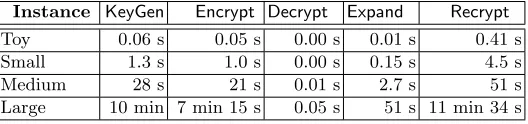
Concrete Key Size and Execution Speed We have updated the parameters from [8] to take into account the improved approximate-GCD attack from [7]; see Table 2. The attack from [7] is memory bounded; however we took a conservative approach and considered a memory unbounded adversary. As in [8] we take n = 4 and θ = 15 for all security levels. We can see in Table 2 that compression reduces the public key size considerably. In Appendix B we describe an optimization (not yet implemented) that further reduces the public key size by a factor 2. Table 3 shows no significant performance degradation with respect to [8].
8 Implementation of Leveled DGHV
Instance λ ρ η γ×10−6 α τ Θ pk size
Toy 42 27 1026 0.15 936 158 144 77 KB
Small 52 41 1558 0.83 1476 572 533 437 KB
Medium 62 56 2128 4.20 2016 2110 1972 2207 KB
Large 72 71 2698 19.35 2556 7659 7897 10.3 MB
Table 2. The concrete parameters of various test instances and their respective public key sizes, for DGHV with compressed public-key.
Instance KeyGen Encrypt Decrypt Expand Recrypt
Toy 0.06 s 0.05 s 0.00 s 0.01 s 0.41 s
Small 1.3 s 1.0 s 0.00 s 0.15 s 4.5 s
Medium 28 s 21 s 0.01 s 2.7 s 51 s
Large 10 min 7 min 15 s 0.05 s 51 s 11 min 34 s
Table 3.Timings of our Sage 4.7.2 [16] code (single core of a desktop computer with an Intel Core2 Duo E8400 at 3 GHz), for DGHV with compressed public-key.
5.3, with an optimization of the ciphertext expansion procedure (see below). We also implement the bootstrapping operation; although not strictly necessary, this enables to get a FHE that can perform homomorphic evaluations indefinitely without needing to specify at setup time a bound on the multiplicative level. It is also interesting to compare the running time of the bootstrapping operation between the non-leveled DGHV scheme of Section 7 and the leveled DGHV scheme.
8.1 Faster Ciphertext Expansion
We consider the modulus-switching procedure of Section 5.3. The initial modulus phas sizeη and the new modulusp0 has sizeη0 < η. The first modulusp is shared among theyi elements as
2η0
p =
Θ
X
i=1
si·yi+ε mod 2η 0+1
(7)
where the si’s are bits, the yi’s have κ bits of precision after the binary point, and |ε| ≤ 2−κ. In
practice one can generate the yi’s pseudo-randomly (except y1), as in Appendix A. However the
ciphertext expansion from Step 2 ofSwitchKeyalgorithm (Section 5.3) is a time-consuming procedure. Therefore instead of using pseudo-random yi’s we use the following (admittedly aggressive)
optimization. Letδ be a parameter specified later. We generate a random y withκ+δ·Θ·η bits of precision after the binary point, and we define theyi’s for 2≤i≤Θ as:
yi =
h
y·2i·δ·η i
2η0+1
keeping only κ bits of precision after the binary point for each yi as previously. We fix y1 so that
equality (7) holds, assuming s1 = 1. Then the ciphertext expansion from Step 2 of the SwitchKey
algorithm (Section 5.3) can be computed as follows, for all 2≤i≤Θ:
zi =bc·yiemod 2η 0+1
Therefore computing all thezi’s (exceptz1) is now essentially a single multiplicationc·y. In Appendix
C we describe a lattice attack against this optimization; we show that the attack is thwarted by selecting δ such thatδ·Θ·η≥3γ.
Finally we use the following straightforward optimization: instead of usingBitDecompandPowersof2
with bits, we use words of size ω bits instead. This decreases the running time of SwitchKey by a factor of about ω, at the cost of increasing the resulting noise by roughly ω bits. We tookω= 32 in our implementation.
8.2 Bootstrapping: The Decryption Circuit.
Recall that the decryption function in the DGHV scheme is:
m←
"
c−
$ Θ X
i=1
si·zi
'#
2
(8)
wherezi = [c·yi]2 for 1≤i≤Θ is the expanded ciphertext, keeping only n=dlog2(θ+ 1)e bits of
precision after the binary point for each zi. Thesi’s form a sparseΘ-dimensional vector of Hamming
weightθ, such that:
1
p =
Θ
X
i=1
si·yi+ε
where theyi’s haveκbits of precision after the binary point, and|ε| ≤2−κ. Note that for bootstrapping
the decryption circuit is only used for the smallest modulus p in the ladder. The following lemma shows that the message m can be computed using a circuit of multiplicative depth exactlyn.
Lemma 7. Leta= [a0, . . . , an] andb= [b0, . . . , bn]be two integers of sizen+1bits, where every bitai
andbihas multiplicative depth at mosti. Then every bitciof the sumc= (a+b) mod 2n+1= [c0, . . . , cn]
has multiplicative depth at most i.
Proof. Let δi be the i-th carry bit, with δ0 = 0. We have ci = ai⊕bi ⊕δi for 0 ≤ i ≤ n, where
δi =ai−1·bi−1+ai−1·δi−1+bi−1·δi−1 for 1≤i≤n. Therefore by recursion δi has multiplicative
depth at most i; this implies that ci has multiplicative depth at most i. ut
Therefore using a simple loop the sum of the Θ numbers si·zi in equation (8) can be computed
with a circuit of multiplicative depthn. Since a subsequent homomorphic operation (either addition or multiplication) must be possible between refreshed ciphertexts, the full bootstrapping procedure requires a leveled FHE scheme with multiplicative depth L = n+ 1. Note that for bootstrapping an encryption of the secret-key bits si (corresponding to the last modulus p1 in the ladder) must
be provided underpL, the first modulus in the ladder, so that the homomorphic evaluation of min
equation (8) can start under the public key pkL.
As in Section 7 we use the optimization from [11] that splits the sparse secret-keysinto θblocks of size B =Θ/θ with a single non-zero bit each, so that the sum of Θ elements can be split into θ sub-sums of B elements.
8.3 Implementation Results
In this section we describe an implementation of the leveled DGHV scheme, including the bootstrapping operation. As mentioned previously we cannot use the variant with noise-freex0 =q0·psince otherwise
Asymptotic key size. Using θ = λ the degree of the decryption polynomial is O(λ) and the multiplicative depth isL=O(logλ). This gives µ=O(λ+ logL) =O(λ) and the largest modulus has sizeη=O(L·(λ+ logL)) = ˜O(λ). For the constraintγ =ω(η2·logλ) we can takeγ= ˜O(λ3) and for the constraintΘ2 =γ·ω(logλ) we can take Θ= ˜O(λ2). From the constraintα·τ ≥γ+ω(logλ) we can take α = ˜O(λ) and τ = ˜O(λ2). The public-key size with compressed ciphertexts is then approximately L·(γ+τ ·(η+λ) +Θ·(η+λ)) = ˜O(λ3).
Concrete Key Size and Execution Speed We summarize in Tables 4 and 5 the performance of our implementation of the leveled DGHV scheme. We denote by η the size of the largest modulus in the ladder. The moduli have size ηi = (i+ 1)·µbits for 1≤i≤L. For simplicity we have used
the same value ofΘ andγ for all levels in the ladder. The running time of the Recryptoperation is disappointing compared to the non-leveled implementation from Section 7; however we think that there is room for improvement.
Instance λ ρ η µ γ×10−6 Θ pk size
Toy 42 14 336 56 0.061 195 354 KB
Small 52 20 390 65 0.27 735 1690 KB
Medium 62 26 438 73 1.02 2925 7.9 MB
Large 72 34 492 82 2.20 5700 18 MB
Table 4.The concrete parameters of various test instances and their respective public-key sizes for leveled DGHV.
Instance KeyGen Encrypt Decrypt Mult&Scale Recrypt
Toy 0.36 s 0.01 s 0.00 s 0.04 s 8.8 s
Small 5.4 s 0.07 s 0.00 s 0.59 s 101 s
Medium 1 min 12 s 0.85 s 0.00 s 9.1 s 32 min 38 s
Large 6 min 18 s 3.4 s 0.00 s 41 s 2 h 27 min
Table 5.Timings of our Sage 4.7.2 [16] code (single core of a desktop computer with an Intel Core2 Duo E8400 at 3 GHz).
Acknowledgments
We would like to thank Tancr`ede Lepoint, Phong Nguyen and the EUROCRYPT referees for their helpful comments.
References
1. E. Bach and J. Shallit,Algorithmic Number Theory, vol. 1, MIT Press, 1996.
3. Z. Brakerski and V. Vaikuntanathan,Efficient Fully Homomorphic Encryption from (Standard) LWE. Proceedings of FOCS 2011. Full version available at IACR eprint.
4. Z. Brakerski and V. Vaikuntanathan,Fully Homomorphic Encryption for Ring-LWE and Security for Key Dependent Messages. In P. Rogaway (Ed.),CRYPTO 2011, LNCS, vol. 6841, Springer, 2011, pp. 505–524.
5. Z. Brakerski, C. Gentry and V. Vaikuntanathan,Fully Homomorphic Encryption without Bootstrapping. Cryptology ePrint Archive, Report 2011/277.
6. A. Cafure and G. Matera,Improved explicit estimates on the number of solutions of equations over a finite field. Finite Fields and Their Applications, vol. 12(2), 2006, pp. 155-185.
7. Y. Chen and P.Q. Nguyen,Faster Algorithms for Approximate Common Divisors: Breaking Fully-Homomorphic-Encryption Challenges over the Integers. Cryptology ePrint Archive, Report 2011/436.
8. J.S. Coron, A. Mandal, D. Naccache and M. Tibouchi,Fully Homomorphic Encryption over the Integers with Shorter Public Keys. In P. Rogaway (Ed.),CRYPTO 2011, LNCS, vol. 6841, Springer, 2011, pp. 487–504. Full version available at IACR eprint.
9. M. van Dijk, C. Gentry, S. Halevi and V. Vaikuntanathan,Fully homomorphic encryption over the integers. In H. Gilbert (Ed.),EUROCRYPT 2010, LNCS, vol. 6110, Springer, 2010, pp. 24–43.
10. C. Gentry,A fully homomorphic encryption scheme. Ph.D. thesis, Stanford University, 2009. Available athttp: //crypto.stanford.edu/craig.
11. C. Gentry and S. Halevi, Implementing Gentry’s fully homomorphic encryption scheme. In K. Paterson (Ed.), EUROCRYPT 2011, LNCS, vol. 6632, Springer, 2011, pp. 129–148.
12. K. Lauter, M. Naehrig and V. Vaikuntanathan,Can Homomorphic Encryption be Practical?, Cryptology ePrint Archive, Report 2011/405.
13. A. K. Lenstra,Generating RSA Moduli with a Predetermined Portion. In K. Ohta and D. Pei (Eds.),ASIACRYPT 1998, LNCS, vol. 1514, Springer, 1998, pp. 1–10.
14. H.W. Lenstra,Factoring integers with elliptic curves. Annals of Mathematics, vol. 126(3): 1987, pp. 649–673. 15. N.P. Smart and F. Vercauteren,Fully homomorphic encryption with relatively small key and ciphertext sizes. In
P.Q. Nguyen and D. Pointcheval (Eds.),PKC 2010, LNCS, vol. 6056, Springer, 2010, pp. 420–443.
16. W.A. Stein et al.,Sage Mathematics Software(Version 4.7.2), The Sage Development Team, 2011,http://www. sagemath.org.
17. D. Stehl´e and R. Steinfeld,Faster fully homomorphic encryption. In M. Abe (Ed.),ASIACRYPT 2010, LNCS, vol. 6477, Springer, 2010, pp. 377–394.
18. https://github.com/coron/fhe
A Complete Description of the DGHV Variant with Compressed Public Key
We provide a complete description of the FHE with the ciphertext compression technique. Note that the ciphertext compression technique is applied to both the public key elements xi of the somewhat
homomorphic scheme and to the encryptionσi of the secret-key bits.
KeyGen(1λ). Generate a random prime integerpof sizeη bits. Pick a random odd integerq0∈[0,2γ/p)
and let x0 =q0·p. Initialize a pseudo-random number generator f1 with a random seed se1. Use
f1(se1) to generate a set of integers χi ∈[0,2γ) for 1≤i≤τ. For all 1≤i≤τ compute:
δi =hχiip+ξi·p−ri
whereri ←Z∩(−2ρ,2ρ) and ξi←Z∩[0,2λ+η/p). Let pk∗= (se1, x0, δ1, . . . , δτ). The corresponding
integers xi for 1≤i≤τ are defined asxi=χi−δi.
Additionally generate a random bit vectorsof length Θ, subject to the conditions that s1 = 1,
that for eachk∈[0, θ), there is at most one nonzero bit among thesi’s fork·B+ 1≤i <(k+ 1)·B+ 1,
whereB =bΘ/θc, and that the Hamming weight of sis exactly θ.
Initialize a pseudo-random number generatorf2with a random seedse2, and usef(se2) to generate
integers ui ∈[0,2κ+1) for 2≤i≤Θ, whereκ:=γ+n+ 2. Then, setu1 such that:
Θ
X
i=1
where xp ← b2κ/pe.
Initialize a pseudo-random number generatorf3 with a random seedse3, and compute encryptions
σ of the vector sas follows: usef3(se3) to generate integersχi0 ∈[0,2γ[ for every 1≤i≤Θ; generate
random integersr0i∈(−2ρ,2ρ) and ξi0 ∈[0,2γ+η/p), and let:
δi0 =hχ0iip+ξi0·p−2·ri0−si
The corresponding encryptionσi of si is then defined as:
σi =χ0i−δ
0
i
Finally, output the secret key sk=s and the public keypk= (pk∗,se2, u1,se3,δ0).
Encrypt(pk, m ∈ {0,1}). Recover the integers xi from pk∗. Choose a random integer vector b =
(bi)1≤i≤τ ∈[0,2α)τ and a random integerr in (−2ρ 0
,2ρ0). Output the ciphertext:
c∗ =m+ 2r+ 2
τ
X
i=1
bi·xi mod x0
Add(pk, c∗1, c∗2). Outputc∗1+c∗2 modx0.
Mult(pk, c∗1, c∗2). Outputc∗1·c∗2modx0.
Expand(pk, c∗). The ciphertext expand procedure takes a ciphertext c∗ and computes the associated expanded ciphertext. To do so, for every 1≤i≤Θ first compute the random integer ui’s using the
seeded pseudo-random number generatorf2(se2), then letyi =ui/2κ and compute zi given by:
zi= [c∗·yi]2
keeping only n=dlog2(θ+ 1)e bits of precision after the binary point. Define the vector z = (zi).
Output the expanded ciphertextc= (c∗,z).
Decrypt(sk, c∗,z). Output m←
c∗− bPΘ
i=1
si·zie
2.
Recrypt(pk, c∗,z). Recover the encrypted secret-key bitsσi from pk. Apply the decryption circuit to
the expanded ciphertext z and the encrypted secret key bits σi. Output the result as a refreshed
ciphertext c∗new.
This completes the description of the scheme.
B Optimization with Ciphertext Pairs
We briefly describe an optimization (not yet implemented) that further reduces the public key size by a factor 2. We first generate a random integerΓ modulopthat must remain secret. Then to encrypt a secret-key bitsfor bootstrapping instead of a single ciphertext we generate a pair of ciphertexts:
σ0=q0·p+Γ ·r0 and σ1 =q1·p+ (Γ−1 modp)·r1
for randoms r0,r1 of size ρ/2 bits (instead ofρ bits), withs= [r0]2 = [r1]2. Then during recryption
σ0·σ01 orσ1·σ00, where (σ00, σ10) is a ciphertext pair corresponding tos0, that isσ00 =q00 ·p+Γ·r00 and
σ01=q01·p+ (Γ−1 modp)·r01. We obtain that the factor Γ cancels in the product:
σ0·σ10 =q
00·
p+r0·r01
so a ciphertext of noise size ρ (instead of 2ρ) is obtained. Therefore with the same decryption polynomial to be evaluated homomorphically, the size η of p can be divided by 2, and from the asymptotic condition γ = η2·ω(logλ) the ciphertext size γ is divided by 4. However twice more ciphertexts are required for encrypting the secret-key bits, so asymptotically the public-key size is divided by 2.
Heuristically it is safe to have ciphertexts (σ0, σ1) with onlyρ/2-bit noise, since the randomsr0,
r1 are further “masked” with the secret integerΓ modulo p.
C Lattice Attack against the Ciphertext Expansion Optimization
In this section we describe a lattice attack against the optimization of ciphertext expansion described in Section 8.1; we show that the attack is thwarted by selecting δ≥3. We consider the equation (7) from Section 8.1:
2η0
p =
Θ
X
i=1
si·yi+ε mod 2η 0+1
where thesi’s are bits and|ε| ≤2−κ, and for 2≤i≤Θ we have:
yi =
h
y·2i·δ·η i
2η0+1
withκ bits of precision after the binary point, wherey is a random number with`:=κ+δ·Θ·η bits of precision after the binary point. We obtain, assuming that s1= 1:
2η0
p =y1+
Θ
X
i=2
si·y·2δ·i·η+ε mod 2η 0+1
Letting:
S :=
Θ
X
i=2
si·2δ·i·η
we obtain:
2η0
p =y1+S·y+ε mod 2
η0+1
This gives:
2η0 =p·y1+S·p·y+ε·p+∆·2η 0+1
for some∆∈Z. LetY1:= 2`·y1 andY := 2`·y which gives Y1, Y ∈Z; we obtain:
2η0+`=p·Y1+S·p·Y +u mod 2`+η 0+1
where all variables are now over Z, with |u| ≤ |2`··p| ≤ 2`−κ+η. The previous equation can be linearized by lettingx1:=p,x2:=p·S and x3 :=u, which gives:
2η0+` =x1·Y1+x2·Y +x3 mod 2`+η 0+1

![Table 5. Timings of our Sage 4.7.2 [16] code (single core of a desktop computer with an Intel Core2 Duo E8400 at 3GHz).](https://thumb-us.123doks.com/thumbv2/123dok_us/1877535.1244534/23.612.136.456.272.337/table-timings-sage-single-desktop-computer-intel-core.webp)
