Comparison of Similarity Models for the Relation Discovery Task
Ben Hachey
School of Informatics University of Edinburgh
2 Buccleuch Place, Edinburgh EH8 9LW
Abstract
We present results on the relation discov-ery task, which addresses some of the shortcomings of supervised relation ex-traction by applying minimally supervised methods. We describe a detailed experi-mental design that compares various con-figurations of conceptual representations and similarity measures across six differ-ent subsets of the ACE relation extraction data. Previous work on relation discovery used a semantic space based on a term-by-document matrix. We find that represen-tations based on term co-occurrence per-form significantly better. We also observe further improvements when reducing the dimensionality of the term co-occurrence matrix using probabilistic topic models, though these are not significant.
1 Introduction
This paper describes work that aims to improve upon previous approaches to identifying relation-ships between named objects in text (e.g., people, organisations, locations). Figure 1 contains sev-eral example sentences from the ACE 2005 cor-pus that contain relations and Figure 2 summarises the relations occurring in these sentences. So, for example, sentence 1 contains an employment rela-tion between Lebron James and Nike, sentence 2 contains a sports-affiliation relation between Stig Toefting and Bolton and sentence 4 contains a business relation between Martha Stewart (she) and the board of directors (of Martha Stewart Liv-ing Omnimedia).
Possible applications include identifying com-panies taking part in mergers/acquisitions from
1 As for that $90 million shoe contract with Nike, it may be a good deal for James.
2 Toefting transferred to Bolton in February 2002 from German club Hamburg.
3 Toyoda founded the automaker in 1937 ... . 4 In a statement, she says she’s stepping aside in
the best interest of the company, but she will stay on the board of directors.
Figure 1: Example sentences from ACE 2005.
Sent Entity1 Entity2 Relation
1 Lebron James Nike Employ
2 Stig Toefting Bolton Sports-Aff 2 Stig Toefting Hamburg Sports-Aff 3 Kiichiro Toyoda Toyota Corp Founder 4 Martha Stewart board Business Figure 2: Example entity pairs and relation types.
business newswire, which could be inserted into a corporate intelligence database. In the biomedical domain, we may want to identify relationships be-tween genes and proteins from biomedical publi-cations, e.g. Hirschman et al. (2004), to help scien-tists keep up-to-date on the literature. Or, we may want to identify disease and treatment relations in publications and textbooks, which can be used to help formalise medical knowledge and assist gen-eral practitioners in diagnosis, treatment and prog-nosis (Rosario and Hearst, 2004).
Another application scenario involves building networks of relationships from text collections that indicate the important entities in a domain and can be used to visualise interactions. The net-works could provide an alternative to searching when interacting with a document collection. This could prove beneficial, for example, in investiga-tive journalism. It might also be used for social science research using techniques from social net-work analysis (Marsden and Lin, 1982). In
ous work, relations have been used for automatic text summarisation as a conceptual representation of sentence content in a sentence extraction frame-work (Filatova and Hatzivassiloglou, 2004).
In the next section, we motivate and introduce the relation discovery task, which addresses some of the shortcomings of conventional approaches to relation extraction (i.e. supervised learning or rule engineering) by applying minimally supervised methods.1 A critical part of the relation discov-ery task is grouping entity pairs by their relation type. This is a clustering task and requires a ro-bust conceptual representation of relation seman-tics and a measure of similarity between relations. In previous work (Hasegawa et al., 2004; Chen et al., 2005), the conceptual representation has been limited to term-by-document (TxD) models of re-lation semantics. The current work introduces a term co-occurrence (TxT) representation for the relation discovery task and shows that it performs significantly better than the TxD representation. We also explore dimensionality reduction tech-niques, which show a further improvement.
Section 3 presents a parameterisation of similar-ity models for relation discovery. For the purposes of the current work, this consists of the semantic representation for terms (i.e. how a term’s context is modelled), dimensionality reduction technique (e.g. singular value decomposition, latent Dirich-let allocation), and the measure used to compute similarity.
We also build on the evaluation paradigm for relation discovery with a detailed, controlled ex-perimental setup. Section 4 describes the experi-ment design, which compares the various system configurations across six different subsets of the relation extraction data from the automatic con-tent extraction (ACE) evaluation. Finally, Section 5 presents results and statistical analysis.
2 The Relation Discovery Task
Conventionally, relation extraction is considered to be part of information extraction and has been approached through supervised learning or rule engineering (e.g., Blaschke and Valencia (2002), Bunescu and Mooney (2005)). However, tradi-tional approaches have several shortcomings. First
1The relation discovery task is minimally supervised in the sense that it relies on having certain resources such as named entity recognition. The focus of the current paper is the unsupervised task of clustering relations.
and foremost, they are generally based on pre-defined templates of what types of relations ex-ist in the data and thus only capture information whose importance was anticipated by the template designers. This poses reliability problems when predicting new data in the same domain as the training data will be from a certain epoch in the past. Due to language change and topical varia-tion, as time passes, it is likely that the new data will deviate more and more from the trained mod-els. Additionally, there are cost problems asso-ciated with the conventional supervised approach when updating templates or transferring to a new domain, both of which require substantial effort in re-engineering rules or re-annotating training data. The goal of the relation discovery task is to identify the existence of associations between en-tities, to identify the kinds of relations that oc-cur in a corpus and to annotate particular associ-ations with relation types. These goals correspond to the three main steps in a generalised algorithm (Hasegawa et al., 2004):
1. Identify co-occurring pairs of named entities
2. Group entity pairs using the textual context
3. Label each cluster of entity pairs
The first step is the relation identification task. In the current work, this is assumed to have been done already. We use the gold standard relations in the ACE data in order to isolate the performance of the second step. The second step is a clustering task and as such it is necessary to compute simi-larity between the co-occurring pairs of named en-tities (relations). In order to do this, a model of re-lation similarity is required, which is the focus of the current work.
We also assume that it is possible to perform the third step.2 The evaluation we present here looks just at the quality of the clustering and does not attempt to assess the labelling task.
3 Modelling Relation Similarity
The possible space of models for relation similar-ity can be explored in a principled manner by pa-rameterisation. In this section, we discuss several
parameters including the term context representa-tion, whether or not we apply dimensionality re-duction, and what similarity measure we use.
3.1 Term Context
Representing texts in such a way that they can be compared is a familiar problem from the fields of information retrieval (IR), text mining (TM), textual data analysis (TDA) and natural language processing (NLP) (Lebart and Rajman, 2000). The traditional model for IR and TM is based on a term-by-document (TxD) vector representa-tion. Previous approaches to relation discovery (Hasegawa et al., 2004; Chen et al., 2005) have been limited to TxD representations, using tf*idf weighting and the cosine similarity measure. In information retrieval, the weighted term represen-tation works well as the comparison is generally between pieces of text with large context vectors. In the relation discovery task, though, the term contexts (as we will define them in Section 4) can be very small, often consisting of only one or two words. This means that a term-based similarity matrix between entity pairs is very sparse, which may pose problems for performing reliable clus-tering.
An alternative method widely used in NLP and cognitive science is to represent a term con-text by its neighbouring words as opposed to the documents in which it occurs. This term co-occurrence (TxT) model is based on the intu-ition that two words are semantically similar if they appear in a similar set of contexts (see e.g. Pado and Lapata (2003)). The current work ex-plores such a term co-occurrence (TxT) represen-tation based on the hypothesis that it will provide a more robust representation of relation contexts and help overcome the sparsity problems asso-ciated with weighted term representations in the relation discovery task. This is compared to a baseline term-by-document (TxD) representation which is a re-implementation of the approach used by Hasegawa et al. (2004) and Chen et al. (2005).
3.2 Dimensionality Reduction
Dimensionality reduction techniques for docu-ment and corpus modelling aim to reduce descrip-tion length and model a type of semantic similar-ity that is more linguistic in nature (e.g., see Lan-dauer et al.’s (1998) discussion of LSA and syn-onym tests). In the current work, we explore sin-gular value decomposition (Berry et al., 1994), a
technique from linear algebra that has been ap-plied to a number of tasks from NLP and cogni-tive modelling. We also explore latent Dirichlet allocation, a probabilistic technique analogous to singular value decomposition whose contribution to NLP has not been as thoroughly explored.
Singular value decomposition (SVD) has been used extensively for the analysis of lexical seman-tics under the name of latent semantic analysis (Landauer et al., 1998). Here, a rectangular matrix is decomposed into the product of three matrices (Xw×p =Ww×nSn×n(Pp×n)T) withn’latent se-mantic’ dimensions. The resulting decomposition can be viewed as a rotation of then-dimensional axes such that the first axis runs along the direction of largest variation among the documents (Man-ning and Sch¨utze, 1999). W and P represent terms and documents in the new space. AndSis a diagonal matrix of singular values in decreasing order.
Taking the product Ww×kSk×k(Pp×k)T over the firstDcolumns gives the best least square ap-proximation of the original matrixXby a matrix of rankD, i.e. a reduction of the original matrix to
Ddimensions. SVD can equally be applied to the word co-occurrence matrices obtained in the TxT representation presented in Section 2, in which case we can think of the original matrix as being a term×co-occurring term feature matrix.
While SVD has proved successful and has been adapted for tasks such as word sense discrimi-nation (Sch¨utze, 1998), its behaviour is not easy to interpret. Probabilistic LSA (pLSA) is a gen-erative probabilistic version of LSA (Hofmann, 2001). This models each word in a document as a sample from a mixture model, but does not pro-vide a probabilistic model at the document level. Latent Dirichlet Allocation (LDA) addresses this by representing documents as random mixtures over latent topics (Blei et al., 2003). Besides hav-ing a clear probabilistic interpretation, an addi-tional advantage of these models is that they have intuitive graphical representations.
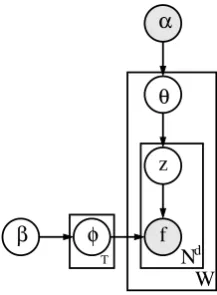
Figure 3 contains a graphical representation of the LDA model as applied to TxT word co-occurrence matrices in standard plate nota-tion. This models the word features f in the co-occurrence context (size N) of each word w
multino-β φ
α
z
θ
d
N
T
[image:4.595.126.235.61.209.2]W f
Figure 3: Graphical representation of LDA.
mial distributionθ. Then, each context feature is generated by sampling from a topic-specific multi-nomial distributionφz.3 In a manner analogous to the SVD model, we use the distribution over top-ics for a wordwto represent its semantics and we use the average topic distribution over all context words to represent the conceptual content of an en-tity pair context.
3.3 Measuring Similarity
Cosine (Cos) is commonly used in the literature to compute similarities between tf*idf vectors:
Cos(p, q) = P
ipiqi pPp2pPq2
In the current work, we use cosine over term and SVD representations of entity pair context. However, it is not clear which similarity measure should be used for the probabilistic topic models. Dagan et al. (1997) find that the symmetric infor-mation radius measure performs best on a pseudo-word sense disambiguation task, while Lee (1999) find that the asymmetric skew divergence – a gen-eralisation of Kullback-Leibler divergence – per-forms best for improving probability estimates for unseen word co-occurrences.
In the current work, we compare KL divergence with two methods for deriving a symmetric
mea-3The hyperparametersαandβare Dirichlet priors on the multinomial distributions for word features (φ ∼ Dir(β)) and topics (θ ∼ Dir(α)). The choice of the Dirichlet is explained by its conjugacy to the multinomial distribution, meaning that if the parameter (e.g.φ,θ) for a multinomial distribution is endowed with a Dirichlet prior then the poste-rior will also be a Dirichlet. Intuitively, it is a distribution over distributions used to encode prior knowledge about the pa-rameters (φandθ) of the multinomial distributions for word features and topics. Practically, it allows efficient estimation of the joint distribution over word features and topicsP(f , ~~z) by integrating outφandθ.
sure. The KL divergence of two probability dis-tributions (p andq) over the same event space is defined as:
KL(p||q) =X
i
pilog
pi
qi
In information-theoretic terms, KL divergence is the average number of bits wasted by encoding events from a distributionpwith a code based on distribution q. The symmetric measures are de-fined as:
Sym(p, q) = 1
2[KL(p||q) +KL(q||p)]
J S(p, q) = 1 2
KL
p||p+q 2
+KL
q||p+q 2
The first is termed symmetrised KL divergence (Sym) and the second is termed Jensen-Shannon (JS) divergence. We explore KL divergence as well as the symmetric measures as it is not known in advance whether a domain is symmetric or not. Technically, the divergence measures are dis-similarity measures as they calculate the differ-ence between two distributions. However, they can be converted to increasing measures of simi-larity through various transformations. We treated this as a parameter to be tuned during develop-ment and considered two approaches. The first is from Dagan et al. (1997). For KL divergence, this function is defined asSim(p, q) = 10−βKL(p||q), whereβis a free parameter, which is tuned on the development set (as described in Section 4.2). The same procedure is applied for symmetric KL di-vergence and JS didi-vergence. The second approach is from Lee (1999). Here similarity for KL is de-fined asSim(p, q) =C−KL(p||q), whereCis a free parameter to be tuned.
4 Experimental Setup
4.1 Materials
Following Chen et al. (2005), we derive our rela-tion discovery data from the automatic content ex-traction (ACE) 2004 and 2005 materials for eval-uation of information extraction.4 This is
prefer-able to using the New York Times data used by Hasegawa et al. (2004) as it has gold standard an-notation, which can be used for unbiased evalua-tion.
The relation clustering data is based on the gold standard relations in the information extraction
data. We only consider data from newswire or broadcast news sources. We constructed six data subsets from the ACE corpus based on four of the ACE entities: persons (PER), organisations (ORG), geographical/social/political entities (GPE) and fa-cilities (FAC). The six data subsets were chosen during development based on a lower limit of 50 for the data subset size (i.e. the number of entity pairs in the domain), ensuring that there is a rea-sonable amount of data. We also set a lower limit of 3 for the number of classes (relation types) in a data subset, ensuring that the clustering task is not too simple.
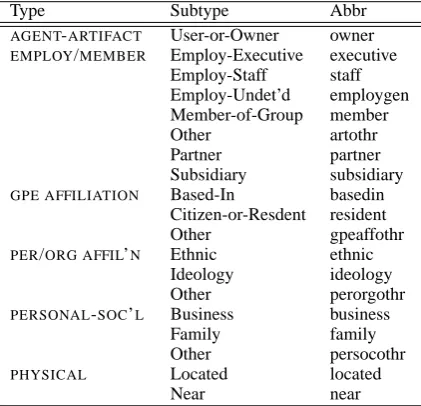
The entity pair instances for clustering were chosen based on several criteria. First, we do not use ACE’s discourse relations, which are relations in which the entity referred to is not an official en-tity according to world knowledge. Second, we only use pairs with one or more non-stop words in the intervening context, that is the context be-tween the two entity heads.5Finally, we only keep relation classes with 3 or more members. Table 4.1 contains the full list of relation types from the subsets of ACE that we used. (Refer to Table 4.2 for definition of the relation type abbreviations.)
We use the Infomap tool6 for singular value decomposition of TxT matrices and compute the conceptual content of an entity pair context as the average over the reducedD-dimensional represen-tation of the co-occurrence vector of the terms in the relation context. For LDA, we use Steyvers and Griffiths’ Topic Modeling Toolbox7). The in-put is produced by a version of Infomap which was modified to output the TxT matrix. Again, we compute the conceptual content of an entity pair as the average over the topic vectors for the con-text words. As documents are explicitly modelled in the LDA model, we input a matrix with raw fre-quencies. In the TxD, unreduced TxT and SVD models we use tf*idf term weighting.
We use the same preprocessing when prepar-ing the text for buildprepar-ing the SVD and probabilistic topic models as we use for processing the interven-ing context of entity pairs. This consisted of Mx-Terminator (Reynar and Ratnaparkhi., 1997) for sentence boundary detection, the Penn Treebank
5
Following results reported by Chen et al. (2005), who tried unsuccessfully to incorporate words from the surround-ing context to represent a relation’s semantics, we use only intervening words.
6
http://infomap.stanford.edu/
7http://psiexp.ss.uci.edu/research/
programs_data/toolbox.htm
sed script8for tokenisation, and the Infomap stop
word list. We also use an implementation of the Porter algorithm (Porter, 1980) for stemming.9
4.2 Model Selection
We used the ACE 2004 relation data to perform model selection. Firstly, dimensionality (D) needs to be optimised for SVD and LDA. SVD was found to perform best with the number of dimen-sions set to 10. For LDA, dimensionality inter-acts with the divergence-to-similarity conversion so they were tuned jointly. The optimal con-figuration varies by the divergence measure with
D= 50andC= 14for KL divergence,D= 200
andC = 4 for symmetrised KL, andD = 150
andC = 2for JS divergence. For all divergence measures, Lee’s (1999) method outperformed Da-gan et al.’s (1997) method. Also for all divergence measures, the model hyper-parameterβwas found to be optimal at 0.0001. The α hyper-parameter was always set to 50/T following Griffiths and Steyvers (2004).
Clustering is performed with the CLUTO soft-ware10 and the technique used is identical across models. Agglomerative clustering is used for comparability with the original relation discovery work of Hasegawa et al. (2004). This choice was motivated because as it is not known in advance how many clusters there should be in a new do-main.
One way to view the clustering problem is as an optimisation process where an optimal cluster-ing is chosen with respect to a criterion function over the entire solution. The criterion function used here was chosen based on performance on the development data. We compared a number of criterion functions including single link, complete link, group average, I1, I2, E1 andH1. I1 is a
criterion function that maximises sum of pairwise similarities between relation instances assigned to each cluster, I2 is an internal criterion function that maximises the similarity between each rela-tion instance and the centroid of the cluster it is as-signed to,E1 is an external criterion function that minimises the similarity between the centroid vec-tor of each cluster and the centroid vecvec-tor of the
8
http://www.cis.upenn.edu/˜treebank/ tokenizer.sed
9
http://www.ldc.usb.ve/˜vdaniel/ porter.pm
10http://glaros.dtc.umn.edu/gkhome/
ORG-GPE ORG-ORG PER-FAC PER-GPE PER-ORG PER-PER basedin 54 subsidiary 36 located 127 located 222 staff 121 business 81 subsidiary 27 emporgothr 14 owner 14 resident 79 executive 100 family 20
located 15 partner 8 near 4 executive 42 member 44 persocothr 16
gpeaffothr 3 member 6 staff 30 emporgothr 27 perorgothr 9
employgen 7 employgen 9 near 7
located 4 ethnic 5
executive 3 ideology 3
member 3
[image:6.595.74.520.61.179.2]Total 99 Total 64 Total 145 Total 380 Total 305 Total 147
Table 1: Relation distributions for entity pair domains.
Type Subtype Abbr
AGENT-ARTIFACT User-or-Owner owner EMPLOY/MEMBER Employ-Executive executive
Employ-Staff staff Employ-Undet’d employgen Member-of-Group member
Other artothr
Partner partner
Subsidiary subsidiary GPE AFFILIATION Based-In basedin
Citizen-or-Resdent resident
Other gpeaffothr
PER/ORG AFFIL’N Ethnic ethnic Ideology ideology
Other perorgothr
PERSONAL-SOC’L Business business
Family family
Other persocothr
PHYSICAL Located located
[image:6.595.75.286.223.426.2]Near near
Table 2: Overview of ACE relations with abbrevi-ations used here.
entire collection, andH1 is a combined criterion function that consists of the ration ofI1overE1.
The I2, H1 andH2 criterion functions
outper-formed single link, complete link and group aver-age on the development data. We useI2, which
performed as well as H1 and H2 and is superior
in terms of computational complexity (Zhao and Karypis, 2004).
5 Experiment
5.1 Method
This section describes experimental setup, which uses relation extraction data from ACE 2005 to an-swer four questions concerning the effectiveness of similarity models based on term co-occurrence and dimensionality reduction for the relation dis-covery task:
1. Do term co-occurrence models provide a bet-ter representation of relation semantics than standard term-by-document vector space?
2. Do textual dimensionality reduction tech-niques provide any further improvements?
3. How do probabilistic topic models perform with respect to SVD on the relation discovery task?
4. Does one similarity measure (for probability distributions) outperform the others on the re-lation discovery task?
System configurations are compared across six different data subsets (entity type pairs, i.e., organisation-geopolitical entity, organisation-organisation, person-facility, person-geopolitical entity, person-organisation, person-person) and evaluated following suggestions by Demˇsar (2006) for statistical comparison of classifiers over multiple data sets.
The dependent variable is the clustering perfor-mance as measured by the F-score. F-score ac-counts for both the amount of predictions made that are true (Precision) and the amount of true classes that are predicted (Recall). We use the CLUTO implementation of this measure for eval-uating hierarchical clustering. Based on (Larsen and Aone, 1999), this is a balanced F-score (F = R2RP+P) that computes the maximum per-class score over all possible alignments of gold stan-dard classes with nodes in the hierarchical tree. The average F-score for the entire hierarchical tree is a micro-average over the class-specific scores weighted according to the relative size of the class.
5.2 Results
dimensional-Sem Space TxD TxT TxT TxT TxT TxT Dim Red’n None None SVD LDA LDA LDA Similarity Cos Cos Cos KL Sym JS
ORG-GPE 0.644 0.673 0.645 0.680 0.670 0.673 ORG-ORG 0.879 0.922 0.879 0.904 0.900 0.904 PER-FAC 0.811 0.827 0.831 0.832 0.826 0.820 PER-GPE 0.595 0.637 0.627 0.664 0.642 0.670 PER-ORG 0.520 0.551 0.532 0.569 0.552 0.569 PER-PER 0.534 0.572 0.593 0.633 0.553 0.618 Micro Ave 0.627 0.661 0.652 0.683 0.658 0.681 Macro Ave 0.664 0.697 0.684 0.714 0.689 0.709 RankAve 5.917 3.083 4.250 1.500 4.000 2.250
Table 3: F-score performance on the test data (ACE 2005) using agglomerative clustering with theI2
criterion function.
ity reduction technique used. The column labels in the third row indicated the similarity measure used, i.e. cosine (Cos) and KL (KL), symmetrised KL (Sym) and JS (JS) divergence. The rows con-tain results for the different data subsets. While we do not use them for analysis of statistical sig-nificance, we include micro and macro averages over the data subsets.11 We also include the aver-age ranks, which show that the LDA system using KL divergence performed best.
Initial inspection of the table shows that all sys-tems that use the term co-occurrence semantic space outperform the baseline system that uses the term-by-document semantic space. To test for sta-tistical significance, we use non-parametric tests proposed by Demˇsar (2006) for comparing clas-sifiers across multiple data sets. The use of non-parametric tests is safer here as they do not as-sume normality and outliers have less effect. The first test we perform is a Friedman test (Friedman, 1940), a multiple comparisons technique which is the non-parametric equivalent of the repeated-measures ANOVA. The null hypothesis is that all models perform the same and observed differences are random. With a Friedman statistic (χ2F ) of
21.238, we reject the null hypothesis atp <0.01. The first question we wanted to address is whether term co-occurrence models outperform the term-by-document representation of relation semantics. To address this question, we continue with post-hoc analysis. The objective here is to
11Averages over data sets are unreliable where it is not clear whether the domains are commensurable (Webb, 2000). We present averages in our results but avoid drawing conclu-sions based on them.
compare several conditions to a control (i.e., com-pare the term co-occurrence systems to the term-by-document baseline) so we use a Bonferroni-Dunn test. At a significance level of p < 0.05, the critical difference for the Bonferroni-Dunn test for comparing 6 systems across 6 data sets is
2.782. We conclude that the unreduced term co-occurrence system and the LDA systems with KL and JS divergence all perform significantly better than baseline, while the SVD system and the LDA system with symmetrised KL divergence do not.
The second question asks whether SVD and LDA dimensionality reduction techniques provide any further improvement. We observe that the sys-tems using KL and JS divergence both outperform the unreduced term co-occurrence system, though the difference is not significant.
The third question asks how the probabilistic topic models perform with respect to the SVD models. Here, Holm-correct Wilcoxon signed-ranks tests show that the KL divergence system performs significantly better than SVD while the symmetrised KL divergence and JS divergence systems do not.
6 Discussion
An interesting aspect of using the ACE corpus is the wealth of linguistic knowledge encoded. With respect to named entities, this includes class infor-mation describing the kind of reference the entity makes to something in the world (i.e., specific erential, generic referential, under-specified ref-erential) and it includes mention type informa-tion (i.e., names, quantified nominal construc-tions, pronouns). It also includes information de-scribing the lexical condition of a relation (i.e., possessive, preposition, pre-modifier, formulaic, , verbal). Based on a mapping between gold stan-dard and predicted clusters, we assigned each case a value of 1 or 0 to indicate whether it is a correct or incorrect classification. We then carried out de-tailed statistical analysis12to test for effects of the entity and relation information described above on each system in each domain.
Overall, the effects were fairly small and do not generalise across domains or systems very well. However, there were some observable tendencies. With respect to entity class, relations with specific referential entities tend to correlate positively with correct classifications while under-specified refer-ential entities tend to correlate negatively with cor-rect classifications. With respect to entity men-tion type, relamen-tions entities that consist of names tend to correlate positively with correct classifica-tions while pronouns tend to correlate negatively with correct classifications. Though, this is only reliably observed in the PER-GPE domain. Fi-nally, with respect to lexical condition, we observe that possessive conditioned relations tend to cor-relate negatively, especially in the PER-GPE and PER-ORGdomains with thePER-PERdomain also showing some effect. Pmodifier conditioned re-lations also tend to correlate negatively in thePER -GPEdomain. The effect with verbally conditioned relations is mixed. This is probably due to the fact that verbal relations tend to have more words occurring between the entity pair, which provides more context but can also be misleading when the key terms describing the relation do not occur be-tween the entity pair (e.g., the first sentence in Fig-ure 1).
It is also informative to look at overall proper-ties of the entity pair domains and compare this
12For this analysis, we used the Phi coefficient, which is a measure of relatedness for binomial variables that is inter-preted like correlation.
Domain Score TTR Entrpy
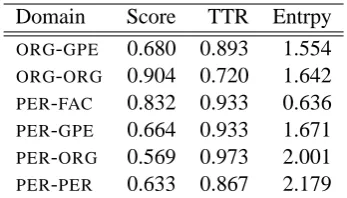
[image:8.595.328.502.61.160.2]ORG-GPE 0.680 0.893 1.554 ORG-ORG 0.904 0.720 1.642 PER-FAC 0.832 0.933 0.636 PER-GPE 0.664 0.933 1.671 PER-ORG 0.569 0.973 2.001 PER-PER 0.633 0.867 2.179 Table 4: System score, type-to-token ratio (TTR) and relation type entropy (Entrpy) for entity pair domains.
to the system performance. Table 6 contains, for each domain, the F-score of the LDA+KL system, the type-to-token ratio, and the entropy of the re-lation type distribution for each domain. Type-to-token ratio (TTR) is the number of words divided by the number of word instances and indicates how much repetition there is in word use. Since TTR can vary depending on the size of the text, we compute it on a random sample of 75 tokens from each domain. Entropy can be interpreted as a measure of the uniformity of a distribution. Low entropy indicates a more spiked distribution while high entropy indicates a more uniform distribu-tion. Though there is not enough data to make a reliable conclusion, it seems that the system does poorly on domains that have both a high type-to-token ratio and a high entropy (uniform relation type distribution), while it performs very well on domains that have low TTR or low entropy.
7 Conclusions and Future Work
This paper presented work on the relation dis-covery task. We tested several systems for the clustering subtask that use different models of the conceptual/semantic similarity of relations. These models included a baseline system based on a term-by-document representation of term context, which is equivalent to the representation used in previous work by Hasegawa et al. (Hasegawa et al., 2004) and Chen et al. (Chen et al., 2005). We hypothesised that this representation suffers from a sparsity problem and showed that models that use a term co-occurrence representation perform significantly better.
specific word forms and therefore more semantic in nature. Our experiments showed an improve-ment over a term co-occurrence baseline when us-ing LDA with KL and JS divergence, though it was not significant. We also found that LDA with KL divergence performs significantly better than SVD.
Comparing the different divergence measures for LDA, we found that KL and JS perform sig-nificantly better than symmetrised KL divergence. Interestingly, the performance of the asymmetric KL divergence and the symmetric JS divergence is very close, which makes it difficult to con-clude whether the relation discovery domain is a symmetric domain or an asymmetric domain like Lee’s (1999) task of improving probability esti-mates for unseen word co-occurrences.
A shortcoming of all the models we will de-scribe here is that they are derived from the basic bag-of-words models and as such do not account for word order or other notions of syntax. Related work on relation discovery by Zhang et al. (2005) addresses this shortcoming by using tree kernels to compute similarity between entity pairs. In future work we will extend our experiment to explore the use of syntactic and semantic features following the frame work of Pado and Lapata (2003). We are also planning to look at non-parametric ver-sions of LDA that address the model order selec-tion problem and perform an extrinsic evaluaselec-tion of the relation discovery task.
Acknowledgements
This work was supported by Scottish Enterprise Edinburgh-Stanford Link grant R37588 as part of the EASIE project. I would like to thank Claire Grover, Mirella Lapata, Gabriel Murray and Se-bastian Riedell for very useful comments and dis-cussion on this work. I would also like to thank the anonymous reviewers for their comments.
References
Michael W. Berry, Susan T. Dumais, and Gavin W. O’Brien. 1994. Using linear algebra for intelligent information retrieval. SIAM Review, 37(4):573–595.
Christian Blaschke and Alfonso Valencia. 2002. The frame-based module of the suiseki information ex-traction system. IEEE Intelligent Systems, 17:14– 20.
David Blei, Andrew Y. Ng, and Michael I. Jordan.
2003. Latent dirichlet allocation. Journal of Ma-chine Learning Research, 3.
Razvan C. Bunescu and Raymond J. Mooney. 2005. Subsequence kernels for relation extraction. In Pro-ceedings of the 19th Conference on Neural Informa-tion Processing Systems, Vancouver, BC, Canada.
Jinxiu Chen, Donghong Ji, Chew Lim Tan, and Zhengyu Niu. 2005. Automatic relation extraction with model order selection and discriminative label identification. In Proceedings of the 2nd Interna-tional Joint Conference on Natural Language Pro-cessing.
Ido Dagan, Lillian Lee, and Fernando Pereira. 1997. Similarity-based methods for word sense disam-biguation. In Proceedings of the 35th Annual Meet-ing of the Association for Computational LMeet-inguis- Linguis-tics, Madrid, Spain.
Janez Demˇsar. 2006. Statistical comparisons of clas-sifiers over multiple data sets. Journal of Machine Learning Research, 7:1–30, Jan.
Elena Filatova and Vasileios Hatzivassiloglou. 2004. Event-based extractive summarization. In Proceed-ings of the ACL-2004 Text Summarization Branches Out Workshop, Barcelona, Spain.
Milton Friedman. 1940. A comparison of alternative tests of significance for the problem of m rankings. The Annals of Mathematical Statistics, 11:86–92.
Thomas L. Griffiths and Mark Steyvers. 2004. Find-ing scientific topics. ProceedFind-ings of the National Academy of Sciences, 101:5228–5235.
Takaaki Hasegawa, Satoshi Sekine, and Ralph Grish-man. 2004. Discovering relations among named entities from large corpora. In Proceedings of the 42nd Annual Meeting of Association of Computa-tional Linguistics.
Lynette Hirschman, Alexander Yeh, Christian Blaschke, and Alfonso Valencia. 2004. Overview of BioCreAtIvE: Critical assessment of information extraction for biology. In Proceedings of Critical Assessment of Information Extraction Systems in Biology Workshop (BioCreAtIvE), Granada, Spain.
Thomas Hofmann. 2001. Unsupervised learning by probabilistic latent semantic analysis. Machine Learning, 42:177–196.
Thomas K. Landauer, Peter W. Foltz, and Darrell La-ham. 1998. An introduction to latent semantic anal-ysis. Discourse Processes, 25:259–284.
Ludovic Lebart and Martin Rajman. 2000. Comput-ing similarity. In Robert Dale, Hermann Moisl, and Harold Somers, editors, Handbook of Natural Lan-guage Processing, pages 477–505. Marcel Dekker, New York.
Lillian Lee. 1999. Measures of distributional similar-ity. In Proceedings of the 37th Annual Meeting of the Association for Computational Linguistics, Col-lege Park, MD, USA.
Christopher D. Manning and Hinrich Sch¨utze. 1999. Foundations of Statistical Natural Language Pro-cessing. MIT Press.
Peter V. Marsden and Nan Lin, editors. 1982. So-cial Structure and Network Analysis. Sage, Beverly Hills.
Sebastian Pado and Mirella Lapata. 2003. Construct-ing semantic space models from parsed corpora. In Proceedings of the 41st Annual Meeting of the As-sociation for Computational Linguistics, Sapporo, Japan.
Martin F. Porter. 1980. An algorithm for suffix strip-ping. Program, 14(3):130–137.
Jeffrey C. Reynar and Adwait Ratnaparkhi. 1997. A maximum entropy approach to identifying sentence boundaries. In Proceedings of the 5th Conference on Applied Natural Language Processing, Washington, D.C., USA.
Barbara Rosario and Marti Hearst. 2004. Classifying semantic relations in bioscience text. In Proceed-ings of the 42nd Annual Meeting of the Association for Computational Linguistics, Barcelona, Spain.
Hinrich Sch¨utze. 1998. Automatic word sense dis-crimination. Computational Linguistics, 24(1):91– 124.
Geoffrey I. Webb. 2000. Multiboosting: A tech-nique for combining boosting and wagging. Ma-chine Learning, 40(2):159–196.
Min Zhang, Jian Su, Danmei Wang, Guodong Zhou, and Chew Lim Tan. 2005. Discovering relations from a large raw corpus using tree similarity-based clustering. In Proceedings of the 2nd International Joint Conference on Natural Language Processing.