Roberto Basili, Malvina Nissim and Giorgio Satta (dir.)
Proceedings of the Fourth Italian Conference on Computational Linguistics CLiC-it 2017
11-12 December 2017, Rome
Accademia University Press
Predicting Controversial News Using Facebook
Reactions
Angelo Basile, Tommaso Caselli and Malvina Nissim
DOI: 10.4000/books.aaccademia.2370 Publisher: Accademia University Press Place of publication: Torino
Year of publication: 2017
Published on OpenEdition Books: 19 April 2018
Serie: Collana dell'Associazione Italiana di Linguistica Computazionale Electronic ISBN: 9788899982942
http://books.openedition.org
Electronic reference
BASILE, Angelo ; CASELLI, Tommaso ; and NISSIM, Malvina. Predicting Controversial News Using Facebook Reactions In: Proceedings of the Fourth Italian Conference on Computational Linguistics CLiC-it 2017: 11-12 December 2017, Rome [online]. Torino: Accademia University Press, 2017 (generated 26 avril 2019). Available on the Internet: <http://books.openedition.org/aaccademia/2370>. ISBN: 9788899982942. DOI: 10.4000/books.aaccademia.2370.
Predicting Controversial News Using Facebook Reactions
Angelo BasileFaculty of ICT, Univ. of Malta CLCG, Univ. of Groningen Groningen, NL [email protected] Tommaso Caselli CLTL, VU Amsterdam CLCG, Univ. of Groningen Amsterdam/Groningen, NL [email protected] Malvina Nissim CLCG, Univ. of Groningen Groningen, NL [email protected] Abstract
English. Different events and their re-ception in different reader communities may give rise to controversy. We pro-pose a distant supervised entropy-based model that uses Facebook reactions as proxies for predicting news controversy. We prove the validity of this approach by running within- and across-source exper-iments, where different news sources are conceived to approximately correspond to different reader communities. Contextu-ally, we also present and share an au-tomatically generated corpus for contro-versy prediction in Italian.
Italiano. Diversi tipi di eventi e la loro percezione in diverse comunit`a di utenti/lettori possono dare vita a contro-versie. In questo lavoro proponiamo un modello basato su entropia e sviluppato secondo il paradigma della “distant su-pervision” per predire controversie sulle notizie usando le reazioni di Facebook come “proxy”. La validit`a dell’approccio `e dimostrata attraverso una serie di esper-imenti usando dati provenienti dalla stessa fonte o da fonti diverse. Contestualmente, presentiamo anche un corpus generato au-tomaticamente per la previsione delle con-troversie in italiano.
1 Introduction and Background
The explosion of social media (e.g. Facebook, Twitter, Disqus, Reddit, Wikipedia, among others) and the increased interactions with readers-users that traditional newspapers embraced, have trans-formed the Web in a hugeagora, where news are
On many topics, such as climate change, abor-tion, vaccinaabor-tion, among others, people strongly disagree. Following the work by Timmermans et al. (2017), we callcontroversiessituations where, even after lengthy interactions, opinions of the in-volved participants tend to remain unchanged and become more and more polarized towards extreme values.
Modeling and understanding controversies may be useful in many situations. Journalists and news agencies may pay additional attention in the fram-ing of a certain news, government officials and policy makers may be more aware of the issues involved in specific laws, social media managers might be more careful, i.e. monitor controver-sial content, in order to avoid the spreading of hate speech, and the general public may benefit as well thanks to a reduction of the “filter bubble” effect (Pariser, 2011).
Recently, computational approaches on contro-versy detection have been developed with vary-ing degrees of success (Awadallah et al., 2012; Borra et al., 2015; Dori-Hacohen and Allan, 2015; Lourentzou et al., 2015). Works in the areas of Sentiment Analysis (Zhou et al., 2013; Deng and Wiebe, 2015; Deng et al., 2013; Chambers et al., 2015; Russo et al., 2015), Emotion Detec-tion (Strapparava and Mihalcea, 2007; Strappar-ava and Mihalcea, 2008; Russo et al., 2011; Pool and Nissim, 2016), and Stance Detection (Mo-hammad et al., 2016) are, on the other hand, only partially related, as they focus on predict-ing/classifying the content of a message with re-spect to specific categories, such as “positive”, “negative”, “neutral”, or “joy”, “sadness” (among others), or as “being in favour” or “being against”. They may be seen as necessary but not sufficient tools for detecting/predicting controversy (Tim-mermans et al., 2017).
Table 1: Sample rows from the dataset showing how entropy varies in relation to the reactions.
ID TEXT LIKE LOVE ANGRY HAHA WOW SAD entropy
1.) In volo sul Piemonte con biplano anni ’30 32 0 0 0 0 0 0.0 2.) Medico anti vaccini radiato 5700 216 220 36 42 22 0.5 3.) Piacenza, abbattuto il cinghiale Agostino 125 7 34 33 5 78 1.9
model to predict controversial news; and ii.) we present and share an automatically created cor-pus to train and test models for controversy de-tection. At this stage of development, we focused only on Italian, although the methods are com-pletely language independent and can be repro-duced for any language for which news are avail-able on Facebook. The remainder of the paper is structured as follows: Section 2 illustrates the methods used to collect the data and develop the entropy-based model. Section 3 reports on the ex-periments and results both in a within- and across-source setting. Finally, Section 4 draws conclu-sions and outlines future research. Data and code are made available at https://anbasile. github.io/predictingcontroversy/.
2
Data and Methodology
We used the Facebook Graph API1 to download news headlines (including the description and body fields) from four major Italian news-papers. Of these, two are slightly politically biased (Corriere della Sera and La Repubblica, both centre/centre-left), two openly biased ones (Il Manifesto, left-wing, andil Giornale, right-wing), and one news agency (ANSA).
Together with each news, we also downloaded all users’ reactions.2 Facebook reactions can be used as a proxy for annotations (Pool and Nissim, 2016), allowing to train a model for predicting the degree of controversy associated to news. On the basis of the definition of controversy previously introduced, our working hypothesis is that if users’ reactions fall in two or more emotion classes (not necessarily opposed in terms of “polarity”) with high frequencies, the controversy of a news item is higher. Building on this, we assume that en-tropy can be explanatory in modelling news’ con-troversy: the higher the entropy, the more contro-versial the news. To better clarify this aspect,
con-1
https://developers.facebook.com/docs/ graph-api
2
Since February 2016, Facebook users can react to a post not only with a like but by choosing from a set of 5 different emotions:ANGRY, LIKE, HAHA, WOW, SAD, LOVE.
sider the data in Table 1. Each sample is the text of a Facebook post, for which we report the reaction breakdown (including LIKE), and its overall en-tropy based on reaction counts. Users expressing different reactions suggest that a text is likely to be controversial as it is shown by the high values of the entropy, as illustrated in examples 2.) and 3.) vs. example 1.).
For each source, namely the newspaper pages mentioned at the beginning of this section, we downloaded a collection of posts which appeared between mid-April and early July 2017. Posts with less than 30 reactions in total were discarded. For each post, we collected: i.) the link to the full article on the source’s website (a large majority of the posts include this); ii.) an excerpt of the arti-cle (the variabletext); iii.) additional texts com-menting the article, when available (the variable descriptor); iv.) the full list of users’ reac-tions. Finally, for a portion of the posts (1024 out of 3595, i.e. 28,48%; column “# body” in Table 2) we downloaded the entire text of the article (the variablebody).3. Table 2 provides an overview of
the data collected, including, for each source, the number of Facebook posts, the number of tokens, the number of posts for which the full article was retrieved, the token-post ratio, i.e. the number of tokens per post, and, finally, the average entropy. Table 2: Dataset shape and average entropy score (avg H) per source.
SOURCE #POSTS #TOKEN #BODY RATIO TOKEN-POST AVGH AgenziaANSA 883 18,635 528 21.10 1.0216 corrieredellasera 594 23,811 124 40.08 0.9135 ilgiornale 1,022 8,665 124 8.47 1.1266 ilmanifesto 752 36,479 124 48.5 0.6195 repubblica 344 7,763 124 22.56 0.9078 total 3,595 95,353 1,024 26.52 0.9386
To further verify the soundness of using en-tropy as an indicator of controversy, we inspected the top-10 and bottom-10 news in the full dataset
3
The full text of the article is not always available or ac-cessible. Furthermore, there is a monthly limit to the data that can be downloaded. We made sure that the final dataset we used contained, for each source, the same number of posts for which the full body could be downloaded. This constraint did not apply toANSA
Table 1: Sample rows from the dataset showing how entropy varies in relation to the reactions.
IDTEXT
LIKELOVEANGRYHAHAWOWSADentropy 1.)In volo sul Piemonte con biplano anni ’3032000000.0 2.)Medico anti vaccini radiato57002162203642220.5 3.)Piacenza, abbattuto il cinghiale Agostino125734335781.9 model to predict controversial news; and ii.) we present and share an automatically created cor-pus to train and test models for controversy de-tection. At this stage of development, we focused only on Italian, although the methods are com-pletely language independent and can be repro-duced for any language for which news are avail-able on Facebook. The remainder of the paper is structured as follows: Section 2 illustrates the methods used to collect the data and develop the entropy-based model. Section 3 reports on the ex-periments and results both in a within- and across-source setting. Finally, Section 4 draws conclu-sions and outlines future research. Data and code are made available athttps://anbasile. github.io/predictingcontroversy/.
2Data and Methodology
We used the Facebook Graph API1 to download news headlines (including thedescription
and
body
fields) from four major Italian news-papers.Of these, two are slightly politically biased (
Corriere della SeraandLa Repubblica, both centre/centre-left), two openly biased ones (Il Manifesto
, left-wing, andil Giornale, right-wing), and one news agency (ANSA).Together with each news, we also downloaded all users’ reactions.2 Facebook reactions can be used as a proxy for annotations (Pool and Nissim, 2016), allowing to train a model for predicting the degree of controversy associated to news. On the basis of the definition of controversy previously introduced, our working hypothesis is that if users’ reactions fall in two or more emotion classes (not necessarily opposed in terms of “polarity”) with high frequencies, the controversy of a news item is higher. Building on this, we assume that en-tropy can be explanatory in modelling news’ con-troversy: the higher the entropy, the more contro-versial the news. To better clarify this aspect,
con-1
https://developers.facebook.com/docs/ graph-api
2Since February 2016, Facebook users can react to a post not only with a like but by choosing from a set of 5 different
emotions:
ANGRY, LIKE, HAHA, WOW, SAD, LOVE. sider the data in Table 1. Each sample is the text of a Facebook post, for which we report the reaction breakdown (includingLIKE), and its overall en-tropy based on reaction counts. Users expressing different reactions suggest that a text is likely to be controversial as it is shown by the high values of the entropy, as illustrated in examples 2.) and 3.) vs. example 1.).For each source, namely the newspaper pages mentioned at the beginning of this section, we downloaded a collection of posts which appeared between mid-April and early July 2017.Posts with less than 30 reactions in total were discarded. For each post, we collected: i.) the link to the full article on the source’s website (a large majority of the posts include this); ii.) an excerpt of the arti-cle (the variabletext); iii.) additional texts com-menting the article, when available (the variable
descriptor); iv.) the full list of users’ reac-tions. Finally, for a portion of the posts (1024 out of 3595, i.e. 28,48%; column “# body” in Table 2) we downloaded the entire text of the article (the variablebody).3. Table 2 provides an overview of the data collected, including, for each source, the number of Facebook posts, the number of tokens, the number of posts for which the full article was retrieved, the token-post ratio, i.e. the number of tokens per post, and, finally, the average entropy. Table 2: Dataset shape and average entropy score (avg H) per source.SOURCE# POSTS# TOKEN# BODYRATIO TOKEN-POSTAVGH AgenziaANSA88318,63552821.101.0216 corrieredellasera59423,81112440.080.9135 ilgiornale1,0228,6651248.471.1266 ilmanifesto75236,47912448.50.6195 repubblica3447,76312422.560.9078 total3,59595,3531,02426.520.9386 To further verify the soundness of using en-tropy as an indicator of controversy, we inspected the top-10 and bottom-10 news in the full dataset 3The full text of the article is not always available or ac-cessible. Furthermore, there is a monthly limit to the data that can be downloaded. We made sure that the final dataset we used contained, for each source, the same number of posts for which the full body could be downloaded. This constraint did not apply toANSA
13
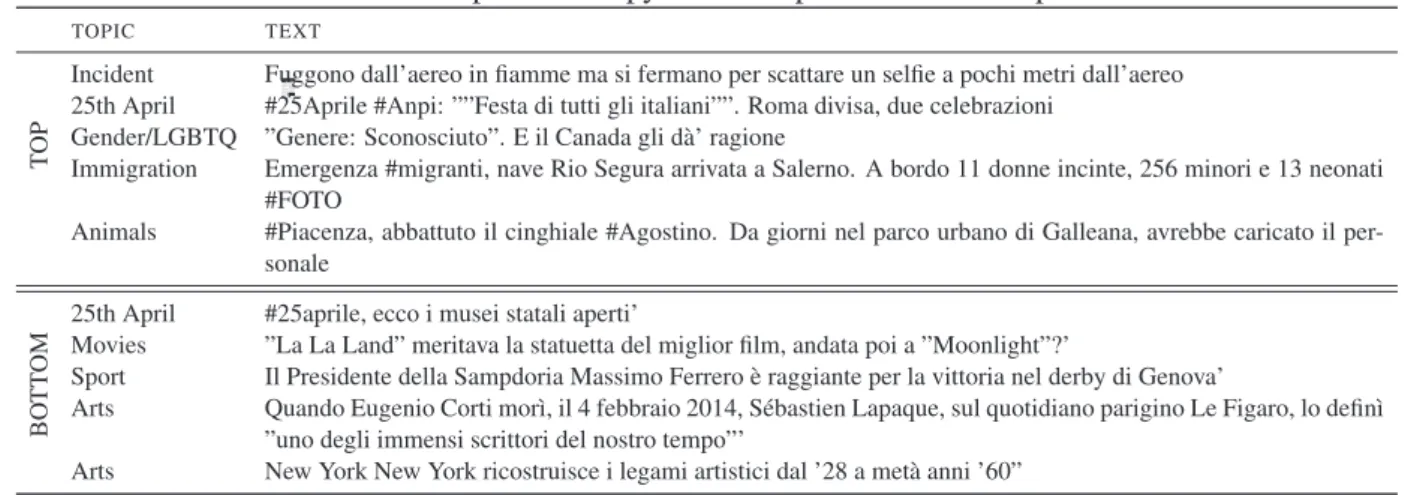
Table 3: Sample of entropy-ranked top-5 and bottom-5 posts.
TOPIC TEXT
TO
P
Incident Fuggono dall’aereo in fiamme ma si fermano per scattare un selfie a pochi metri dall’aereo
25th April #25Aprile #Anpi: ””Festa di tutti gli italiani””. Roma divisa, due celebrazioni
Gender/LGBTQ ”Genere: Sconosciuto”. E il Canada gli d`a’ ragione
Immigration Emergenza #migranti, nave Rio Segura arrivata a Salerno. A bordo 11 donne incinte, 256 minori e 13 neonati
#FOTO
Animals #Piacenza, abbattuto il cinghiale #Agostino. Da giorni nel parco urbano di Galleana, avrebbe caricato il
per-sonale
BO
TT
OM
25th April #25aprile, ecco i musei statali aperti’
Movies ”La La Land” meritava la statuetta del miglior film, andata poi a ”Moonlight”?’
Sport Il Presidente della Sampdoria Massimo Ferrero `e raggiante per la vittoria nel derby di Genova’
Arts Quando Eugenio Corti mor`ı, il 4 febbraio 2014, S´ebastien Lapaque, sul quotidiano parigino Le Figaro, lo defin`ı
”uno degli immensi scrittori del nostro tempo”’
Arts New York New York ricostruisce i legami artistici dal ’28 a met`a anni ’60”
sorted by entropy (high values on top, high con-troversy) and manually assigned them to a topic. Table 3 illustrates the results for the top 5 and bot-tom 5 posts, in terms of entropy score. In addi-tion to identifying a different distribuaddi-tion of topics according to degrees of controversy, we also ob-served that in some cases, the entities and the spe-cific event mentions interact to generate contro-versy. For instance, in the case of the “25th April” topic4, the controversial news involves a political actor (i.e. ANPI, the National Association of Ital-ian Partisans), and divisions on the celebration of this day, while the non-controversial news reports on museums being open on that day. The entropy score appears to capture this distinction.
3
Experiments
We use the ANSA dataset to develop our model. The rationale behind this is that, being ANSA a news agency, the texts should be more objective and the controversy should depend on the event itself rather than by its framing in a specific, po-tentially biased, community. We treat this task as a regression problem, and use mean squared error (MSE) to measure the performance of our system. As baseline, we use a dummy regres-sor which always predicts the mean entropy of the train dataset: considering that the values range be-tween 0 and 2.9, with a standard deviation of 0.4, a system that always predicts the mean entropy is already performing reasonably well. Further-more, this is in line with the average entropy val-ues of each dataset, ranging from 0.6195 (Table 2,
Il Manifesto) up to 1.1266 (Table 2,Il Giornale). 4
April 25th is a national holiday in Italy to celebrate the end of World War II.
Settings We use two main settings. Firstly, the data for training and testing the model originates from the same Facebook page, and we use cross-validation. Secondly, we train and test across pages, so as to investigate the model’s portabil-ity across potentially different communities. This second setting can shed light on the issue of per-spective bias, as controversy around a specific topic or entity could exist in one domain (or, in this case, in one community as proxied by Facebook pages) and not in another one. In both settings, we run our best model, developed as described below.
Features For predicting the entropy of the reac-tions to a given text, we built a system using a sparse feature representation and an SVM regres-sor, with thescikit-learnLinearSVR implementa-tion (Buitinck et al., 2013). We used a tf-idf vec-torizer to represent the text as both word and char-acter n-grams.
As sentiment might contribute to controversy prediction (Dori-Hacohen and Allan, 2015), we also extended the features with coarse-grained prior polarity information derived from Sen-tix (Basile and Nissim, 2013), a resource for Ital-ian automatically mapped from the English Senti-WordNet (Esuli and Sebastiani, 2006). We repre-sent each token with the absolute values of its po-larity (which in Sentix ranges from -1 to +1). This allows us to ignore the specific positive/negative values, and get a more abstract representation on the subjectivity relevance of a token: high values indicate that the text is rich of subjectivity relevant tokens; 0 means that the text is merely objective. For each post, we then compute the average polar-ity and encoded it into a separate vector. Missing words in the lexicon are simply skipped.
Model development For development, as men-tioned, we only used ANSA. We experimented with different features and different sizes of texts. In particular, we ran experiments using: i.) only thetextvariable; ii.) a combination of thetext and thedescriptorvariables; and iii.) a com-bination of thetext, thedescriptor, and the body variables. Furthermore, these three basic settings have been extended with the polarity val-ues from Sentix. To fine tune the parameters, a grid-search of the model using a 10-fold cross-validation was conducted. Table 4 reports the re-sults of the different models as well as of the base-lines.
Table 4: Results for the cross-validated ANSA
dataset.
DATA BASELINE MODEL +SENTIX
text 0.24 0.154 0.155 text+descriptor 0.24 0.146 0.148 text+descriptor+body 0.24 0.146 0.148
The best model shows an improvement of 0.094 MSE with respect to the baseline when extending the variabletextwithdescriptorandbody. The use of the variabletextalone still beats the baseline, but obtains a lower score than the mod-els which include both thedescriptorand the body variables. The extensions with the polar-ity scores from Sentix decrease the model perfor-mances (though still outperforming the baselines). We believe that this behaviour is mainly due to noise in the resource itself and calls for better and more context-oriented sentiment lexicons in Ital-ian. Table 5 summarises the features of the best model, which is based on a combination of the three text variables only: text, descriptor, and body (whenever available), represented as word and character n-grams, ignoring the polar-ity vectors. This model was used on the reminder of the datasets.
Results on the test set Table 6 illustrates cross-validated results for the newspaper datasets. For comparison and completeness, we report also the results of the cross-validation on the full test set, with and without the extension of the data with
ANSA.
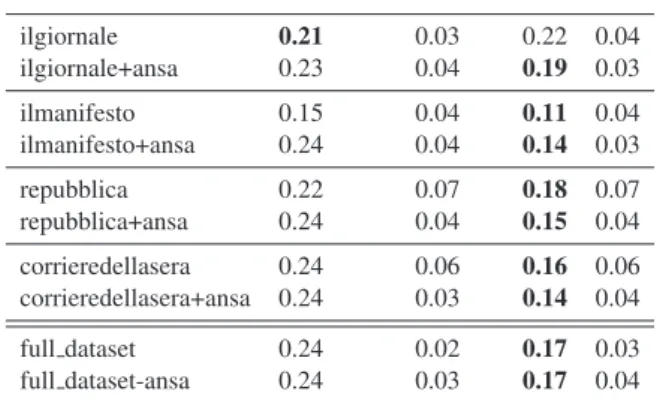
With the exception of Il Giornale, our model always beats the baseline, confirming the validity of the designed approach. Extending the newspa-per dataset with the data from ANSA, we can
ob-Table 5: Best model’s settings and features.
PARAMETER VALUE
SVR C 10
character ngrams (2,3) character binary features True character normalization l2 character sublinear tf False
word ngrams (1,3)
word binary features False word normalization l2 word sublinear tf True
Table 6: Cross-validated results on all datasets.
BASELINE STD MODEL STD ilgiornale 0.21 0.03 0.22 0.04 ilgiornale+ansa 0.23 0.04 0.19 0.03 ilmanifesto 0.15 0.04 0.11 0.04 ilmanifesto+ansa 0.24 0.04 0.14 0.03 repubblica 0.22 0.07 0.18 0.07 repubblica+ansa 0.24 0.04 0.15 0.04 corrieredellasera 0.24 0.06 0.16 0.06 corrieredellasera+ansa 0.24 0.03 0.14 0.04 full dataset 0.24 0.02 0.17 0.03 full dataset-ansa 0.24 0.03 0.17 0.04
serve a reinforcement of the predicting power of the model, with a range between 0.04 to 0.1 points with respect to the corresponding baselines. The positive effect on Il Giornale dataset can be due to an extension of the number of tokens, sinceIl Giornaleis the dataset with the lowest token-post ration (8,47 tokens per post), which clearly affects our model.
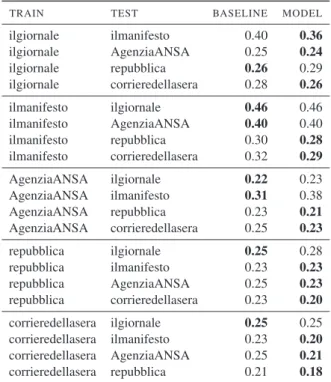
Cross-source results in Table 7 are less clear-cut. In these experiments, it clearly emerges that our model works in the large majority of cases, al-though with no big gains over the baselines. All datasets fail to beat the baseline when predicting controversy on Il Giornale and, on the contrary, training onIl Giornaleonly fails to beat the base-line when testing onLa Repubblica. This suggests that either there must be a difference in the word-ing used by Il Giornale with respect to the other datasets, or that the controversy is affected by per-spective bias associated to different communities.
On the other hand, slightly politically oriented newspapers (La RepubblicaandIl Corriere della Sera) and the ANSA news agency tend to have a homogeneous behavior, being able to correctly predict controversy in highly politically oriented
news (see results forIl Manifestoin Table 7). As a matter of fact, the more the post/token ratio is sim-ilar between different sources, the better the model works in predicting controversy. For instance, Il Corriere della Sera and Il Manifestohave a very similar post/token ratio (40,08 and 48,5, respec-tively) and not surprisingly both cross-source ex-periments beat the baseline.
Table 7: Cross-source results on all datasets.
TRAIN TEST BASELINE MODEL
ilgiornale ilmanifesto 0.40 0.36 ilgiornale AgenziaANSA 0.25 0.24 ilgiornale repubblica 0.26 0.29 ilgiornale corrieredellasera 0.28 0.26 ilmanifesto ilgiornale 0.46 0.46 ilmanifesto AgenziaANSA 0.40 0.40 ilmanifesto repubblica 0.30 0.28 ilmanifesto corrieredellasera 0.32 0.29 AgenziaANSA ilgiornale 0.22 0.23 AgenziaANSA ilmanifesto 0.31 0.38 AgenziaANSA repubblica 0.23 0.21 AgenziaANSA corrieredellasera 0.25 0.23 repubblica ilgiornale 0.25 0.28 repubblica ilmanifesto 0.23 0.23 repubblica AgenziaANSA 0.25 0.23 repubblica corrieredellasera 0.23 0.20 corrieredellasera ilgiornale 0.25 0.25 corrieredellasera ilmanifesto 0.23 0.20 corrieredellasera AgenziaANSA 0.25 0.21 corrieredellasera repubblica 0.21 0.18
4
Conclusions and Future Work
This paper presents a simple regression model to predict the entropy of a post’s reactions based on the Facebook reaction feature. We take this mea-sure as a proxy to predict thecontroversyof news, where the higher the entropy (indicated by highly mixed reactions), the bigger the controversy. We run experiments both within and across communi-ties, exemplified by the Facebook pages of specific newspapers. As a by-product, we have also au-tomatically generated a first reference corpus for controversy prediction in Italian.
The results are promising, given that our model beats the baseline in almost all cases in cross-validation of same source data (see Table 6), and in the large majority of cases when applied cross-sources (see Table 7). At this stage of develop-ment, we observed that coarse-grained sentiment values are not useful, although this may depend on the quality of the lexicon employed. Test and training on openly biased datasets (e.g. Il
Gior-naleT RAI N -Il ManifestoT E S T, and vice-versa) results in the lowest entropy, suggesting perspec-tive bias in the different community.
The approach we have developed is based on discrete linguistically motivated features. This has an impact in the learned model as it is not able to generalise enough when dealing with low-frequency features and unseen data in the test set. To alleviate this issue, we are planning to model the post representations by using word embed-dings.
We are planning to expand the model to ac-count for perspective bias in different communi-ties. News from different sources may be aggre-gated per event type, for example via the Even-tRegistry API5, allowing to explore entropy (and polarisation of reactions) on exactly the same event instance. A first step in this direction would be to detect and match Named Entities to approx-imately identify similar events. At the reaction-level, the obvious next step is to explore and ex-periment with clusters of reactions (for instance, positive (LIKE,LOVE,AHAH), negative (ANGRY, SAD), or ambiguous (WOW)), instead of treating them all as single and distinct indicators.
Another follow-up is to extend this work to other social media data, such as Twitter. Twitter does not allow for nuances in reactions in the same way that Facebook does, as only one kind of “like” is provided. However, the substantial use of hash-tags and emojis might offer alternative proxies to capture a variety of reactions. There is plenty of work on the usefulness of leveraging hashtags as reaction proxies both at a coarse and finer level (Mohammad and Kiritchenko, 2015), but this in-formation, to the best of our knowledge, has not been used to predict likelihood of controversy.
Acknowledgments
One of the authors wants to thank the Spinoza-NWO Project “Understanding Language by Ma-chines” subtrack 3 for making this work possible.
References
Rawia Awadallah, Maya Ramanath, and Gerhard Weikum. 2012. Opinions network for politically controversial topics. InProceedings of the first edi-tion workshop on Politics, elecedi-tions and data, pages 15–22. ACM.
5
Valerio Basile and Malvina Nissim. 2013. Sentiment analysis on italian tweets. In WASSA@ NAACL-HLT, pages 100–107.
Erik Borra, Esther Weltevrede, Paolo Ciuccarelli, Andreas Kaltenbrunner, David Laniado, Giovanni Magni, Michele Mauri, Richard Rogers, and Tom-maso Venturini. 2015. Societal controversies in wikipedia articles. In Proceedings of the 33rd an-nual ACM conference on human factors in
comput-ing systems, pages 193–196. ACM.
Lars Buitinck, Gilles Louppe, Mathieu Blondel, Fabian Pedregosa, Andreas Mueller, Olivier Grisel, Vlad Niculae, Peter Prettenhofer, Alexandre Gramfort, Jaques Grobler, Robert Layton, Jake VanderPlas, Arnaud Joly, Brian Holt, and Ga¨el Varoquaux. 2013. API design for machine learning software: experi-ences from the scikit-learn project. InECML PKDD Workshop: Languages for Data Mining and
Ma-chine Learning, pages 108–122.
Nathanael Chambers, Victor Bowen, Ethan Genco, Xisen Tian, Eric Young, Ganesh Harihara, and Eu-gene Yang. 2015. Identifying political sentiment between nation states with social media. InEMNLP, pages 65–75.
Lingjia Deng and Janyce Wiebe. 2015. Joint predic-tion for entity/event-level sentiment analysis using probabilistic soft logic models. In EMNLP, pages 179–189.
Lingjia Deng, Yoonjung Choi, and Janyce Wiebe. 2013. Benefactive/malefactive event and writer at-titude annotation. InProceedings of the 51st Annual Meeting of the Association for Computational
Lin-guistics (Volume 2: Short Papers), pages 120–125,
Sofia, Bulgaria, August. Association for Computa-tional Linguistics.
Shiri Dori-Hacohen and James Allan. 2015. Auto-mated controversy detection on the web. In
Eu-ropean Conference on Information Retrieval, pages
423–434. Springer.
Andrea Esuli and Fabrizio Sebastiani. 2006. Sen-tiwordnet: A publicly available lexical resource for opinion mining. In Proceedings of the 5th Conference on Language Resources and Evaluation
(LREC’06, pages 417–422.
Hyunseo Hwang, Youngju Kim, and Catherine U Huh. 2014. Seeing is believing: Effects of uncivil online debate on political polarization and expectations of deliberation. Journal of Broadcasting & Electronic
Media, 58(4):621–633.
Ismini Lourentzou, Graham Dyer, Abhishek Sharma, and ChengXiang Zhai. 2015. Hotspots of news ar-ticles: Joint mining of news text & social media to discover controversial points in news. InBig Data
(Big Data), 2015 IEEE International Conference on,
pages 2948–2950. IEEE.
Saif M Mohammad and Svetlana Kiritchenko. 2015. Using hashtags to capture fine emotion cate-gories from tweets. Computational Intelligence, 31(2):301–326.
Saif Mohammad, Svetlana Kiritchenko, Parinaz Sob-hani, Xiaodan Zhu, and Colin Cherry. 2016. Semeval-2016 task 6: Detecting stance in tweets. In
Proceedings of the 10th International Workshop on
Semantic Evaluation (SemEval-2016), pages 31–41,
San Diego, California, June. Association for Com-putational Linguistics.
Eli Pariser. 2011. The filter bubble: What the Internet
is hiding from you. Penguin UK.
Chris Pool and Malvina Nissim. 2016. Distant su-pervision for emotion detection using facebook re-actions. InProceedings of the Workshop on Com-putational Modeling of People’s Opinions,
Person-ality, and Emotions in Social Media (PEOPLES),
pages 30–39, Osaka, Japan, December. The COL-ING 2016 Organizing Committee.
Irene Russo, Tommaso Caselli, Francesco Rubino, Es-ter Boldrini, and Patricio Mart´ınez-Barco. 2011. Emocause: an easy-adaptable approach to emotion cause contexts. In Proceedings of the 2nd Work-shop on Computational Approaches to Subjectivity
and Sentiment Analysis, pages 153–160. Association
for Computational Linguistics.
Irene Russo, Tommaso Caselli, and Carlo Strapparava. 2015. Semeval-2015 task 9: Clipeval implicit po-larity of events. InSemEval@ NAACL-HLT, pages 443–450.
Carlo Strapparava and Rada Mihalcea. 2007. Semeval-2007 task 14: Affective text. In Proceedings of the 4th International Workshop on Semantic
Evalu-ations, pages 70–74. Association for Computational
Linguistics.
Carlo Strapparava and Rada Mihalcea. 2008. Learning to identify emotions in text. InProceedings of the
2008 ACM symposium on Applied computing, pages
1556–1560. ACM.
Benjamin Timmermans, Lora Aroyo, Evange-los Kanoulas Tobias Kuhn, Kaspar Beelen, and Gerben van Eerten Bob van de Velde. 2017. Controcurator: Understanding controversy using collective intelligence. In Collective Intelligence 2017.
Xujuan Zhou, Xiaohui Tao, Jianming Yong, and Zhenyu Yang. 2013. Sentiment analysis on tweets for social events. InComputer Supported Coopera-tive Work in Design (CSCWD), 2013 IEEE 17th