FACULTY OF ARCHITECTURE of WrUT
COURSE SYLLABUS
PRAWO W PLANOWANIU PRZESTRZENNYM Course title in English Law in Spatial Planning
Academic major: SPATIAL MANAGEMENT Study cycle and study mode: second cycle, full‐time Course type:obligatory
Course code: GPA100522W Group of courses: NO
Lecture Tutorial Lab Project Seminar
Number of contact hours 15
Number of student workload
hours 30
Grading policy pass with
grade
ECTS points: 1
Including ECTS points for practical
hours (P)
Including ECTS points for contact
hours (CH) 1
PREREQUISITES RELATING TO KNOWLEDGE, SKILLS AND OTHER COMPETENCIES Basic knowledge of the spatial planning system in Poland
Knowledge of basic issues related to the development of planning documents at the municipal level
COURSE OBJECTIVES
C1 ‐ To introduce students to the legal circumstances of the design and investment processes in spatial management.
C2 – to prepare students for the editing of planning provisions according to the legal regulations.
COURSE LEARNING OUTCOMES, upon completion the students Related to knowledge:
PEK_W01 Demonstrate advanced knowledge of the legal environment necessary to practice as a spatial planner.
PEK_W02 Understand the relationships and dependencies between the legal regulations and planning provisions
Related to skills:
PEK_U01 Demonstrate skills of using provisions of law in reference to the spatial planning, in particular to use the possessed knowledge during the editing of the planning provisions.
PEK_U02 Demonstrate the ability to cooperate with the authorities of the municipality during the procedure of creating planning documents at the level of the commune.
Related to social competencies:
PEK_K01 Understands the need to keep track of the amended legal requirements and develop their professional skills.
CURRICULUM CONTENT Mode of teaching ‐ lectures
Numb
hours Lec1 Introduction, curriculum, requirements.
Examples of legal regulations applied in spatial management. 2 Lec2 Construction law in the context of the act on spatial planning and management 2 Lec3 Environmental protection in spatial planning. 2 Lec4 Specialized studies in planning studies. 2 Lec5
Examples of relationships and dependencies between the legal regulations and planning provisions ‐ editing of general provisions concerning the principles of development and land‐use.
2 Lec6
Examples of relationships and dependencies between the legal regulations and planning provisions ‐ editing of provisions concerning the protection of
environment and culture.
2 Lec7 Current tendencies regarding supervisory decisions of the province governor
and the judicature in the field of spatial planning. 2
Lec8 Final test 1
Total hours 15
TEACHING TOOLS
N1. Expository lecture with elements of problem‐solving lecture. N2. Multimedia presentations N3. Interactive lecture. N4. Consultations. ASSESSMENT OF ACHIEVEMENT OF LEARNING OUTCOMES Assessment (F – formative (during the semester), S – summative (at the end of
semester)
Number of learning outcome
Method of assessing the achievement of the learning outcome P PEK_W01, PEK_W02, PEK_U01,
PEK_U02, PEK_K01 Written test BASIC AND ADDITIONAL LITERATURE BASIC LITERATURE:
[1] Act of July 7, 1994 Building code (Dz.U.of 1994 No 889, item414.)
[2] Regulation of the Minister of Infrastructure of April 12, 2002 on the technical conditions that buildings and their location should meet. (Dz.U 2002 no 75 item 690 )
[3] Act on spatial planning and management of March 27, 2003 (Dz.U.of 2003 No 80, item 717 as amended).
[4] Regulation of the Ministry of Infrastructure of August 26, 2003 on the required scope of the local land use plan Dz.U. of 2003 No 164, item 1587).
[5] Regulation of the Minister of Infrastructure of April 28, 2004 on the scope of the study of the circumstances and trends of spatial development of the gmina (Dz U. of 2004r. No 118. item 1233).
[6] Ustawa zdnia 3 października 2008r. o udostępnianiu informacji o środowisku i jego ochronie, udziale społeczeństwa w ochronie środowiska oraz o ocenach oddziaływania na środowisko, (Dz.U. z 2008r. No 199, item1227).
[7] Act of April 27, 2001 Environmental protection law (Dz.U. of 2001 No 62, item 627 as amended).
[8] Act on historical preservation and protection of monuments Dz.U. of 2003 No 162, item 1568 as amended).
[9] Act on protection of agricultural and forested areas of February 3, 1995 (Dz.U.of 1995 No 16, item 78 as amended).
[10] Ustawa z dnia 21 marca 1985 r. o drogach publicznych, (Dz.U. z 2004r. No 204, item 2086 as amended).
[11] Rozporządzenie Ministra Transportu i Gospodarki Morskiej z dnia 2 marca 1999 r. w sprawie warunków technicznych, jakim powinny odpowiadać drogi publiczne i ich usytuowanie (Dz.U.99.43.430).
[12] Ustawa z dnia 10 kwietnia 2003 r. o szczególnych zasadach przygotowania i realizacji inwestycji w zakresie dróg publicznych,(Dz.U. z 2003r. No 80, item 721 as amended).
[13] Act of July 18, 2001 on water law, Warszawa, (Dz.U. of 2005r. No 239, item. 2019 as amended).
[14] Act of February 4, 1994 on geological and mining law, (Dz.U. of 2005r. No 228, item. 1947 as amended).
[15] Act of August 21, 1997 on real asset management , (Dz.U. of 2004r. No 261, item. 2603 as amended).
[16] Act of July 28, 2005 on health springs treatment, health springs and areas of health springs protection and health springs gminas, (Dz.U. of 2005r. No 167, item. 1399 as amended). [17] Act of April 16, 2004 on environmental protection, (Dz.U. of 2004r. Nr 92, poz. 880 as
amended).
[18] Act of December 15, 2000 on local governments of professional architects, building engineer and urban planners, (Dz.U.of 2001 No 5, item 42 as amended).
ADDITIONAL LITERATURE: [1] http://www.sejm.gov.pl/ [2] http://www.uwoj.wroc.pl/ [3] http://www.umwd.pl/ [4] http://www.zoiu.pl/ [5] http://www.mb.gov.pl/
COURSE ADVISOR (NAME, SURNAME, E‐MAIL) Krzysztof Balcerek PhD, [email protected]
EQUIVALENCY MATRIX OF LEARNING OUTCOMES FOR COURSE PRAWO W PLANOWANIU PRZESTRZENNYM
Course learning outcome
Relation of course outcome with learning outcomes formulated for
the major Course objectives Curriculum content Number of teaching tool PEK_W01‐ PEK_W03, K_W07 C1‐C3 Lec1‐ Lec8 N1‐N4 PEK_U01 ‐ PEK_U02, K_U06, K_U14, K_U15 C1‐C3 Lec1‐ Lec8 N1‐N4 PEK_K01 K_K01 C1‐C3 Lec1‐ Lec8 N1‐N4
Zał. nr 4 do ZW 33/2012 FACULTY OF ARCHITECTURE
COURSE SYLLABUS Systems Theory Course title in English Systems Theory
Academic major: Spatial Management Study cycle and study mode: second cycle, full‐time Course type: obligatory
Course code GPA 000006W Group of courses No
Lecture Tutorial Lab Project Seminar
Number of contact hours 30
Number of student workload hours
90
Grading policy Examination
Mark (X) for final course in a group of courses
ECTS points: 3
including ECTS points for practical hours (P)
including ECTS points for contact hours (CH)
2
PREREQUISITES RELATING TO KNOWLEDGE, SKILLS AND OTHER COMPETENCIES 1. KNOWLEDGE
foundations of mathematics and physics in terms of high school curriculum, methods of
mathematical analysis (function, derivative function, integral of the function), basis of analysis in n‐ dimensional space, basic calculus, basic algebra (matrix, vector, matrix calculus)
2. SKILLS:
application of methods of mathematical analysis for the basic functions, create matrices and basic matrix operations, matrix equation)
3. OTHER COMPETENCIES:
ability to observe and analyze the phenomena, the ability to perceive patterns in complex processes, the ability to scientific abstraction.
COURSE OBJECTIVES
C1: To develop basic knowledge in the field of systems theory: the philosophy of the system, general systems theory and systems engineering.
C2: To learn to recognize the phenomena of perception system of rules governing processes. C3: To develop an understanding of the aspects of the application of systems theory, and
mastering the skills of application of the laws in matters forecasting system
COURSE LEARNING OUTCOMES Related to knowledge:
PEK_W01: understand the concept of systems theory and its difference with respect to the classical study
PEK_W02: recognize the importance of teaching the system to describe complex phenomena PEK_W03: Demonstrate knowledge of the fundamental rights of the system and how they work PEK_W04: demonstrate knowledge of methods of mathematical analysis leading to the identification
of the parameters of system rights Related to skills:
PEK_U01: Demonstrate the ability to recognize the rights of systems in the observed phenomena PEK_U02: Demonstrate the ability to solve practical tasks of system analysis of phenomena related
to spatial planning
PEK_U03: Demonstrate the ability to perform predictions of social, economic, spatial processes, based on the known System laws
Related to social competencies:
PEK_K01: Demonstrate the ability to apply a creative approach in the context of urban design and planning
PEK_K02: Demonstrate the ability to work in interdisciplinary research teams of professional and project dealing with spatial planning
PEK_K03: Demonstrate the ability to predict the effects of spatial policy and planning decisions considered CURRICULUM CONTENT Mode of teaching ‐ lectures Number of ho urs Lec1 Paradigm System ‐ a new scientific approach to describe complex
phenomena and processes. 2
Lec2 The fundamental assumptions of system philosophy
2
Lec3
Basic concepts of systems theory ‐ system, structure, behaviors, open systems, influences, feedback
2
Lec4
Thermodynamic perspective in systems theory, the energy and the entropy of the system
2 Lec5 System Concepts of the ecosystem 2 Lec6 System concepts of cultural environment ‐ historical perspective
2
Lec7 Models of the market system
2
Lec8 Self‐regulating mechanisms. Types of feedback and their impact on the
behavior of the system 2
Lec9 Dynamics of systems ‐ state space, dynamic equations, trajectory
2
Lec10
Balance in open systems.
Equations of balance, types of balance.
Lec11 System laws: the law of growth (exponential growth, logistic law), the law of
competition. 3
Lec12 System laws: additivity and wholeness of systems
2
Lec13 System laws: Lotek‐Volterr laws
2
Lec14 Isomorphism ‐ the basics of modeling and simulation 1
Total hours 30
TEACHING TOOLS N1: Traditional lecture using visualization
N2: Discussion.
N3: Experiment on the model and simulation animation
N4: Presentation of model solutions to practical problems
ASSESSMENT OF ACHIEVEMENT OF LEARNING OUTCOMES
Assessment (F – formative (during the semester), S –
summative (at the end of semester)
Number of learning outcome Method of assessing the
achievement of learning outcome
F1 PEK_W01 PEK_W04 PEK_U01 PEK_U03 PEK_K01 PEK_K03 Written exam P = F1 BASIC AND ADDITIONAL LITERATURE BASIC LITERATURE:
[19] Bertalanffy Ludwig, Ogólna teoria systemów, PWN, 1984.
[20] Ziemba Stefan, Jaromirek W., Staniszewski R., Problemy teorii systemów, Wszechnica Polskiej Akademii Nauk, Ossolineum, 1980.
ADDITIONAL LITERATURE:
[1] Heisenberg Werner, Część i całość, PIW, 1987. [2] Capra Fritjof, Punkt zwrotny, PIW, 1987.
[3] Huxley Aldus, Filozofia Wieczysta, Wydawnictwo Pusty Obłok, Warszawa 1989. [4] Prigogine Ilya, Isabele Stengers, Z chaosu ku porządkowi, PIW, 1990.
COURSE ADVISOR (NAME, SURNAME, E‐MAIL) Jerzy Sławski, [email protected]
EQUIVALENCY MATRIX OF LEARNING OUTCOMES FOR COURSE SYSTEMS THEORY
WITH THE LEARNING OUTCOMES FOR THE SPATIAL MANAGEMENT MAJOR Course learning outcome Relation of course outcome with learning outcomes formulated for the major Course objectives Curriculum content No. of teaching tool PEK_W01 (knowledge) K_W01, K_W03 C1, C2 Lec1 Lec3 N1, N2 PEK_W02 K_W01, K_W03 C2, C3 Lec1 Lec14 N1, N2, N3 PEK_W03 K_W01, K_W02, K_W03 C3 Lec8 Lec13 N1, N2, N3 PEK_W04 K_W02, K_W03 C3 Lec9 Lec13 N1, N2, N3, N4
PEK_U01 (skills)
K_U04, K_U19, K_U23, K_U24 C1, C2 Lec8 Lec13 N1, N2, N3 PEK_U02 K_U04, K_U19, K_U23, K_U24 C2, C3 Lec9 Lec14 N1, N2, N3, N4 PEK_U03 K_U01, K_U04, K_U19, C2, C3 Lec11, Lec12 N1, N2, N3, N4 PEK_K01
(competencies )
K_K02, K_K05 C1, C2, C3 Lec1 Lec14 N1, N2, N3 PEK_K02 K_K02, K_K05 C1, C2, C3 Lec1 Lec14 N1, N2, N3, N4 PEK_K03 K_K02, K_K05 C2, C3 Lec8 Lec14 N2, N3, N4
Zał. nr 4 do ZW 33/2012 FACULTY OF ARCHITECTURE
COURSE DESCRIPTION
PLANOWANIE OBSZARÓW WIEJSKICH Course title in English Rural Planning
Academic major: SPATIAL MANAGEMENT Study cycle and study mode: second cycle, full‐time Course type: obligatory
Course code: GPA000014W Group of courses No
Lecture Tutorial Lab Project Seminar
Number of contact hours 15
Number of student workload hours
30
Grading policy pass with grade Mark (X) for final course in a group of courses ECTS points: 1 including ECTS points for practical hours (P) including ECTS points for contact hours (CH) 1 PREREQUISITES RELATING TO KNOWLEDGE, SKILLS AND OTHER COMPETENCIES 1. none COURSE OBJECTIVES C1: To acquaint students with the dynamics of rural planning
C2: Influence of the planning process on the trends in transformations of rural settlements C3: Corrections of communication systems.
C4: To equip students with skills in protecting agricultural areas
C5: Solving the relationship between protected areas and recreational and tourist areas and areas of agricultural and forest planning/management
COURSE LEARNING OUTCOMES Related to knowledge:
PEK_W01: Demonstrate systematic theoretical knowledge of spatial problems of rural areas PEK_W02: Demonstrate knowledge of the protected areas for agricultural development
PEK_W03: understand the spatial relationship of agricultural areas and other non‐agricultural socio‐ economic activities
PEK_W04 demonstrate systematic knowledge of communication services Related to skills:
PEK_U01: Demonstrate the ability to distinguish spatial protected areas for agricultural development PEK_U02: analytically select areas of high attractiveness for the development of recreation and
tourism
PEK_U03: define spatial areas for afforestation
PEK_U04: propose new communication systems associated with rural settlements and spatial management of agricultural areas
Related to social competencies:
PEK_K01: demonstrate awareness of the close dependence of physiographic conditions on the development of agricultural areas
PEK_K02: demonstrate awareness of the necessary changes in the development of rural buildings PEK_K03: demonstrate awareness of the progressing changes in the agrarian structure of rural areas
and the necessary protection of agricultural land
PEK_K04: understand the environmental circumstances for the development of recreation and tourism CURRICULUM CONTENT Mode of teaching ‐ lectures Number of ho urs Lec1 Basic elements required to start the process of spatial planning of rural
areas 2
Lec2 Rural settlement; the origins, traditions and contemporary trends. 2 Lec3 Trends in the agrarian structure of rural areas, their valuation and necessary
treatment planning to improve their value. 2 Lec4 Attractive areas, forests, recreation and tourism areas in spatial
development of villages. 2
Lec5 Other non‐agricultural social‐economic activities of developing rural areas 2 Lec6 Environmentally protected areas and their relation to settlement,
agricultural, forestry, and recreation and tourism areas. 2 Lec7
Dynamics of spatial changes and their interdependence on conditions of the natural environment
2 Lec8 Communication services and water relations 1
Total hours 15
TEACHING TOOLS N1. problem‐solving lectures
N2. expository lectures N3. multimedia presentations
ASSESSMENT OF ACHIEVEMENT OF LEARNING OUTCOMES
Assessment (F – formative (during the semester), S –
summative (at the end of semester)
Number of learning outcome
Method of assessing the achievement of learning outcome
P: (for all learning outcomes): written test
BASIC AND ADDITIONAL LITERATURE BASIC LITERATURE:
[21] Mrozowski E., Pogoziński Z., Planowanie przestrzenne i projektowanie terenów wiejskich, PWN, Warszawa 1988
[22] Thumenas W., Zarys planowania obszarów wiejskich, Warszawa 1973 [23] Trybuła M., Zagadnienia gospodarki wodnej w rolnictwie, Warszawa 1978
[24] Radziszewski E., Wieczorkiewicz W., Wiśniewska M., Planowanie przestrzenne i zabudowa wsi, Arkady, 1983
ADDITIONAL LITERATURE:
[5] Organizacja przestrzenna obszarów wiejskich, PAN, Warszawa 1979
[6] Strzałko J, Mossor‐Pietraszewska, Kompendium wiedzy o ekologii, PWN, Warszawa 2003 [7] Seneta W., Dolatowska I., Dendrologia, PWN, Warszawa 2000
COURSE ADVISOR (NAME, SURNAME, E‐MAIL)
EQUIVALENCY MATRIX OF LEARNING OUTCOMES FOR COURSE RURAL PLANNING
WITH THE LEARNING OUTCOMES FOR THE SPATIAL MANAGEMENT MAJOR Course learning outcome Relation of course outcome with learning outcomes formulated for the major Course objectives Curriculum content No. of teaching tool PEK_W01 (knowledge) K_W03,K_W08,K_W15 C1‐C5 Lec1‐8 N1,N2,N3 PEK_W02 K_W03,K_W08,K_W15 C1‐C5 Lec1‐8 N1,N2,N3 PEW_W03 K_W03,K_W08,K_W15 C1‐C5 Lec1‐8 N1,N2,N3 PEW_W04 K_W03,K_W08,K_W15 C1‐C5 Lec1‐8 N1,N2,N3
PEK_U01 (skills) K_U19, K_U15, K_U06, K_U07 C1‐C5 Lec1‐8 N1,N2,N3 PEK_U02 K_U19, K_U15, K_U06, K_U07 C1‐C5 Lec1‐8 N1,N2,N3 PEK_U03 K_U19, K_U15, K_U06, K_U07 C1‐C5 Lec1‐8 N1,N2,N3 PEK_U04 K_U19, K_U15, K_U06, K_U07 C1‐C5 Lec1‐8 N1,N2,N3 PEK_K01 (competencies) K_K03, K_K02, K_K01, K_K07 C1 Lec1 N1,N2,N3 PEK_K02 K_K03, K_K02, K_K01, K_K07 C1 Lec1 N1,N2,N3 PEK_K03 K_K03, K_K02, K_K01, K_K07 C1 Lec1 N1,N2,N3 PEK_K04 K_K03, K_K02, K_K01, K_K07 C1 Lec1 N1,N2,N3
Za
ł
. nr 4 do ZW 33/2012
FACULTY OF ARCHITECTURE
COURSE SYLLABUS
Course title in Polish
Legislative Drafting in Planning
Course title in English:
Legislative Technique in Planning
Academic major:
SPATIAL MANAGEMENT
Course level and study mode:
second cycle, full-time
Course type: obligatory
Course code
GPA000007W
Group of courses:
NO
Lecture
Tutorial
Lab
Project
Seminar
Number of contact
hours
30
Number of student
workload hours
90
Grading policy
Examination
Mark (X) for final
course in a group of
courses
ECTS points:
3
including ECTS points
for
practical hours (P)
including ECTS points
for contact hours (CH)
2
PREREQUISITES RELATING TO KNOWLEDGE, SKILLS AND OTHER
COMPETENCIES
Competencies in the preparation of local land-use plans and basic knowledge of law acquired
at the undergraduate level
COURSE OBJECTIVES
C1. Develop basic knowledge of the principles of constructing legislation acts relating to
spatial planning and arrangements in such acts pertaining to different fields.
COURSE LEARNING OUTCOMES
I. Related to knowledge: Demonstrate basic knowledge of the principles of constructing
legislation relating to spatial planning and arrangements in such acts pertaining to different
fields.
PEK_W01 identify general objectives implemented by local zoning plans and land-use
plans.
PEK_W02 - identify the ways of linking textual provisions with space
PEK_W03 - understand the structure and nature of the law on spatial planning
PEK_W04 - identify the types of arrangements that can be introduced into local plans and to
zoning plans.
PEK_U05 - identify the structure of a resolution on the adoption of the local plan.
PEK_W06 – identify the rules of adopting definitions of individual categories of functions for
the local plan. Identify the inherent difficulties in adopting such definitions.
PEK_W07 - identify frontage types used in local plans and typical weaknesses of different
types of these frontages .
PEK_W08 - identify typical arrangements relating to the principles of land development and
typical weaknesses of formulating these principles
PEK_W09 - identify types of arrangements of local plans relating to spatial composition.
PEK_W10 - Identify basic types of indicators and measures used in local plans
PEK_W11 - identify the basic types of arrangements of local plans relating to the transport
system.
PEK_W12 - identify the basic types of arrangements of local plans relating to the problem of
protection.
PEK_W12 - identify the basic types of arrangements of local plans relating to the problem of
technical infrastructure.
PEK_W14 - identify the basic types of arrangements of local plans relating to the problem of
property division.
PEK_W15 - Identify the method of formulating provisions pertaining to payments connected
with an increase in the value of real estate as a result of entry into force of the local plan, as
well as provisions that serve as the base for taking over land by the commune.
II. Related to social competencies: Develop the ability to draw conclusions relating to the
formulation of provisions of local plans, based on changes in the law and experience
relating to the effectiveness of the planning regulations.
PEK_K01 – develop the ability of critical analysis of provisions of local plans in terms of
their legal validity.
PEK_K02 – draw conclusions related to changes in the principles of creating local plan in
connection with the changing legal regulations,
PEK_K03 – draw conclusions related to changes in the principles of creating local plan as a
result of comparing the intent of designers with the investment effect.
CURRICULUM CONTENT
Mode of teaching - lectures
Number of h
Lec1 Presentation of the subject of lectures. The objectives implemented by
development. Criteria for assessment of the language of planning
arrangements.
Lec2
Linking of plan arrangements with space. Arrangements for the entire
area covered by the plan. Arrangements for lands. The concept of
elementary area. Single-layer and multi-layer divisions (overlay).
Hierarchical divisions. Functional and spatial zoning and additional
arrangements. Classic , flexible, overlay and encouraging zoning.
2
Lec3
Nature of provisions of law in planning. Types of arrangements
according to their legal force and character.
2
Lec4
Construction and other elements of the resolution on the adoption of
the local plan. Spatial and thematic criteria for organizing the content
of the plan and study.
2
Lec5-7
Land function.
6
Lec8 Frontages
2
Lec9 Principles of development and land development
2
Lec10 Composition arrangements.
2
Lec11 Indicator arrangements
2
Lec12 Transport arrangements.
2
Lec13
Arrangements pertaining to protection of the environment
Arrangements pertaining to division of property
2
Lec14
Arrangements pertaining to the protection of historic and cultural
heritage.
2
Lec15
Arrangements pertaining to technical infrastructure
Arrangements pertaining to the percentage and areas of
implementation public objectives
2
Total
hours
30
TEACHING TOOLS
N1. Traditional lecture using slides
N2. Individual work – study and preparation for the final examination.
ASSESSMENT OF ACHIEVEMENT OF LEARNING OUTCOMES
LECTURE
Assessment
(F –
formative (during the
semester), S –
summative (at the end
of semester)
Number of learning
outcome
Method of assessing the achievement of
learning outcome
P
PEK_W01
PEK_W15;
P=Written exam in the form of a test
BASIC AND ADDITIONAL LITERATURE
basic literature:
[1] Mironowicz I. Technika zapisu planistycznego, Instytut Rozwoju Miast, Kraków 2005
[2] Ossowicz T. Linie zabudowy w planach miejscowych, w: J
ę
drzejkowski Piotr, Wiland
Marek, Wójcik Agnieszka (red.) „Planowanie przestrzenne w miastach”, Zeszyt Zachodniej
Okr
ę
gowej Izby Urbanistycznej, Oficyna Wydawnicza ZOIU, Wroc
ł
aw 2004, ss. 102-114
[3] Ustawa z dnia 23 marca 2003 roku o planowaniu i zagospodarowaniu przestrzennym tj.
additional literature:
[1]
Mironowicz I., Ossowicz T., Technika zapisu planu miejscowego. Problemy zapisu w
wybranych dzia
ł
ach tematycznych., w: E. Bagi
ń
ski (red.), Zarys metod i technik
badawczych, Oficyna Wydawnicza Politechniki Wroc
ł
awskiej, Wroc
ł
aw, 1996
[2]
Ziobrowski Z., Zastawniak B., Reizer S., Zasady zapisu ustale
ń
planów miejscowych.
Instytut Gospodarki Przestrzennej i Komunalnej Oddzia
ł
Kraków, Kraków, 1995
[3] Cullingworth B., Caves Roger W., Planning in the USA. Policies, issues and processes,
Routledge, London, New York, 2003
COURSE ADVISOR (NAME, SURNAME, E-MAIL)
Professor Tomsasz Ossowicz,
EQUIVALENCY MATRIX OF LEARNING OUTCOMES FOR COURSE
Legislative Drafting in Planning
WITH THE LEARNING OUTCOMES FOR THE SPATIAL MANAGEMENT MAJOR
Course
learning
outcome
Relation of course outcome with
learning outcomes formulated
for the major and specialization
(if applicable)**
Course
objectives***
Curriculum
content***
of teaching
No.
tool***
PEK_W01
(knowledge
)
K_W07, K_W12
C1, C2, C3
Lec1
N1,2
PEK_W02
K_W07, K_W12
C1, C2, C3
Lec2
N1,2
PEK_W03
K_W07, K_W12
C1, C2, C3
Lec3
N1,2
PEK_W04
K_W07, K_W12
C1, C2, C3
Lec3
N1,2
PEK_W05
K_W07, K_W12
C1, C2, C3
Lec4
N1,2
PEK_W06
K_W07, K_W12
C1, C2, C3
Lec5-7
N1,2
PEK_W07
K_W07, K_W12
C1, C2, C3
Lec8
N1,2
PEK_W08
K_W07, K_W12,
C1, C2, C3
Lec9
N1,2
PEK_W09
K_W07, K_W12
C1, C2, C3
Lec10
N1,2
PEK_W10
K_W07, K_W12
C1, C2, C3
Lec11
N1,2
PEK_W11
K_W07, K_W12
C1, C2, C3
Lec12
N1,2
PEK_W12
K_W07, K_W12
C1, C2, C3
Lec13, 14
N1,2
PEK_W13
K_W07, K_W12
C1, C2, C3
Lec15
N1,2
PEK_W14
K_W07, K_W12
C1, C2, C3
Lec13
N1,2
PEK_W15
K_W07, K_W12
C1, C2, C3
Lec15
N1,2
PEK_K01
(competenc
ies)
K_K01 C3
Lec1-15
N1-2
PEK_K02
K_K01 C3
Lec1-15
N1-2
PEK_K03
K_K01 C3
Lec1-15
N1-2
Za
ł
. nr 4 do ZW 33/2012
FACULTY OF ARCHITECTURE
COURSE SYLLABUS
Course title in Polish PLANOWANIE ROZWOJU MIAST 1
Course title in English URBAN PLANNING AND DEVELOPMENT module 1
Academic major SPATIAL MANAGEMENT
Course level and study mode:second cycle, full-time
Course type: obligatory
Course code GPA000003W
Group of courses No
Lecture
Tutorial
Lab
Project
Seminar
Number of contact
hours
30
Number of student
workload hours
60
Grading policy
pass with
grade
Mark (X) for final
course in a group of
courses
ECTS points:
2
including ECTS
points for
practical hours (P)
including ECTS
points for contact
hours (CH)
2
PREREQUISITES RELATING TO KNOWLEDGE, SKILLS AND OTHER
COMPETENCIES
No prerequisites.
COURSE OBJECTIVES
C1: to present and introduce the problems of planning city development in the context of
global trends and internal and external constraints
C2: To introduce students to techniques of analyzing urban structures
COURSE LEARNING OUTCOMES
Related to knowledge:
PEK_W01: develop an understanding of the structure of the city as a whole and the context of
city development
PEK_W02: understand processes shaping the structure of the city
PEK_W03 identify and understand development circumstances of cities.
PEK_W04 identify and understand the external context for the condition of city development.
PEK_U05: demonstrate knowledge of methods of diagnosing the condition of the city
structure
PEK_U06: demonstrate knowledge of tools of diagnosing the condition of the city structure
Related to skills:
PEK_U01: develop skills in using analytical methods for diagnosing the state of the city
structure
PEK_U02: develop the ability to analyze the various parts of the city and determine the
condition of these structures
PEK_U03: develop skills in determining the external context and its relationship to the
structure of the city
PEK_U04: to develop skills in diagnosing the condition of the city structure
Related to social competencies:
PEK_K01: develop skills in communication regarding professional matters with various
entities
PEK_K02 understand the social responsibility and obligations of urban planner who operates
in the urban structure
CURRICULUM CONTENT
Mode of teaching - lectures
Number of
ho
ur
s
Lec1
The characteristics and circumstances in the work of a city planner.
Documents which outline the competences and challenges for the
planner the new Athens Charter as of 2003, the Zipser scheme, the
Kunzman scheme.
1
Lec2
The concept of city. The definition of city. General typology of city
definitions. Characteristics that distinguish cities from other
settlements.
2
Lec3
The paradigm of spatial decisions as the operational basis of city
planning.
1
Lec4
City development factors in free market economy and democracy. The
relations of urban spatial policy with social and economic policy. The
goals of urban planning.
2
Lec5
Relationship between cities and the surrounding area. The role of the
city in the region. Topographic position of cities and their influence on
the city structure.
2
Lec6
The concept of the functional and spatial structure of the city. Internal
variety in the city structure. Characteristic types of internal city
structures. The concepts of ideal city structures. Main theories related to
the development of internal city structures. Elements of diagnosis of the
condition of the spatial and functional structure of a city.
Lec7
Composition (physiognomy) of cities. Characteristic types of spatial
structures of a city. Development of spatial structures of a city. Elements
of theory and methods of analyzing the spatial structure of a city.
2
Lec8
City as a field of development. Types of activities in the city. Conditions
for development of individual activities. Value of land. The influence of
land property on city planning. General principles for the location of the
various types of activity. Conflicts between activities. Relations
between activities.
2
Lec9
Service centers typology. Multifunctional service centers their types
and characteristic features. The influence of multifunctional service
centers on the city structure.
2
Lec10
Specialist service centers their features and their influence on the city
structure.
2
Lec11
Areas of economic activity typical activities, their types and distribution
in the city structure. The influence of modern technology and economic
changes on areas of economic activity. New spatial forms of economic
activity.
2
Lec12
Residential areas types and development factors in different parts of the
city. The influence of new patterns of social behavior on residential
areas. The problem of revitalization of residential areas. Urban sprawl.
Urban sprawl.
4
Lec13
The rules for forming transport systems in cities and connected with
them elements of the functional and spatial structure. Vehicular
communication the system of vehicular transport in a city and
connected to it elements of development, the system of pedestrian
traffic, and the system of cycle paths.
2
Lec14
System of railroad transport in a city and connected to it elements of
development. Changes and prospects for the development of rail
transport. Public transport.
2
Lec15
System of railroad transport in a city and connected to it elements of
development. Changes and prospects for the development of air
transport and its importance for the development of cities.
1
Lec16
System of water transport in a city and connected to it elements of
development. Changes and prospects for the development of water
transport.
1
Total
hours
30
TEACHING TOOLS
N1. Computer presentations
N2. Discussion.
ASSESSMENT OF ACHIEVEMENT OF LEARNING OUTCOMES
Assessment
(F –
semester), S –
summative (at the end
of semester)
P: (for all learning outcomes): written test
BASIC AND ADDITIONAL LITERATURE
BASIC LITERATURE:
[1]
Beaujeu–Garnier J., Chabot G.,
Zarys geografii miast
, PWE, 1971
[2]
Benevolo L., Miasto w dziejach Europy, Wydawnictwo Kr
ą
g & Oficyna Wydawnicza
Volumen, 1995
[3]
Benko G., Geografia technopolii, PWN, 1993
[4]
Chmielewski J.M., Teoria urbanistyki w projektowaniu i planowaniu miast, Oficyna
Wydawnicza Politechniki Warszawskiej, Warszawa, 2001.
[5]
Czarnecki W.,
Planowanie miast i osiedli
. T. 1 – 6. PWN, Warszawa, 1964–65.
[6]
R. Doma
ń
ski, Gospodarka przestrzenna, Warszawa 1993.
[7]
Doma
ń
ski R., Przestrzenna transformacja gospodarki, PWN, 1997
[8]
Dziadek S., Systemy transportowe o
ś
rodków zurbanizowanych, PWN, 1991.
[9]
Gehl J., Cities for People. IslandPress, 2010.
[10]
Hall P.
Urban and Regional Planning
. Routledge, 2002.
[11]
Kostof S.,
The City Shaped
. Thames & Hudson, 1991.
[12]
Malisz B.,
Przemiany i rozwój planowania miast i urbanistyki
, Biuletyn KPZK PAN, z.
152, 1991
[13]
I. Mironowicz, T. Ossowicz, Koncepcja teoretyczna analizy kompozycyjnej uk
ł
adów
przestrzennych. Bagi
ń
ski E. (red.) Techniki i metody badawcze w planowaniu
przestrzennym, Oficyna Wydawnicza Politechniki Wroc
ł
awskiej, 1997
[14]
Ossowicz T., Mironowicz I.,
Studium uwarunkowa
ń
i kierunków zagospodarowania
przestrzennego gminy.
Wybrane podej
ś
cia metodyczne, w:
Wroc
ł
aw 2001 Plus.
Studia
nad strategi
ą
miasta, Urz
ą
d Miejski Wroc
ł
awia, 1998
[15]
Ostrowski W. (1975) Urbanistyka wspó
ł
czesna. Arkady, Warszawa.
[16]
Ostrowski W. (1996), Wprowadzenie do historii budowy miast. Ludzie i
ś
rodowisko.
Oficyna Wydawnicza Politechniki Wroc
ł
awskiej, 2003.
[17]
Poradnik Gospodarka przestrzenna gmin.
Tom I–XII
. Praca zbiorowa pod kierunkiem Z.
Ziobrowskiego i G. Tomlinsona, IGPiK Kraków & Llewelyn – Davies, 1996–1997
[18]
Sumie
ń
T., Forma miasta kontekst i anatomia, IGPiK Warszawa, 1992
[19]
Ward S., Planning the Twentieth-Century City. John Wiley & Sons, 2002
[20]
Ziobrowski Z. (red.),
Instrumenty urbanistyki operacyjnej we Francji: mo
ż
liwo
ś
ci i
ograniczenia ich stosowania w Polsce
. Urz
ą
d Mieszkalnictwa i Rozwoju Miast, 1997
[21]
Ziobrowski Z.,
Studium uwarunkowa
ń
i kierunków zagospodarowania przestrzennego –
zró
ż
nicowania metodyczne
, w:
Wroc
ł
aw 2001 Plus.
Studia nad strategi
ą
miasta, Urz
ą
d
Miejski Wroc
ł
awia, 1998
[22]
Zipser T., S
ł
awski J., Modele procesów urbanizacji, Studia KPZK PAN, t. XCVII, 1988
[23]
Zipser T.,
Zasady planowania przestrzennego
, Wydawnictwo Politechniki Wroc
ł
awskiej,
1983
ADDITIONAL LITERATURE:
[24]
Ashworth G.J.,
Planowanie dziedzictwa
, w: Miasto historyczne. Potencja
ł
dziedzictwa,
Mi
ę
dzynarodowe Centrum Kultury Kraków, 1997
[25]
Adamczewska-Wejchert H.,
Kszta
ł
towanie zespo
ł
ów mieszkaniowych
. Arkady,
[26]
Bacon E.N.,
Design of Cities
. Viking Press, New York, 1967.
[27]
Barley N. (red.),
Breathing Cities.
The Architecture of Movement
. Birkhauser – Publishers
for Architecture, Basel – Boston – Berlin.
[28]
Batten D.F.,
Network cities:
Creative urban agglomerations for the 21th century
, Urban
Studies, nr 2, str. 313–328, 1995
[29]
Bury P., Markowski T., Regulski J.,
Podstawy ekonomiki miasta
, Fundacja Rozwoju
Przedsi
ę
biorczo
ś
ci, 1993
[30]
Fielding A.J.,
Industrial change and regional development in Western Europe
, Urban
Studies, nr 4/5, str. 679–704, 1994
[31]
George P.,
Miasto
. PWN, Warszawa, 1956
[32]
Giedion S.,
Czas, przestrze
ń
i architektura
. Narodziny nowej tradycji. PWN, 1968.
[33]
Hall P.,
Forces shaping urban Europe
, Urban Studies, nr 6, str. 883–898, 1993.
[34]
Hertmans S.,
Intercities
., Reaktion Books, London, 2001.
[35]
Kie
ł
czewska–Zaleska M.,
Geografia osadnictwa.
Zarys problematyki
, PWN, 1972
[36]
Korcelli P. (red.),
Aglomeracje miejskie w procesie transformacji
, Zeszty IGiPZ PAN,
1996
[37]
Korcelli P.,
Teoria rozwoju struktury przestrzennej miast
, Studia KPZK PAN t. XLV,
1974
[38]
Kozina A., Miku
ł
a B., Nalepka A.,
Analiza wybranych aspektów procesu zarz
ą
dzania
gmin
ą. Szko
ł
a Przedsi
ę
biorczo
ś
ci i Zarz
ą
dzania AE, Kraków, 1994.
[39]
Malisz B.,
Zarys teorii kszta
ł
towania uk
ł
adów osadniczych
. Arkady, Warszawa, 1981
[40]
Markowski T.
Zarz
ą
dzanie rozwojem miast
. PWN, Warszawa, 1999.
[41]
Miasto historyczne.
Potencja
ł
dziedzictwa
. Mi
ę
dzynarodowe Centrum Kultury Kraków,
1993
[42]
Mumford L.,
The City in History
, Harbinger Book, 1961
[43]
Lynch K.,
The Image of the City
. The MIT Press, 1960
[44]
Noworól A.,
Instrumenty zarz
ą
dzania rozwojem miasta
, IGPiK Kraków, 1998
[45]
Parysek J.J. (red.),
Rozwój lokalny: zagospodarowanie przestrzenne i nisze atrakcyjno
ś
ci
gospodarczej
. Studia KPZK PAN, t. CIV, 1995
[46]
Parysek J.J.,
Podstawy gospodarki lokalnej
, Wydawnictwo Uniwersytetu im. Adama
Mickiewicza w Poznaniu, 1997
[47]
Parysek J.J.,
Pryncypia zagospodarowania przestrzennego
, w: Wroc
ł
aw 2001 Plus.
Studia nad strategi
ą
miasta, Urz
ą
d Miejski Wroc
ł
awia, 1998
[48]
Spreiregen P.D.,
Urban Design:
The Architecture of Towns and Cities
, McGraw–Hill
Book Company, 1965
[49]
To
ł
wi
ń
ski T.,
Urbanistyka.
T.2, Budowa miasta wspó
ł
czesnego
. Wydawnictwo Zak
ł
adu
Urbanistyki Politechniki Warszawskiej, Warszawa 1939.
[50]
Wejhert K.,
Elementy kompozycji urbanistycznej
. Arkady, Warszawa, 1974.
COURSE ADVISOR (NAME, SURNAME, E-MAIL)
Izabela Mironowicz, izabela.mironowicz(at)pwr.wroc.pl
EQUIVALENCY MATRIX OF LEARNING OUTCOMES FOR COURSE
CITY DEVELOPMENT PLANNING I
WITH THE LEARNING OUTCOMES FOR THE SPATIAL MANAGEMENT MAJOR
Course
learning
outcome
Relation of course outcome with
learning outcomes formulated
for the major and concentration
Course
objectives
Curriculum
content
teaching tool
No. of
PEK_W01
(knowledge
)
K_W11, K_W12
C1
Lec1-16
N1, N2
PEK_W02
K_W04, K_W09, K_W10,K_W12,
K_W14
C1, C2
N1, N2
PEK_W03
K_W05, K_W06, K_W07, K_W08
C1, C2
N1, N2
PEK_W04
K_W03, K_W14,
C1, C2
N1, N2
PEK_W05
K_W11, KW12, KW_15
C1, C2, C3
N1, N2
PEK_W06
KW-14, K_W15
C1, C2, C3
N1, N2
PEK_U01
(skills)
K-U02, K-U04
C2, C3
N1, N2
PEK_U02
K-U02, K-U04, K_U12
C2, C3
N1, N2
PEK_U03
K-U07, K_U11
C3, C3
N1, N2
PEK_U04
K-U12
C2, C3
N1, N2
PEK_K01
(competenc
ies)
K_K06, K-K07
C1, C3
N1, N2
PEK_K02
K_K07
C1, C3
N1, N2
Annex no 4 to ZW 33/2012
FACULTY OF ARCHITECTURE
COURSE SYLLABUS
Course title in Polish
ENVIRONMENTAL STUDIES
Course title in English
ENVIRONMENTAL STUDIES
Academic major (if applicable):
SPATIAL MANAGEMENT
Course level and study mode:
second cycle, full-time
Course type:
obligatory
Course code:
GPA000015W GPA000015P
Group of courses No
Lecture Tutorial Lab Project Seminar
Number of contact hours 15 45
Number of student workload hours
30 90
Grading policy pass with
grade pass grade with
Mark (X) for final course in a group of courses
x x
ECTS points: 1 3
including ECTS points for
practical hours (P) 3
including ECTS points for
contact hours (CH) 1 3
PREREQUISITES RELATING TO KNOWLEDGE, SKILLS AND OTHER COMPETENCIES
2.
Basic knowledge of environmental development on a national, regional and local scale
COURSE OBJECTIVES
C1
– to acquaint students with environmental protection tasks in spatial management in the
context of sustainable development principles
[basic knowledge of eco-development with special regard to urbanized environment];
C2
– to acquaint students with the principles of ecological policies and examples of best
practices to reduce the ecological footprint through sustainable spatial management, to
introduce basic knowledge of environmental impact assessment systems
[basic knowledge of ecological footprint and the application of this tool in spatial planning; eia];
C3
– to develop basic skills in formulating environmental policies and sustainable spatial
development strategies,
[skills: performing an analysis of environmental resources, formulating environmental policies and sustainable development strategy]
C4
– to teach the environmental circumstances of professional ethics,
[social competencies: understanding the role and responsibility of the individual and the society for the state of the environment and its resources]
C5
– to shape civic attitudes through involving students in the process of social
participation in real planning intentions,
[social competencies: knowledge of civil rights related to access to environmental information and participation in planning processes]
LEARNING OUTCOMES
Related to knowledge:
PEK_W01
─
demonstrate basic knowledge of the state of environmental degradation and the
depletion of resources in the context of social and economic needs (sustainable
development policy), students know methods and trends in sustainable spatial
planning,
PEK_W02
─
understand the relationships and dependencies between the ecological footprint
and the adopted directions of development, students can creatively combine social,
economic and environmental goals in the context of protecting resources and
environmental quality,
PEK_W03
─
demonstrate knowledge of examples of best practices related to protection and
sustainable management of natural resources at typical scales for spatial plans.
Related to skills:
PEK_U01
─
analyze the natural resources and threats to environmental quality at planning
scales, for the purposes of planning studies of environmental character, creatively use
the results of analyses and reviews of literature of the subject,
PEK_U02
─
identify environmental priorities and combine objectives of environmental
actions within sustainable spatial development strategies and programs.
Related to social competencies:
PEK_K01
─
understand the importance of dialog and social participation in the problems of
environmental protection, express opinion which they can rationally justify and clearly
present it in a public debate.
PEK_K02
─
work in a project team.
CURRICULUM CONTENT
Mode of teaching - lectures
Number of hoursLec 1
The dawn of the “ecological” era towards the end of the 20th century.
Scale of needs and goals of environmental protection. Successes and
failures. Protection of nature, environmental protection, sustainable
development – three attempts to curb negative tendencies.
1
Lec2
Types of protective actions and principles of environmental protection.
Environmental protection policies and programs.
1
Lec 3
Global and local aspects of protection and sustainable management of
natural resources. Ecological footprint and environmental thresholds in
spatial management.
1
Lec 4
Ecological footprint and climate protection in spatial management.
Kyoto Protocol.
1
Lec 5
Ecological footprint and water protection in spatial management.
Natural water barrier to development. Floods.
1
Lec 6
Ecological footprint and land surface protection. Agricultural land -
the problem of desertification Mineral deposits and natural water and
energy barriers to development. Waste management. Cradle to cradle
method
1
Lec7
Ecological footprint and protection of quality of life.
1
Lec 8
Ecological footprint and contemporary ideas of urban form
development: compact city and urban village.
1
Lec 9
Environmental aspects of urbanization – examples from Holland,
France and Poland.
1
Lec10
Sustainable investments. Examples of good practices.
1
Lec
11
Evaluation and predictions of the impact on the environment.
1
Lec
12
Access to environmental information and participation of local
community in environmental protection.
1
Lec
13
Environmental protection law. Ecological conscience and
ecophilosophy.
1
Lec
14
Summary of lectures. Problematic issues.
1
Lec
15
Final test
1
Mode of teaching - project
Number of hoursPr1
Scope of the project, course completion requirements, literature.
Discussion of topics for Project Assignment.
1
Pr2
The perfect environment – brainstorm.
2
Pr3
Team presentations related to the principles of formulating
environmental protection policies and programs. The 1st and 2nd
ecological policy of the state. Discussion. A hindsight evaluation.
3
Pr4
Team presentations (as above). Environmental objectives of the
National Spatial Development Concept 2030. Discussion. Comparison
with objectives of environmental policy.
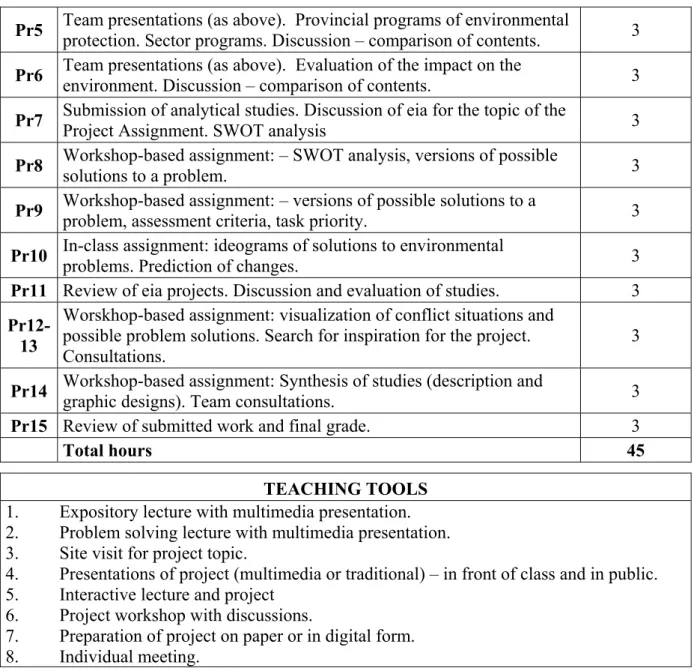
Pr5
Team presentations (as above). Provincial programs of environmental
protection. Sector programs. Discussion – comparison of contents.
3
Pr6
Team presentations (as above). Evaluation of the impact on the
environment. Discussion – comparison of contents.
3
Pr7
Submission of analytical studies. Discussion of eia for the topic of the
Project Assignment. SWOT analysis
3
Pr8
Workshop-based assignment: – SWOT analysis, versions of possible
solutions to a problem.
3
Pr9
Workshop-based assignment: – versions of possible solutions to a
problem, assessment criteria, task priority.
3
Pr10
In-class assignment: ideograms of solutions to environmental
problems. Prediction of changes.
3
Pr11
Review of eia projects. Discussion and evaluation of studies.
3
Pr12-13
Worskhop-based assignment: visualization of conflict situations and
possible problem solutions. Search for inspiration for the project.
Consultations.
3
Pr14
Workshop-based assignment: Synthesis of studies (description and
graphic designs). Team consultations.
3
Pr15
Review of submitted work and final grade.
3
Total
hours
45
TEACHING TOOLS
1.
Expository lecture with multimedia presentation.
2.
Problem solving lecture with multimedia presentation.
3.
Site visit for project topic.
4.
Presentations of project (multimedia or traditional) – in front of class and in public.
5.
Interactive lecture and project
6.
Project workshop with discussions.
7.
Preparation of project on paper or in digital form.
ASSESSMENT OF ACHIEVEMENT OF LEARNING OUTCOMES
Assessment
(F –
formative (during the
semester), S –
summative (at the end
of semester)
Number of learning outcome
Method of assessing the achievement of learning outcome
F1 PEK_U01
PEK_K02
Assessment of the analytical part of the project: scope of analysis, validity of conclusions, methods of calculating indices
F2 PEK_K01
PEK_K02
Assessment of the quality of content and the aesthetics of presentations with results of work
F3 PEK_U02
PEK_K02
Assessment of compliance of the proposed strategy and planning provisions with:
1. objectives of sustainable development 2. conclusion of the analytical part
F4 PEK_W01,
W02,
PEK_U01, U02
Final test result
P Weighted average:
(F1x0,4+F2x0,2+F3x0,4)x0,6+F4x0,4
BASIC AND ADDITIONAL LITERATURE
BASIC LITERATURE:
[1] Bar M., Bukowski Z., Jendro
ś
ka J. (red.), Jerzma
ń
ski J., Urban S., 2012, Leksykon prawa
ochrony
ś
rodowiska. Wolters Kluwer Polska – LEX, Seria: S
Ł
OWNIKI I LEKSYKONY
[2] Do
łę
ga J.M. 2006. Ekofilozofia – nauka XXI wieku. Problemy Ekorozwoju. Vol. 1. No 1,
s. 17-22.
[3] Doniec A., 2011, Symbioza i parki ekoprzemys
ł
owe. Wolters Kluwer Polska - ABC
[4] Hull Z., 2008, Filozoficzne i spo
ł
eczne uwarunkowania zrównowa
ż
onego rozwoju.
Problemy ekorozwoju. Vol. 3. No 1, s. 27-31.
[5] Kenig-Witkowska M.M., 2011, Prawo
ś
rodowiska Unii Europejskiej. Zagadnienia
systemowe. Wolters Kluwer Polska – LEX; Warszawa.
[6] Mici
ń
ska M., 2011, Udzia
ł
spo
ł
ecze
ń
stwa w ochronie
ś
rodowiska. Instrumenty
administracyjno-prawne. Wydawnictwo: Adam Marsza
ł
ek, Toru
ń
.
[7] Papuzi
ń
ski A., (red.), 1999, Wprowadzenie do filozoficznych problemów ekologii. WSP.
Bydgoszcz.
[8] Paw
ł
owski A., 2008, Rozwój zrównowa
ż
ony – idea, filozofia, praktyka. Monografie
Komitetu In
ż
ynierii
Ś
rodowiska PAN, vol. 51, Lublin.
[9] Planowanie zrównowa
ż
onego rozwoju gminy w praktyce. 2006, KUL, Lublin
Poni
ż
y L., 2008, Wp
ł
yw jako
ś
ci
ś
rodowiska przyrodniczego na nasze zdrowie. Analiza
przestrzenna na przyk
ł
adzie Poznania. Sorus SC
[10] Poskrobko B., Poskrobko T., 2012, Zarz
ą
dzanie
ś
rodowiskiem w Polsce. Polskie
Wydawnictwo Ekonomiczne, Warszawa,
[11] Poskrobko B., Poskrobko T., Skiba K, 2007, Ochrona biosfery. Polskie Wydawnictwo
Ekonomiczne, Warszawa,
[12] Tyburski W., 2006, Powstanie i rozwój filozofii ekologicznej. Problemy Ekorozwoju. Vol.
1. No 1, s. 7-15.
[13] Wyzwania dla Polskiej Polityki Przestrzennej, 2008. Kancelaria Sejmu, Biuro Analiz
Sejmowych. Warszawa.
ADDITIONAL LITERATURE:
[1] I Polityka ekologiczna Pa
ń
stwa, 1991, M.P. 1991 nr 18 poz. 118.
[2] II Polityka ekologiczna Pa
ń
stwa, 2000, M.P. 2003 nr 33, poz. 433.
[3] Koncepcja Przestrzennego Zagospodarowania Kraju 2030. Uchwa
ł
a nr 239 rady Ministrów
z dnia 13 grudnia 2011, Monitor Polski 2012-04-27
[4] Polityka Ekologiczna Pa
ń
stwa na lata 2009 – 2012 z perspektyw
ą
do roku 2016. M.P. 2009.
nr 34 poz. 501.
[5] Program zrównowa
ż
onego rozwoju i ochrony
ś
rodowiska Województwa Dolno
ś
l
ą
skiego.
Uchwa
ł
a nr XLIV/842/ 2002 Sejmiku Woj. Dolno
ś
l
ą
skiego z 26 kwietnia 2002 roku.
[6] Wojewódzki Program Rozwoju Alternatywnych
Ź
róde
ł
Energii dla Województwa
Lubelskiego.
www.bpp.lublin.pl/oprac1/oze/prognoza.pdf
[7] Wytyczne sporz
ą
dzania programów ochrony
ś
rodowiska na szczeblu regionalnym i
lokalnym, 2002, Ministerstwo
Ś
rodowiska, Warszawa.
COURSE ADVISOR (NAME, SURNAME, E-MAIL)
EQUIVALENCY MATRIX OF LEARNING OUTCOMES FOR COURSE
ENVIRONMENTAL STUDIES
WITH THE LEARNING OUTCOMES FOR THE
SPATIAL MANAGEMENT
MAJOR
Course learning outcome
Relation of course outcome with learning outcomes formulated for the
major and specialization (if applicable)** Course objectives*** Curriculum content*** No. of teaching tool*** PEK_W01
(knowledge)
K_W01, K_W02
C1, C2
Lec4 – Lec7
1,2,5
PEK_W02
K_W01, K_W02, K_W06,
K_W08, K_W09, K_W12,
C1, C2
Lec1 – Lec7
1,2,5
PEK_U01
(skills)
K_U01, K_U02, K_U07, K_U12,
K_U19
C2, C3
Pr2 – Pr9
3-6, 8
PEK_U02K_U01, K_U07,K_U11, K_U12,
K_U19, K_U23, K_U24
C2,C3
Pr9 – Pr12
7.8
PEK_K01 (competencies )K_U09, K_K05
C3
Pr2 – Pr7
Pr10 – Pr13
3-7
PEK_K02K_K03, K_K06
C3
Pr1 – Pr13
4,5,7
Annex no 4 to ZW 33/2012 FACULTY OF ARCHITECTURE COURSE SYLLABUS Course title in Polish WIEDZA O ARCHITEKTURZE Course title in English KNOWLEGE OF ARCHITECTURE Academic major: Spatial Management Course level and study mode: second cycle, full‐time Course type: obligatory Course code GPA000005W Group of courses No
Lecture Tutorial Lab Project Seminar
Number of contact hours 30
Number of student workload hours
60
Grading policy pass with grade
Mark (X) for final course in a group of courses
ECTS points: 2
including ECTS points for practical hours (P)
including ECTS points for contact hours (CH)
1
PREREQUISITES RELATING TO KNOWLEDGE, SKILLS AND OTHER COMPETENCIES General architectural knowledge acquired during the 1st cycle program, knowledge of specialized terminology.
COURSE OBJECTIVES
C1 The aim of the course is to expand students’ knowledge of architecture and designing residential buildings, commercial and industrial buildings and communication and transport.
COURSE LEARNING OUTCOMES Related to knowledge:
PEK_W01 Define and describe: modern trends in designing residential, commercial, industrial architecture and communication and transport, functional and spatial solutions, material and construction solutions, references to surrounding circumstances (natural, cultural and other).