UNIVERSITY 0F THE WITATERSRAND –JOHANNESBURG
SCHOOL OF EDUCATION
Education Decentralisation in Malawi: Current Trends and
Developments.
Submitted in fulfillment of the requirements for the degree of
MASTERS OF EDUCATION
(Education Policy, Planning and Management)
By
Noel Drake Kufaine
Supervisor
Francine de Clercq
EDUCATION DECENTRALISATION IN MALAWI: CURRENT
TRENDS AND DEVELOPMENTS.
ABSTRACT
The government of Malawi has embarked on a decentralisation program, whose primary objective is to improve service delivery. The program is implemented by transferring responsibility and authority from central office to the district assemblies. The study aimed at assessing the implementation situation of education decentralisation and its effects on the district education office operations and the primary school support. The study uses qualitative research method and undertook a case study of two districts. Data was collected by using in-depth individual interviews and document analysis. The results show that decentralisation is a complex phenomenon with problems at all stages from design to implementation. On the one hand the government appears committed to transferring responsibilities and authority gradually to district assembly level while on the other hand it is not prepared to compensate for the disparities existing in the districts by increasing resources. There is an acute shortage of material and human resources in terms of numbers as well as competency levels. This has affected the pace and smooth implementation of decentralisation. Because decentralisation is not a ‘once and for all’ act but a complex process, it is recommended to intensify advocacy, capacity building and support with relevant resources at all levels.
DECLARATION
I Noel Drake Kufaine declare that EDUCATION DECENTRALISATION IN MALAWI: CURRENT TRENDS AND DEVELOPMENTS is my work. It has never been submitted for a degree or examination before in this, or any other
University. Sources in this study have been fully indicated and acknowledged by means of complete references.
Signed________________________
ACKNOWLEDGEMENTS
My heartfelt gratitude should go to the following persons who contributed to the successful completion of this work.
Ms. Francine de Clercq, my supervisor, for the expert guidance, suggestions, patience and motivation which contributed much towards the completion of this commendable work.
My friends, Ken Ndala, Mrs. Uce Mmadi and Dikeledi Modisane for support and encouragement so that I could complete my study.
My wife Ruth, my daughter Rachel and my son Mayamiko for encouragement and moral support and also for persevering despite the loneliness during the period I was away doing my studies.
The almighty God for taking care of me and sustaining my health to the realisation of this dream.
ACRONYMS
DAPP Development Aid from People to People DEM District Educational Manager
DFID Department for International Development
DOE Department of Education
EFA Education for All
GOM Government of Malawi
HT Head Teacher
LGA Local Government Act
MASAF Malawi Social Action Fund
MP Member of Parliament
NGO Non- Governmental Organisation
PEA Primary Education Advisor
PIF Policy Investment Framework
TA Traditional Authority
UNDP United Nation Development Program
UNESCO United Nation Education Scientific and Culture Organisation
TABLE OF CONTENT ABSTRACT I DECLARATION II ACKNOWLEDGEMENT III ACRONYMS IV TABLE OF CONTENT V CHAPTER 1: INTRODUCTION 1.1 INTRODUCTION 1
1.2 STATEMENT OF THE PROBLEM 3
1.3 RATIONALE 4
1.4 STUDY OBJECTIVES 4
1.5 OVERVIEW OF THE STUDY 6
CHAPTER 2 : LITERATURE REVIEW
2.1 INTRODUCTION 8
2.2 FORMS AND TYPES OF DECENTRALISATION 9 2.3 ORIGIN AND RATIONALE OF DECENTRALISATION 11 2.4 ADVANTAGES AND DISADVANTAGES OF DECENTRALISATION 13 2.5 PRE-CONDITIONS FOR DECENTRALISATION 14 2.6 DISTRICT ROLE AND LIMITATION 17
2.6 CONCEPTUAL FRAMEWORK 21
2.7 SUMMARY 22
CHAPTER 3: RESEARCH METHODOLOGY
3.1 INTRODUCTION 24
3.2 CASE STUDY 26
3.3 SAMPLING 26
3.4 DATA COLLECTION 28
3.6 VALIDITY AND RELIABILITY 31
3.7 RESEARCH ETHICS 32
3.8 LIMITATIONS 32
3.9 SUMMARY 33
CHAPTER 4: RESULTS AND DISCUSSIONS
4.1 INTRODUCTION 34
4.1.1 SAMPLE INTERVIEWED 35
4.2 MINISTRY HEADQUARTER 36
4.2.1 BACKGROUND 36
4.2.2 UNDERSTANDING DECENTRALISATION ORIGIN AND AIMS 41 4.2.3 IMPLEMENTATION OF DECENTRALISATION PROCESS 43 4.2.4 EFFECTS OF IMPLEMENTATION OF DECENTRALISATION 47
4.3 DISTRICT (A) 48
4.3.1 PROFILE 48
4.3.2 UNDERSTANDING DECENTRALISATION ORIGIN AND AIMS 52 4.3.3 IMPLEMENTATION OF DECENTRALISATION PROCESS 53 4.3.4 EFFECTS OF IMPLEMENTATION OF DECENTRALISATION 64
4.4 DISTRICT (B) 68
4.4.1 PROFILE 68
4.4.2 UNDERSTANDING DECENTRALISATION ORIGIN AND AIMS 72 4.4.3 IMPLEMENTATION OF DECENTRALISATION PROCESS 73 4.4.4 EFFECTS OF IMPLEMENTATION OF DECENTRALISATION 80
4.5 SUMMARY 82
CHAPTER 5 EVALUATION OF IMPLEMENTATION OF DECENTRALISATION
5.1 PROFILE OF IMPLEMENTATION OF DECENTRALISATION 85 5.2 PROFILE OF IMPLEMENTATION CHALLENGES 87
CHAPTER 6 CONCLUSSION AND RECOMMENDATION 6.1 CONCLUSION 93 6.2. RECOMMENDATION 95 REFERENCES 97 APPENDICES 1 102 APPENDICES 2 104 APPENDICES 3 106 APPENDICES 4 107
EDUCATION DECENTRALISATION IN MALAWI: CURRENT
TRENDS AND DEVELOPMENTS
CHAPTER 1
INTRODUCTION
This chapter is a general overview of this study on the decentralisation of primary education to districts in Malawi in 1998. It outlines the aim of the study which examines the degree of success and efficacy of administrative and fiscal education decentralisation to districts. It then explains why it is an important research undertaking and concludes with an overview of the study which serves as a summary of the different chapters of the study.
1.1. BACKGROUND TO THE STUDY
The Government of Malawi has embarked on a decentralisation program through the Ministry of Local Government and Rural Development (Local Government Act, 1998: 1). The primary objectives of the program are to improve service delivery, enhance participatory democracy and good governance as reported below:
‘‘Decentralisation will be the major driving force in strengthening efficiency and accountability of resources and results. Basic education will be made accountable to local level authorities with development and operational responsibilities transferred from central government to districts.’’ (Government of Malawi, 2002: 52)
In Malawi, decentralisation involves central government departments transferring responsibilities and authorities to the district assembly through the Ministry of Local Government and Rural Development. The district assembly has two structures: the political structure which comprises the elected ward councilors chaired by the mayor and the administrative structure which comprises the
The main functions of the assembly, according to Local Government Act (1998: 4), are the promotion of democracy and citizen participation in development, the passing of by-laws for good governance and providing services like education, health services, environmental protection, road construction and maintenance and community amenities. The political wing of the assembly works through committees in liaison with the departmental heads in the district.
Departments which are decentralised are the department of health and population, department of education, science and technology, department of trade and private sector development, department of water and irrigation, department of agriculture, department of gender, child welfare and community services and department of natural resources and environmental affairs (Kashoti, 2007: 2). There are reports that the department of education, science and technology and the department of gender, child welfare and community services are making progress in the devolution to district assemblies (Kashoti, 2007: 2). However, education decentralisation has been making slow progress due to barriers such as resource and capacity constraints, and more importantly due to resistance to change, as reported by Rose (2005: 164)
The district education office works in liaison with the education committee of the district assembly and is answerable to the district commissioner, chief executive of district assembly and therefore accountable to the Ministry of Local Government and Rural Development as well as to the Ministry of Education, Science and Technology. On school development and district education office expenditures the district education manager is accountable to the district assembly and the Ministry of Education, Science and Technology. On education teaching and learning activities the district education manager is accountable to the Ministry of Education, Science and Technology.
The education system in Malawi is managed through an education central office which has six education divisional offices which are responsible for the running of secondary education, thirty-three education district offices, which are responsible for running primary school education in the district, three-hundred and seventeen education zones, which are responsible for primary school monitoring and supervision and 5,231 schools, which are responsible for teaching and learning.
The district education office has a district education manager, who serves as overall district education administrator, a district education desk officer who is responsible for the technical administrative issues in the district education office. There are three sub-divisions in the district education office: human resources with an officer responsible for personnel administration, finance with a principal accountant responsible for finance and senior education advisor responsible for the support, monitoring and supervision of education in schools. Under the district education office, there are education zones which are headed by a primary education advisor and primary schools headed by a head teacher.
The district education office, according to the Local Government Act (1998: 4), is funded by government through a budgeted monthly subvention, and receives an allocation from the district assembly which is empowered by the Local Government Act (1998: 4), to levy and collect revenues through property rates, ground rent, fees and license, commercial undertaking and service charges.
1.2 STATEMENT OF THE PROBLEM
With the advent of free primary education in 1994 and the education decentralisation in 1998, the government has argued that: ‘‘Decentralisation will be the major driving force in strengthening efficiency and accountability of resources and results” (GoM 2002: 52). Thus, the Department of Education assumes that decentralisation of education management and administration can
1.3 RATIONALE
Since the advent of decentralisation in general and educational decentralisation in particular, the situation and effects of education decentralisation on education service delivery at the district level has not been sufficiently researched. This study is important because the decentralisation policy was adopted by Malawi in 1998 and there is research evidence of some problems and inefficiencies. Based on this understanding, this study endeavors to go deeper and contribute to a further investigation of the issues and factors undermining and/or assisting the process of education decentralisation and its benefits for the Malawian education system. The findings from this study will hopefully be useful for policy makers and district education offices in their efforts to meet the decentralisation challenges experienced at district level and the way forward.
1.4 STUDY OBJECTIVES
The study aims to shed light on the progress of the implementation of the education decentralization policy which is expected to contribute to the alleviation of some of the education problems in Malawi. According to the Malawian government: ‘‘Decentralization will be the major driving force in strengthening efficiency and accountability of resources and results” (GoM 2002: 52).
This study focuses on the district education office and its operations. It examines the situation and the effects of education decentralisation and in particular its administrative and fiscal operations. Administrative decentralisation refers to the delegation of roles and responsibilities to lower levels of the administration in response to demands for better primary education service delivery in the district. Fiscal decentralisation refers to the lower administrative level, in this case the district education office, assuming financial authorities in education administration to improve education delivery in the district.
The success and efficacy of administrative and fiscal decentralisation can be measured differently according to different perspectives (see next chapter). But key to all is whether decentralisation has made the provision and delivery of education services and goods more efficient for the education system.
The study intends to assess the situation under which the district education office functions and the extent to which it has affected the operations of other structures. In order to unpack this big issue, the following questions will be asked:
a. Why and what powers and authority were transferred to the district education office?
b. How does the district education office understand the decentralisation effort and its different lines of accountability?
c. How does the district education office assume its administrative authority and financial responsibility in terms of decision-making and operations?
d. What are the effects and situation of education decentralisation on district education office operations and the support to schools?
The first question helps to establish how the origin, aim and form of education decentralisation are perceived. This information is useful in terms of understanding the degree of power and authority devolved. It is imperative to understand what exactly is transferred and how meaningful the form and authority is. The information is also useful in terms of assessing the relationship between the district education office and district assembly as well as within and between departmental district offices, education zones and the Ministry of Education, Science and Technology.
The third question helps to assess the way the district education office assumes its authority and responsibility over decision making, capacity building, and resources management.
The fourth question helps to understand the situation and the effects of education decentralisation on district education office operations and school support.
1.5 OVERVIEW OF THE STUDY.
This study is structured in the following manner. Chapter One
Chapter one is the introductory chapter which deals with the general overview of this study on education decentralisation to districts in Malawi. It outlines the study protocol and help to capture the investigative process. The outline locates the research, research purpose and explains the importance of the undertaking.
Chapter Two
This chapter on the literature review, examines decentralisation in general and education decentralisation in particular. It presents various debates around decentralisation in order to develop a theoretical framework to analyse education decentralisation to districts in Malawi. Various positions are presented to show how the understanding of decentralisation has shifted over the years.
Chapter Three.
This chapter on the research methodology explains the methodological approach and the way this research was conducted. The interpretive paradigm and qualitative research method is discussed as well as the qualitative data gathering methods and its instruments. This is done by referring to the research method literature to justify the choices made.
Chapter Four.
Chapter four, on the implementation of decentralisation and its impact on districts, deals with the presentation and analysis of the different data collected from the various stakeholders. The viewpoints of the different stakeholders are presented according to their workplace, and are also analysed by using the categories/themes identified in the literature review.
Chapter Five
Chapter five on the evaluation of the implementation of district decentralisation in two districts, deals with an evaluation of the implementation and impact of decentralisation in two districts. A comparison of implementation and the challenges of decentralisation between two districts is made on the basis of the data collected on the themes derived from our theoretical framework. The role of district education office is particularly emphasized as it is the pivot of education decentralisation in Malawi. The role and effectiveness of its leadership is also discussed.
Chapter Six
Chapter six concludes with the researcher’s interpretation of the findings. This is done with reference to the relevant literature. Suggestions are then put forward and concluding remarks are made.
LITERATURE REVIEW
2.1 INTRODUCTION.
This chapter looks at the literature of decentralisation in general and education decentralisation in particular. It presents a theoretical framework within which decentralisation is discussed. Various theoretical positions are presented to show how decentralisation understanding has continued to shift over the years.
In order to understand decentralisation in general and education decentralisation in particular, it is important to review decentralisation theories as well as empirical research undertaken on educational decentralisation in various countries including Malawi. The literature review also assists in the shaping of the research design and the development of conceptual framework which is used in framing the study and analysing its data and findings.
The following structure is used for the literature review in order to understand the situation and effects of decentralisation on the operations of the district education office and the extent to which these have affected primary education delivery in the districts.
• Forms and types of decentralisation. • Origin of and rationale for decentralisation.
• Advantages and disadvantages of decentralisation. • Pre-conditions for decentralisation.
• Roles and limitations of districts
These debates will then assist with the conceptual framework for this study.
There is need for a comprehensive understanding of the context in which decentralisation initiatives are undertaken, their forms and their major outcomes. This is important as it provides a basis for identifying viable strategies that ensure effective decentralisation and sustainable local development (Hussein, 2004: 107).
There seems to be a general agreement by different authors that decentralisation is a vague, slippery and complex concept to define because, as Bray (1985: 184) argues, decentralisation covers a wide range of processes and structures. But while it is appreciated that decentralisation is a complex process, different authors (Work, 2002: 5; Bray 1985: 185; Lane and Murray, 1985: 163; McGinn and Welsh 1999: 17), have tried to define it. Work (2002: 5) defines decentralisation as the transfer of responsibility for planning, management and resource raising and allocation from the central government and its agencies to lower levels of government. This definition emanates from the understanding that decentralisation has a development agenda alongside the renewed global emphasis on governance and human development. Bray (1985: 185) defines decentralisation as the transfer of decision making powers from higher levels in the official hierarchy to lower ones, because he looks at decentralisation as a change in the administrative system. Lane and Murray (1985: 163) see decentralisation as re-assigning responsibility and corresponding decision authority for specific functions from higher to lower levels of government and organizational units and McGinn and Welsh (1999: 17) define decentralisation as a shift in the location of those who govern, a transfer of authority from those in one location or level of organisation to those in another level. Lane and Murray (1985: 163) and McGinn and Welsh (1999: 17) argue that decentralisation is a continuation of what was being done by somebody at a higher level, but now done by somebody at a lower level. Thus, the basic definition of decentralisation may be the transfer of decision making authority, responsibility and tasks from the higher to a lower organizational level.
The diversity of the definition on decentralisation emanates from the complexity of the variables which are used to define this phenomenon. Education decentralisation has many facets because it deals with changes in the way school systems go about making policies, generating revenue, spending funds, training teachers, designing curricula and managing local schools (Dyer and Rose 2005: 105). According to Dyer and Rose (2005: 106); Davies et al (2003: 143) and Chisinga (2005: 531), stakeholders rarely make distinctions between different types of decentralisation and do not often appreciate the consequences associated with each type. It is important therefore to clarify the type of authority and responsibility to be shifted as well as how it is to be done.
Naidoo (2003: 3) points out that decentralisation takes many forms, depending on the level of government to which decisions are devolved and the kind of decisions moved to these other levels of government and the rationale behind it. Chimombo (2005: 3) says education decentralisation is complex because it has different meanings and refers to different types and reforms of decentralised education administration, management and government system with different policy aims and strategies.
Different forms have different characteristics, policy implications and different conditions of success. Decentralisation can be political, administrative and fiscal. Political decentralisation, as described by Work (2002: 6) and Lauglo (1995: 9), refers to the devolution of political power and authority to sub-national levels of government, usually by election. Devolution, as defined by Dyer and Rose (2005: 106), refers to power formally held at sub-national level, where local decision makers do not need to seek higher level approval for their action.
According to Work (2002: 6) and Lauglo (1995: 9), administrative decentralisation refers to the transfer of decision making authority, resources and responsibilities for the delivery of selected number of public services from central government to other levels of government agencies. Dyer and Rose (2005: 106) describe
deconcentration and delegation of authority, as involving the shifting of management responsibilities from the center to the lower level, but the center still retains the overall control of powers. Delegation involves leaving a degree of decision making to the lower level but the delegated system still rests on the central authority and the power can be withdrawn (Dyer and Rose 2005: 106). Fiscal decentralisation refers to authority over budget and resource allocated to the local levels of government (Work 2002: 6).
2.3. ORIGIN AND RATIONALE FOR DECENTRALISATION
Research in decentralisation has shown that factors which push for decentralisation in most countries are: external pressure by international agencies and internal political expediency in the national context (De Grauwe, et al. 2005: 2; Davies et al 2003: 140). As pointed out by Work (2002: 5), the western world sees decentralisation as an alternative to inefficient centralised public services which will be more cost effective. Post communist countries take decentralisation as a natural step in the shift to market economy and democracy. But many developing countries decentralise to counter economic managerial deficiencies and ineffective central governance. Some Latin American countries decentralised as a result of political pressure to democratise. This means, apart from having different meanings, the phenomenon of decentralisation shows variations in rationales and purposes attributed to the concept in different parts of the world. The motives at institutional levels include: increasing efficiency and accountability, or increasing democratisation and community participation, mobilising resources, or becoming more responsive to local needs (Work 2002: 5).
Decentralised education functions differ according to countries. They include, organisation of instruction (this involves text books, teaching methods, curricula and schedule), personnel management (which involves hiring and firing, paying,
involves examination development, school opening and closing and course content) and resource management (which involves expenditure, budget allocation and school improvement plan) (Dyer and Rose 2005: 105; Naidoo, 2003: 4).
The origin of decentralisation is determined by the context in which it takes place. This means that the content of decentralisation policies and their interaction with broader political and economical systems determines its situation (Bray 1985: 187; Tordoff 1994: 556; Work 2002: 8). The consolidation and balance of power, the strengthening of regions and the reduction of central government powers are some of the factors which influence the establishment of decentralisation in different countries (Fiske, 1996: 12). There are reports that decentralisation is symbolic and that there is little evidence to support the claim that decentralisation genuinely promotes democracy (Fiske, 1996: 12; Dyer and Rose 2005: 107). Weiler (1990: 440) argues that decentralisation should be seen as an instrument of conflict management, which means that central governments decentralise to avoid tension.
The rationale behind education decentralisation, according to Gershberg and Winkler (2003: 1) is to improve efficiency, effectiveness and democracy. Naidoo (2003: 3) adds that UNESCO sees decentralisation as a hopeful trend in the management and governance of the education system. The literature (Rose, 2005: 155; Gershberg and Winkler, 2003: 1; Herbert, et al, 2000: 155) argues that decentralisation is intended to bring numerous improvements, and it is believed that decentralisation can contribute to further democratisation, more efficient public administration, more effective development, as well as good governance.
Herbert, et al (2000: 165) and Dyer and Rose (2005: 107) argue that there is not sufficient evidence to support the point that decentralisation improves education efficiency. Naidoo (2003: 3) says decentralisation just revolves around attempts
to restructure centralised education bureaucracy and create devolved systems with different administrative levels, varying levels of institutional autonomy and forms of school based management.
Educational decentralisation has become increasingly apparent in accompanying the drive for education for all. The intention is to improve education access and equity through education decentralisation to promote greater education autonomy. Research has shown that reforms in education need to be accompanied by strategies to strengthen capacities and leadership and provide support to schools through professional development (McGinn and Welsh, 1999: 24 and Naidoo, 2003: 15).
But according to Work (2002: 8), the implementation of decentralisation of different types and degrees across the countries shows how difficult it is to compare decentralisation. In Malawi, according to the local government act (1998: 52), the primary objectives of administrative decentralisation are to improve service delivery, through sound decision making and transparent resource utilisation, as well as enhance participatory democracy and good governance (Hussein, 2004: 113; Chisinga, 2005: 531 and Rose, 2005: 156).
2.4 ADVANTAGES AND DISADVANTAGES OF DECENTRALISATION
The well known benefits of administrative decentralisation is the improved responsiveness to local conditions by placing decision making with those closest to the work (Dyer and Rose, 2005: 106; Bray and Mukundan, 2003: 5; Gershberg and Winkler, 2003: 1; Work, 2002: 5; Herbert et al 2000: 156; Tordoff, 1994: 556). This improves accountability of public services because people can scrutinize the local level more closely than they can with the central government. It is also argued that services are delivered more speedily than the centralised administration because decentralisation reduces the lengthy procedures for
more responsive to and tailored for different needs to suit different localities. The process has also individual advantages like reducing the stress and burdens of senior managers, while empowering local managers and encouraging them to be more innovative and motivated. It is pointed out that subordinates may have better knowledge of local conditions affecting their areas of work and this will assist them to make well informed judgments on the choice of the development required. At the same time, the devolution of responsibility enables junior managers to be groomed to take over higher responsibilities. They acquire experience of decision making when carrying out delegated tasks. There is also greater flexibility and quick response to changes.
The limitation of administrative decentralisation pointed out by some authors (De Grauwe, et al. 2005: 3; and Dyer and Rose 2005: 105) is the failure to adhere to common standards by different localities, because of the lack of coordination and control of activities. This is caused by different factors which include capacity of personnel and resources of different local governments (De Grauwe, et al. 2005: 3; Dyer and Rose 2005: 107; Naidoo, 2003: 2). Work (2002: 18) acknowledges that the decentralisation process is a challenging and complex process that requires patience and dedication on the part of stakeholders.
2.5 PRE-CONDITIONS FOR DECENTRALISATION
The literature highlights the importance of acknowledging that most of the decentralisation initiatives experience constraints. In so doing the decisions on the form and degree of decentralisation should consider the challenges in the decentralisation as a process. The most important pre-conditions for successful implementation of decentralisation, according to literature (Tordoff, 1994: 556; Fullan, 2005: 175; Geo-Jaja, 2006: 146; Dyer and Rose, 2005: 109; Falleti,1999: 327), are district staff and leadership capacity, clear lines of accountability, commitment by government to transfer adequate resources to districts, stable political system and the sequence of form of decentralisation to be implemented.
According to Tordoff (1994: 556), decentralisation to districts means the tasks which were performed at the central office will be done by staff at district level which will need qualified personnel to be deployed. The district capacity, and its leadership capacity in particular, is critical in developing and sustaining those district level conditions believed essential for successful implementation of decentralisation (Spillane, 2003: 343). Leadership in this context is understood to be the exercise of authority and the making of decisions, as well as directing and coordinating tasks relevant to the institutional goals. As pointed by Davidoff and Lazarus (2002: 37), in the school context, leaders have an important role to play in drawing people together and motivating them to take leaps into often risky futures. This is particularly important in the unstable context of decentralisation currently being experienced, where this aspect of leadership can assist in transcending the many fears and anxieties common in such situations. According to Spillane and Thompson (1997: 187), the human capital of the district is vital and training is needed for staff to develop a greater sense of responsibility, trust and participation. This can, in turn, promote social capital which, according to Spillane and Thompson (1997: 187), is the creation of social links within and outside the district, together with the norms and trust to support open communication via these links. The success of the implementation of decentralisation in this sense depends on strong leadership and human and social capacity at the district level.
Yet in most district assemblies in Malawi, a shortage of qualified officials is often experienced, due to inadequate capacity building training programmes, inadequate qualifications among serving members in financial management and/or numerous vacant positions (UNDP 2000). There is also need to ensure that positions in the district assemblies are commensurate with the responsibilities devolved to them (Hussein 2004: 129).
Increased public spending is, according to Geo-Jaja (2006: 146), also important for successful implementation of decentralisation because decentralisation increases the costs and expenses of districts which have higher demands made on them regarding staffing, coordination and capacity support. This means that the government or district revenue must increase and that the macroeconomics fundamentals are stable. As pointed by de Grauwe, et al (2005: 9), lack of resources beyond the basic, hinders districts from planning strategically, taking initiatives and focus the effort where most needed. It has been reported by Ayee, (1997: 53) that financial constraints in developing countries have meant that most decentralisations are often de facto financial decentralisations. As a result, districts operate in tight budget lines and district managers have little autonomy in using resources as these are very insufficient. Too often, the financial support given to district does not take into account the characteristics and needs of districts. This situation is counterproductive because it makes district managers frustrated and inefficient.
The importance of a stable government committed to transfer authority and resources to district level is also important, according to Dyer and Rose (2005: 109), because it will enable districts to assume the devolved responsibilities. This is because the problems during implementation are exacerbated when transfer of responsibility results in conflict between actors, particularly where there is fear of loss of power and control. If decentralisation involves only the shifting of functions from central office to district while everything else remains unchanged, successful implementation of decentralisation is unlikely to be achieved.
Another precondition, according to Falleti (1999: 327), is that the degree of change depends also on the sequence in the forms of decentralisation which, he argues, should be political first, then fiscal and lastly administrative. Falleti (1999: 328) argues that the sequence of having political authority first enables the implementation of other forms of decentralisation to be bargained by using the devolved political powers. But the trend from developing countries has been
administrative decentralisation first but the political and fiscal dimensions have rarely been fully decentralised. Falleti (1999: 343) argues that decentralisation without political and fiscal decentralisation has slim chances of being successful. This is why decentralisation favours countries with high Gross Domestic Product (GDP) and relatively low income disparity as these make possible the promotion of fiscal decentralisation. Those countries with low (GDP) and high income disparities which decentralise do not find fiscal decentralisation obvious.
Malawi appears to have combined a degree of administrative and political decentralisation without much fiscal decentralisation. It will therefore be important to assess the decentralisation sequence in Malawi and its effect on district education office operations.
All this means that to have a clear rationale is one thing, but to have goals fulfilled is another because there are many factors to take into account. Work (2002: 15) argues that decentralisation is not a ‘one size fit all’ and factors mentioned above have an influence on the design, execution and results of implementing a decentralisation reform.
2.6 DISTRICTS: ROLES AND LIMITATIONS
It is the district office which has the obligation to make sure things function properly between headquarters and schools. Anderson (2003: 4) points out that the district plays a role in interpreting and mediating schools’ response to state policy. It has also been pointed by Massell (2000: 2) that districts act as a gatekeeper for state policy and school requests as they have to relay the instructions from education head office to schools as well as coordinate and respond to various schools’ needs.
teachers and learners, assisting schools with monitoring and reflection on their progress as well as facilitating inter-school sharing (Anderson 2003: 3, Massell 2000: 2, Ayee 1997: 39, Spillane and Thompson, 1997: 199).
The district office is the pivot for development in the district; it has the role to contribute vision and guidance to schools (Anderson 2003: 3). This is achieved by planning, financing and infrastructure development, which is done by adapting existing standards and operating procedures (Ayee, 1997: 38).
Massell (2000: 2) points out that capacity building is one of the most important roles of the district office. This is achieved by offering menu of workshops or providing resources to staff to pursue professional development. There should also be additional resources and capacity building targeted for poor performing schools. According to Anderson (2003: 13), this district capacity building role should target teachers, learners and schools to improve the quality of teaching and learning.
However, despite the introduction of decentralisation and institutional reforms, De Grauwe, et al (2005: 3) argue that the performance of local districts has not been responsive due to several challenges which they cannot address effectively such as: building capacity for reform, bypass of projects to schools, to be answerable to two ministries, issues of finance, accommodation, and a legal basis for operation.
Anderson (2003: 7) points out that districts are also challenged to respond to disparities within themselves. There are high expectations from communities, according to Ayee, (1997: 53) that the district cannot easily achieve. Issues such as unsatisfactory achievements, especially for minority groups, suggest that strong disparities in capacity of teaching staff exist in schools serving different student population. These disparities mean that many learners suffer from poor instructional coherence within and across schools in the district. The capacity of
leadership is also a challenge for successfully meeting new expectations in high accountable context.
However the district still remains the pivot for all activities happening within it, according to Massell (2000: 6). Lack of coordination between central office leadership and district leadership creates tensions which often lead to the central office opting to operate directly with schools, bypassing the district. This usually happens when the central office is threatened with a loss of power and control. Donors also sometimes would want to go straight to schools, bypassing the district office (Ayee 1997: 52). This situation undermines the district leadership and its control on how schools operate and perform goals set by state, whether or not they have the necessary capacity to do so.
The new responsibilities devolved to the district mean additional district costs and this has led to the district inability to meet all the demands within it. This has been exacerbated by poor revenue collection capacities in districts, especially those with poor socio-economic status. In this case, decentralisation can reinforce existing district inequalities, in that districts with financially better-off localities such as cities and towns have prospered while districts with poor rural areas have lagged behind (Dyer and Rose 2005: 108).
The decentralisation experience has shown that districts account to two ministries, the mother Ministry (like Ministry of Education Science and Technology) as well as the Ministry of local government and rural development. This situation according to Ayee (1997: 39) leads to district offices having divided loyalty.
District decentralisation can suffer from a lack of legal basis for its operation, which, according to Onyach-Olaa (2003: 111), threatens the success of the operation. This is the case in Malawi where guidelines on decentralisation
operation are only available up to the district level and not below. There are also no elected councilors to make the by-laws in the district assembly.
The way forward to counter the challenges outlined above appears difficult but possible. According to Onyach-Olaa (2003: 105), there is need for a committed political leadership. This is possible in the district because decentralisation has given districts some political power, through the elected councilors who could help to establish a stable political leadership in the district. It is the same political power which could respond to the issue of incomplete legal framework in the district. The elected councilors are mandated to formulate by-laws in the assembly.
One way to enhance district capacity, according to Spillane and Thompson (1997: 199), is through social capital or the networking and partnering with government, Non-governmental organisations, and donors under the guidance of the local district leadership.
Most decentralisation initiatives in developing countries are pursued in the context of a centralised financial system. This is where availability and sources of funds is only from government monthly subventions. The locally collected revenue and donor aid has very little impact. But districts could respond to the lack of finance and the district inequalities by mobilising local resources and managing more efficiently their own revenues.
It is important to consider the issue of accountability inevitably associated with the decentralisation reforms. Accountability, according to Fullan (2005: 175), involves targets, inspection or form of monitoring along with action consequences. According to Anderson (2003: 10), accountability during reforms like decentralisation is not created only to gather information on district performance for planning, but also to hold officials at all levels accountable for progress towards the state goals, aligned with standards. It is this information
which translates into various supports to help the development of capacity in the district.
2.7 CONCEPTUAL FRAMEWORK
The general overview of the literature on decentralisation shows that decentralisation is a complex phenomenon. Hussein, (2004: 112), Work, (2002: 10) and McGinn and Welsh, (1999: 18) discusses that decentralisation is not an obvious one-off exercise but a long process. Decentralisation has to be understood comprehensively in its context, form and rationale. As Hussein (2004: 110) argues, this is important as it will provide a basis for identifying the potential and limits of a particular form of decentralisation as well as evaluate how effective the strategies are in ensuring its effective implementation. In Malawi, the primary objectives of administrative education decentralisation are to improve service deliver and to enhance participatory democracy and good governance through district assemblies and district offices (Local government act, 1998: 57). The study aims to examine how district decentralisation in Malawian education results in greater efficacy and improved participation and governance.
The conceptual framework of the study is influenced by the arguments and ideas made above. It is clear from the literature that the shift from centralisation to decentralisation is influenced by international and domestic pressures with different goals. The study follows Work’s argument (2002: 18) that, as a reform strategy, decentralisation requires commitment, patience and dedication on the part of stakeholders, and that it can be a promising mechanism, if the conditions are favourable for achieving its goals of greater efficiency, participation, good governance and human development. The study will therefore test, in the district case study, to what extent these goals have been attained or are in the process of being achieved for the potential benefits of administrative decentralisation to be realised.
It is also clear from the literature that there are many areas of tensions and conflicts existing at all governance levels, and in particular at district level. Hence, this study will also examine the areas of tension and challenges at the district office as well as between districts and the other levels of authority and the way in which the districts respond to these.
2.8 SUMMARY
In this chapter I have looked at decentralisation as defined by various authors and found that decentralisation is a vague and complex phenomenon. Authors using different theoretical framework explain differently the origin and impact of decentralisation programs.
The origin and rationale for decentralisation is understood as the combination of external pressures by international agencies and internal political expediency in the national context. The rationale behind decentralisation appears to be increasing efficiencies and accountability, community participation and resource mobilisation. The advantages embraced in the study are improved efficiency, effectiveness and democracy. Failure to adhere to common standard, which is caused by differences in resources, is the obvious disadvantage.
The pre-conditions for successful implementation of decentralisation include staff and leadership capacity, accountability, commitment resources, stable political system and clear demarcation of roles and lines of accountability. The district’s position in the implementation of decentralisation is also highlighted as it is a gateway for state policy and school needs as it relays instructions from head office to school as well as coordinate and respond to various school needs.
The argument that, decentralisation is often symbolic and that there is little evidence that decentralisation necessarily improves education efficiency and/or democracy through participation underpins the importance of this study.
CHAPTER 3
RESEARCH METHODOLOGY
This chapter explains and justifies the way in which I go about doing research. The interpretive paradigm and qualitative research method is discussed as well as the data gathering methods. This is done with theoretical support so as to understand the choices I have made.
3.1 RESEARCH APPROACH
This study is conducted in the interpretive paradigm, based on the understanding that interpretive involves qualitative approach. According to Terreblanche and Durrehelm (1999: 124) interpretive research “--- relies on first-hand information or account, and tries to describe what it sees in rich detail and presents its findings”. Since this study intends to gain an in-depth understanding of the experience and developments associated with the implementation of education decentralisation in districts, the study adopts a qualitative research approach whose purpose is to understand the social phenomena from the respondents and participants’ perspective (Macmillan and Schumacher, 2006: 26).
Qualitative research method is known for its flexibility in nature. It allows the decisions about data collection strategies also to be flexible. In qualitative research, the researcher becomes the research instrument, meaning that he/she becomes immersed in the research project (McMillan and Schumacher 2006: 26).
From the reasons mentioned above, it is clear that the qualitative method is most appropriate for this study, since decentralisation is a phenomenon, involving a group of people interacting in their practical context. In addition, the study intends
to examine the situation, dynamics and effects of such a process as perceived by various stakeholders.
Research design, according to McMillan and Schumacher (2006: 117), is the plan and structure of the investigation used to obtain evidence to answer the research question. It also provides the most valid and accurate answers possible for the research questions. It is important because it shows the individual what is to be studied, when, and under which conditions they may be studied.
The strength of qualitative research is that it is an attempt to inform our deep understanding of issues and thereby helps in the interpretation process. In the light of this, it is clear that the approach relevant to the study is the qualitative approach as it can assist with an understanding of the current trends and developments in the implementation of education decentralisation, as seen through the eyes of various actors at national level and district level. The study relies mainly on the perceptions, practices and experiences of various respondents in two different districts about decentralisation, in terms of their understanding, operations, implementation, effects and challenges.
I tried to maintain a reflective interaction with respondents as they begin to make sense of their situation as well as think about the meaning they attach to their actions. Since it is important to suspend the researcher’s biases, perceptions and judgments, respondents such as the director of planning, district education manager, primary education advisor and head teachers will be encouraged to speak for themselves and present their own way of understanding education decentralisation and how it has affected their operations.
3.2 CASE STUDY
because it is designed to bring out the details from the viewpoint of participants by using multiple sources of data (MacMillan and Schumacher, 2006: 316). The study involves a case study of two districts. As Merriam (1998) points out, case studies are differentiated from other types of qualitative research in that they are intensive description and analysis of a single or bounded system. According to MacMillan and Schumacher, (2006: 317), case study is described as a type of descriptive research in which data is gathered directly from individuals or community groups in their natural environment for purpose of studying interactions, attitudes and characteristics of the individual community. A case study is therefore appropriate for this study because it aims to understand two different districts and their operations in their natural environment. It is hoped that the two districts are sufficient to identify trends in the meaningful lessons and conclusions pertaining to the different implementations of district education decentralisation.
3.3 SAMPLING
MacMillan and Schumacher (2006: 126) describe a sample as the collective, group of subjects or participants from whom the data are collected. Sampling involves the drawing of the subject from the population for data collection. The study used purposeful sampling because according to McMillan and Schumacher (2006: 126), purposeful sampling is:
- Done when you want to understand something without needing to generalize to all.
- Done to increase the utility of information obtained from a small sample.
- Used because it is likely to be informative about the issues being investigated.
- Used in situations where simple random sampling can not be applied to give every one an equal chance of being selected due to limitations.
The study adopted purposive sampling which uses the researcher’s judgment as to which districts are rich in the information to be tested to illustrate the research questions of the study. Due to time and transport limitations, two districts close to Blantyre (where the researcher was) were selected.
The two districts were selected based on characteristics such as districts’ geographical location, socio-economic background and presence of NGOs. The first education district was Chiradzulu district because it was also the pilot for district decentralisation. The Chiradzulu initiative of 2000 was intended to see how affordable, equitable, good quality and replicable community-based primary education might be delivered in a single district (Davies et al 2003: 143). It was to operate in a context of increased district administrative responsibility, supported by government and international agencies in terms of deploying and training human resources and building of offices and school blocks infrastructure. This helped to assess how the government and international agencies support in the district affects education district operations.
The second education district was Mulanje, one of the rural districts in Malawi with an average socio-economic status, because of tea estates, which provide employment to most households in the district. Other households have formed tea growing farmers associations where they grow tea and sell to the estates. The district is committed to development by enlisting the assistance of NGOs in building of school blocks and teachers’ houses. This allowed the researcher to understand the kind of district support (and its relevance) given by the NGOs in improving the efficiency of education district operations.
Participants were selected to ensure a good representation of the different levels involved with primary education delivery: the national, district, zone and school levels. Altogether, 15 participants were interviewed, one director of planning, two district education managers, four primary school advisors and eight head
places were first visited to seek permission and cooperation to conduct the study. They were briefed on the aim and subject of the study to acquaint them with the kind of information that was solicited and were given assurance of anonymity and confidentiality.
3.4 DATA COLLECTION INSTRUMENTS
According to McMillan and Schumacher (2006: 415), the utilisation of different techniques of data collection is justified on the basis of their suitability and relevance to the nature and purpose of the research. Merriam (1998) cautioned that exclusive reliance on one method may lead to bias or distortion of the picture of the reality under investigation. In this case, the use of in-depth individual interviews from different stakeholders was supplemented by document analysis to complement each other. A study on the impact of district decentralisation of education, as perceived by various actors involved, is therefore best done by choosing two different data collection methods: individual in-depth interviews, guided by a semi-structured questionnaire, and document analysis.
Semi-structured interviews give choice to respondents as the questions are phrased to allow the respondents to elaborate. These are open ended questions but fairly specific in their focus and intent. They allow free flowing engagement which enables rich and detailed discussion of key elements. This enables the researcher to access specific information in a free interaction atmosphere with respondents.
Documents are records of past events prepared intentionally to preserve records or prepared for immediate practical use. As such documents express the organisation official perspective on the topic, issue or process. But the researcher does not extract evidence and does not find it easy to determine authenticity and accuracy to identify the content (McMillan and Schumacher, 2006: 428).
This study employed a combination of individual in-depth interviews at different levels of the education sector and document analysis, because there is no single source of information which could be trusted to provide a comprehensive perspective. It was also important that data gathered through interviews was verified and validated through a different research instrument, such as document analysis (McMillan and Schumacher, 2006: 374). This was also a way of establishing a triangulation process, where the responses were cross checked with the policy documents.
INTERVIEWS
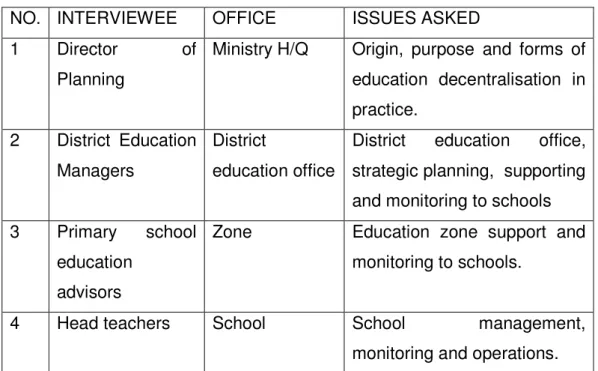
The study used semi-structured questionnaires for the interviews to get an insight into the origin and aim of decentralisation. Individual interviews were conducted, as Table 1 shows, with the Ministry of Education, Science and Technology director of planning, two district education officials, four primary school education advisors and eight primary school head teachers.
Table 1 List of interviewees
NO. INTERVIEWEE OFFICE ISSUES ASKED 1 Director of
Planning
Ministry H/Q Origin, purpose and forms of education decentralisation in practice. 2 District Education Managers District education office
District education office, strategic planning, supporting and monitoring to schools 3 Primary school
education advisors
Zone Education zone support and monitoring to schools.
DOCUMENT ANALYSIS
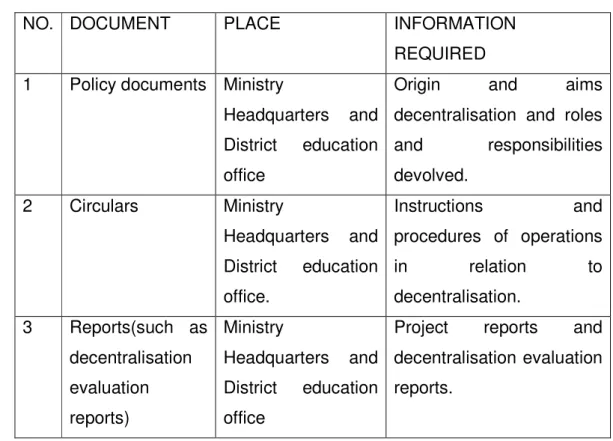
Document analysis involves the reviewing and analysis of official documents that were useful in terms of the information and themes the research was investigating. The documents include policy documents, circulars and reports.
Table 2: List of documents
NO. DOCUMENT PLACE INFORMATION
REQUIRED 1 Policy documents Ministry
Headquarters and District education office
Origin and aims decentralisation and roles and responsibilities devolved. 2 Circulars Ministry Headquarters and District education office. Instructions and procedures of operations in relation to decentralisation. 3 Reports(such as decentralisation evaluation reports) Ministry Headquarters and District education office
Project reports and decentralisation evaluation reports.
3.5 DATA ANALYSIS
Data analysis can be described as the systematic search and arranging of data from interview transcripts, which increases an understanding of the data and enables a clear and structured presentation. The qualitative data analysis is an ongoing process, which is integrated into all phases of qualitative research (McMillan and Schumacher, 2006: 417). McMillan and Schumacher (2006: 417) argue that the data to be analysed has to pass through inductive analysis which involves data coding, data categorizing and interpretation before providing an
explanation that makes sense. The qualitative data will be analysed using grounded theory. According to Merriam (1998), grounded theory involves grouping data into segments and categories which are compared to derive similarities and differences. The analysis seeks to establish pattern in the data and any relationship development developed from such patterns builds on into a theory grounded in the data.
Cross-case analysis within and between districts was used to explore relationship and patterns that will emerge from the individual districts.
3.6 VALIDITY AND RELIABILITY
Validity is a judgment of appropriateness of a measure. It is important to have validity in relation to instruments used to collect and analyse data (McMillan and Schumacher (2006: 324). This study has tried to describe and justify all the instruments and methods in use in terms of their appropriateness at ensuring validity of data collection and analysis. This was also done by conducting a pilot study to test the interview schedule and improve it.
Reliability is a measure of consistency, which is the extent to which the results are similar over different forms of the same instrument or occasion of data collection (McMillan and Schumacher, 2006: 183). The researcher tried to ensure that the respondents felt at ease during the interviews and had time to reflect on the questions to ensure that their answers were genuine. Thus, the study tried to get different data collection approaches and methods to maximize the reliability and validity of the findings.
3.7 RESEARCH ETHICS
of the individual, individual privacy and informed willingness on the part of the subject to participate voluntarily in the research activity. Since the issue this study is investigating might result in some respondents not giving information by fear of reprisal by their managers, it was imperative to be ethically conscious by explaining the importance of the investigation and the type of information required and guarantee respondents’ confidentiality by respondents’ anonymity.
3.8 LIMITATIONS
The limitation of the study is that no generalisation can be made. The fact that the case study was only on two districts is a limitation because, if this was a fully-fledged project, a much broader area and sample population would have been included in the investigation. The study may suffer from the weakness that interpretive studies are inclined to exhibit, which is the subjective nature of interpretive case study research. My use of triangulation at different stages may hopefully have gone a long way towards validating my findings. Accessibility of interviewees in Malawi was a problem because of the short time spent there and the interviewees’ busy schedules. Lack of trust emanated every now and then because some questions touched on the performance of their units/institutions and therefore their bosses and the interviewees had some reservations about sharing all their views openly. These appeared to have constituted the main limitations of the study.
3.9 SUMMARY
I have shown that this study is conducted in an interpretive paradigm as a way of capturing the rich detail of the researched phenomenon. The significance of the interpretive orientation and qualitative approach has been pointed out. I have supported the use of case study method in my investigation as appropriate because it helps in understanding the deeper features of a case in a given context.
I have shown that, apart from document analysis, semi-structured interviews were conducted to gain an understanding of various actors’ perceptions of the impact of decentralisation and also to have a two-way interaction and discussion to allow for greater depth.
Data analysis and discussion was done after a thorough understanding of the interviews’ content. The selected themes from the literature were used to summarize and categorize the data collected and to highlight the important features of the decentralisation implementation process.
I have noted that ethical considerations have been accommodated to ensure that the research is conducted honestly and that respect for people was an overriding consideration.
CHAPTER 4
IMPLEMENTATION OF DECENTRALISATION AND ITS IMPACT ON TWO DISTRICTS: RESULTS AND DISCUSSIONS
4.1 INTRODUCTION
This chapter deals with the data presentation and analysis of the implementation of decentralisation and its impact on districts. The research question seeks to understand how district education offices functioned, since decentralisation was instituted in 1998. My approach is to present these ideas and perceptions of the different stakeholders affected by decentralisation, as they have emerged from the semi-structured interviews which were structured in terms of the categories/themes identified in the literature.
The presentation is in a narrative conversation and includes varying use of long and short embedded quotes as the narrative unfolds to describe the decentralisation implementation. The major task is to gain the respondents’ view on education decentralisation and its impact on the overall performance of primary schools in the district.
The introduction of decentralisation to different district assemblies was meant to improve service delivery, enhance participatory democracy and good governance (Local government act, 1998: 4). District assemblies are encouraged to be independent and self-reliant. In order to achieve this, different departments in the district assemblies are taking active roles to fulfill the new roles and responsibilities. There are many challenges which district assemblies are experiencing, particularly, regarding the resources and skills required to exercise the new roles and responsibilities. This study intends to answer the following questions: how do district education offices function, since decentralisation was
instituted in 1998, and to what extent have their operations been affected and changed?
4.1.1 SAMPLE INTERVIEWED
In line with Macmillan and Schumacher (2006: 126) I purposely sampled 15 respondents because they satisfied the sufficiency and saturation requirement Interviews were conducted at the Ministry of Education, Science and Technology headquarters and in two districts. The director of planning was interviewed at the Ministry of Education, Science and Technology headquarters, two district education managers were interviewed at the two sampled district education offices, four primary school education advisors were interviewed at education zone offices, two from each of the two districts sampled. Eight head teachers were interviewed at primary schools, two from each of the four sampled education zones. The respondents were interviewed in their respective work places after getting permission from the Ministry of Education, Science and Technology headquarters and district education offices. The interviews were conducted in vernacular language except three because most respondents were not proficient enough to respond in English.
In total, the study involved fifteen interviews: Ministry Headquarters;
- Director of planning District education offices;
- District education manager EA - District education manager EB District A zones;
- PEA. EA1 - PEA. EA2 District B zones;
- PEA. EB2 Zone EAI primary schools;
- Head teacher. EA1a - Head teacher. EA1b Zone EA2 primary schools;
- Head teacher. EA2a - Head teacher. EA2b Zone EB1 primary schools;
- Head teacher. EB1a - Head teacher. EB1b Zone EB2 primary schools;
- Head teacher. EB2a - Head teacher. EB2b
4.2 MINISTRY HEADQUARTERS
4.2.1 BACKGROUND AND DEVELOPMENT OF THE EDUCATION SYSTEM: RESPONSIBILITY OF HEADQUARTERS
The Ministry of Education, Science and Technology is the biggest among all government ministries in Malawi and it commands the lion share of the national budget (20%). The Ministry of Education, Science and Technology headquarters has departments with different functions and responsibilities related to the management of education in the country. There are several departments which include: the department of planning, the department of finance, the department of human resources, the department of primary and basic education and the department of secondary and higher education. Each departmental director reports to the principal secretary. As a response to the Malawi National Decentralisation Policy, education decentralisation mainly involved the primary and basic education department which was under pressure with the high primary school enrolment which followed the free primary education policy of 1994, a