2002
Bayesian design for life tests and accelerated life
tests
Yao Zhang
Iowa State University
Follow this and additional works at:https://lib.dr.iastate.edu/rtd Part of theStatistics and Probability Commons
This Dissertation is brought to you for free and open access by the Iowa State University Capstones, Theses and Dissertations at Iowa State University Digital Repository. It has been accepted for inclusion in Retrospective Theses and Dissertations by an authorized administrator of Iowa State University Digital Repository. For more information, please [email protected].
Recommended Citation
Zhang, Yao, "Bayesian design for life tests and accelerated life tests " (2002).Retrospective Theses and Dissertations. 493. https://lib.dr.iastate.edu/rtd/493
This manuscript has been reproduced from the microfilm master. UMI films the text directly from the original or copy submitted. Thus, some thesis and dissertation copies are in typewriter face, while others may be from any type of computer printer.
The quality of this reproduction is dependent upon the quality of the copy submitted. Broken or indistinct print, colored or poor quality illustrations
and photographs, print bleedthrough, substandard margins, and improper alignment can adversely affect reproduction.
In the unlikely event that the author did not send UMI a complete manuscript and there are missing pages, these will be noted. Also, if unauthorized copyright material had to be removed, a note will indicate the deletion.
Oversize materials (e.g., maps, drawings, charts) are reproduced by sectioning the original, beginning at the upper left-hand corner and continuing from left to right in equal sections with small overlaps.
ProQuest Information and Learning
300 North Zeeb Road, Ann Arbor, Ml 48106-1346 USA 800-521-0600
by
Yao Zhang
A dissertation submitted to the graduate faculty in partial fulfillment of the requirements for the degree of
DOCTOR OF PHILOSOPHY
Major: Statistics
Program of Study Committee: William Q. Meeker, Major Professor
David A. Carter-Lewis Max Morris Hal S. Stern Huaiqing Wu
Iowa State University Ames, Iowa
2002
UMT
UMI Microform 3061878
Copyright 2002 by ProQuest Information and Learning Company. All rights reserved. This microform edition is protected against
unauthorized copying under Title 17, Uniteid States Code.
ProQuest Information and Learning Company 300 North Zeeb Road
P.O. Box 1346 Ann Arbor, Ml 48106-1346
Graduate College Iowa State University
This is to certify that the doctoral dissertation of Yao Zhang
has met the dissertation requirements of Iowa State University
Major Professor
For the Major Program Signature was redacted for privacy.
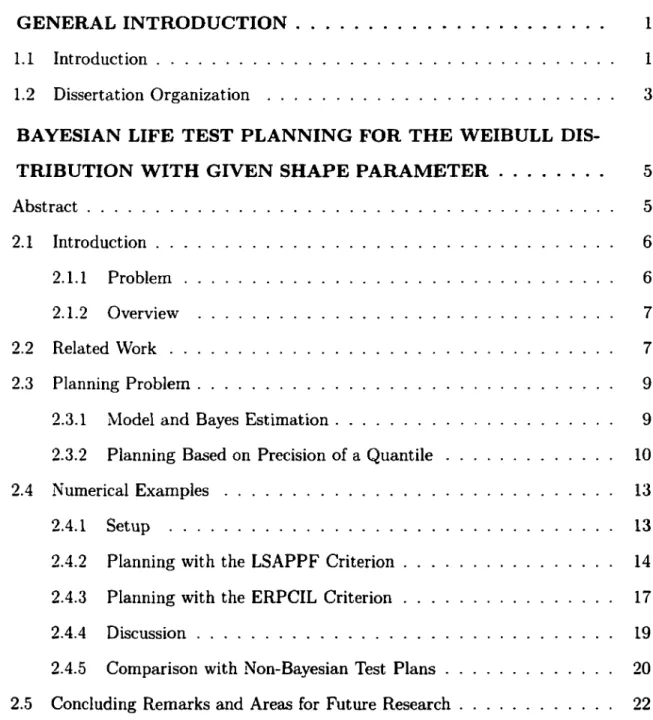
TABLE OF CONTENTS
1 GENERAL INTRODUCTION 1
1.1 Introduction 1
1.2 Dissertation Organization 3
2 BAYESIAN LIFE TEST PLANNING FOR THE WEIBULL DIS
TRIBUTION WITH GIVEN SHAPE PARAMETER 5
Abstract 5 2.1 Introduction 6 2.1.1 Problem 6 2.1.2 Overview 7 2.2 Related Work 7 2.3 Planning Problem 9
2.3.1 Model and Bayes Estimation 9
2.3.2 Planning Based on Precision of a Quantile 10
2.4 Numerical Examples 13
2.4.1 Setup 13
2.4.2 Planning with the LSAPPF Criterion 14
2.4.3 Planning with the ERPCIL Criterion 17
2.4.4 Discussion 19
2.4.5 Comparison with Non-Bayesian Test Plans 20
References 22
3 BAYESIAN DESIGN FOR LIFE TESTING 25
Abstract 25
3.1 Introduction 26
3.1.1 Background and Motivation 26
3.1.2 Related Work 27
3.1.3 Overview 28
3.2 The Bayesian Life Test Design Problem and The Criterion 29
3.3 General Large Sample Approximation for the Bayes Life Test Design Cri
terion 31
3.3.1 The Posterior Distribution of Lifetime Model Parameters and Their
Variances 32
3.3.2 The Large Sample Approximate Bayes Criterion 33
3.4 Weibull Life Test Design with Prior Information on the Shape Parameter 34
3.5 Effects of Prior Information on the Posterior Variance of the Quantile of
Interest 36
3.6 Test Plan Solutions 37
3.7 Example 41
3.8 Discussion 44
3.8.1 Solution for Type I Censoring 44
3.8.2 Shape of Prior Distribution 44
3.8.3 Joint Informative Prior Information 45
3.9 Weibull Life Test with Given Shape Parameter 45
3.10 Simulation Approach 48
3.11 Comparison of the Simulation Approach and the Large Sample Approxi
References 57
BAYESIAN OPTIMUM DESIGN FOR ACCELERATED LIFE TESTS 60
Abstract 60
4.1 Introduction 61
4.1.1 Background and Motivation 61
4.1.2 Related Work 62
4.1.3 Overview 64
4.2 The Bayesian ALT Design Problem 65
4.2.1 The Model 65
4.2.2 The Prior Distribution 66
4.2.3 The Bayes Design Criterion 67
4.3 Large-Sample Approximation for the Bayesian ALT Design Problem ... 68
4.3.1 Posterior Variance 68
4.3.2 The Large-Sample Approximate Bayes Criterion 70
4.4 General Equivalence Theorem for the Bayesian ALT Design Problem . . 71
4.5 Numerical Example 73
4.5.1 Description 73
4.5.2 Numerical Search for Optimum Design 75
4.5.3 Derivative Function at the Optimum Design 79
4.6 Further Investigation 79
4.6.1 Effect of Prior Information on the Slope Parameter 79
4.6.2 Effect of Censoring 83
4.6.3 Effect of Sample Size 84
4.6.4 Type II Censoring 85
4.8 Simulation Evaluation for Bayesian ALT Design 87
4.8.1 Simulations Based on Fixed Model Parameters 88
4.8.2 Simulations Based on Simulated Model Parameters 88
4.9 Concluding Remarks and Areas for Future Research 91
References 93
5 CONCLUSION 96
APPENDIX A TECHNICAL DETAILS FOR RESULT (2.5) 98
APPENDIX B CONCAVITY OF THE BAYESIAN CRITERION (4.9)
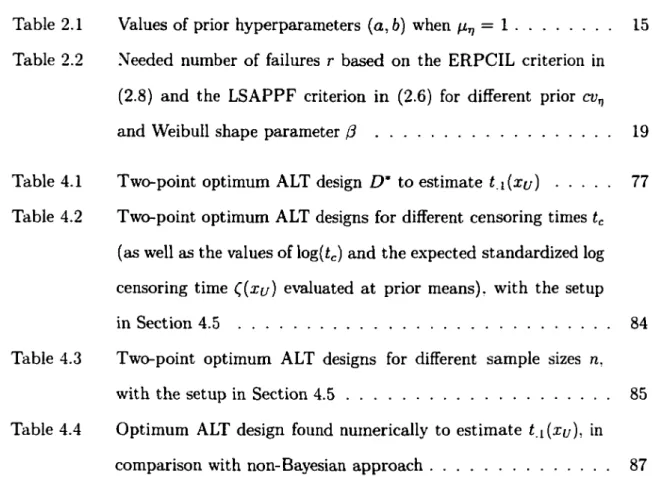
LIST OF TABLES
Table 2.1 Values of prior hyperparameters (a, b) when fiv = 1 15
Table 2.2 Needed number of failures r based on the ERPCIL criterion in
(2.8) and the LSAPPF criterion in (2.6) for different prior cvn
and Weibull shape parameter /3 19
Table 4.1 Two-point optimum ALT design D ' to estimate t .i( x u ) 77
Table 4.2 Two-point optimum ALT designs for different censoring times tc
(as well as the values of log(ic) and the expected standardized log
censoring time Ç(xv) evaluated at prior means), with the setup
in Section 4.5 84
Table 4.3 Two-point optimum ALT designs for different sample sizes n,
with the setup in Section 4.5 85
Table 4.4 Optimum ALT design found numerically to estimate £.i(x(/), in
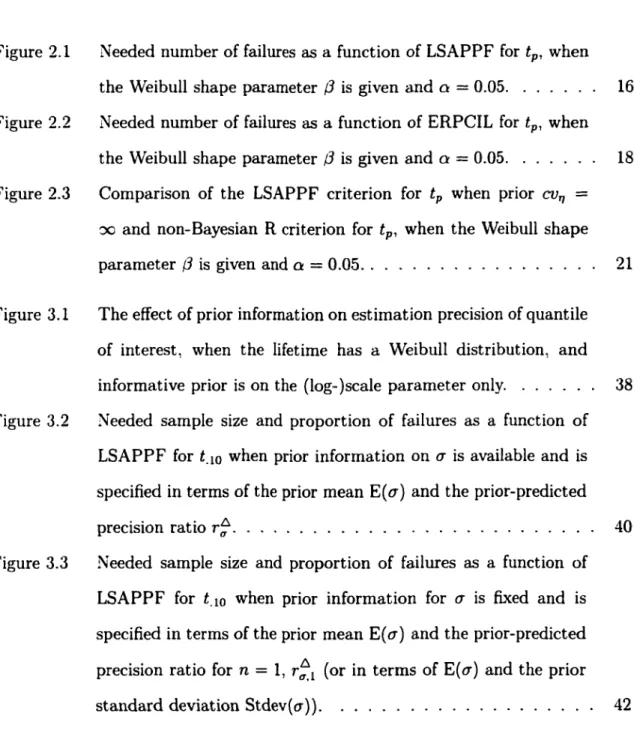
LIST OF FIGURES
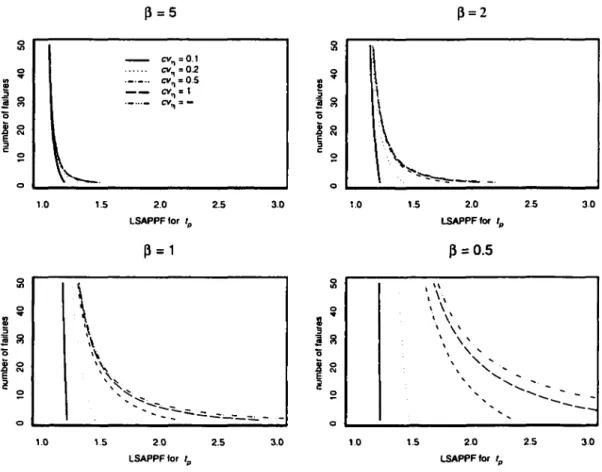
Figure 2.1 Needed number of failures as a function of LSAPPF for tp, when
the Weibull shape parameter 0 is given and a = 0.05 16
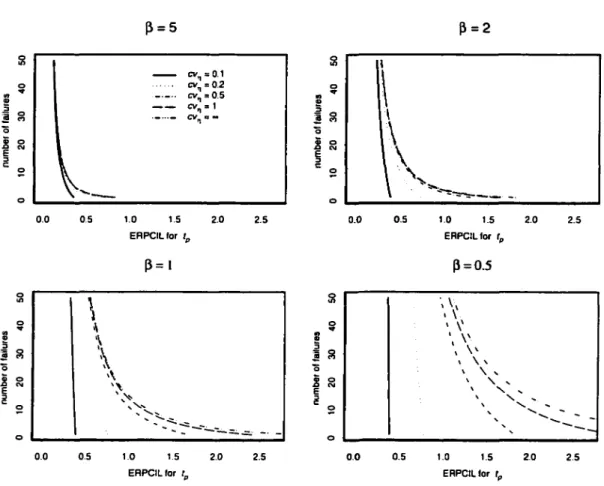
Figure 2.2 Needed number of failures as a function of ERPCIL for tp, when
the Weibull shape parameter 0 is given and a = 0.05 18
Figure 2.3 Comparison of the LSAPPF criterion for tp when prior cvn =
oc and non-Bayesian R criterion for tp, when the Weibull shape
parameter (3 is given and a = 0.05 21
Figure 3.1 The effect of prior information on estimation precision of quantile
of interest, when the lifetime has a Weibull distribution, and
informative prior is on the (log-)scale parameter only 38
Figure 3.2 Needed sample size and proportion of failures as a function of
LSAPPF for t io when prior information on a is available and is specified in terms of the prior mean E(o") and the prior-predicted
precision ratio r„ 40
Figure 3.3 Needed sample size and proportion of failures as a function of
LSAPPF for Z.io when prior information for a is fixed and is specified in terms of the prior mean E(er) and the prior-predicted
precision ratio for n = 1, (or in terms of E(cr) and the prior
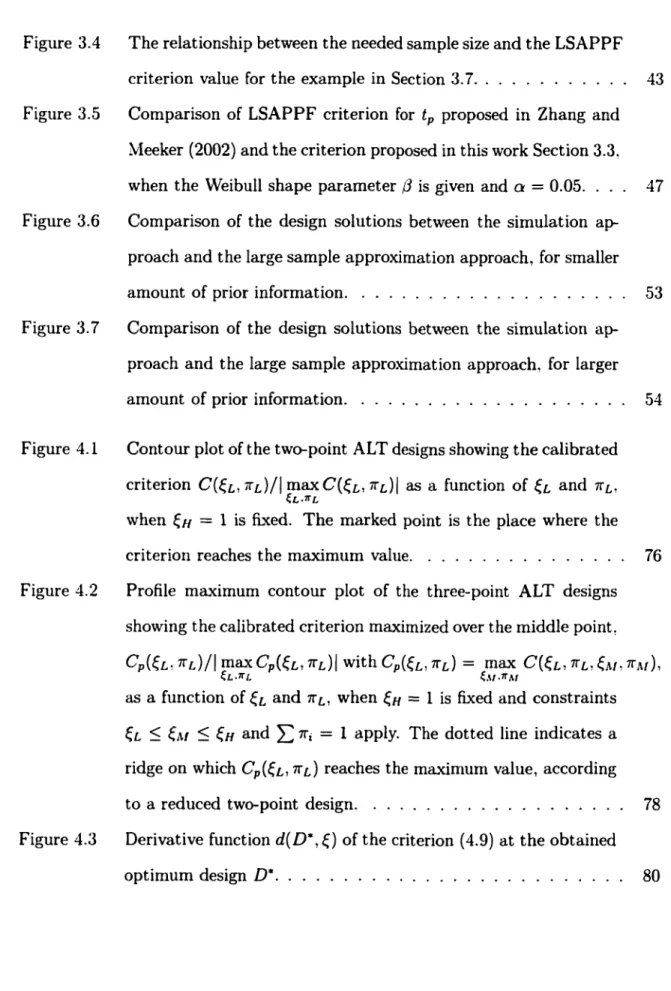
Figure 3.4 The relationship between the needed sample size and the LSAPPF
criterion value for the example in Section 3.7 43
Figure 3.5 Comparison of LSAPPF criterion for tp proposed in Zhang and
Meeker (2002) and the criterion proposed in this work Section 3.3. when the Weibull shape parameter (3 is given and a = 0.05. ... 47
Figure 3.6 Comparison of the design solutions between the simulation ap
proach and the large sample approximation approach, for smaller
amount of prior information 53
Figure 3.7 Comparison of the design solutions between the simulation ap
proach and the large sample approximation approach, for larger
amount of prior information 54
Figure 4.1 Contour plot of the two-point ALT designs showing the calibrated
criterion C { ^L, tt^,)/| maxC(Çi„ irL)\ as a function of and irL,
when Ç// = 1 is fixed. The marked point is the place where the
criterion reaches the maximum value 76
Figure 4.2 Profile maximum contour plot of the three-point ALT designs
showing the calibrated criterion maximized over the middle point.
Cp(£z., 7Tz,)/| maxCp(ÇL,irL)\ with Cp(ÇL,7rL) = max C(^, *m),
as a function of ^ and tcl, when Of = 1 is fixed and constraints
Çl < £a/ <
Ç
h and %-, = 1 apply. The dotted line indicates aridge on which
C
P(Ç
l,
%"&) reaches the maximum value, accordingto a reduced two-point design 78
Figure 4.3 Derivative function d ( D ' , £ ) of the criterion (4.9) at the obtained
Figure 4.4 Contour plots of
C
{£l, maxCfe, ttl)\ in two-point ALT de-signs showing the change of the optimum design when the priorcoefficient of variation on (3\ decreases 82
Figure 4.5 Derivative function d(D*,Ç) of the criterion (4.9) at the one-point
optimum design allocating all units to £// = 1 83
Figure 4.6 Simulations for evaluation of the optimum design in Table 4.1
under the numerical example in Section 4.5, when the true model
parameters are the means of the prior distributions 89
Figure 4.7 Simulations for evaluation of the optimum design in Table 4.1 un
der the numerical example in Section 4.5, when each true model parameter is specified to be one prior standard deviation less than
its prior mean 90
Figure 4.8 Histogram of the posterior variances for log(£.[(xj/)) using the
optimum design in Table 4.1 under the numerical example in Section 4.5, when marginal data are simulated with respect to
ACKNOWLEDGMENTS
My first, and most earnest, acknowledgment must go to my advisor Dr. William Meeker, for being such a great advisor. I could never measure how much I have learned from him, and how much help and support that he has provided to me. Whenever I need, he is always available for providing invaluable advice, no matter it was 5 o'clock in the morning to review a paper, or it was a 30 minute transfer time at the airport while travelling to have a phone talk with me. No need even to mention those long but really helpful discussions during days and nights, weekdays and weekends. In every sense, none of this work would have been possible without him. My many thanks also go to the committee members for their great support during the course of my PhD study.
The faculty, staff, and my friends in the Statistics Department at ISU all have my sincere gratitude. I am also indebted to the Survey Section for the opportunity to apply my knowledge to practical problems and sharpen my skills.
I would like to give special thanks to the faculty of the Department of Physics and Astronomy at ISU, particularly to Dr. David Lynch, for preparing me with a solid physics background. The knowledge and skills I learned in physics have been of extreme value during my studies in statistics.
My final, and most heartfelt, acknowledgment must go to my wife Yifan Wang. Yifan has worked successfully to show me life outside of research study. Her companionship, encouragement, and support have turned my graduate school experience into a great pleasure. For all that, she has my everlasting love.
1 GENERAL INTRODUCTION
1.1 Introduction
Life testing is important in reliability studies. It puts a set of sample products or sample components directly under test to observe failures, for evaluating the products' lifetime information. Because of the underlying stochastic processes, the lifetimes (failure times) for the products are expected to be randomly distributed, which, in reliability studies, are usually modelled by an appropriate parametric distribution, such as the Weibull distribution or the lognormal distribution. Therefore, the interest of the life testing is usually focused on some properties of the lifetime distribution, such as a particular quantile of the lifetime distribution. The lower quantile of lifetimes often provides a meaningful characteristic of the product's reliability because, for modern high reliable products, the time when a certain small proportion of the products start to fail is usually considered as an critical time for the product's reliability.
There are roughly two kinds of life testing. One is the case in which all units are tested at one condition (typically the use condition), called a single distribution life testing, or simply, life testing (LT). The other is the case where higher than usual stresses are applied to the product to allow for shorter failure times. This type of life testing is called accelerated life testing (ALT). In ALTs, the lifetime information at use conditions is extrapolated from the lifetime information at higher stresses, under a certain stress-lifetime model.
experiment typically can not be run within practical test time to have all of the samples fail, resulting in censored lifetime data. The experiment usually is terminated either after a certain amount of time has passed (time or Type I censoring), or after a certain proportion of failures has been observed (failure or Type II censoring). With the ex periments having time and cost constraints, how to plan the censored life test so that maximum information can be provided by the experiment and maximum information can be obtained through inferences are essential issues in reliability studies. In LTs. the planning questions are typically on the sample size to be tested and the length of the test (alternatively, in Type II censoring cases, the number of failures to be observed). In ALTs, in addition to choosing the sample size and length of experiment, the planning questions are focused on the stress levels and the allocation of samples to these levels.
Traditional planning methods for the LT and ALT designs have been developed and used in engineering fields. These methods are appropriate when there is no prior in formation available for inference. With today's quick accumulation of knowledge and information on similar studies, situations with available prior information on the prop erties of the products under test, especially the information related to the characteristic properties such as failure mechanism, becomes more and more important in practi cal problems. Taking advantage of this available information will allow a reduction in needed experimental resources and provide better estimation. How to extend the tra ditional planning methods and incorporate the available prior information into life test planning for the experiments that use the available prior information in inference be comes an important problem in the reliability studies. This problem has not been well addressed in the previous work in this field. The increasing interest and importance of the problem for practical usage motivate the research work in this dissertation.
This dissertation uses Bayesian methods and techniques to study the LT and ALT designs with available prior information. Bayes design criteria are developed for the estimation of a specified quantile of interest. Closed form solutions are derived for some
particular cases, and two approaches are developed for the general design solutions based on the Bayes criteria. One is a large sample approximation approach and the other is a simulation approach. Applications in practical usage are illustrated through numerical investigations and examples.
1.2 Dissertation Organization
This dissertation consists of three papers written in cooperation with the thesis ad visor Professor William Q. Meeker. The first paper discusses the Bayesian LT planning problem for the Weibull distribution when the shape parameter is given and the data is Type II censored. Two Bayes criteria are proposed for the design problem and closed form expressions between the criterion value and design specifications are derived. Nu merical examples are used to illustrate the practical usage.
The second paper discusses the Bayesian LT design for a general distribution in a log-location-scale family. A general Bayes criterion is provided for this case, and two approaches to evaluate the criterion, a large sample approximation approach and a simulation approach, are developed for the planning solutions. The applications are illustrated by studying a Weibull life test with Type II censoring, when the prior infor mation on the scale parameter is available. Numerical solutions are presented, and the two approaches are compared.
The third paper discusses the Bayesian optimum ALT design with one accelerat ing variable, when the acceleration model is linear, for a general distribution in a log-location-scale family. Bayes criterion for the general design problem is provided, and the large sample approximation is used for the test solutions. Numerical optimizations are employed for the design solutions, and the general equivalence theorem by Whit tle (1973) is applied for verification of the global optimality. the resulting designs are evaluated by the proposed simulation procedures.
A general conclusion on the LT and ALT Bayesian design methods developed in this dissertation is presented afterwards. Future research areas are outlined.
2 BAYESIAN LIFE TEST PLANNING FOR THE
WEIBULL DISTRIBUTION WITH GIVEN SHAPE
PARAMETER
Yao Zhang and William Q. Meeker
Abstract
This paper describes Bayesian methods for life test planning with Type II censored data from a Weibull distribution, when the Weibull shape parameter is given. We use conjugate prior distributions and criteria based on estimating a quantile of interest of the lifetime distribution. One criterion is based on a precision factor for a credibility interval for a distribution quantile and the other is based on the length of the credibility interval. We provide simple closed form expressions for the relationship between the needed number of failures and the precision criteria. Examples are used to illustrate the results.
Key words: Bayesian design; Conjugate prior; Exponential distribution; Life data;
2.1 Introduction
2.1.1 Problem
Life testing is an important method for evaluating component reliability. In appli cations. some number of samples are tested under particular conditions to estimate the lifetime properties of the component at these conditions. Because of the often high reliability of the tested components and time/cost constraints of the experiment, life tests are usually terminated after a specific amount of time elapses (Type I censoring) or after a specific number of failures have been observed (Type II censoring). Careful planning for how many units are to be tested and the length of the experiment (for Type II censoring, how many failures are to be observed) is important to obtain the maximum possible information with the minimum cost possible, on the average.
Often the purpose of a life test is to estimate a specific quantile of the lifetime dis tribution. for instance, the .10 quantile. A life test can then be planned according to the needed estimation precision for this quantile. The Weibull and lognormal distribu tions are appropriate to describe the variation in the lifetimes of many different types of components. In the traditional approach to the test planning problem, the goal is to estimate unknown fixed parameters and "planning values" of the distribution parame ters are used for planning purposes (cf. Chapter 10 of Meeker and Escobar 1998). The Bayesian approach arises naturally when information is available a priori for planning and estimation. This happens frequently in practical situations when there is available engineering or physical knowledge, or previous experience with similar components hav ing the same failure mechanisms. Careful planning with relevant prior information can reduce needed experimental resources. For the log-location-scale such as the Weibull and lognormal distributions, Bayesian methods usually yield no closed forms for inferences on the planning criteria, partly because of the censoring. Numerical methods must be applied instead. For the Weibull distribution with a given shape parameter, however,
closed forms exist if standard conjugate prior distributions are used. The given shape parameter Weibull cases are important in certain practical applications. Section 2.3 of Nordman and Meeker (2002) describe several applications where it is appropriate to use a given shape parameter. For example, the exponential (Raleigh) distribution is a special case when the Weibull shape parameter is given as one (two). Also, the plan ning solutions for these special cases provide useful insight into the more complicated planning problem where the Weibull shape parameter is unknown. In this paper, we describe the Bayesian approach of life test planning for the Weibull distribution with given shape parameter, and provide the closed forms for the planning criteria. Planning solutions are illustrated with numerical examples.
2.1.2 Overview
The remainder of this paper is organized as follows. • Section 2.2 reviews related work.
• Section 2.3 describes the Bayesian planning problem for the Weibull distribution with a given shape parameter, with a conjugate prior formulation.
• Section 2.4 presents numerical examples that illustrate the Bayesian planning so lutions and comparisons with results from the non-Bayesian approach.
• Section 2.5 gives some concluding remarks and describes areas for future research.
2.2 Related Work
Numerous results for life test planning are available in the statistical and engineering literature. Many non-Bayesian approaches have been developed for different life testing considerations. Gupta (1962), Grubbs (1973), and Narula and Li (1975) describe sam ple size determination methods for controlling error probabilities in hypothesis testing
of life distribution parameters and functions of distribution parameters. Meeker and Nelson (1976) describe the asymptotic theory and application for planning a life test to estimate a Weibull quantile with a specified precision. Meeker and Nelson (1977) also present general theory and application for sample size determinations in life test plan ning when other functions of Weibull parameters are to be estimated. Danziger (1970) describes life test planning for estimating the hazard rate of a Weibull distribution with a given shape parameter. Meeker. Escobar, and Hill (1992) present asymptotic theory and methods for planning a life test to estimate a Weibull hazard function, when all parameters are unknown .
Using prior information and Bayesian techniques in life test planning has also been explored in previous work. Thyregod (1975) develops methods using the Type II cen soring, exponential life test sampling plan problem. The method presented uses a cost-based utility function and a Taylor expansion around the estimated mean to incorporate prior information. Zaher, Ismail, and Bahaa (1996) present Bayesian life test planning methods for the Weibull distribution with a known shape parameter under Type I cen soring, using a criterion based on expected gain of Shannon information. The paper uses approximations and numerical solutions to obtain test plans.
More recently, there has been a series papers describing Bayesian theories, methods, and discussions of the general sample size determination problem. For example, Joseph, Wolfson and Berger ( 1995a,b) provide three Bayes criteria based on highest posterior density (HPD) intervals for the sample size determination problem and illustrate the calculations for binomial proportions. These Bayesian approaches are based on the pre cision of interval estimation for a particular quantity of interest. Lindley (1997) provides a fully Bayesian treatment for the sample size problem based on a utility function, and compares the method with other Bayes criteria based on interval estimation precision, in particular, with the average length criterion (ALC) proposed by Joseph, Wolfson and Berger (1995a,b). Pham-Gia (1997) makes more comparisons between these two kinds of
criteria, outlying the differences and similarities, and making an effort to better match them by using a utility function for the ALC criterion. Joseph and Wolfson (1997) discuss the advantages and disadvantages of using these two kinds of criteria with an emphasis on the practical aspects. Bernardo (1997) illustrates the decision-theoretic Bayesian approach suggested by Lindley (1997) in the particular case where inference is seen as a decision problem with an action space consisting of the class of possible distributions of the relevant quantity and the utility function being a logarithmic score. Adcock (1997) argues that it is not always necessary to use the utility function in a Bayesian approach and, by example, shows, for some cases, the equivalence of the utility function and the average length Bayesian procedures.
2.3 Planning Problem
2.3.1 Model and Bayes Estimation
Suppose that the lifetimes of the units being tested have a Weibull(^, j3) distribution with pdf
where rj is the unknown scale parameter and (3 is the given shape parameter. Here we consider the life test planning problem when the test is Type II censored with sample size n and fixed number of failures r. The likelihood is
where Z(i) is the <th ordered lifetime and
n r
Assume also that prior information on the scale parameter of the lifetime distribution is available. Let 6 = 7]^ denote the transformed scale parameter of the lifetime model on the /3-power scale. An inverted gamma distribution IG(a, b) for 6 provides a flexible conjugate prior representation for the prior information, and the prior density is
"| 6 k 6 ) =r ( ^e x pH ) ' ( 2 1 )
where the hyperparameters a > 0 and 6 > 0 are given. In practical applications with
informative prior information on the Weibull scale parameter 77 = d1^, the prior variance
is usually finite, which implies a > 2/&. In any case, the posterior distribution of 9 is
u/(0|a,6) x L ( 0 , dl / 0: t )
/(0|£, (3,a,b) =
f ui(6\a, b) x L{0,0W
- , t )
d{0)IG(a + r, T T T0 + 6), (2.2)
an inverted gamma distribution. When a + r > 2, the posterior variance is finite. This means that with a sufficient number of failures (r) the experiment will provide a posterior with finite variance, even in cases where prior variance does not exist (i.e., a < 2 / p ) . Bayes estimation of any function of the unknown parameter 6 can be based on this posterior distribution of 0.
2.3.2 Planning Based on Precision of a Quantile
A commonly used reliability metric is the p quantile of the lifetime distribution,
tp = [-0log(l -p)]l/^. (2.3)
We propose two ways of planning by considering the precision when using Bayes esti
2.3.2.1 Criterion based on a large sample approximate posterior pre cision factor (LSAPPF)
When using a large sample approximation (e.g., in more complicated problems for which closed-form solutions are not available), quantification of precision for estimating
a positive quantity like tp is often performed in the log scale. In large samples, the
posterior credibility interval for tp can be expressed, approximately, as [tpjR, tp x R\,
where tp is the Bayes estimate of tp and R is a posterior credibility interval precision
factor
R = exp ^1— a/2 ^yŒPosterior (log tp) (2.4)
log (jTT[j + 6)
and ~\—a/2 is the 1 — a / 2 quantile of standard normal distribution. Here R serves as a metric for estimation precision. From the posterior distribution of 9 in (2.2),
Varpos£crior(log tp) = —Varpos£er,or (log 9)
= Posterior
= ^'(a + r), (2.5)
where ty'{z) = dip(z)/dz is the polygamma function, ip(z) = r'(z)/F(z) is the digamma
function, and F(z) is the gamma function. The justification of the last step in (2.5) is given in the Appendix A. Combining (4) and (5) gives
R =
[exp (2[_Q/2\/V(a + r)) j . (2.6)Note that R depends only on a , r, 0 and the hyperparameter a but not on the data. Thus it can be used as a criterion for test planning. Because it is the number of failures r rather than the sample size n that affects the precision of estimation of tp, the number
of failures can be chosen before the experiment to control the precision of estimation of the p quantile in terms of R, as a function of the given prior information. The sample
size n can be chosen based upon time and cost availability considerations (with the constraint r < n), where the expected test length will be shorter for larger n. Also note that R does not depend on the value of p, so that the planning solution is the same for all quantiles of the lifetime distribution.
2.3.2.2 Criterion based on an exact relative posterior credibility in terval length (ERPCIL)
A Bayes credibility interval for tp that does not depend on the large sample normal
a p p r o x i m a t i o n c a n b e c o n s t r u c t e d d i r e c t l y f r o m t h e p o s t e r i o r d i s t r i b u t i o n . L e t La( tp
\t)
denote the length of the 100(1 — a)% credibility interval from the posterior distribution
of tp. Then using the posterior distribution of 6 in (2.2),
£0(tp|t) = [-iog(i-p)lwMf>W|t) = (-log(l-p)l W0 A Qgamma{ct/1\ d T ) (7T7> + 6)1//3, (2.7) where 1 1 1
Qgamma (t*/2; Q + T ) Qgamma (c*/2; Q + 7") Qgamma ( 1 Ot/2] Q . 7 " )
and qg am m a( o t / 2 ; a + r ) is the a / 2 quantile of gamma probability distribution with shape
parameter (a + r) and unit scale parameter. This exact posterior credibility interval length depends on the data through TTTp, the value of p, and both prior
hyperparam-eters a and b. Estimation precision of a positive quantity like tp is more reasonably
specified relative to the value of tp to be estimated. Such a relative precision metric is
La(tp
\t)
r (a + r )E(tp|t) f(a + r — -j)
1
Qgamma(oc/2; Q + 7")
(2.8)
where E(fp) is evaluated relative to the posterior distribution of 0 (2.2), based on the
relationship (2.3) between tp and 6. Because the metric in (2.8) does not depend on
according to the value of this criterion specified by the experimenter. Similar to the LSAPPF criterion in (2.6), this criterion depends on the number of failures r, rather than the sample size n. Also, the planning solution does not depend on p, the particular quantile.
2.3.2.3 Exponential distribution case
The exponential distribution, as the special case of the Weibull distribution with given shape parameter (5 = 1. has the following particular forms of the criteria in (2.6) and in (2.8).
• The LSAPPF criterion:
R = exp x/V''(a + r)j . (2.9)
The ERPCIL criterion:
L g { t p
\ t )
E(tp\t)
where i A-= (a + r — 1) A Qgamma{&/2,(1 -f* T")_ (2.10)9gamma(^/2, (Z "I™ 7*) Çgamma(û/2; Û + 7") QgammaiX Ci/Q + 7")
2.4 Numerical Examples
This section uses numerical examples to illustrate the life test planning procedures obtained in the previous section. We also illustrate the correspondence of the Bayes test plans when prior information is vague to test plans from a non-Bayesian approach.
2.4.1 Setup
Suppose that an experimenter is interested in estimating a quantile of the lifetime distribution of a specific component, and that the estimation precision is to be based on
a 95% credibility level (a = 0.05). Assume that the lifetimes of the component have a Weibull distribution, and the shape parameter j3 of the distribution is given, but that the scale parameter rj is unknown. In addition, assume that prior information on the scale parameter 77 is available before the experiment, specified in terms of a prior distribution
with mean iiv and standard deviation sd^. With the inverted gamma conjugate prior
specification of 0 = 77^ in (2.1), the relationships between the prior hyperparameters
(a, b) and ^ and sdn are
sd, hT)
cvn =
V-T)
^
- •». . ...Eilli!,
where cvn = sdv/^ is the coefficient of variation (CV) of the prior distribution for
77. Note that the prior hyperparameter a is a function of the prior cVj, (and the given
Weibull shape parameter p) only. In general, only numerical solutions of a and b can be found, but for the exponential distribution (f3 = 1), these relationships reduce to
a = cu~2 + 2 (2.13)
6 = 1
Lin{cv~2 + 1)
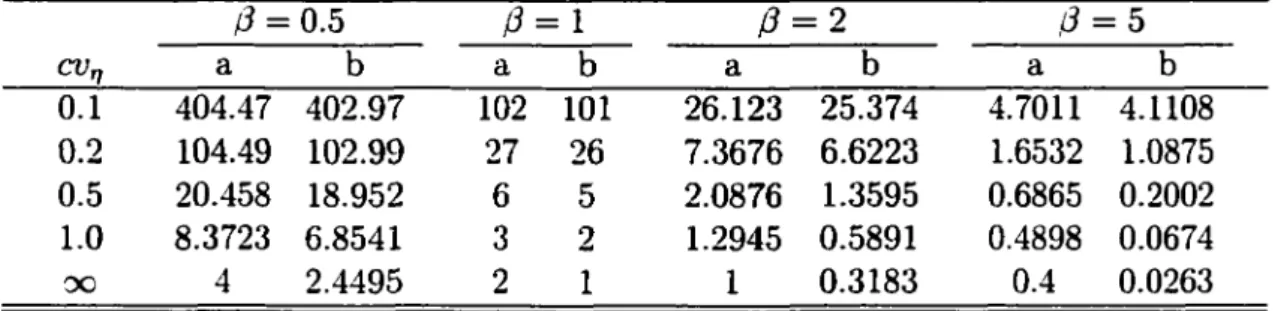
For the Weibull distribution, Table 2.1 gives values of (a, b) for some combinations of 0
and cuv, when = 1. Life test planning procedures presented in the previous section
will be illustrated under these numerical conditions.
2.4.2 Planning with the LSAPPF Criterion
If the precision for estimation of tp is considered in terms of the precision factor R , the
LSAPPF criterion in (2.6) can be used for the planning. Note that this criterion is not a function of the prior hyperparameter b, implying that the planning solution from this
Table 2.1 Values of prior hyperparameters (a, b) when = 1 CUn 0 = 0.5 0 = 1 0 = 2 0 = 5 CUn a b a b a b a b 0.1 404.47 402.97 102 101 26.123 25.374 4.7011 4.1108 0.2 104.49 102.99 27 26 7.3676 6.6223 1.6532 1.0875 0.5 20.458 18.952 6 5 2.0876 1.3595 0.6865 0.2002 1.0 8.3723 6.8541 3 2 1.2945 0.5891 0.4898 0.0674 oc 4 2.4495 2 1 1 0.3183 0.4 0.0263
a (or equivalently cvn) is specified [cf. (2.11) and (2.12)]. As previously mentioned, this
criterion does not depend on the value of p of the quantile of interest. Figure 2.1 gives the number of failures r as a function of the LSAPPF criterion value, for the different
combinations of cvn and 0 provided in Table 2.1.
Figure 2.1 shows that, for any given shape parameter, the necessary experimental resources (number of failures r) increases, as expected, with larger required estimation precision. This increase in the necessary resources grows substantially when high estima tion precision is required. On the other hand, needed experimental resources decreases with increasing prior information (decreasing prior CV). This is especially true when the
prior CV on the scale parameter is small (e.g., cvn < 1). When the prior CV for the scale
parameter is already large (cvn > 1), further reduction in the amount of prior informa
tion results in only small increases in the number of failures r required and the increase is only noticeable for large values of R. This can be explained intuitively by noting that prior information can be interpreted as prior "pseudo-samples", and the prior CV is inversely proportional to the prior "pseudo-sample" size [cf. expression (2.13) and the correspondence between the prior hyperparameter a and number of failures r in crite
rion (2.6)]. When the prior cvv is greater than 1, the prior "pseudo-sample-size" falls to
a small number and a large amount of change in specified precision implies only a small amount of change in required sample size. The information from the current experiment
(3 = 5 p = 2 1.0 1.5 2.0 2.5 LSAPPF for L 3.0 1.0 1.5 2.0 2.5 LSAPPF tor f„ 3.0 P = 1 P = 0.5 LSAPPF for t 1» . u , \x - \ V \ \ V \ W \ \ -\ N -X ~ \ ^ 10 1.5 2.0 2.5 3.0 LSAPPF for tp
Figure 2.1 Needed number of failures as a function of LSAPPF for tp, when
dominates, unless the current sample size is also small and little estimation precision
is required. When the prior cvn decreases to a certain point, a substantially increased
amount of prior "'pseudo-data" is implied, and the needed experimental resources can therefore be reduced significantly.
Figure 2.1 also shows the effect of different given values of the Weibull shape param eter 0. For a certain specified precision R, small values of 0 require more experimental resources. This is because Weibull distributions with smaller values of /3 have more rela tive variability. Note that the effect of prior information is larger when (3 is small. Thus, as one might expect, prior information plays a more important role when the variation in failure times is large.
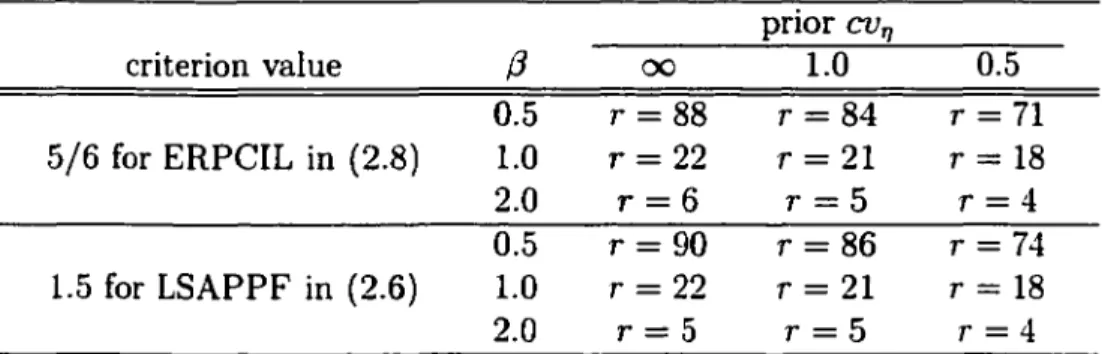
Figure 2.1 gives test plan solutions for the LSAPPF criterion. For instance, for the
exponential distribution {(3 = 1), if R is required to be 1.5, then r = 22 for prior cvn = oc
(no prior information), r = 21 for prior cvn = 1, and r = 18 for prior cvn = 0.5. For
the Weibull distribution with 0 = 2, the needed numbers of failures decrease to 5, 5, and 4 respectively, while they increase to 90. 86, and 74, respectively, for the Weibull distribution with 0 = 0.5. These numerical solutions are summarized in Table 2.2.
2.4.3 Planning with the ERPCIL Criterion
The ERPCIL criterion in (2.8) is a relative precision criterion, and it also does not depend on p or the prior mean. Figure 2.2 shows the relationship between the number
of failures and the ERPCIL criterion value, using the same combinations of cvn and 0
entries used in Table 2.1.
We can see that, for given Weibull shape parameter and prior information, the rela tionships between the criterion value and number of failures r are similar to those of the LSAPPF criterion, except for the scale difference. Because both (2.6) and (2.8) reflect
relative precision (not depending on the value of tp to be estimated), the interpretation of
p = 5 P = 2 o.o CVJJ s 0.1 CV, = 0.2 cv^ = 0.5 cv„ = 1 • •••*• CV_ B ** 0.0 05 1.0 1 5 2.0 2.5 ERPCIL lor tp II C O .
\
\
A \V x> 0.5 1 0 1.5 2.0 2.5 ERPCIL lor t„ 0.0 I S 0.5 1.0 1.5 2.0 ERPCIL for f„ P = 0.5 2.5 •'.V \, V v X V . \ x x \ X 4 \ N » X x X X ~ \ \ - ^ ~ _ 0.0 0.5 1.0 1.5 2.0 2.5 ERPCIL for t„Figure 2.2 Needed number of failures as a function of ERPCIL for tp, when
using the LSAPPF criterion in (2.6).
As a direct comparison between the ERPCIL and LSAPPF criteria, Table 2.2 gives the needed numbers of failures based on these relationships for a certain specified crite rion value, for selected combinations of prior information and the Weibull shape param eter. Note that, corresponding to R = 1.5, the relative credibility interval length from
the large sample approximation is (tpx R — tp/R)/tp = 5/6. The test solutions from the
two criteria only differ slightly, showing that the large sample approximation on which the precision factor R is based works quite well for this life test planning problem.
Table 2.2 Needed number of failures r based on the ERPCIL criterion in
(2.8) and the LSAPPF criterion in (2.6) for different prior cvn
and Weibull shape parameter 0
prior cur, criterion value 0 oo 1.0 0.5 0.5 -i II 00 OO II oo r = 71 5/6 for ERPCIL in (2.8) 1.0 r = 22 r = 21 r = 18 2.0 r = 6 r = 5 r = 4 0.5 r = 90 r = 86 r = 74 1.5 for LSAPPF in (2.6) 1.0 "1 II !o r = 21 r = 18 2.0 r = 5 r = 5 r = 4 2.4.4 Discussion
The examples in this section explored the life test plans based on two different criteria: the LSAPPF criterion, based on the large-sample approximate Bayes credibility interval precision factor R and the ERPCIL criterion, based on the relative Bayes credibility interval length with respect to the mean. Both are relative precision metrics, and neither depends on the particular value of p corresponding to the quantile of interest or the prior mean of the unknown Weibull scale parameter. The criterion based on the relative Bayes credibility interval length describes relative estimation precision in a more exact way.
We also computed a preposterior Bayes credibility interval length based on large
sample normal approximation, E$[2zi_q/2 >/Varposte7.1OT.(tp)], and a preposterior exact
Bayes Length of (2.7).
Ei[L
a(tp\t)\.
The latter is an average length criterion (ALC) likethat proposed by Joseph, Wolfson and Berger ( 1995a,b). For design purposes, these criteria take the marginal expectation of the data to account for all possible outcomes of the data. These are absolute precision criteria, and they also lead to test plans that are close to each other. Because they are less frequently used in practice for planning to estimate positive quantities, the results are not presented in this paper.
2.4.5 Comparison with Non-Bayesian Test Plans
In the non-Bayesian approach of the life test planning problem, it is typical to use the inverse of the Fisher information matrix as the large sample approximate variance-covariance matrix of the maximum likelihood estimators of the unknown parameters. In the Weibull (Type II censoring) case with a given shape parameter, the information on T} is
h i ) = E
d2\og
L
(0, T j; t ) '
rf32i2
drj2
where the fact that ~ Exp(^) and TTT$ ~ Gamma(r, rj13) is used to obtain the
expectation (cf. Epstein and Sobel 1953). Then, it follows that
R
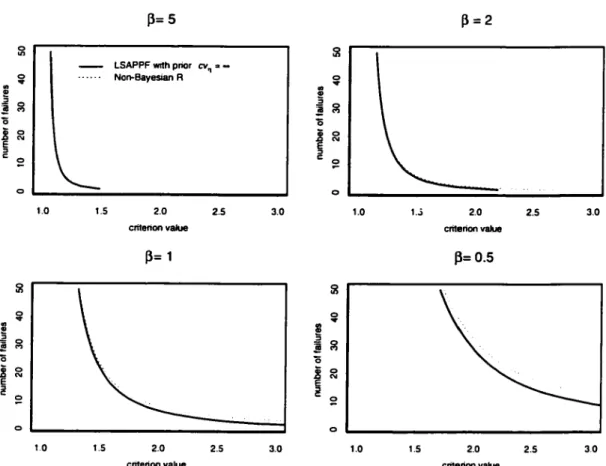
= [exp (zi-Q/.jVr3') j ' , (2.14)which is the Bayesian analog to the Bayes LSAPPF criterion (2.6). This non-Bayesian criterion is similar to LSAPPF in that it depends on r rather than n and provides a relative precision metric. Figure 2.3 shows that the test solutions from this non-Bayesian R criterion are close to those from the LSAPPF criterion when prior cur, = oo, which is a non-Bayesian asymptotic case from Bayesian point of view. They differ slightly from each other when r is small because LSAPPF uses the exact (posterior)
9=5 P = 2
LSAPPF with prior cvn
Non-Bayesian R 1.5 2.0 criterion value 2.5 3.0 1.0 2.0 criterion value 2.5 3.0 P = i P= 0.5 10 1.5 2.0 criterion value 2.5 3.0 1.0 1.5 2.0 criterion value 2.5 30
Figure 2.3 Comparison of the LSAPPF criterion for tp when prior cvn = oo
and non-Bayesian R criterion for tp, when the Weibull shape
maximum likelihood estimator (the inverse of the Fisher information matrix). This establishes the correspondence between the Bayesian life test procedures obtained in Section 2.3 and non-Bayesian procedures.
2.5 Concluding Remarks and Areas for Future Research
We have presented Bayes life test planning solutions for the Weibull lifetime distri bution with a given shape parameter for Type II censored data. The closed forms of the planning criteria are easy to use in practice, and the solutions are meaningful for the practical problems where there is useful engineering information about the Weibull shape parameter. The results given here also provide an approximation to the case where a life test is terminated after a given amount of time (Type I censoring). In addition, the discussion of the criteria in this paper suggests that the large sample nor mal approximation works well for this Bayes life test planning problem and may also provide a simplified and effective approach for the more general case where the Weibull distribution parameters are all unknown. The large sample approximation approach of the more general case, as well as some numerical validation such as simulation methods, should be explored in subsequent work.
References
Adcock, C. J. (1997), The choice of sample size and the method of maximum expected utility - comments on the paper by Lindley, The Statistician 46, 155-162.
Bernardo, J. M. (1997), Statistical inference as a decision problem: the choice of sample size, The Statistician 46, 151-153.
Danziger, L. (1970), Planning censored life tests for estimation of the hazard rate of a Weibull distribution with prescribed precision, Technometrics 12, 408-412.
Epstein, B. and Sobel, M. (1953), Life testing, Journal of the American Statistical Association 48, 486-502.
Grubbs, F. E. (1973), Determination of number of failures to control risks of erro neous judgements in exponential life testing, Technometrics 15, 191-193.
Gupta, S. S. (1962). Life test sampling plans for normal and lognormal distributions. Technometrics 4, 151-175.
Joseph, L., Wolfson, D. B. and du Berger, R. (1995a), Sample size calculations for binomial proportions via highest posterior density intervals, The Statistician 44, 143-154.
Joseph, L., Wolfson, D. B. and du Berger, R. (1995b), Some comments on Bayesian sample size determination, The Statistician 44, 167-171.
Joseph, L. and Wolfson, D. B. (1997), Interval-based versus decision-theoretic criteria for the choice of sample size, The Statistician 46, 145-149.
Lindley. D. V. (1997), The choice of sample size, The Statistician 46, 129-138. Meeker, W. Q. and Escobar L. A. (1998), Statistical Methods for Reliability Data, New York: John Wiley & Sons, Inc.
Meeker, W. Q., Escobar L. A., and Hill, D. A. (1992), Sample sizes for estimating the Weibull hazard function from censored samples, IEEE Transactions on Reliability
R-41, 133-138.
Meeker, W. Q. and Nelson, W. (1976), Weibull percentile estimates and confidence limits from singly censored data by maximum likelihood, IEEE Transactions on
Meeker, W. Q. and Nelson, W. (1977), Weibull variances and confidence limits by maximum likelihood for singly censored data, Technometrics 19, 473-476.
Narula, S. C. and Li, F. S. (1975), Sample size calculations in exponential life testing, Technometrics 17, 229-231.
Nordman. D. and Meeker, W. (2002), Weibull prediction intervals for a future number of failures. Technometrics 44, 15-23.
Pham-Gia T. (1997), On Bayesian analysis, Bayesian decision theory and the sample size problem. The Statistician 46, 139-144.
Thyregod. P. (1975), Bayesian single sampling plans for life-testing with truncation of the number of failures, Scandinavian Journal of Statistics 2, 61-70.
Zaher, A. M., Ismail, M. A., and Bahaa, M. S. (1996). Bayesian Type I censored designs for the Weibull lifetime model: information based criterion, The Egyptian Statistical Journal 40, 127-150.
3 BAYESIAN DESIGN FOR LIFE TESTING
Yao Zhang and William Q. Meeker
Abstract
This paper describes Bayesian methods for life test planning with censored data from a log-location-scale distribution, when prior information of the distribution parameters is available. We use a Bayes criterion based on the estimation precision of a distribution quantile. A large sample normal approximation gives a simplified, easy-to-interpret. yet valid approach to this design problem, where in general no closed form solutions are available. To illustrate this approach, we present numerical investigations using Weibull distribution with Type II censoring. We also assess the effects of prior distribution choice. A simulation approach of the same Bayesian problem, which uses the Metropolis algorithm, is also presented as a tool for visualization and validation. The validation re sults generally are consistent with those from the large sample approximation approach.
Key words: Life data; Life test planning; Log-location-scale family; Metropolis algo
3.1 Introduction
3.1.1 Background and Motivation
Careful planning of life tests in reliability studies is important because performing such experiments usually is expensive and time generally is limited. Usually life tests are censored from stopping the experiment after a certain amount of test time has elapsed (time or Type I censoring) or from stopping the experiment when a certain number of failures has occurred (failure or Type II censoring). Life tests are planned to control the number of sample units, test time (for Type I censoring), and/or number of failures to be observed (for Type II censoring) so that, if possible, a specified precision can be obtained for the estimation of a particular quantity of interest.
In traditional life test planning, "planning values" of the unknown parameters of the lifetime distribution are required as inputs. Then with the test specification (i.e., sample sizes and censoring time/number of failures) one can compute some precision factor of the estimation, such as the confidence interval precision factor described in Chapter 10 of Meeker and Escobar (1998). The planning values are chosen to describe the experimenter's best knowledge about the underlying failure-time model to allow for planning an efficient experiment. Bayesian methods allow one to combine prior information with data to make inferences. Bayesian methods are used in this paper to provide an appropriate life test design for situations in which prior information is to be used in inference problems.
Log-location-scale distributions, such as the Weibull and lognormal, are commonly used in lifetime studies. When the Weibull distribution shape parameter is given (e.g., the exponential and Raleigh distributions), a conjugate distribution for the prior dis tribution of the unknown scale parameter and closed form solutions for the Bayesian design problem are available (see Zhang and Meeker 2002 for a description and solution for this case). In other situations, the solutions become more complicated because both
parameters are unknown and because of the censoring. No closed forms are available for these design problems. Instead, numerical methods, simulations, or approximations need to be employed. In this paper, we first develop a general approach of large sample approximation that makes it relatively easy to solve the life test planning problem. Then we illustrate the use of simulât ion-based methods that allow for evaluating proposed test plans without relying on the large sample approximation.
3.1.2 Related Work
Chapter 10 of Meeker and Escobar (1998) describe general approaches and many useful techniques for non-Bayesian life test planning. Gupta (1962), Grubbs (1973) and Narula and Li (1975) describe the life test sample size determination to control error probabilities in hypothesis testing of distribution parameters and functions of distri bution parameters. Meeker and Nelson (1976, 1977) present the asymptotic methods and applications in life test planning for estimating functions of Weibull parameters. Danziger (1970) provides life test plans for estimating a Weibull hazard rate, when the shape parameter is given. Meeker, Escobar, and Hill (1992) develop the asymptotic theory and methods for life test planning if a Weibull hazard function is to be estimated and both parameters are unknown. Escobar and Meeker (1994) provide an algorithm to compute the Fisher information for the commonly-used log-location-scale distributions for left and right censoring.
For Bayesian life test planning, Thyregod (1975) presents a cost-based utility func tion approach to exponential life test with Type II censored data. Zaher, Ismail, and Bahaa (1996) provide Bayesian life test plans, using approximations and numerical solu tions, for the Weibull Type I censoring cases when the shape parameter is given, based on a Shannon information criterion. Zhang and Meeker (2002) describe the Bayesian methods for the Weibull life test planning to estimate a specified quantile of interest, when the shape parameter is given and the data are Type II censored. Closed form
solutions are derived for the planning problem.
Bayesian design theories and methods are also presented in other problems and in general sample size determination studies. For example, Poison (1993) develops a gen eral decision-theory approach for a Bayesian accelerated life test design problem, and provides a general preposterior expected utility function for the problem. Clyde, Millier, and Parmigiani (1995) present Bayesian design methods for evaluating a heart defibril lator, which has a logistic regression model. Preposterior expectation is used for the criterion and a large sample approximation is applied for the non-sequential designs and sequential designs. Joseph, Wolfson and Berger ( 1995a,b) develop three Bayes criteria to determine sample sizes, based on the estimation precision of highest posterior den sity (HPD) intervals for the particular quantity of interest. Lindley (1997) describes a decision-theoretic Bayesian approach for the general sample size problem based on a utility function, and makes comparisons between the method and other Bayes criteria based on interval estimation precision. Bernardo (1997) utilizes the decision-theoretic Bayesian approach suggested by Lindley (1997) for the particular case where inference is a decision problem based on information consideration. Pham-Gia (1997), Joseph and Wolfson (1997), and Adcock (1997) provide more detailed discussions and comparisons of these two kind of criteria in Bayesian applications, and make efforts to show the equivalence of using utility function and using the average length Bayesian procedures for some cases.
3.1.3 Overview
The remainder of this paper is organized as follows:
• Section 3.2 describes the Bayesian life test design problem and the evaluation criterion.
Bayesian design of life tests.
• Sections 3.4 through 3.8 apply the large sample approximation method to the more specific life planning problems, where the Weibull distribution with Type II censor ing is considered and prior information on the shape parameter is available. The effects of prior distribution are explored through these cases. Test plan solutions are provided, and a numerical example is presented to illustrate the application. • Section 3.9 uses the large sample approximation method in the cases of Weibull
life tests with given shape parameter, and compares the results with those from Zhang and Meeker (2002).
• Section 3.10 develops a simulation approach for the same Bayesian life test design problem. We use the Metropolis Algorithm because no conjugate distribution is available.
• Section 3.11 applies the simulation approach to the Weibull Type II censoring prob lem and provides a comparison of the results with the large sample approximate method.
• Section 3.12 gives some concluding remarks and outlines areas for further research.
3.2 The Bayesian Life Test Design Problem and The Criterion
Life tests are often designed to estimate a particular quantile of the lifetime distribu tion, such as the 0.10 quantile. For a high-reliability component, a quantile in the lower tail of the failure-time distribution provides a meaningful life characteristic. Therefore, it is natural to use a criterion for the design problem that is constructed from some measure of the precision of estimation of this quantile of interest in the log scale (be cause the quantile is a positive quantity). In the Bayesian framework, the precision of
estimation is usually specified as a (monotone) function of the posterior variance. For a given design D, the posterior variance depends on the data. A reasonable Bayes criterion for test planning is then the preposterior expectation of the posterior estimation preci sion function. This criterion is computed by taking an expectation over the marginal distribution of the data to account for all possible overcomes from the experiment.
Suppose that the lifetime distribution is in the log-location-scale family. log(<) - n
~ 0.
<7
where 0 is a standardized pdf, and 0 = (/z, a)T are the unknown location and scale
parameters, respectively. For example, using the smallest extreme distribution 0sev(~) = exp[z — exp(z)] implies that the lifetime has a Weibull distribution. Using the standard
normal 0nor(z) gives the lognormal distribution.
Suppose also that we have a prior distribution for the unknown parameters, uj(0\(3), where /3 is a given vector of hyperparameters. Denote the data from the experiment by
t
and the p quantile of interest by tp. Then the criterion for the Bayesian life test designis
C ( D ) = E(logt)|D [ g (Var0|(logt) D(logtp))] , (3.1)
which is the preposterior expectation of some function g of the posterior variance of the p quantile of interest in the log scale. The function g(-) provides an interprétable precision measure defined by the experimenter to focus on the quantity of interest for the estimation. Using the function g(x) = x expresses precision in terms of the posterior variance of the quantile in the log scale, which is equivalent to the utility defined from the quadratic loss function. Another reasonable function is based on appropriate credi
bility interval precision of tp on the original scale. Such an interval can be constructed
normal approximate credibility interval precision factor
R = exp [^-a/2v/Var0|(Iogt) D(logtp)J ,
and zi-q/2 is the (1 — a/2) quantile of the standard normal distribution. The prepos
terior credibility interval precision factor R, defined as E(log(,|D[Â], can be used as the
precision measure and in this case,
g ( x ) = e x p ( z i -a / 2\ / x ) . (3.2)
The life test design problem therefore is to find the most cost/1ime-effective combi nation of sample size and censoring time (Type I censoring) or number of failing (Type II censoring) subject to a constraint on expected precision defined by the criterion (3.1).
3.3 General Large Sample Approximation for the Bayes Life
Test Design Criterion
Large sample normal approximations are frequently used in statistical inference and test planning because they are
• Asymptotically correct under mild conditions, met in the log-location-scale distri butions here;
• They provide useful approximations when the sample sizes are reasonably large; • They provide a relatively simple but useful approach to study complicated prob
lems.
For the Bayesian life tests design problem, the large sample approximations provide a simple, useful description of the design problem. In the following, we first describe the posterior distribution of the model parameters and their variances in the large sample approach, and then provide the approximation to the design criterion based on the large
sample estimation variance of the quantile of interest, a specific function of the model parameters.
3.3.1 The Posterior Distribution of Lifetime Model Parameters and Their Variances
Life test data are usually censored and for Bayesian methods, numerical methods are needed to obtain the posterior distribution. When sample sizes are reasonably large, however, a normal distribution provides a good approximation for the posterior distribu tion. Berger (1985). for example, gives some analytical forms of normal approximations for stable estimation (as it is called in the Bayesian literature). In this case, the variance of the posterior distribution can be expressed as a combination of the prior information
and the data. Let
S~
l denote the precision matrix of the prior distribution for the unknown parameter(s)
0,
and letIg(D)
denote the (expected) Fisher information matrixfor the proposed experiment design
D.
Then the posterior varia nce-covariance matrixfor 0 is
Varposterlor(S|<,
D) «
[S"1+ Î
0( D ) }
. (3.3)Here
t
denotes the observations of the experiment,0
is the maximum likelihood estimator of
0,
andIq(D)
isIq{D)
evaluated at0.
The posterior variance is important indesign problems because most design criteria are related to estimation precision and are functions of the variance of the unknown parameter(s).
The Fisher information
Iq(D
) in the posterior variance-covariance matrix (3.3) quantifies the amount of information provided by the proposed experiment. Therefore, the
design
D
affects the estimation precision only through this function. With larger samplesizes this information will increase and in the limit will dominate the prior information. Correspondingly, estimation of the unknown parameter(s) will become more and more accurate. With experimental cost control, however, the sample size will be chosen as
small as possible subject to some precision requirement. Censoring also plays a role through the Fisher information matrix. Escobar and Meeker (2001) showed that, for Type I and Type II censored data from location-scale families, the Fisher information matrices are asymptotically equivalent. In this paper, we use Type II censoring as an illustration. Then design is specified by D = {n, r) where n is the sample size and r is
the number of failures. The proportion failing, denoted by pc = r/n, can also be used
to describe the amount of censoring independently of the sample sizes.
Escobar and Meeker (1994) gave a Fortran subroutine to compute the scaled Fisher information matrix elements for different kinds of censoring and for a variety of location-scale families. With this program, the posterior distribution and its variance are rel atively simple to compute numerically under this large sample normal approximation, providing easy-to-use methods for obtaining Bayesian designs of life tests.
3.3.2 The Large Sample Approximate Bayes Criterion
Because the quantile tp is a function of the model parameters 0 = (p., a)T,
log tp = p. + $-1(p)<7 = cT0,
where c = [1, $-1(p)]T and $-1(p) is the p quantile of the standardized log-location-scale
distribution, under the large sample approximation, the criterion (3.1) for Bayesian life test design is
C(D) = E( i o g t ) | D^(Var0|(logt)D(logtp))]
= E(!ogt)|D [g (crVar0|(.ogt),DWC)] (3.4)
(3.5)
The approximation from (3.4) to (3.5) is based on the large sample approximation of the posterior variance. Because the large sample approximate posterior variance of the log quantile of interest depends on the expected data only through the maximum likelihood
estimate of
0,
the preposterior expectation can be obtained by taking the expectationover the predictive distribution of the maximum likelihood estimate
0.
From (3.5) to(3.6), the prior distribution was used a preposteriori to approximate the predictive
distribution of the maximum likelihood estimate
0.
The predictive distribution of0
is aconvolution of the prior distribution of 0 and the distribution arises from estimation of
0 from the data, and will approach the prior distribution as the sample size increases.
Similar approximations have also been used for other Bayesian design problems (e.g., Clyde. Millier, and Parmigiani 1995).
We can see from criterion (3.6) that, instead of taking expectation in the dimension of assumed experimental data as in (3.1), the large sample approximation reduces the problem to an integration in the dimension of the model parameters. 2 in this case. Therefore, the design problem can be solved more easily. When using g(-) in terms of the posterior credibility interval precision factor as in (3.2), the resulting Bayes criterion under the large sample approximation is the large sample approximate preposterior precision factor (LSAPPF). In the following sections, we use numerical investigations in more specific situations to illustrate the methods.
3.4 Weibull Life Test Design with Prior Information on the
Shape Parameter
This section applies the large sample approximation approach to the Weibull distri bution with Type II censoring case when the prior information is available on the Weibull shape parameter. Suppose that the experimenter wants to estimate the p = 0.10 quan tile of the lifetime distribution with a 1 — a = 0.95 coverage probability. The precision is
specified in terms of a credibility interval for tp so that g ( - ) is of the form (3.2). Suppose
also that the lifetime has a Weibull distribution with pdf
where q is the Weibull scale parameter and j3 is the Weibull shape parameter. On the log scale the lifeti