© 2016. Bibi. Nasreen, V. Vijaya Kumar, A. Obulesu. This is a research/review paper, distributed under the terms of the Creative Commons Attribution-Noncommercial 3.0 Unported License http://creativecommons.org/licenses/by-nc/3.0/), permitting all non-commercial use, distribution, and reproduction inany medium, provided the original work is properly cited.
Image Retrieval based on Macro Regions
By Bibi. Nasreen, V. Vijaya Kumar, A. Obulesu
Anurag Group of Institutions
Abstract-
Various image retrieval methods are derived using local features, and among them the local
binary pattern (LBP) approach is very famous. The basic disadvantage of these methods is they
completely fail in representing features derived from large or macro structures or regions, which are
very much essential to represent natural images. To address this multi block LBP are proposed in the
literature. The other disadvantage of LBP and LTP based methods are they derive a coded image
which ranges 0 to 255 and 0 to 3561 respectively. If one wants to integrate the structural texture
features by deriving grey level co-occurrence matrix (GLCM), then GLCM ranges from 256 x 256 and
3562 x 3562 in case of LBP and LTP respectively.
Keywords:
multi block, LBP; LTP; dimensionality; GLCM
GJCST-F Classification:
I.3.3, B.4.2, H.2.8ImageRetrievalbasedonMacroRegions
Strictly as per the compliance and regulations of:
Online ISSN: 0975-4172& Print ISSN: 0975-4350
Publisher: Global Journals Inc. (USA)
Type: Double Blind Peer Reviewed International Research JournalVolume 16 Issue 3 Version 1.0 Year 2016
Graphics & Vision
Image Retrieval based on Macro Regions
Bibi. Nasreenα, V. Vijaya Kumarσ& A. ObulesuρAbstract- Various image retrieval methods are derived using local features, and among them the local binary pattern (LBP) approach is very famous. The basic disadvantage of these methods is they completely fail in representing features derived from large or macro structuresor regions, which are very much essential to represent natural images. To address this multi block LBP are proposed in the literature. The other disadvantage of LBP and LTP based methods are they derive a coded image which ranges 0 to 255 and 0 to 3561 respectively. If one wants to integrate the structural texture features by deriving grey level co-occurrence matrix (GLCM), then GLCM ranges from 256 x 256 and 3562 x 3562 in case of LBP and LTP respectively. The present paper proposes a new scheme called multi region quantized LBP (MR-QLBP) to overcome the above disadvantages by quantizing the LBP codes on a multi-region, thus to derive more precisely and comprehensively the texture features to provide a better retrieval rate. The proposed method is experimented on Corel database and the experimental results indicate the efficiency of the proposed method over the other methods.
I.
I
ntroductionth the development in the computer technologies and the advent of the internet, there has been bang in the amount and the difficulty of digital data being produced, stored, conve-yed, analyzed, and accessed. The lots of this informa-tion are multimedia in behavior, comprising digital
imag-es, audio, video, graphics,and text information. In order
to construct use of this enormous amount of data, proficient and valuable techniques to retrieve multimedia information based on its content need to be developed. In all the features of multimedia, image is the prime
factor. Image retrieval techniques are splitted into two
categories text and content-based categories. The text-based algorithm comprises some special words like keywords. Keywords and annotations should be
dispen-ses to each image, when the images are stored in a
database. The annotation operation is time consuming and tedious. Furthermore, the annotations are someti-mes incomplete and it is possible that some image features may not be mentioned in annotations [1]. In a CBIR system, images are automatically indexed by their visual contents through extracted low-level features, such as shape, texture, color, size and so on [1, 2].
However, extracting all visual features of an image is a difficult task and there is a problem namely semantic gap. In the semantic gap, presenting high-level visual concepts using low-level visual concept is very hard. In order to alleviate these limitations, some researchers use both techniques together using different features. This combination improves the performance compared to each technique separately [3, 4]. A typical CBIR sys- tem automatically extract visual attributes (color, shape, texture and spatial information) of each image in the database based on its pixel values and stores them in to a different database within the system called feature database [5,6]. The feature data for each of the visual attributes of each image is very much smaller in size compared to the image data. The feature database contains an abstraction of the images in the image database; each image is represented by a compact representation of its contents like color, texture, shape and spatial information in the form of a fixed length real-valued multi-component feature vectors or signature. The users usually prepare query image and present to the system.
II.
R
elatedW
orkThere are various method has been proposed to extract the features of images from very large database. Jisha. K. P, Thusnavis Bella Mary. I, Dr. A. Vasuki [7] proposed the semantic based image retrieval system using gray level co-occurrence matrix (GLCM) for texture attribute extraction. On the basis of texture features, semantic explanation is given to the extracted textures. The images are regained according to user contentment and thereby lessen the semantic gap between low level features and high level features. Swati garwal, A. K. Verma, Preetvanti Singh [8] proposed algorithm enlightened for image retrieval based on shape and texture features not only on the basis of color information. This algorithm [8] is skilled and examined for large image databas image retrieval technique using color and texture infor- mation, which achieves higher retrieval effectiveness. The experimental results of this color image retrieval algorithm [9] is more accurate and efficient in retrieving the user-interested images. Heng Chen and Zhicheng Zhao [10] described relevance feedback method for image retrieval. Relevance feedback (RF) is an efficient method for content-based image retrieval (CBIR), and it is also a realistic step to shorten the semantic gap between low-level visual feature and high-level
w
Keywords:multi block, LBP; LTP; dimensionality; GLCM.
Author α: M. Tech, Anurag Group of Institutions (Autonomous), Hyderabad, Telangana, India. e-mail: [email protected]
Author σ:Professor, Dean and Director for CACR, Anurag Group of Institutions (Autonomous), Hyderabad, Telangana, India.
e-mail: [email protected]
Authorρ:Asst. Professor, Anurag Group of Institutions (Autonomous), Hyderabad, Telangana, India. e-mail: [email protected]
Global Journal of Computer Science and Technology Volume XVI Issue III Version I
25 Year 2016 ( ) F
perception. SVM-based RF algorithm is proposed to advances the performance of image retrieval [10]. Monika Daga, Kamlesh Lakhwani [11] proposed a new CBIR classification using the negative selection algorithm (NSA) of ais. Matrix laboratory functionalities are being used to extend a fresh CBIR system which has reduced complexity and an effectiveness of retrieval is increasing in percentage depending upon the image type.S. Nandagopalan, Dr. B. S. Adiga, and N. Deepak [12] they proposed a novel technique for generalized image retrieval based on semantic contents. The algorithm [12] groupthree feature extraction methods specifically color, texture, and edge histogram descriptor. G. Pass [13]proposed a novel method to describe spatial features in a more precise way. Moreover, this model [13] is invariant to scaling, rotation and shifting. In the proposed method segmentations are objects of the images and all images are segmented into several pieces and ROI (Region of Interest) technique is applied to extract the ROI region to enhance the user interaction. Yamamoto [14] proposed a content-based image retrieval system which takes account of the spatial information of colors by using multiple histograms. The proposed system roughly captures spatial information of colors by dividing an image into two rectangular sub-images recursively.
Texture plays an important role in image processing applications. Texture and its features plays a major role in various image and video processing applications [15-29]. The local descriptors such as local binary pattern (LBP) have shown very promising discriminative ability in several applications [30]. The LBP is widely adopted in the Computer Vision research community for its simplicity as well as effectively [31]. Various variants of LBP are available through the published literature which is inspired by the great success of LBP. Some typical examples are Local Ternary Pattern (LTP) [32], Local Derivative Pattern (LDP) [33], Interleaved Intensity Order Based Local Descriptor (IOLD) [34], and Local Tetra Pattern (LTrP) [35]. These descriptors are mainly computed over the raw intensity values. In order to utilize the richer local information, many researchers performed some kind of preprocessing before the feature extraction. Some typical examples are Sobel Local Binary Pattern (SOBEL-LBP) [36], Local Edge Binary Pattern (LEBP) [37], Semi Structure Local Binary Pattern (SLBP) [38] and Spherical Symmetric 3D Local Ternary Pattern (SS-3D-LTP) [39]. James has compared the preprocessed images directly which is obtained by multiple filtering [40] for face recognition.
The rest of the paper organized as follows: Section III gives the proposed algorithm, section IV describes about results and discussions and finally section V conclude the paper.
III.
M
ethodologyThe present paper intends to reduce the dimensionality and complexity issues of LBP coded image while preserving the significant local texture features precisely and accurately. To address these issues, the proposing strategy divide the image into multi regions and on each region of the image, employed LBP quantization for CBIR. This strategy consist of seven steps
Step One: Compute HSV color histograms of the
images using HSV quantization.
Step Two:Convert the color image into HSV color space
as given below.
In color image processing, there are various color models in use today. In order to extract grey level features from color information, the proposed method utilized the HSV color space. In the RGB model, images are represented by three components, one for each primary color – red, green and blue. Hue is a color attribute and represents a dominant color. Saturation is an expression of the relative purity or the degree to which a pure color is diluted by white light. HSV color space is a non-linear transform from RGB color space that can describe perceptual color relationship more accurately than RGB color space. Based on the above the present paper used HSV color space model conversion.
HSV color space is formed by hue (H), saturation (S) and value (V). Hue denotes the property of color such as blue, green, red. Saturation denotes the perceived intensity of a specific color. Value denotes brightness perception of a specific color. However, HSV color space separates the color into hue, saturation, and value which means observation of color variation can be individually discriminated. In order to transform RGB color space to HSV color space, the transformation is described as follows:
The transformation equations for RGB to HSV color model conversion is given below i.e from equations 1 to 5. 𝑉𝑉= max( 𝑅𝑅,𝐺𝐺,𝐵𝐵) (1) S = V−min (R,G,B) V (2) H =G6S−B𝑖𝑖𝑖𝑖 V = R (3) H =13+B6S−R𝑖𝑖𝑖𝑖 V = G (4) H =13+R6S−G𝑖𝑖𝑖𝑖 (5) V = B
Step Three: convert the grey level image into a
multi-region-LBP image [MR-LBP] as given below.
where the range of color component Hue (H) is [0,255], the component saturation (S) range is [0,1] and the Value (V) range is [0,255]. In this, the color component Hue (H) is considered as color information for the classification of facial images.
Global Journal of Computer Science and Technology Volume XVI Issue III Version I
26 Year 2016 ( ) F
The ‘Local Binary Pattern’ (LBP) operator, first introduced by Ojala et al. [11], is a robust but theoretically and computationally simple approach for texture analysis. It brings together the separate statisti- cal and structural approaches to texture analysis of both stochastic micro textures and deterministic macro textures simultaneously.
LBP is a simple operator. It is calculated by computing the binary differences between the grey value of a given pixel x and the grey values of its p neighboring pixels on a circle or radius R around x. the LBP operator is rotation invariant when the smallest value of p-1 bitwise shift operations on the binary pattern is selected. Local Binary Pattern (LBP) is based on the concept of texture primitives. This approach is a theore-
tically,computationally simple and efficient methodology
for texture analysis. To represent the formations of a textured image, the LBP approach, models 3×3 neigh- borhood as illustrated in Figure 1. A 3×3 circular neighborhood consists of a set of nine elements, P = {pc, p0, p1, …, p7}, where pc represents the grey level
value of the central pixel and pi (0≤i≤7) represent the
grey level values of the peripheral pixels. Each 3×3 circular neighborhood then can be characterized by a
set of binary values bi (0≤i≤7) as given in equation 6.
<
∆
≥
∆
=
0
0
1
0
i i ip
p
b
(6) where ∆pi= pi-pc.For each 3×3 neighborhood, a unique LBP code is derived from the equation 7.
∑
= =×
=
7 0 ,2
i i i i R Pb
LBP
(7) Every pixel in an image generates an LBP code. A single LBP code represents local micro texture information around a pixel by a single integer code LBP𝜖𝜖 [0, 255]. p0 p1 p2 b0 b1 b2 20 21 22 p3 pc p4 b7 b3 27 2 LBP 3 p5 p6 p7 b6 b5 b4 26 25 24 Figure 1:Representation of LBP
The LBPP,R operator produces 2P different
output values, corresponding to the 2P different binary
patterns that can be formed by the P pixels in the neighbor set. Achieving rotation invariance, when the image is rotated, the grey values gp will correspondingly move along the perimeter of the circle, so different
LBPP,R may be computed. To achieve rotational
invariance a unique identifier to each LBP is assigned in the present paper as specified in equation 8.
LBPP,Rri (x, y) = min�ROR�LBPP,R, i�|
i = 0,1,2, … , P−1� (8) where the superscript ‘ri’ stands for “rotation invariant”.
The function ROR�LBPP,R, i�performs a circular bit-wise
right shift on the P-bit number LBPP,Ri times to the right
(|i| < P). LBP is a local texture operator with low computational complexity and low sensitivity to changes in illumination LBP has the following advantages.
1. The local texture character can be described
efficiently.
2. It is easy to use.
3. The whole image character description can be
easily extended.
Though LBP is widely used in various image classification and recognition approaches, but it suffers with following disadvantages.
1. In the course of analysis, its window size is fixed.
2. It neglects the effect of the central pixel in local
region.
3. It can’t avoid the variety of local greyscale caused
by the illumination.
4. Sensitive to image rotation.
5. Loss of global texture information.
6. Sensitive to noise.
Step Three (a): Formation of Multi Region Local Binary
Pattern (MR-LBP)
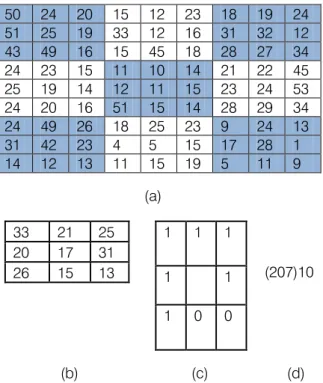
The basic LBP operators with any (P, R) (where P corresponds to the number of neighboring pixels on a circle of radius of R) only capable of extracting features on small spatial neighborhood i.e. micro level features and thus they fail in capturing larger scale structures or macro structures which are also dominant and essential features on faces. Further the grey level comparison between center pixel and the neighboring pixel may also prone to noise effect, especially when the neighboring pixels grey level values are equal or less than one to centre pixel value [41]. To overcome this Multi Region Local Binary Pattern (MB-LBP) features are introduced in the literature [42, 43]. The Multi Region Local Binary Pattern (MR-LBP) approach maintains the size of the region as V *W where V and W are multiples of three. The region of size V * W is subdivided into nine multi regions LBP’s of size N*M where N=V/3 and M=W/3. This gives the uniformity in the formation of MR-LBP. The mechanism of encoding a large neighborhood or square region into LBP is the basis for MR-LBP. The region size VxW denotes the scale of MR-LBP for R=3 and S=3, it particularly derives the basic LBP and in this case N=1 and M=1.
The average value of each of the nine sub regions represents the grey level value of pixels of basic LBP. Based on this LBP code is generated and this
represents the MR-LBP code. The scalar values i.e. average pixel grey level values of each sub region of
Global Journal of Computer Science and Technology Volume XVI Issue III Version I
27 Year 2016 ( ) F
size N*M can be computed very efficiently from integral image. Therefore MR-LBP features extraction process is very fast. However it only incurs a little more cost when compared to basic LBP operator (8,1). Even as ‘P’ increases the basic LBP feature extraction becomes costlier. The basic parameters V and W of the MR-LBP
influence the overall structure of the features. IfV and W
are small then MR-LBP captures only the local features and when V and W are large (especially V and W>=9) the MR-LBP captures both micro and macro structure features. The average grey level values of sub regions N*M over comes the noise effect, makes MR-LBP as robust, and provides large scale information in addition to micro level information. The MR-LBP mechanism on a region size9*9 is shown in Figure 2, the block sizes are 3*3. (a) 50 24 20 15 12 23 18 19 24 51 25 19 33 12 16 31 32 12 43 49 16 15 45 18 28 27 34 24 23 15 11 10 14 21 22 45 25 19 14 12 11 15 23 24 53 24 20 16 51 15 14 28 29 34 24 49 26 18 25 23 9 24 13 31 42 23 4 5 15 17 28 1 14 12 13 11 15 19 5 11 9 33 21 25 20 17 31 26 15 13 1 1 1 1 1 1 0 0 (207)10 (b) (c) (d)
The MR-LBP code is evaluated in the same way as represented in equation 6 and 7. This way the MR-LBP code represents some advantages:
• It is robust
• MR-LBP can be calculated efficiently using integral
images
• The MR-LBP represents both micro structures i.e. by
taking the average of each block and also macro
structures by representing 9 blocks under single 3*3 neighborhood.
• The resulting binary patterns as features of MR-LBP
can detect diverse image structures such as lines,
edges, spots, corners [67] at different scale and location.
• There will be fewer number MR-LBP code features
when compared to basic LBP. A basic LBP with image dimension PxQ generates(P-1)*(Q-1) LBP codes, where as a MR-LBP with a region size of VxW generates a total number of (P*Q)/(V*W) LBP
codes in a non-overlapped manner. Therefore the
implementation of the MR-LBP code feature selection is significantly easier.
Step Four:To overcome the high dimensionality problem
the present paper quantized the MR-LBP coded image
in to 10 levels ranging from 0 to 9. This reduced the
dimension of the GLCM into 10 x 10. The quantization process is done using the following equation 9.
𝐼𝐼(𝑥𝑥,𝑦𝑦) = ⎩ ⎪ ⎪ ⎨ ⎪ ⎪ ⎧0 𝑖𝑖𝑖𝑖𝐼𝐼(𝑥𝑥,𝑦𝑦)≥0𝑎𝑎𝑎𝑎𝑎𝑎𝐼𝐼(𝑥𝑥,𝑦𝑦)<26 1 𝐼𝐼(𝑥𝑥,𝑦𝑦)≥26𝑎𝑎𝑎𝑎𝑎𝑎𝐼𝐼(𝑥𝑥,𝑦𝑦)<50 2 𝐼𝐼(𝑥𝑥,𝑦𝑦)≥50𝑎𝑎𝑎𝑎𝑎𝑎𝐼𝐼(𝑥𝑥,𝑦𝑦)<75 3 𝐼𝐼(𝑥𝑥,𝑦𝑦)≥75𝑎𝑎𝑎𝑎𝑎𝑎𝐼𝐼(𝑥𝑥,𝑦𝑦)<100 4 𝐼𝐼(𝑥𝑥,𝑦𝑦)≥100𝑎𝑎𝑎𝑎𝑎𝑎𝐼𝐼(𝑥𝑥,𝑦𝑦)<125 5 𝐼𝐼(𝑥𝑥,𝑦𝑦)≥125𝑎𝑎𝑎𝑎𝑎𝑎𝐼𝐼(𝑥𝑥,𝑦𝑦)<150 6 𝐼𝐼(𝑥𝑥,𝑦𝑦)≥150𝑎𝑎𝑎𝑎𝑎𝑎𝐼𝐼(𝑥𝑥,𝑦𝑦)<175 7 𝐼𝐼(𝑥𝑥,𝑦𝑦)≥175𝑎𝑎𝑎𝑎𝑎𝑎𝐼𝐼(𝑥𝑥,𝑦𝑦)<200 8 𝐼𝐼(𝑥𝑥,𝑦𝑦)≥200𝑎𝑎𝑎𝑎𝑎𝑎𝐼𝐼(𝑥𝑥,𝑦𝑦)<225 9𝐼𝐼(𝑥𝑥,𝑦𝑦)≥225𝑎𝑎𝑎𝑎𝑎𝑎𝐼𝐼(𝑥𝑥,𝑦𝑦)≤255 (9)
Step Five: Derive GLCM on quantized MR-LBP coded
image. The GLCM is constructed with varying distances d =1, 2, 3 and 4. And on each d four GLCM’s are
constructed with 0°, 45°, 90°and 135°. Thus the present
paper derived sixteen GLCM’s and four GLCM’s on each di = {1, 2, 3, 4} .
The grey level co-occurrence matrix (GLCM) was introduced by Haralick et al. [44]. It is a second order statistical method which is reported to be able to characterize textures as an overall or average spatial relationship between grey tones in an image [45]. Its development was inspired by the conjectured from Julesz [46] that second order probabilities were sufficient for human discrimination of texture. The GLCM approach has been used in a number of applications, e.g.[47-51]. In general, GLCM could be computed as follows. First, an original texture image D is re-quantized into an image G with reduced number of grey level, Ng. A typical value of Ng is 16 or 32. Then, GLCM is computed from G by scanning the intensity of each pixel and its neighbor, defined by displacement d and angle ø. A displacement, d could take a value of 1,2,3,…n
whereas an angle, ø is limited 0°, 45°, 90°and 135°.
Step Six: Derive GLCM features with 0°, 45°, 90° and
135° on each di ={1,2,3,4} . The average values of 0°,
45°, 90° and 135°are considered by the present paper
as feature vectors for image retrieval.
Global Journal of Computer Science and Technology Volume XVI Issue III Version I
28 Year 2016 ( ) F
Figure 2:Multi Region-Local Binary Pattern Code
gener-ation (a) Division of Region of size 9*9 into ‘9’ sub regions of 3*3 (b) Representation of average values of ‘9’ sub region of 3*3 (c) LBP Representation (d) MR-LBP Code.
From the literature survey, the present paper found the ‘grey level co-occurrence matrix’ (GLCM) is a benchmark method for extracting Haralick features such as [44] (angular second moment, contrast, correlation,
variance, inverse difference moment, sum average, sum variance, sum entropy, entropy, difference variance, difference entropy, information measures of correlation and maximal correlation coefficient), or Conners' features [48] (inertia, cluster shade, cluster prominence, local homogeneity, energy and entropy). These features have been widely used in the analysis, classification and interpretation of remotely sensed data. Its aim is to characterize the stochastic properties of the spatial distribution of grey levels in an image. The GLCM features are defined below.
𝑃𝑃𝑥𝑥(𝑖𝑖) =� 𝑃𝑃(𝑖𝑖,𝑗𝑗) 𝐺𝐺−1 𝑗𝑗=0 𝑃𝑃𝑦𝑦(𝑗𝑗) =� 𝑃𝑃(𝑖𝑖,𝑗𝑗) 𝐺𝐺−1 𝑖𝑖=0 µ𝑥𝑥=� 𝑖𝑖 �𝐺𝐺−1𝑃𝑃(𝑖𝑖,𝑗𝑗) 𝑗𝑗=0 𝐺𝐺−1 𝑖𝑖=0 =� 𝑖𝑖𝑃𝑃𝑥𝑥(𝑖𝑖) 𝐺𝐺−1 𝑖𝑖=0 µ𝑦𝑦 =� �𝐺𝐺−1𝑗𝑗𝑃𝑃(𝑖𝑖,𝑗𝑗) 𝑗𝑗=0 𝐺𝐺−1 𝑖𝑖=0 =� 𝑗𝑗𝑃𝑃𝑥𝑥(𝑗𝑗) 𝐺𝐺−1 𝑗𝑗=0 𝜎𝜎2 𝑥𝑥= � �𝑖𝑖 −µ𝑥𝑥� 2 �𝐺𝐺−1𝑃𝑃(𝑖𝑖,𝑗𝑗) 𝑗𝑗=0 𝐺𝐺−1 𝑖𝑖=0 = � �𝑃𝑃𝑥𝑥(𝑖𝑖)−µ𝑥𝑥(𝑖𝑖)� 2 𝐺𝐺−1 𝑖𝑖=0 𝜎𝜎2 𝑦𝑦 = � �𝑖𝑖 −µ𝑦𝑦� 2 �𝐺𝐺−1𝑃𝑃(𝑖𝑖,𝑗𝑗) 𝑖𝑖=0 𝐺𝐺−1 𝑗𝑗=0 = � �𝑃𝑃𝑦𝑦(𝑗𝑗)−µ𝑥𝑥(𝑗𝑗)� 2 𝐺𝐺−1 𝑗𝑗=0 and 𝑃𝑃𝑥𝑥+𝑦𝑦(𝑘𝑘) =� � 𝑃𝑃(𝑖𝑖,𝑗𝑗) 𝐺𝐺−1 𝑗𝑗=0 𝐺𝐺−1 𝑖𝑖=0 𝑖𝑖+𝑗𝑗=𝑘𝑘 for k=0, 1, 2, 3…,2(G-1). 𝑃𝑃𝑥𝑥−𝑦𝑦(𝑘𝑘) =� � 𝑃𝑃(𝑖𝑖,𝑗𝑗) 𝐺𝐺−1 𝑗𝑗=0 𝐺𝐺−1 𝑖𝑖=0 |𝑖𝑖 − 𝑗𝑗| =𝑘𝑘 for k=0, 1, 2, 3…,(G-1).
µ𝑥𝑥, µ𝑦𝑦, 𝜎𝜎𝑥𝑥 and 𝜎𝜎𝑦𝑦 are the means and standard
deviations of Px, Py. Px( i ) is ith entry in the marginal-probability matrix obtained by summing the rows of P(i, j).
• Homogeniety, Angular Second Moment (ASM):
ASM= ∑ ∑𝐺𝐺−1{𝑃𝑃(𝑖𝑖,𝑗𝑗)}2
𝑗𝑗=0
𝐺𝐺−1
𝑖𝑖=0 (10)
ASM is a measure of homogeneity of an image. A homogeneous scene will contain only a few grey levels, giving a GLCM with only a few but relatively high values of P (i, j ). Thus, the sum of squares will be high.
• Energy Energy :
( )
2 ,,
∑
ijP
i
j
(11) IDM= ∑𝑖𝑖𝐺𝐺−=01∑𝑗𝑗𝐺𝐺−=011+(𝑖𝑖−𝑗𝑗1 (12))2 P(i,j)IDM is also influenced by the homogeneity of
the image. Because of the weighting factor (1+(i −j
)2)−1 IDM will get small contributions from
inhomogeneous areas (i != j ). The result is a low IDM
value for inhomogeneous images, anda relatively higher
value for homogeneous images.
• Contrast :
Contrast = ∑𝐺𝐺−1𝑎𝑎2
𝑎𝑎=0 �∑ ∑𝑖𝑖𝐺𝐺=1 𝐺𝐺𝑗𝑗=1𝑃𝑃(𝑖𝑖,𝑗𝑗)�, |𝑖𝑖 − 𝑗𝑗| =𝑎𝑎 (13)
This measure of contrast or local intensity variation will favor contributions from P (i, j ) away from the diagonal, i.e. i ! = j.
• Correlation : Correlation = ∑ ∑ {𝑖𝑖𝑖𝑖𝑗𝑗}𝑖𝑖𝑃𝑃(𝑖𝑖,𝑗𝑗)−�µ𝑥𝑥𝑖𝑖µ𝑦𝑦� 𝜎𝜎𝑥𝑥𝑖𝑖𝜎𝜎𝑦𝑦 𝐺𝐺−1 𝑗𝑗=0 𝐺𝐺−1 𝑖𝑖=0 (14)
Correlation is a measure of grey level linear dependence between the pixels at the specified positions relative to each other.
• Entropy :
Inhomogeneous scenes have low first order entropy, while a homogeneous scene has high entropy.
• Sum of Squares, Variance:
VARIANCE= ∑ ∑𝐺𝐺−1(𝑖𝑖 − µ)2𝑃𝑃(𝑖𝑖,𝑗𝑗)
𝑗𝑗=0
𝐺𝐺−1
𝑖𝑖=0 (16)
This feature puts relatively high weights on the elements that differ from the average value of P(i, j).
• Sum of Average : AVERAGE= ∑2𝑖𝑖=0𝐺𝐺−1𝑖𝑖𝑃𝑃𝑥𝑥+𝑦𝑦(𝑖𝑖) (17) • Sum Entropy(SENT) : SENT= − ∑2𝑖𝑖=0𝐺𝐺−2𝑃𝑃𝑥𝑥+𝑦𝑦(𝑖𝑖)𝑙𝑙𝑙𝑙𝑙𝑙 �𝑃𝑃𝑥𝑥+ 𝑦𝑦(𝑖𝑖)� (18) • Difference Entropy(DENT): DENT= − ∑𝐺𝐺−𝑖𝑖=01𝑃𝑃𝑥𝑥+𝑦𝑦(𝑖𝑖)𝑙𝑙𝑙𝑙𝑙𝑙 �𝑃𝑃𝑥𝑥+𝑦𝑦( (19)𝑖𝑖)� • Inertia : INERTIA=∑ ∑𝐺𝐺−1{𝑖𝑖 − 𝑗𝑗}2𝑖𝑖𝑃𝑃(𝑖𝑖,𝑗𝑗) 𝑗𝑗=0 𝐺𝐺−1 𝑖𝑖=0 (20) • Cluster Shade : SHADE= ∑𝐺𝐺−𝑖𝑖=01∑𝑗𝑗𝐺𝐺−=01�𝑖𝑖+𝑗𝑗 − µ𝑥𝑥− µ𝑦𝑦�3𝑖𝑖𝑃𝑃(𝑖𝑖,𝑗𝑗) (21) • Cluster Prominence: PROM= ∑𝐺𝐺−𝑖𝑖=01∑𝑗𝑗𝐺𝐺−=01�𝑖𝑖+𝑗𝑗 − µ𝑥𝑥− µ𝑦𝑦�4𝑖𝑖𝑃𝑃(𝑖𝑖,𝑗𝑗) (22)
Step Seven: Use similarity distance measure for
comparing the query image feature vector and feature vectors of the database images.
Entropy= − ∑ ∑𝐺𝐺−1𝑃𝑃(𝑖𝑖,𝑗𝑗)𝑖𝑖log (𝑃𝑃(𝑖𝑖,𝑗𝑗))
𝑗𝑗=0 𝐺𝐺−1
𝑖𝑖=0 (15)
Global Journal of Computer Science and Technology Volume XVI Issue III Version I
29 Year 2016 ( ) F
where G is the number of grey levels used. µ is the mean value of P.
• Local Homogeneity, Inverse Difference Moment
The present model extracts all 16 GLCM features on the MR-LBP and also HSV color space histograms on the database images and query image. The present retrieval model selects 16 top images from the database images that are matching with query image. And also experimented with more number of top images and retrieval performance is measured. The image retrieval is accomplished by measuring the distance between the query image and database images. The present paper used Euclidean distance as the distance measure and as given below
𝐷𝐷𝑖𝑖𝐷𝐷𝐷𝐷𝐷𝐷(𝑇𝑇𝑎𝑎,𝐼𝐼𝑎𝑎) = �∑𝑖𝑖,𝑗𝑗=1�𝑖𝑖𝑖𝑖(𝑇𝑇𝑎𝑎)− 𝑖𝑖𝑗𝑗(𝐼𝐼𝑎𝑎)�2�
1/2
(23)
WhereTn query image, In imagein database;
IV.
R
esults andD
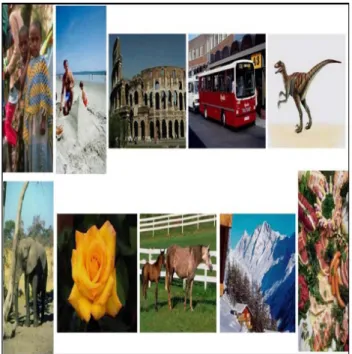
iscussionsThe present paper carried out image retrieval on Corel database [52]. This database consists of a large number of images of various contents ranging from animals to outdoor sports to natural images. These images have been pre classified into different categories each of size 100 by domain professionals. Researchers are of the opinion that the Corel database meets all the requirements to evaluate an image retrieval system, due to its large size and heterogeneous content. For our experiment, we have collected 1000 images form database compromising 10 classes. That is each class consists of 100 images. The classes of image are
displayed in Figure 3 i.e. African, Sea shore, Tombs,
Bus, Dinosaur, Elephants, Fancy Flowers, Horses, Valleys and Evening Skies. Each category has images with resolution of either 256x384 or 384X256. The performance of the present model is evaluated in terms of average precision (APR), average recall rate (ARR) and accuracy. Precision is the ratio of number of retrieved images Vs. the number of relevant images retrieved. The recall is the ratio of number of relevant image retrieval Vs. total number of relevant images in the database. 𝑝𝑝𝑝𝑝𝑝𝑝𝑝𝑝𝑖𝑖𝐷𝐷𝑖𝑖𝑙𝑙𝑎𝑎= 𝑁𝑁𝑁𝑁𝑁𝑁𝑁𝑁𝑝𝑝𝑝𝑝𝑙𝑙𝑖𝑖𝑝𝑝𝑝𝑝𝑙𝑙𝑝𝑝𝑁𝑁𝑎𝑎𝑎𝑎𝐷𝐷𝑖𝑖𝑁𝑁𝑎𝑎𝑙𝑙𝑝𝑝𝐷𝐷𝑝𝑝𝑝𝑝𝐷𝐷𝑝𝑝𝑖𝑖𝑝𝑝𝑎𝑎𝑇𝑇𝑙𝑙𝐷𝐷𝑎𝑎𝑙𝑙𝑎𝑎𝑁𝑁𝑁𝑁𝑁𝑁𝑝𝑝𝑝𝑝𝑙𝑙𝑖𝑖𝑖𝑖𝑁𝑁𝑎𝑎𝑙𝑙𝑝𝑝 𝐷𝐷𝑝𝑝𝑝𝑝𝐷𝐷𝑝𝑝𝑖𝑖𝑝𝑝𝑁𝑁𝑝𝑝𝑎𝑎 (24) 𝑅𝑅𝑝𝑝𝑝𝑝𝑎𝑎𝑙𝑙𝑙𝑙 = 𝑇𝑇𝑙𝑙𝐷𝐷𝑎𝑎𝑙𝑙𝑎𝑎𝑁𝑁𝑁𝑁𝑁𝑁𝑝𝑝𝑝𝑝𝑙𝑙𝑖𝑖𝑝𝑝𝑝𝑝𝑙𝑙𝑝𝑝𝑁𝑁𝑎𝑎𝑎𝑎𝐷𝐷𝑖𝑖𝑁𝑁𝑎𝑎𝑙𝑙𝑝𝑝𝐷𝐷𝑖𝑖𝑎𝑎𝑎𝑎𝑎𝑎𝐷𝐷𝑎𝑎𝑁𝑁𝑎𝑎𝐷𝐷𝑝𝑝𝑁𝑁𝑁𝑁𝑁𝑁𝑁𝑁𝑝𝑝𝑝𝑝𝑙𝑙𝑖𝑖𝑝𝑝𝑝𝑝𝑙𝑙𝑝𝑝𝑁𝑁𝑎𝑎𝑎𝑎𝐷𝐷𝑖𝑖𝑁𝑁𝑎𝑎𝑙𝑙𝑝𝑝𝐷𝐷𝑝𝑝𝑝𝑝𝐷𝐷𝑝𝑝𝑖𝑖𝑝𝑝𝑁𝑁𝑝𝑝𝑎𝑎 (25) 𝐴𝐴𝑃𝑃𝑅𝑅(𝑎𝑎) = 𝑁𝑁1 𝐶𝐶∑ 𝑝𝑝𝑝𝑝𝑝𝑝𝑝𝑝𝑖𝑖𝐷𝐷𝑖𝑖𝑙𝑙𝑎𝑎(𝐼𝐼𝑖𝑖, 𝑁𝑁𝐶𝐶 𝑖𝑖=1 ) (26) 𝐴𝐴𝑅𝑅𝑅𝑅(𝑎𝑎) = 𝑁𝑁1 𝐶𝐶∑ 𝑝𝑝𝑝𝑝𝑝𝑝𝑎𝑎𝑙𝑙𝑙𝑙(𝐼𝐼𝑖𝑖, 𝑁𝑁𝐶𝐶 𝑖𝑖=1 ) (27) 𝐴𝐴𝑝𝑝𝑝𝑝𝑁𝑁𝑝𝑝𝑎𝑎𝑝𝑝𝑦𝑦= 𝐴𝐴𝑃𝑃𝑅𝑅 ( 𝑎𝑎)+(𝐴𝐴𝑅𝑅𝑅𝑅(𝑎𝑎) 2 (28)
Where 𝑝𝑝𝑝𝑝𝑝𝑝𝑝𝑝𝑖𝑖𝐷𝐷𝑖𝑖𝑙𝑙𝑎𝑎(𝐼𝐼𝑖𝑖,) is precision value of image Ii , Nc
is number of images in each category.
The present paper compute GLCM features on MR-QLBP using various distance values: D = 1, 2, 3, 4 and color histograms. The query matching is performed using Euclidean distance. The present retrieval model
selects 16 top images from the database images that are matching with query image. And also experimented with more number of top images and retrieval
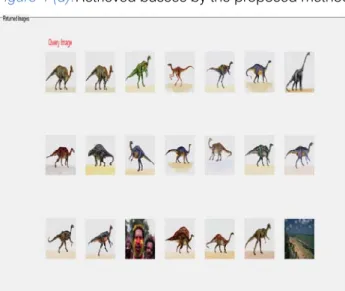
performance is measured. Figure 4(a)-4(e) shows five
examples of retrieval images, i.e. one image from each class, by the proposed method with D=4 for 16 top matched images and top left most image is the query image.
Figure 3: Considered 10 classes of Corel database from
top left tobottom right African, Sea shore, Tombs, Bus,
Dinosaur, Elephants, Fancy Flowers, Horses, Valleys
and EveningSkies.
Figure 4(a):Retrieved African images by the proposed
method
Global Journal of Computer Science and Technology Volume XVI Issue III Version I
30 Year 2016 ( ) F
Figure 4 (b) :Retrieved monuments by the proposed method
Figure 4(c): Retrieved beach sand images by the
proposed method
Figure 4 (d):Retrieved busses by the proposed method
Figure 4(e):Retrieved dinosaurs by the proposed
method
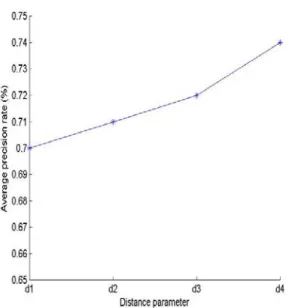
The average precision, recall rates and accuracy computed based on MR-QLBP and HSV histograms listed in Tables 1. The best performance of integrated Q-LBP is obtained when D = 4. The average precession, recall rates and accuracy of proposed method for different d values are plotted in graphs, indicated in Figure 5, Figure 6 and Figure 7 respectively.
Table 1: Average precision rate of all classes of images with various distance measures for 16 top matched images
Proposed method Distance parameter
d=1 d=2 d=3 d=4 MR-QLBP Precision 0.70 0.71 0.72 0.74 Recall 0.37 0.41 0.42 0.44 Accuracy 0.54 0.56 0.57 0.59
Global Journal of Computer Science and Technology Volume XVI Issue III Version I
31 Year 2016 ( ) F
Figure 5:Average precision graph for proposed method (MR-QLBP) for different d values
Figure 6:Average recall graph for proposed method
(MR-QLBP) for different d values
Figure 7:Accuracy graph for proposed method
(MR-QLBP) for different d values
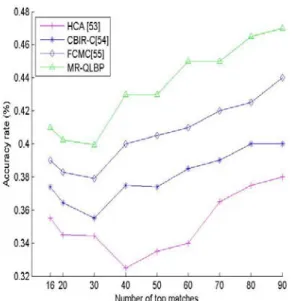
The average precision rate of proposed method MR-QLBP and existing methods i.e. hierarchical clustering algorithms (HCA), Content Based Image Retrieval Using Clustering (CBIR-C), Fuzzy C-Means clustering scheme (FCMC) is given in Table 2 and plotted graphs as shown in Figure 8, Figure 9 and Figure 10. From these graphs, it is clearly seen that the proposed MR-QLBP outperforms the HCA, CBIR-C, and FCMC over the considered database using both ARP, ARR and average accuracy evaluation metrics.
Table 2: Average precession rate on each class of images between existing and proposed method for 16 top
retrieved images
Image category and the precision (%)
Methods Africans monuments Sand Buses Dinosaurs Average
HCA [53] 0.39 0.42 0.44 0.48 0.5 0.45
CBIR_C[54] 0.4 0.43 0.46 0.49 0.52 0.46
FCMC[55] 0.61 0.6 0.66 0.67 0.7 0.64
MR-QLBP 0.69 0.71 0.73 0.74 0.72 0.72
Global Journal of Computer Science and Technology Volume XVI Issue III Version I
32 Year 2016 ( ) F
Figure 8: Average Performance curve (precision) using HCA, CBIR-C, FCMC and proposed MR-QLBP method
Figure 9: Average Performance curve (recall) using
HCA, CBIR-C, FCMC and proposed MR-QLBP method
Figure 10: Average accuracy graph using HCA, CBIR-C,
FCMC and proposed MR-QLBP method
V.
C
onclusionsThe present paper has proposed and successfully implemented the quantized approach for image retrieval i.e. MR-QLBP on Corel databases. The proposed MR-QLBP captured image features efficiently. The GLCM features are evaluated and retrieval performance is noted using average precision, average recall and accuracy parameters. The proposed method showing evocative performance compare with other existing methods. The proposed method also compared with the existing methods and the precision and recall graphs indicates the high performance of the proposed method when compared with existing methods HCA, CBIR-C and FCMC.
R
eferencesR
éférencesR
eferencias1. H. Mohamadi, A. Shahbahrami, J. Akbari, “ Image
retrieval using the combination of text-based and content-based algorithms”, Journal of AI and Data Mining, Published online: 20, February-2013.
2. Pabboju , S. and gopal, R. ( 2009). A Novel Approa-
ch For Content- Based Image Global and Region Indexing and Retrieval System Using Features. International Journal of Computer Science and Net- work Security. 9(2), 15-21.
3. Li, X., Shou, L., Chen, G., Hu, T. and Dong, J.
(2008). Modelling Image Data for Effective Indexing and Retrieval In Large General Image Database. IEEE Transaction on Knowledge and Data Enginee- ring. 20(11), 1566-1580.
4. Demerdash, O., Kosseim, L. and Bergler, S. (2008).
CLaC at Image CLEFphoto 2008, ImageCLEF Working Notes.
5. K. C. Sia and Irwin King. “Relevance feedback
based on parameter estimation of target distribu-
Global Journal of Computer Science and Technology Volume XVI Issue III Version I
33 Year 2016 ( ) F
tion” In IEEE International Joint Conference on Neural Networks, pages 1974–1979, 2002.
6. Simon Tong and Edward Chang. “Support vector
machine active learning for image retrieval. In MULTIMEDIA “in Proceedings of the ninth ACM international conference on Multimedia, pages 107– 118.2001.
7. Jisha. K.P, Thusnavis Bella Mary. I, Dr. A.Vasuki,
“An Image Retrieve Al Technique Based On Texture Features Using Semantic Properties”, International Conference on Signal Processing, Image Processing and Pattern Recognition [ICSIPR], 2013.
8. Swati Agarwal, A. K. Verma, Preetvanti Singh, “Con-
tent Based Image Retrieval using Discrete Wavelet Transform and Edge Histogram Descriptor”, International Conference on Information Systems and Computer Networks, proceeding of IEEE xplo- re-2013.
9. Xiang-Yang Wang, Hong-Ying Yang, Dong-Ming Li
“A new content-based image retrieval technique using color and texture information”, Computers & Electrical Engineering, Volume 39, Issue 3, April 2013, Pages 746-761.
10. Heng chen, zhicheng zhao “an effective relevance
feedback algorithm for image retrieval” 978-1-4244-6853-9/10/ 2010 IEEE.
11. Monika Daga, Kamlesh Lakhwani, “A Novel Content
Based Image Retrieval Implemented By NSA Of AIS”,International Journal Of Scientific & Technology Research Volume 2, Issue 7, July 2013 ISSN 2277-8616.
12. S. Nandagopalan, Dr. B. S. Adiga, and N. Deepak,
“A Universal Model for Content-Based Image Retrieval”, World Academy of Science, Engineering and Technology, Vol:2 2008-10-29.
13. ROI Image Retrieval Based on the Spatial Structure
of Objects, Weiwen ZOU1 , Guocan FENG2, 12 Mathematics and Computational School, Sun Yat-sen University, Guangzhou, China, 510275 paper: 05170290.
14. H. Yamamoto, H. Iwasa, N. Yokoya, and H.
Takemura, “Content- Based Similarity Retrieval of Images Based on Spatial Color Distributions”, ICIAP '99 Proceedings of the 10th International Conference on Image Analysis and Processing.
15. Y Venkateswarlu, B Sujatha, V Vijaya Kumar, Image
classification based on center symmetric fuzzy texture unit matrix, International journal of scientific & engineering research, Vol.13, No.11, pp.5-11, Oct-2012, ISSN 2229-5518.
16. V.Vijaya Kumar, B. Eswar Reddy, U.S.N. Raju, K.
Chandra Sekharan, An innovative technique of texture classification and comparison based on long linear patterns, Journal of computer science, Science publications, Vol.3, No.8, pp.633-638, Aug-2007, ISSN: 1552-6607.
17. V Vijaya Kumar, U S N Raju, K Chandra Sekaran, V
V Krishna, Employing long linear patterns for texture classification relying on wavelets, ICGST-Graphics, vision and image processing (ICGST-GVIP), Vol.8, No.5, pp. 13-21, Jan-2009, ISSN: 1687-398X.
18. V. Vijaya Kumar, K. Srinivasa Reddy, V. Venkata
Krishna , Face Recognition Using Prominent LBP Model; International Journal of Applied Engineering Research , Vol. 10, Issue 2, pp. 4373-4384, 2015, ISSN: 0973-4562
19. M. Chandra Mohan, V. Vijaya Kumar U.S.N. Raju,
New face recognition method based on texture fea- tures using linear wavelet transforms, International journal of computer science and network security (IJCSNS), Vol.9 No.12, pp.223-230, Dec-2009, ISSN: 1738-7906.
20. P. Chandra Sekhar Reddy, B. Eswara Reddy, V.
Vijaya Kumar, Fuzzy based image dimensionality reduction using shape primitives for efficient face recognition, ICTACT- Journal on image and video processing, Vol. 04, NO. 02, pp. 695-701, Nov-2013, ISSN: 0976-9102.
21. V Vijaya Kumar, Gorti Satyanaraya Murty, PS V V S
R Kumar, Classification of facial expressions based on transitions derived from third order neighborhood LBP, Global journal of computer science and technology graphics & vision (GJCST), Vol.14, N0.1, pp. 1-12, Jan-2014, ISSN: 0975-4350.
22. G S Murty, J SasiKiran, V.Vijaya Kumar, Facial
expression recognition based on features derived from the distinct LBP and GLCM, International journal of image, graphics and signal processing (IJIGSP), , Vol.2, No.1, pp. 68-77,2014, ISSN: 2074-9082.
23. V. Vijaya Kumar, Saka Kezia, I. Santi Prabha, A new
texture segmentation approach for medical images, International journal of scientific & engineering research, Vol. 4, No.1, pp.1-5, January-2013, ISSN: 2229-5518.
24. V. Vijaya Kumar, U.S.N. Raju, M. Radhika Mani, A.
Narasimha Rao, Wavelet based texture segmen- tation methods based on combinatorial of morpho- logical and statistical operations, International jour- nal of computer science and network security (IJCSNS), Vol.8, No.8, pp.176-181, Aug-2008, ISSN : 1738-7906.
25. Saka Kezia, I. Santi Prabha, V. Vijaya Kumar, A
color-texture based segmentation method to extract object from background, International journal image, and graphics and signal processing, Vol. 5, No. 3, pp.19-25, March-2013, ISSN: 2074- 9082.
26. NG rao, DVVKDPSVS Rao, Novel Approaches of
evaluating Texture Based Similarity Features for Efficient Medical Image Retrieval System, International Journal Of Computer Applications, ISSN-0975-8887 20(7), 20-26.
Global Journal of Computer Science and Technology Volume XVI Issue III Version I
34 Year 2016 ( ) F
27. A Obulesu, JSKiran, VV Kumar, Facial image retrieval based on local and regional features, IEEE- 2015 International Conference on Applied and Theo-retical Computing and Communication Technology (iCATccT), 29-31 Oct. 2015, Pp:841 – 846.
28. V.Vijaya Kumar, A. Srinivasa Rao, YK Sundara
Krishna, Dual Transition Uniform LBP Matrix for Effi- cient Image Retrieval, I.J. Image, Graphics and Signal Processing, 2015, 8, 50-57.
29. Vijaya Kumar, N. Gnaneswara Rao, A.L.Narsimha
Rao, And V.Venkata Krishna4, IHBM: Integrated histogram bin matching for similarity measures of color image retrieval, International journal of signal processing, image processing and pattern recog nition, Vol. 2, No.3, pp. 109-120, Sep-2009, ISSN: 2005-4254.
30. Hadid and G. Zhao, “Computer vision using local
binary patterns,” Vol. 40. Springer, 2011.
31. T. Ojala, M. Pietikainen and T. Maenpaa,
“Multireso-lution gray-scale and rotation invariant texture classification with local binary patterns,” IEEE Transactions on Pattern Analysis and Machine Intelligence, vol. 24, no. 7, pp. 971-987, 2002.
32. X. Tan and B. Triggs, “Enhanced local texture
feature sets for face recognition under difficult lighting conditions,” IEEE Transactions on Image Processing, vol. 19, no. 6, pp. 1635-1650, 2010.
33. B. Zhang, Y. Gao, S. Zhao and J. Liu, “Local
derivative pattern versus local binary pattern: face recognition with high-order local pattern descriptor,” IEEE Transactions on Image Processing, vol. 19, no. 2, pp. 533-544, 2010.
34. S.R. Dubey, S.K. Singh, and R.K. Singh, “Rotation
and Illumination Invariant Interleaved Intensity Order Based Local Descriptor,” IEEE Transactions on Image Processing, vol. 23, no. 12, pp. 5323-5333, 2014.
35. S. Murala, R.P. Maheshwari and R. Bala
subrama-nian, “Local tetra patterns: a new feature descriptor for content-based image retrieval,” IEEE Transac-tions on Image Processing, vol. 21, no. 5, pp. 2874-2886, 2012.
36. S. Zhao, Y. Gao and B. Zhang, “SOBEL-LBP,” In
Proceedings of the 15th IEEE International Confe
-rence on Image Processing, pp. 2144-2147, 2008.
37. J. Sun, G. Fan and X. Wu, “New local edge binary
patterns for image retrieval,” In Proceedings of the 20th IEEE International Conference on Image Processing, pp. 4014-4018, 2013.
38. K. Jeong, J. Choi, and G. Jang, “Semi-Local
Structure Patterns for Robust Face Detection,” IEEE Signal Processing Letters, vol. 22, no. 9, pp. 1400-1403, 2015.
39. S. Murala and QM J. Wu, “Spherical symmetric 3D
local ternary patterns for natural, texture and biomedical image indexing and retrieval,” Neuroco-mputing, vol. 149, pp. 1502-1514, 2015.
40. A.P. James, “One-sample face recognition with
local similarity decisions,” International Journal of Applied Pattern Recognition, vol. 1, no. 1, pp. 61-80, 2013.
41. X.Tan and B.Trigs, Enhanced local texture feature
set for face recognition under difficult lightening conditions, Image Processing, IEEE Transaction, 19(6) (2010) 1635-1650.
42. S.Liao, X.Zhu Z.Lei and L.Zhang, Learning multi
scale block local binary patterns for face recogni-tion, Advances in Biometrics, Springer, (2007) 828-837.
43. V. Vijaya kumar, K. Srinivasa reddy, Face
Recog-nition Using Multi Region Prominent Lbp Represe-ntation, International Journal of Electrical And Com-puter Engineering (IJECE), 2016, accepted
44. Haralick RM , Shanmugan K and Dinstein I,
"Textural features for image classification", IEEE
Trans. Sysr., Man., Cybern., Vol. SMC-3, no. 6, pp.
610-621, 1973.
45. R.F. Walker, “Adaptive Multi-scale Texture Analysis
with Application to Automated Cytology”, Ph.D. Thesis, The University of Queensland, 1997.
a. Julesz, “Visual Pattern Discrimination”, IRE
Transactions on Information Theory IT, Vol. 8, no. 2, pp. 84-92, 1962.
46. M.M. Trivedi, R.M. Haralick, R.W. Conners, and S.
Goh, ”Object Detection based on Gray Level Coocurrence”, Computer Vision, Graphics, and Image Processing, Vol. 28, pp. 199-219, 1984.
47. R. W. Conners, M. Trivedi, and C.A. Harlow,
“Segmentation of a High Resolution Urban Scene using Texture Operators”, Computer Vision, Graphics, and Image Processing, Vol. 25, no. 3, pp. 273-310, 1984.
48. M. Iizulca, ”Quantitative evaluation of similar images
with quasi-gray levels”, Computer Vision, Graphics,
and Image Processing, Vol. 38, pp. 342-360, 1987.
49. L.H. Siew, R.H. Hodgson, and E.J. Wood, ”Texture
Measures for Carpet Wear Asessment”, IEEE Trans. on Pattern Analysis and Machine Intell., Vol.
PAMI-10, pp. 92-105, 1988.
50. R.W. Conners and C.A. Harlow, ”A theoretical
comparison of texture algorithms”, IEEE Trans. on Pattern Analysis and Machine Intell., Vol. PAMI-2, pp. 204-222, 1980.
51. http://wang.ist.psu.edu/.
52. K. Jarrah,S. Krishnan, L. Guan , "Automatic
content-based image retrieval using hierarchical clustering algorithms," in Proc. International Joint Conference on Neural Networks (IJCNN '06), Oct. 2006,
Vancouver, BC pp. 3532 -3537.
53. Ms. Urvashi Chavan1, Prof. N. M. Shahane2,
Content Based Image Retrieval Using Clustering, International Journal of Application or Innovation in Engineering & Management (IJAIEM), Volume 3, Issue 10, October 2014
Global Journal of Computer Science and Technology Volume XVI Issue III Version I
35 Year 2016 ( ) F
54. L. Pengyu, J. Kebin, Z. Peizhen, “An effective method of image retrieval based on modified Fuzzy C-Means clustering scheme”, Proceeding ICSP2006.
Global Journal of Computer Science and Technology Volume XVI Issue III Version I
36 Year 2016 ( ) F
Global Journals Inc. (US)
Guidelines Handbook 2016