Manotumruksa, Jarana (2019) Effective neural architectures for
context-aware venue recommendation. PhD thesis.
https://theses.gla.ac.uk/76735/
Copyright and moral rights for this work are retained by the author
A copy can be downloaded for personal non-commercial research or study,
without prior permission or charge
This work cannot be reproduced or quoted extensively from without first
obtaining permission in writing from the author
The content must not be changed in any way or sold commercially in any
format or medium without the formal permission of the author
When referring to this work, full bibliographic details including the author,
title, awarding institution and date of the thesis must be given
E
FFECTIVE
N
EURAL
A
RCHITECTURES
FOR
C
ONTEXT
-A
WARE
V
ENUE
R
ECOMMENDATION
J
ARANA
M
ANOTUMRUKSA
SUBMITTED IN FULFILMENT OF THE REQUIREMENTS FOR THE DEGREE OF Doctor of Philosophy
S
CHOOL OF
C
OMPUTING
S
CIENCE
C
OLLEGE OFS
CIENCE ANDE
NGINEERINGU
NIVERSITY OFG
LASGOWNOVEMBER2019
Abstract
Users in Location-Based Social Networks (LBSNs), such as Yelp and Foursquare, can search for interesting venues such as restaurants and museums to visit, or share their location with their friends by making an implicit feedback (e.g. checking in at venues they have visited). The users can also leave explicit feedback on the venues they have visited by providing rat-ings and/or comments. Such explicit and implicit feedback by the users provide rich infor-mation about both users and venues, and thus can be leveraged to study the users’ movement in urban cities, as well as enhance the quality of personalised venue recommendations. Un-like traditional recommendation systems (e.g. book and movie recommendation systems), making effective venue recommendations is more challenging because we need to take into account the users’ current context (e.g. time of the day, user’s current location as well as his recently visited venues).
Two common techniques that are widely used in the literature for venue recommen-dation systems are Matrix Factorisation (MF) and Bayesian Personalised Ranking (BPR). MF is a popular Collaborative Filtering (CF) technique that can leverage the users’ explicit feedback (e.g. the numerical ratings) to predict the users’ ratings on the venues and hence relevant venues can be suggested to the users based on these predicted ratings. On the other hand, BPR is a pairwise ranking-based model that can leverage implicit feedback to generate effective top-K venue recommendations. In this thesis, based upon MF and BPR models, we aim to generate effectivecontext-awarevenue recommendation that a user may wish to visit based on the user’s historical explicit and implicit feedbacks, the user’s contextual informa-tion (e.g. the user’s current locainforma-tion and time of the day) and addiinforma-tional informainforma-tion (e.g. the geographical location of venues and users’ social relationships). To achieve this goal, we need to address the following challenges: namely (C1) modelling the users’ preferences and the characteristic of venues, (C2) capturing the complex structure of user-venue inter-actions in a Collaborative Filtering manner, (C3) modelling the users’ short-term (dynamic) preferences from the sequential order of user’s observed feedback as well as the contextual information associated with the successive feedback, (C4) generating accurate top-K venue recommendations based on the users’ preferences using a pairwise ranking-based model and
(C5) appropriately sampling potential negative instances to train a ranking-based model. First, to address challengeC1, we leverage the users’ explicit feedback (e.g. their rat-ings and the textual content of the comments) and additional information (e.g. users’ social relationships) to effectively model the users’ preferences and the characteristics of venues. In particular, we propose a novel regularisation technique and a factorisation-based model that leverages the users’ explicit feedback and the additional information to improve the rat-ing prediction accuracy of the traditional MF model. Experiments conducted on a large scale rating dataset on LBSN demonstrate that the textual content of comments plays an important role in enhancing the accuracy of rating prediction.
Second, we investigate how to leverage the users’ implicit feedback and additional in-formation such as the users’ social relationship and the geographical location of venues to improve the quality of top-K venue recommendations. We argue that the potential negative instances can be effectively sampled based on the social correlations between users and their friends as well as the geographical influences between the users’ and venues’ geographi-cal location. In particular, to address challengesC4 andC5, we propose a novel pairwise ranking-based framework for top-K venue recommendations that can incorporate multiple sources of additional information (e.g. the users’ social relationship and the geographical location of venues) to effectively sample the potential negative instances. Experimental re-sults on three large scale checkin and rating datasets from LBSNs demonstrate that the social correlations and the geographical influences play an important role to the quality of sampled negative instances and hence can improve the quality of top-K venue recommendations.
Finally, to address challengesC2andC3, we propose a framework for context-aware venue recommendations that exploits Deep Neural Network (DNN) models to effectively capture the complex structure of user-venue interactions and the users’ long-term (dynamic) preferences from their sequential order of checkins. In particular, within the framework, we propose a novel Recurrent Neural Network (RNN) architecture that can effectively in-corporate the contextual information associated with the successive implicit feedback (e.g. the time interval and the geographical distance between two successive checkins) to gener-ate high quality context-aware venue recommendations. Experimental results on three large scale checkin and rating datasets from LBSNs demonstrate the effectiveness and robustness of our proposed framework for context-aware venue recommendations. In particular, the results demonstrate that the sequential order of users’ implicit feedback can be leveraged to effectively improve the effectiveness of context-aware venue recommendation system. In addition, the time intervals and the geographical distances between two successive checkins play an important role in capturing the users’ short-term preferences.
Acknowledgements
This thesis has been one of the most interesting journeys of my life. I have learned tremen-dously from this journey. I owe my deepest gratitude to various people for their immense support during the course of my PhD.
First and foremost, I would like to express my sincere gratitude to my supervisors, Craig Macdonald and Iadh Ounis, for their endless support and inspiration. Without their insightful advice and extensive support, this work would have not been possible.
I would also like to thank my colleagues and friends at the Terrier team and the school of computing science for collaboration and support: Anjie Fang, Graham MacDonald, Xiao Yang, Xi Wang, Ting Su, Richard McCreadie, Stuart Mackie, Romain Deveaud, Saul Vargas, Sean Moran, Jeff Dalton, Nut Limosopathan, Eugene Kharitonov, David Maxwell, Horatiu Bota, David Paule, Stewart Whiting, Fajie Yuan, Colin Wilkie, Fatma Elsafoury, and Rami S. Alkhawaldeh. I have learned a lot from them. It has been an honour and a pleasure to work with them.
I am grateful to Bowei Chen and Fabio Crestani for their thoughtful feedback and suggestions during my PhD viva, to Nick Craswell and Jaap Kamps for mentoring me in SIGIR 2017 Doctoral Consortium.
I am also thankful to my mentors at SignalAI, Dyaa Albakour and Miguel Martinez, and my mentors at Microsoft, Bhaskar Mitra, Chen Zhou and Saurabh Tiwary, for great internship experiences.
Last but not least, I am most grateful to my family, Jarean Saebang, Manee Man-otumraksa, Jaranee ManMan-otumraksa, Jarani Jaranee ManMan-otumraksa, and my uncle, Suchart Manotumraksa, for their endless support and love throughout my life.
Table of Contents
Abstract i
Acknowledgements iii
List of Figures ix
List of Tables xii
1 Introduction 1 1.1 Motivations . . . 1 1.2 Thesis Statement . . . 5 1.3 Contributions . . . 5 1.4 Origins of Material . . . 9 1.5 Thesis Outline . . . 10 2 Background 13 2.1 Overview of Recommendation Systems . . . 13
2.1.1 Basic Models of Recommendation Systems . . . 15
2.1.1.1 Collaborative Filtering-Based Recommendation Systems 15 2.1.1.1.1 Memory-based Collaborative Filtering Approaches 16 2.1.1.1.2 Model-based Collaborative Filtering Approaches 17 2.1.1.1.3 Bayesian Personalised Ranking (BPR) . . . 18
2.1.2 Evaluation of Recommendation Systems . . . 20
Table of Contents
2.1.2.1.1 User Studies . . . 21
2.1.2.1.2 Online Evaluations . . . 21
2.1.2.1.3 Offline Evaluations . . . 22
2.1.2.2 Evaluation Metrics . . . 23
2.2 Basic Architecture of Deep Neural Networks . . . 27
2.2.1 Multi-Layer Perceptron (MLP) . . . 27
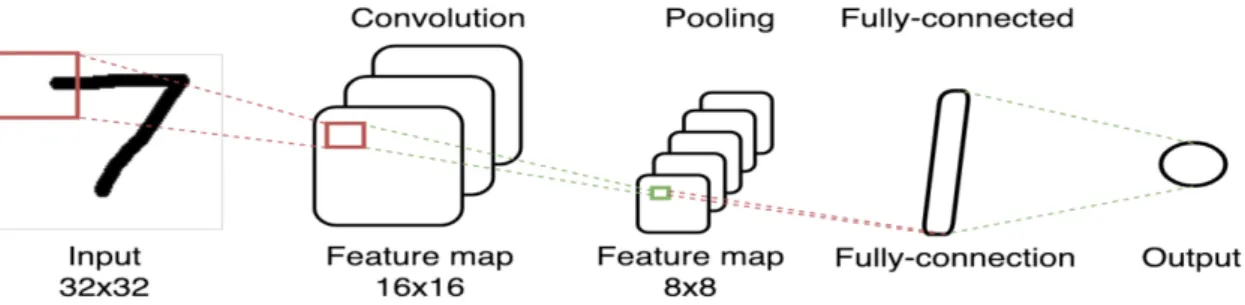
2.2.2 Convolutional Neural Networks (CNN) . . . 28
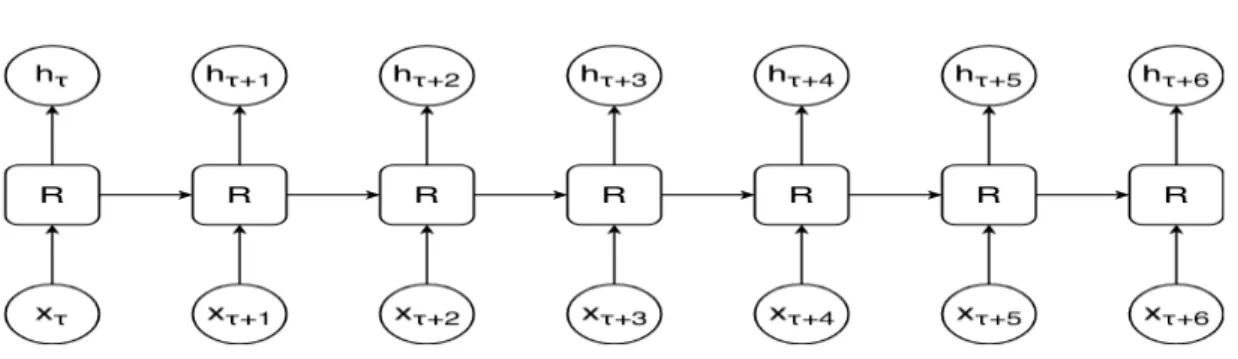
2.2.3 Recurrent Neural Networks (RNN) . . . 29
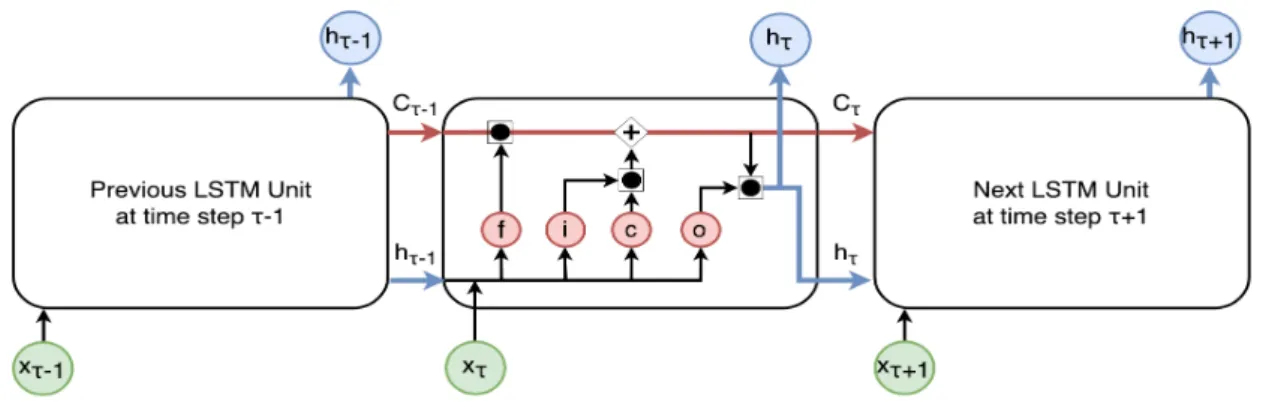
2.2.3.1 Architecture of Traditional Recurrent Neural Networks . 30 2.2.3.2 Long Short-Term Memory (LSTM) . . . 31
2.2.3.3 Gated Recurrent Units (GRU) . . . 33
2.3 Conclusions . . . 34
3 Related Work 35 3.1 Introduction . . . 35
3.2 Problem Statement and Notations . . . 37
3.3 Extensions of Matrix Factorisation Models . . . 39
3.3.1 Social Regularisation Technique . . . 39
3.3.2 Textual-based Matrix Factorisation Models . . . 41
3.4 Neural Matrix Factorisation (NeuMF) . . . 43
3.4.1 Limitation of Traditional Matrix Factorisation . . . 44
3.4.2 General framework of NeuMF . . . 44
3.4.3 Generalised Matrix Factorisation model (GMF) . . . 46
3.4.4 Multi-Level Perceptron model (MLP) . . . 47
3.4.5 Limitations of NeuMF framework . . . 48
3.5 Negative Sampling Approaches and Ranking Functions for BPR . . . 49
3.5.1 BPR with Geographical Influences . . . 50
3.5.2 BPR with Social Correlations . . . 52 3.5.3 Limitations of Existing Negative Sampling Approaches and Ranking
Table of Contents
3.6 Recurrent Neural Network Models for Recommendation Systems . . . 56
3.6.1 Recurrent-based Factorisation Approaches . . . 57
3.6.2 Gating Mechanism of RNN Architectures . . . 59
3.6.2.1 Time-aware GRU architecture (TimeGRU) . . . 59
3.6.2.2 Context-aware GRU architectures . . . 61
3.6.3 Limitations of RNN models . . . 63
3.7 Roadmap of Addressing Limitations of Previous Works . . . 64
3.8 Conclusions . . . 66
4 Enhancing Collaborative Filtering-based Approaches with Additional Informa-tion 68 4.1 Introduction . . . 68
4.2 Enhancing the Rating Prediction of MF with Word Embeddings . . . 70
4.2.1 Social and Textual Regularisation Technique . . . 71
4.2.2 Textual-based Matrix Factorisation Approaches . . . 73
4.2.3 Experimental Methodology . . . 75
4.2.4 Experimental Results & Discussion . . . 79
4.3 Personalised Ranking Framework with Multiple Sampling Criteria . . . 80
4.3.1 An Overview of the PRFMC Framework . . . 81
4.3.2 A Negative Sampling Criterion with Geographical Influence . . . . 85
4.3.3 A Negative Sampling Criterion with Social Correlation . . . 88
4.3.4 Experimental Methodology . . . 90
4.3.5 Baselines and Parameter Setup . . . 92
4.3.5.1 Traditional BPR . . . 92
4.3.5.2 Geo-based approaches . . . 92
4.3.5.3 Social-based approaches . . . 93
4.3.5.4 Hybrid (social & geo)-based approaches . . . 93
4.3.6 Experimental Results & Discussion . . . 94
Table of Contents 5 Deep Recurrent Collaborative Filtering Framework 102
5.1 Introduction . . . 102
5.2 Overview of Deep Recurrent Collaborative Filtering (DRCF) Framework . 105 5.3 Sequential Geo-based Negative Sampling Approaches . . . 107
5.4 Generalised Recurrent Matrix Factorisation (GRMF) . . . 108
5.5 Multi-Layer Recurrent Perceptron (MLRP) . . . 110
5.6 Recurrent Matrix Factorisation (RMF) . . . 112
5.7 Experimental Methodology . . . 113
5.7.1 Datasets & Measures . . . 114
5.7.2 Baselines . . . 115
5.7.2.1 Trivial Sanity-Check Baselines . . . 116
5.7.2.2 Traditional MF-based approaches . . . 116
5.7.2.3 RNN-based approaches . . . 116
5.7.2.4 Deep Neural Network (DNN)-based approaches . . . 117
5.7.3 Recommendation Parameter Setup . . . 117
5.8 Experimental Results . . . 118
5.8.1 The Effectiveness of the DRCF Framework . . . 118
5.8.2 The Effectiveness of DRCF’s Components . . . 122
5.8.3 The Usefulness of Sequential-based Negative Sampling Approaches 125 5.8.4 Cold-Start Users Experiments . . . 127
5.9 Conclusions . . . 128
6 Contextual Attention Recurrent Architecture 130 6.1 Introduction . . . 130
6.2 Overview of the Contextual Attention Recurrent Architecture (CARA) . . . 133
6.3 Contextual Attention Gate (CAG) . . . 135
6.4 Time- and Spatial-based Gates (TSG) . . . 136
6.5 Experimental Methodology . . . 138
Table of Contents
6.5.2 Baselines . . . 141
6.5.2.1 Trivial Sanity-Check Baselines . . . 141
6.5.2.2 Recurrent Neural Network Architectures . . . 141
6.5.2.3 Factorisation Approaches . . . 142
6.5.3 Recommendation Parameters Setup . . . 143
6.6 Experimental Results . . . 143
6.7 The Effectiveness of CARA Architecture . . . 143
6.8 The Usefulness of Gating Mechanisms of the CARA Architecture . . . 149
6.9 Conclusions . . . 151
7 Contextual Recurrent Collaborative Filtering Framework 153 7.1 Introduction . . . 153
7.2 Contextual Recurrent Collaborative Filtering Framework (CRCF) . . . 155
7.3 Experimental Methodology . . . 157
7.3.1 Datasets . . . 158
7.3.2 Baselines . . . 159
7.3.3 Recommendation Parameter Setup . . . 161
7.3.4 Measures . . . 161
7.4 Experimental Results . . . 162
7.4.1 Effectiveness Evaluation . . . 163
7.4.1.1 Effectiveness of the CRCF framework . . . 163
7.4.1.2 Usefulness ofDynamicGeo-based Negative Sampling . . 165
7.4.2 Robustness Evaluation . . . 169
7.4.2.1 Robustness of the CRCF framework . . . 170
7.4.2.2 Usefulness of Dynamic Geo-based Negative Sampling for Robustness . . . 173
Table of Contents
8 Conclusions 187
8.1 Contributions and Conclusions . . . 187
8.1.1 Contributions . . . 188
8.1.2 Conclusions . . . 190
8.2 Directions for Future Work . . . 194
8.3 Closing Remarks . . . 196
Appendix 197
A Summary of Limitations of Previous Works 198
List of Figures
2.1 The architecture of Recurrent Neural Networks. This figure is inspired from
Teow (2017) . . . 29
2.2 The architecture of Recurrent Neural Networks . . . 30
2.3 The architecture of Long Short-Term Memory . . . 31
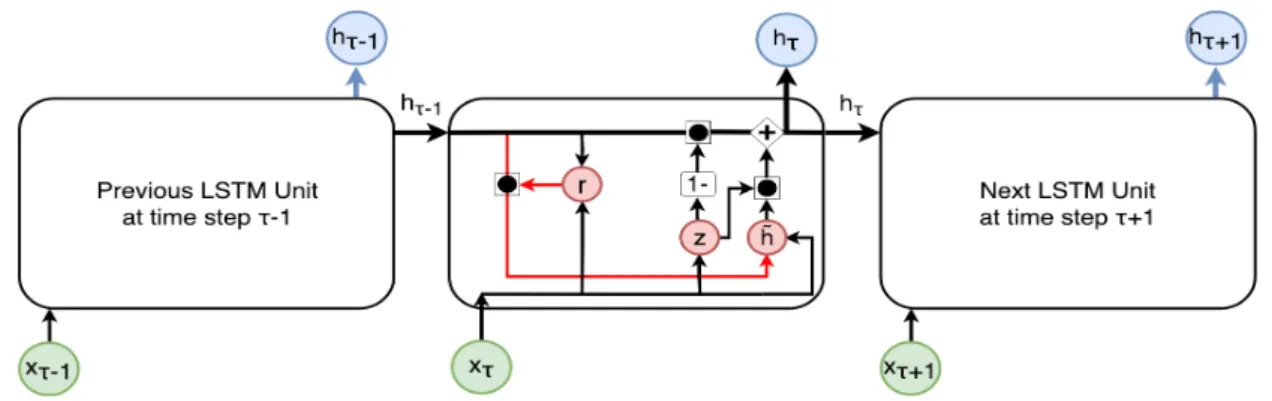
2.4 The architecture of GRU units . . . 33
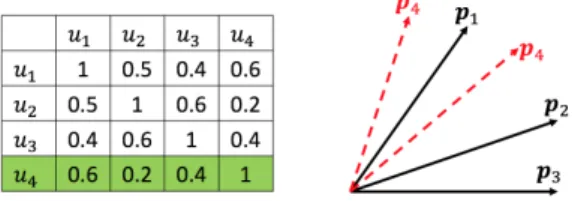
3.1 An illustration of the similarity between users and vectors representing the latent factors of each user in user latent spaceP. Note that these figures are regenerated from He et al. (2017). . . 43
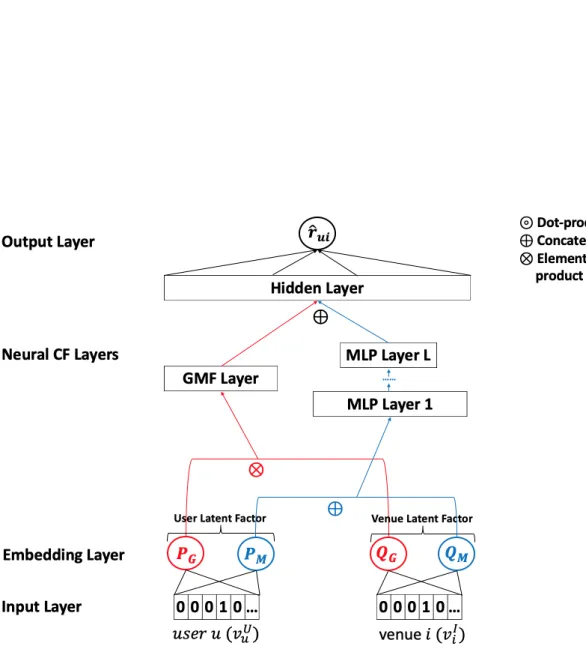
3.2 The diagram of Neural Matrix Factorisation (NeuMF) framework. . . 45
3.3 An illustration of the user’s sequence of checkins, where each timestamp of the checkin is highlighted in blue, tand g are the time interval and the distance between checkins at time step⌧, respectively (red text). . . 60
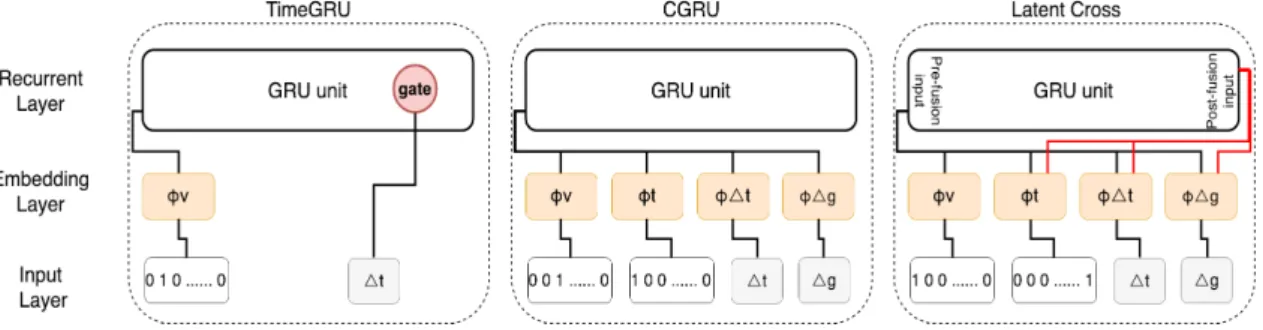
3.4 Diagrams of existing recurrent architectures for CAVR . . . 60
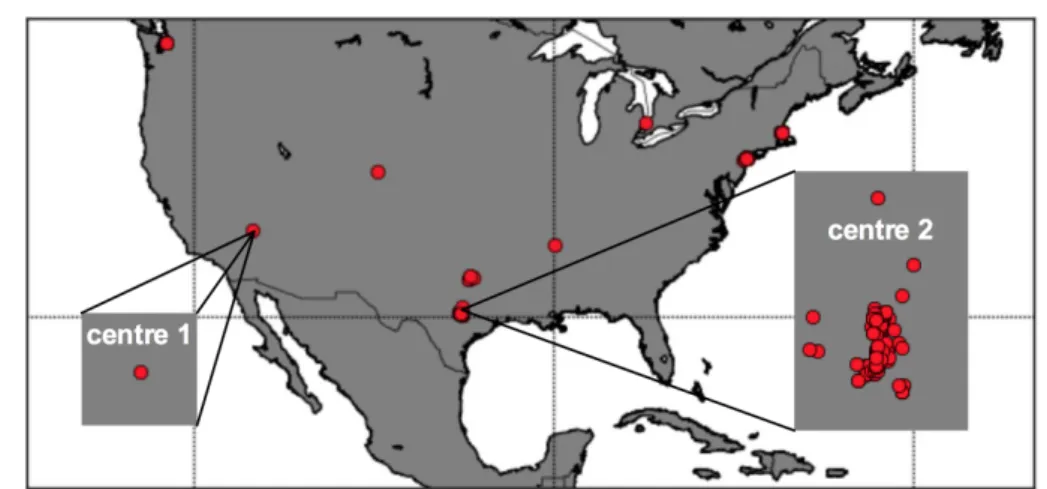
4.1 A typical user’s multi-centres checkin behaviour sampled from the Brightkite dataset. This figure is obtained from Manotumruksa et al. (2017b). . . 86
5.1 Deep Recurrent Collaborative Filtering Framework. The connections of each layer linked by the red-dotted lines illustrate the NeuMF framework. This figure is obtained from Manotumruksa et al. (2017a) . . . 106
5.2 Test recommendation HR & NDCG of various approaches with respect to the number of applied iterations. . . 121
6.1 An overview of Contextual Attention Recurrent Architecture (CARA) unit at time step⌧. . . 134
List of Figures
6.2 The gating mechanisms of our proposed Contextual Attention Recurrent Ar-chitecture (CARA). The Rectangle symbols indicate inputs of the unit, a red-dashed rectangle symbol indicates the output of the unit and the circle symbols are the unit’ gates. This figure is obtained from Manotumruksa et al. (2018) . . . 135 6.3 Performances between our proposed CARA architecture and various GRU
architectures on the Brightkite, Foursquare and Yelp datasets by varying the time interval tin terms of hours with the fixed values of the geographical
distances g(1 and 5 km). . . 150
7.1 A diagram of Contextual Recurrent Collaborative Filtering Framework. The connections of each layer linked by the red-dashed lines illustrate the DRCF framework. . . 155 7.2 Test recommendation performances in terms of HR & NDCG of various
approaches with respect to the number of iterations. . . 167 7.3 Performances of various approaches in terms of NDCG@10 on the Brightkite,
Foursquare and Yelp datasets by varying the time interval t in terms of
hours with the fixed values of the geographical distances g(1 and 5 km). . 168
7.4 Typical Wins-Losses histogram of target new models (DRCF, CARA and CRCF) in comparison with the CF ranking baseline model, BPR, under the
NormalandCold-start Userssettings. The vertical line in the figures sepa-rates wins from losses. We omit to report the number of users with no change in NDCG@10 over BPR (i.e. a target model is as effective as BPR). . . 172 7.5 The changes in standardisedTrisk scores for DRCF, CARA and CRCF with
respect to the baseline, denoted inside the parentheses, over different↵
val-ues under theNormalandCold-Start Usersexperiments. . . 174 7.6 As per Figure 7.4, typical Wins-Losses histograms of the CRCF
frame-work with or without the dynamic geo-based negative sampling approach (CRCFdgeo and CRCF) in comparison with the CF ranking baseline model,
BPR, under theNormalandCold-Start Usersexperiments. . . 176 7.7 As per Figure 7.4, typical Wins-Losses histograms of target new models that
incorporates the dynamic geo-based negative sampling approach (DRCFdgeo,
CARAdgeoand CRCFdgeo) in comparison with the CF ranking baseline model,
List of Figures
7.8 The changes in standardisedTrisk scores for CRCF and CRCFdgeo with
re-spect to the baseline, denoted inside the parentheses, over different↵values
List of Tables
1 List of Abbreviation used in this thesis. . . xvii
2 List of notations used in this thesis. . . xviii
3.1 Summary of venue recommendation tasks . . . 37
3.2 List of notations used in this thesis. . . 38
3.3 Summary of existing works and their limitations . . . 64
4.1 Summary of each research question and its corresponding success decision and the limitations of the existing approaches. . . 76
4.2 Overview of regularisation techniques and MF-based approaches for the user-venue rating prediction. +indicates an addition to the intuition of the tradi-tional MF model. . . 78
4.3 Prediction accuracy in terms of MAE and RMSE of various approaches. Per-centage differences of prediction accuracy are calculated with respect to the best performance achieved for that metric, which are highlighted in bold. . . 80
4.4 Summary of each research question and its corresponding success decision and the limitations of the existing approaches. . . 91
4.5 Statistics of three datasets . . . 92
4.6 Performances in terms of MAP, NDCG and MRR of various approaches. For each type of additional information and evaluation measure, the best per-forming result is highlighted in bold and⇤indicates significant differences in terms of paired t-test with p < 0.01, comparing to the best performing result. Percentage differences compared to BPR are denoted by . . . 96
4.7 Mean percentage differences across MAP, NDCG and MRR of various ap-proaches compared to BPR. . . 97
List of Tables
5.1 Summary of existing factorisation approaches and its corresponding limitations104 5.2 Summary of each research question and its corresponding success decision
and the limitations of the existing approaches. . . 114 5.3 Statistics of the three used datasets. . . 115 5.4 Performances in terms of HR@10 and NDCG@10 of various approaches for
the Normal Users setting. The best performing result is highlighted in bold; and ⇤ denote a significant difference compared to the best performing result, according to the paired t-test forp <0.05andp <0.01, respectively. 119
5.5 Performances in terms of HR@10 and NDCG@10 of various approaches. The best performing result is highlighted in bold; and ⇤ denote a sig-nificant difference compared to the best performing result, according to the paired t-test forp <0.05andp < 0.01, respectively. . . 123
5.6 Performances in terms of HR@10 and NDCG@10 between various approaches. The best performing result is highlighted in bold; and⇤denote a signif-icant difference compared to the best performing result, according to the paired t-test forp <0.05andp < 0.01, respectively. . . 125
5.7 Performances in terms of HR@10 and NDCG@10 of various approaches for Cold-Start Users setting. The best performing result is highlighted in bold; and⇤denote a significant difference compared to the best performing result,
according to the paired t-test forp <0.05andp <0.01, respectively. . . 126
6.1 Summary of the existing RNN-based factorisation approaches and the GRU architectures and their corresponding limitations . . . 131 6.2 Summary of each research question and its corresponding success decision
and the limitations of the existing approaches. . . 139 6.3 Statistics of the three used datasets. . . 140 6.4 Performances in terms of HR@10 and NDCG@10 of various approaches.
The best performing result is highlighted in bold; and ⇤ denote a
sig-nificant difference compared to the best performing result, according to the paired t-test forp <0.05andp < 0.01, respectively. . . 144
6.5 Mean percentage improvements of CARA over various baselines across the three used datasets in terms of HR@10 and NDCG@10, which are obtained from Table 6.4. . . 145
List of Tables
6.6 As per Table 6.4; comparison between our proposed CARA architecture and various factorisation baselines. . . 147 6.7 Mean percentage improvements of CARA over various baselines across the
three used datasets in terms of HR@10 and NDCG@10, which are sum-marised from Table 6.6. . . 148 7.1 Summary of the DRCF framework and the CARA architecture and their
cor-responding limitation . . . 154 7.2 Summary of each research question and its corresponding success decision. 158 7.3 Statistics of the three used datasets. . . 159 7.4 Performance in terms of HR@10 and NDCG@10 between various approaches.
The best performing approach is highlighted in bold; and⇤denote a
sig-nificant difference compared to the best performing result, according to the paired t-test forp <0.05andp < 0.01, respectively. . . 181
7.5 As per Table 7.4. Performances in terms of HR@10 and NDCG@10 be-tween various approaches that apply our proposeddynamicgeo-based nega-tive sampling approach (see Section 5.3), denoted asdgeo. . . 182
7.6 The robustness of various approaches in comparison with the BPR baseline in terms of NDCG@10 on three datasets for Normal users. Trisk scores
greater than+2or less than -2 indicate that a two-tailed paired t-test gives
significance withp < 0.05. Trisk scores greater than+2are indicated with ⇤. The best score w.r.t. each risk-sensitive measure is highlighted in bold. . 183 7.7 The robustness of various approaches in comparison with the BPR
base-line in terms of NDCG@10 on three datasets for theCold-Startusers. Trisk
scores greater than+2or less than -2indicate that a two-tailed paired t-test
gives significance withp <0.05. Triskscores greater than+2are indicated
with⇤. The best score w.r.t. each risk-sensitive measure is highlighted in bold.184 7.8 The robustness of various approaches that incorporate the dynamic
geo-based negative sampling in comparison with the BPR baseline in terms of NDCG@10 on three datasets forNormalusers. Triskscores greater than+2
or less than -2indicate that a two-tailed paired t-test gives significance with
p < 0.05. Trisk scores greater than+2are indicated with⇤. The best score
List of Tables
7.9 The robustness of various approaches that incorporate the dynamic geo-based negative sampling in comparison with the BPR baseline in terms of NDCG@10 on three datasets for the Cold-Startusers. Trisk scores greater
than+2or less than -2 indicate that a two-tailed paired t-test gives
signifi-cance withp <0.05. Trisk scores greater than+2are indicated with⇤. The
best score w.r.t. each risk-sensitive measure is highlighted in bold. . . 186 A.1 Summary of existing works and their limitations . . . 199
List of Tables
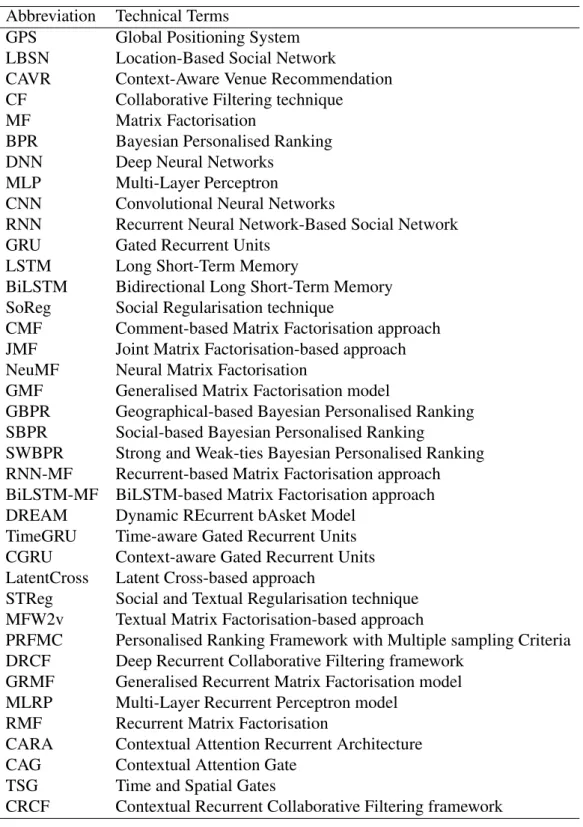
Table 1: List of Abbreviation used in this thesis.
Abbreviation Technical Terms
GPS Global Positioning System LBSN Location-Based Social Network
CAVR Context-Aware Venue Recommendation CF Collaborative Filtering technique MF Matrix Factorisation
BPR Bayesian Personalised Ranking DNN Deep Neural Networks
MLP Multi-Layer Perceptron
CNN Convolutional Neural Networks
RNN Recurrent Neural Network-Based Social Network GRU Gated Recurrent Units
LSTM Long Short-Term Memory
BiLSTM Bidirectional Long Short-Term Memory SoReg Social Regularisation technique
CMF Comment-based Matrix Factorisation approach JMF Joint Matrix Factorisation-based approach NeuMF Neural Matrix Factorisation
GMF Generalised Matrix Factorisation model
GBPR Geographical-based Bayesian Personalised Ranking SBPR Social-based Bayesian Personalised Ranking
SWBPR Strong and Weak-ties Bayesian Personalised Ranking RNN-MF Recurrent-based Matrix Factorisation approach BiLSTM-MF BiLSTM-based Matrix Factorisation approach DREAM Dynamic REcurrent bAsket Model
TimeGRU Time-aware Gated Recurrent Units CGRU Context-aware Gated Recurrent Units LatentCross Latent Cross-based approach
STReg Social and Textual Regularisation technique MFW2v Textual Matrix Factorisation-based approach
PRFMC Personalised Ranking Framework with Multiple sampling Criteria DRCF Deep Recurrent Collaborative Filtering framework
GRMF Generalised Recurrent Matrix Factorisation model MLRP Multi-Layer Recurrent Perceptron model
RMF Recurrent Matrix Factorisation
CARA Contextual Attention Recurrent Architecture CAG Contextual Attention Gate
TSG Time and Spatial Gates
List of Tables
Table 2: List of notations used in this thesis.
Notation Meaning
R user-venue rating matrix C users’ checkin matrix F users’ social link matrix U set of users
V set of venues V+
u list of venues that useruhas visited Su sequence of checkins of useru
ru,i rating of useruon venuei
cu,i,t checking of useruon venueiat timet
su,t sequence of checkins of useruup to timet
latj, lngi latitude and longitude of venuei
P the latent factors of users
pu, uu the latent factors of useruprojected fromP
Q the latent factors of venues
qi vi the latent factors of venueiprojected fromQ
t the latent factors of time
⌧ particular time step of the recurrent unit
h hidden state
t the time interval between two checkins
g the geographical distance between two checkins
the sigmoid activation
tanh the tangent activation
the dot product operation
⌦ the element-wise product operation
Chapter 1
Introduction
1.1 Motivations
With the advance of technology such as Global Positioning System (GPS) and mobile net-works in smartphones, users are increasingly interested in location-based recommendations (Narayanan and Cherukuri, 2016). An increasing number of tourists who travel to unfamil-iar cities nowadays use their smartphones to find interesting places to visit or activities to do based on their current location detected by their smartphones (Yao et al., 2016). An example scenario could be a Londoner who is travelling to Glasgow and looking for a nearby local restaurant for a dinner with his family. With the emergence of Location-Based Social Net-works (LBSNs) such as Yelp1and Foursquare2, the users can download and install the mobile
applications of various LBSNs into their smartphones. Within a given application, users are able to find various types of interesting venues to visit, share their location with their friends by making a check-in at the venue they are visiting, leave their feedback in the form of ratings as well as explicitly share their opinions by commenting/reviewing the venues they visited (Liu et al., 2013; Narayanan and Cherukuri, 2016). Large amount of feedback such as checkins, ratings and comments are generated by the users in these LBSNs. This feedback can be categorised into two types based on the users’ intent when they leave the feedback, namely explicit and implicit feedback. Ratings and comments represent explicit feedback, as users explicitly specify whether they like or dislike the venues they visited. In contrast to rat-ings and comments, the checkin behaviour of users in LBSNs can be categorised as implicit feedback, as it is derived from the users’ real-world activities (i.e. visiting venues) and does not explicitly indicate whether the users like that venues. These implicit and explicit
feed-1https://www.yelp.com 2https://foursquare.com
1.1. Motivations
back provide rich information about users and venues and can be leveraged to investigate many areas including: understanding the user’s movements in urban cities (Noulas et al., 2011; Ying et al., 2012), modelling the user’s preferences and the characteristic of venues to enhance the quality of personalised venue recommendations (Preot¸iuc-Pietro and Cohn, 2013; Liu et al., 2013), as well as provide an insight into why users visit venues, which is beneficial for businesses to find potential customers (Eravci et al., 2016).
Making effective recommendations of venues that a user may wish to visit relies on the user’s feedback (e.g. his/her historical checkins) and the contextual information about the user (e.g. the user’s location and time of visit). In contrast to the implicit feedback of traditional recommendation systems (e.g. item purchase feedback in Amazon3), making a
checkin at a venue in LBSNs is a physical activity that involves various types of physical context such as the geographical influences and specific temporal characteristics. For exam-ple, users are likely to checkin at parks and museums nearby their hotels in the daytime while they might later checkin at bars in the evening. These geographical influences (e.g. visiting venues nearby their hotel) and temporal characteristics (e.g. visiting different types of venues at different times of the day) make the venue recommendation task more challenging than traditional recommendation systems. Using traditional recommendation systems that do not take various types of real-word contexts into account to generate venue recommendations may not be effective as previous works (Zhang and Chow, 2015; Zhang et al., 2015a) have shown that contexts play an important role in improving the quality of venue recommen-dations. As a result, Context-Aware Venue Recommendation (CAVR) has gained a lot of attention from researchers in academia and industry and has become a key functionality for users in LBSNs (Liu et al., 2013; Ying et al., 2012; Yao et al., 2016; Zhao et al., 2016; Cheng et al., 2013; Deveaud et al., 2014). Dey et al. (2001) defined context as “any information that can be used to characterize the situation of an entity that is considered relevant to the interaction between a user and an application”. In the CAVR task, the involved entity is the user, whose context can be explicitly provided by the user (e.g. preferred time of the day) or implicitly detected by sensing devices (e.g. the user’s location automatically detected from GPS in his/her smartphone).
Collaborative Filtering (CF) is a widely used technique to suggest relevant venues to users based on an assumption that similar users, who share similar preferences (i.e. visiting similar venues), are likely to visit similar venues (Koren, 2010b). Venue recommendation systems (Ma et al., 2011; Hu et al., 2014; Cheng et al., 2012) have been proposed extend Matrix Factorisation (MF), a CF-based technique that is widely used to effectively predict a user’s rating on venues by exploiting explicit feedback (e.g. ratings and comments) (Koren
1.1. Motivations
et al., 2009), to generate venue suggestions. In particular, MF-based approaches typically aim to embed the users’ preferences and the characteristics of venues within latent factors, which are combined with the dot product operator to estimate the user’s preference for a given venue. Then, a ranked list of venues is generated based on the predicted user-venue rating generated by the MF model. However, explicit feedback is relatively sparse in LBSNs, which can lead to a degradation of the effectiveness of the MF-based approaches (Hu et al., 2008). In addition, in practice, users only focus on the top-K ranked list of venues (Yuan et al., 2016; Ying et al., 2016; Li et al., 2015). This implies that effective ranking-based models (e.g. learning-to-rank) that aim to generate accurate top-K venue suggestions are more useful than effective rating prediction-based models (i.e. regression models) (Rendle et al., 2009). From this point of view, MF-based approaches are not expected to perform as effectively as learning-to-rank models for the CAVR task (Shi et al., 2012). For these reasons, Bayesian Personalisation Ranking (BPR) (Rendle et al., 2009) was proposed to leverage
implicitfeedback, which is more abundant than explicit feedback and largely available in LBSNs, to generate accurate ranked lists of venues. A challenge of implicit feedback from observing checkins is that only positive feedback can be observed (i.e. we only know that users visited venues but we do not know whether they liked those venues or not), and BPR models trained on only positive feedback are likely to be biased to positive instances (Rendle et al., 2009; Zhao et al., 2014; Yuan et al., 2016). To address this challenge, various negative sampling approaches have been proposed (Rendle et al., 2009; Yuan et al., 2016; Zhao et al., 2014; Wang et al., 2016). For example, the negative sampling approach proposed in BPR by Rendle et al. (2009) uniformly and randomly selects venues that the users have not visited as negative instances. Moreover, users’ preferences extracted fromimplicitfeedback are not
staticand change dynamically over time (e.g. users may prefer to visit shopping malls during the daytime but prefer to visit bars in the evenings) (Koren, 2010a). Unfortunately, traditional BPR models (e.g. (Rendle et al., 2009; Wang et al., 2016; Zhao et al., 2014; Yuan et al., 2016)) can only capture the users’ long-term (static) preferences and not their short-term (dynamic) preferences. Since the traditional BPR models assume that the users’ preferences are static, users who have visited similar sets of venues in different orders would get similar venue suggestions (Yu et al., 2016; Zhang et al., 2014b). However, the previous literature have shown that recent observed feedback can have more influence on users’ behaviour than historical feedback (Zhu et al., 2017; Liu et al., 2016c; Cheng et al., 2013; Rendle et al., 2010; Yu et al., 2016). For instance, consider a user who has recently visited several art museums and a restaurant, sequentially. Models that only capture the user’s long-term preferences will recommend other museums to visit, whereas a model that can capture the user’s short-term preferences might recommend a bar to visit instead. In this thesis, we argue that the sequential properties of observed checkin feedback can be leveraged to effectively capture
1.1. Motivations
the users’staticanddynamicpreferences.
Another challenge of CAVR is the problem of cold-start users (i.e. users who have typically only visited and checked in a very small number of all venues in the LBSNs). The existing literature have shown that traditional BPR models typically suffer from the cold-start user problem, which hinders the quality of the personalised venue suggestions. To mitigate the cold-start user problem, various approaches have been previously proposed to leverage additional information such as social information (Zhao et al., 2014; Wang et al., 2016; Ma et al., 2011), temporal influence (Gao et al., 2013), textual content of comments (Zhang et al., 2015a) as well as geographical information (Cheng et al., 2012; Yuan et al., 2016; Zhang and Chow, 2015; Lian et al., 2014; Ying et al., 2016; Li et al., 2015). In particular, a common approach that enhances the performance of BPR models under cold-start conditions is to extend the sampling criterion and pairwise ranking function of BPR to incorporate
additionalsources of information (e.g. social links (Wang et al., 2016; Zhao et al., 2014) and the geographical information of venues (Yuan et al., 2016)). However, the sampling criterion and pairwise ranking function of BPR do not take the sequential properties of observed feedback into account and still assume that the users’ preferences are static.
To leverage the sequential properties of implicit feedback in order to capture the users’
dynamicpreferences, existing approaches in the literature (e.g. (Cheng et al., 2013; Rendle et al., 2010)) have been proposed based on Markov Chains. However, such Markov Chains-based approaches have a well-known limitation in that they can only model local sequential behaviour between each pair of adjacent observed feedback (Yu et al., 2016). To effectively capture the users’ dynamic preferences from their observed implicit feedback, various ap-proaches (Tang et al., 2017; Yu et al., 2016; Zhang et al., 2014b) have been proposed to exploit Recurrent Neural Network models (RNN) for recommendation systems. There are several limitations of these existing RNN-based approaches. First, they still rely on the dot product of latent factors of users and venues to estimate the user’s preference for a given venue. However, He et al. (2017) argued that the dot product of latent factors may not be sufficient to capture the complex structure of user-venue interactions. To address this chal-lenge, they proposed a Neural Matrix Factorisation (NeuMF) framework that replaces the dot product operation with a neural architecture that can learn an arbitrary function from user-venue interactions. However, the NeuMF framework is not sufficiently flexible to in-corporate the sequential properties of observed implicit feedback. Second, these RNN-based approaches are not suitable for CAVR because they can only take the sequential order of checkins into account and ignore the contextual information associated with the sequences of checkins (e.g. time interval and geographical distance between two successive checkins). Indeed, such contextual information have been shown to play an important role in generating
1.2. Thesis Statement
effective CAVR systems (Beutel et al., 2018; Liu et al., 2016b,c; Zhu et al., 2017; Smirnova and Vasile, 2017).
1.2 Thesis Statement
The statement of this thesis is that the quality of the personalised ranked list of venues based on the user’s preferred context, Context-Aware Venue Recommendation, can be effectively enhanced by leveraging the additional information such as the users’ social relationships, the textual content of comments and the geographical information of venues, the sequential properties of the users’ implicit feedback and the contextual information associated with the sequences of users’ implicit feedback, which can be achieved by a framework that consists of the following four functionalities/components, namely (1) capturing the complex struc-ture of user-venue interactions in a collaborative filtering manner using an effective neural architecture to learn an arbitrary function from the user’s implicit feedback, (2) modelling the users’ long- (static) and short-term (dynamic) preferences from the sequential order of user’s checkins and the contextual information associated with the successive checkins, (3) generating accurate top-K venue suggestions based on the user’sstaticanddynamic prefer-ences using a pairwise ranking function and (4) sampling potential negative instances that take into account the additional information such as the geographical information of venues, the users’ social relationships and the sequential order of users’ checkins.
1.3 Contributions
The main contributions of this thesis are the following. Our first contribution is to enhance the effectiveness of Collaborative Filtering-based (CF) approaches such as the traditional Matrix Factorisation (MF) and Bayesian Personalised Ranking models. In particular, we propose a novel regularisation technique and a factorisation-based model that leverage the additional information (e.g. the users’ social relationships and the textual content of com-ments associated with users’ ratings) to improve the rating prediction accuracy of the tra-ditional MF model. Then, we propose a Personalised Ranking Framework with Multiple sampling Criteria (PRFMC), an extension of the traditional BPR model, that can incorporate multiple sources of additional information during the negative sampling and ranking process. The summary of our first contribution, which consists of two sub-contributions, is described below:
1.3. Contributions
• Enhanced MF-based Approaches: We propose a Social-Textual Regularisation (STReg)
technique that leverages the users’ social links and the textual content of comments associated with the users’ ratings to enhance the effectiveness of the traditional MF model. In particular, the STReg technique exploits word embeddings to estimate a se-mantic similarity of friends based on their textual comments to regularise the complex-ity of the traditional MF model. Moreover, we propose a novel textual factorisation-based model (MFw2v), an extension of the traditional MF model, which exploits word embeddings to effectively model users’ preferences and the characteristics of venues from the textual content of comments left by the users. Experiments conducted on a large user-venue rating dataset from a commercial LBSN demonstrate that the textual content of comments play an important role in enhancing the effectiveness of tradi-tional MF model. In addition, our experimental results demonstrate that our proposed STReg technique and MFw2v model can outperform various state-of-the-art rating prediction approaches.
• Enhanced BPR-based framework: We propose a novel Personalised pairwise Rank-ing Framework with Multiple samplRank-ing Criteria (PRFMC) that can leverage multiple sources of additional information to enhance the quality of venue recommendation of the traditional BPR model. In particular, the PRFMC framework exploits state-of-the-art geographical and social probabilistic models that can effectively capture the users’ geographical movements and social influences to effectively sample negative instances during the training process. We empirically evaluate the effectiveness of the PRFMC framework in comparison with various existing BPR-based models on three public large-scale datasets from commercial LBSNs. Our comprehensive experiments demonstrate the effectiveness of the PRFMC framework, which are superior to the current state-of-the-art BPR models.
Our second contribution is to propose a CF-based framework for sequential-based top-K venue recommendations. Firstly, we propose a Deep Recurrent Collaborative Filtering framework (DRCF) that leverages the sequential order of users’ checkins to capture the users’staticanddynamicpreferences to effectively generate the ranked list of personalised venues. The DRCF framework consists of two components, namely (1) the neural architec-ture that models the complex strucarchitec-ture of user-venue interactions in a Collaborative Filtering manner and (2) the pairwise ranking function and dynamic geo-based negative sampling ap-proach that aim to enhance the quality of sequential-based venue recommendations as well as alleviate the problem of cold-start users. A summary of our second contribution, which consists of two sub-contributions, is described below:
1.3. Contributions
• Neural Network Architecture: Within the DRCF framework, we propose the
Gen-eralised Recurrent Matrix Factorisation (GRMF), Multi-Level Recurrent Perceptron (MLRP) and Recurrent Matrix Factorisation (RMF) models that exploit Deep Neural Network models to capture the complex structure of user-venue interactions from ob-served checkins in a Collaborative Filtering manner. In particular, the GRMF, MLRP and RMF models use the element-wise, concatenation and dot product operations, re-spectively, to combine the latent factors of users and venues. Then, these combinations of latent factors are weighted by using a Deep Neural Network architecture. We eval-uate the effectiveness of our proposed models in capturing the complex structure of user-venue interactions in comparison with various MF-based Deep Neural Network approaches previously proposed in the literature (He et al., 2017; Yu et al., 2016). In particular, our comprehensive experiments on three public large-scale datasets from commercial LBSNs demonstrate the effectiveness of the DRCF framework, which are superior to the current state-of-the-art Deep Neural Network approaches.
• Pairwise Ranking Function & Negative Sampling Approach: Within the DRCF framework, we propose a noveldynamic geo-based negative sampling approach that takes the sequential order of users’ checkins as well as the geographical information of venues into account to effectively sample negative venues, which are used in the pair-wise loss function. In particular, the pairpair-wise ranking function aims to rank venues that the users have previously visited higher than the venues they have not visited before, while our proposed dynamic geo-based negative sampling approach aims to sample venues that users have never visited before but are located nearby the venues they pre-viously visited in their sequence of checkins. We conduct experiments to investigate the effectiveness of our proposed ranking function and our negative sampling approach in enhancing the quality of personalised ranked list of venues and alleviating the prob-lem of cold-start users. The experimental results show that our proposed dynamic
geo-based negative sampling approach can significantly improve the effectiveness of the DRCF framework as well as alleviate the cold-start problem.
Next, our last contribution is to propose a CF-based framework for context-aware sequential-based top-K venue recommendations. We propose a Contextual Attention Re-current Architecture (CARA) that effectively captures the users’dynamicpreferences from the sequential properties of users’ checkins and the contextual information associated with the successive checkins. Finally, we propose a Contextual Recurrent Collaborative Filtering framework (CRCF) that aims to generate effective ranked lists of venues to the users based on their preferences as well as their preferred context. In particular, the CRCF framework is
1.3. Contributions
built upon both the DRCF framework and the CARA architecture for CAVR. A summary of our third contribution is described below:
• Contextual Attention Recurrent Architecture: We propose a novel Contextual
At-tention Recurrent Architecture (CARA) for CAVR that leverages both sequences of user’s observed feedback and the contextual information associated with these se-quences to capture the users’static and dynamic preferences. Within the CARA ar-chitecture, inspired by the gating mechanism of Gated Recurrent Units (GRU), we propose two refined gating mechanisms: a Contextual Attention Gate (CAG) and a Time- and Spatial-based Gate (TSG). The CAG controls the influence of the user’s preferred context and previous visited venues, while TSG controls the influence of the hidden state of the previous RNN unit based on the time interval and geographical dis-tances between two successive checkins. In particular, TSG assumes that the shorter the time interval and geographical distance between two successive checkins, the more likely the previous checkin influences the users’dynamicpreferences on the next visit venues. To the best of our knowledge, CARA is the first RNN architecture that can incorporate multiple types of contextual information associated with the successive checkins. Our thorough experiments on three large checkin and rating datasets from commercial LBSNs demonstrate the effectiveness of our proposed CARA architecture by significantly outperforming various state-of-the-art matrix factorisation approaches and existing RNN architectures, respectively.
• Contextual Recurrent Collaborative Filtering Framework: We propose a
Contex-tual Recurrent Collaborative Filtering framework (CRCF) that combines the DRCF framework and the CARA architecture for CAVR. In particular, we first modify the GRMF, MLRP and RMF models of the DRCF framework to effectively capture the users’dynamicand contextual preferences from their sequence of checkins by exploit-ing the CARA architecture. Then, we modify the pairwise rankexploit-ing function of the DRCF framework to take the users’ preferred context into account. We evaluate the effectiveness of our proposed CRCF framework in comparison with the state-of-the-art CAVR systems on three large-scale datasets from commercial LBSNs. Experimental results demonstrate that CRCF can significantly and consistently outperform both the DRCF framework and the CARA architecture as well as the state-of-the-art CAVR systems across the three used datasets.
1.4. Origins of Material
1.4 Origins of Material
Most of the material presented in this thesis has been published in various international con-ferences during the course of the PhD programme. The following lists various publications that form the basis of research detailed in the following chapters:
• Chapter 4: We propose the Social and Textual Regularisation (STReg) technique and
the textual MF-based model (MFw2v) that both exploit word embeddings to effec-tively model users’ preferences and the characteristics of venues from the textual con-tent of comments on LBSN. These works were published at CIKM 2016 (Manotum-ruksa et al., 2016) and ECIR 2017 (?). In addition, we propose Personalised pairwise Ranking Framework with Multiple sampling Criteria (PRFMC) for venue recommen-dation that exploits probabilistic models to effectively sample negative examples and generate personalised venues to users. This work was published in CIKM 2017 (Man-otumruksa et al., 2017b)
• Chapter 5: We propose the Deep Recurrent Collaborative Filtering framework (DRCF) for venue recommendation that exploits a Deep Neural Architecture to effectively cap-ture the users’ static and dynamic preferences from their sequence of checkins. We also propose the noveldynamicgeo-based negative sampling and the pairwise ranking function that take the sequential order of users’ checkins as well as the geographical information of venues into account. These approaches were first published at CIKM 2017 (Manotumruksa et al., 2017a). These works were also presented at the Doctoral Consortium of SIGIR 2017 (Manotumruksa, 2017).
• Chapter 6: We propose the Contextual Attention Recurrent Architecture (CARA), which leverages the sequences of users’ checkins and contextual information asso-ciated with the successive checkins to capture the users’dynamic preferences. This architecture was first published in SIGIR 2018 (Manotumruksa et al., 2018).
• Chapter 7: We propose the Contextual Recurrent Collaborative Filtering framework
(CRCF) for context-aware venue recommendation, which integrates both the CARA architecture into the CRCF framework. This framework is in press for a special issue on Deep Learning for Information Retrieval in the Information Processing and Man-agement (IPM) journal.
1.5. Thesis Outline
1.5 Thesis Outline
The remainder of this thesis is organised as follows:
• Chapter 2 introduces important collaborative filtering concepts for Recommendation Systems (RS) that are used all throughout the thesis. In particular, we begin by describ-ing two different types of methods that are commonly used in Collaborative Filterdescrib-ing, which are referred to as memory-based methods and model-based methods. Moreover, we describe types of users’ feedback in LBSNs and the evaluation of recommendation systems. Furthermore, we discuss more advanced research areas in Deep Neural Net-work (DNN) that are used or extended in the later chapters of this thesis to tackle specific Context-Aware Venue Recommendation (CAVR) tasks.
• Chapter 3 discusses related work in venue recommendation systems previously
pro-posed in the literature. In particular, we review various existing MF-based approaches that leverage additional information (e.g. the users’ social links and textual content of comments associated with the users’ ratings) to enhance the prediction accuracy of the traditional MF models. Then, we describe the state-of-the-art Matrix Factorisation framework that exploits Deep Neural Network (DNN) to model the user-venue inter-actions in a Collaborative Filtering manner. Moreover, we review the existing negative sampling approaches and ranking functions that aim to enhance the effectiveness of Bayesian Personalised Ranking (BPR) for top-K venue recommendations. Further-more, we review existing RNN-based factorisation approaches and extensions of RNN architectures that capture the users’ short-term (dynamic) preferences from the sequen-tial order of users’ checkins. Finally, we identify the knowledge gap in these existing approaches that this thesis aims to address.
• Chapter 4 describes our proposed Social and Textual Regularisation (STReg)
tech-nique and our textual MF-based model (MFw2v) that exploit word embeddings to model the users’ preferences and the characteristic of venues from the users’ textual comments. In addition, we describe our proposed Personalised Ranking Framework with Multiple sampling Criteria (PRFMC), which can leverage multiple sources of ad-ditional information to generate top-K venue recommendations. Then, we investigate the effectiveness of our proposed STReg technique and MFw2v model in enhancing the prediction accuracy of the traditional MF model in comparison with existing MF-based approaches previously proposed in the literature. In addition, we evaluate the effectiveness of our proposed PRFMC framework for top-K venue recommendations
1.5. Thesis Outline
He et al. (2017); Yuan et al. (2016); Yu et al. (2016)) on three large-scale checkin and rating datasets from commercial LBSNs.
• Chapter 5 describes our proposed Deep Recurrent Collaborative Filtering (DRCF) framework that exploits the Deep Neural Network (DNN) architectures to capture the complex structure of user-venue interactions from their checkin feedback. Our pro-posed framework consists of three components, namely Generalised Recurrent Ma-trix Factorisation (GRMF), Multi-Level Recurrent Perceptron (MLRP) and Recurrent Matrix Factorisation (RMF) models. In particular, GRMF, MLRP and RMF use the element-wise, concatenation and dot product operations, respectively, to combine the latent factors of users and venues. We postulate that using these different operations is more effective in capturing the user-venue interactions than the dot product operation, which is widely used in MF-based approaches. Moreover, we describe our proposed pairwise ranking function and dynamic geo-based negative sampling approach that takes the sequential order of users’ checkins as well as the geographical information of venues into account to effectively sample negative instances. We hypothesise that venues that have not been visited by users but are nearby to venues that the users pre-viously visited are more likely to attract the user’s preferences. Then, we investigate the effectiveness of the DRCF framework and its components in comparison with var-ious matrix factorisation approaches on three large-scale checkin and rating datasets from commercial LBSNs. Furthermore, we empirically evaluate whether our proposed ranking function and our negative sampling approach can enhance the effectiveness of the DRCF framework in producing a higher quality personalised ranked list of venues as well as alleviating the problem of cold-start users.
• Chapter 6 describes our proposed Contextual Attention Recurrent Architecture (CARA), an extension of the Recurrent Neural Network models, that effectively captures the users’dynamic preferences by taking the contextual information associated with the sequences of users’ checkins into account. The proposed architecture consists of two gating mechanisms that aim to control the impact of context associated with the suc-cessive checkins that influences the users’dynamicpreferences. Then, we evaluate the effectiveness of our proposed architecture in capturing the users’dynamicpreferences and alleviating the cold-start user problem by comparing with various state-of-the-art RNN architectures (e.g. (Zhu et al., 2017; Smirnova and Vasile, 2017; Beutel et al., 2018)).
• Chapter 7 describes our proposed Contextual Recurrent Collaborative Filtering (CRCF) framework, which is built upon both our proposed Deep Recurrent Collaborative
Fil-1.5. Thesis Outline
tering framework (DRCF) and Contextual Attention Recurrent Architecture (CARA) for CAVR. In particular, we propose to integrate the CARA architecture into the DRCF framework to effectively capture the users’dynamicpreferences from their sequences of checkins. Finally, we investigate the effectiveness and robustness of the CRCF framework in comparison with various matrix factorisation approaches on three large-scale checkin and rating datasets from commercial LBSNs.
• Chapter 8 closes this thesis by highlighting the contributions and the conclusions of each chapter. We also discuss some possible future directions for our research.
Chapter 2
Background
In this chapter, we provide an overview of the recommendation systems in general and ba-sic architectures of deep neural networks that this thesis builds on. Indeed, we describe the existing work that our proposed framework relies on as a basis for modelling the complex structure of user-venue interactions in a collaborative filtering manner, generating accurate top-K venue suggestions using a pairwise ranking function, sampling potential negative in-stances and modelling sequential properties from the users’ observed sequence of checkins using deep neural networks. In particular, we first describe the general background of rec-ommendation systems including the goals and formulations of recrec-ommendation systems in Section 2.1. Then, we provide basic models of collaborative filtering algorithms such as Matrix Factorisation (MF) and Bayesian Personalised Ranking (BPR) widely used in the lit-erature (Rendle et al., 2009; Koren et al., 2009) in Section 2.1.1. Although these CF-based models (i.e. MF and BPR) were not originally proposed for venue recommendations, they are sufficiently flexible to be applied to the venue recommendation task. From now on, we explain these models in the context of venue recommendation for reasons of uniformity. The evaluation methodology and metrics used in recommendation systems are provided in Sec-tion 2.1.2. Finally, in SecSec-tion 2.2, we describe basic architectures of deep neural networks such as Multi-Layer Perceptron (MLP), Convolutional Neural Networks (CNN) and Recur-rent Neural Networks (RNN), which are used by advanced recommendation approaches, including those proposed in this thesis.
2.1 Overview of Recommendation Systems
Recommendation Systems are software tools and techniques that provide personalised sug-gestions for users about a catalogue of items such as products, video, songs, venues, or other
2.1. Overview of Recommendation Systems
resources (Resnick and Varian, 1997; Ricci et al., 2015b; Aggarwal et al., 2016). In scenarios where there is an overwhelming amount of information, the recommendation systems aim to help the users to explore and select information based on their preferences. Personalised suggestions generated by the recommendation systems have been shown to be effective in enhancing users’ satisfaction and improving the revenues of many e-commerce and media streaming platforms such as Amazon, Netflix, Youtube or Spotify as well as commercial LB-SNs such as Foursquare and Yelp (Aggarwal et al., 2016; Yang et al., 2015; Narayanan and Cherukuri, 2016). In general, recommendation systems are built based on a set of multidis-ciplinary theories including technologies and algorithms from various fields such as Infor-mation Retrieval, Machine Learning, Human Computer Interaction, Marketing, Economics and many others (Vargas, 2015). Recommendation Systems are an interesting research topic that has attached tremendous amount of attention from both industries and academics in the last decade.
With the emergence of e-commerce and Location-Based Social Networks (LBSN) platforms, users can explicitly or implicitly provide feedback whether they like or dislike services/venues provided by the platforms. User feedback can be categorised into two cate-gories: namelyexplicit andimplicitfeedback. Withexplicitfeedback, the users consciously and explicitly express their preferences for the service/venues in the form of preference as-sessments such as a simple binary feedback (i.e. like or dislike), numerical ratings (typically 1-5 starts) as well as textual content of comments. In contrast, withimplicitfeedback (e.g. click, view and checkin), the users’ preferences in the services/venues are indirectly observed and estimated by other variables that do not require the active involvement of the users. In-deed, the type of users’ feedback largely determines the choice of algorithms and evaluation methodologies for the development of recommendation systems. Next, we describe several ways in which the recommendation systems can be formulated. The two primary approaches are described as follows:
• Rating prediction-based approaches: These approaches aim to predict the numerical rating score (e.g. 1-5 scale rating stars) of a user for a given venue. They require train-ing data that indicates user-venue rattrain-ings to model the users’ preferences for venues. Traditionally, the user-venue ratings are represented as a matrixRm⇥n wheremandn
are the number of users and venues, respectively. ri,j indicates the observed 1-5 scale
rating feedback by user ion venue j. These ratings are used for training, while the
missing or unobserved values in the user-venue rating matrixRcan be predicted using
the trained model. This problem can be referred to as the matrix completion problem because we have an incompletely specified matrix of values, and the remaining values
2.1. Overview of Recommendation Systems
• Ranking-based approaches: In practice, users only focus on the top-K
recommenda-tions generated by the e-commerce and social networks platforms. Unlike the rating prediction-based approaches, the ranking-based approaches are designed to directly optimise for ranking venues (i.e. focusing on getting the top-ranked venue sugges-tions that are relevant to users). In general, the ranked list of venue suggessugges-tions can be obtained based on the predicted user-venue rating scores generated by the rating prediction-based approaches. However, previous works (Rendle et al., 2009; Shi et al., 2012) have shown that effective ranking-based approaches that aim to generate accu-rate top-K venue suggestions are more useful than effective rating prediction-based approaches. We will further discuss this aspect through several empirical studies con-ducted in Chapter 4
2.1.1 Basic Models of Recommendation Systems
The basic models for venue recommendation systems generally leverage two types of data to generate effective venue suggestions to the users, which are (1) the user-venue interac-tions (i.e. user-venue ratings or checkins) and (2) the information about the users and venues such as the textual content of comments of venues left by the users. Approaches that use the former are referred to as Collaborative Filtering-based recommendation systems whereas approaches that use the latter are referred to as content-based recommendation systems (Ag-garwal et al., 2016).
2.1.1.1 Collaborative Filtering-Based Recommendation Systems
Collaborative Filtering-based (CF) recommendation systems use the collaborative power to make recommendations, by leveraging the observed user-venue interactions, such as the rat-ings and checkins of multiple users. The main challenge in designing CF-based approaches is that the user-venue rating and checkin matrix is generally sparse, because the users only explicitly rate or checkin a small fraction of the large universe of available venues on LBSNs (i.e. most of the rating and checkin values in the matrix are unobserved). The basic idea of the CF-based approaches is that these unobserved ratings/checkins can be estimated based on the observed ratings/checkins, which are likely to be correlated across various users and venues (Aggarwal et al., 2016). In particular, CF-based approaches assume that users who share similar preferences (e.g. rating positively or negatively the same venues or checking in at similar venues) are likely to prefer similar venues (Koren et al., 2009). From the techni-cal perspective, CF-based approaches can be categorised intoMemory-based (Linden et al.,
2.1. Overview of Recommendation Systems
2.1.1.1.1 Memory-based Collaborative Filtering Approaches Memory-basedCF
ap-proaches are the earliest collaborative filtering algorithms (Sarwar et al., 2001; Linden et al., 2003), which are widely used to predict the user-venue ratings. The memory-based ap-proaches can be categorised into user- and item-based collaborative filtering apap-proaches.
User-basedCF approaches leverage the ratings of like-minded users of a target user to pre-dict the rating of the target venue for the target user. The basic idea is to determine the like-minded users who have similar preferences to the target user and predict the rating of the target venue by computing weighted averages of the ratings of the target venue observed from those like-minded users. For instance, users A and B have similarly rated venues in the past, then one can use A’s observed rating on a target venue to predict B’s unobserved rating on the target venue. In contrast,item-basedCF approaches first determine a set of venues that are most similar to a target venue. Then, the ratings of the set of venues, which are pro-vided by the target user, are used to predict whether the target user prefers the target venue or not. Intuitively, the user’s rating on a target restaurant can be estimated based on the ratings of other restaurants specified by the user. BothUser- andItem-basedCF approaches (e.g. Linden et al. (2003); Sheugh and Alizadeh (2015)) rely on similarity metrics such as cosine similarity and Pearson correlation, which have been widely used to determine similar users and venues, respectively. For example, in the User-based CF approaches, we can estimate the cosine similarity between two users, A and B, as follows:
similarity(a, b) = cos(a, b) = ab
kakkbk (2.1)
wherea and bcorrespond to rows the from user-venue rating matrix of user A and B,
re-spectively. Then the predicted rating score of target venueifor target user u, rˆu,i, can be
estimated as follows: ˆ ru,i= P j2Pu(i)similarity(vu, vj)·rj,i P j2Pu(i)|similarity(vu, vj)| (2.2)
wherePu(i)denotes the set of the top-k similar users of target useru, for which ratings of
venueihave been observed andvu andvj are the corresponding rows from the user-venue
rating matrix of useruandj, respectively. The advantages ofMemory-basedCF approaches
are that they are simple to implement and the resulting recommendations are often easy to explain. However, the effectiveness of such approaches can be markedly degraded when the user-venue rating matrix is sparse. An example scenario can be if there are no users whose preferences are similar to the target user and have rated a target venue, then such an approach can fail to predict the rating of the target venue for the target user.
2.1. Overview of Recommendation Systems
2.1.1.1.2 Model-based Collaborative Filtering Approaches Unlike theMemory-based
CF approaches, theModel-basedCF approaches exploit machine learning techniques to au-tomatically learn parameters in order to capture the users’ preferences from the observed user-venue interactions. Well known and effective example of the Model-based CF ap-proaches is Matrix Factorisation (MF), proposed by Koren et al. (2009). Traditional MF-based approaches assume that users can influence each other if they share similar preferences, i.e. who rate venues similarly. In particular, the MF-based approaches aim to approximate the matrixRby finding a decomposition ofRinto two lower dimensional matrices, namely
the latent factors of usersP 2 Rm⇥dand venuesQ
2 Rn⇥d wheredis the number of latent
dimensions, such that the predicted rating of useruon venueican be computed as follows:
ˆ ru,i=pTuqi=pu}qi = d X k=1 pu,kq˙i,k (2.3)
where}denotes the dot product and pu andqi are the latent factors of user uand venuei,
respectively. Indeed, MF behaves as a linear model of latent factors by assuming that each dimension of the latent factor is independent and linearly combining those dimensions with the same weight (He et al., 2017). The objective of MF is to minimise the pointwise loss between the predicted ratingˆru,iand the observed ratingru,iand hence the loss function of
MF is defined as follows: L(⇥) =min ⇥ 1 2 m X u=1 n X i=1
Iu,i·(ru,i ˆru,i)2+ 2k⇥k
2
F (2.4)
where Iu,i is an indicator variable that is 1 if user u leaves a rating at venue i, otherwise
0. To avoid overfitting, i.e.PTQ = R, a traditional regularisation technique is added into
Equation (2.4), where 0is a regularisation parameter, ⇥ = {P, Q}denotes all the
pa-rameters to be learnt andkAk2 F =
qPm i=1
Pn
j=i|ai,j|2denotes the Frobenius norm of matrix
A2 Rm⇥n. Next, Stochastic Gradient Descent (SGD) is applied to find a local minimum of
the loss function, by optimising each of the latent factors,pu andqi, while fixing the other,
until convergence. @L @pu = n X j=1 Ii,j(ri,j pTuqi)qi+ pu @L @qi = m X i=1 Ii,j(ri,j pTuqi)pu+ qi (2.5)
Previous works by Cheng et al. (2012); Lee and Seung (1999); Griesner et al. (2015); Lian et al. (2014) have shown that the traditional MF model can accurately predict the users’ rat-ings on LBSNs. To generate a ranked list of venues to the users, a common approach is to
2.1. Overview of Recommendation Systems
rank the venues based on the predicted ratings generated by the MF model. In the next sec-tion, we discuss why the traditional MF model is not effective for venue recommendations and then describe an extension of the MF model that focuses on generating effective ranked list of venues.
2.1.1.1.3 Bayesian Personalised Ranking (BPR) In practice, as mentioned in
Sec-tion 1.1, users only focus on the top-K ranked list of venues, hence effective ranking-based models that aim to generate accurate top-K venue suggestions are more useful than effective rating prediction-based models (i.e. MF models) (Rendle et al., 2009). From this point of view, MF-based approaches are not expected to perform as effectively as learning-to-rank models for the venue recommendation task (Shi et al., 2012). In addition, explicit feed-back is relatively sparse in LBSNs, which can degrade the effectiveness of the MF-based approaches (Hu et al., 2008). To address these challenges, various ranking-based approaches (e.g. (Rendle et al., 2009)) have been proposed to leverage implicit feedback (e.g. check-ins), which is more abundant than explicit feedback (Eravci et al., 2016; Preot¸iuc-Pietro and Cohn, 2013; Yu et al., 2014; Li et al., 2016), to generate accurate venue sug