Citation: Baig, Muhammad Zeeshan, Aslam, Nauman, Shum, Hubert P. H. and Zhang, Li
(2017) Differential Evolution Algorithm as a Tool for Optimal Feature Subset Selection in
Motor Imagery EEG. Expert Systems with Applications, 90. ISSN 0957-4174
Published by: Elsevier
URL:
https://doi.org/10.1016/j.eswa.2017.07.033
<https://doi.org/10.1016/j.eswa.2017.07.033>
This version was downloaded from Northumbria Research Link:
http://nrl.northumbria.ac.uk/31394/
Northumbria University has developed Northumbria Research Link (NRL) to enable users to
access the University’s research output. Copyright
©and moral rights for items on NRL are
retained by the individual author(s) and/or other copyright owners. Single copies of full items
can be reproduced, displayed or performed, and given to third parties in any format or
medium for personal research or study, educational, or not-for-profit purposes without prior
permission or charge, provided the authors, title and full bibliographic details are given, as
well as a hyperlink and/or URL to the original metadata page. The content must not be
changed in any way. Full items must not be sold commercially in any format or medium
without formal permission of the copyright holder. The full policy is available online:
http://nrl.northumbria.ac.uk/policies.html
This document may differ from the final, published version of the research and has been
made available online in accordance with publisher policies. To read and/or cite from the
published version of the research, please visit the publisher’s website (a subscription may be
required.)
Differential Evolution Algorithm as a Tool for Optimal Feature Subset
Selection in Motor Imagery EEG
Muhammad Zeeshan Baig∗, Nauman Aslam∗∗, Hubert P. H. Shum, Li Zhang
Department of Computer Science and Digital Technologies, Northumbria University, Newcastle upon tyne, UK, NE18ST
Abstract
One of the challenges in developing a Brain Computer Interface (BCI) is dealing with the high dimensionality of the data when extracting features from EEG signals. Different feature selection algorithms have been proposed to overcome this problem but most of them involve complex transformed features, which require high computation and also result in increasing size of the feature set. In this paper, we present a new hybrid method to select features that involves a Differential Evolution (DE) optimization algorithm for searching the feature space to generate the optimal feature subset, with performance evaluated by a classifier. We provide a comprehensive study of the significance of evolutionary algorithm in selecting the best features for EEG signals. The BCI competition III, dataset IVa has been used to evaluate the method. Experimental results demonstrate that the proposed method performs well with Support Vector Machine (SVM) classifier, with an average classification accuracy of above 95% with a minimum of just 10 features. We also present a comparison of Differential Evolution (DE) with other evolutionary algorithms, and the results show the superiority of DE which implies that, with the selection of a good searching algorithm, a simple Common Spatial Pattern filter features can produce good results.
Keywords: Differential Evolution, EEG, Feature Selection, BCI, Motor Imagery, CSP.
1. Introduction
Brain Computer Interface (BCI) is a device that permits an alternative channel of communication by sending signals directly from brain to computer. The computer analyses brain activity and converts it into decision signals. In the last two decades, due to its numerous benefits and characteristics, BCI has been progressively significant among industries and scientific institutes. BCI has been categorized mainly into two types, namely invasive BCI and non-invasive BCISitaram et al.(2007). In invasive BCI, signals are extracted by placing electrodes into the brain skin (requires surgery). In non-invasive BCI, placement of electrodes is on the surface of the
∗Corresponding author
∗∗Principal corresponding author
Email addresses: [email protected]
(Muhammad Zeeshan Baig ),
[email protected](Nauman Aslam ),
[email protected](Hubert P. H. Shum),
[email protected](Li Zhang)
scalp. Due to its wide range of application, the BCI system has been used to provide assistance to paral-ysis, quadriplegic and amyotrophic lateral sclerosis patients to control computers and machines, with-out physical movement using nerves and muscles, directly by brain signals. At the same time, it is equally useful for non-disabled individuals to con-trol a hardware system in a convenient way. A BCI system can also be applied in different areas includ-ing robotics, biomedical technologies, surgery, etc.
Coyle et al.(2007).
Multiple invasive and non-invasive sources are available to record brain activities. For invasive BCIs electrocorticography (ECoG), single micro-electrode (ME), micro-micro-electrode array (MEA) and local field potentials (LFPs) have been used. For non-invasive BCIs, electroencephalography (EEG), magnetoencephalography (MEG), Functional Mag-netic Resonance Imaging (fMRI) and Near Infrared Spectroscopy (NIRS) have been utilized. One of the most popular choices of BCI system is consid-ered to be EEG due to the non-invasive EEG
elec-trodes, low hardware cost and transferability. EEG signals also exhibit high temporal resolution Hill et al.(2006). They can be acquired through differ-ent ways over differdiffer-ent positions on the brain. The method that requires a subject to imagine a motor movement is known as Motor Imagery (MI) EEG signals. MI-based EEG signals have been applied to many BCI applications where these signals have been controlled to open an interface with the exter-nal environmentPineda(2005).
In the last decade, the use of BCI has increased. Many researchers utilize single trial EEG signals for developing BCI applicationsParra et al.(2002)
Hsu(2012a). Some studies are specific to MI data to discriminate between left and right hand move-ment using Event Related Synchronization (ERS)/ desynchronization (ERD) Hsu (2011). However, many studies have been done on multichannel data without any feature selection. Not applying feature selection results in a reduction of the performance and practicality of the system and also increases the overall computationHsu(2012b).
The fuzzy logic theory is also gaining impor-tance in decision-making applications and put chal-lenges to the feasibility of traditional techniques for EEG signals analysis, recognition, and classification
Nauck and Kruse (1999). Yang et al. Yang et al.
(2014) presented a study based on adaptive neuro-fuzzy inference system (ANFIS) to classify back-ground EEG from electrical status epilepticus slow wave sleep (ESES) syndrome patients and controls using permutation and sample entropy as features. The average accuracy of 89% was recorded. In an-other study, Herman et al. Herman et al.(2017) uti-lizes interval type-2 fuzzy logic system (IT2FLS) to handle the uncertainties of non-stationary EEG sig-nals and presented a method suitable for online BCI development. The method surpasses other state-of-the-art classification methods and achieved a clas-sification accuracy of 71.2% plus minus 8.4 with 5-fold cross validation. Jiang et al. Jiang et al.
(2017) applied Takagi-Sugeno-Kang fuzzy system (TSK-FS) to detect epileptic EEG signals. They introduced a multi-view learning framework and combine it with TSK-FS to get a better general-ization and interpret-ability. The proposed method achieved a Friedman Rank of 3.65 with TSK-FS and 1 with multiview TSK-FS. In a study by Datta et al. Datta et al.(2015), classification of cognitive ac-tivities by IT2FS has been proposed. Hurst Expo-nents, Approximate Entropy, Adaptive Autoregres-sive and Hjorth Parameters are used as features.
The algorithm generates a classification accuracy of 85.33%.
Feature selection techniques have been used in the literature to improve classification accuracy. Some of the most common feature selection and dimensionality reduction algorithms include Prin-cipal Component Analysis (PCA)Yu et al.(2014), Independent Component Analysis (ICA)Guo et al.
(2013), Sequential Forward and Backward Searches
Chandrashekar and Sahin (2014a). Recently, re-searchers are exploring the applications of evolu-tionary algorithms such as Particle Swarm Opti-mization Kennedy (2011), Differential Evolution (DE)Qin et al.(2009), Artificial Bee Colony (ABC) OptimizationKaraboga(2005) in BCI applications. Typical feature selection techniques have few drawbacks: the classification is poor even if the variance is good, which may be because of the re-dundant features that simple feature selection al-gorithm failed to remove. Simple features extrac-tion techniques usually transform features linearly to reduce dimensionality without considering the classifier stage. If the linear transformation of the original features reduces the dimensionality, we still need to consider the original features for transfor-mation. Evolutionary algorithms. on the other hand, has shown some success in a task that has large search space of features. The optimal fea-tures subset is only employed for classification not the all features and this method also optimizes the classifier performance.
It is still a hard problem to find optimal feature set using features selection algorithms. Different studies have been performed that applied evolu-tionary algorithms to reduce the feature set. To the best of our knowledge, this is the first work that uses a Differential Evolution (DE) based tech-nique to select discriminating features in MI-based EEG Price et al.(2006). To evaluate the proposed method, different potential feature selection algo-rithms have been implemented with a set of classi-fiers. Our method can effectively increase the ac-curacy, decrease the number of features and reduce the computation complexity.
In this paper, features are extracted through Common Spatial Pattern (CSP) filters and, to gen-erate the optimized feature subset for each subject, the Differential Evolution (DE) optimization rithm has been used, a type of evolutionary algo-rithm. The objective function for DE is classifica-tion accuracy. For establishing a comparison, other evolutionary algorithms like Simulated Annealing
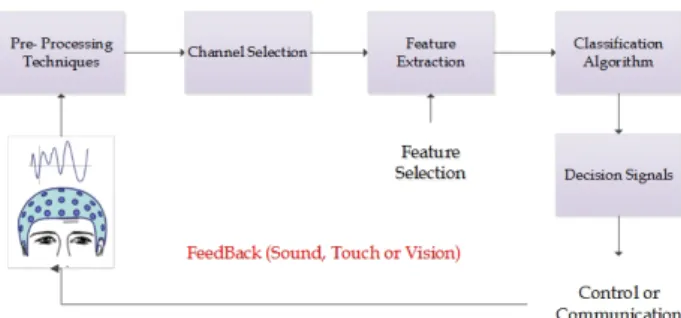
Figure 1: Schematic diagram of Brain Computer Interface with feedback
(SA), Artificial Bee Colony (ABC), Ant Colony Op-timization (ACO) and Particle Swarm Optimiza-tion (PSO) are also implemented and the results of these algorithms have been compared. For classify-ing data, five different classifiers have been used to generate balanced and generalized results.
The rest of the paper is organized as follows. Sec-tion 2 contains details about related methods and techniques used in BCIs along with brief details of evolutionary algorithms. Section 3 is about the re-sults, analysis and a comparison with the results of techniques that have not used any feature selection algorithm. In Section 4, we conclude the paper and provide details about future work directions.
2. Materials and Methods
A typical BCI system contains a signal acquisi-tion part, followed by pre-processing, feature ex-traction and a selection algorithm; the last part is to classify the selected features and generate deci-sion signals for control or communication as shown in Fig. 1. Different feature extracting techniques have been used in the literature to convert the raw EEG signal into useful features, e.g. Common Spa-tial Pattern (CSP)Ramoser et al.(2000), AAR pa-rameters Guger et al. (2003), Wavelet coefficients
G¨uler and ¨Ubeyli (2005)Baig et al. (2014), power spectral density Trejo et al. (2006), etc. In this study, we have implemented Common Spatial Pat-tern (CSP) filters for extracting features. For sub-set generation, a Differential Evolution based evolu-tionary algorithm has been used in off-line training, and different classifiers have been used to classify the features.
2.1. Data Acquisition and Pre-processing
The dataset used in this experiment is from BCI competition III, dataset IVa provided by the Fraunhofer FIRST, Intelligent Data Analysis Group Dornhege et al. (2004). The EEG signal was recorded from five healthy subjects sitting in a chair, with arms in the rest position. The data was captured without any feedback from the initial 4 sessions. The visual stimuli became active from 3.5 s. The task is to generate the motor imagery signals related to left and right hand movement or foot movement based on the clues shown. The data were acquired from 118 channels, and a total of 280 trials for each subject was recorded. A BrainAmp amplifier was used to record data from 128-channel Ag/AgCl electrodes placed using the extended in-ternational 10/20 position system. The signals were then filtered using a Band-pass filter of 0.05-200 Hz. The sampling rate of the data is 1000Hz, which was down-sampled to 100Hz for analysis purposes. EEG signal pre-processing is important to remove arte-facts as well as to extract frequencies of interest. To get the µ and β bands of the EEG signals a fifth-order Butter worth band-pass filter of pass band 8-30Hz was used. All 118 channels have been fil-tered and used for further processing.
2.2. Feature Extraction
After processing the acquired EEG data, the next step is to extract features from that data. The pur-pose of feature extraction is to enhance the variance between classes and improve the classification. Fea-ture extraction favorably affects the classification process, as better features directly contribute to classification accuracy. To improve classification, different feature selection algorithms are available in the literature; for extracting features from motor imagery EEG signals, the best algorithm is a Com-mon Spatial Pattern filter (CSP) Ramoser et al.
(2000). In this paper, we use CSP to extract fea-tures from all 118 EEG channels. Details of the CSP algorithm are given below:
2.2.1. Common Spatial Pattern
Motor Imagery EEG signals are generated be-cause motor movement, practical or imaginary, causes an increase or decrease in neural activities called Event-Related Synchronization (ERS) or De-synchronization (ERD) Pfurtscheller and Da Silva
CSP has been used widely because it has the abil-ity to maximize the difference in variance between the two classesKoles et al.(1990).
Let Xl and Xr be the left and right hand MI EEG matrix with a dimension ofNxM, whereN is the total number of channels used and M is the number of samples per channel. The normalized spatial co-variance of left and right EEG signals can be calculated as:
Cl= Xl X T l traceXl X T l Cr= Xr X T r traceXr X T r (1) where XT represents the transpose of X and trace is the sum of all the diagonal entries of a matrix. The average normalized co-variance matrices Cl andCrcan be obtained by averaging over all trials for each group. The combined average normalized co-variance matrix can be given as
C=Cl+Cr=V0ΣV0T (2) where V0 is the eigenvector matrix and Σ is the corresponding diagonal matrix of eigenvalues. The whitening transformation matrixP = Σ−12VT0 con-verts the average normalized covariance matrices as follows:
Sl=P ClPT (3)
Sr=P CrPT (4)
whereSl andSr have common eigenvectors and the sum of their diagonal matrix is an identity ma-trix,
Sl=VΣlVT Sr=VΣrVT Σl+Σr=I (5) The eigenvector with the largest eigenvalue corre-sponds to one class and the eigenvector with small-est eigenvalue corresponds to the other class. The whitening transformation of EEG onto the eigen-vectors of largest eigenvalues is optimal for sepa-rating the variance in the two signal matrices. The projection matrix can be computed as:
W =VTP (6)
where W is the projection matrix, and the original EEG can be transformed into uncorrelated compo-nents by multiplying EEG with the projection ma-trix W:
Z =W X (7)
where Z is the EEG source component including common and specific component of different tasks. The original EEG can be reconstructed by multi-plying the inverse of W with Z:
X=W−1Z (8)
The columns ofW−1are known as spatial patterns that are considered to be the EEG source distribu-tion vector. The first column of W−1 shows the largest variance of one task and the last column shows the smallest variance of the other task. A time window of 3.5 seconds has been selected for CSP and all data samples were used. The window of 3.5 seconds is selected because the visual stimulus is active for 3.5s and we have used all the samples in the active time window for CSP. As the sampling rate is 100Hz, so a total of 350 samples were used to calculate CSP for each trial.
2.3. Feature Selection
The features extracted from EEG signals are usu-ally large in size for a single channel and increase proportionally for multiple channels. Classifying a large number of features requires more time and computation. To overcome this problem, there is a need for a feature selection algorithm to generate a subset of features that are more closely related to the mental task than other features.
The feature selection algorithms may generally be classified into three categories, Filtering, Wrap-per and Hybrid techniques. In the filtering tech-nique, an independent evaluation criterion such as distance or information measure has been used to rank features. Most of the filtering techniques are high speed, provide independence from the classifier and stability, but they are of low accuracyAlotaiby et al. (2015). Wrapper Techniques use a classifica-tion algorithm to evaluate the feature subset. The Wrapper uses a predictor and its output as an ob-jective function to evaluate the subset. The ad-vantages of using wrapper techniques are the accu-racy, as wrappers generally achieve better recogni-tion rates than filters since they are tuned to the specific interactions between the classifier and the dataset.
Wrappers have a mechanism to avoid over-fitting, as they typically use cross-validation measures of predictive accuracy. The disadvantages are slow execution and the lack of generality: the solution lacks generality since it is tied to the bias of the
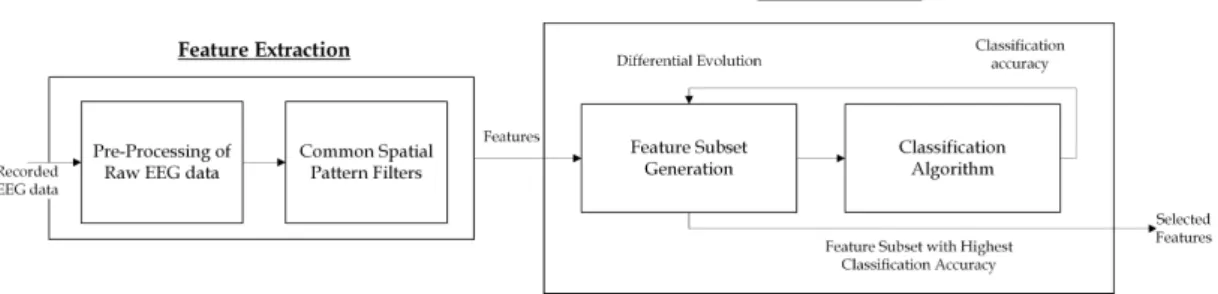
Figure 2: System diagram for dividing the EEG feature space. The feature space is searched in a wrapper fashion directed by classifier performance
classifier used in the evaluation function. The op-timal feature subset will be specific to the classi-fier under consideration Chandrashekar and Sahin
(2014b). The hybrid feature selection method uses a combination of filtering and wrapper techniques to select features. Some of the algorithms used for EEG data are discussed in the next subsection.
2.3.1. Feature selection methods for EEG
Different feature selection algorithms have been used in literature to generate an optimal feature subset so that the overall computational complex-ity is reduced and the classification accuracy is im-proved. A Genetic Algorithm (GA) based feature selection algorithm along with SVM, neural net-work and LDA as classifiers has been suggested by Garret et al. Garrett et al. (2003). The method used GA to search the feature space and generate an optimal feature subset, SVM, was used to evalu-ate the fitness of the generevalu-ated feature subset. The results suggested that 72% of the test data had been correctly classified using SVM. Kohonen’s Learn-ing Vector Quantization (LVQ), commonly known as Distinction Sensitive Learning Vector Quantiza-tion (DSLVQ), was used to overcome the problem of feature dependency using a weighted distance func-tion. The results demonstrated a classification ac-curacy of 80%. The major problem with LVQ is static preselection which cannot be updated with additional dataPregenzer et al. (1996).
A technique for feature selection of an EEG sig-nal using an intelligent genetic search process had been presented for epileptic seizure prediction. The features used in this experiment were curve length, energy, spectral entropy, sixth power, non-linear en-ergy, energy of wavelet packets, second and third-level features. For evaluating the subset perfor-mance, a Probabilistic Neural Network (PNN) was
used as a classifier and managed to restrict the clas-sification error to 0.09 D’Alessandro et al.(2003). Another wrapper method based on genetic algo-rithm and SVM was proposed for automated fea-ture selection on two different datasets, recorded with the TTD system Birbaumer et al. (1999) and Neural Information Processing Systems (NIPS) 2001Blankertz et al.(2002). The results displayed an average improvement of 8.11% in classification accuracy for the TTD dataset and 3.15% for the NIPS dataset Schroder et al.(2003).
Gupta et al. Gupta et al. (2015) implemented a multivariate feature selection algorithm to in-crease the classification accuracy of the LDA and SVM for mental tasks using EEG signals. Atkin-son and CamposAtkinson and Campos(2016) pro-posed feature selection technique for emotion recog-nition from EEG signals. Their method utilizes mu-tual information for feature selection and SVM for classification. In another experiment, Lee et al. Lee et al.(2015) proposed a feature selection algorithm based on fuzzy rough theory and multi-tree genetic programming to improve the classification accuracy of brain signals data measured by fNIRS. Adam et al. Adam et al. (2016) implemented angle mod-ulated simmod-ulated Kalman filter to select features along with neural network as a classifier. They found the detection performance of the method is better than the other feature selection method with random weight neural network classifier. In another study, a wrapper technique based on multiobjec-tive optimization using deep belief networks (DBN) classifier for feature selection application has been studied. The results showed that performance of DBN decreases with a large number of features and they suggest that it is necessary to determine the suitable number of hidden layer units for efficient classification.
In the literature, Genetic algorithms have been widely used for searching feature space. The effec-tiveness and searching power for feature selection of other evolutionary algorithms has not been studied in detail for EEG data. In this paper, we have im-plemented a novel hybrid method that uses CSP to extract feature space, then used Differential Evo-lution with a classifier (Wrapper) to discover the optimized feature subset. An architecture of the system is presented in Fig. 2. The feature selec-tion part has two main modules, the first module is the feature subset generation using differential algorithm and the second module is the classifica-tion algorithm used to evaluate the credibility of a subset towards classification accuracy.
2.4. Evolutionary feature selection methods
Evolutionary algorithms gained a lot of interest for their applications in feature selection. Differen-tial Evolution (DE) is the main focus of this work, as well as a comparison with other evolutionary al-gorithms like Simulated Annealing (SA), Particle Swarm Optimization (PSO), Artificial Bee Colony (ABC) and Ant Colony Optimization (ACO). We have implemented a modified version of DE based on a float optimizer, as no well-known binary ver-sion of DE is currently available that can yield re-sults as sound as generated by the above mentioned nature-inspired algorithms. To give a comparative study, other evolutionary algorithms have been im-plemented in MATLAB and their results are com-pared. Details of these algorithms are given below:
2.4.1. Differential Evolution
Differential Evolution (DE) is a vector-based search algorithm similar to a pattern search or ge-netic algorithm and has a good convergence prop-erty. It is a stochastic search algorithm with an ability of self-organization without using derivative information. Like GA, DE also uses the crossover and mutation concepts as differential operators, but it has explicit updating equationsQin et al.(2009). The process of DE is shown in Fig. 3. The algo-rithm starts with a randomly selected solutionxi, where i=1, 2, 3, . . . , n. and 3 randomly selected distinct vectorsxp, xq, xrto generate a new donor vectorv by mutation
vt+1i =xtp+F xtq−xtr
(9) where F[0, 2] is the differential weight and t de-notes the current iteration. The crossover is
con-trolled by Cr [0, 1]. The jth component of each
vi, update: ut+1j,i = v j,i if ri≤Cr or j=Jr, xt j,i ri> Cr and j6=Jr, (10) The solution is selected and updated by minimiz-ing the objective function by the followminimiz-ing equation:
xt+1i = ut+1i if f ut+1i ≤f(xt i), xt i otherwise. (11) where f() is the objective function; in our case is the classification accuracy Khushaba et al.(2011). The Population size has been set to 50 and a to-tal of 100 iterations has been used. The crossover probability Cr used in our experiment is 0.5 and the initial and final inertia weights are 0.95 and 0.35 re-spectively. The other population-based algorithms used in this study are discussed briefly below.
2.5. Particle Swarm Optimization
Particle Swarm Optimization (PSO) is one of the most popular evolutionary algorithms and has been applied to almost every field of research where there is a need for optimization. PSO algorithms regulate the velocities and trajectories of individual elements called particles in order to move through the space to find the objective function. The particle move-ment is based on a stochastic and a deterministic component. Each particle in a swarm is attracted to the position of the current global best and its own best location. When a particle finds a better loca-tion, it updates the current location and considers the current best for all n particles at any time. The main goal is to search for the global best among all current best solutions until the objective func-tion does not improve furtherKennedy(2011). The update in a particle’s velocity can be calculated as
vit+1=θvti+α1g∗−sti
+β2
h
x∗(t)i −xtii, (12) wherexiandviare the position and velocity vec-tors for particle i, respectively. 1and 2 are two random vectors with each entry between 0 and 1. αandβ are the learning parameters,g∗ is the cur-rent global best and x∗(t)i is the current best for particle i at time t. θ is the inertia function used to stabilize particle motion. The updated position can be calculated as
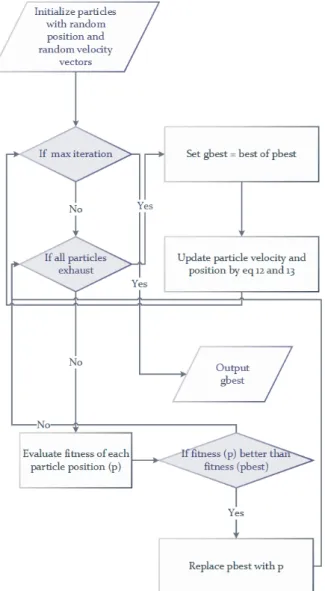
Figure 3: Flowchart of Differential Evolution Algorithm
The flowchart for PSO is given in Fig. 4. In our experiment, the swarm size is 20, the inertia weight is 0.72, damping ratio is 1, individual learning coef-ficient and global learning coefcoef-ficient have been set to 1.4962.
Figure 4: Block diagram of Particle Swarm Optimization
2.5.1. Simulated Annealing
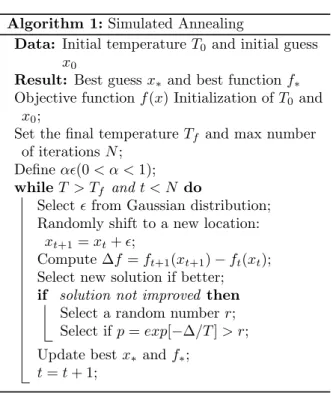
Simulated annealing (SA) is a trajectory-based technique that uses a random search to find the global optimization, and is one of the earliest nature-inspired algorithms.
The basic theme of SA is to use random-search algorithms like a Markov chain and keep accepting those changes that improve the objective function
Algorithm 1: Simulated Annealing
Data: Initial temperatureT0 and initial guess x0
Result: Best guessx∗ and best functionf∗ Objective functionf(x) Initialization ofT0 and
x0;
Set the final temperatureTf and max number of iterationsN;
Defineα(0< α <1); whileT > Tf andt < N do
Selectfrom Gaussian distribution; Randomly shift to a new location:
xt+1=xt+;
Compute ∆f =ft+1(xt+1)−ft(xt); Select new solution if better; if solution not improved then
Select a random numberr; Select ifp=exp[−∆/T]> r; Update bestx∗ andf∗;
t=t+ 1;
Szu and Hartley (1987). The SA algorithm can be summarized as pseudo code in algorithm1Yang
(2014).
2.5.2. Ant Colony Optimization
Ant Colony Optimization (ACO) utilizes the be-havior of ants to find the optimal solution. Ants live in colonies and communicate with the environ-ment in groups or swarms. The optimization is achieved based on the way ants communicate indi-rectly the direction to each other while searching for food. The first algorithm was presented by Marco Dorigo in his PhD thesisDorigo et al. (2006) and after that many variants have been presented. The main point to follow in this algorithm is the proba-bility of choosing the route and evaporation rate of a pheromone.
The probability of selection of a particular node
i to choose the route from nodei to j can be cal-culated as pij= φαijdβij Pn i,j=1φ α ijd β ij (14)
whereαandβ are the influence parameters and must be greater than zero, typically 2. φij is the concentration of pheromone on route i to j and dij is the desirability of the route. The pheromone
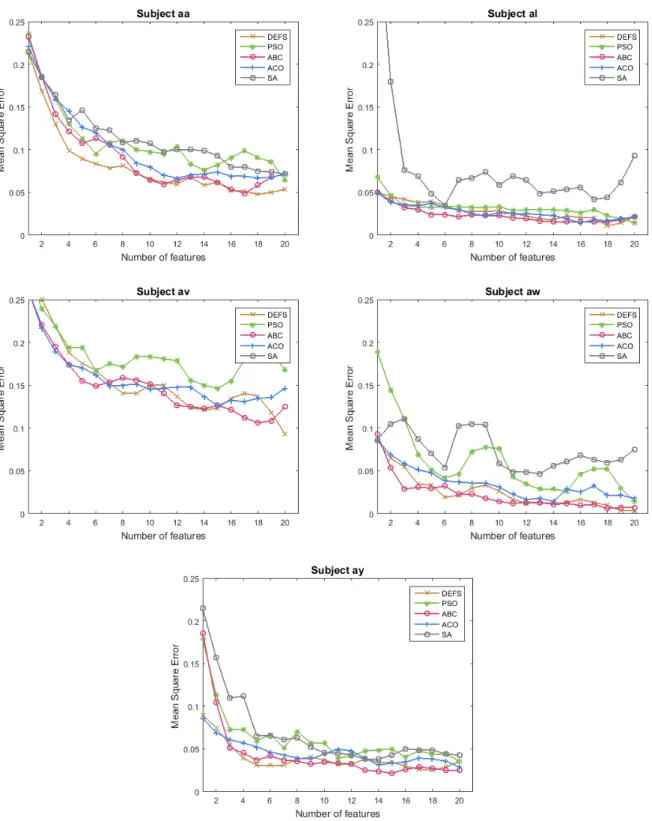
Figure 6: Plot of mean square error against number of features selected by different evolutionary algorithms using SVM as a classifier for 5 subjects: (a) subject aa; (b) subject al; (c) subject av; (d) subject aw; (e) subject ay.
concentration usually varies with time as
φ(t) =φ0e−γt (15) where φ0 is the initial concentration and γ is the constant rate of pheromone evaporation Dorigo et al. (2008). The flowchart of a simple ACO is shown in Fig. 5. A total of 20 iterations has been used in this experiment with an ant population size of 10 and evaporation rate of 0.05. α,β and initial pheromone were set to 1.
2.5.3. Artificial Bee Colony
The Artificial Bee Colony (ABC) algorithm was proposed by Karaboga in 2005 and is an optimiza-tion algorithm utilizing the foraging behavior of a honey bee swarm Karaboga (2005). In the ABC algorithm, the swarm or colonies are divided into three different categories of bees: employed, on-lookers and scout bees. The assumption is that, for every food source there is only one artificial em-ployed bee, i.e. the number of emem-ployed artificial bees in a colony is equal to the number of food sources around a hive. The area between hive and food source becomes the dancing area that can be explored by employed bees. A scout is an employed bee whose food source has been abandoned; they start searching for new food sources. Onlookers select the food source based on an employed bees dance. A simple explanation of the different steps involved in the ABC algorithm is given below:
1. Initialize food source for all employed bees 2. Repeat Step 3 to Step 6
3. Every employed bee calculates nectar of food source and dances in the hive after going to a food source and determining a neighbor source 4. The onlooker watches the dance of employed bees to choose a source based on their dance and goes to that source and evaluates its nectar amount
5. Scout bees determine and replace new food sources for abandoned food sources
6. Output the best food source found so far In the ABC algorithm, the possible solutions are the positions of food sources, and the fitness of this solution is related to the nectar amount. The first step is to initialize the population using ran-domly distributed values. After initialization the search process of employed, onlooker and scout bees starts. The employed bees generate a modification of a source in their memory and memorize it if
the amount of nectar is greater than the current food source. After each iteration, the employed bees share the position with the onlookers on the dance area. The onlooker evaluates the amount of nectar at a new food source position and se-lects accordingly. The scout bees replace the aban-doned sources with new sources produced randomly
Karaboga(2010).
2.6. Classification
The selection of a classification algorithm is of vi-tal importance in some scenarios. In this study, we utilize five different classifiers to get a generalized view of the hybrid method. The methods include Linear Discriminant Analysis (LDA) that attempts to transform one dependent variable as a linear combination of other features Mika et al. (1999), Support Vector Machine (SVM) which constructs a hyper-plane in a high-dimensional space to separate the classesHearst et al.(1998), K-nearest neighbors (k-NN) which utilizes a voting-based mechanism based on neighbors with the sample being assigned to the class most appear in its k nearest neighbors
Fukunaga and Narendra(1975), Naive Bayes (NB) classifiers, simple probabilistic classifiers, based on Bayes’ theorem with an assumption of naive inde-pendence between features Leung (2007), Regres-sion Tress which generates deciRegres-sions using a tree-like graph or model and their possible consequences
Breiman et al.(1984).
3. Results and Discussion
To evaluate and compare the performance of the presented DE feature selection method, some well-known population-based feature selection al-gorithms were also implemented. Each of the algo-rithms was tested on the same dataset. In the ex-periment, five different classifiers were used to eval-uate the classification accuracy of DE feature se-lection method including LDA, SVM, k-NN, Naive Bayes and regression trees. For other feature selec-tion algorithms, only SVM and LDA were imple-mented.
Data from all five subjects in BCI competition III dataset IVa have been used for training and test-ing purposes. The dataset contains a total of 280 samples for each subject with 118 channels. After applying CSP, 236 features were extracted from all five subjects. A 10-fold cross-validation has been used to get an average classification accuracy.
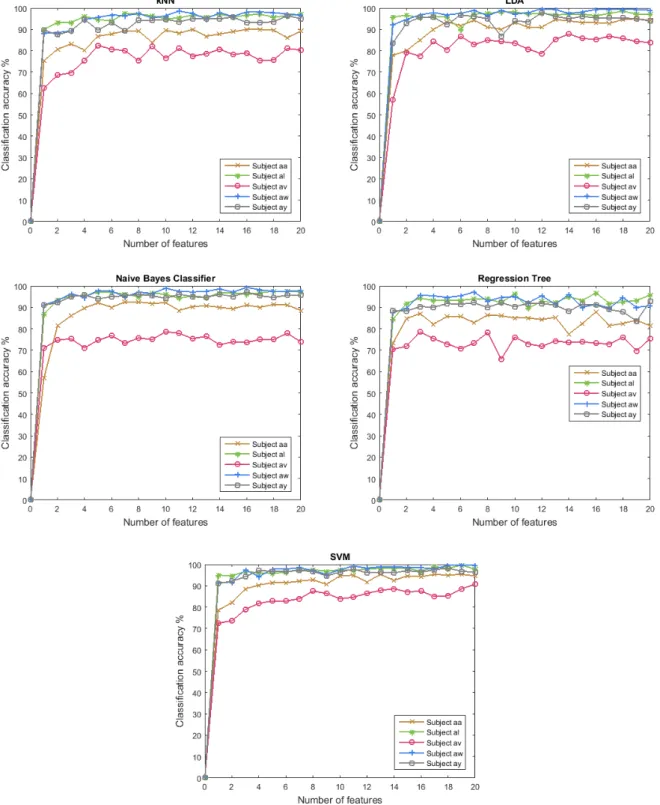
Figure 7: Average Classification accuracy plot of 5 subjects using differential evolution algorithm for feature selection using different classifiers: (a) k-NN; (b) LDA; (c) Naive Bayes; (d) Regression tree; (e) SVM.
The results in Fig. 6shows the mean square clas-sification error of five subjects with different feature selection techniques with respect to the number of features selected, using SVM as a classifier. After a certain number of features, the Mean Square Er-ror (MSE) remains almost steady. For example, the subject aa maintains an average of 10% MSE with 9 features or more. Simulated annealing shows the worst classification compared to other algorithms, and Differential Evolution (DE) and Artificial Bee Colony (ABC) generate maximum classification ac-curacy for all five subjects with DE beating ABC in some cases. The subject av shows a high mean square error compared to other subjects with an av-erage 15 to 20 %. The best MSE is of 0% with the number of features 18 and 19 for the subject aw.
Different classifiers have been used to evaluate the performance of the proposed method and the re-sults are recorded in Fig. 7. SVM and LDA perform well compared to kNN, Naive Bayes and Regres-sion Trees for all the five subjects, with an average classification of around 90%. The best results are obtained for feature subset sizes of 8 or more. LDA and SVM classifiers generate the maximum classi-fication accuracy. The lowest classiclassi-fication rate is shown by subject av followed by subject aa and the maximum classification accuracy has been achieved by subject aw for all classifiers. For subject av, the possible reason not to generate a better classifica-tion can be due to weak brain signals or lack of interest in the experiment by the subject.
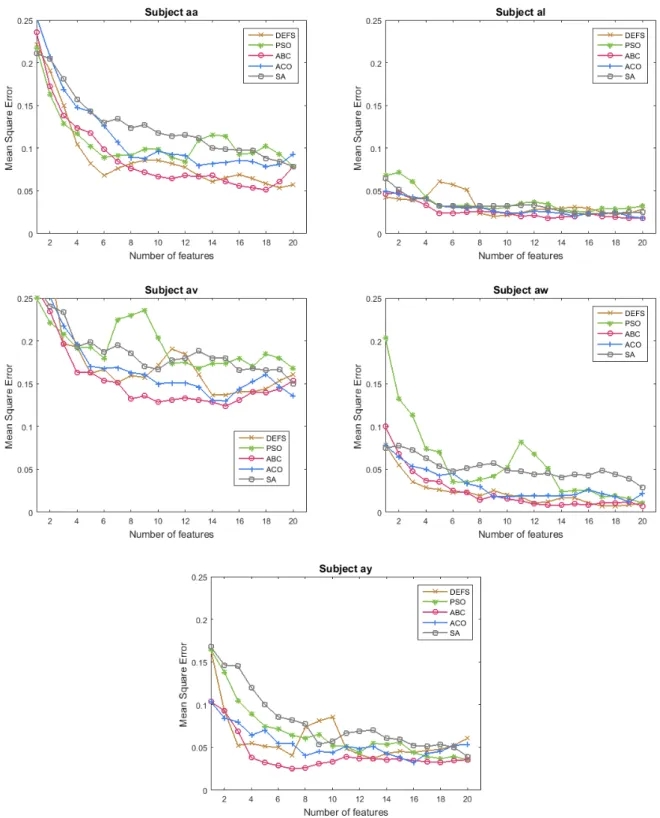
In Fig. 8, LDA has been used for classification. The graph shows that ABC results are stable com-pared to other classification algorithms for LDA, with a lowest mean square error for subjects al and ay. It can be seen that the second-best algorithm for feature selection is DE whose classification ac-curacy is approximately equal to that of ABC. The MSE becomes stable after the feature subset size becomes 12 or more for almost all cases.
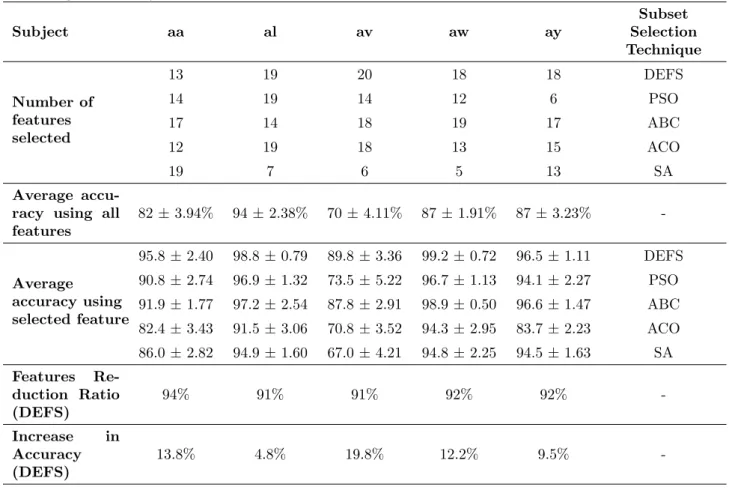
Table 1 shows the number of features that gen-erates the maximum classification accuracy along with the corresponding classification rate and sub-set generation algorithm. DE generates the best results with an average of 19 features and a classi-fication accuracy of above 90%. The results show a reduction of 90% in the features with an improve-ment of 8 to 10% in classification results.
The box plot in Fig. 10shows the average classifi-cation accuracy of all five subjects through different classifiers while using DE for feature subset gener-ation. The results show that SVM is the best
clas-sifier for this problem with an average classification accuracy of 97%, and the variation is in between 88 and 100%. Regression tree shows a minimum accuracy of 86% with a swing between 75 and 95 %. The LDA performs well with a performance measure approximately the same as SVM.
The individual subject performance has been shown in Fig. 9 with the help of a box plot. The plot shows that the subjects al and aw achieved the maximum classification accuracy of 100% for most of the cases. There is a slight reduction in accuracy for subject ay, which swings around 98%. Subject aa has the ability to generate an accuracy of 95% for most of the cross-validations, and the lowest per-formance has been recorded for subject av with an average of 85%.
Table 2 shows a comparison of previously pub-lished techniques for classification of motor imagery EEG signals. The references mentioned applied their proposed method on the same dataset used in our experiment. Wang et al. used CSP and Auto-regressive (AR) models for feature extraction to achieve an accuracy of 94.17%. The subjects al, aw and ay showed almost 100% of classification accuracy, but this method used a bootstrap aggre-gation to make the final decision which makes the method computationally expensive. CSP was ap-plied for subjects al, aw and ay whereas CSP along with AR and LDA were used for subjects aa and av, which makes the algorithm complex and adap-tive Wang et al. (2006). With the implementation of discriminant filter CSP for all channels, Thomas et al. Thomas* et al.(2009) managed to produce a classification accuracy of 91.57%. Ang et al. Ang et al.(2008) applied filter-bank CSP for feature ex-traction and achieved an accuracy of 88%.
Lu et al. Lu et al. (2015) maximized the classi-fication accuracy to 68.94% by applying structure constrained semi-non-negative matrix factorization. Zhang et al. Zhang et al. (2015) generated fea-tures using sparse filter-band CSP and got a clas-sification accuracy of 92.05%. Das et al Das et al.
(2016a) proposed a method for subject specific fil-ter selection using cognitive fuzzy inference system of type 2 (SS-CFIS). The method has gain an in-crease in performance by 15-18% compared to CSP algorithm. They have achieved a classification ac-curacy of 77.75% with a standard deviation of more than 16% with the SS CFIS approach. In another study, Das et al Das et al.(2016b) presented a ro-bust CSP algorithm for motor imagery EEG sig-nals. The algorithm utilizes a self regulated interval
Figure 8: Mean square error against number of features selected by different evolutionary algorithms using LDA as a classifier for 5 subjects: (a) subject aa; (b) subject al; (c) subject av; (d) subject aw; (e) subject ay.
Table 1: Number of features selected for 5 subjects and 5 evolutionary algorithms along with average classification accuracy of individual subjects using all features and a feature subset generated by evolutionary algorithms, reduction of features using DEFS and gain in accuracy
Subject aa al av aw ay Subset Selection Technique Number of features selected 13 19 20 18 18 DEFS 14 19 14 12 6 PSO 17 14 18 19 17 ABC 12 19 18 13 15 ACO 19 7 6 5 13 SA Average accu-racy using all features 82±3.94% 94±2.38% 70±4.11% 87±1.91% 87±3.23% -Average accuracy using selected feature 95.8±2.40 98.8±0.79 89.8±3.36 99.2±0.72 96.5±1.11 DEFS 90.8±2.74 96.9±1.32 73.5±5.22 96.7±1.13 94.1±2.27 PSO 91.9±1.77 97.2±2.54 87.8±2.91 98.9±0.50 96.6±1.47 ABC 82.4±3.43 91.5±3.06 70.8±3.52 94.3±2.95 83.7±2.23 ACO 86.0±2.82 94.9±1.60 67.0±4.21 94.8±2.25 94.5±1.63 SA Features Re-duction Ratio (DEFS) 94% 91% 91% 92% 92% -Increase in Accuracy (DEFS) 13.8% 4.8% 19.8% 12.2% 9.5%
-Figure 9: Box plot of average classification accuracy for the 5 subjects using DEFS and SVM
Figure 10: Box plot of average classification accuracy by different classifiers using DEFS
Table 2: Comparison of feature selection method with proposed technique
Contributor Accuracy Technique aa al av aw ay
Wang et al. (2006) 94.17% CSP and Auto-regressive models 95.5% 100% 80.6% 100% 97.6% Thomas* et al. (2009) 91.75 % Discriminant Filter CSP 90.21% 98.68% 77.80% 97.85% 94.23%
Ang et al.(2008) 88% Filter bank CSP 94% 97% 86% 93% 93%
Lu et al.(2015) 68.94% Structure constrained semi-non-negative matrix factorization
64.21% 92.67% 60.00% 72.58% 55.56%
Zhang et al.
(2015)
92.05% Sparse Filter bands CSP 91.64% 98.67% 77.43% 98.03% 94.69% Das et al. (2016a) 77.75% Subject-specific CFIS 82.14% 100% 63.27% 83.04% 60.32% Proposed Method
96.02% CSP with DE for fea-ture selection
95.8 % 98.8 % 89.8 % 99.2 % 96.5 %
type 2 neuro fuzzy inference system in for handling EEG signals. The mean classification accuracy has increased with these proposed techniques, also the standard deviation which is more than 10% in each case. In comparison, the proposed method utilizes the DE algorithm to generate an optimal features subset and the subset is then made available to the classifier to achieve maximum results. The features have been extracted by applying CSP to EEG data from all the channels. The results showed that sub-jects al and aw have a maximum accuracy of almost 100%, almost the same as other algorithms. Sub-jects aa and ay displayed an accuracy of above 95% and most importantly the classification accuracy for subject av is averaged around 90% which is better than for all other algorithms.
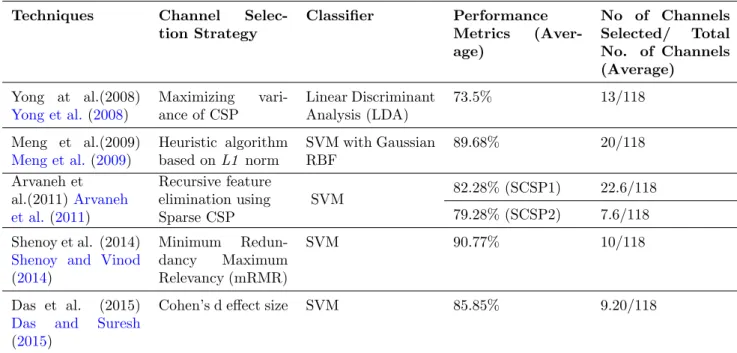
Table3shows a summary of channel selection al-gorithm for motor imagery EEG signals. The clas-sification accuracy after applying channel selection 90% (maximum). With the proposed feature selec-tion method, the classificaselec-tion accuracy is of 96% with a variance of less than 3%.
Subject variability is observed to have a notable affect the performance as seen in Table 2. We ob-serve that the classification accuracy of subject aa, al, aw and ay are much higher than av. This trend (effect) can also be seen in feature selection using evolutionary algorithm. Because we choose wrap-per techniques, the effect has been minimized (as seen from the results). The difference in patterns of different subjects cannot be seen from the naked
eye.
4. Conclusion
The benefit of applying a feature selection algo-rithm is that it reduces computational complexity and increases feature set effectiveness by selecting relevant features. Once a feature subset is selected, it requires a classifier to generate control signals. This paper presents a new hybrid method for fea-ture selection of an EEG signal for the MI-related task. The proposed DE-based EEG feature selec-tion successfully generates the optimal feature sub-set based on the maximum classification accuracy of a subset feature. The method uses a simple feature extraction technique i.e. CSP and produces promis-ing results. The dataset used to evaluate the pro-posed method is dataset IVa from BCI competition III and the method successfully enhances the classi-fication accuracy of the dataset. The results showed that the average of 96.02% classification accuracy was achieved with an increase of 2% in classification accuracy compared to other methods in the litera-ture. SVM and LDA prove to be the best classi-fiers for DE-based feature selection; both classiclassi-fiers showed an accuracy of 95% with a deviation of 0.1. Subjects al and av produced an average accuracy of almost 100%, aa and ay showed a mean classifica-tion accuracy of 95% and av showed an average of 88%. Preliminary results of the presented method
Table 3: Summary of Channel Selection Method for Motor Imagery EEG evaluated on BCI Competition III Dataset IVa
Techniques Channel Selec-tion Strategy Classifier Performance Metrics (Aver-age) No of Channels Selected/ Total No. of Channels (Average) Yong at al.(2008) Yong et al.(2008) Maximizing vari-ance of CSP Linear Discriminant Analysis (LDA) 73.5% 13/118 Meng et al.(2009) Meng et al.(2009) Heuristic algorithm based on L1 norm SVM with Gaussian RBF 89.68% 20/118 Arvaneh et al.(2011)Arvaneh et al.(2011) Recursive feature elimination using Sparse CSP SVM 82.28% (SCSP1) 22.6/118 79.28% (SCSP2) 7.6/118 Shenoy et al. (2014)
Shenoy and Vinod
(2014) Minimum Redun-dancy Maximum Relevancy (mRMR) SVM 90.77% 10/118 Das et al. (2015)
Das and Suresh
(2015)
Cohen’s d effect size SVM 85.85% 9.20/118
show a simple feature extraction technique can pro-duce remarkable results. The proposed algorithm is slow compared to the typical feature selection algo-rithms and the classifier of the wrapper technique make it even more slower. However, we argue that it has significant benefit that over-weigh the the limitation of slow operation. A notable benefit of using the evolutionary algorithm is that it is ap-plied only once to select the best features related to an application. Once the set of optimal features is obtained, then it is simply a classification problem which can be processed in much efficient manner. The results show the effectiveness of the presented feature selection method, and future work includes more extensive testing of evolutionary algorithms and its application to an on-line BCI system.
Acknowledgment
This project is supported in part by the Eu-ropean Unions Erasmus Mundus Grant cLINK project (Grant Number 2012-2645), the Engineer-ing and Physical Sciences Research Council (EP-SRC) (Ref: EP/M002632/1), and the Royal Society (Ref: IE160609).
References
Adam, A., Ibrahim, Z., Mokhtar, N., Shapiai, M.I., Mu-bin, M., Saad, I.. Feature selection using angle modu-lated simumodu-lated kalman filter for peak classification of eeg signals. SpringerPlus 2016;5(1):1580.
Alotaiby, T., El-Samie, F.E.A., Alshebeili, S.A., Ahmad, I.. A review of channel selection algo-rithms for eeg signal processing. EURASIP Jour-nal on Advances in SigJour-nal Processing 2015;2015(1):66. URL: http://dx.doi.org/10.1186/s13634-015-0251-9. doi:10.1186/s13634-015-0251-9.
Ang, K.K., Chin, Z.Y., Zhang, H., Guan, C.. Filter bank common spatial pattern (fbcsp) in brain-computer interface. In: 2008 IEEE International Joint Conference on Neural Networks (IEEE World Congress on Computa-tional Intelligence). IEEE; 2008. p. 2390–2397.
Arvaneh, M., Guan, C., Ang, K.K., Quek, C.. Optimizing the channel selection and classification accuracy in eeg-based bci. IEEE Transactions on Biomedical Engineering 2011;58(6):1865–1873.
Atkinson, J., Campos, D.. Improving bci-based emotion recognition by combining eeg feature selection and kernel classifiers. Expert Systems with Applications 2016;47:35– 41.
Baig, M.Z., Javed, E., Ayaz, Y., Afzal, W., Gillani, S.O., Naveed, M., Jamil, M.. Classification of left/right hand movement from eeg signal by intelligent algorithms. In: Computer Applications and Industrial Electronics (IS-CAIE), 2014 IEEE Symposium on. IEEE; 2014. p. 163– 168.
Birbaumer, N., Ghanayim, N., Hinterberger, T., Iversen, I., Kotchoubey, B., K¨ubler, A., Perelmouter, J., Taub,
E., Flor, H.. A spelling device for the paralysed. Nature 1999;398(6725):297–298.
Blankertz, B., Curio, G., Muller, K.R.. Classifying single trial eeg: Towards brain computer interfacing. Advances in neural information processing systems 2002;1:157–164. Breiman, L., Friedman, J., Stone, C.J., Olshen, R.A..
Classification and regression trees. CRC press, 1984. Chandrashekar, G., Sahin, F.. A survey on feature
se-lection methods. Computers & Electrical Engineering 2014a;40(1):16–28.
Chandrashekar, G., Sahin, F.. A survey on feature se-lection methods. Computers & Electrical Engineering 2014b;40(1):16–28.
Coyle, S.M., Ward, T.E., Markham, C.M.. Brain-computer interface using a simplified functional near-infrared spectroscopy system. Journal of neural engineer-ing 2007;4(3):219.
D’Alessandro, M., Esteller, R., Vachtsevanos, G., Hinson, A., Echauz, J., Litt, B.. Epileptic seizure prediction using hybrid feature selection over multiple intracranial eeg electrode contacts: a report of four patients. IEEE Transactions on Biomedical Engineering 2003;50(5):603– 615.
Das, A., Suresh, S.. An effect-size based channel selection algorithm for mental task classification in brain computer interface. In: Systems, Man, and Cybernetics (SMC), 2015 IEEE International Conference on. IEEE; 2015. p. 3140–3145.
Das, A., Suresh, S., Sundararajan, N.. A discriminative subject-specific spatio-spectral filter selection approach for eeg based motor-imagery task classification. Expert Systems with Applications 2016a;64:375–384.
Das, A.K., Sundaram, S., Sundararajan, N.. A self-regulated interval type-2 neuro-fuzzy inference system for handling nonstationarities in eeg signals for bci. IEEE Transactions on Fuzzy Systems 2016b;24(6):1565–1577. Datta, S., Khasnobish, A., Konar, A., Tibarewala, D..
Cognitive activity classification from eeg signals with an interval type-2 fuzzy system. In: Advancements of Medi-cal Electronics. Springer; 2015. p. 235–247.
Dorigo, M., Birattari, M., Blum, C., Clerc, M., Sttzle, T., Winfield, A.. Ant Colony Optimization and Swarm Intelligence: 6th International Conference, ANTS 2008, Brussels, Belgium, September 22-24, 2008, Proceedings. volume 5217. Springer, 2008.
Dorigo, M., Birattari, M., Stutzle, T.. Ant colony op-timization. IEEE computational intelligence magazine 2006;1(4):28–39.
Dornhege, G., Blankertz, B., Curio, G., Mller, K.R.. Boosting bit rates in noninvasive eeg single-trial classifications by feature combination and multiclass paradigms. Biomedical Engineering, IEEE Transactions on 2004;51(6):993–1002.
Fukunaga, K., Narendra, P.M.. A branch and bound algo-rithm for computing k-nearest neighbors. IEEE transac-tions on computers 1975;100(7):750–753.
Garrett, D., Peterson, D.A., Anderson, C.W., Thaut, M.H.. Comparison of linear, nonlinear, and feature se-lection methods for eeg signal classification. Neural Sys-tems and Rehabilitation Engineering, IEEE Transactions on 2003;11(2):141–144.
Guger, C., Edlinger, G., Harkam, W., Niedermayer, I., Pfurtscheller, G.. How many people are able to operate an eeg-based brain-computer interface (bci)? IEEE trans-actions on neural systems and rehabilitation engineering
2003;11(2):145–147.
G¨uler, I., ¨Ubeyli, E.D.. Adaptive neuro-fuzzy inference system for classification of eeg signals using wavelet coeffi-cients. Journal of neuroscience methods 2005;148(2):113– 121.
Guo, X., Wu, X., Gong, X., Zhang, L.. Envelope de-tection based on online ica algorithm and its application to motor imagery classification. In: Neural Engineering (NER), 2013 6th International IEEE/EMBS Conference on. IEEE; 2013. p. 1058–1061.
Gupta, A., Agrawal, R., Kaur, B.. Performance enhance-ment of enhance-mental task classification using eeg signal: a study of multivariate feature selection methods. Soft Computing 2015;19(10):2799–2812.
Hearst, M.A., Dumais, S.T., Osman, E., Platt, J., Scholkopf, B.. Support vector machines. IEEE Intel-ligent Systems and their Applications 1998;13(4):18–28. Herman, P.A., Prasad, G., McGinnity, T.M.. Designing
an interval type-2 fuzzy logic system for handling uncer-tainty effects in brain–computer interface classification of motor imagery induced eeg patterns. IEEE Transactions on Fuzzy Systems 2017;25(1):29–42.
Hill, N.J., Lal, T.N., Schrder, M., Hinterberger, T., Wid-man, G., Elger, C.E., Schlkopf, B., Birbaumer, N.. Classifying event-related desynchronization in eeg, ecog and meg signals. In: Pattern Recognition. Springer; 2006. p. 404–413.
Hsu, W.Y.. Eeg-based motor imagery classification using enhanced active segment selection and adaptive classifier. Computers in biology and medicine 2011;41(8):633–639. Hsu, W.Y.. Application of competitive hopfield neural
net-work to brain-computer interface systems. International journal of neural systems 2012a;22(01):51–62.
Hsu, W.Y.. Enhanced active segment selection for single-trial eeg classification. Clinical EEG and neuroscience 2012b;43(2):87–96.
Jiang, Y., Deng, Z., Chung, F.L., Wang, G., Qian, P., Choi, K.S., Wang, S.. Recognition of epileptic eeg signals using a novel multiview tsk fuzzy system. IEEE Transac-tions on Fuzzy Systems 2017;25(1):3–20.
Karaboga, D.. An idea based on honey bee swarm for nu-merical optimization. Technical Report; Technical report-tr06, Erciyes university, engineering faculty, computer en-gineering department; 2005.
Karaboga, D.. Artificial bee colony algorithm. scholarpedia 2010;5(3):6915.
Kennedy, J.. Particle swarm optimization. In: Encyclopedia of machine learning. Springer; 2011. p. 760–766. Khushaba, R.N., Al-Ani, A., Al-Jumaily, A.. Feature
subset selection using differential evolution and a sta-tistical repair mechanism. Expert Systems with Appli-cations 2011;38(9):11515–11526. doi:http://dx.doi.org/ 10.1016/j.eswa.2011.03.028.
Koles, Z.J., Lazar, M.S., Zhou, S.Z.. Spatial pat-terns underlying population differences in the background eeg. Brain Topography 1990;2(4):275–284. doi:10.1007/ bf01129656.
Lee, J.H., Anaraki, J.R., Ahn, C.W., An, J.. Efficient classification system based on fuzzy–rough feature selec-tion and multitree genetic programming for intension pat-tern recognition using brain signal. Expert Systems with Applications 2015;42(3):1644–1651.
Leung, K.M.. Naive bayesian classifier. Polytechnic Univer-sity Department of Computer Science/Finance and Risk Engineering 2007;.
Lu, N., Li, T., Pan, J., Ren, X., Feng, Z., Miao, H.. Structure constrained semi-nonnegative matrix factoriza-tion for eeg-based motor imagery classificafactoriza-tion. Com-puters in Biology and Medicine 2015;60:32–39. doi:http: //dx.doi.org/10.1016/j.compbiomed.2015.02.010. Meng, J., Liu, G., Huang, G., Zhu, X.. Automated
selecting subset of channels based on csp in motor im-agery brain-computer interface system. In: Robotics and Biomimetics (ROBIO), 2009 IEEE International Confer-ence on. IEEE; 2009. p. 2290–2294.
Mika, S., Ratsch, G., Weston, J., Scholkopf, B., Mullers, K.R.. Fisher discriminant analysis with kernels. In: Neu-ral Networks for Signal Processing IX: Proceedings of the 1999 IEEE Signal Processing Society Workshop (Cat. No.98TH8468). 1999. p. 41–48. doi:10.1109/NNSP.1999. 788121.
Nauck, D., Kruse, R.. Obtaining interpretable fuzzy classi-fication rules from medical data. Artificial intelligence in medicine 1999;16(2):149–169.
Parra, L., Alvino, C., Tang, A., Pearlmutter, B., Yeung, N., Osman, A., Sajda, P.. Linear spatial integration for single-trial detection in encephalography. Neuroimage 2002;17(1):223–230.
Pfurtscheller, G., Da Silva, F.H.L.. Event-related eeg/meg synchronization and desynchronization: basic principles. Clinical neurophysiology 1999;110(11):1842–1857. Pineda, J.A.. The functional significance of mu rhythms:
translating seeing and hearing into doing. Brain Research Reviews 2005;50(1):57–68.
Pregenzer, M., Pfurtscheller, G., Flotzinger, D.. Auto-mated feature selection with a distinction sensitive learn-ing vector quantizer. Neurocomputlearn-ing 1996;11(1):19–29. Price, K., Storn, R.M., Lampinen, J.A.. Differential
evolution: a practical approach to global optimization. Springer Science & Business Media, 2006.
Qin, A.K., Huang, V.L., Suganthan, P.N.. Differential evolution algorithm with strategy adaptation for global numerical optimization. IEEE transactions on Evolution-ary Computation 2009;13(2):398–417.
Ramoser, H., Muller-Gerking, J., Pfurtscheller, G.. Op-timal spatial filtering of single trial eeg during imagined hand movement. IEEE transactions on rehabilitation en-gineering 2000;8(4):441–446.
Schroder, M., Bogdan, M., Hinterberger, T., Birbaumer, N.. Automated eeg feature selection for brain computer interfaces. In: Neural Engineering, 2003. Conference Pro-ceedings. First International IEEE EMBS Conference on. IEEE; 2003. p. 626–629.
Shenoy, H.V., Vinod, A.P.. An iterative optimization tech-nique for robust channel selection in motor imagery based brain computer interface. In: Systems, Man and Cyber-netics (SMC), 2014 IEEE International Conference on. IEEE; 2014. p. 1858–1863.
Sitaram, R., Caria, A., Veit, R., Gaber, T., Rota, G., Kuebler, A., Birbaumer, N.. Fmri bracomputer in-terface: a tool for neuroscientific research and treatment. Computational intelligence and neuroscience 2007;2007. Szu, H., Hartley, R.. Fast simulated annealing. Physics
letters A 1987;122(3-4):157–162.
Thomas*, K.P., Guan, C., Lau, C.T., Vinod, A.P., Ang, K.K.. A new discriminative common spatial pat-tern method for motor imagery brain& x2013;computer interfaces. IEEE Transactions on Biomedical Engineering 2009;56(11):2730–2733. doi:10.1109/TBME.2009.2026181. Trejo, L.J., Rosipal, R., Matthews, B.. Brain-computer
interfaces for 1-d and 2-d cursor control: designs using vo-litional control of the eeg spectrum or steady-state visual evoked potentials. IEEE transactions on neural systems and rehabilitation engineering 2006;14(2):225–229. Wang, Y., Gao, S., Gao, X.. Common spatial pattern
method for channel selelction in motor imagery based brain-computer interface. In: Engineering in Medicine and Biology Society, 2005. IEEE-EMBS 2005. 27th An-nual International Conference of the. IEEE; 2006. p. 5392– 5395.
Yang, X.S.. Nature-inspired optimization algorithms. Else-vier, 2014.
Yang, Z., Wang, Y., Ouyang, G.. Adaptive neuro-fuzzy inference system for classification of background eeg sig-nals from eses patients and controls. The Scientific World Journal 2014;2014.
Yong, X., Ward, R.K., Birch, G.E.. Sparse spatial filter optimization for eeg channel reduction in brain-computer interface. In: Acoustics, Speech and Signal Processing, 2008. ICASSP 2008. IEEE International Conference on. IEEE; 2008. p. 417–420.
Yu, X., Chum, P., Sim, K.B.. Analysis the effect of pca for feature reduction in non-stationary eeg based motor imagery of bci system. Optik-International Journal for Light and Electron Optics 2014;125(3):1498–1502. Zhang, Y., Zhou, G., Jin, J., Wang, X., Cichocki, A..
Optimizing spatial patterns with sparse filter bands for motor-imagery based braincomputer interface. Journal of Neuroscience Methods 2015;255:85–91. doi:http://dx. doi.org/10.1016/j.jneumeth.2015.08.004.