
TECHNICAL UNIVERSITY OF CLUJ-NAPOCA
ACTA TECHNICA NAPOCENSIS
Series: Applied Mathematics, Mechanics, and Engineering Vol. 61, Issue Special, September, 2018
ECONOMIC ANALYSIS ALGORITHM OF A PV – WIND HYBRID SYSTEM
Meda GHEORGHE, Daniela CIOBANU, Radu SAULESCU, Codruta JALIU
Abstract: Renewable energies benefits include lower energy dependency, reduction of losses in energy transmission and transformation, lack of gaseous and liquid pollutants, reduced price of primary energy. The main disadvantage of renewable energy sources is their unpredictable nature and dependence on weather conditions. This problem can be solved by integrating renewable sources into an appropriate hybrid combination. In order to obtain electricity from a hybrid system, its design has to be optimal in terms of operation and component selection. Therefore, the paper presents an economic analysis algorithm for the selection of the appropriate PV-wind hybrid system for a specific application. The algorithm aims to determine the optimal configuration for the PV-wind hybrid system, configuration that takes into account the components price, the energy requirement and the climatic conditions of the implementation area. The algorithm is exemplified on a case study.
Key words: PV, wind, hybrid, economic, algorithm.
1. INTRODUCTION
The energy produced by conventional energy sources leads to an increase in greenhouse gas emissions, global warming and climate changes. Finding solutions for these issues requires long-term actions for sustainable development. Thus, the benefits of renewable energy include a decrease in external energy dependency, in transmission and transformation losses and so on. Moreover, almost none of the renewable energy sources releases gaseous or liquid pollutants during operation.
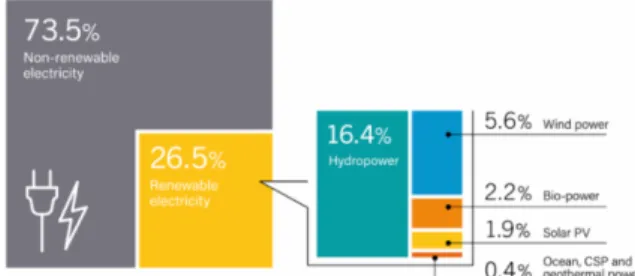
According to the report published by REN 21 (Renewable Energy Policy Network for the 21st Century) [1], 2017 was the year with the highest growth in terms of electricity demand and of the use of renewable sources for energy production. Since 2017, the PV panels and wind turbines are becoming competitive. The electric energy produced in 2017 from renewable sources is presented in Figure 1.
The photovoltaic systems are the renewable energy systems with the highest development rate in 2017, reaching 402 GWdc. In the same year, the electricity produced by wind systems was 539 GW. Even though the renewable energy sources mentioned above are considered
to be promising sources of energy, one of their disadvantage is the dependence on weather and climate conditions.
Fig. 1. The weight of renewable energy sources used to produce electricity in 2017 [1]
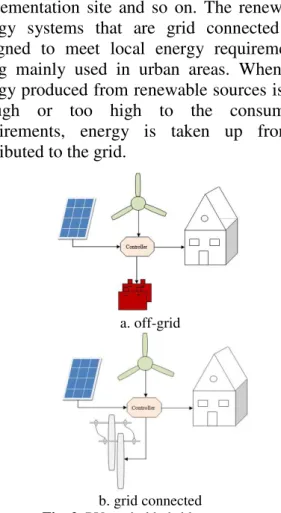
based on parameters, such as network availability, cost of electricity provided by the power grid, the weather conditions for the implementation site and so on. The renewable energy systems that are grid connected are designed to meet local energy requirements, being mainly used in urban areas. When the energy produced from renewable sources is not enough or too high to the consumers’ requirements, energy is taken up from / distributed to the grid.
a. off-grid
b. grid connected Fig. 2. PV – wind hybrid system
The two variants of hybrid systems are presented in Fig. 2: a. independent system (off-grid); b. grid connected system (on grid).
The independent hybrid systems (see Figure 2a) are considered to be one of the most promising ways to cope with the electrification requirements regardless of the implementation area. These systems involve the use of back-up sources such as batteries and / or diesel generators to meet consumer’s requirements under any circumstances.
Even though renewable energy systems have many positive effects, the current costs of these systems hinder large-scale deployment, and therefore R&D efforts are focused on reducing costs quickly and improving their efficiency.
The paper presents the algorithm for the design of a PV-wind hybrid system, which ensures the necessary electric energy for a determined period, taking into account the system cost and the area available for
implementation. Conclusions are formulated regarding the use of PV – wind systems in certain applications. The algorithm is further exemplified on a case study.
2. HYBRID SYSTEM DESIGN
In order to obtain electricity from a reliable hybrid system based on renewable energy with a reduced cost, its design must be optimal in terms of functioning and component selection. Thus, an optimal dimensioning method is absolutely necessary for the efficient and economical use of the renewable energy resources [3]. The method takes into account the influence of various variables such as solar radiation, wind speed and ambient temperature for the implementation site and the system cost.
Fig. 3. PV – wind hybrid system with back-up source
The main subsystems of a PV - wind hybrid system are: the photovoltaic subsystem (S1, Fig. 3), the wind subsystem (S2), and the energy storage subsystem (S3).
enough energy, then the batteries will provide the difference. If the batteries do not have the required energy, then a back-up source (diesel generator) will be used to supplement it for the consumer.
3. DESIGN ALGORITHM OF THE PV-WIND HYBRID SYSTEM
The design and operation of the hybrid system are based on the complementarity of the two renewable energy sources (solar and wind), the necessary energy (or a large part of it) being generated both in days with low solar radiation but with average wind intensity, and in days with clear sky, but with no wind. The energies produced by the two subsystems are summed up and compared to the consumer's energy demand.
The efficient design of a hybrid renewable energy system involves finding out the optimum combination between the two subsystems so as to ensure the consumer’s energy demand at the lowest price and using the available area for the installation of the PV panels. The design algorithm for the hybrid system is presented in Fig. 4. The type and number of components of the hybrid system depend on the weather data for the implementation site, the cost of the components, the type of batteries, but also the period for which the energetic autonomy should be ensured.
The design of the hybrid system starts by choosing the first type of PV panel and wind turbine from the database. Afterwards, the algorithm enters in a loop that calculates the energy generated by the hybrid system, the area occupied by PV panels and the cost of the produced energy. The loop involves increasing the number of PV panels by one unit until the available area is reached or until the energy requirement is covered. If the available area is exceeded, a wind turbine is added. All variants of PV panels and the main variants of wind turbines are further tested, after which the final configuration is saved. This configuration is characterized by the smallest energy cost.
The initial cost of the system consists of component prices (wind turbine, including tower and controller, PV panels, batteries, inverter), implementation / maintenance, installation and connection cables. Work is considered to be 20% of the price of the wind turbine (turbine + tower + controller) for the wind subsystem and 40% of the PV panels for the PV subsystem.
The value of the replaced components depends mainly on the replacement need. Since the wind turbine and the PV panels have a lifetime approximately equal to the system lifetime, replacement costs can be considered zero, while batteries and inverter need to be replaced every 5 years [4]. In the case of PV panels and the inverter, the maintenance costs are considered to be 1% of the initial cost, while for wind turbines is of 3%. For the batteries, the annual maintenance costs are considered zero because the initial price is very low [5]. The initial cost, maintenance cost, and lifetime of PV panels, wind turbine, inverter and batteries are systematized in Table 1 [6].
Thus, the cost of the hybrid system consist of: component costs (PV panels, wind turbines, batteries, inverter, diesel generator), installation costs of PV panels (20% of panels cost [7]) and of wind turbines (40% of their cost), replacement costs (the batteries have a lifetime of 5 years, so they will be replaced 4 times during the system lifetime, the inverter of 10-15 years, so it will be replaced once), maintenance costs (1% of the cost of panels/ year and 3% of the cost of wind turbines /year) [8].
4. CASE STUDY
Fig. 4. The design algorithm of hybrid PV-wind system
Table 1: Initial cost, maintenance cost and lifetime of components
Initial cost [€/W] Maintenance cost in the first year [%]
Lifetime [year]
PV panels 1.18 1% of price 25
Wind turbine 3.000 3% of price 25
Inverter 0.707 1% of price 10
Battery bank 0.171 0% of price 4
The dimensioning of the hybrid system requires information regarding the following weather data: solar radiation intensity, wind speed and direction, and ambient temperature. According to the weather data recorded in 2016 at the weather station located on the L7 laboratory of the Research Institute of Transilvania University of Brasov, the worst month in terms of solar radiation is March and the best one is August [5]. In terms of wind energy, the worst
month is August, and the most favorable one is March. As the main renewable energy source is the solar energy, the most unfavorable month, namely March, will be taken into account in dimensioning the hybrid system.
PV PV PV E A
E = ⋅ ⋅η [kWh/day] (1)
where: E is the solar energy provided per square meter [kWh/m2/day], APV is the area of a PV panel [m2]; ɳPV is the efficiency of a PV panel.
Based on these weather data, and according to the algorithm from Fig.4, 4 types of PV panels on the market nowadays are considered in the database [11, 12]. Their technical data are systematized in Table 2.
A Si-Polycrystalline PV panel of 260 W is considered in order to minimize the costs of PV subsystem installation. The energy produced by the PV panel is EPV = 0.754 kWh / day [5]. The number of PV panels required to meet the energy requirements can be obtained from rel. (2):
PV DEMAND PV
E E
N = (2)
where EDEMAND is the required energy [kWh/day].
According to relation (2), a number of 133 panels are required to provide the needed energy. The area to install the 133 panels so that not to shade each other is given by the following relation:
PV PV
PV
PV L l N
S = ⋅ ⋅ 2⋅ [m2] (3) where: LPV represents the length of the PV panel [m]; lPV is the panel width [m]. In this case, by avoiding shading, the area for the 133 panels has to be of 306 m2. Since the required area is too large compared to the available area (170 m2), the maximum number of PV panels that can be installed is 74 (73.8 from rel. (3)). Thus, the hybrid system will contain 74 PV panels, which provide 55.7 kWh/day, the rest of energy being covered by the wind turbine (44.3 kWh/day) [13]. According to the design algorithm, different types of wind turbines that produce different amounts of energy are further proposed:
•variant 1: wind turbine of 100 kW; •variant 2: wind turbine of 50 kW; •variant 3: wind turbine of 25 kW.
The one that produces an energy close to the required one (depending on the wind speed), combined with the cost requirement is chosen to be included in the hybrid system. In the first case, according to the power curve (Fig. 5) and
average wind speed that was recorded in 2016, (Fig 6) [5], the 100 kW turbine will provide the amount of energy presented in Table 3.
Fig. 5. The power curve of the 100 kW wind turbine [14]
In the case of the 50 kW wind turbine, the power curve is presented in Fig. 7, the wind frequency and the produced energy in Fig.8, while the energy supplied by this turbine according to the wind speed is determined in Table 4.
The energy generated by the 25 kW wind turbine is computed in Table 5 based on the power curve given by the manufacturer [14] (Fig. 9), and the energy provided according to the recordings from March 2016 (Fig. 10).
The following criteria must be taken into account when choosing a type of wind turbine: the energy supplied; the turbine cost, cost of transport (for tower, rotor, and blades), cost of installation, tower height, and rotor diameter, maintenance.
Fig. 6. Energy produced by the 100 kWh wind turbine
Fig. 7. The power curve of the 50 kW wind turbine [14]
Fig. 8. Energy produced by the 50 kWh wind turbine
Fig. 9. The power curve of the 25 kW wind turbine [14]
Fig. 10. Energy produced by 25 kWh wind turbine
The cost of the 50 kW turbine is 18750 €, the installation - 5000 €, the transport - 3500 €, the tower is 24.4 m high and the rotor diameter
is 16.5 m. The data presented above highlight that the wind turbine of 50 kW nominal power is the most suitable for the considered application [15].
The off-grid system includes a storage system that ensures energy autonomy for a period of 2 days, the optimal period according to the specialists [3]
Different types of batteries can be chosen from the database to store energy. The following types of batteries are considered in this case:
• variant 1: a battery of 2 V, 1100 Ah, 442 € [13]. In order to get a voltage of 48 V (the recommended voltage in case of a consumption bigger than 700 kWh/month [8]) it is necessary to connect in series 24 batteries into 4 strings. The price of these batteries is 42432 €.
• variant 2: a battery of 12 V, 230 Ah, 310 € [16]. In order to get a voltage of 48 V, 18 strings of 4 batteries each should be used. In this case, the total price is 22320 €.
The algorithm will choose the battery type 2 due to its lower cost. The same type of batteries will be used for energy storage in the case of wind turbines.
The hybrid system must also contain an inverter that ensures the DC into AC transformation. An inverter with a lifetime of 10 years costs 3311.47 € [17].
Table 6 presents the total cost of the hybrid system by taking into account the lifetime and cost of each component, the installation and maintenance costs.
5. CONCLUSIONS
A general algorithm for a PV-wind hybrid system is presented in this paper by taking into account the available renewable energy potential, the area needed for the implementation of PV panels and the cost of energy.
Table 3: The daily energy provided by the 100 kW wind turbine
Average wind speed [m/s] 3 4 5 6 7 8 9 10
Operating time [h/day] 3,73 1,93 0,98 0,66 0,47 0,3 0,38 0,15
Power [kW] 2,6 7,7 15 26 41,2 61,5 87,6 100
Total [kWh/day] 142,521 Table 4: The daily energy generated by the 50 kW wind turbine
Average wind speed [m/s] 3 4 5 6 7 8 9 10
Operating time [h/day] 3,73 1,93 0,98 0,66 0,47 0,3 0,38 0,15
Power [kW] 0,3 1,6 4,4 8,6 14,2 21,5 30,3 40,1
Provided [kWh] 1,119 3,088 4,312 5,676 6,674 6,45 11,514 6,015
Total [kWh/day] 44,848
Table 5: The daily energy generated by the 25 kW wind turbine
Average wind speed [m/s] 3 4 5 6 7 8 9 10
Operating time [h/day] 3,73 1,93 0,98 0,66 0,47 0,3 0,38 0,15
Power [kW] 0,2 1 2,9 5,5 9,1 13,6 19,2 25
Provided energy [kWh] 0,746 1,93 2,842 3,63 4,277 4,08 7,296 3,75
Total [kWh/day] 28,551
This algorithm is exemplified on a case study in which it is necessary to provide the electrical energy for a guesthouse that is located in Moieciu de Sus, at an altitude of 1250 m.
The PV subsystem is dimensioned for the weather data recorded during the most unfavourable month of the year in terms of solar radiation. Four variants of PV panels with different powers are selected; the number of PV panels for the considered application is established at 74, the area for their implementation being of approx. 170 m2. To ensure the electricity demand for 2 days, the system must contain an inverter and 72 batteries. One wind turbine has to be chosen to ensure the rest of the required energy (44
kWh/day), being selected among the proposed turbines based on the onsite wind potential for the month with the best wind potential from 2016, the average values of wind speed in each interval of the frequency chart, the turbine power curve and the cut-in speed. Thus, the energy generated by the wind turbine can be computed and compared to the energy demand. The cost of the PV-wind hybrid system can be further obtained. The energy cost for the case study is of 0.195 € / kWh and the hybrid system lifetime is of 25 years.
The use of PV-wind hybrid system with energy storage provides reliable and qualitative power supply for consumers.
Table 6: PV - wind hybrid system cost
Type No./ %*cost Cost [€] Replacement / Lifetime [year] Total
PV panels 74 220.15 - 16291.1
PV Installation 20% - - 3258.22
PV Maintenance 1% - 25 4072.775
Wind turbine 1 27500 - 27500
Turbine Installation 40% - - 11000
Turbine Maintenance 3% - 25 20625
Invertor 1 3311.47 2 6622.94
Battery 72 310 4 89280
Total cost [€] 178650
Energy cost [€/kWh] 100% 365 25 0.195781
6. REFERENCES
[1]
[2] Elistratov, V.V, Hybrid system of Renewable Energy Sources with Hydro Accumulation, Proc. of World Wind Energy Association, online, (2008)
[3] Erdinc, O., Uzunoglu, M. Optimum design of hybrid renewable energy systems: Overview of different approaches, Renewable and Sustainable Energy Reviews, 16 (3), pp.1412-1425 (2012)).
[4] Diafa, S., Belhamelb, M., Haddadic, M., Louchea, A. Technical and economic assessment of hybrid photovoltaic/wind system with battery storage in Corsica island, Energy Policy 36, pp. 743–754, (2008).
[5] Jaliu C., Săulescu R., Ciobanu D., Panainte Fl., PV-Wind Hybrid System for the Energy Supply of an Off Grid Application, Nearly Zero Energy Communities , Ed. Springer, pp443-460, 2017.
[6] Hongxing, Y., Wei, Z., Chengzhi, L. Optimal design and techno-economic analysis of a hybrid solar–wind power generation system, Applied Energy 86, pp. 163–169, (2009).
[7] Arulmurugan, R., Suthanthiravanitha, N. Investment Cost Evaluation and Sizing Approach of Isolated Residential PV Scheme, IJSSST, 14 (3), pp.42-53 (2006).
[8] Kaabeche, A., Ibtiouen, R. Techno-economic optimization of hybrid photovoltaic /wind /diesel/ battery generation in a stand-alone power system, Solar Energy 103, pp. 171–182, (2014).
[9] Jaliu C., Saulescu R., Ciobanu D., Hybrid system for a stand-alone application, International ICPR-QIEM Conference, Cluj 2016, ISBN 978-606-737-180-2, pp. 125-130.
[10] Burduhos, B., Visa, I., Diaconescu D.V., Saulescu R., Novel orientation step program of a pseudo-equatorially tracked PV panel, 24th EU PVSEC, Hamburg Germany, pp. 3835-3843, 2009.
[11]. https://www.victronenergy.ro/solar-pv-panels/bluesolar-panels (last access on June 6, 2018).
[12]. www.euro-house.ro/panouri-fotovoltaice-c5_48.html?zenid=ad9aotlj20rlf2trkjn68jj7u 6 (last access on May 29, 2018).
[13] www.esolar.ro/baterie-panou-fotovoltaic-2v-1100ah-l16re-trj-pl.html (last access on May 29, 2018).
[14]http://www.polarisamerica.com/turbines/10 0kw-wind-turbines/#!prettyPhoto/0/ (last access on Jun 13, 2018).
[15] https://www.hitwind.com/50kw-100kw-wind-turbines-special-offers/ (last access on June 5, 2018).
[16] www.alternativepureenergy.ro/pret- baterie-acumulator-solar-calciu-gel-agm-deep-cycle-vrla-li-ion/ (last access on May 30, 2018).
[17]
http://www.eco- distributing.com/Solectria-PVI-14TL-14-kW-Inverter-208-VAC_p_1373.html (last access June 5, 2018). [23] Sottile Jr. J.M., Brozik D., The Use of Simulations in a Teacher Education Program: The Impact on Student Development Paper presented at the 2004 Hawaii International Conference On Education January 3-6, Honolulu, Hawaii, (2004)
[https://files.eric.ed.gov/fulltext/ED490383.p df access 15.01.2018]
ALGORITM PENTRU ANALIZA ECONOMICĂ A UNUI SISTEM HIBRID FOTOVOLTAIC-EOLIAN
Rezumat: Beneficiile energiilor regenerabile includ scăderea dependentei de energie, scăderea pierderilor prin transmisii si prin transformare, lipsa poluanților gazoși si lichizi, prețul redus al energiei primare. Această problemă
poate fi rezolvată prin integrarea surselor regenerabile într-o combinație hibridă adecvată. Pentru a obține energie electrică dintr-un sistem hibrid designul său trebuie să fie optim în ceea ce privește funcționarea și selecția componentelor.
In lucrare se prezintă un algoritm de analiza financiara a unui sistem hibrid PV- Vânt, algoritm care are ca obiectiv determinarea unei configurații optime pentru un sistem hibrid PV- Vânt, configurație care tine cont de prețul componentelor, necesarul de energie si condițiile climatice zonei de implementare. Acest algoritm este exemplificat pe un studiu de caz.
Meda GHEORGHE, Renewable Energy System and Recycling R&D Centre, Transilvania University of Brasov, Eroilor Str., No. 29, 50036, Brasov, e_mail: [email protected] Daniela CIOBANU, Renewable Energy System and Recycling R&D Centre, Transilvania
University of Brasov, Eroilor Str., No. 29, 50036, Brasov, e_mail: [email protected] Radu SAULESCU, Design of mechanical elements and system R&D Centre, Transilvania
University of Brasov, Eroilor Str., No. 29, 50036, Brasov, e_mail: [email protected]

![Fig. 5. The power curve of the 100 kW wind turbine [14] In the case of the 50 kW wind turbine, the power curve is presented in Fig](https://thumb-us.123doks.com/thumbv2/123dok_us/7996723.2120437/5.892.483.830.205.423/fig-power-curve-turbine-turbine-power-curve-presented.webp)
![Fig. 7. The power curve of the 50 kW wind turbine [14]](https://thumb-us.123doks.com/thumbv2/123dok_us/7996723.2120437/6.892.65.408.119.541/fig-power-curve-kw-wind-turbine.webp)

