STUDY OF RENAL AND LIVER FUNCTION MARKERS IN TYPE
Dr. Dileep Singh Nirwan,
*Department of Biochemistry, Sardar Patel Medical College & P.B.M. Group of Hospitals, Bikaner (Raj)
ARTICLE INFO ABSTRACT
Background:
the pancreas fails to produce the insulin which is one of the essential hormone for regulation of blood glucose level. Most frequently developes in childhoood with highest incid
states, but is being increasingly noted later in life.
stress on kidneys and liver, causing serious damage to the blood vessels, leading to kidney and liver disease. Liver plays a cent
functioning is essential for the maintenance of blood glucose levels and a continuous supply to organs that require a glucose energy source. This central role of liver in glucose hom
the pathogenesis of glucose intolerance in liver disease but little insight into the mechanism of liver disease in diabetes mellitus.
Aims & Objective:
hepatic function markers (especially AST, ALT, ALP and GGT) in type 1 diabetes mellitus.
Method:
as controls. RFT and some LFT’s were estimated using standard evaluated by Student’s t
Result :
transaminase, Alanine transaminase and alkaline phosphatise) were observed in type 1 diabe subjects as compared to controls.
Conclusion:
these parameters can help in prevention and early diagnosis of renal and liver damage.
Copyright©2016, Dr. Dileep Singh Nirwanet al.This
unrestricted use, distribution, and reproduction in any medium, provided the original work is properly cited.
INTRODUCTION
Diabetes was recognized in antiquity, and its clinical features were recorded over 3500 years ago in the Egyption Ebers papyrus. Diabetes mellitus (DM) can be defined as a state of chronic hyperglycemia sufficient to cause long term damage to specific tissues like retina, kidney, nerve and arteries, but this functional label gives little insight into the long and colourf history of this disease. chronic metabolic disorder caused by an absolute or relative deficiency of insulin, an anabolic hormone. Insulin is produced by the Beta-cells of the islets of Langerhans located in the pancreas (William H. Lamb
DM is classified on the basis of the pathogenic process that leads to hyperglycemia. The two main types of DM are designated as type I & type II. Type I diabetes is the result of complete or near total insulin deficiency. Type II DM is a heterogeneous group of disorders characterized by variable degrees of insulin resistance, impaired insulin secretion, a
*Corresponding author: Dr. Mamta Choudhary,
Department of Biochemistry, Sardar Patel Medical College & P.B.M. Group of Hospitals, Bikaner (Raj).
ISSN: 0975-833X
Article History:
Received 23rd September, 2016
Received in revised form 17th October, 2016
Accepted 25th November, 2016
Published online 30th December,2016
Key words:
Type 1 diabetes, Urea, creatinine, AST, ALT, ALP and GGT.
Citation: Dr. Dileep Singh Nirwan, Dr. Mamta Choudhary, Dr. Vyas, R.K. and Dr. Yogita Soni type -1 diabetes mellitus: A comparative analysis”, International Journal of Current Research
RESEARCH ARTICLE
STUDY OF RENAL AND LIVER FUNCTION MARKERS IN TYPE -1 DIABETES MELLITUS: A
COMPARATIVE ANALYSIS
Dr. Mamta Choudhary, Dr. Vyas, R.K. and
Department of Biochemistry, Sardar Patel Medical College & P.B.M. Group of Hospitals, Bikaner (Raj)
ABSTRACT
Background: Type 1 diabetes previously reffered as “juvenile onset or insulin dependent” in which the pancreas fails to produce the insulin which is one of the essential hormone for regulation of blood glucose level. Most frequently developes in childhoood with highest incid
states, but is being increasingly noted later in life. When blood sugar is high, it can put too much stress on kidneys and liver, causing serious damage to the blood vessels, leading to kidney and liver disease. Liver plays a central and crucial role in regulation of carbohydrate metabolism. Its normal functioning is essential for the maintenance of blood glucose levels and a continuous supply to organs that require a glucose energy source. This central role of liver in glucose hom
the pathogenesis of glucose intolerance in liver disease but little insight into the mechanism of liver disease in diabetes mellitus.
Aims & Objective: The aim of the study was to find out the levels of renal (urea and creatinine) hepatic function markers (especially AST, ALT, ALP and GGT) in type 1 diabetes mellitus.
Method: In study 50 patients with Type 1 diabetes were compared with 50 normal healthy subjects as controls. RFT and some LFT’s were estimated using standard
evaluated by Student’s t-test.
Result : A significant increase in the serum levels of renal markers and liver enzymes (Aspartate transaminase, Alanine transaminase and alkaline phosphatise) were observed in type 1 diabe subjects as compared to controls.
Conclusion: Type 1diabetes results in abnormal organ function tests. Proper and timely screening of these parameters can help in prevention and early diagnosis of renal and liver damage.
This is an open access article distributed under the Creative Commons Att use, distribution, and reproduction in any medium, provided the original work is properly cited.
Diabetes was recognized in antiquity, and its clinical features were recorded over 3500 years ago in the Egyption Ebers papyrus. Diabetes mellitus (DM) can be defined as a state of chronic hyperglycemia sufficient to cause long term damage to specific tissues like retina, kidney, nerve and arteries, but this functional label gives little insight into the long and colourful history of this disease. chronic metabolic disorder caused by an absolute or relative deficiency of insulin, an anabolic hormone. cells of the islets of William H. Lamb, 2010). assified on the basis of the pathogenic process that leads to hyperglycemia. The two main types of DM are designated as type I & type II. Type I diabetes is the result of complete or near total insulin deficiency. Type II DM is a sorders characterized by variable degrees of insulin resistance, impaired insulin secretion, and
Department of Biochemistry, Sardar Patel Medical College & P.B.M. Group
increased glucose production (
Medicine, 2008). According to World Health Organization (WHO) there were 135 million diabetics in 1995 and this number would increase to 300 million by the year 2025 (RoshanTakhelmayum, 2014).
rarer than type 2, accounting for between 5 and 15% of all diabetes and 30 to 50% of insulin treated cases in various populations. The liver plays a central and crucial role in the regulation of carbohydrate metabolism. Its normal f
is essential for the maintenance of blood glucose levels and of a continued supply to organs that
source (Gavin, 1999). When blood glucose level is high, it puts a lot of stress on kidneys and liver, causing serious damage to the blood vessels, leading to kidney and liver disease. End stage renal disease requiring dialysis or transplantation develops in approx. 33% patients with type 1 diabetes. Evaluation of a patient’s renal and liver function may be used for two different purposes. First is to diagnose impaired renal and hepatic functions, and second is to detect the presence of a progressive loss of functions of these organs over time. Measurement of the serum urea and creatinine is
International Journal of Current Research
Vol. 8, Issue, 12, pp.43501-43505, December, 2016
INTERNATIONAL
Dileep Singh Nirwan, Dr. Mamta Choudhary, Dr. Vyas, R.K. and Dr. Yogita Soni, 2016. “Study of renal and liver function markers in
International Journal of Current Research, 8, (12), 43501-43505.
1 DIABETES MELLITUS: A
and Dr. Yogita Soni
Department of Biochemistry, Sardar Patel Medical College & P.B.M. Group of Hospitals, Bikaner (Raj)
diabetes previously reffered as “juvenile onset or insulin dependent” in which the pancreas fails to produce the insulin which is one of the essential hormone for regulation of blood glucose level. Most frequently developes in childhoood with highest incidence in northern European
When blood sugar is high, it can put too much stress on kidneys and liver, causing serious damage to the blood vessels, leading to kidney and liver ral and crucial role in regulation of carbohydrate metabolism. Its normal functioning is essential for the maintenance of blood glucose levels and a continuous supply to organs that require a glucose energy source. This central role of liver in glucose homeostasis offers a clue to the pathogenesis of glucose intolerance in liver disease but little insight into the mechanism of liver
The aim of the study was to find out the levels of renal (urea and creatinine) and hepatic function markers (especially AST, ALT, ALP and GGT) in type 1 diabetes mellitus.
In study 50 patients with Type 1 diabetes were compared with 50 normal healthy subjects as controls. RFT and some LFT’s were estimated using standard kit methods. Data were statistically
A significant increase in the serum levels of renal markers and liver enzymes (Aspartate transaminase, Alanine transaminase and alkaline phosphatise) were observed in type 1 diabetic
results in abnormal organ function tests. Proper and timely screening of these parameters can help in prevention and early diagnosis of renal and liver damage.
is an open access article distributed under the Creative Commons Attribution License, which permits
(Harrison's Principles of Internal According to World Health Organization (WHO) there were 135 million diabetics in 1995 and this number would increase to 300 million by the year 2025 Type 1 diabetes is considerably rarer than type 2, accounting for between 5 and 15% of all diabetes and 30 to 50% of insulin treated cases in various populations. The liver plays a central and crucial role in the regulation of carbohydrate metabolism. Its normal functioning is essential for the maintenance of blood glucose levels and of a continued supply to organs that require a glucose energy When blood glucose level is high, it puts a lot of stress on kidneys and liver, causing serious age to the blood vessels, leading to kidney and liver disease. End stage renal disease requiring dialysis or transplantation develops in approx. 33% patients with type 1 Evaluation of a patient’s renal and liver function may rent purposes. First is to diagnose impaired renal and hepatic functions, and second is to detect the presence of a progressive loss of functions of these organs Measurement of the serum urea and creatinine is
INTERNATIONAL JOURNAL OF CURRENT RESEARCH
widely regarded as a test of renal function. Although serum creatinine and BUN (Blood urea nitrogen) tests are used to access renal function, serum creatinine is a more sensitive indicator, as many extra renal conditions such as dehydration, diet and activity of urea cycle enzymes can affect BUN levels but serum creatinine levels change little except in renal disease. Urea clearance is a poor indicator of GFR, as its production rate is dependent on several nonrenal factors, including diet and liver function. Serum creatinine may serve as a surrogate marker of muscle mass and a possible relationship between serum creatinine and diabetes has recently been demonstrated. If kidney function is decreasing, serum creatinine level increases. This test should be performed when patients are diagnosed as diabetics and at the time of follow up annually (Sharma, 2011 and Wagle, 2010). The association of increased serum urea, serum creatinine and higher urinary albumin excretion rate with advanced impaired renal function prompts an examination of its role in early renal function decline in patients with type1 diabetes before proteinuria develops (Elizabeth, 2008). Liver Function Tests (LFTs) are commonly used in clinical practice to check liver disease. The most common LFTs include the serum aminotransferases (ALT, AST), alkaline dphosphatase, bilirubin & albumin. People with diabetes have a higher incidence of liver function test abnormalities than individuals who do not have diabetes. Aminotransferases, such as alanine aminotransferase (ALT) and aspartate aminotransferase (AST), measure the concentration of intracellular hepatic enzymes that have leaked into circulation and serve as a marker of hepatocyte injury. Alkaline phosphatase, gamaglutamyltransferase (GGT), and bilirubin act as markers of biliary function and cholestasis. Albumin reflect liver synthetic function (Harris, 2005). The status of different renal and liver function markers in Type-1 diabetes is not well established. Furthermore, these markers in diabetes mellitus patients is not well studied previously. The aim of our study is to measure serum urea, creatinine and liver enzymes levels in clinically established Type-1 diabetes and non-diabetic samples.
MATERIAL AND METHODS
This study was designed to evaluate renal and some liver function markers level in serum of 50 patients with type-1 Diabetes mellitus. The data obtained from our study is to be compared with age and sex matched 50 normal healthy persons without Diabetes disease or any other clinical problems. Both study and control group were of same socio-economic status with similar diet habits. Depending on the results of clinical examinations and biochemical investigations the subjects selected for the study were grouped as follows:
Group I : Healthy control subjects (n=50) (Age18 to 36 years)
Group II: This group consists of type I (IDDM) diabetic subjects (n=50)(Age 18 to 36 years)
Inclusion criteria
Patient with the following condition were included in the study:
Age ranges between 18 to 36 years
Clinically established Type-1 diabetic patients
Exclusion criteria
Patient with the following condition were excluded from the study:-
Age ranges <18 years and >36 years The alcoholics and smokers
Subjects with systemic and other hepatic diseases Pregnant women
Patients with infectious diseases Post operative patients
Patients on drugs (except antidiabetic treatment) and genetic disorders
Sample collection and Preparation
Taking written consent from all the subjects before taking the samples. After an overnight fasting of 10-12 hours, About 10 ml of blood was drawn from the ante-cubital vein by aseptic techniques and transferred to a well cleaned and metal free test tube without any anticoagulant to avoid hemolysis. The plain test tube was left at room temperature for 20 minutes and after clotting, centrifuged at 2500 rpm for 15 minutes.
Biochemical analysis
All the estimation were done by using automated analyser by following methods:
Determination of serum glucose: Serum glucose (fasting and post prandial) was measured by GOD-POD, enzymatic end point method.
Determination of renal function markers: Serum urea was estimated in serum by the use of urea kit (precision), according to the urease-modified end point Bearthlot reaction. The serum creatinine was estimated by the use of creatinine kit (Erba Mannheim) according the Jaffe’s Modified kinetic determination.
Determination of liver function enzymes: Serum SGOT (AST), SGPT (ALT) and ALP determinations were done by using single reagent system of Autozyme reagent set of Accurex biomedicals. These were UV- kinetic methods done on automated analyser. Serum GGT estimation was done by γ-GT reagent set (precision), based on Kinetic method, substrate gamma-glutamyl-3-carboxy-4-nitroanilide, recommended by IFCC.
RESULT AND DISSCUSSION
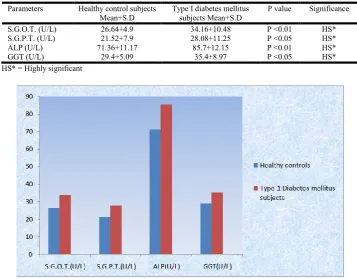
(Table 1). SGPT level showed significant increase (P<0.05) in type I diabetes mellitus subjects (Group II) (Table 1) (Fig. 1) when compared to healthy control subjects. (Table 2) (Fig. 2). The mean+SD value of GGT level in healthy control subjects was 29.4±5.09 U/L, in type I diabetes subjects (Group II) it was 35.4±8.97 U/L.GGT level showed significant increase (P<0.05) in type I diabetes mellitus subjects (Group II) (Table) (Fig.) when compared to healthy control subjects. (Table 2) (Fig. 2). The mean±SD value of ALP in healthy control subjects was 71.36±11.17 U/L, in type I diabetes mellitus subjects (Group II) it was 85.7±12.15 U/L.
[image:3.595.99.489.212.455.2]The increase in ALP was observed statistically highly significant (P<0.01) in type I diabetes mellitus subjects (Group II) when compared with healthy control subjects (Table 2) (Fig. 2). Salim Jasim Khalaf (2010) studied urea and creatinine level in 90 diabetes patients and was compared with 35 age matched healthy group. This study shows the significant (P<0.05) elevations of blood urea, and serum creatinine in diabetic patients in comparison with healthy individuals. These resembles our study.(9) Sugam Shrestha et al.(2008), conducted a study of 103 diabetic samples and 49 control samples within three month period.
Table 1. Renal function markers in healthy controls and type-i diabetes mellitus subjects (Group II) (N = 50 each)
Parameters Healthy control subjects Mean±S.D
Type I diabetes mellitus subjects Mean±S.D
P value Significance
Urea(mg/dl) 18.5±5.8 32.6±9.3 P<0.05 HS*
Creatinine(mg/dl) 0.9±0.2 1.3±0.4 P<0.05 HS*
HS* = Highly significant
[image:3.595.114.472.505.784.2]Figure 1. Renal function markers in healthy controls and type-i diabetes mellitus subjects (Group II) (n = 50 each)
Table 2. Liver function markers in healthy controls and type-i diabetes mellitus subjects (Group II) (n = 50 each)
Parameters Healthy control subjects Mean+S.D
Type I diabetes mellitus subjects Mean+S.D
P value Significance
S.G.O.T. (U/L) 26.64+4.9 34.16+10.48 P <0.01 HS*
S.G.P.T. (U/L) 21.52+7.9 28.08+11.25 P <0.05 HS*
ALP (U/L) 71.36+11.17 85.7+12.15 P <0.01 HS*
GGT (U/L) 29.4+5.09 35.4+8.97 P <0.05 HS*
HS* = Highly significant
The main variables under study were urea, creatinine and blood glucose levels. Out of 49 control samples taken, 47 samples had normal urea level and 48 samples had normal creatinine level. On the other hand 18 out of 103 diabetes samples had high urea level and 11 out of 103 had increase creatinine level, which correlates our findings (Sugam Shrestha, 2008). In our study blood urea and serum creatinine was increased in a significant pattern in diabetic patients, but serum albumin decrease non significantly. However, Viswanathan in 2004, have noted there is a positive association between these parameters and diabetic disease. Research conducted by Anjaneyulu et al 2004 had found that increase urea and serum creatinine in diabetic rats indicates progressive renal damage. 8which also supports our parameters (Anjaneyulu, 2011). In our finding sex was not the determining factor for the diabetes. There was not relationship between sex and the blood sugar levels likewise significant relation between sex and urea level was also not observed. This result is supported by various researchers who showed that sex wise variation occurs only in serum creatinine level but not in blood sugar level and urea level. (Salim Jasim Khalaf, 2010) Leeds JS et al. (2009) studied on 911 type 1 & 963 type 2 diabetic patients and determine the prevalence of elevated ALT in a large cohort of patients with Type 1 diabetes and to examine the clinical correlations and causes.
They found the prevalence of elevated ALT was dependent on the cut-off value: > 30 IU/l in males and > 19 IU/l in females, > 50 and > 63 IU/l was 34.5, 4.3 and 1.9%, respectively, in Type 1 diabetes. In Type 1 diabetes an elevated ALT was associated with worse glycaemic control. Patients with Type 1 diabetes and elevated ALT should be investigated as significant abnormalities may be found which are amenable to interventions.These parameters also supports our study (Leeds, 2009). Salmela et al. (1984) studied the prevalence of abnormal LFTs and their relationship to type I and type II diabetes. The type II diabetic patients frequently had elevated ALT and GGT levels than those with type I diabetes which is also consistent with our findings, (Salmela, 1984). Our study also correlates with the Sabanayagam et al. (2009) who examined the association between serum GGT and diabetes mellitus and reported that higher serum GGT levels were positively associated with diabetes mellitus, independent of alcohol consumption, hypertension and other confounders. Jamieson A. (2003) studied that deranged liver function tests are common in diabetic population which also supports our findings (Sabanayagam, 2009 and Jamieson, 2003). L. Tibi et al. (2003) measured alkaline phosphatase in type I, type II and non-diabetic control group and concluded that liver ALP was significantly higher in diabetes compared with the control group. Iman Mahomad Paruk et al. (2011) analyzed liver function test abnormalities in 146 diabetes patients. Elevations of GGT, alkaline phosphatase and alanine transaminase were found when compared with subjects with normal results. This also correlates with our study (Tibi, 2017 and Imran Mahomed Paruk, 2011).
Conclusion
To conclude, the present study gives us an idea that abnormal renal and some liver function enzymes in diabetes mellitus especially in type 1 diabetic subjects. Proper and timely screening of these parameters can help in early diagnosis &
prevention of diabetes mellitus. Based on the findings of this study, raised urea and creatinine along with ALT, AST, ALP and GGT are more common among the type 1 diabetes patients with compared to healthy controls. Derangement of liver enzymes and renal markers, correlated statistically significantly with fatty liver and renal dysfunctions on ultrasound. More comprehensive study with large samples should required, so it would be -recommendable to provide laboratory analysis of these markers as a routine and also have the scope for further deep research in this field because diabetes mellitus is most common among all the endocrine diseases.
REFERENCES
Anjaneyulu, Muragundla; Chopra, Kanwaljit quercetin, an anti-oxidant biofl avonoid, attenuates diabetic nephropathy in rats. Clinical & Experimental Pharmacology & Physiology 2004;31:244-8.
Elizabeth T. R, Linda H. F, Nicholas J. M, et al. High-Normal Serum Uric Acid Is Associated with Impaired Glomerular Filtration Rate in Nonproteinuric Patients with Type 1 Diabetes. Clin J Am Soc Nephrol 3: 706-713, 2008. Gavin N. Levinthal and Anthony S. Tavill, :Liver disease and
diabetes mellitus, 1999; vol 17 : 2.
Harris EH : Elevated liver function tests in type II diabetes. Clinical Diabetes. 2005; 23 : 115-119.
Harrison's Principles of Internal Medicine, 2008, 17th ed, 338. Imran Mahomed Paruk, Fraser J Pirie, Ayesha A Motala,
Babatope, A Kolawale : High prevalence of abnormal liver enzymes in South African patients with type 2 diabetes mellitus attending a diabetic clinic. Journal of Endocrinology, Metabolism and Diabetes of South Africa. 2011; vol 16, no. 1.
Jamieson A. : Deranged liver function tests in type I diabetes mellitus. Eur J. Internal Med. 2003 Mar.; 14 (2) : 113-115. Leeds JS, Forman EM, Morley S, Scott AR, Tesfaye
S, Sanders DS: Abnormal liver function tests in patients with Type 1 diabetes mellitus: prevalence, clinical correlations and underlying pathologies. Diabet Med. 2009; 26(12):1235-41.
RoshanTakhelmayum,C. Thanpari and Paras Singh: Liver dysfunction in diabetic patients admitted In referral hospital Bali Medical Journal (Bali Med. J.) 2014, Volume 3, Number 3: 122-124
Sabanayagam C, Shankar A, Li J, Pollard C, Ducatman A : Serum g GT level and diabetes mellitus among US adults. Eur J Epidemiol. 2009; 24 (7) : 369-73.
Salim Jasim Khalaf :Study of some biochemical markers in diabetic patients,2010; Tikrit Medical Journal 16(2):84-87. Salmela PI, Sotaniemi EA, Niemi M, Maentausta O. Liver
function tests in diabetic patients. Diabetic Care 1984; 7 : 248-254.
Sharma A, Hirulkar NB, Wadel P, Prakash D; Influence of Hyperglycemia on Renal Function Parameters in Patients with Diabetes Mellitus; 2011; International Journal of Pharmaceutical & Biological Archives; 2(2):734-739 Sugam Shrestha, Prajwal Gyawali, Rojeet Shrestha, Bibek
Tibi, L. A. Collier, A.W. Patrick, B.F. Clarke and A.F. Smith. Serum Alkaline Phosphatase in diabetes mellitus, 2003. Wagle TJ; Genderwise Comparison of Serum Creatinine and
Blood Sugar Levels in Diabetic Patients; 2010 Bombay Hospital Journal, Vol. 52, No. 1
William H. Lamb: Diabetes mellitus, type I. Pediatrics: General Medicine. Sep. 2010.