A Design Framework for Highly Concurrent Systems
Matt Welsh, Steven D. Gribble, Eric A. Brewer, and David CullerComputer Science Division University of California, Berkeley
Berkeley, CA 94720 USA
{mdw,gribble,brewer,culler}@cs.berkeley.edu
Abstract
Building highly concurrent systems, such as large-scale Internet services, requires managing many information flows at once and maintaining peak throughput when demand ex-ceeds resource availability. In addition, any platform sup-porting Internet services must provide high availability and be able to cope with burstiness of load. Many approaches to building concurrent systems have been proposed, which generally fall into the two categories of threaded and event-driven programming. We propose that threads and events are actually on the ends of a design spectrum, and that the best implementation strategy for these applications is somewhere in between.
We present a general-purpose design framework for build-ing highly concurrent systems, based on three design com-ponents —tasks,queues, andthread pools— which encapsu-late the concurrency, performance, fault isolation, and soft-ware engineering benefits of both threads and events. We present a set of design patterns that can be applied to map an application onto an implementation using these compo-nents. In addition, we provide an analysis of several systems (including an Internet services platform and a highly avail-able, distributed, persistent data store) constructed using our framework, demonstrating its benefit for building and reasoning about concurrent applications.
1 Introduction
Large Internet services must deal with concurrency at an unprecedented scale. The number of concurrent sessions and hits per day to Internet sites translates into an even higher number of I/O and network quests, placing enormous demands on underlying re-sources. Microsoft’s web sites receive over 300 million hits with 4.1 million users a day; Lycos has over 82 mil-lion page views and more than a milmil-lion users daily. As the demand for Internet services grows, as does their functionality, new system design techniques must be used to manage this load.
In addition to high concurrency, Internet services have three other properties which necessitate a fresh look at how these systems are designed: burstiness, continuous demand, and human-scale access latency. Burstiness of load is fundamental to the Internet; deal-ing with overload conditions must be designed into the system from the beginning. Internet services must also exhibit very high availability, with a downtime of no more than a few minutes a year. Finally, because ac-cess latencies for Internet services are at human scale and are limited by WAN and modem access times, an important engineering tradeoff to make is to optimize for high throughput rather than low latency.
Building highly concurrent systems is inherently dif-ficult. Structuring code to achieve high throughput is not well-supported by existing programming mod-els. While threads are a commonly used device for expressing concurrency, the high resource usage and scalability limits of many thread implementations has led many developers to prefer an event-driven ap-proach. However, these event-driven systems are gen-erally built from scratch for particular applications, and depend on mechanisms not well-supported by most
languages and operating systems. In addition,
us-ing event-driven programmus-ing for concurrency can be more complex to develop and debug than threads.
That threads and events are best viewed as the op-posite ends of a design spectrum; the key to developing
highly concurrent systems is to operate in the middle
of this spectrum. Event-driven techniques are useful for obtaining high concurrency, but when building real systems, threads are valuable (and in many cases re-quired) for exploiting multiprocessor parallelism and dealing with blocking I/O mechanisms. Most devel-opers are aware that this spectrum exists, by utilizing both thread and event-oriented approaches for concur-rency. However, the dimensions of this spectrum are not currently well understood.
building highly concurrent systems. The key idea be-hind our framework is to use event-driven program-ming for high throughput, but leverage threads (in limited quantities) for parallelism and ease of program-ming. In addition, our framework addresses the other requirements for these applications: high availability and maintenance of high throughput under load. The former is achieved by introducing fault boundaries be-tween application components; the latter by condition-ing the load placed on system resources.
This framework provides a means to reason about the structural and performance characteristics of the system as a whole. We analyze several different sys-tems in terms of the framework, including a distributed persistent store and a scalable Internet services
plat-form. This analysis demonstrates that our design
framework provides a useful model for building and reasoning about concurrent systems.
2 Motivation: Robust Throughput
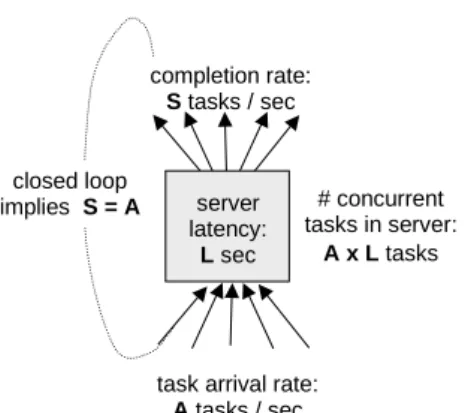
To explore the space of concurrent programming styles, consider a hypothetical server (as illustrated in
Figure 1) that receivesAtasks per second from a
num-ber of clients, imposes a server-side delay ofL seconds
per task before returning a response, but overlaps as many tasks as possible. We denote the task completion
rate of the server as S. A concrete example of such a
server would be a web proxy cache; if a request to the cache misses, there is a large latency while the page is fetched from the authoritative server, but during that time the task doesn’t consume CPU cycles. For each response that a client receives, it immediately issues another task to the server; this is therefore a closed-loop system.
There are two prevalent strategies for handling
concurrency in modern systems: threads and events.
Threading allows programmers to write straight-line code and rely on the operating system to overlap com-putation and I/O by transparently switching across
threads. The alternative, events, allows programmers
to manage concurrency explicitly by structuring code as a single-threaded handler that reacts to events (such as non-blocking I/O completions, application-specific messages, or timer events). We explore each of these in turn, and then formulate a robust hybrid design pat-tern, which leads to our general design framework.
2.1 Threaded Servers
A simple threaded implementation of this server (Figure 2) uses a single, dedicated thread to service
server latency:
L sec
task arrival rate: A tasks / sec # concurrent tasks in server: A x L tasks completion rate: S tasks / sec closed loop implies S = A
Figure 1: Concurrent server model: The server receives
A tasks per second, handles each task with a latency of
L seconds, and has a service response rate of S tasks per second. The system is closed loop: each service response causes another tasks to be injected into the server; thus,
S =A in steady state.
the network, and hands off incoming tasks to individ-ual task-handling threads, which step through all of the stages of processing that task. One handler thread is created per task. An optimization of this simple scheme creates a pool of several threads in advance and dispatches tasks to threads from this pool, thereby amortizing the high cost of thread creation and
de-struction. In steady state, the number of threads T
that execute concurrently in the server is S×L. As
the per-task latency increases, there is a corresponding increase in the number of concurrent threads needed to absorb this latency while maintaining a fixed through-put, and likewise the number of threads scales linearly with throughput for fixed latency.
Threads have become the dominant form of
ex-pressing concurrency. Thread support is
standard-ized across most operating systems, and is so well-established that it is incorporated in modern lan-guages, such as Java [9]. Programmers are comfortable coding in the sequential programming style of threads and tools are relatively mature. In addition, threads allow applications to scale with the number of proces-sors in an SMP system, as the operating system can schedule threads to execute concurrently on separate processors.
Thread programming presents a number of
correct-ness and tuning challenges. Synchronization
primi-tives (such as locks, mutexes, or condition variables) are a common source of bugs. Lock contention can cause serious performance degradation as the number of threads competing for a lock increases.
closed loop implies S = A
task arrival rate:
A tasks / sec # concurrent threads in server: T threads completion rate: S tasks / sec thread.sleep( L secs ) dispatch( ) or create( )
Figure 2: Threaded server: For each task that arrives at
the server, a thread is either dispatched from a statically created pool, or a new thread is created to handle the task. At any given time, there are a total of T threads executing concurrently, whereT =A×L.
Regardless of how well the threaded server is crafted, as the number of threads in a system grows, operat-ing system overhead (scheduloperat-ing and aggregate mem-ory footprint) increases, leading to a decrease in the overall performance of the system. There is typically
a maximum number of threads T0 that a given system
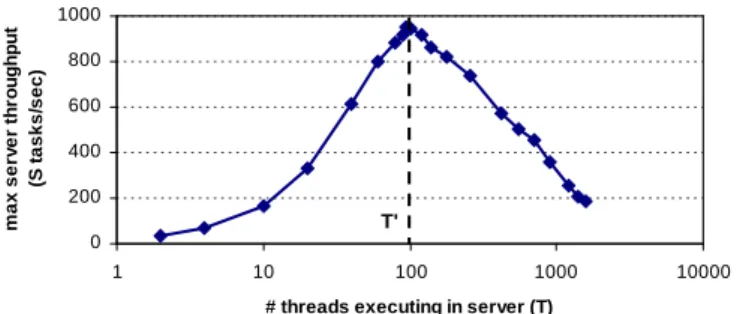
can support, beyond which performance degradation occurs. This phenomenon is demonstrated clearly in
Figure 3. In this figure, while the thread limitT0would
be large for general-purpose timesharing, it would not be adequate for the tremendous concurrency require-ments of an Internet service.
2.2 Event-Driven Servers
An event-driven implementation of this server uses a single thread and non-blocking interfaces to I/O sub-systems or timer utilities to “juggle” between the con-current tasks, as shown in Figure 4. Event-driven sys-tems are typically structured as a program thread that loops continuously, processing events of different types from a queue. This thread either blocks on or polls the queue to wait for new events.
Event-driven programming has its own set of inher-ent challenges. The sequinher-ential flow of each task is no longer handled by a single thread; rather, one thread processes all tasks in disjoint stages. This can make debugging difficult, as stack traces no longer represent the control flow for the processing of a particular task. Also, task state must be bundled into the task itself, rather than stored in local variables or on the stack as in a threaded system. Event packages are not stan-dardized, and there are few debugging tools for
event-0 200 400 600 800 1000 1 10 100 1000 10000
# threads executing in server (T)
m ax se rv e r th ro u ghpu t (S tasks /sec ) T'
Figure 3: Threaded server throughput degradation: This
benchmark has a very fast client issuing many concurrent 150-byte tasks over a single TCP connection to a threaded server as in Figure 2 with L= 50ms on a 167 MHz Ultra-SPARC running Solaris 5.6. The arrival rate determines the number of concurrent threads; sufficient threads are preal-located for the load. As the number of concurrent threads
T increases, throughput increases untilT ≥T0, after which the throughput of the system degrades substantially.
driven programmers. However, event-driven program-ming avoids many of the bugs associated with synchro-nization, such as race conditions and deadlocks.
Events generally cannot take advantage of SMP sys-tems for performance, unless multiple event-processing threads are used. Also, event processing threads can block regardless of the I/O mechanisms used. Page faults and garbage collection are common sources of thread suspension that are generally unavoidable. In addition, it may be impossible for all application code be non-blocking; often, standard library components
and third-party code export blocking interfaces. In
such cases, threads are valuable in that they provide a mechanism for obtaining concurrency over these block-ing interfaces.
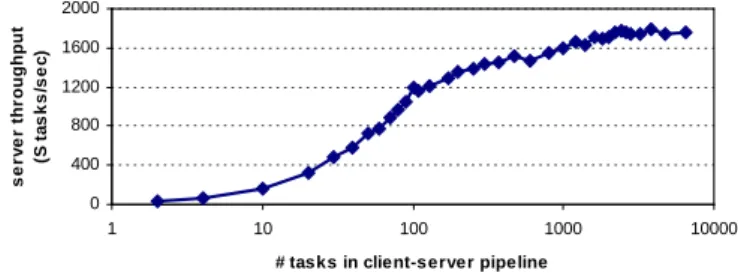
Event-driven systems tend to be robust to load, with little degradation in throughput as offered load in-creases beyond that which the system can deliver. If the handling of events and bundling of task state is efficient, the peak throughput can be high. Figure 5 shows the throughput achieved on an event-driven im-plementation of the network service from Figure 4 as a function of the load. The throughput exceeds that of the threaded server, but more importantly does not degrade with increased concurrency. As the number of tasks increases, the server throughput increases un-til the pipeline fills and the bottleneck (the CPU in this case) becomes saturated. If the number of tasks in the pipeline is increased further, the excess tasks are absorbed in the queues of the system, either in the main event queue of the server, or in the network
closed loop implies S = A
task arrival rate:
A tasks / sec completion rate: S tasks / sec timer queue with latency: L seconds
Figure 4: Event-driven server: Each task that arrives at
the server is placed in a main event queue. The dedicated thread serving this queue sets an Lsecond timer per task; the timer is implemented as queue which is processed by another thread. When a timer fires, a timer event is placed in the main event queue, causing the main server thread to generate a response.
stack queues associated with the client/server trans-port connection. The throughput of the server remains constant in such a situation, although the latency of each task increases.
Concurrency is explicit in the event-driven approach
and associated directly with queues. With
multi-ple tasks at various stages exposed in one or more queues, programmers can make use of application-specific knowledge to reorder event processing for pri-oritization or efficiency reasons.
2.3 The Thread and Event Spectrum
Although highly concurrent services provide new fuel for the debate over threads and events, a key ob-servation is that the design space for concurrency isn’t limited to these two points. Rather, there is a spec-trum between these extremes and it is possible to build hybrid systems that strategically exploit properties of both. The goal is to obtain the benefit of threads, but to limit their number so as to prevent performance degradation. The question to be asked is how many threads are needed, and whether that number can fit within the operating range of the system.
The simplest example of a hybrid thread and event server is shown in Figure 6. It limits the number of con-current threads running in the system to no more than
T threads in a preallocated thread pool, and buffers
in-coming tasks in an event queue from which the thread pool feeds. Each task is handled by a single thread us-ing standard blockus-ing interfaces and developed usus-ing
0 400 800 1200 1600 2000 1 10 100 1000 10000
# tasks in client-server pipeline
s e rv e r th ro u g h pu t (S ta s k s /s e c )
Figure 5: Event-driven server throughput: Using the same
benchmark setup as in Figure 3, this figure shows the event-driven server’s throughput as a function of the num-ber of tasks in the pipeline. The event-driven server has one thread receiving all tasks, and another thread han-dling timer events. The throughput flattens in excess of that of the threaded server as the system saturates, and the throughput does not degrade with increased concurrent load.
familiar tools. Excess concurrency is absorbed by the queue, and thus the response time increases with load but throughput does not degrade.
This hybrid approach makes it possible to determine whether a given implementation is sufficient to meet a target efficiency and throughput. Returning to our ex-ample service, the concurrency demand on the system
isA×L, which is serviced by theT threads in the pool.
Within the operating regime where A×L ≤T ≤T0,
the hybrid server performs as well as an event-driven
server, as shown in Figure 7(a). However, ifA×L > T0,
then it will be impossible to service the concurrency
de-mand without creating more thanT0threads, as shown
in Figure 7(b). If the size of the thread pool exceedsT0,
throughput degrades regardless of whether the thread pool is as large as the concurrency load. Therefore,
T should be set to never exceed T0, and if A > T /L,
then the excess tasks will accumulate in the task queue, which absorbs bursts but increases the latency to pro-cess each task.
Figure 7(c) shows the performance of a microbench-mark implementation of this hybrid server for various
values ofL, demonstrating that asLincreases, the
hy-brid system will be unable to meet the concurrency
demand A×L. Note that because tasks are buffered
by the incoming queue, throughput will not degrade as long as the size of the thread pool is chosen to be less
# simultaneous threads (T) th roughpu t T' AL A = S (a) # simultaneous threads (T) th roughpu t AL A (b) S (c) T' 0 200 400 600 800 1000 1 10 100 1000 10000 # simultaneous threads (T) th ro u g h p u t L=10ms L=50ms L=400ms 0 400 800 1200 1600 1 10 100 1000 10000
# ta sks in clie n t-se rve r p ip e lin e
se rv e r th rou g hpu t (S ta sk s / se c ) (d)
Figure 7: Throughput of the hybrid event and thread system: (a) and (b) illustrate the theoretical performance of the
hybrid server, whereT0 is larger or smaller than the concurrency demandA×L. (c) shows measurements of the benchmark presented in Figure 3, augmented by placing a queue in front of the thread pool, for different values ofLandT. (d) shows the throughput of the hybrid server when T =T0, which is the optimal operating point of the server. Here, L = 50ms. The middle plateau in (d) corresponds to the point where the pipeline has filled and convoys are beginning to form in the server. The right-hand plateau in (d) signifies that the convoys in all stages of the pipeline have merged. Note that the
x-axis of (a) and (b) are on a linear scale, while (c) and (d) are on logarithmic scales.
closed loop implies S = A
task arrival rate: A tasks / sec completion rate: S tasks / sec # concurrent threads in server: T<T’ threads thread.sleep( L secs ) thread pool of T’ threads event queue to absorb bursts of tasks
Figure 6: A hybrid thread and event system: This server
uses a constant-size thread pool ofTthreads to service tasks with an arrival rate ofAfrom an incoming task queue; each task experiences a service latency ofLseconds. If the num-ber of tasks received by the hybrid server exceeds the size of the thread pool, the excess tasks are buffered by the in-coming task queue.
2.4 The Case for a New Design Framework
There are many parameters to consider in the de-sign space of highly concurrent systems. One must not only strike the right balance between event-driven and threads-based concurrency; issues such as fault isola-tion, data sharing, and ease of programming are im-portant concerns as well. The number of choices in this design makes it difficult for application designers to construct new applications easily and reason about
how they will perform.
This initial investigation into the spectrum of con-currency models indicates the need for systematic tech-niques for mapping an application design onto an im-plementation that provides efficiency and robustness despite the inherent limits of the underlying operating system. We feel that the design space that represents the full spectrum between threads and events has not yet been adequately explored; this paper attempts to understand its characteristics and the tradeoffs inher-ent when building applications in this space.
Rather than continue to build new concurrency
models in an ad hoc manner for specific applications,
we propose a general-purpose design framework that addresses the holistic requirements of highly
concur-rent systems. This framework provides a structure
within which one can build and reason about
large-scale server applications. By following a small set
of specific design principles, application designers can make certain assertions about the performance and fault-isolation properties of their system.
3 Design Framework
3.1 Framework Components
There are four general-purpose building blocks for
constructing applications under our framework: tasks,
3.1.1 Tasks
A task is the fundamental unit of work in our
frame-work. It is a typed message that contains a description of some work to be done, along with the data required to complete that task. An example of a task might be “retrieve the contents of a web page” where the data associated with that task is a URL.
Tasks are processed in a series of stages by
individ-ual components of the application. For example, for a web server to retrieve a static HTML page, the task’s URL must be first parsed, the page looked up in a local cache, and finally (if necessary) read from disk. Stages of a task can either be executed in sequence or in parallel, or a combination of the two.
By decomposing the task into a series of stages, it is possible to distribute those stages over multiple physi-cal resources, and reason about the flow of those tasks for load-balancing and fault-isolation purposes.
3.1.2 Thread pools
A thread pool is a collection of threads on the same machine that operate by continually processing tasks. Logically, a thread pool is associated with a set of task types, and each thread in the pool executes a piece of code that consumes a task, processes it, and dispatches one or more outgoing tasks to a thread pool. A thread pool must have at least one thread within it.
Thread pools are the only source of execution
con-texts within our framework. Modularity is
accom-plished by structuring applications as a set of thread pools each processing a particular set of task types. Parallelism can be exploited since each thread can run on a separate CPU in a multiprocessor system.
3.1.3 Queues
Queues are the means of communication between thread pools. A queue logically consists of a list of tasks; thread pools pull tasks from their incoming task queue, and dispatch tasks by pushing them onto the incoming queues of thread pools. The operation of two thread pools can be composed by inserting a queue be-tween them, thereby allowing tasks to pass from one to the another. We call a thread pool coupled with its
incoming task queue a task handler.
Queues act as the separation mechanism between thread pools, by introducing an explicit control bound-ary. Because a thread cannot cross over this boundary (it can only pass data across the boundary by enqueu-ing a task), it is possible to constrain the execution of threads to a given task handler. This is desirable
(a) Wrap (b) Pipeline (c) Combine (d) Replicate Before
After
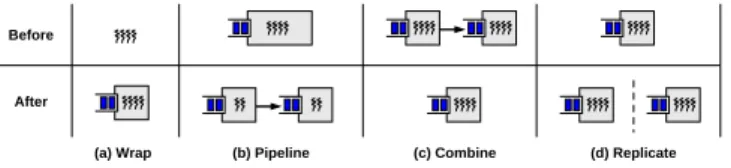
Figure 8: The four design patterns.This figure depicts each
of the four design patterns used to construct applications within our framework.
for two reasons. First, it makes applications easier to debug, as the thread pool’s internal state is not visible to other thread pools. Second, it can eliminate cases where threads “escape” into a piece of code where they may never return — for example, into a library that performs blocking I/O operations.
In addition, queues provide a mechanism for over-flow absorption, backpressure, and fairness. Queues act to buffer incoming tasks when their number out-weighs the number of threads available to process them. Backpressure can be implemented by having a queue reject new entries (e.g., by raising an error con-dition) when it becomes full. This is important as it allows excess load to be rejected by the system, rather than buffering an arbitrary amount of work. Fairness can be accomplished by scheduling thread pools based on their incoming queue length.
3.2 Design Patterns
We turn now to the question of how to map an appli-cation onto an implementation using the components presented above. The decision of where thread pools and queues are used has an important impact on the performance and fault-tolerance properties of the re-sulting application.
We propose four design patterns that can be
ap-plied to construct an application using our framework. These patterns encapsulate fundamental properties of our framework components and describe how to build up an application using them.
3.2.1 Wrap
TheWrappattern involves “wrapping” a set of threads
with a queue interface, as illustrated in Figure 8(a). Each thread processes a single task through some num-ber of stages and may block one or more times.
Ap-plyingWrapplaces a single input queue in front of the
set of threads, effectively creating a task handler out of them. This operation makes the processing within the task handler robust to load, as the number of threads
inside of the task handler can now be fixed at a value that prevents thread overhead from degrading perfor-mance, and additional tasks that cannot be serviced by these threads will accumulate in the queue.
The Wrap pattern was used in our example
thread/event hybrid system in Section 2.3. In that
example, each thread in the pool processed a single task and made one blocking call (a sleep operation). By fixing the number of threads within the pool to
some value T < T0 and placing a queue in front of
them, peak throughput was be maintained despite the threads sleeping within the task handler.
3.2.2 Pipeline
The Pipeline pattern takes a single-threaded piece of code and splits it into multiple pipeline stages by intro-ducing a queue and thread pool boundary at various points. This is illustrated in Figure 8(b). For example, if queues are introduced for each blocking I/O call, this operation makes each call appear to be non-blocking, as separate threads are responsible for processing the task on either side of the call.
The Pipeline pattern has two uses. The first is to limit the number of threads allocated for handling low-concurrency operations. If a pipeline stage has a task
arrival rate ofAtasks/second and a per-task latency of
L seconds, the number of threads needed to maintain
a completion rate of A for that stage is A×L, as in
Section 2.3. Now consider a pipeline stage which is limited in the number of concurrent tasks that it can handle. For example, UNIX filesystems can generally handle a fixed number (between 40 and 50) concurrent
read/write requests before becoming saturated. We
call this limit thewidthof the pipeline stage and denote
it by the value W.
The width of a pipeline stage places an upper bound on the number of threads that yield concurrency
ben-efit to that stage. That is, if W <(A×L) there is no
need to supply the stage with more than W threads;
additional threads within that stage would only
re-main idle. The completion rate S of the stage will be
S =W/L; if W <(A×L) thenS < A. Limited width therefore limits the completion rate of a task handler; width can only be increased through replication (dis-cussed below).
Pipeline provides a way of limiting the threads needed for a particular pipeline stage to that stage’s width, rather than “wasting” threads that would oth-erwise remain idle. Breaking the processing for a task into separate pipeline stages allows the size of the thread pool to be tailored for that stage, and allows
that stage to be replicated across separate physical re-sources (as we will see below) to achieve greater paral-lelism.
The second use of thePipelinepattern is to increase
locality. Cache locality is an increasingly important concern for building high-throughput systems as the performance gap between cache and main memory
in-creases. In addition, the use of multiple processors
taxes the available memory bandwidth and can lead to lengthy stall times if a cache miss must be taken.
In a thread-per-task system, the instruction cache tends to take many misses as the thread’s control passes through many unrelated code modules to pro-cess the task. In addition, whenever a context switch occurs (due to thread preemption or a blocking I/O call, say), other threads will invariably flush the wait-ing thread’s state out of the cache. When the original thread resumes execution, it will need to take many cache misses in order to bring its code and state back into the cache. In this situation, all of the threads in the system are competing for limited cache space.
Applying thePipelinepattern can increase data and
instruction cache locality to avoid this performance hit. Each pipeline stage can process a “convoy” of tasks all at once, keeping the instruction cache warm with its own code, and the data cache warm with any shared
data used to process the convoy. In addition, each
pipeline stage has the opportunity to service incoming tasks in an order that optimizes for data cache locality. For example, if queues are serviced in last in, first out order, then the tasks that arrived most recently may still be in the data cache.
AlthoughPipelineincreases task processing latency,
recall that the goal of our framework is to optimize for aggregate throughput, not the time to process an individual task.
3.2.3 Combine
The Combinepattern (Figure 8(c)) combines two sep-arate task handlers into a single task handler with a shared thread pool. As we have seen, if the number of threads in the system is too high then performance will
degrade. Combineis used to allow multiple task
han-dlers to share a thread pool for the purposes of thread conservation.
Consider a set of three sequential pipeline stages
re-sulting from the use of Pipeline to isolate a blocking
operation into its own thread pool. If the first and
third stages are both CPU bound, their width W is
the number of CPUs in the system. Rather than have
be shared between them by applyingCombine. In this
sense, Combineis the inverse of Pipeline.
3.2.4 Replicate
The Replicate pattern (Figure 8(d)) makes a “copy” of an existing task handler. Additionally, it either in-stantiates that task handler on a new set of physical resources, places a failure boundary between the two
copies, or both. Replicate is used to achieve both
par-allelism and fault isolation.
By replicating a task handler across physical
re-sources, the combined width W of the replicas is
in-creased. This can be used to eliminate a bottleneck in a pipeline of task processing stages. A failure bound-ary can be introduced between two replicas by run-ning them in separate address spaces or on separate machines. This is done to make the replicas highly available; if one fails, the other can continue process-ing tasks.
Replication raises concerns about distributed state management. The failure of a network link within the cluster can lead to partitioning, which is troublesome if task handlers residing on different cluster nodes need to maintain consistent state. There are several ways to avoid this problem. One is to employ one of vari-ous distributed consistency or group membership pro-tocols [20, 27]. Another is to engineer the cluster inter-connect to eliminate partitioning. This is the approach taken by DDS [10] (see Section 4.1) and the Inktomi search engine [6].
3.3 Applying the Design Patterns
In this section we provide a set of heuristics that can be used to determine how the above design pat-terns should be applied to a given application. Each of the patterns has an effect on the performance or
fault-isolation properties of the application. In
ad-dition, there are a number of constraints that must be met to keep the application within its operational range. Obtaining the desired application properties, therefore, can be viewed as solving a multivariate con-straint problem. The goal is to maximize the service task completion rate and minimize the probability of application failure. The various constraints include:
Physical resource limits: The number of cluster nodes available to the application is assumed to be fixed at some value. Likewise, the CPU speed, amount of memory, disk and network bandwidth, and other pa-rameters are assumed fixed for a given configuration.
Thread limits: As we have seen, thread implementa-tions generally impose a limit on the number of threads that the system can support before performance
degra-dation occurs, which we call T0. To what extent this
limit applies depends on the thread implementation.
A user-level threads package may allowT0 threads per
process, while kernel-level threads may be limited to
T0 per machine.
Latency and width: The values for L and W for a given task processing stage drive much of the decision to apply the design patterns above.
Starting with a thread-per-task implementation, the following design rules can be used to transform that implementation into one that obtains the benefits of our framework.
Apply Wrap to introduce load conditioning:
Placing the application threads within a task handler structure allows the number of threads to be limited
to some optimum value (less than T0), with additional
tasks absorbed by the queue. This was the transforma-tion used to produce the hybrid system in Sectransforma-tion 2.3.
Apply Pipeline to avoid wasting threads: Af-ter the above transformation, it is possible to increase
throughput by isolating code with a low widthW into
its own task hander, and limit the number of threads
within that task handler to W. For example, one
can apply Pipeline at the point where filesystem calls
are made, and limit the number of threads within the filesystem task handler to the number of concurrent
accesses that the filesystem can handle. This
effec-tively “frees” additional threads which can be placed into other task handlers that can make use of them.
Apply Pipelinefor cache performance: As
dis-cussed above, Pipeline can also be used to increase
cache locality by isolating the code for related task
processing stages within its own task handler. The
cache locality benefit of structuring applications in this way depends on two major factors. The first is the amount of code and shared data used internally by a task handler when processing a convoy of tasks. This determines the potential cache locality benefit that can be achieved internally to a task handler. The second is the amount of data carried between task handlers when a task is pushed onto a queue. This determines the potential data cache locality benefit of processing tasks out of order. The performance effect of pipelin-ing task processpipelin-ing can be measured directly, and used to determine whether a particular application should use this structure.
Apply Replicate for fault tolerance: Replica-tion of task handlers across multiple resources increases the reliability of the application as a whole, by
intro-ducing redundancy for task processing stages. If we
replicate a task handler n times, and the probability
of a failure for each task handler during a given time
interval isF0, then the probability that all replicas will
fail during this time isF =F0n. As we can see,
replica-tion has an exponential effect on the reliability of the set of task handlers.
The benefit of replication depends on several factors. One is whether enough physical resources are available to support replication. If we wish to replicate across
cluster nodes n times to achieve a particular failure
probability F, then clearly n cluster nodes must be
available. Another is whether the task handlers to be replicated will rely on shared state, which raises several design concerns, as discussed above.
Apply Replicate to scale concurrency:
Repli-catecan also be used to effectively increase the
concur-rency widthW of a particular task handler by running
multiple instances on separate resources. In general
replicating a task handler ntimes increases the width
of the collective replicas to W ×n. For a task
han-dler with latency L, this increases the task
comple-tion rate of the combined replicas from S = W/L to
S = (W ×n)/L, which can eliminate the throughput
bottleneck.
Apply Combine to limit the number of threads per node: After pipelining and replicating the thread-per-task application, we may end up with a large number of task handlers each with their own pri-vate thread pool. If the latency of some of these task handlers is low, then it makes sense to “share” thread pools between them, thereby reducing the overall num-ber of threads. As discussed above it is important to
limit the number of threads per node to some valueT0,
which can be measured for a given system. Combine
merges the thread pools for disparate task handlers on the same node, allowing threads to be conserved.
These heuristics assumes that the application de-signer is also keeping in mind the inherent resource limits of the underlying platform. For example, a task handler should not be placed onto a node if that would increase the total number of threads on that node
be-yond T0. While these heuristics can help to structure
an application using our framework, they are by no means exhaustive.
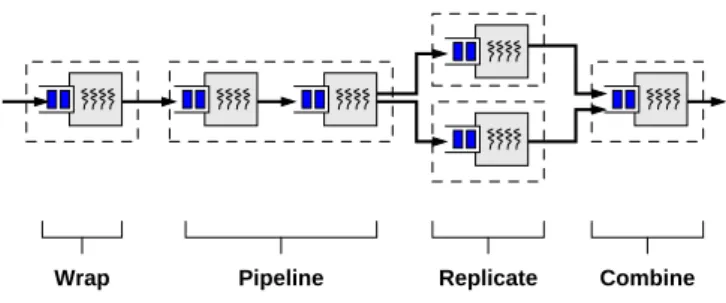
The structure of an application constructed using our framework is illustrated in Figure 9. Here we see 6 thread pools, each with their own incoming task queue, running on 5 separate machines. The communication arrows are only intended as an example of how tasks might flow between application components; a real ap-plication would involve many more components and
Replicate Combine
Wrap Pipeline
Figure 9: An application resulting from the use of the
de-sign patterns. Data flows from left to right, with tasks
entering the application at the leftmost queue. Dashed boxes represent machine boundaries. Each design pat-tern is labelled below its use.
communication paths between them.
3.4 Principles
Apart from the design patterns presented above, our framework reveals several other principles should be followed when engineering a system.
First, task handlers should be stateless whenever possible. This allows a task handler to be lock-free as no state is shared between its threads. In addition this allows task handlers to be easily created or restarted on demand, for example, in response to a load spike or failure.
Second, data associated with tasks should be passed by value, rather than by reference, whenever possi-ble. Data sharing between two task handlers raises
a number of concerns. Consistency of shared data
must be maintained using locks or a similar mecha-nism; locks can lead to race conditions and long ac-quisition wait-times when contended for, which in turn reduces concurrency. Also, passing data by reference is problematic when two task handlers are located in dif-ferent addresses spaces or machines. While Distributed Shared Memory (DSM) [18] can be used to make cross-address-space sharing transparent, DSM mechanisms are complex and raise concurrency concerns of their
own. Data sharing requires task handlers to agree
upon who is responsible for deallocating data once it is no longer used. In a garbage-collected environment (within a single address space) this is straightforward; without garbage collection, more explicit coordination is required. Perhaps most importantly, data sharing re-duces fault isolation. If a task handler fails and leaves shared data in an inconsistent state, any other task handlers sharing that data must be able to recover from this situation or risk failure themselves.
An alternative to passing by value is to pass by refer-ence with the originator relinquishing access. Another means of reducing data sharing is to space-partition application state, in which multiple pipeline stages or replicas of a task handler process their own private partition of the application state, rather than sharing state and using locks to maintain consistency.
The third principle is that fate sharing should be avoided. If two task handlers share physical resources, they also share their fate: that is, if the physical re-sources fail (e.g., the node crashes), both task handlers will also fail. Clearly, replicas of the same task handler should be kept on separate physical nodes, or at least in separate address spaces, to avoid this fate sharing.
Note that task handlers can be linked in terms of
load, not just in terms of failures. For example, if
one replica of a task handler fails, other replicas will be required to take on its load in order to maintain throughput.
The fourth principle is that admission control should be done at the “front door” of the application, that is, at its interface to the outside world. By denying or delaying task entry at the application’s topmost layer, task handlers are able to stay within their operational range in terms of resource demand. This approach re-quires that all task handlers implement backpressure by rejecting new tasks when queue lengths become too long. Without an external admission control mecha-nism, a slow task handler can become overloaded and many tasks can queue up within the application. This increases latency as well as resource demand within the system.
4 Analysis of the Framework
To demonstrate its utility, we analyze a number of existing systems in terms of our design framework. These systems predate this paper, and so were not built with our framework explicitly spelled out, al-though they were designed with the framework’s key features in mind.
4.1 Distributed Data Structures
In [10], we present a scalable, available cluster-based storage layer for Internet services. The system exposes conventional data structure APIs (such as hash tables and trees) to service authors, but replicates the state of the data structures throughout the cluster for the sake of scalability and availability. All persistent state
is managed by software components called bricks;
ap-plications run in the same cluster as the bricks, but
I/O core disk I/O core network buffer cache single-node HT distributed hashtable “RPC” stubs operating system I/O core disk I/O core network file system /
raw disk network stack
I/O core disk
I/O core network
file system /
raw disk network stack
(a)
(b)
(c)
Figure 10: Distributed hash tables: (a) illustrates the
struc-ture of the distributed hash table “brick” process; the thick arrows represent request tasks, and the thin arrows repre-sent completion tasks. (b) shows the ideal operating system and I/O core implementation, in which the OS exports a non-blocking interface. (c) shows our current implementa-tion, in which blocking the I/O interfaces exposed by the Java class libraries force us to dispatch threads to handle I/O requests from a fixed-sized thread pool. There are also dedicated threads that block listening on incoming sockets.
communicate with them using distributed data struc-ture (DDS) libraries. These libraries handle the distri-bution, replication, and recovery of the data, shielding services from this complexity. The DDS bricks were de-signed using a hybrid thread/event framework tailored for the high concurrency and throughput required by Internet services. Figure 10(a) illustrates the bricks’ design. The DDS layer is implemented in Java using Linux as the cluster operating system.
A brick is a single process composed of many lay-ers, each of which is separated by a thread boundary. References to tasks are placed on queues that bridge these boundaries. The bottom layer of a brick is an
abstraction library called the I/O core. The library
provides non-blocking interfaces to both disk and net-work I/O, as well as implementations of queues, events, and thread pools. A buffer cache layer sits on top of the disk interface, which is used to implement a single-node hash table layer. We expose the single-single-node hash table to the rest of the cluster with an asynchronous RPC layer using the networking interfaces of the I/O core.
asynchronous RPC layer each have a single, dedicated thread that waits for tasks on that layer’s task queue. When a task arrives in a given layer, the task’s state is retrieved and the task is passed to an event handler within that layer. No data locks are necessary due to the single-threaded design of these layers, although one implication is that event handlers can never block.
The state for each distributed data structure is hor-izontally partitioned. For the sake of availability, par-titions are replicated across at least two cluster nodes. Replicas are kept consistent with two-phase commits, yielding one-copy equivalence.
An ideal implementation of the I/O core layer is shown in Figure 10(b). Here, the operating system ex-poses non-blocking interfaces to the disk and network, allowing the I/O core to be implemented using a single-threaded state machine. Unfortunately, Java’s class li-braries do not expose non-blocking I/O interfaces, and the version of Linux used in our cluster does not pro-vide non-blocking file system interfaces. Therefore, the I/O core uses a thread pool (as shown in Figure 10(c)) to provide non-blocking interfaces to the high layers. For each task placed in the I/O core’s queue, a thread is dispatched from the pool to issue the blocking I/O re-quest. The thread pool is made large enough to handle the width of the disk and of the inter-cluster network I/O. In this case the disk width is approximately 30 threads, and the network width is 2 times the number of cluster nodes (two threads are dedicated per network connection: one for reading and one for writing). Note that as the number of cluster nodes grows, the number of threads required by the network layer increases.
The DDS is an example of a complex, hybrid thread and event system that fits into our framework. Each layer of the DDS brick is an event-driven task handler
with a single thread. The lowest layer of the DDS
uses a thread pool to gain concurrency from blocking
I/O interfaces; this is an example of theWrappattern.
The Pipeline pattern is used to separate the higher
layers of the DDS, and theReplicatepattern is used to
replicate bricks across multiple cluster nodes. The fact that there is a single thread pool serving both disk and
network I/O exemplifies theCombine pattern.
4.2 vSpace
vSpace is a platform for scalable, flexible Internet
services.1 vSpace uses workstation clusters and the
Java programming language to provide a high-level programming model which hides most of the details
1
vSpace is still in the early stages of development, and as of yet no concrete performance results are available.
of Internet service construction from application devel-opers. vSpace borrows many of the ideas embodied in MultiSpace [11] and TACC [7], but goes a step further by providing data persistence (through a Distributed Data Structure layer) and an event-driven execution model for high concurrency.
In vSpace, applications are constructed as a set of
workers which run across the nodes of a workstation
cluster. Workers operate by processing tasks, each of
which generally consists of a small amount of data.
Each task has an associatedtask typewhich specifies its
contents; workers register with the system their ability to handle one or more task types. For example, an
HTTP protocol worker might handle tasks of type
In-comingHttpRequest while a disk-storage worker might
handle types DiskWriteRequest and DiskReadRequest.
In addition, workers can dispatch outgoing tasks for other workers to handle.
The vSpace model maps very neatly onto our de-sign framework. vSpace workers correspond directly to task handlers, and queues are implemented through the task dispatch operation in vSpace, which can cause tasks to flow either to workers on the same node or across the cluster network to other nodes. Each vS-pace worker has a thread pool of size one; running multiple workers on a single node is used to achieve high concurrency.
In vSpace, the Pipeline pattern is used to
decom-pose applications into workers, andReplicateto achieve
scalability and fault tolerance across nodes. Wrap is
used to introduce a single logical task queue for the workers each node. Because all vSpace workers use soft state, except that managed by the Distributed Data Structure layer, the failure of a cluster node does not affect other nodes, and the workers on that node can be restarted elsewhere. Load balancing is accom-plished by interposing on the task dispatch operation: vSpace determines the most suitable cluster node, and worker on that node, to handle each new task. This de-termination is based on load information periodically gathered from cluster nodes.
4.3 Flash and Harvest
Our framework can be used to analyze other
suc-cessful concurrent system designs. The Flash web
server [23] and the Harvest web cache [4] are based on an asynchronous, event-driven model very much like that proposed here. Although each was conceived for a specific application, they can be mapped onto our design framework. In Flash, each component of the web server responds to particular types of events, such
as socket connections or filesystem accesses. The main server process is responsible for continually dispatch-ing events to each of these components, which are im-plemented as library calls. Because certain I/O op-erations (in this case, filesystem access) do not have asynchronous interfaces, the main server process
han-dles these events by dispatching them to helper
pro-cesses via IPC. Helper processes issue (blocking) I/O requests and return an event to the main process upon completion. Harvest’s structure is very similar: it is single-threaded and event-driven, with the exception of the FTP protocol, which is implemented by a
sepa-rate process.2
Flash and Harvest’s main thread and helper pro-cesses can be considered task handlers in our
frame-work as would be produced by applying the Pipeline
pattern. Queues are implemented using UNIX IPC
mechanisms (e.g., a pipe). Each of the task handlers has a thread pool of size one, and multiple helper
pro-cesses are created (using the Replicate pattern) to
in-crease throughput. Our framework suggests
improve-ments on the Flash and Harvest designs: Pipelinecould
be used to further decompose event processing stages
to increase bandwidth, and Replicatecould be applied
to produce a clustered version of each application.
5 Related Work
Several other programming models have been pro-posed for building scalable, highly concurrent systems. None of these systems, however, attempt to cover the wide range of requirements addressed by our frame-work.
Application servers, including BEA WebLogic [3], ObjectSpace Voyager [22], and IBM WebSphere [15] aim to support scalable, concurrent applications using industry-standard programming interfaces, such as En-terprise Java Beans [25] and Java Servlets [16]. Gen-erally, application servers are used as a “middleware” component between a presentation system (such as a web server) and a back-end database or mainframe. While these systems provide a variety of application programming interfaces, their internal structure is
gen-erally thread-based. Threads, network connections,
2
Interestingly, Harvest’s asynchronous disk read mechanism relied on the use of the select()call in UNIX, which under most implementations (including Solaris, Linux, and FreeBSD) re-turns immediately regardless of whether or not the requested data is in fact in memory. Therefore, the application thread could block waiting for data to be read from disk even when non-blocking file descriptors are used. Squid [21] corrected this bug by using a separate thread pool to issue disk I/O requests.
and database connections are usually pooled to limit resource consumption on the server; replication is used across several servers to provide scalability and fault
isolation. Because these systems tend to be
imple-mented on standard Java Virtual Machines and op-erating systems, they have little control over low-level I/O and concurrency mechanisms. As such, these sys-tems require overprovisioning of resources to handle load bursts.
The structure of our framework was influenced greatly by TACC [7] and SNS [5], which propose
scal-able service models based on collections of workers
replicated across a cluster. Although the structural components of task handlers and queues are evident in these systems, they did not adopt an event-driven ap-proach to achieving robust high concurrency. Rather, they rely upon threads, and obtain scalability by grow-ing the number of cluster nodes.
The JAWS web server [13] combines an event-driven concurrency mechanism with a high-level
program-ming construct, the Proactor pattern [14], which is
in-tended to simplify the development of highly concur-rent, event-driven applications. While JAWS does not directly address fault isolation or clustering, the use of the Proactor pattern to describe the event-driven pro-gramming model is a useful tool which could be applied to the task handlers in our framework.
Kaashoek et al. [17] propose specializing operating
system architectures for server applications, using In-ternet services as a specific example. While this work focuses on low-level aspects of O/S performance for servers (such as disk and network access overhead), it also realizes the benefit of an event-driven concurrency model. Application-Specific Handlers [29] are used to install application-level event handlers in the kernel for added performance. This approach complements our design framework by providing novel kernel-level func-tionality to improve I/O performance.
Other work has looked at improving threaded and
event-driven programming models. Banga et al. [2]
suggest changes to the UNIX system call interface to better support event-driven applications, and sched-uler activations [1] can be used to reduce the cost of kernel-based thread implementations.
The Click modular packet router [19] uses a soft-ware architecture which is similar to our framework; packet processing stages are implemented by separate code modules with their own private state. Click mod-ules communicate using either queues or function calls, so threads can cross module boundaries. Click is a domain-specific system for obtaining high concurrency in a packet router, and as such is less general and
lower-level than the framework presented here.
Click uses bothpushandpullsemantics for flow
con-trol; that is, packet processing modules can send data downstream or request that data be pushed upstream to it. The rationale for pull processing is that push se-mantics require packets to be queued up before stages which are not ready to process a packet (for exam-ple, when a network port is busy). The push/pull dis-tinction is important when threads can cross module boundaries, as is the case in Click. Our framework always imposes a queue between modules, so threads push data downstream (to other queues) and pull data
upstream (from their incoming queue). Click could
be implemented using our framework, by creating a
thread pool boundary (using the Wrappattern) where
a queue exists between two Click modules. Click mod-ules that communicate through function calls would operate within a single task handler using our frame-work.
6 Future Work and Conclusions
We believe that our design framework will enable the construction of a new class of highly concurrent applications. We are in the process of building several systems based upon this design. These include novel Internet services [30, 8], a new segment-based database storage manager [12], and a secure, consistent, highly available global filesystem [26]. All of these applica-tions share the concurrency and availability require-ments targeted by our framework.
In addition, we continue to explore the design trade-offs within this framework. Many approaches to load-balancing and resource management within a cluster have yet to be investigated in depth. In particular, we are interested in using economic models to manage arbitration for “competing” applications sharing the same physical resources [24, 28].
Building event-driven systems could be supported by better high-level language features for managing state, consistency, and scheduling. While much of our current work is based in Java [9], new language abstrac-tions supporting our framework reveal several avenues for future research.
Our goal has been to map out the design space of highly concurrent systems, and to present a framework which provides a way to reason about their perfor-mance, fault isolation, and software engineering char-acteristics. Our framework is based on three simple
components —tasks,queues, andthread pools— which
capture the benefits of both threaded and event-driven
concurrency models. We have presented a set of im-plementation guidelines, expressed as a small number of design patterns, which allow application designers to directly obtain the benefit of these framework com-ponents.
The demands of highly concurrent systems, such as Internet services, present new challenges for operat-ing system and language designers. High concurrency, high throughput, burstiness, and fault-tolerance are all required for these applications, yet existing sys-tems generally fail to provide all of these features in a form which is “ready to use” by application develop-ers. Our design framework presents a straightforward programming model which allows these applications to be constructed using existing techniques (such as threads, non-blocking I/O, and clustering); we suggest that future O/S and language designs should support our framework as a first-class programming schema.
References
[1] T. Anderson, B. Bershad, E. Lazowska, and H. Levy. Scheduler Activations: Effective Kernel Support for the User-Level Management of Parallelism. ACM
Trans-actions on Computer Systems, 10(1):53–79, February
1992.
[2] Gaurav Banga, Jeffrey C. Mogul, and Peter Druschel. A scalable and explicit event delivery mechanism for UNIX. In Proceedings of the USENIX 1999 Annual
Technical Conference, Monterey, CA, June 1999.
[3] BEA Systems. BEA WebLogic.
http://www.beasys.com/products/weblogic/. [4] A. Chankhunthod, P. B. Danzig, C. Neerdaels, M. F.
Schwartz, and K. J. Worrell. A hierarchical internet object cache. InProceedings of the 1996 Usenix Annual
Technical Conference, pages 153–163, January 1996.
[5] Yatin Chawathe and Eric Brewer. System support for scalable and fault tolerant internet services. In
Pro-ceedings of Middleware ’98, September 1998.
[6] Inktomi Corporation. Inktomi search engine.
http://www.inktomi.com/products/portal/search/. [7] Armando Fox, Steven D. Gribble, Yatin Chawathe,
Eric A. Brewer, and Paul Gauthier. Cluster-Based Scalable Network Services. In Proceedings of the 16th
ACM Symposium on Operating Systems Principles,
St.-Malo, France, October 1997.
[8] Ian Goldberg, Steven D. Gribble, David Wagner, and Eric A. Brewer. The Ninja Jukebox. InProceedings of the 2nd USENIX Symposium on Internet Technologies
[9] J. Gosling, B. Joy, and G. Steele. The Java Language
Specification. Addison-Wesley, Reading, MA, 1996.
[10] Steven D. Gribble, Eric A. Brewer, Joseph M. Heller-stein, and David Culler. Scalable, Distributed Data Structures for Internet Service Construction. Submit-ted to the Fourth Symposium on Operating System De-sign and Implementation (OSDI 2000), October 2000. [11] Steven D. Gribble, Matt Welsh, David Culler, and Eric Brewer. MultiSpace: An evolutionary platform for infrastructural services. InProceedings of the 16th
USENIX Annual Technical Conference, Monterey,
Cal-ifornia, 1999.
[12] Joe Hellerstein, Eric Brewer, and Mike Franklin. Telegraph: A Universal System for Information.
http://db.cs.berkeley.edu/telegraph/.
[13] James C. Hu, Irfan Pyarali, and Douglas C. Schmidt. High Performance Web Servers on Windows NT: De-sign and Performance. InProceedings of the USENIX
Windows NT Workshop 1997, August 1997.
[14] James C. Hu, Irfan Pyarali, and Douglas C. Schmidt. Applying the Proactor Pattern to High-Performance Web Servers. InProceedings of the 10th International Conference on Parallel and Distributed Computing and
Systems, October 1998.
[15] IBM Corporation. IBM WebSphere Application Server.
http://www-4.ibm.com/software/webservers/. [16] Sun Microsystems Inc. Java Servlet API.
http://java.sun.com/products/servlet/index.html. [17] M. Frans Kaashoek, Dawson R. Engler, Gregory R.
Ganger, and Deborah A. Wallach. Server Operating Systems. InProceedings of the 1996 SIGOPS European
Workshop, September 1996.
[18] P. Keleher, S. Dwarkadas, A. L. Cox, and W. Zwaenepoel. TreadMarks: Distributed Shared Memory on Standard Workstations and Operating Sys-tems. InProceedings of the Winter 94 Usenix Confer-ence, pages 115–131, January 1994.
[19] Robert Morris, Eddie Kohler, John Jannotti, and M. Frans Kaashoek. The Click modular router. In
Proceedings of the 17th ACM Symposium on
Operat-ing Systems Principles (SOSP ’99), pages 217–231,
Ki-awah Island, South Carolina, December 1999.
[20] L. E. Moser, Y. Amir, P. M. Melliar-Smith, and D. A. Agarwal. Extended virtual synchrony. InProceedings of the Fourteenth International Conference on Distributed
COmputing Systems, pages 56–65, Poznan, Poland,
June 1994.
[21] National Laboratory for Applied Network Re-search. The Squid Internet Object Cache.
http://www.squid-cache.org.
[22] ObjectSpace Inc. ObjectSpace Voyager.
http://www.objectspace.com/Products/voya-ger1.htm.
[23] Vivek S. Pai, Peter Druschel, and Willy Zwaenepoel. Flash: An efficient and portable Web server. In Pro-ceedings of the 1999 Annual Usenix Technical Confer-ence, June 1999.
[24] M. Stonebraker, R. Devine, M. Kornacker, W. Litwin, A. Pfeffer, A. Sah, and C. Staelin. An economic paradigm for query processing and data migration in Mariposa. InProceedings of the 3rd International Con-ference on Parallel and Distributed Information Sys-tems, September 1994.
[25] Sun Microsystems Inc. Enterprise Java Beans Technol-ogy. http://java.sun.com/products/ejb/.
[26] UC Berkeley OceanStore Project.
http://oceanstore.cs.berkeley.edu.
[27] Robbert van Renesse, Kenneth P. Birman, and Silvano Maffeis. Horus: A flexible group communication
sys-tem. Communications of the ACM, 39(4):76–83, April
1996.
[28] C. A. Waldspruger, T. Hogg, B. A. Huberman, J. O. Kephart, and S. Stornetta. Spawn: A Distributed Computational Economy. IEEE Transactions on
Soft-ware Engineering, 18(2):103–177, February 1992.
[29] Deborah A. Wallach, Dawson R. Engler, and M. Frans Kaashoek. ASHs: Application-specific handlers for high-performance messaging. In Proceedings of the ACM SIGCOMM ’96 Conference: Applications, Tech-nologies, Architectures, and Protocols for Computer
Communication, pages 40–52, Stanford, California,
August 1996.
[30] Matt Welsh, Nikita Borisov, Jason Hill, Rob von Behren, and Alec Woo. Querying large collections of music for similarity. Technical Report UCB/CSD-00-1096, U.C. Berkeley Computer Science Division, November 1999.